At a time when Europe was in the throes of the Reformation crisis, Paracelsian physicians offered a kind of ‘intellectual balsam’ for religious and political malaise.Reference Moran1 This emphasis on healing through a process of transformation was one of the reasons why alchemy was ‘the greatest passion of the age’ in the decades leading up to the outbreak of the Thirty Years’ War in 1618, especially in Central Europe.Reference Evans2
Paracelsus himself spent most of his life challenging authority, and was known as the ‘Luther of medicine’ for his radical views. But by the end of the 16th century a particular group of Paracelsian physicians had successfully gained recognition from some of the most powerful patrons in Europe, most notably the Holy Roman Emperor Rudolf II at his court in Prague. Among those Paracelsians who lived in Rudolfine Prague at some point were Oswald Croll, Michael Maier, and Heinrich Khunrath, all of whom published influential alchemical treatises. Another important magnet for alchemists, Paracelsians and other mystical philosophers was the German court of Hesse-Kassel, where Prince Moritz of Hesse himself engaged in alchemical studies. The prince's personal physician was another Paracelsian, Johannes Daniel Mylius, and Moritz was also in communication with Maier at Prague.Reference Pumfrey3
A key feature of Paracelsian alchemy was fundamental research into the composition of matter. This quest was not so much about transmuting base metals into gold, but more about discovering compounds that might prove beneficial to the health of mankind. This emphasis on developing new chemical remedies is now regarded as characteristic of modern experimental science. However, as I will explain, around 1600 it was more identified with magic and even religion. Indeed, alchemy was classified among the occult sciences, which embodied broader attempts to penetrate beyond the world of experience to the reality that underlies it. I should explain that in this period the term ‘occult’ did not only refer to the agency of angels or demons but also simply referred to hidden or secret powers of nature that could be used to bring about amazing or unusual effects. This form of natural magic might only be accomplished by wise men or magi whose deep understanding of the structure of the universe was matched by a purity of spirit that brought them close to God in their manipulation of nature. Thus we find that another essential dimension of Paracelsian alchemy was its emphasis on improving the spiritual health of mankind. As we will see shortly, both the material and the spiritual aims of this kind of Christian alchemy were to be achieved through the manipulation of spirits of one form or another.
Rudolf and Moritz became increasingly focused on the exercise of hidden, magical powers in the universe even as extreme political and religious uncertainty dominated their public lives. Contemporaries observed Rudolf as melancholic, with moods that could pass into profound withdrawal. But he was not alone in turning inwards towards a private, secret world in the face of outward turmoil, or in trying to find a balance between religious extremes. Moritz also found psychological refuge in a magical and experimentally-based philosophy that would not only provide effective medicines for individuals, but promised to restore health to the social body through enlightened spiritual reform.
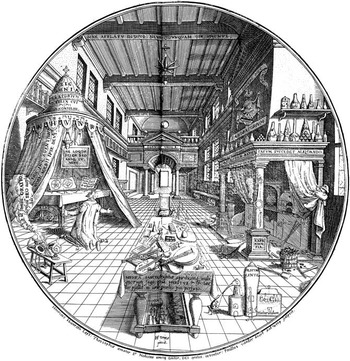
What did Paracelsian alchemists actually do as a means of achieving their lofty aims? This question should be intrinsically hard to answer, since occult philosophy was by its very nature meant to be a secret pursuit. Fortunately one of the best pieces of evidence we have is an engraving found in Khunrath's Amphitheatrum sapientiae aeternae or ‘Amphitheatre of eternal wisdom’, which was first printed in 1595 and republished in 1609 four years after his death. This image (Figure 1) is one of the earliest depictions of a laboratory, a term that alchemists were already using in the 16th century to refer to their workplace. However, in contrast to a modern scientific laboratory, Khunrath's is designed as a private, inner sanctum rather than a more public space. The image supposedly portrays Khunrath himself, but it is also meant to embody the ideals and pious practices of Europe's most noble living alchemists.
Heinrich Khunrath, ‘Lab-Oratorium’, Amphitheatrum sapientiae aeternae (1609). Bodleian Library, University of Oxford, R. 1. 9. Med.

This engraving can tell us quite a lot about the overlap between the supposedly distinct worlds of magic and science, and their relationship to religion. On the right side we can see chemical apparatus, which calls to mind the adept's search for chemical medicines to heal bodily ills through the use of experimental techniques, a form of natural magic. On the left side we see Khunrath kneeling before an oratory engaged in his private spiritual devotions, the ultimate purpose being to achieve his soul's mystical union with God. This was understood as a form of ritual or ceremonial magic because it was characterized by ceremonial activity and the use of accessories to assist the practitioner's communication with the divine. Taken together the oratory and the laboratory represent two means by which divine knowledge is to be achieved by the pious Christian ‘Theosopher’ – the lover of divine wisdom and enlightened doctor of medicine, which Khunrath is being portrayed as here.
But what about the foreground of this image? Why are there musical instruments and music books lying so prominently on the table? And what does the inscription on the tablecloth say? Clearly Khunrath is telling us something else about his laboratory that has so far been missing from my account, and indeed is missing from most discussions of Paracelsianism. Yet there is obviously a connection to be found.Reference Gouk4 The puzzle is that Paracelsus said practically nothing about music himself, so there must have been another good reason why Khunrath and Croll both thought it appropriate to associate music with their alchemical labours. We don't know for sure whether either individual was musically active, but it is important to note that this was a period when the ability to make music, particularly with stringed instruments such as the lute, was very highly valued in European society.
Moritz of Hesse was an accomplished musician as well as an amateur composer, and it is also striking that two alchemists connected with Moritz's court also composed music. While Mylius produced a collection of lute music in 1622, Maier explicitly united the arts of music and alchemy in the form of 50 alchemical canons in his Atalanta fugiens or ‘Atalanta fleeing’ of 1618. (This collection is based on the Greek myth of the huntress Atalanta, who raced against her suitors only to be outwitted by Hippomenes who dropped three golden apples given to him by Aphrodite to distract her from the contest. The first voice, Atalanta, represents quicksilver; the second voice, Hippomenes, is sulphur, while the cantus firmus beneath stands for the apple.) So the simple answer to our question might be that alchemy and music were both pastimes that were enthusiastically cultivated at the highest social levels, and some level of overlap was therefore inevitable. However, I don't think that this explanation sufficiently accounts for the dominance of musical instruments in Khunrath's ideal laboratory. I believe that there is something fundamental about their presence that can give us insight into the multiple meanings of this image and the practices it represents.
In the first place, I agree with my colleague Peter Forshaw, who in a recent article argues that the reader meditating on this mandala-like image enters Khunrath's world by way of the musical instruments resting on the table.Reference Forshaw5 Centrally positioned, the table occupies a space midway between the oratory and the laboratory that suggests there is a third kind of magic that takes place in his Amphitheatre. We already know that the right side of the room is focused on the material realm of physics, while the left engages with the invisible realm of metaphysics. The crucial significance of music is that as embodied sound it mediates between these levels of being, and can produce powerful effects on both body and soul, transforming inner states without any visible external cause. Thus, within the occult philosophy, music was regarded as a form of natural magic, because as we will see it interacted with certain kinds of spirits in nature. Alternatively, it was identified as a form of mathematical magic, because music making requires an understanding of number, measure and proportion, especially in the tuning and use of particular instruments.
This interpretation of the image is supported by the most famous Renaissance magus and Neoplatonist, Marsilio Ficino (1433–1499). Ficino claimed that as medicine is important for the body and theology for the soul, so music is important for the spirit or spiritus that mediates between them. This is because musical sound is of the same nature as the spiritus, which Ficino conceptualized as an extremely fine substance that acts as an agent for all life functions. Crucially, however, in Ficino's magical world view spiritus also connects the earth and the heavens and acts as the channel for astrological influences. This effect he thought to be similar to the way that the Holy Spirit mediates between God and His creation, and acts as His agent in the physical world.Reference Tomlinson6 To sum up so far, then, it seems clear that music plays a pivotal role in Khunrath's laboratory. It is linked to alchemy at a number of different levels by virtue of spiritus, an extremely active substance that, according to Paracelsus, also figured in the alchemical transformation of matter.
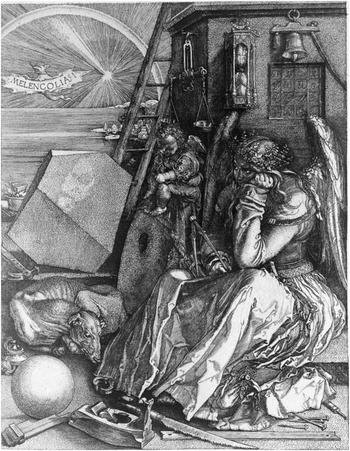
To go deeper into the musical symbolism of this image we now need to take a step back and place it in a broader iconographical and philosophical context. Khunrath's picture belongs to an emblematic tradition of ‘Melancholia’, a visual convention that began with Albrecht Dürer's famous engraving Melencolia I of 1514 (Figure 2). In fact, this convention had its theoretical origins in Marsilio Ficino's Three Books on Life of 1489, a theory that was further popularized in Heinrich Cornelius Agrippa's Occult Philosophy of 1533. This tradition assumes that the philosopher engaged in pursuit of the higher, contemplative sciences is likely to suffer melancholy or soul sickness. According to prevailing medical theory, this condition was normally ascribed to an excess of black bile, one of the four bodily humours which, since the time of the ancient Greek physician Galen (AD 129–199), had provided the main explanation for physiological and psychological change. The melancholic state was further exacerbated by depletion of the animal spirits that were stored in the brain and moved through the nerves. These spirits (also known as spiritus in Latin) were understood by early modern physicians to be a vital, vaporous substance distilled out of the blood and which served as the first instrument of the soul. In other words the spiritus was responsible for all sensory, cognitive and motor functions and, as a result of this activity, was gradually used up. Loss of spirit allowed black bile to accumulate in the blood and caused the blood to be sluggish, a condition that led to a whole array of symptoms including the torpor and darkened, downcast gaze of Dürer's winged figure.
Albrecht Dürer, Melencolia I (1514). Wellcome Library, London.

Of course 16th-century physicians were familiar with Galen's explanation of melancholy as a temporary chemical imbalance of humours, and it was generally regarded simply as an unpleasant disease. However, it was Ficino who first observed that introspective philosophers are constitutionally melancholic not only because they are under the influence of Saturn but because they neglect the spiritus. To maintain spiritual health and to prolong life these special individuals therefore need constantly to replenish and nourish their extremely fine spirits. Ficino explains in his Three Books on Life that one of the best cures for melancholy is ‘sound and song’, the reason being that air, the medium of musical sound, is similar in nature to the spiritus. Lacking any clear understanding of the ear's anatomy it was thought that sounds combine directly with the spirits in the inner ear and thence affect the animal spirits by virtue of their movement. Musical sounds are particularly beneficial because their harmonious, organized movement has the effect of composing the disordered spirits and thence the mind. By this means it restores the balance between body and soul, which itself was thought of as a form of harmony.
However, it is important that Khunrath specifically identifies sacred music as a remedy, as we can tell from the inscription on the tablecloth. This translates as ‘Sacred Music is the dispeller of sadness and evil spirits, because the Spirit [SPIRITUS] of Jehovah gladly sings in a heart filled with pious joy’. The part-books behind the instruments suggest a polyphonic (multi-part) setting of the psalms, a practice which by 1600 was cultivated in pious Protestant households as part of one's private devotions. In fact, on the altar Khunrath is kneeling before there is a psalter open at Psalm 145. This promises that ‘Jehova does the will of them that fear him’. Elsewhere in the Amphitheatre he cites St Paul's advice to be ‘filled with the Holy Spirit, speaking to yourselves in psalms and hymns and Spiritual canticles, in your hearts to the Lord’. He also gives examples of the powers of sacred music, which include David allaying Saul's madness. This echoes Agrippa's remark in his Occult Philosophy that ‘there is nothing more efficacious to drive away evil spirits than musical harmony … as David by his harp appeased Saul’. From this evidence we may conclude that Khunrath's kneeling figure is identifiable with King David, the charismatic leader of the Israelites who was inspired by the Holy Spirit to sing God's praises with voice and harp.
Thus the harp is adequately explained by its association with David, but this leaves three instruments to be accounted for. Lying on the harp, the other instrument on the left is most probably a lira da braccio, while the fretted instruments on the right are a lute (the larger of the two) and a cittern. Scholars seem to be agreed that they collectively symbolize the harmony between macrocosm and microcosm, the universe and man. This is a central principle of Paracelsian magical doctrine, in fact of magic generally, and it crops up repeatedly in Khunrath's works. The concept of harmony as a principle of cosmic order of course goes back to antiquity, a key text being Plato's Timaeus, which describes the harmonic structure of the heavens and of the human soul, a philosophy that was typically attributed to Pythagoras.
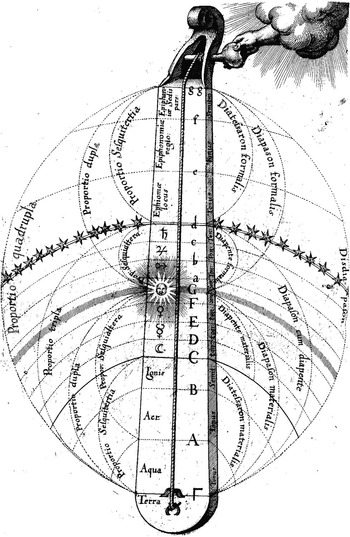
The importance of these harmonies for understanding the nature of the universe and man is vividly demonstrated by two engravings taken from The History of the Macrocosm and Microcosm (1617–1619). This was by the English Paracelsian physician Dr Robert Fludd (1574–1637). The first of these images (Figure 3) shows the universe as a monochord, an instrument going back to antiquity that was made of a box and a single string and was used to demonstrate the mathematical relations of musical tones. The string is divided into two octaves from G (gamut) to gg, and the realm of the zodiac between the moon and the fixed stars is bounded by the octave D–d. Each of the planets is assigned a tone, the pitch getting higher the further the distance away from the earth, which is at the centre of the universe.
Robert Fludd, Utriusque cosmi … historia I (1617, p. 90), ‘The divine monochord’. Wellcome Library, London.

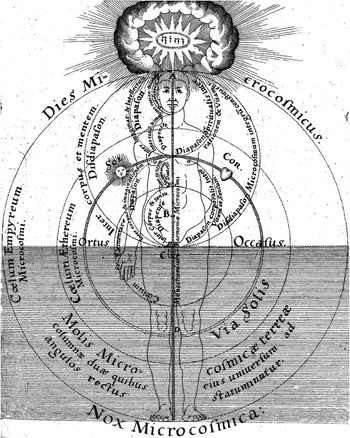
The second image (Figure 4) shows man the microcosm, whose body is similarly divided by musical proportions. Of particular interest to us is the musical string that stretches from head to toe, from heaven to earth; this represents the dynamic property of the spiritus that connects body and soul and, in the form of the spiritus mundi or world soul, also acts as the intermediary for astrological influences. It is also the aetherial vehicle through which the human soul descends from and re-ascends towards the divine, achieving along the way purification and enlightenment. The affinity that exists between all parts of the cosmos is maintained by a sympathetic principle of the spiritus mundi. This sympathetic principle can be demonstrated by means of two lutes. When a string on one lute has been struck, one tuned to the same pitch on the other lute will vibrate sympathetically at a distance. This motion can be detected by placing a straw on the strings of the second lute, which falls off as the string begins to vibrate. This phenomenon of sympathy, which we know as musical resonance, is a classic example of an occult power in nature. One string clearly has an influence on the other but its cause is imperceptible to the unaided human senses.
Robert Fludd, Utriusque cosmi … historia II (1619, p. 275). ‘Man the microcosm’. Wellcome Library, London.

Another important Neoplatonic text was Iamblichus's On Mysteries of the fourth century AD, which includes a biography of Pythagoras. In brief, Ficino learned from this work about the amazing effects Pythagoras could achieve through music. He sang to the accompaniment of his lyre in the tradition of Orpheus the mystical bard, and Apollo the Greek god of music. Pythagoras sang morning and evening hymns to the planetary deities with his disciples to purify their minds and souls. This rite involved drawing down beneficial influences, especially from Apollo the sun. Pythagoras also applied his musical medicine to mental and physical ailments, and was notably able to calm strong passions and raging madness.Reference Gorman7 In the light of this information, it seems that Ficino tried to imitate Pythagoras's Orphic music. Indeed his aim was nothing less than to recreate the healing and purifying effects that Orpheus, Pythagoras and also David achieved by singing to their deities. He was particularly keen to emulate their ability to cure diseases of the soul, to expel evil passions, and to bring the soul into a state of virtuous harmony.
There is no way of knowing what Ficino's hymns actually sounded like. However, it is likely he used words from the Orphic Hymns he had edited in 1462, and accompanied them with the instrument known in Italy as the lira da braccio, which in Ficino's mind and those of his contemporaries was the instrument most like the lira used in ancient Greece. This seems to be the instrument lying above the harp in Khunrath's picture, and we can now appreciate the rich associations it has with Pythagorean lore. I want to suggest that our kneeling figure is not only recalling David, but also Pythagoras, a magus who grasped the dynamic structure of the universe, who practised spiritual medicine to heal the sick, and also used music as a vehicle for spiritual purification. All this mirrors the practice of Paracelsian alchemy in its twofold goal to produce medicines and to achieve spiritual enlightenment.
There still remain two instruments unaccounted for, the lute and the cittern. I have to confess that their individual significance is less obvious than that of the harp and the lira da braccio. Nevertheless, they were both popular among elite amateurs for private use around 1600, and we have already noted that Daniel Mylius published a collection of lute music in 1622. Forshaw suggests that since both these instruments closest to the earthly laboratory are fretted, they may represent the quantitative divisions of weight and measure necessary in the alchemical study of nature.Reference Forshaw8 In support of this notion there is a set of balance scales and weights behind them as well as an open book with musical staves; collectively they may allude to the Biblical phrase ‘thou has ordered all things in measure, number and weight’ which was popular among alchemists who saw themselves as engaged in a form of mathematics. Another detail to consider is the number of strings on each of the instruments, which does not correspond to the number they have in real life. Here the harp has eight strings, the cittern and lute both have five, and the lira four. These numbers correspond to the first three musical intervals after the unison, namely the octave (1:2), fifth (2:3) and fourth (3:4), numerical ratios that Pythagoras was the first to discover governed consonance and which he understood as constituting the elements out of which the cosmos was made.
Regarded in this light, Khunrath's musical instruments not only signify a mathematical approach to the world, but also allude to a form of experimental practice which, in the 1620s, was to be identified by the English philosopher Francis Bacon as a ‘higher kind of natural magic’. Bacon is best known for advancing a new kind of science whose experimental principles were a model for the first public scientific institution, the Royal Society, which was founded in 1660.Reference Gouk9 At first it might seem unlikely that Bacon should have associated his new experimental philosophy with natural magic, but if we compare some of their core features these practices will not seem so far distant from one another. In the first place, Bacon's new science was envisaged as an empirical method of generating effective knowledge about the world as well as a deeper understanding of its elemental nature. This dual goal distinctly resembles the magus's desire to discover the ultimate secrets of the universe and to bring about astonishing effects. Another common theme linking these traditions is their emphasis on technical skills, notably in the creation of devices that imitate nature, and in the use of instruments that extend the range of the philosopher's power. As well as these practical connections there are also similar assumptions being made about the structure of the universe, notably in understandings of matter. Thus, for example, Bacon thought that most natural phenomena, including the influence of the stars and chemical transformations, can be explained in terms of the interaction of spiritus and tangible matter. He thought that musical sound mingles with the inert spirits trapped in inanimate bodies and causes them to vibrate sympathetically. Similarly, he believed that the effects of music on man involve the mingling of harmonious sound with the vital spirit or spiritus responsible for sensory and motor functions and especially the actions of the imagination. The crucial thing is that Bacon thought that musical instruments offered the best resource for an empirical investigation into the power of sound, effectively turning them into experimental devices that were at once both a source of this power and a means of understanding it.
In this paper I have argued that the practice of alchemy around 1600 was portrayed as a transformative process that could improve the state of mankind at both an individual and societal level. The activities of refining, distilling and transmutation associated with Paracelsian alchemy revolved around spiritus, the animating force present throughout the universe, including all metals and stones as well as living beings. At the same time alchemy was also a step towards the spiritual purification that would enable the practitioner to achieve mystical union with the divine. However, the chief purpose of my paper has been to demonstrate music's fundamental place in the magical universe within which Khunrath and his fellow alchemists operated. By focusing on one of the most iconic images in the occult tradition I have explained how particular musical instruments were thought to provide access to the human spiritus through their harmony, a process that made it possible to restore balance between body and soul, and especially to alleviate melancholy.
Khunrath thought the most beneficial type of music to be psalmody, the means by which David communicated with his God through the power of the Holy Spirit. But there is also the implied presence of Pythagoras, a magus who through music drew down heavenly influences into his disciples’ spirits and calmed strong passions. I have argued that music not only acted as an intermediary between material and immaterial realms, but was also recognized as a pathway towards a deeper knowledge of the universe and its hidden forces, the kind of knowledge that was essential to the magus. This brings us to the perhaps unexpected connection between alchemy, music, and experimental philosophy, mediated through the use of instruments, which reveal the harmonies immanent in nature. In sum, the viewer is being invited to enter imaginatively into the aural, as well as the visual, space occupied by Khunrath's laboratory design: its inner meaning will also be revealed through actually experiencing the sounds that are embodied here.
Penelope Gouk is currently an Honorary Research Fellow in History at the University of Manchester. She took her doctorate at the Warburg Institute in London on the subject of ‘Music in the Natural Philosophy of the early Royal Society’ and went on to hold a series of postdoctoral research fellowships at Oxford and Manchester before becoming a Senior Lecturer in History at Manchester. Dr Gouk has wide-ranging and interdisciplinary interests in early modern European intellectual and material culture, most of which stem from her fascination with sound as an object of scientific and historical enquiry. This research has notably focused on the use of musical models in early modern medical and scientific thought and on musical healing from a cross-cultural perspective. Her publications include Music, Science and Natural Magic in Seventeenth-Century England (1999) and the edited volumes The Second Sense: Studies in Hearing and Musical Judgement from Antiquity to the Seventeenth Century (co-edited, 1991); Musical Healing in Cultural Contexts (2000); and Representing Emotions: New Connections in the Histories of Art, Music and Medicine (co-edited, 2005). She is currently working on a book about early modern understandings of music's effects and how these changed between the Renaissance and the Enlightenment.