It is a commonplace to link Homer with tragedy. Plato calls Homer the first tragedian, Aristotle praises the dramatic concentration of his plots, and pseudo-Plutarch claims that in Homer we find ‘all elements of tragedy: great and unexpected deeds, epiphanies of gods, and speeches full of thought and representing all kind of characters’.Footnote 1 Likewise, modern critics write studies on Nature and Culture in the Iliad. The Tragedy of Hector, ‘Tragic Form and Feeling in the Iliad’, ‘Homeric Epic and the Tragic Moment’, and Homer and the Dual Mode of the Tragic.Footnote 2
When calling Homer a tragedian, critics mainly refer to the tragic content of the Homeric epics, especially the fates of the two protagonists of the Iliad: Hector and Achilles. Hector, spurred on by Zeus's support, does not lead back his troops into the city after Achilles' return to battle, and pays with his own life. Achilles reluctantly lets his friend Patroclus take his place in battle, loses him, and in avenging him precipitates his own death. Both men experience their moment of what Aristotle called anagn ōrisis, well phrased by John Gould as ‘the moment where human blindness and the limitations of man's vision and understanding are suddenly confronted with undeniable truth in a lightning stroke’.Footnote 3
In this article I want to focus on another aspect of Homer the tragedian: the form of his epic. My discussion will consist of three parts. In the first part, I will look for elements in epic that may have inspired later tragedians when writing their plays. I aim to complement and reinforce John Herington's magisterial reconstruction of the birth of tragedy from the entire Greek tradition of poetry from Homer onwards.Footnote 4 He shows how tragic poets could look at earlier poetry for their metre and mythological themes, and especially at Homer for their plot construction and methods of characterization. Building on this idea, I will show how there are many more elements in Homer that may have inspired the tragedians. As John Gould formulates it: ‘for the playwrights of the fifth century, there was everything to learn from the poetry of Homer’.Footnote 5 In the second part, I will discuss the performance of the Homeric poems. The third part, finally, will look at the first actor in European literature: Odysseus acting the part of beggar in the Odyssey.
Epic as formal model for drama
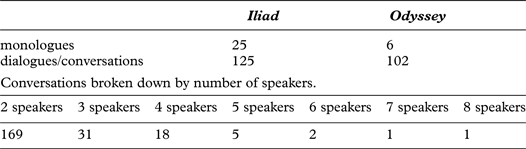
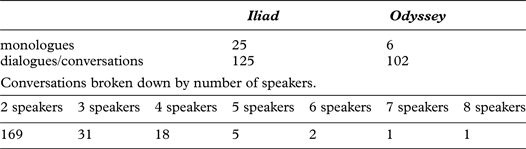
The most important reason why the Homeric epics inspired dramatists is the amount of direct speech they contain: forty-five per cent of the Iliad and sixty-six per cent of the Odyssey. Most of these speeches form conversations between two or three persons, exactly the number of persons on stage in later drama. In Table 1 I give some statistics, which I have derived from Samuel Bassett's The Poetry of Homer, in which he also discusses the ‘the dramatic in Homer’.Footnote 6
Analysis of the speeches in the Iliad and Odyssey. Based on Bassett (n. 6).
When we take a closer look at these speeches we may detect more models for later drama, apart from the ubiquitous dialogues/conversations. In the first place, there are the monologues. Monologues in drama typically show a character pondering a line of action and wrestling with his or her emotions. A famous example is Medea wrestling with the question as to whether to kill her children in order to hurt Jason:
Alas, what am I to do? My courage is gone, women, ever since I saw the bright faces of the children. I cannot do it. Farewell, my former designs! I shall take my children out of the land. Why should I wound their father with their pain and win for myself pain twice as great? I shall not: farewell, my designs! But what is coming over me? Do I wish to suffer mockery, letting my enemies go unpunished? Must I put up with that? No, it is mere weakness in me even to admit such tender words in my heart. Children, go into the house. Whoever is not permitted to attend the sacrifice must take care himself not to be there: I shall not weaken my hand.
(Euripides, Medea, 1042–55)Footnote 7A very similar monologue, showing a character weighing different alternatives, is that of Hector, who is alone waiting for Achilles outside the walls of Troy:
What am I to do? If I go back inside the gates and the wall, Polydamas will be the first to criticize me, who urged me to lead the Trojans back to the city in that horrible night when godlike Achilles came in action again. But I did not take his advice … In that case it would be better for me to face Achilles and either kill him and return home, or die a glorious death at his hand in front of my city. But suppose I put down my bossed shield and heavy helmet and lean my spear against the wall, and go out as I am to meet the excellent Achilles, and would promise him to return Helen … But why do I debate these things in my heart? I fear that if I go up to him he will not show me any pity or regard, but will kill me unarmed like a woman, since I have put off my armour.
(Homer, Iliad, 22.90–131)Footnote 8In the second place, there is the messenger-speech. In almost every tragedy at some point a messenger enters the stage and informs the chorus (and often a character) about dramatic events that have taken place offstage. An example is the messenger who reports to Peleus the death of his grandson in Euripides, Andromache, 1070–4:
MESSENGER: Ah me. What terrible news have I, unlucky man, come bearing for you, old sir, and for those who love my master!
PELEUS: Oh no! My prophetic heart foretells disaster!
MESS.: To tell you my news, aged Peleus, your grandson is dead: such are the sword thrusts he has received from the men of Delphi and the stranger from Mycenae.
Primed by his addressees, the messenger then typically embarks on a long and emotional report of what he has seen.Footnote 9 Such long narratives by messengers are lacking in epic (where the narrator himself can change place and watch events that for his characters are ‘offstage’: for instance, Odysseus sitting on the shore of Calypso's island, while his family on Ithaca are asking themselves where he is), but an embryonic form of a messenger scene is to be found when Archilochus informs Achilles about the death of Patroclus:
the son of proud Nestor came up close to him, shedding warm tears, and gave his sorrowful message: ‘O, son of illustrious Peleus, you will hear very terrible news, which I wish had never happened. Patroclus lies dead, and they are fighting over his naked body. For Hector of the glancing helmet has his armour.’
(Iliad, 18.16–21)Footnote 10For Achilles, sulking in his tent at the shore, the death of Patroclus on the Trojan battlefield is an ‘offstage’ event about which he has to be informed by a messenger.
A third possible epic model for a later dramatic building block is the prologue speech. Most plays of Euripides open with a monologue in which a character – a god or a mortal – after indicating where the scene is set and sketching the events which have led up to the situation at the beginning of the play, gives some clues (sometimes false trails) about the plot to follow. An example is Dionysus' announcement:
This man [Pentheus] is a god-fighter where my worship is concerned, forcibly excluding me from libations and making no mention of me in his prayer. For this reason I will demonstrate to him and to all the Thebans that I am a god. And when I have set all here to rights, I shall journey on to another land and show myself there. But if the city of Thebes gets angry and tries to bring the bacchants from the mountain by force of arms. I will meet them in battle at the head of an army of maenads.
(Euripides, Bacchae, 43–52)The scholiasts compare Zeus's speech in which he reveals his plans to Hera with such a prologue speech:Footnote 11
And Achilles will rouse up his companion, Patroclus. And him glorious Hector will kill with his spear in front of Ilion, after he has slaughtered many young warriors, others, and among them my own son, godlike Sarpedon. And in anger for him [Patroclus] godlike Achilles will kill Hector.
(Iliad, 15.64–8)The association seems to be fed by negative feelings on the part of the scholiasts, who both in Homer and in Euripides dislike the poet giving away the plot.
When we turn to the chorus, John Gould is right when he writes that this is ‘clearly an expressive medium which has no direct analogue in the Homeric poems, and whose origins lie in quite other areas of Greek literary tradition’.Footnote 12 But the Homeric epics do contain an embryonic form of that typically tragic use of choral speech: when a collective evaluates events that have just taken place on stage. These are the so called tis-speeches, collective speeches spoken by the soldiers in the Iliad or the suitors in the Odyssey, in which they react to what they have just seen happening.Footnote 13 An instance is found at the moment when Odysseus has forcefully silenced Thersites, a soldier who openly and harshly criticized the generals:
And one man said to his neighbour glancing at him: ‘Oh yes, Odysseus has already done thousands of fine things, proposing good plans and commanding battles. But now he has done this as his best thing among the Argives, putting a stop to his horror's ranting in assembly. I am sure that his proud heart will never again impel him to taunt the kings with insults.’ Thus the mass of soldiers spoke.
(Iliad 2.271–7)To this we may compare, for instance, the reaction of the chorus to Medea's decision to kill her children:
Hard-hearted wretch, you are, it seems, a stone or a piece of iron! You mean to kill the children you gave birth to with a fate your own hand deals out! … What further horror is now impossible? O womankind and marriage fraught with pain, how many are the troubles you have already wrought for mortal men!
(Euripides, Medea, 1280–91)In both cases we see an anonymous group comment on an event and add their collective perspective to that of the individual protagonists, the similarity leading the German Homerist Hentze to call the tis-speeches in Homer ‘choral speeches’.Footnote 14
Both the scholia and modern scholars have found an early form of the dramatic device of the deus ex machina in Homer, a fifth example of epic providing a model for tragedians. We know this dramatic device mainly from Euripides: a god appears with the help of a crane or mechan e¯ on the roof of the ske¯ne¯-building and interferes in the action, which has usually reached some form of stalemate. The god cuts the knot by interpreting the recent past, giving explanations, and revealing the future of each protagonist. An example is Athena's intervention at the end of Euripides' Iphigenia in Tauris. Orestes has come incognito to Tauris and taken his sister, Iphigenia, who lived there at the court of King Thoas, with him. When Thoas finds this out, he wants to pursue the Greeks:
THOAS: Up, all you citizens of this barbarian land! Put bridles on your horses, gallop to the shore, pick up the wreck of the Greek ships! With the goddess' help hurry and hunt down the godless men … But I cannot stay here idle: I have pressing business.
He starts to leave in haste. His departure is halted when athena enters by mechane, alighting on the theologeion.
ATHENA: This haste, King Thoas, where is it taking you? I am Athena: listen to my words. Stop your pursuit, stop this torrent of armed men! (Euripides, Iphigenia in Tauris, 1422–37)
Exactly such a role as deus ex machina is played by Athena at the end of the Odyssey, when there is a fierce fight between the families of the suitors and Odysseus and his men:
And now they would have killed them all and taken away their homecoming, if Athena, daughter of Zeus who holds the aegis, had not shouted loud with her voice and stopped the whole throng: ‘Stop miserable fighting, men of Ithaca, so as to part at once with no more bloodshed.’ … And then Pallas Athena, daughter of Zeus who holds the aegis made a sworn peace between the two sides.
(Odyssey, 24.528–47)Francis Dunn in his study on the ends of Euripides’ plays writes: ‘Athena, like a Euripidean deus, intervenes with a command, inspires awe in those who see her, and ratifies with a truce the warring parties’ acceptance of her dispensations.’Footnote 15 In a similar vein, the scholiasts note at the moment that Athena intervenes to prevent a premature return home of the Greeks home (Il. 2.156) that Homer ‘was the first to introduce for the tragedians the mechanas, sc. the deus ex machina’.
A sixth and last dramatic device that the tragedians possibly may have derived from epic is the silent character, or k ōphon prosōpon. In a study from 1987 I discussed a number of examples, of which I would like to mention here Patroclus in Book 9.Footnote 16 Throughout the scene of the embassy he is present in Achilles' barrack: when the Greeks arrive they find Achilles playing on his lyre and Patroclus silently waiting until it is his turn to take over; when Achilles offers his guests a meal, it is Patroclus who does the chores; when Achilles invites Phoenix to stay for the night, it is Patroclus who makes the bed for this guest; and when the heroes retire to bed, we hear how Patroclus lies down on the opposite side of Achilles' bedroom. John Herington observes: ‘Patroklos, though present throughout says not a word: one is almost reminded of the kōpha prosōpa in tragedy.’Footnote 17
The Homeric epics, then, contain many elements from which the dramatists may have taken their cue when developing drama: conversations between two or three characters, monologues, messenger-scenes, the prologue speech in which a god announces actions to come, collectives speeches by a ‘chorus’ in which events are evaluated, the deus ex machina, and silent characters.Footnote 18
The performance of the Homeric epics: from aoidos to rhapsode
Apart from content and form, there is another aspect of the Homeric epics that may have formed a source of inspiration to the dramatists: their performance. I have already mentioned that about half of the Homeric epics consist of direct speech, and it is highly likely that the oral poet Homer (or any other aoidos performing his poems) would have delivered those speeches with some form of acting. The question is: how much? As we will see, the answer to this question has been somewhat obfuscated by the mixing up of the aoidos, Homer or other singers who sang the Iliad and Odyssey while sitting and accompanying themselves on a lyre, and the later rhapsode, who recited them standing and holding a staff in his hands.
Let us consult an expert from antiquity:
‘Tell me. Do you know the first lines of the Iliad in which the poet says that Chryses implored Agamemnon to release his daughter … ’ ‘I do.’ ‘You know then that as far as these verses “And Chryses implored all Greeks and especially the two sons of Atreus, leaders of men” the poet himself is the speaker and does not even try to suggest to us that anyone but himself is speaking. But what follows he delivers as if he were himself Chryses and tries as far as possible to make us feel that not Homer is the speaker, but the priest, an old man.’ … ‘But when he delivers a speech as if he were someone else, shall we not say that he then assimilates his own vocabulary (λέξις) as far as possible to that of the person whom he announces as about to speak … And is not likening oneself to another in voice/intonation (ϕωνή) or body language (σχῆμα) imitating that person to whom one likens oneself.’
(Plato Republic 392e–393b)Footnote 19I agree that Homer may have adapted his vocabulary to the speaking character whom he impersonates. Indeed, work by several scholars has shown that important Homeric speakers have their own vocabulary.Footnote 20 It also does not seem unthinkable that Homer could modulate his voice or intonation. Thus the speech-introductions which invariably precede speeches often give an indication of their tone: ‘Achilles on his turn addressed Agamemnon with baneful words’ (Iliad, 1.223–4) or ‘At once he spoke a mellow and subtle word’ (Odyssey, 6.148). Such indications of course primarily suggest how we are to imagine the character in the story to speak but they may have functioned at the same time as a script for the singer; thus, one scholar called them ‘Bühnenanweisungen’ (stage directions).Footnote 21
But the idea that Homer may have imitated the σχῆμα of his characters is problematic. If Plato means with σχῆμα facial expressions, this is just about possible and again speech introductions often refer to these: for instance, ‘Then swift-footed Achilles scowled at him and said … ’ (Iliad, 1.148). (However, facial expression is of course one of the things drama, using masks, could not take over from epic!) But if Plato refers to things such as posture or gesticulation, we run into trouble. For how could Homer, sitting and holding a lyre in his hands, physically move or gesticulate? Here it is crystal clear that Plato, though speaking of the poet Homer, was actually thinking of the rhapsodes of his own day, whom he is likely to have seen perform at the Panathenaic Festival.Footnote 22 Such rhapsodes, memorably described by Plato in his dialogue Ion, could and clearly did act and make gestures. The following remark of Ion suggests as much: ‘When I recount an episode of woe, my eyes filled with tears. But when I recount a frightening or awesome episode, my hair stands on end with terror and my heart leaps’ (Plato, Ion, 535c). Indeed, Plato even sometimes refers to the rhapsodes with hypokritai, the very word for actor.
And Herington, talking about the rhapsodic performance of the Homeric epics, likewise stresses its histrionic aspect:
And to this day, as a matter of practical experience, anyone who sets himself seriously to declaim a Homeric episode – for instance, the debate in the Greek camp near the opening of the Iliad – will be led almost without noticing it into acting out the very voices and emotions of Agamemnon, Achilles, and Nestor; … He may even find himself led into physically miming certain of their actions: the half-drawing and then the slamming home of Achilles' sword … , or the magnificent gesture of the hurling of the sceptre to the ground after the hero has sworn by it … In such passages as these … we come very close to drama in the fifth-century and later senses.Footnote 23
I conclude that, if we want to assume Homeric performance as a possible model for Athenian dramatists, as I do, we must make clear that we are talking about the performance of the rhapsodes, whom the dramatists, like Plato, will have watched in action for themselves, rather than that of Homer himself.
There is a final aspect of the Homeric speeches that deserves to be mentioned here. They had a very lively and mimetic quality through the abundant presence of deictic pronouns such as ὅδε and οὕτος.Footnote 24 A truly spectacular example is found at the moment in the Odyssey when Athena has to convince Odysseus that he really has come home to Ithaca:
In my commentary on the Odyssey I wrote: ‘Throughout the dialogue the use of deictic pronouns is conspicuous … and this brings it close to drama’.Footnote 25 In Table 2 I give some statistics to back up this claim. In the case of Homer performing his epics, these deictic pronouns merely helped his listeners to imagine the gestures that the characters in the story were making: that is, they increased the enargeia of the epics; in the case of the rhapsodes, they could also be accompanied by gestures, much in the way that actors on stage (and, of course, real speakers in the Mediterranean world!) would do. Thus, it is interesting to note that, in the famous depiction of a rhapsode by the Kleophrades painter (in the British Museum), he is gesticulating and ‘quoted’ as saying words with a deictic pronoun: ὧδε ποτ’ ἐν Τύρινθι (‘thus once in Tiryns’).
Average number of deictic pronouns per 500 lines in Homer and in Sophocles' Ajax.

We may conclude that the speeches in Homer had much to teach tragedians: characterization by vocabulary, intonation, and lifelikeness.
Odysseus as actor
In the preceding section I discussed Homer and rhapsodes acting the parts of speaking characters. But the Homeric epics also provide another example of acting: not of real acting but of narrated acting, the acting by a character: Odysseus acting the role of beggar in the Odyssey. In what follows I cannot, of course, discuss this topic in its entirety, since that would entail discussing almost all of the second half of the Odyssey.Footnote 26 I will merely pick out some salient passages.
The idea of Odysseus' disguise comes from Athena. Odysseus must first reconnoitre the situation in his palace and then wait for a good moment to attack the more than one hundred young suitors who meet there every day. She changes him into an old beggar, so as to arouse the least suspicion about his true identity. It means that Odysseus has to play the exact opposite of his real status: a king must become beggar. Let us take a look at whether he is a good actor.
Odysseus first goes to the house of Eumaeus, his swineherd, and his stay there can be considered a kind of rehearsal before he faces the suitors in the palace. Will he be able to make Eumaeus believe that he is an old beggar? The ‘play’ starts spectacularly, in that Eumaeus' watchdogs attack Odysseus, taking him for a stranger. This is what he does: ‘Suddenly the dogs which love to bark caught sight of Odysseus. Barking loudly they rushed at him. But Odysseus in his shrewdness sat down and let his walking-stick drop from his hand’ (Odyssey, 14.29–31). Commentators suggest that Odysseus is here doing what all Greeks did in antiquity when meeting with aggressive dogs: he sits down. Yet I think that the detail ‘in his shrewdness’ (κερδοσύνῃ) indicates that Odysseus is not just reacting instinctively but is consciously acting. As Stanford writes in his commentary: ‘Odysseus is acting his part as a beggarman well, feigning fear’.Footnote 27 Had he been his true self, Odysseus would probably have chased the dogs with stones, exactly as Eumaeus does afterwards. His role as beggar requires passive and humble behaviour even when confronted with aggression, and there are many more times when Odysseus will have to curb his emotions and restrain his heroic instinct.
Eumaeus, not recognizing his master, receives the beggar hospitably and offers him food. While Odysseus eats, he tells him about the situation in the palace, with the suitors devouring the estate of the king. This is Odysseus' reaction: ‘Odysseus eagerly ate the meat and drank the wine, heartily, silently, but he was sowing the seeds of destruction for the suitors’ (14.109–10). Most commentators suggest that Odysseus is here eating eagerly (ἐνδυκέως) and heartily (ἁρπαλέως) in order to distract himself and not show his anger at the suitors. In my commentary, I suggest that his hearty appetite may also be part of his role-playing. Beggars in Homer are notorious for their appetite and insatiable belly.
When Telemachus arrives in Eumaeus' hut, Odysseus politely stands up, so as to offer his seat to the young master (16.42). A conversation develops between Telemachus and Eumaeus about the suitors, and at some point the beggar meekly asks permission to join the conversation. Soon he becomes more and more excited, however, and nearly forgets himself: ‘If only I could be young like you, my bodily strength matching my anger, or the son of the noble Odysseus or even Odysseus himself would return from his wanderings’ (16.99–101). We can imagine that Homer, acting the role of Odysseus acting the role of beggar, will have made his pause slightly longer after line 100, to allow his listeners to savour the suspense of the moment: Odysseus almost makes a mistake and says ‘if only I were Odysseus himself’ (αἲ γὰρ … εἴην … αὐτός), but quickly adds ‘would return’ (αὐτὸς ἔλθοι), which changes the meaning of the preceding words into ‘if only Odysseus would return’.
After this scene Odysseus reveals his true identity to Telemachus and the next morning he goes to his own palace, together with Eumaeus (17.195–8):
‘Let us be going then, and you take the lead all the way from now. And if there is some walking stick ready cut, give it to me to lean on. For the road is said to be very slippery.’ He spoke and slung over his shoulders his shabby wallet, full of holes, with a twist of rope attached to hang it by.
We see Odysseus here again performing very well. To start with, he acts the stranger by indicating that he knows about the state of the road only from hearsay (it ‘is said to be very slippery’). He plays his role of old man by asking for a walking stick to lean on, and his role of beggar by asking specifically for a ‘simple and unadorned stick’ (ῥόπαλον, such as used by the Cyclops).
On their way to the palace Odysseus has an unpleasant meeting with a goatherd, who kicks at him. As in the case of the dogs, Odysseus restrains himself, but we get to know what he would have liked to do: hit him with his club or dash his head against the ground. Not letting himself be provoked and react in a heroic manner, Odysseus acts the beggar. The next test comes when his palace comes within sight. Again he plays the role of stranger well, saying ‘this must be the house of Odysseus’, rather than ‘this is my house’. The only sign of emotion seems to be his gripping Eumaeus' hand.
Then something unexpected happens. At the entrance of the palace lies Argos, Odysseus' old dog. He immediately recognizes his master and wags his tail, but is too old to stand up and come nearer (17.304–10):
And he turning away his head wiped away a tear, easily escaping the attention of Eumaeus, and hastily asked him: ‘Eumaeus, truly amazing is this dog that is lying here in the dung. He is fine-looking, but this I do not know, whether speed of running matched his looks, or whether he was only like table-dogs are, whose masters keep them just for show.’
This time Odysseus cannot wholly restrain his emotions and has to cry. But he still manages to conceal his tears from Eumaeus by turning away his head and, as Russo writes in his commentary, ‘channels his feelings into a series of questions about the animal. This allows him to “manage” his strong emotions by a kind of role-playing in which he deals with the painful subject in the persona of an outsider, so that he can keep some distance from it.’Footnote 28 This analysis is apt except for the formulation ‘by a kind of role-playing’: Odysseus is really playing a role.
Odysseus enters the palace and sits down on the threshold (17.339). Normally a stranger would stand at the threshold until invited in by his host and given a seat, but Odysseus sits down at the spot where beggars typically find themselves. Athena urges Odysseus to go up to the suitors and beg for food: ‘So Odysseus set off to beg from every man in turn, from left to right, holding his hand out in every direction, as if he had long been a beggar’ (17.365–6). As Russo writes in his commentary: ‘This whole verse [366] adds a marvellous touch, showing off Odysseus' brilliance at acting his role and imitating the beggar's routines.’
This moment of Homer as director of the play paying his actor Odysseus a compliment seems a good point to end my discussion, although Odysseus will continue to play the role of beggar for another four books, including the perhaps most difficult test of all, conversing with his wife, Penelope, and the involuntary prolongation of his role, when both wife and father take a long time to recognize him.
It seems no coincidence that it is polytropos Odysseus, man of many resources, rather than Achilles, who is the first actor in (European) history.Footnote 29 It also seems no coincidence that it is the Odyssey, story of cunning, rather than the Iliad, ‘poème de la force’, that offers this first sustained performance of an actor. Creating that role for Odysseus, Homer truly showed himself the first tragedian.