Introduction
Electroconvulsive therapy (ECT) is an effective treatment for depression (UK ECT Review Group, 2003) but the extent and duration of cognitive side effects remain uncertain. In a systematic review and meta-analysis of research using standardized cognitive tests across a variety of domains, Semkovska & McLoughlin (Reference Semkovska and McLoughlin2010) found that short-term deficits (0 to 3 days post-ECT) existed, and a deficit was found in one test (verbal paired associates delayed recall) 4 to 5 days after final ECT. However, there was little evidence that impairments lasted longer than 15 days post-ECT. However, these authors recognized that their research was limited to the domains in which performance had been tested using standardized tests (i.e. not developed for individual studies) and in which baseline scores were collected. These qualifications are important, as patients' subjective reports suggest that cognitive impairments are longer lasting (e.g. Brakemeier et al. Reference Brakemeier, Berman, Prudic, Zwillenberg and Sackeim2011).
Studies may not detect longer-lasting impairments because of the persisting use of the Mini Mental State Examination (MMSE; Folstein et al. Reference Folstein, Folstein and McHugh1975) as a measure of cognitive outcome. This test was used in 35% of the studies reviewed and meta-analysed by Semkovska & McLoughlin (Reference Semkovska and McLoughlin2010) and in seven of eight trials in a later systematic review and meta-analysis comparing different ECT administration techniques (Dunne & McLoughlin, Reference Dunne and McLoughlin2012), despite the fact that the MMSE is a generalized test of cognition, and potentially unsuitable for use in assessing the effects of ECT. Falconer et al. (Reference Falconer, Cleland, Fielding and Reid2010) and Tsaltas et al. (Reference Tsaltas, Kalogerakou, Papakosta, Kontis, Theochari, Koutroumpi, Anyfandi, Michopoulos, Poulopoulou, Papadimitriou and Oulis2011) have suggested that use of such generalized tests may not have the specificity required to adequately assess impairment in memory. Indeed, Falconer et al. (Reference Falconer, Cleland, Fielding and Reid2010) used tests from the Cambridge Neuropsychological Test Automated Battery (CANTAB) and found impairments in pattern recognition, paired-associative learning and spatial recognition memory in the days following patients' final ECT and that, importantly, the spatial recognition impairments persisted to 1 month post-ECT.
Relatively few studies have followed patients for as long as 1 month post-ECT: only 15% of studies included in the Semkovska & McLoughlin (Reference Semkovska and McLoughlin2010) meta-analysis had follow-up beyond this period. Where such follow-up has been conducted, results using standardized neuropsychological memory tests generally show no change or slight improvement relative to baseline (pre-ECT): at 1 month (Ng et al. Reference Ng, Schweitzer, Alexopoulos, Celi, Wong, Tuckwell, Sergejew and Tiller2000; McCall et al. Reference McCall, Dunn, Rosenquist and Hughes2002) and 2 months (Sackeim et al. Reference Sackeim, Prudic, Devanand, Kiersky, Fitzsimons, Moody, McElhiney, Coleman and Settembrino1993); or overall improvement (Sackeim et al. Reference Sackeim, Prudic, Fuller, Keilp, Lavori and Olfson2007) or at least no deficits at 6 months (Calev et al. Reference Calev, Nigal, Shapira, Tubi, Chazan, Ben-Yehuda, Kugelmass and Lerer1991). Impairments relative to a pre-ECT baseline have been found in autobiographical memory 1 month after ECT (Ng et al. Reference Ng, Schweitzer, Alexopoulos, Celi, Wong, Tuckwell, Sergejew and Tiller2000; McCall et al. Reference McCall, Dunn, Rosenquist and Hughes2002), extending up to 6 months (Sackeim et al. Reference Sackeim, Prudic, Fuller, Keilp, Lavori and Olfson2007). However, autobiographical memory assessments are difficult to standardize across participants (Ingram et al. Reference Ingram, Saling and Schweitzer2008).
When subjective memory is assessed post-ECT, improvement is often reported (Brakemeier et al. Reference Brakemeier, Berman, Prudic, Zwillenberg and Sackeim2011). However, subjective reports are not correlated generally with objective measures (Fraser et al. Reference Fraser, O'Carroll and Ebmeier2008). Subjective reports may be more closely related to mood state, with greater impairment reported by those with worse moods (Coleman et al. Reference Coleman, Sackeim, Prudic, Devanand, McElhiney and Moody1996; Ng et al. Reference Ng, Schweitzer, Alexopoulos, Celi, Wong, Tuckwell, Sergejew and Tiller2000; Prudic et al. Reference Prudic, Peyser and Sackeim2000), suggesting that subjective reports may be a consequence of affective state rather than cognitive function (Fraser et al. Reference Fraser, O'Carroll and Ebmeier2008). The discrepancy between subjective and objective measures may also reflect the quality of assessments of subjective memory. The frequently used Squire Subjective Memory Questionnaire (SSMQ) (Squire et al. Reference Squire, Wetzel and Slater1979; Prudic et al. Reference Prudic, Peyser and Sackeim2000; Sienaert et al. Reference Sienaert, Vansteelandt, Demyttenaere and Peuskens2010) has been criticized on account of the complexity of its questions, requiring patients to compare current and past memory performance (Coleman et al. Reference Coleman, Sackeim, Prudic, Devanand, McElhiney and Moody1996; Robertson & Pryor, Reference Robertson and Pryor2006; Brakemeier et al. Reference Brakemeier, Berman, Prudic, Zwillenberg and Sackeim2011). On the other hand, Berman et al. (Reference Berman, Prudic, Brakemeier, Olfson and Sackeim2008) have found that simply asking patients post-ECT whether their memory was affected by ECT is associated with some objective measures (an autobiographical memory interview) 6 months after ECT. Brakemeier et al. (Reference Brakemeier, Berman, Prudic, Zwillenberg and Sackeim2011) replicated this result over a short timescale (1 week after ECT). In both studies a majority of patients believed ECT negatively affected their memory.
In this paper we report results from a retrospective case-note study of routinely collected clinical data in which a brief cognitive testing battery was administered. This battery was developed at the Royal Cornhill Hospital in Aberdeen in order to meet the recommendations set out by the Scottish ECT Accreditation Network for completing patient assessments post-discharge and up to 6 months post-ECT [Scottish ECT Accreditation Network (SEAN), 2010]. In this battery we included the test from the study of Falconer et al. (Reference Falconer, Cleland, Fielding and Reid2010) that was most sensitive to memory impairment: spatial recognition memory (SRM) from the CANTAB (Owen et al. Reference Owen, Sahakian, Semple, Polkey and Robbins1995). We included the MMSE because it has commonly been used as a test of general cognition in ECT research to compare the different approaches. In assessing patients' subjective experience of memory function we compared the SSMQ with a relatively new measure – the Prospective and Retrospective Memory Scale (PRMQ; Smith et al. Reference Smith, Della Sala, Logie and Maylor2000). The PRMQ was developed to measure slips in memory occurring in everyday life. It benefits from assessing both prospective and retrospective memory, having normative data (Crawford et al. Reference Crawford, Smith, Maylor, Della Sala and Logie2003) and a confirmed factor structure for prospective, retrospective and total memory.
Method
Sample
All 132 patients who were treated with ECT between June 2010 and October 2012 at the Royal Cornhill Hospital, Aberdeen were considered for the study. Insufficient data were available for six patients due to the severity of their illness; thus 126 patients were entered into the analyses. Of these, the majority (n = 107) had clinical diagnoses of major depressive disorder. Other diagnoses included depressive episodes of bipolar disorder (n = 11), schizo-affective disorder (n = 5), mixed anxiety/depressive disorder (n = 2) and manic episode (n = 1). There were no exclusion criteriaFootnote 1 Footnote †. Of the patients, 59.5% were female (n = 75). The patients' mean age was 61.13 [s.d. = 15.01; females 61.60 (s.d. = 16.88); males: 60.45 (s.d. = 11.88)]. All patients were Caucasian. The mean number of ECT treatments was 7.55 [s.d. = 3.19; males: 7.67 (s.d. = 2.64); females: 7.47 (s.d. = 3.53)]. Prior medication was continued during treatment, with most patients taking antidepressants and smaller proportions being treated with additional mood-stabilizers (lithium or anticonvulsants) and antipsychotics.
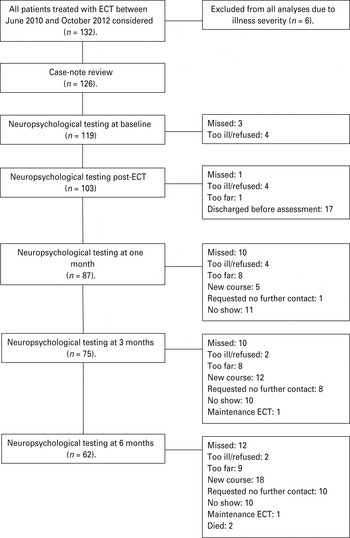
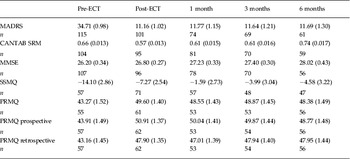
Complete data were not available at all time points or on all measures for all patients. Figure 1 displays the reasons why assessments were missed. Further, five patients were unable to complete the CANTAB or full MMSE due to poor eyesight. At the beginning of our study period not all measures were included in the assessments. Mood ratings (assessed using the Montgomery–Åsberg Depression Rating Scale; MADRS) were gathered pre- and post-ECT until November 2010; subsequently we included the MADRS at each assessment. We also introduced the SSMQ at this time but discontinued its use in October 2012 as it was too time consuming to administer and our results suggested it was not useful (presented here). The PRMQ was introduced into our assessment in April 2011. Due to the partial nature of the data, linear mixed-models analyses were used. Table 1 shows the number of patients completing each measure over time.
Reasons for missing data across study assessments. In all, five patients were unable to complete the Cambridge Neuropsychological Test Automated Battery or the full Mini Mental State Examination due to poor eyesight. ECT, Electroconvulsive therapy.

Scores and number of patients completing each cognitive measure in the linear mixed-models analyses a

ECT, Electroconvulsive therapy; MADRS, Montgomery–Åsberg Depression Rating Scale; CANTAB, Cambridge Neuropsychological Test Automated Battery; SRM, spatial recognition memory; MMSE, Mini Mental State Examination; SSMQ, Squire Subjective Memory Questionnaire; PRMQ, Prospective and Retrospective Memory Scale.
Data are given as mean (standard error) and number of patients.
a The discrepancy in number of patients for the PRMQ and its subcomponents arises as some patients did not complete the whole questionnaire, but completed a sufficient amount for one subcomponent to be calculated.
Patients were assessed before ECT, at the end of treatment (mean interval since end of ECT was 6.82 days; range 1–36 days), 1 month following the end of treatment, 3 months following the end of treatment and 6 months following the end of treatment.
Tests
CANTAB SRM (Owen et al. Reference Owen, Sahakian, Semple, Polkey and Robbins1995)
There are two phases to the CANTAB SRM. In the first phase five unfilled white squares are presented sequentially in different areas of the screen for 3 s each. In the second phase, each square is presented again but in reverse order, together with another square of the same size in a previously unseen on-screen position. Participants must choose the square from the first phase. Correct choices result in a green tick being displayed within the chosen square accompanied by an auditory tone. Incorrect choices result in the display of a red cross accompanied by a deep auditory beep. Overall there are four blocks of the two-phase task. The dependent variable is a participant's total score (maximum = 20) expressed as the percentage correct.
The CANTAB SRM has five different stimuli sets with one, the clinical set, having normative data for comparison and the other parallel sets provided for repeated administration. The order in which patients saw each stimuli set was pre-determined such that the clinical set was used pre-ECT, parallel 2 post-ECT, parallel 3 at 1-month, and parallel 4 at 3-months. At 6 months we reverted to the clinical set. Parallel 1 was used after the fourth ECT in all patients who had four or more ECTs. This data is not reported.
MMSE (Folstein et al. Reference Folstein, Folstein and McHugh1975)
The MMSE is widely used in clinical (and ECT) practice as a test of cognitive impairment. It is a 30-point questionnaire test measuring seven cognitive components (orientation in time, orientation in place, registration, attention, recall, language, repetition and commands). The dependent variable is a total score out of 30.
SSMQ (Squire et al. Reference Squire, Wetzel and Slater1979)
On the SSMQ patients are asked to compare their ability at that time with their ability before their depression began on 18 items linked to memory. Each item has a rating scale from−4 to 4 in which zero indicates no change, and negative and positive scores represent deterioration or improvement in memory, respectively. If patients could not establish a comparator from before they were depressed they were asked to compare their memory with 1 year before.
PRMQ (Smith et al. Reference Smith, Della Sala, Logie and Maylor2000)
The PRMQ consists of 16 items assessing the frequency of memory slips in everyday life. Frequency is rated on a five-point Likert scale from ‘never’ to ‘very often’, with increased frequency garnering a higher score. Raw total scores were reflected so that a high score represents ‘good’ subjective memory, and then converted to T scores based on the population statistics in Crawford et al. (Reference Crawford, Smith, Maylor, Della Sala and Logie2003). T scores have a mean of 50 and a standard deviation of 10. Equations for this calculation were provided via personal correspondence with J. R. Crawford.
Testing procedure
Patients were invited to complete the suite of tests prior to the first session of ECT, following the fourth ECT session, following the final session, and approximately 1 month, 3 months and 6 months following the final ECT session.
Mood ratings were conducted first. The neuropsychological tasks followed, with priority given to collecting CANTAB SRM and MMSE data. Generally, the MMSE was administered first followed by the PRMQ, CANTAB SRM and SSMQ. Patients were given the same standard instructions for each task prior to attempting it on all occasions. They were instructed to complete the two self-rating scales themselves although if they had difficulty in completing the forms a researcher would read the items to them using a standard set of instructions and ask patients to rate the items verbally.
ECT procedure
ECT was administered twice weekly using a Thymatron DGx device (Somatics Inc., USA) and the default settings during the period of study. A conventional, standardized protocol based on seizure threshold was used to determine treatment dose (twice seizure threshold; Royal College of Psychiatrists, Reference Scott2005). All patients received bilateral ECT. Patients received a range of anaesthetics: the majority were given propofol, but a small proportion received thiopentone, etomidate or ketamine, usually because seizure threshold was very high. Glycopyrrolate was used routinely to reduce airway secretions, and occasionally intravenous β-blockers were used to reduce hypertension.
Data analysis and missing data
As there were data missing from this sample we employed linear mixed modelling to analyse change from baseline in these data. Mixed-model analyses benefit from using all available data and handling missing data appropriately. They also account for correlation between repeated measurements on the same subject. All models included time and sex as fixed factors and age as a covariate. To localize any change over time, planned Sidak comparisons compared each assessment with the baseline (pre-ECT) measurement. Where factors or covariates had no significant effects they were removed and the models re-run. All models were run with a first-order autoregressive covariance matrix and compared with an unstructured covariance matrix. Model fit was compared using Akaike's Information Criterion (AIC) and the better-fitting model (smallest AIC) reported. Estimation proceeded using restricted maximum likelihood to a maximum of 100 iterations. Comparisons between model residuals and predicted values found that all data were normally distributed. All analyses were conducted in SPSS v. 21.0 (IBM, USA).
Results
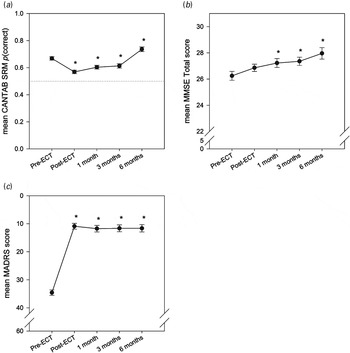
Mean proportion correct on the CANTAB SRM task (p correct) is displayed in Fig. 2 a. Mixed-model analyses with a first-order autoregressive covariance structure with time as a fixed factor (age at treatment and sex were non-significant covariates and removal improved model fit) found a significant effect of time (F 4 = 20.35, p < 0.01). Planned comparisons revealed that CANTAB SRM p correct was significantly lower compared with baseline (0.67) at post-ECT (0.57, p < 0.01), at the 1-month (0.61, p < 0.01) and 3-month (0.61, p < 0.05) assessments and significantly higher at the 6-month assessment (0.74, p < 0.01).
(a) Cambridge Neuropsychological Test Automated Battery spatial recognition memory (CANTAB SRM) percentage correct (p correct) across time (n = 121). (b) Mini Mental State Examination (MMSE) total score across time (n = 123). (c) Montgomery–Åsberg Depression Rating Scale (MADRS) score across time (n = 125). ECT, Electroconvulsive therapy. The dotted line represents chance performance. Values are means, with standard errors represented by vertical bars. * Mean value was significantly different compared with that pre-ECT (p < 0.05).

Mean MMSE score is displayed in Fig. 2 b. Mixed-model analyses with an unstructured correlations covariance structure, time as a fixed factor and age at treatment (sex was a non-significant factor) found a significant effect of time (F 4 = 3.09, p < 0.05). Planned comparisons revealed that MMSE score was significantly higher compared with baseline (26.25) at the 1-month (27.23, p < 0.05), 3-month (27.36 p < 0.05) and 6-month (27.96, p < 0.01) assessments. A significant effect of age at treatment was also found (F 1 = 18.50, p < 0.01) where an increase in age was linked to a decrease (b = − 0.065) in MMSE score.
Scores were also calculated for submodalities (orientation in time, orientation to place, registration, attention, recall, language, commands) of the composite MMSE score and then subjected to liner mixed models analysis with time as a fixed factor and age at treatment as a covariate. Main effects of time were observed for orientation in time (F 4 = 8.52, p < 0.01), orientation to place (F 4 = 8.22, p < 0.01) and commands (F 4 = 7.54, p < 0.01). Significant effects of age at treatment were also observed for recall (b = − 0.011, F 1 = 12.06, p < 0.01), repetition (b = − 0.010, F 1 = 27.87, p < 0.01) and commands (b = − 0.019, F 1 = 25.30, p < 0.01). Planned comparisons showed positive changes compared with baseline (orientation in time for 3 and 6 months; orientation to place for 1, 3 and 6 months; commands at 1 and 3 months).
Mean MADRS score is displayed in Fig. 2 c. Mixed-model analyses with a first-order autoregressive covariance structure, time as a fixed factor, and age at treatment as a covariate (sex was a non-significant factor and removal improved model fit) found a significant effect of time (F 4 = 138.12, p < 0.01). Planned comparisons revealed that MADRS score was significantly lower compared with baseline (34.58) at all follow-ups: post-ECT (10.89, p < 0.01); 1 month (11.75, p < 0.01); 3 months (11.63, p < 0.01); and 6 months (11.63, p < 0.01). A significant effect of age at treatment was also found (F 1 = 16.97, p < 0.01), where younger age was linked to a decrease (b = − 0.19) in MADRS score.
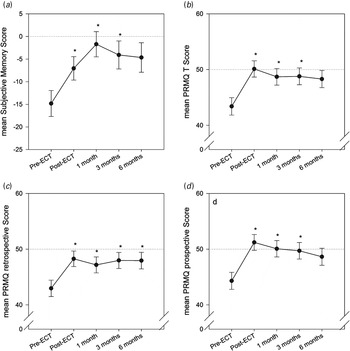
Mean SSMQ score is displayed in Fig. 3 a. Mixed-model analyses with a first-order autoregressive covariance structure, time as a fixed factor, and age at treatment as a covariate (sex was a non-significant factor and removal improved model fit) found a significant effect of time (F 4 = 3.71, p < 0.01). Planned comparisons revealed that SSMQ was significantly lower compared with baseline (−14.82) at post-ECT (−7.05, p < 0.05), at the 1-month follow-up (−1.71, p < 0.01) and at the 3-month follow-up (−4.09, p < 0.05). The effect of age at treatment was not significant (F 1 = 1.50).
(a) Squire Subjective Memory Questionnaire (SSMQ) score across time (n = 103). (b) Prospective and Retrospective Memory Scale (PRMQ) total (T) score across time (n = 104). (c) PRMQ retrospective scores across time (n = 104). (d) PRMQ prospective scores across time (n = 104). ECT, Electroconvulsive therapy. The dotted line represents no subjective change in memory compared with before the depressive episode on the SSMQ and the normative population average score on the PRMQ. Values are means, with standard errors represented by vertical bars. * Mean value was significantly different compared with that pre-ECT (p < 0.05).

Mean PRMQ total score is displayed in Fig. 3 b. Mixed-model analyses with a first-order autoregressive covariance structure, time as a fixed factor, and age at treatment as a covariate (sex was a non-significant factor and removal improved model fit) found a significant effect of time (F 4 = 6.37, p < 0.01). Planned comparisons revealed that PRMQ score was significantly higher compared with baseline (43.40) at all follow-ups except the last: post-ECT (50.11, p < 0.01); 1 month (48.71, p < 0.01); 3 months (48.78, p < 0.05); and 6 months (48.30, p = 0.07). The effect of age at treatment was also significant (F 1 = 10.86, p < 0.01), where an older age was linked to an increase (b = 0.23) in PRMQ score.
In separating the analyses of PRMQ score into the prospective and retrospective components, the linear mixed models found an effect of time (F 4 = 6.76, p < 0.01) and age at treatment (b = 0.29, F 1 = 17.03, p < 0.01) on prospective memory. Planned comparisons revealed that PRMQ prospective memory score was significantly higher compared with baseline (44.32) at post-ECT (51.21, p < 0.01), and at 1-month (50.07, p < 0.01) and 3-month (49.70, p < 0.05) follow-ups. Significant effects of time (F 4 = 4.45, p < 0.01) and age at treatment (b = 0.14, F 1 = 4.13, p < 0.05) were found for retrospective memory. Planned comparisons revealed that PRMQ retrospective memory score was significantly higher compared with baseline (42.97) at all follow-up assessments: post-ECT (48.27, p < 0.01), 1 month (47.18, p < 0.05), 3 months (47.98, p < 0.05) and 6 months (47.95, p < 0.05).
Pearson's correlations between MADRS score and each measure were conducted for each assessment. The neuropsychological measures did not correlate with MADRS score at any point whereas the subjective memory measures were almost universally negatively correlated with depression severity, meaning that patients who were more depressed rated their memory as worse. The correlations between MADRS score and subjective memory measures are displayed in Table 2. Pearson correlations were also conducted between the two neuropsychological measures and the two subjective memory measures for each assessment. Again, almost universally, performance on the CANTAB and MMSE was positively correlated while the same was true of the subjective measures. These results are displayed in Table 2. At no assessment did either of the neuropsychological measures correlate significantly with either subjective measure.
Correlations between MADRS score and each subjective memory scale at each assessment and correlations between the two neuropsychological measures and two subjective memory measures at each assessment

MADRS, Montgomery–Åsberg Depression Rating Scale; ECT, electroconvulsive therapy; SSMQ, Squire Subjective Memory Questionnaire; PRMQ, Prospective and Retrospective Memory Scale; CANTAB, Cambridge Neuropsychological Test Automated Battery; MMSE, Mini Mental State Examination.
Significant correlation: * p < 0.05, ** p < 0.01.
Discussion
In previous studies of memory function following ECT, assessments have often stopped relatively shortly after the end of treatment, with assessments being made only on a couple of occasions. In this study patients receiving ECT were followed up regularly for 6 months after the end of ECT. Patients' memory was objectively assessed using a popular and regularly used global measure of cognition (MMSE), a standardized neuropsychological test of visuospatial memory (CANTAB SRM), while changes in their subjective memory were monitored using another commonly used measure (SSMQ) and a further questionnaire not previously used in this population (PRMQ). The CANTAB SRM results show that memory impairments following ECT extend to at least 3 months after completion of the ECT course. This result is important for two reasons. First, it replicates and extends the results of Falconer et al. (Reference Falconer, Cleland, Fielding and Reid2010), where the same impairment was found at 1 month post-ECT but in a smaller sample. Second, our finding of deficient performance on a standardized neuropsychological memory test contrasts with the majority of published findings where no differences or improvements relative to baseline are generally found. Crucially, these results show that ECT has longer-lasting cognitive effects than suggested by the extant literature (Semkovska & McLoughlin, Reference Semkovska and McLoughlin2010). The results also provide reassurance that while these deficiencies exist, they are not permanent: 6 months after ECT visuospatial memory performance is superior to that at baseline. The practical significance of the spatial recognition memory deficit for everyday tasks is uncertain: while this may have important implications for driving and other spatial tasks, this remains to be tested. The subjective memory findings suggest that patients are unaware of the deficit. The electrically induced seizures themselves are the likely source of the memory effects described here given their extended duration, though the effects of anaesthesia and medication cannot be excluded. The ECT dosing protocol used here was at the upper limit of UK recommendations (1.5 to 2 times seizure threshold); lower doses may have less impact on the magnitude of cognitive dysfunction than described here (potentially at the expense of efficacy), but the effect of dose on duration of memory impairment is unknown.
The replication of the results of Falconer et al. (Reference Falconer, Cleland, Fielding and Reid2010) confirms their argument that the CANTAB SRM task is a sensitive instrument for detecting anterograde changes in visuospatial memory following ECT. In contrast, and despite being positively correlated with CANTAB SRM performance, the MMSE did not detect these deficits. Indeed, if considered alone, the significant increases in MMSE scores compared with baseline after 1, 3 and 6 months found here would suggest recovery of function. Our examination of the MMSE subcomponent scores suggests that the improvements in the global score may simply reflect patients being able to successfully orient themselves in time and space from 1 month post-ECT. For the majority of patients this will also be after they have been discharged from hospital. Despite its wide use in psychiatric practice our results concur with the criticisms offered by others that the MMSE does not have the sensitivity to detect the deficits associated with ECT (Robertson & Pryor, Reference Robertson and Pryor2006; Falconer et al. Reference Falconer, Cleland, Fielding and Reid2010; Tsaltas et al. Reference Tsaltas, Kalogerakou, Papakosta, Kontis, Theochari, Koutroumpi, Anyfandi, Michopoulos, Poulopoulou, Papadimitriou and Oulis2011).
In common with the majority of previous reports we found that subjective ratings of memory performance improved post-ECT. There was a significant improvement compared with baseline in the SSMQ at the post-ECT, 1- and 3-month assessments, but the wide variability in responses was reflected in the large standard errors on this measure (Fig. 3 a). Total scores on the PRMQ showed that patients' ratings of their memory were significantly improved compared with baseline at all follow-up points with the exception of the final one. Fig. 3 b also shows that, on average, patients' ratings are in line with the average for a normal population. This is consistent across assessments when patients are generally still hospitalized (post-ECT) and when they have generally returned home. Thus, although the PRMQ includes questions about situations that would not be encountered while in hospital, the consistent ratings across times when these situations would be encountered suggest that the measure has validity. Another advantage of the PRMQ is the differences in reporting that appear when the subscales are analysed. Fig. 3 d shows that patients generally see an improvement relative to baseline in their prospective memory (e.g. deciding to do something in a few minutes and then forgetting to do it; forgetting to tell someone something they had meant to mention a few minutes before) which remains around the normative mean. Rather, impairments relative to the normative mean (dotted line in Fig. 2 c) are found in retrospective memory (e.g. forgetting something you were told a few minutes before; failing to recall something that happened in the last few days) consistently across assessments. This result fits with patients' perspectives of ECT where retrospective memory problems are commonly reported (Robertson & Pryor, Reference Robertson and Pryor2006; Brakemeier et al. Reference Brakemeier, Berman, Prudic, Zwillenberg and Sackeim2011).
We found a significant correlation between each of the subjective memory scores and MADRS score, consistent with previous reports (Coleman et al. Reference Coleman, Sackeim, Prudic, Devanand, McElhiney and Moody1996; Ng et al. Reference Ng, Schweitzer, Alexopoulos, Celi, Wong, Tuckwell, Sergejew and Tiller2000; Prudic et al. Reference Prudic, Peyser and Sackeim2000). In short, patients who were more depressed perceived their memory to be poorer.
Many patients found the SSMQ difficult to understand and this may in part explain the difference in variability compared with the PRMQ, despite the strong consistent correlation between measures across assessments. Rather than conducting a comparison of their memory ‘now’ versus before hospital admission as instructed, some patients used the SSMQ simply to rate their memory ‘now’, while others found the meta-memory assessment difficult as they struggled to remember what their memory was like before they were depressed, having been ill for an extended period in many cases. This observation is consistent with previous findings and one of the main reasons why the SSMQ has been criticized (Coleman et al. Reference Coleman, Sackeim, Prudic, Devanand, McElhiney and Moody1996; Robertson & Pryor, Reference Robertson and Pryor2006; Brakemeier et al. Reference Brakemeier, Berman, Prudic, Zwillenberg and Sackeim2011). In contrast, fewer participants found the PRMQ difficult to complete, or in the cases where reading was a problem, to understand in order to answer. This is probably because this measure asks concrete questions about the present time, providing examples of the memory lapses it assesses. The PRMQ was easier than the SSMQ for patients to complete, even before recovery of mood had begun. At all assessments fewer patients needed assistance to complete the PRMQ and fewer administrations were aborted as a result of patients' failure to understand the questions being asked.
Although our sample was large and the follow-up assessments carried out over a relatively long period, we had an incomplete data profile for some patients on some tests. For example, we only obtained subjective reports of memory function for approximately half the sample. However, linear mixed-models analyses are robust to the missing data analysed across repeated measures (Howell, Reference Howell2012) when the data are missing at random (MAR) or missing completely at random (MCAR). The majority of our missing data was missing due to low mood. As mood was observed at time T – 1 and related to the reason it was missing at time T it can be considered MAR. Where data were missing for logistical reasons it can be considered MCAR. In common with other studies of cognitive function following ECT we compared the scores at follow-up with those obtained by the patient immediately prior to ECT. This is, of course, the time when they are most severely ill which will also affect cognitive functioning (Porter et al. Reference Porter, Bourke and Gallagher2007; Tsaltas et al. Reference Tsaltas, Kalogerakou, Papakosta, Kontis, Theochari, Koutroumpi, Anyfandi, Michopoulos, Poulopoulou, Papadimitriou and Oulis2011), meaning that improvements relative to baseline may still be poorer than the performance of a non-clinical sample. Finally, as our results are limited by a relatively homogeneous ethnic profile from which our sample was drawn, our results may not generalize to all patients who receive ECT.
Conclusions
In conclusion, our study investigated change in cognitive measures in a large clinical sample of consecutive patients receiving ECT. This study showed that cognitive deficits following ECT extend to at least 3 months following ECT when an appropriate task is used to measure them. Results on the spatial recognition memory test from the CANTAB showed that patients' visuospatial memory performance is significantly worse than at baseline pre-ECT, during ECT treatment and for at least 3 months after, but that performance is significantly improved 6 months after ECT. A general screening test, the MMSE, was insufficiently sensitive to detect change over time, with an additional problem being that it cannot be modified to minimize practice effects. Finally, our results showed that ECT improves mood and subjective reports of memory disturbance following ECT. However, subjective reports correlated with mood and did not correlate with either neuropsychological measure, such that the CANTAB SRM detected deficiencies in cognition that the MMSE and patients' subjective reports did not.
Declaration of Interest
None.