1. Introduction
I have argued (Boyd Reference Boyd and Savage1989, Reference Boyd1991, Reference Boyd and Wilson1993, Reference Boyd and Nida-Rümelin1999a) that biological species are homeostatic property cluster (HPC) natural kinds, as have others (Kornblith Reference Mishler and Wilson1993; Griffiths Reference Hennig1999; Wilson Reference Wilson, Barker and Brigandt1999, Reference Wilson2005, Reference Wilson and Zalta2007; for critiques, see Ereshefsky and Matthen Reference Ereshefsky2005; Ereshefsky Reference Ereshefsky and Matthen2007a, Reference Ereshefsky and Zalta2007b). I have suggested (BoydReference Boyd and Nida-Rümelin1999a, Reference Boyd and Schantz1999b) that some higher taxa are also HPC natural kinds. This position, too, has received some support (Keller, Boyd, and Wheeler Reference Larsson2003; Rieppel Reference Wagner2005b, Reference Rieppel2005c; Wilson, Barker, and Brigandt Reference Wilson, Barker and Brigandt2009).
Here, I will argue that higher taxa in general are HPC natural kinds (call this the HPC conception). I will follow the basic argumentative strategy of Rieppel (Reference Wagner2005b), but I will argue that further revisions of the prevailing conceptions of HPC natural kinds (henceforth, HPC kinds) and of monophyly are required, as is a clarification of some methodological issues. I will defend the following statements.
1. The HPC conception requires an extension of the current understanding of HPC kinds. This extension is independently justified.
2. The HPC conception is incompatible with the requirement that higher taxa be monophyletic in the traditional sense: that each taxon must consist of a single species and all of its descendants. An alternative conception—HPC monophyly—is preferable.
3. The HPC conception has important methodological implications. It entails a reconceptualization of precision in systematics and underwrites a conception of monophyly that does not rely on the now controversial assumption that species form a distinct category among taxa.
1.1. Natural Kinds and Monophyly
Rieppel (Reference Wagner2005b) represents the most systematic development to date of the HPC conception. The key points are as follows: first, “for Quine (Reference Rieppel1994), a special branch of science matures if the ‘primitive’ … relation of similarity is replaced by a more sophisticated, theoretical concept of sameness. The special branch of biological science called systematics is said to mature if nonmonophyletic groups are replaced by monophyletic groups” (466). Second, “privileging the genealogical over all other hierarchies for the grouping of species means that the domain of interest of scientific taxonomy is phylogeny. If monophyletic taxa are natural kinds, then the explanatory function of their names is genealogical: the ‘shared nature’ of a monophyletic group qua natural kind is ‘a certain evolutionary origin’ (Devitt and Sterelny Reference Ereshefsky and Wilson1999, 88)” (477).
Third, “systematic biology aims at replacing artificial (nonmonophyletic) groups by natural (monophyletic) groups. … Systematic biology strives to replace artificial (nominal) kind terms with NKT's. If this is true, then supraspecific taxa are not individuals, as is argued to be the case for species . … If supraspecific taxa are natural kinds, they cannot be anything else but homeostatic property cluster natural kinds” (Rieppel Reference Wagner2005b, 478). Fourth, “in contrast, the relevance of homeostasis for supraspecific taxa is hardly controversial. The homeostatic mechanisms that keep supraspecific taxa afloat yet anchored in morphospace are the ones discussed above, which can be summarized under the heading of mechanism of developmental integration” (482).Footnote 1
Fifth and finally,
leaving the question of the ontological status of species, … Hennig's (Reference Kearney, Hull and Ruse1950, Reference Keller, Boyd and Wheeler1996) request that nonmonophyletic groups must be replaced by monophyletic groups results in the insight that the hierarchy of higher taxa can be conceptualized as a hierarchy of natural kinds. A solution, then, to Hennig's (Reference Kearney, Hull and Ruse1950, 26) problem of the genealogical re-interpretation of the hierarchy of types on the basis of morphological investigation obtains if this hierarchy of types is considered as stereotypical, i.e., as a descriptive representation of a hierarchy of natural kinds whose extension needs to be ‘filled in’ by scientific theory construction. However the hierarchy of kinds obtained on the basis of morphological investigation and parsimony will be one of property cluster natural kinds with potentially fuzzy boundaries. … Investigations into developmental homeostasis, developmental constraints, and the integration of developmental modules of morphology (Wagner Reference West-Eberhard1989, Reference Wilson and Wilson2001; Larsson Reference Mishler and Brandon1998) ultimately establish the extension of the stereotypical hierarchy as a genealogical hierarchy, i.e., as a hierarchy of homeostatic property cluster natural kinds, with genealogy being one of the homeostatic mechanisms. (Rieppel Reference Wagner2005b, 483; italics mine)
A key idea of Rieppel (Reference Rieppel and Kearney2005a, Reference Wagner2005b, Reference Rieppel2005c, Reference West-Eberhard2007) and of Rieppel and Kearney (Reference Rieppel2007) is that what is definitive of natural kinds is that they be causally grounded: defined so that their inductive or explanatory roles are suitably aligned with the causal factors in the world so as to underwrite methodological reliability in the relevant disciplines (see also Boyd Reference Boyd and Nida-Rümelin1999a, Reference Boyd and Schantz1999b). Rieppel maintains that systematics achieves maturity in understanding that higher taxa should be reconceptualized as a causally grounded hierarchy of monophyletic HPC natural kinds (fifth key point above). Rieppel (fourth key point above) takes the association of higher taxa with property homeostasis underwriting phyletic inertia to be uncontroversial.
1.2. What Is New?
1.2.1. New: Conception of HPC Kinds
In the earliest literature (Boyd Reference Boyd1988, Reference Boyd1991, Reference Boyd and Wilson1993,Reference Boyd and Nida-Rümelin1999a, Reference Boyd and Schantz1999b), the conception was that an HPC kind is defined by something like a single cluster(ing) of properties suited to the inductive/explanatory role associated with the kind. If higher taxa are to be HPC kinds, a broader conception is required. If Carnivora is defined by a phyletic-inertia-explaining HP clustering, its manifestations are currently reflected, not in some single property clustering but in the independent operations of the different HP clusters associated with Felis, Ursus, and other taxa within Carnivora. The work of anchoring Carnivora in morphospace has been done, at any given time (except at its very beginning), not by a single property clustering but by independent HP clusterings corresponding to subtaxa within Carnivora. Rieppel's conception requires expanding our understanding of HPC kind to cover branching process HPC kinds: kinds defined by branching processes punctuated by the emergence of HPC kinds in the original sense.
1.2.2. New: Higher Taxa as Natural Kinds
Since the rise of cladistics, the idea that species or higher taxa are natural kinds has been associated with “essentialism” and has been largely abandoned in favor of the view that species and higher taxa are individuals not kinds. The HPC maintains that higher taxa are natural kinds.
1.2.3. Old: Evolutionary Systematics ‘Light’
Evolutionary systematists sought to erect higher taxa so as to reflect the (explanatory) importance both of genealogical relationship between species and of (adaptive) evolutionary innovations. They were criticized for the speculative nature of their judgments about evolutionary importance and for erecting nonmonophyletic taxa (Kearney [Reference Kornblith1997] provides an excellent discussion). Many critics—certainly those who insist that higher taxa are individuals rather than kinds—have held that evolutionary systematists were mistaken in thinking that higher taxa are explanatory kinds. Instead, according to “individualists,” the only role of a higher taxon name is to refer to a particular branch of the phylogenetic tree.
According to Rieppel, higher taxa are natural kinds that figure in the explanation of phyletic inertia. Like evolutionary systematists, he holds both that a legitimate higher taxon is defined in terms of a sort of evolutionary “innovation” (the emergence of an inertia-initiating HP clustering) and that taxonomic practices are properly theory dependent rather than algorithmic (see the fifth key point above and also Rieppel and Kearney [Reference Rieppel2007]). He differs from of evolutionary systematists in that (1) he holds that HPC higher taxa must be monophyletic, (2) he does not hold that the emergence of an inertial HP cluster need be an adaption, and (3) for that reason he thinks that appropriate taxonomic methods are those suited to reconstructing phylogeny rather than those suited to evaluating the evolutionary importance of particular adaptations.
2. Expanding the HPC Conception
2.1. Clarification and Terminology
The branching process HPC conception of higher taxa envisions that an initial HP clustering appropriate to a new taxon, T, emerges when there occurs a directional change from the phyletic inertia manifested in the immediately preceding HP clustering: an explanatorily important change in constraints on evolvability. The initial HP clustering of T and that of its sister taxon, T′, will ordinarily share many of the properties and homeostatic mechanisms of the ancestral HP clustering but will differ in manifesting different gradient factors: properties and homeostatic mechanisms that are responsible for the differences in the evolvability constraints manifested in T and T′.
Three questions can be raised by asking how higher taxa are “defined.” One concerns reference: How is the reference of a taxon name, like ‘Carnivora’, fixed? Another concerns the differences between closely related taxa: What features distinguish Feliformia from its sister taxon Caniformia within Carnivora? A third concerns the inductive/explanatory role of taxa: What features of feliforms make the category Feliformia explanatorily important?
The HPC conception addresses only the third question. Like all contemporary discussions of the definitions of scientific categories, it presupposes some sort of naturalistic conception of reference. It does not entail that the answer to the second sort of question must always be provided by an HP clustering. Two HPC sister taxa might be distinguished even by, for example, a single morphological factor rather than by some HPC cluster, if that factor contributed to establishing distinct new phyletic inertia sustaining HP clusters (if it constituted the relevant gradient factor).
2.2. The Key HPC Ideas
Three ideas characterize the early literature on HPC kinds. First, there are important natural kinds such that membership in them is a matter of participating in (types or tokens of) natural kinds of processes. Second, in many important cases the relevant processes will involve imperfect homeostatic clustering, so the kinds defined in terms of those processes will have indeterminate boundaries.
Finally, because the HPC conception was developed so as to apply to species definitions, there was an emphasis on the dynamics of HP cluster(ing) (so that the relevant homeostatic clustering mechanisms were to be counted as elements in the HP cluster) and on variability: on the possibility that the components of a single HP cluster would vary over space and time. Such HP cluster(ing)s were seen as historically individuated in ways that reflected the contributions that reference to them makes to the reliability of inductive and explanatory practices (i.e., in order to make the corresponding kinds causally grounded, sensu Rieppel and Kearney [Reference Rieppel2007]).
According to the HPC view of species, reference to species as natural kinds plays two methodological roles. The clustering phenomena that constitute the definitions of any given species play an explanatory role as a locus of evolutionary stability. Reference to species also plays a research-guiding role: on the one hand, it is methodologically important to study the mechanisms of homeostasis that sustain various species; on the other, it is important to study the ways in which these break down when speciation occurs.
2.3. Extending the HPC Conception
The initial conception of HPC kinds envisioned that a HPC kind would be defined by a single explanatorily relevant property clustering (however historically individuated), such that the causal powers associated with that particular clustering would underwrite the causal grounding of the kind. The extended conception contemplates extending the category of HPC kinds to include kinds with membership conditions defined by participation in HP clusterings associated with particular stages of an extended process with independent branches whose inductive/explanatory relevance (i.e., causal grounding) depends crucially on the different causal profiles associated with different stages along different branches, where those profiles are themselves manifested in HPCs in the original sense.
Of course there are lots of HP natural kinds that correspond in this sort of way to independent stages of nonbranching processes. The stages of growth and metamorphosis of any given insect species are examples. Similarly, at least one very important biological process (other than the emergence of HPC higher taxa) has the posited branching form. What is definitive of allopatric speciation is that the HP clusters corresponding to the original species and to the new species that emerges (i.e., branches off) within an isolated population have relevantly different causal profiles.
So the extension of the HPC conception of natural kinds to include branching process HPC kinds is well motivated. Does this extension fit well the conception that the methodological role of reference to higher taxa lies in explaining phyletic inertia?
Pretty obviously it does. Just as in the case of the HPC conception of species, the branching process HPC conception of higher taxa would assign to higher taxa two methodological roles. First, the emergence of a (branching process) HPC taxon would explain many aspects of the preservation of genetic and phenotypic traits in the branching lineages to which it gives rise. Reference to such a taxon would also be research guiding in two ways. Just as in the case of an HPC species, recognition of an HPC higher taxon would raise questions about the sorts of homeostatic processes that sustain such preservation insofar as it occurs. Just as reference to HPC species raises questions about speciation, reference to a more inclusive HPC higher taxon would raise research questions about the nature of processes by which the HP clusterings corresponding to descendant HPC taxa come to differ from the taxon's initial HP clustering. Reference to Tetrapoda would (1) identify an explanatorily important source of branching phyletic inertia, (2) raise research questions about the processes by which traits like quadrupedality tended to be preserved, and (3) raise questions about, for example, the processes by which the legless squamates emerged.
This is exactly the methodological role appropriate to higher taxa considered as loci of phyletic inertia. Extending the conception of HPC natural kinds in the way appropriate to an HPC conception of higher taxa is entirely justified.
3. Monophyly
According to Rieppel, higher taxa are monophyletic HPC natural kinds. That is right, I believe, but only if the prevailing conception of monophyly is suitably revised.
3.1. Why Monophyly?
It is widely agreed that higher taxa should be monophyletic and that a taxon is monophyletic just in case it consists of some ancestral species and all of its descendants. Two very different sorts of considerations can be advanced in favor of a monophyly requirement.
3.1.1. Taxa Are Not Natural Kinds
One sort of consideration—one that resonates with individualism about higher taxa—rejects the idea that species should be grouped into higher taxa on the basis of the explanatory importance of properties they share (homeostatically or otherwise). According to this view, whatever natural kinds there are in other areas of biology, it is an error (perhaps an “essentialist” error) for systematists to sort species on the basis of any respect of causal “similarity” other than descent from a common ancestral species. Obviously this approach is inappropriate to a conception of higher taxa as HPC natural kinds.
3.1.2. Taxa Are HPC Kinds “with genealogy being one of the homeostatic mechanisms”
This is Rieppel's position. He follows Devitt and Sterelny in holding that what defines “a monophyletic group qua natural kind is a ‘certain evolutionary origin.’” In order for this to be consistent with the HPC conception (rather than an endorsement of the higher-taxa-are-not-natural-kinds position), it must be understood as endorsing the position that a higher taxon is defined by the branching HP clustering initiated by a particular historical event—the emergence of an inertia-initiating branching HP clustering.
Two questions remain. One is the question of how such evolutionary origins are to be individuated. Must the emergence of a taxon initiating HP clustering always be associated with a single speciation event as traditional monophyly requires?
There is a prior question: Why should higher taxa be (in some sense) monophyletic at all? It is widely recognized (see, e.g., Wagner Reference West-Eberhard1989, Reference Wilson and Wilson2001; West-Eberhard Reference Wilson2003; Rieppel Reference Rieppel and Kearney2005a) that there are many highly conserved gene complexes and developmental modules, which themselves probably fall into HPC natural kinds (Wagner Reference Wilson and Wilson2001; Rieppel Reference Rieppel and Kearney2005a). When a highly conserved developmental module is manifested in quite distinct lineages but not in their common ancestor, we have the phenomenon of broad-sense homology (sensu West-Eberhard Reference Wilson2003). Recognizing broad-sense homology is important for the study of phyletic inertia. When the manifestations of such a module make a significant contribution to underwriting phyletic inertia, reference to the category consisting of the various species in which the module is manifested together with their descendants may be important in causally grounding research on phyletic inertia. That category will be a branching process HPC kind important in evolutionary theory despite being profoundly polyphyletic.
Why should we not follow in the footsteps of evolutionary taxonomists and countenance some of these kinds as legitimate higher taxa? Why not take the emergence—in quite distinct lineages—of the HP clustering associated with a highly conserved developmental module to constitute a relevant “certain evolutionary origin” and abandon any pretense that the HPC conception preserves anything like the traditional requirement of monophyly?
Rieppel does not address this question; he acknowledges that there are paraphyletic HPC kinds relevant to the study of phyletic inertia and homology (Reference Rieppel2005c) but does not explore the question of polyphyletic HPC natural kinds. Framing the answer requires that we explore the metaphysics of natural kinds a bit more.
3.2. Anchoring Islands, Grounding Inferences, and Defining Kinds
The fundamental question that the theory of natural kinds addresses is this: How do classificatory practices and their linguistic manifestations help to underwrite (ground) the reliability of scientific (and everyday) inductive/explanatory practices? When we inquire about the definition of a natural kind, K, we are asking something like this: What commonalities in the causal profiles of things we classify as Ks explain such inductive and explanatory successes as we have achieved? H2O is the definition of the kind water because (1) to a good enough first approximation we tend to classify substances under the term “water” (or a related term in other languages), just in case they are mainly H2O, and (2) this fact helps to explain our inductive/explanatory successes with respect to the term “water.”
3.3. Grounding and Inferential Architecture
The proper definition of a natural kind, K, depends, of course, on the actual inferential practices of the relevant scientific communities: on the inferential architecture of the relevant discipline. So the proper definition of any given K depends on the characteristic inferential connections between the term referring to K and all of the other natural kind terms within the discipline. The correct referential semantics for discourse within a discipline will be an assignment, to each natural kind term, of a family of properties such that (1) the actual usage of each term approximately “tracks” the family assigned to it, and (2) the fact that this pattern of tracking occurs explains the reliability—such as it is—of the disciplines inferential practices (see Boyd Reference Boyd and Savage1989, Reference Boyd and Boolos1990a, Reference Boyd1990b, Reference Boyd1991, Reference Boyd and Nida-Rümelin1999a, Reference Boyd and Schantz1999b, Reference Ereshefsky2001).
In particular, the “naturalness” and the definition of any natural kind depends on the naturalness and the definitions of the other natural kinds in the relevant discipline. Naturalness is thus cooperative rather than competitive. The element carbon is a natural kind in chemistry. So is the kind substituted bicyclic hydrocarbon. Even if elements are somehow more “fundamental” than compounds, they are no more or less natural. Indeed, carbon earns its naturalness partly by the explanatory role of reference to carbon in predicting and explaining the properties of substituted bicyclic hydrocarbons.
3.4. Why Monophyly? (Again)
The lesson is that HPC higher taxa do not compete for naturalness with the branching HPC kinds corresponding to instances of broad sense homology. The justification for insisting that some HPC kinds in evolutionary biology—the taxa—be monophyletic is simply that reference to the history of the emergence of phyletic inertia initiating HP clusterings and the history of their descendant HP clusterings is important for understanding evolvability and phyletic inertia. So we need conceptual and linguistic resources for referring to such branching HP clusterings, however much we may also need to refer to other, polyphyletic, HPC kinds. We need not think of monophyletic groups as occupying some especially privileged methodological position relative to other natural kinds in evolutionary biology in order to insist that higher taxa must be monophyletic. It remains to see just what conception of monophyly is appropriate to the HPC conception of higher taxa.
4. Rethinking Monophyly
In order for HPC higher taxa to be understood as monophyletic, monophyly must be reconceptualized. I will take it for granted that the ‘shared nature’ of a monophyletic taxon is a shared origin in the emergence of a phyletic inertia initiating HP clustering. Quite general considerations indicate that the emergence of such a taxon defining HP clustering need not (and in many important cases will not) coincide with a single speciation event.
4.1. The Generic Argument against the Traditional Conception
The basic idea behind the HPC conception of higher taxa is that the HP clusterings that define those taxa mark out (in a branching way) the emergence of new phyletic inertial constraints on evolvability: directional changes in inertia. The very idea of phyletic inertia—whether it is incorporated into an account of higher taxa or not—is that constraints on evolvability (phyletic inertia) tend to be preserved under speciation events. If we make the highly plausible assumption that new dimensions of phyletic inertia are established by changes in HP clusterings (by changes corresponding to gradient factors), then, quite independently of the question of the nature of higher taxa, we will reach the following conclusion, which is a crucial tacit premise in the argument for the HPC conception of higher taxa.
The Speciation Indifference Premise: Very, very often, speciation events preserve phyletic inertial HP clusterings.Equivalent formulation: Very, very often, speciation events have little effect on evolvability.
A central point of the theory of HPC natural kinds (whether in biology or elsewhere) is as follows.
Indeterminacy of Clustering Principle: Ordinarily the boundaries both of an HPC natural kind and of the HP clustering that defines it will be somewhat indeterminate.
Given both the indeterminacy generally associated with HPC natural kinds and the special sort of indeterminacy with respect to speciation events represented by the speciation indifference principle, it is all but impossible that HPC higher taxa would always be initiated by a single speciation event. HPC monophyly does not correspond to monophyly in the traditional sense. In fact, there are two different respects in which HPC monophyly would depart from traditional monophyly: horizontal emergence and vertical indeterminacy.
4.2. Horizontal Emergence (Think of Branching as Corresponding to the Horizontal Axis)
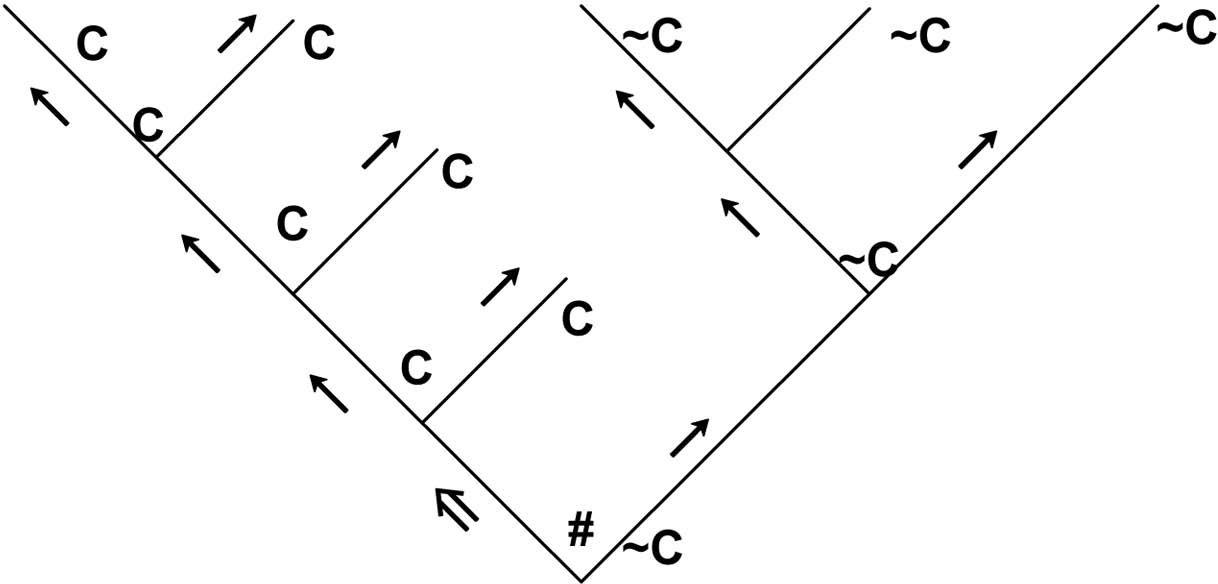
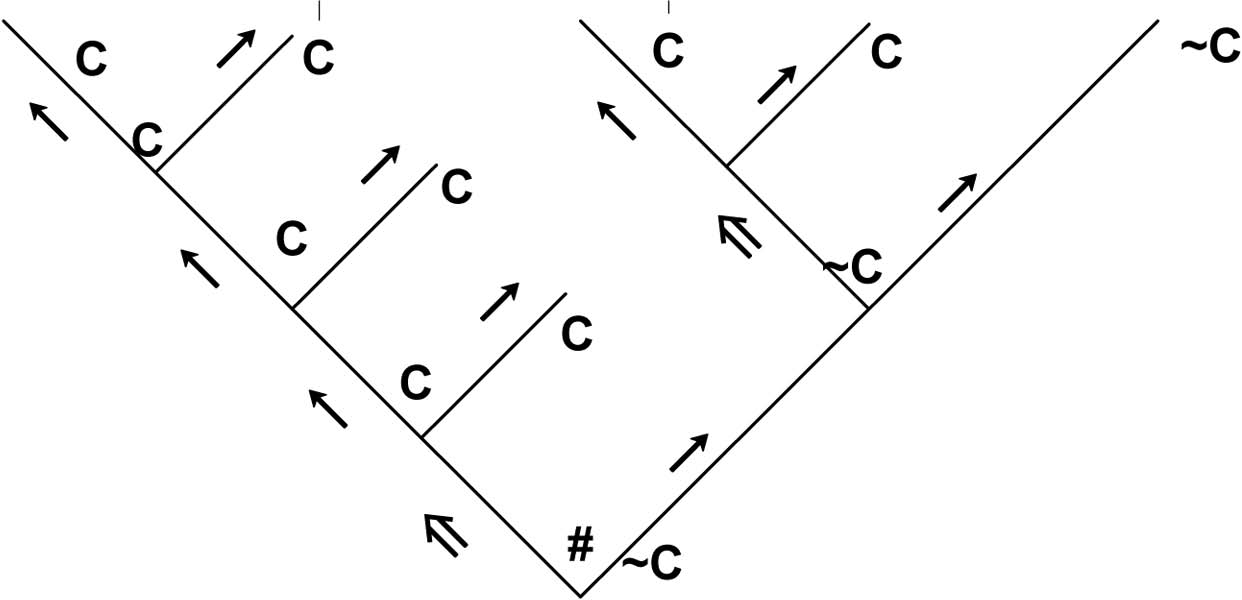
The speciation indifference premise suggests that it is unusual for a taxon-defining HP cluster to emerge with a single speciation event, but we may suppose that some less inclusive higher taxa corresponding to minor changes in an ancestral HP clustering—to a very simple gradient factor—do so arise. In such a case, a taxon-defining HP cluster, C, would arise in a single speciation event from some species # not participating in C (see fig. 1). So, the cluster C would be evolvable from #. By the speciation indifference premise, one should expect that, quite often, the evolvability of C would be preserved under some few speciation events starting from #, so that C could have independently evolved twice—once by a single individuation event from # and once by a single individuation event from a non-C descendent of # (see fig. 2). If the former sort of scenario is possible, there is no reason (given speciation indifference) why the latter should not be also. In the latter sort of scenario, the taxon initiated by C would be HPC monophyletic but not monophyletic in the traditional sense.
Horizontal emergence, single speciation event. Vertices = speciation events; C = homeostatic property cluster introducing new dimension of phyletic inertia; double-line arrows = speciation events introducing C; single-line arrows = C-indifferent speciation events.

Horizontal emergence, multiple speciation events. Vertices = speciation events; C = homeostatic property cluster introducing new dimension of phyletic inertia; double-line arrows = speciation events introducing C; single-line arrows = C-indifferent speciation events.

It is important to see that this prospect is not biologically implausible in cases in which the relevant gradient factors are simple enough. West-Eberhard (Reference Wilson and Zalta2006) indicates ways in which developmental plasticity in response to an environmental change can lead to speciation. Phenotypic differences arising in an isolated population as an adaptive response to a new environment, initially without genetic changes, can create the conditions under which there is subsequent selection for genes that facilitate or enhance the effectiveness of the new phenotypes and lead to the emergence of a new species. Imagine a case in which (a) the genetic and phenotypic changes thus established in the newly emerged species represent the gradient factor leading to the initial HP clustering, C, for a new HPC higher taxon and (b) the relevant genetic changes involve the recruitment, in the new population, of some few common mutations that had been subject to strong adverse selection in the original population. Think of this as happening to a population of species # in response to a local environmental change as in figure 1.
Now imagine a similar scenario in which a speciation event preserving the evolvability of C occurs just before the environmental change in question and in which both # and one of its daughter species respond by adaptive changes in phenotype later stabilized by recruiting the same few mutations as in figure 2. The taxon defined by the emergence of C will then be HPC monophyletic but not traditionally monophyletic. Indeed, it will be strictly polyphyletic according to the traditional conception.
Note that the issue for the HPC conception is not how often this sort of thing happens but whether the theory of phyletic inertia rules it out altogether. It does not. Much, much more common will be vertical indeterminacy.
4.3. Vertical Indeterminacy (Think of Time as the Vertical Axis)
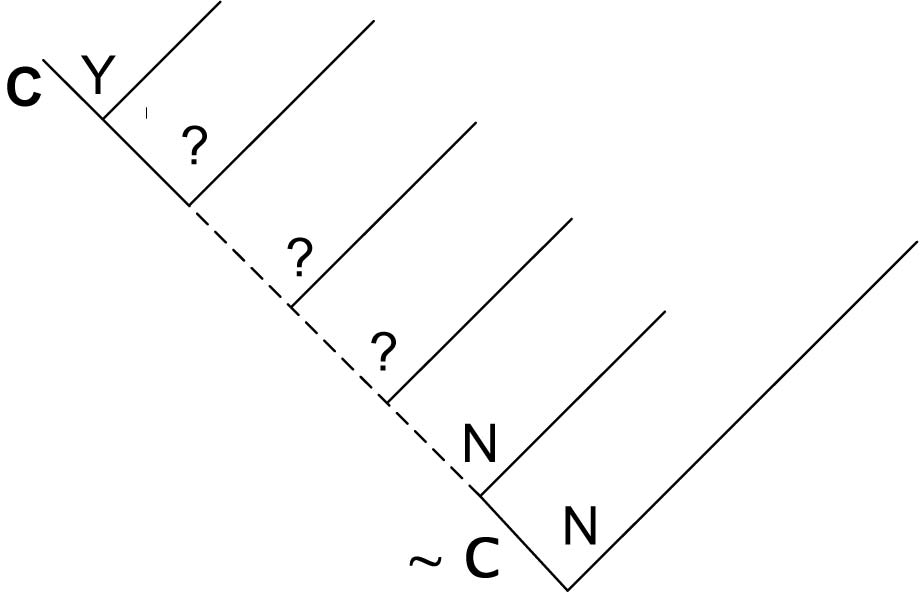
Consider the case of a more inclusive taxon in which the emergence of the initial HP clustering, C, depends on a much more complex gradient factor: on changes involving a large number of new properties and homeostatic mechanisms. It is plausible that such HP clusterings would almost always arise within a single lineage. In this case, however, the speciation indifference premise and the indeterminacy of clustering principle all but guarantee that there will be no particular species in that lineage such that the taxon in question consists of it and all its descendants. Instead, there will be an HPC-typical indeterminacy both in membership in C and in membership in the taxon it defines (see fig. 3).
Gradual emergence of homeostatic property cluster, C, for more inclusive taxon. N = species clearly not in new taxon; Y = species clearly in new taxon; question mark = homeostatic property cluster (HPC) indeterminacy for cluster C and for taxon membership. Key idea: no determinate first (ancestral) member; still HPC monophyletic.

4.4. HPC Monophyly
The HPC conception is compatible with the requirement that higher taxa be monophyletic provided that monophyly is reconceptualized as HPC monophyly. This is exactly the conception appropriate to the idea that higher taxa are explanatory loci of phyletic inertia. It should be adopted.
5. Methodological Issues
5.1. Definitional Precision
It might be objected that traditional monophyly provides a precise conception of higher taxa, whereas the “vague” HPC conception abandons the concern for precision. Two replies are appropriate.
5.1.1. Precision and Reality
The methodologically appropriate standard for precision of language and definitions is that they reflect the real nature of the relevant phenomena. Lots of phenomena—species, islands, kinds of economic systems, biological populations, and higher taxa—have just the sort of “vague” boundaries recognized by the HPC conception.
5.1.2. What Precision?
In any event, the perennial debate over the “species question” (see, e.g., Wilson Reference Wilson, Barker and Brigandt1999) indicates that even pseudoprecision is unavailable in our understanding of “strict” monophyly.
5.2. ‘Judgment’ and Systematics
Might the HPC conception require that systematists make highly subjective judgments about the evolutionary importance of particular HP clusterings? Alternatively, might implementing the HPC conception require reducing the resolving power of systematic methodology so as to diagnose HPC monophyletic higher taxa rather than “strictly” monophyletic ones?
The HPC conception entails neither of these methodological peculiarities. What the HPC conception entails—and this is especially clear in Rieppel's presentations—is that what ordinary cladistic methods reliably track is the emergence of inertia-initiating HP clusterings.
5.3. Species?
Arguably there is no determinate species category among the taxa (see, e.g., Ereshefsky Reference Griffiths and Wilson1998, Reference Hennig1999; Mishler Reference Rieppel1999). Suppose (as I do) that this is right. What are the implications for the HPC conception? There are three.
1. The basic argument for the HPC conception goes through if the speciation indifference premise is rephrased: very, very often, inertial HP clusterings are preserved under the sorts of changes associated with the received notion(s) of speciation.
2. The defense of HPC monophyly goes through unchanged.
3. The HPC conception implies that often the evolutionary origin of an explanatory taxon will not involve just a single species (however understood), but it does not rule out the possibility that some explanatory taxa might arise in single populations or other small groups. This fits well with, and ratifies, the conception of Mishler and Brandon (Reference Quine and Stalker1987).
5.4. The Status of the HPC Conception
It remains to see what the appropriate methodology is for assessing the HPC conception itself. Is it to be assessed by distinctly “philosophical” standards, by scientific ones, or by some combination? According to the conception of “causal grounding” advocated by Rieppel and Kearney, and according to the closely related conception that I have defended (see, e.g., Boyd Reference Boyd and Nida-Rümelin1999a, Reference Boyd and Schantz1999b), hypotheses about reference and natural kind definitions are hypotheses about the ways in which the use of scientific language contributes causally to the epistemic reliability of scientific practices. So such hypotheses are empirical scientific hypotheses, albeit of a distinctly philosophical sort. To a good first approximation, the HPC conception of higher taxa embraces the following claims: (1) Reference to higher taxa figures prominently in the methodological practice of framing and answering evolutionary questions, especially questions about phyletic inertia. (2) Scientific practices of this sort are often enough epistemologically reliable (3) because taxonomic practices approximately track inertia initiating HPC clusterings. (4) Those clusterings do not usually arise from particular ancestral speciation events.
A strong case for the HPC conception is emerging in the literature. That conception requires, as do most interesting scientific claims, a revision of our understanding of some key concepts. In the case of the HPC conception, the required revisions seem fully warranted.