INTRODUCTION
Over the past fifty years, sub-Saharan Africa has been experiencing the highest urban population growth and urbanization rates anywhere in the world (United Nations 2010) against a backdrop of macro-economic stagnation and decline. With many national governments and urban authorities being ill-prepared to tackle the challenges associated with these demographic dynamics (Potts Reference Potts2009; UN-Habitat 2009), urban poverty has been on the increase (Mitlin Reference Mitlin2005; Satterthwaite Reference Satterthwaite2007). This has drawn attention to the sustainability of cities in general and of the livelihoods of the urban poor in particular (Maxwell Reference Maxwell1999; Floro & Swain Reference Floro and Swain2010). And although many countries experienced considerable economic improvements between 2000 and 2009 (Dietz Reference Dietz2011), this has not necessarily signalled a lessening of urban poverty and livelihood insecurity in urban areas (Potts Reference Potts2009). As has come to be recognised in livelihood studies, however, urban residents are not passive victims of structural constraints; rather, as Maxwell (Reference Maxwell1999: 1950) has noted – a point that is a central premise of the Sustainable Livelihood Approach (SLA) – ‘within the constraints they face, people do their best to cope, to make ends meet, to protect their livelihoods, and meet their basic requirements’ (see also Moser Reference Moser1998; de Haan & Zoomers Reference de Haan and Zoomers2006). Owing to limited livelihood opportunities in the formal sector, the urban poor mostly deploy whatever assets in their possession in pursuit of diverse livelihood strategies in the informal sector to survive hard economic times (Krüger Reference Krüger1994; Sardier Reference Sardier2003). Among these informal sector survival strategies is urban agriculture, which has gained increasing importance in recent years across sub-Saharan Africa.
It has been recognised, however, that while the urban poor's livelihood strategies may be primarily aimed at achieving material livelihood outcomes necessary for immediate or short term survival – e.g. improvements in income levels, access to nutrition and food – they also often pursue and/or achieve other longer-term non-material outcomes such as self-esteem, dignity, status. Also central to the Sustainable Livelihoods Approach is the recognition that policies and institutions – both formal (e.g. laws, regulations and policies in public or private sector) and informal (e.g. cultural structures and social norms) – that govern people's everyday lives play an important role in shaping conditions under which they may or may not access certain assets and/or pursue certain livelihood strategies (Oberhauser et al. Reference Oberhauser, Mandel and Hapke2004). And whereas more attention has focused on formal policies and institutions (Brons et al. Reference Brons, Dietz, Niehof and Witsenburg2005), at the household level social norms and gender ideologies are particularly important in household livelihood construction.
In many sub-Saharan African communities, men traditionally occupy higher social statuses as household heads, breadwinners, principal decision-makers and community leaders, while women's role is confined to the domestic sphere where, as care givers and home-keepers, they generally spend long hours on reproductive responsibilities (Blackden & Canagarajah Reference Blackden and Canagarajah2003). Compared with men, women also command limited ownership of, access to and control over productive resources (Adepoju Reference Adepoju2004; Ishengoma Reference Ishengoma2004) and are disadvantaged in accessing educational, training and employment opportunities in the formal sector (Ellis et al. Reference Ellis, Cutura, Dione, Gillson, Manuel and Thongori2007). However, these social conventions do not necessarily apply to all men and women equally across time and space. Rather, their impact varies with class, life-course circumstances, and agency of individual men and women. For instance, older, single, and economically independent women tend to enjoy greater mobility, autonomy, decision-making power and property ownership (Mwaipopo Reference Mwaipopo2000; Simiyu Reference Simiyu2012; Mandel Reference Mandel2004). The specificities of urban life, especially its commoditisation, have particularly challenged social norms and gender relations in sub-Saharan Africa. Economic circumstances have pushed both men and women into taking up livelihood opportunities and roles – some of which had hitherto been associated with the opposite gender – both outside the home and within it (Mwaipopo Reference Mwaipopo2000; Odhiambo & Manda Reference Odhiambo and Manda2003; Overå Reference Overå2007; Bardasi & Wodon Reference Bardasi and Wodon2009).
The aim of this paper is to highlight the gender dynamics in urban livestock keeping in Eldoret municipality, Kenya. It pays particular attention to the role of men and women in decision-making, their respective labour contributions, and the household and individual livelihood outcomes deriving from the activity. In sub-Saharan Africa, livestock keeping is an integral part of urban agriculture, which is conceptualised primarily as an informal sector survival strategy adopted by (poor) urban residents to improve their households' food security and incomes during difficult economic times (Maxwell et al. Reference Maxwell, Levin and Csete1998; Foeken Reference Foeken2006). However, compared with urban crop cultivation, urban livestock keeping is relatively under-researched and under-published, and this applies even more to the gender aspects of the activity. Nonetheless, its importance for households' livelihoods and its potential impact on the urban food security, economy and environment as well as the gender dynamics within it can be gleaned from the limited literature on the subject.
In Nakuru (Kenya), livestock keeping was found to constitute an important additional food source for about half of the households, and a major food source for another 16% (Foeken Reference Foeken2006). In Kampala (Uganda), it was the primary source of income for 25%, and a secondary source for 38% of the households (Ishagi et al. Reference Ishagi, Ossiya, Aliguma and Aisu2002). Often livestock is not kept as a regular source of income but rather as a liquid asset to be converted into cash in times of cash flow crises (Armar-Klemesu & Maxwell Reference Armar-Klemesu, Maxwell, Bakker, Dubbeling, Guendel, Sabel-Koschella and de Zeeuw2000). Urban residents have also been known to keep livestock in town for other reasons as well. Mlozi (Reference Mlozi1997) found out that approximately half of the livestock in Dar es Salaam were kept because of their ‘cultural utility’, a reason that was also advanced by 44% of livestock keepers in South Africa's Grahamstown urban settlement (Thornton Reference Thornton2008). And with 74% of urban farmers keeping livestock in Dar es Salaam (Tanzania), urban agriculture constituted the most important employer after petty trade in the 1990s (Smit et al. Reference Smit, Ratta and Nasr1996). In terms of food supply, urban poultry production in Gaborone (Botswana) was deemed to satisfy the city's broiler demand (Hovorka Reference Hovorka2005); Dakar (Senegal) met its dietary needs from poultry produced in its suburbs (Mbaye & Moustier Reference Mbaye, Moustier, Bakker, Dubbeling, Guendel, Sabel-Koschella and de Zeeuw2000); and about 80% of the milk in Addis Ababa (Ethiopia) was supplied by urban farmers (Tegegne Reference Tegegne2000). Environmental benefits of urban livestock keeping have also been noted, including urban waste re-use and bush clearing (FAO 2001; Schiere et al. Reference Schiere, Tegegne and van Veenhuizen2000).
More often than not, however, livestock has been associated with disease transmission risks, nuisance, bad smell, disruption of traffic flows and safety threats to pedestrians, and environmental degradation (Mlozi Reference Mlozi1997; Armar-Klemesu Reference Armar-Klemesu, Bakker, Dubbeling, Guendel, Sabel-Koschella and de Zeeuw2000; Poynter & Fielding Reference Poynter and Fielding2000; FAO 2001). Although some of these supposed risks have been echoed in various studies, overall evidence as to their severity remains scant and inconclusive. Foeken (Reference Foeken2006) reports that one third of Nakuru's (Kenya) livestock keepers dumped all or parts of animal waste into the streets, while Flynn (Reference Flynn2001) notes the contamination of Lake Victoria by chemical and animal waste emanating from urban farming in Mwanza (Tanzania). And although Nyamari & Simiyu's (Reference Nyamari and Simiyu2007) laboratory tests on kidney and liver tissues from animals slaughtered in Eldoret town showed higher concentration levels of heavy metals (lead and cadmium) in animals originating in urban areas compared with those from rural areas, the concentration levels fell below maximum tolerable levels recommended by WHO/FAO and therefore did not pose any health risks to consumers. Nyamari & Simiyu caution though, that ‘there is potential of heavy metals accumulating along the food chain, thereby posing health risk to meat consumers depending on the rate of exposure’ (p. 105).
On account of (supposed) social, health and environmental risks, urban livestock keeping has been a controversial aspect of urban agriculture, and many urban authorities have restricted its practice and routinely harassed livestock keepers (see e.g. Poynter & Fielding Reference Poynter and Fielding2000; Simiyu & Foeken Reference Simiyu, Foeken, Abbink and de Bruijn2011). However, due to rapid urbanisation and the concomitant increase in demand for animal products in the rapidly growing cities in developing countries – and given the perishable nature of most animal products on the one hand, and poor transportation networks and the lack of refrigeration facilities on the other – the phenomenon of keeping livestock within and around cities and towns has been on the rise (FAO n.d.; Ishagi et al. Reference Ishagi, Ossiya, Aliguma and Aisu2002). Moreover, it has been shown that proper regulatory and support programmes can in fact mitigate the potential negative impacts and challenges associated with urban livestock keeping (Foeken Reference Foeken2006). Thus, as with urban agriculture more generally, many urban authorities, national governments and international research and development organisations are increasingly paying attention to livestock keeping (FAO 2001).
Gender differences have also been noted in urban livestock keeping. Men take up the activity primarily for income, are overrepresented among commercial livestock keepers, and tend to be involved more (in terms of control and responsibility taking) with large livestock while women concern themselves more with small livestock (Armar-Klemesu & Maxwell Reference Armar-Klemesu, Maxwell, Bakker, Dubbeling, Guendel, Sabel-Koschella and de Zeeuw2000; Mbaye & Moustier Reference Mbaye, Moustier, Bakker, Dubbeling, Guendel, Sabel-Koschella and de Zeeuw2000). In her study among livestock keepers in Kisumu (Kenya), Ishani (Reference Ishani, Hovorka, de Zeeuw and Njenga2009: 110) concluded that while women in male-headed households exercised control over small livestock, for large livestock ‘[E]ven where the woman had bought the livestock, she neither owned it nor controlled it’. In contrast, female household heads owned livestock even if they had adult sons. Generally, women tend to contribute the most labour in livestock keeping, and division of labour in terms of taking overall responsibility for different animals as well as performing specific tasks have also been reported (Ishani Reference Ishani, Hovorka, de Zeeuw and Njenga2009; Tegegne Reference Tegegne2000).
The remainder of this paper is organised as follows: The study's methodology is outlined in the next section. This is followed by a brief overview of the practice of livestock keeping within Eldoret municipality, with a focus on the legal and policy context and the prevalence and scope of the activity. We then highlight men's and women's respective roles in decision-making, before exploring the responsibility and task sharing patterns, as well as the benefits that households and individual men and women drew from livestock keeping. The paper ends with a summary of the study findings and draws conclusions about what the findings portend for sustainable household livelihoods, individual well-being, and gender planning in urban agriculture.
METHODOLOGY
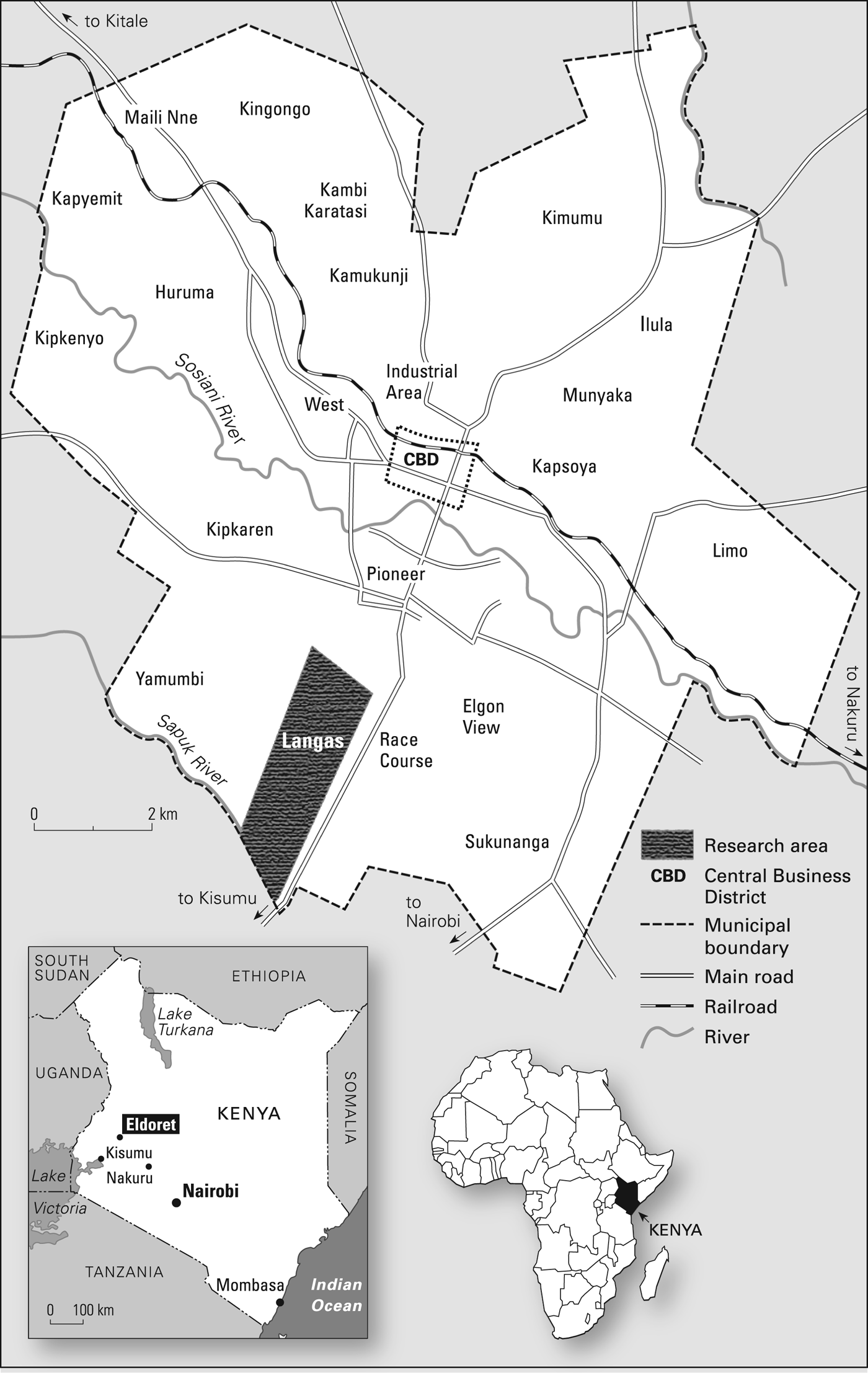
This paper is based on fieldwork that was carried out between 2007 and 2010 in Eldoret, a Kenyan medium-sized town with about 300,000 inhabitants. It involved interviews with key informants,Footnote 1 a survey among 117 urban livestock-keeping households, and in-depth interviews. The area under study was part of Langas, the largest (informal) settlement in Eldoret (see Figure 1).
Eldoret, showing Langas informal settlement.

Langas is divided into four physical planning blocks. On account of perceived income/poverty levels,Footnote 2 two contrasting blocks were purposively selected – one considered as worse-off and another as better-off – and a census carried out in the selected blocks to identify urban farming households. Out of the 1,051 households counted, 232 (22%) engaged in urban farming. All conjugal and female-headed urban farming households in the two blocks were eligible for the survey, with both spouses in male-headed households and the heads of female-headed households being targeted for the interviews. In order to get the respondents to volunteer information more freely, the interviewers (two males and two females) administered the questionnaire to respondents of the same gender, whereby spouses in male-headed households were interviewed separately.
Interviews were granted in 160 urban farming households, of which 117 kept livestock. Out of the 90 male-headed livestock-keeping households, both spouses were interviewed in 28 households, with only one spouse (the majority of whom were female) being available or willing to be interviewed in the other households. In the 26 female-headed households, the household head was interviewed. The quantitative analysis focused on the gender differences within conjugal households and how these gender differences played out in the context of large livestock (i.e. cattle, pigs, sheep and goats) and small livestock (chickens, ducks, pigeons, turkeys and geese). The quantitative analysis was augmented by qualitative accounts from in-depth interviews, which were conducted to provide further insights on some of the issues that arose during the survey and those that could not be captured adequately by the survey. Seventeen livestock-keeping households were purposively selected from among those surveyed. The criteria for selection included: household headship, types of animals kept, and scale and system of production. In-depth interviews were conducted by the principal researcher and one female research assistant.
LIVESTOCK KEEPING IN ELDORET TOWN
The legal and policy framework governing urban farming in Eldoret reflected a greater concern about the (potential) negative impacts of livestock keeping compared with crop cultivation, and the need to regulate the former rather than the latter. The 2009 Eldoret Municipal Council (EMC) by-laws contain a wide range of specific regulatory – often stringent and repressive – provisions on livestock keeping but not a single provision on crop cultivation (Simiyu & Foeken Reference Simiyu, Foeken, Abbink and de Bruijn2011; Simiyu Reference Simiyu2012). This reflects the general unfavourable official attitude towards livestock keeping within EMC. Indeed, 46% of the 200 respondents surveyed said they had either been personally harassed or had witnessed someone else being harassed by EMC officers for farming in town. Of these, 44% (N = 92) of such incidents had involved confiscation of roaming livestock, particularly cows (22%) and pigs (21%), while 45% involved killing of the animals (pigs in all cases). EMC officials also confirmed to have organised the killing (by shooting) of roaming pigs in the town in 2003/2004,Footnote 3 and some interviewees in Langas also recounted suspected baiting of pigs by municipal council officers some time in 2006/2007.
As Nyamari & Simiyu's (Reference Nyamari and Simiyu2007) study indicated, there is no clear-cut evidence in the particular case of Eldoret as to the extent of the supposed livestock-related risks, which have provided the pretext for restricting urban livestock keeping. The EMC's Chief Public Health Officer (26 July 2007 int.) cited a 2006 outbreak of African swine fever disease in the municipality that virtually wiped out the entire urban pig population as underlining the health risks posed by urban livestock keeping, given the highly infectious nature of the disease. He nonetheless conceded that no related cases of human infection had been reported, nor that any particular disease outbreak among humans had previously been attributed to livestock keeping in Eldoret.
Despite the legal and policy restrictions, livestock keeping is a common practice in Eldoret. Of the 160 urban farming households surveyed, 73% kept livestock – 60% kept livestock in addition to cultivating crops, while 13% kept livestock only. At least nine types of livestock were raised in the study area. Chickens and sheep were the commonest livestock, kept in both cases by one in every three households. Between them, the 117 livestock-keeping households surveyed kept a total of 572 chickens, 265 sheep, 261 ducks, 116 cows, 109 pigs, 30 goats, 71 pigeons, 13 turkeys and 11 geese.
DECISION-MAKING BY LIVESTOCK KEEPERS
Choice of livestock
Table 1 shows that the decision to keep large livestock (i.e. cows, sheep, goats and pigs) was mostly taken by men while women made the choice in a majority of cases involving small livestock (chickens, ducks). Men took the decision in 50% of the instances involving large livestock compared with their role in only 23% involving small livestock, while for women it was the other way round. These decision-making patterns mirror social norms governing livestock ownership. In most Kenyan communities, large livestock were traditionally considered the property of men, not the least because they constituted important signifiers of wealth. Consistent with Ishani's (Reference Ishani, Hovorka, de Zeeuw and Njenga2009) findings in another Kenyan urban context, men in Langas were the declared owners of large livestock – even where such livestock were purchased by women or with women's contribution. Thus, decisions about whether to keep large livestock could only be taken by men or with their involvement. Men's prominent role in the decision to keep large livestock is not surprising given men's breadwinner role and the fact that large livestock constituted an important form of liquid assets that could easily be converted into cash income to meet lump sum household expenditures such as education and medical expenses (for which men were primarily responsible). Besides, the keeping of large livestock – especially dairy cows and pigs – required considerable financial investment, technical knowledge and high labour input. Access to and control over these resources was therefore an important factor in leveraging decision-making regarding whether or not to keep the livestock. Thus, women's decision-making power with respect to large livestock was constrained by their limited financial power and agricultural knowledge and information, and restricted to sheep and goats.
Decision-making on choice of livestock, by type of livestock and gender (%)

* The percentages do not add up to 100% because in a few cases household members other than the male household head and/or the female spouse also took decisions on the choice of livestock.
However, as Wandera'sFootnote 4 (male spouse) comments below indicate, women with access to financial resources wielded considerable influence on decisions relating to the keeping of large livestock. The labour demands and subsistence value of certain livestock, especially dairy cows, also necessitated consultations between spouses in many cases. Some form of concurrence about the need to rear large livestock and how to share responsibility was deemed critical for the success of livestock-keeping projects; hence the relatively high level of joint decision-making in the choice of large livestock (Table 1).
I was encouraged [to keep cows] by a workmate who kept cows in Yamumbi estate. He told me how he benefited from the cows in terms of getting milk for the family and earning some income by selling milk. I visited him and saw how well his animals were doing. I then took my wife there so she could also see for herself. When we came back we agreed that keeping dairy cows was a good idea. My wife then raised most of the money needed to buy the first cow. She got the money through a women's rotating savings and credit association [ROSCA]. I added my contribution and we bought the cow. If you want to be a good farmer, you must involve your wife in the decisions you make. (…) Were it not for my wife, we couldn't have even bought the cows in the first place, let alone take care of them. (Wandera 30 May 2009 int.)
Use of animal products and income
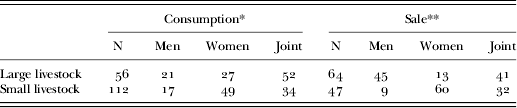
Differences were noted between men and women in their respective responsibilities for the decisions as to whether livestock products should be consumed and/or sold (see Table 2). These differences reflected socially sanctioned livestock ownership and control patterns, and gender division of responsibilities. Thus, most decisions about committing small livestock-related products for both home consumption and sale were taken by women (83%), be it alone (49%) or together with the husband (34%).
Decision-making on the use of animal products, by type of livestock and gender (%)
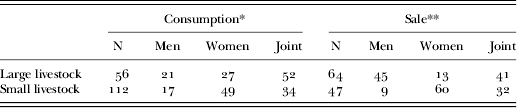
Chi-square: * χ2 = 7·853, df = 2, p = 0·02 < 0·05; ** χ2 = 31·337, df = 2, p = 0·00 < 0·05.
In the case of large livestock, women's say was only marginally higher than men's in consumption-related decisions (27% versus 21% of the instances), but men controlled the sale of animal products in the majority of cases (as sole decision makers in 45% of the instances and jointly with their wives in 41% of the instances). An important point to make here is that most of the sales related to large livestock involved live animals and that pigs and sheep were the most commonly sold animals. In this respect – as also in the case of small livestock – culture, social norms, intra-household power relations, market information and control over the livestock were important influences on decision-making patterns relating to livestock sales. We illustrate this point using the testimonies below.
My husband owns everything on this plot so in case he wants to sell any of the livestock, he never consults me and I never ask for the money. What I know is that he uses some of the money to pay school fees and pockets the rest. The only things I am allowed to sell are milk and eggs … . My work is to milk the cows and I decide how we use the milk. We use part of it in the house and sell the rest. My husband never asks for the money but he expects me to use the income I receive from the milk to buy other food items and to meet basic household needs … . He only wants to see that there is food and that I do not ask him for any money as long as I am selling milk (Kerubo 6 June 2009 int.).
When you have an emergency, you can sell sheep quickly to solve the problem. But whenever that happens, it is my husband who sells. He can sell even without telling me. He will just say he wants to sell and you cannot object. As I grew up I never saw women [in her community] sell sheep or cattle; it is men who do. Even when I want to sell my sheep we have to agree with my husband; then he will look for someone to buy. But I can sell chickens and ducks without telling him. (Mama Sella 30 May 2009 int.)
When I want to sell pigs I do not consult my wife as doing so brings about quarrels, especially when she gets to know the selling price. I usually do not want to give her any money after paying school fees. (Obachi 6 June 2009 int.)
Since he [the husband] is the one who struggles with the cow every day, when he milks the cow we usually wait for him to decide how much milk to leave for us and how much to sell. He has some regular customers who take milk every day and pay at the end of the month. He gives such customers priority and he does not want them to miss out. He normally puts aside milk for his customers before he gives us whatever remains. (Muhonja 2 June 2009 int.)
The comments above suggest that men and women were less inclined to consult their spouses about the sale of livestock if they considered the livestock as personal property over which they exercised full control. Obachi's statement also indicates that while rooted in skewed gender relations, men's unilateral decisions to sell livestock were also an important strategy of excluding their spouses from sharing in the income accruing to the sale of the livestock. Whether or not men and women were involved in decision-making about sale of animal products or ceded decision-making power to their spouses also depended on their labour contributions.
But as Table 2 shows, the level of consultation between spouses in the contexts of the two uses (i.e. consumption and sales) for livestock products was both high and comparable. It must be noted that the proportion of mutual decisions was particularly high where large livestock were involved (52% and 41% in the case of consumption and sales, respectively). This owes not only to the fact that large livestock were an important form of household liquid assets, but also that the keeping of large livestock was a labour-intensive venture requiring, in some instances, division of labour and roles between men and women. As a result of this, and as shall be demonstrated below, labour contribution became an important basis – on the part of women in particular – for being involved in decisions relating to the sale of the livestock. Consultations between men and women were especially common in the case of dairy cows; the additional reason being that cow milk was an important part of household nutrition and a source of regular income. Thus, regardless of whose initiative it was to keep it, a dairy cow was considered more of a household asset than a personal asset and therefore disposing of it was more often than not a consensual decision between spouses.
Mama Sella's account (above) also points to the influence of social norms and intra-household power relations on men's and women's control over the sale of live animals. Cultural patterns of livestock ownership and of responsibility-sharing necessitated that women who owned sheep and pigs consult their husbands whenever they wished to sell the animals. This was reinforced by women's relatively limited access to market information. However, as shall be demonstrated below, single women from Mama Sella's community exercised greater control over their livestock and could sell them whenever they wanted and without any restrictions.
MEN'S AND WOMEN'S LABOUR CONTRIBUTIONS IN LIVESTOCK KEEPING
In the analysis of divisions of labour in livestock keeping, we make a distinction between taking overall responsibility for different livestock types, and performing specific tasks related to the upkeep of the livestock. Taking overall responsibility refers to being charged with the role of ensuring that the livestock receives the required care. However, this did not necessarily mean that the person(s) involved performed all the tasks in respect of the livestock concerned; nor that they owned or exercised control over the livestock.
Division of responsibility for livestock
In general, spouses jointly took responsibility for livestock in only about 20% of the instances. Women shouldered the bigger burden, overall taking responsibility for livestock more than twice as often as the men (97 instances compared with 40 for men). However, the level of involvement for the two sexes varied between large and small livestock (Table 3). Whereas women's role in both cases was greater than that of men, women were represented more among primary care takers for small livestock (72% of the instances) than for large ones (41%); the corresponding levels of involvement for men being 13% and 30%. Considering the patterns of decision-making on choice of livestock (Table 1), it can be construed that women more often took responsibility for men's livestock (mostly large livestock) than men were willing to give a helping hand to the women for the latter's livestock (mostly small livestock).
Responsibility for livestock, by type of livestock and gender

* The percentages do not add up to 100% because in some cases household members other than the male household head and/or the female spouse also took responsibility for the livestock.
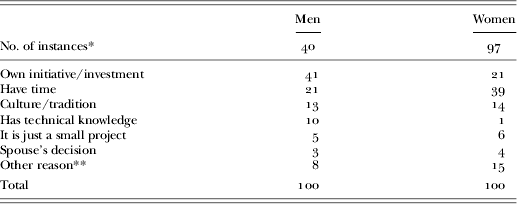
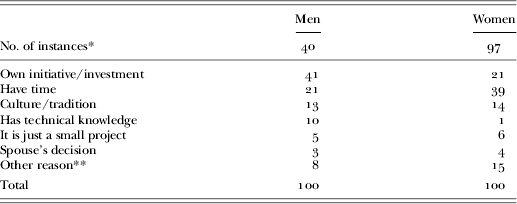
The reasons for taking responsibility for livestock varied significantly between men and women (Table 4). Whether or not the keeping of livestock was a personal initiative or investment for a spouse was an important determinant of the spouse's involvement with the livestock. This reason was cited in one third of all instances, and was twice as important among men as it was among women (41% versus 21%). In-depth interviews revealed that this reason was also more important where sheep, pigs and small livestock were involved compared with dairy cows. Mhubiri's case is illustrative. The farmer used to keep pigs, for which he personally took responsibility. According to his wife, ‘the pigs were his property and he would sell them any time as he wished. He would never ask anyone or reveal the price at which he sold the pigs'. Mhubiri's household also kept sheep that, unlike pigs, were shared out among family members, a strategy that had been adopted, as he explained, ‘to remove any conflict in the household and to motivate family members to take greater interest in taking good care of the animals'. However, when it came to selling, the situation was not very different as with the pigs: he could sell his sheep whenever he chose and for whatever reason, but his wife was not as privileged. Although Mhubiri had no problem with his wife selling chickens and ducks, he had this to say about the sheep:
When it comes to selling sheep, I normally do not involve my wife. Sometimes there are pressing issues to sort out urgently such as paying school fees or an electricity bill. But if I were to consult her about the need to sell some sheep, she would not agree with me. She would say that men should look for money from elsewhere to solve family problems instead of selling household assets. In the circumstances, I decide to sell by force, even when I know she would feel bad about it … I cannot give her that freedom [to sell sheep]. Even when I am far and there is an emergency that would warrant selling of sheep, I must give authority before she can sell the sheep. You must always draw boundaries with your wife, otherwise you may one day return home only to find that she has sold your livestock and gone away. Our culture does not allow women to sell sheep. Were that to happen, elders would have to be called in. (Mhubiri 30 May 2009 int.)
Reasons for taking responsibility for livestock, by gender (%)
* The figures refer to the 137 instances where only one spouse was solely responsible for the livestock. In the remaining 42 instances, both spouses were jointly responsible.
** This includes ‘cannot afford hired labour’, ‘it benefits me the most’ and ‘it relates to other responsibilities’.
Chi-square: χ2 = 28·052; df = 8; p = 0·00 < 0·05.
The time factor was an important reason why either men or women were responsible for livestock (Table 4). This relates to the fact that the keeping of some animals, particularly dairy cows, but also confined pigs, were labour-intensive undertakings that, in the words of one urban dairy farmer, ‘was like a full-time job with which one could not do much else’ (Wandera 30 May 2009 int.). Compared with men, women were almost twice as likely to have been responsible for livestock on account that they had time to do so (39% versus 21% of the men).
Although it influenced the farmers to a limited extent, the role of one's knowledge and information about the animals for which they took responsibility revealed clear gender differences, being a more important factor among men (10%) than among women (1%) (see Table 4). In-depth interviews revealed, for instance, that dairy cows and pigs required a certain level of technical knowledge and information related to sourcing for feeds, accessing veterinary services (common with cows), and finding the market for the animals (common with pigs). For these reasons – coupled with the labour requirements mentioned above – the keeping of dairy cows and pigs was men's primary responsibility in most instances. On the other hand, sheep and small livestock were easier to keep; hence, women's labour was more visible.
Gender differences were also noted among reasons that constitute ‘other reasons’ (Table 4). Only women mentioned that they took up responsibility for livestock because they benefited the most from it (9%) or that doing so related to their other responsibilities (6%). On the other hand, only men mentioned that they were responsible for the livestock because they could not afford to hire external labour for the work (8%).
Performance of specific tasks related to livestock keeping
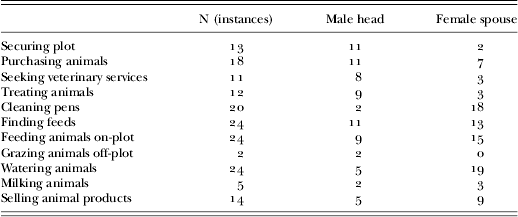
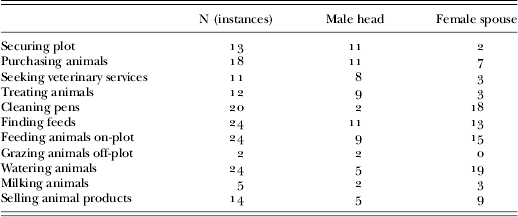
Patterns of task-sharing among spouses in livestock-keeping households were gendered. Table 5 shows that in the 28 livestock-keeping households where both spouses were interviewed, men were more often involved with tasks that were undertaken only occasionally, and which required some technical knowledge and financial resources, and of an outdoor nature. Men more often fenced plots, purchased animals on the market for rearing, sought veterinary services for their animals, treated the animals and grazed them off-plot.Footnote 5
Labour involvement in livestock-related tasks, by gender (number of instances; 28 households)*
* The (absolute) figures presented in this table concern the 28 households in which both spouses were interviewed.
In contrast, women's tasks were commonly carried out within the households' compounds, and performed on a more regular and routine basis. The tasks included the cleaning of animal pens and feeding and watering of the animals on-plot. However, there were other tasks that were performed by both spouses to more or less the same extent, such as finding animal feeds, milking and selling animal products. Whether and to what extent men and women shared livestock-related tasks also depended on the type of livestock and the nature and multiplicity of tasks involved, as well as the motive for keeping the livestock. Although it was noted above that men dominated dairy and pig-keeping enterprises because they were labour-intensive, it must be pointed out that female labour was still important, but more so in the case of dairy cows as compared with pigs. This is due largely to the fact that the latter were kept for a purely income motive while the former were kept for both income and direct home consumption of milk. In addition, unlike pigs whose care was less differentiated and revolved only around feeding and watering, rearing of cows was multi-tasked with a clear gender division of tasks. Milking, selling of milk and on-plot watering were mainly done by women, either because the tasks were performed on-plot or they required certain feminine attributes such as marketing/bargaining skills in the case of selling milk. Thus, there was greater room for cooperative arrangements between spouses in the context of dairy cows than in the case of pig keeping. This is reflected in the following narrative:
Wandera and his wife, Auma, had been keeping dairy cows since 1993 when he was still employed by Rift Valley Textiles. His wife used to perform most of the tasks then and he would only assist whenever he was not working. However, after leaving his job, he got involved more with the livestock and shared tasks with his wife. He would look for fodder in open spaces and on people's plots and once he brought it home, it was his wife's responsibility to feed the animals and give them water. Cleaning the pen, milking and selling of milk were also done by Auma. Whenever the cows fell sick, it was Wandera to look for a vet or for veterinary drugs. However, since Auma's health started deteriorating in 2005, Wandera had to take up most of his wife's responsibilities, much like she did when he was still employed. Drawing from his experience, Wandera advised thus:
It is important that both spouses understand various aspects of rearing cows. They should also like livestock keeping and be willing to assist each other. Were it not for my wife, we wouldn't be having these cows. You know, men are not people who stay at home or at one place, so unless the wife understands what to do with the animals you cannot succeed. Similarly, should anything happen to your wife and you can't do what she used to do, then you are finished. My wife used to do most of the work when I was still employed and now I do most of it because of her poor health. (Wandera 30 May 2009 int.)
Where income was the main motive for keeping livestock and the upkeep of the livestock involved only a few tasks, gender division of labour sometimes reflected individual household members' preferences and interests, and the crossing of gender boundaries was common. For instance, some men monopolised certain livestock-related activities including those that are ordinarily performed by women as a strategy to control income, and to make illegitimate any claims by their wives to the income. The division of labour between Obachi (6 June 2009 int.) and his wife, Kerubo (6 June 2009 int.), illustrates this point:
The couple kept several livestock, including two dairy cows and four pigs. Obachi took overall responsibility for the livestock. He looked for feeds, took cows and sheep out for grazing, watered them, etc. His wife assisted him with watering cows, and especially milking the cows and selling surplus milk. Obachi did not ask about income from milk sales so long as there was food in the house. However, as his wife pointed out, ‘When it comes to pigs, he prefers to do everything by himself. He never asks for assistance’. In the end, and much like Mhubiri above, he sold his pigs whenever he wanted without consulting his wife.
The importance of Obachi's strategy of assuming all responsibilities related to pig keeping is underlined by the fact that in some cases, women reportedly resisted men's unilateral actions of selling animals and negotiated access to income accruing to livestock sales by threatening to withdraw their labour subsequently. One pig farmer explained thus:
It is common in this area for men who keep pigs to look for a potential buyer and even receive payment in advance without the knowledge of their wives. But when the person comes to take away the pig(s), most women usually protest and refuse to give away the pig(s) unless they see the money. Often the men would have already spent part if not the whole of it. Women resist because they are sometimes the ones who do most of the work related to pig keeping. When such a thing happens, the man will have no choice but to listen to the wife, otherwise she will refuse to attend to the animals subsequently. Such incidences happen all the time in this area. (Njoroge 23 May 2009 int.)
BENEFITS OF LIVESTOCK KEEPING
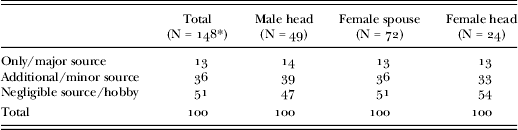
Overall, livestock keepers, irrespective of gender, perceived livestock keeping as constituting a modest source of food. Table 6 shows that almost nine in every ten respondents considered livestock keeping to have made at best a minor contribution to their households' food requirements. Yet, only 7% of the respondents noted that their households had not derived any food from the livestock they kept. The table also reveals that men and women hardly had different views on this.
Perception of the importance of livestock keeping as a source of food, by relationship to household head (%)
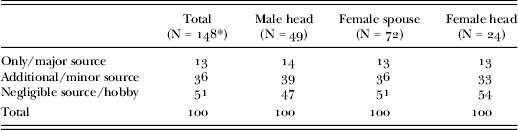
* Total number of respondents from the 117 livestock-keeping households, including three single-male heads that do not appear in the right-hand side of the table.
Chi-square: χ2 = 0·415; df = 4; p = 0·981 > 0·05.
The relative insignificance of urban livestock keeping as a source of food could be attributed to the fact that only a limited range of livestock products constituted regular food items in household diets. Only milk and, to a lesser extent, eggs were regularly consumed by households. Other livestock products were either only periodically or rarely consumed, if at all. Although many farmers who kept chicken, ducks and sheep said they had at one time or another slaughtered some of their stock for home consumption, this happened on very rare occasions. Nonetheless, many households still attached greater importance to the limited, and often rare, livestock food products than the latter's quantitative value as a proportion of overall household food supply would suggest. This was partly for nutritional and partly for cultural reasons. For instance, Wandera lamented the loss of his dairy cow as follows:
Before my dairy cow died, I used to take good tea in my house whenever I wanted to. My cow's milk was of very high quality, and there was always milk in my house. But nowadays, if I want to take tea I have to buy milk, which is very expensive and you cannot get good milk in the market. Most vendors dilute their milk with water and since I cannot afford milk from the shop, black tea is the order of the day in my house these days. (30 May 2009 int.)
Similarly, as negligible as chicken and sheep meat might have been as food sources, their cultural value was much greater among members of the Luhya and Kikuyu ethnic communities, respectively. The chickens and sheep were slaughtered for food periodically during cultural ceremonies, special occasions, and for ‘important’ visiting friends and relatives. Thus for a household of eight, like Mama Ben's (16 August 2009 int.), five chickens would constitute an infinitesimal proportion of household food over several months. But for Mama Ben, the five chickens she kept gave her a peace of mind and sense of pride knowing that she could ‘comfortably feed important visitors, as is expected of a respectable Luhya woman, at any time even if they found [her] without any money in the house’. The cultural significance of sheep to Kikuyus was underscored by the fact that Kikuyu-headed households were not only more likely than farmers from other ethnic backgrounds to keep sheep (constituting 77% (N = 52) of all sheep-keeping households), they were also more likely to have done so as much for cultural reasons as for income. As was noted earlier, the importance of culture in the decision to keep livestock has also been demonstrated in other eastern and southern African urban centres (see e.g. Mlozi Reference Mlozi1997; Thornton Reference Thornton2008).
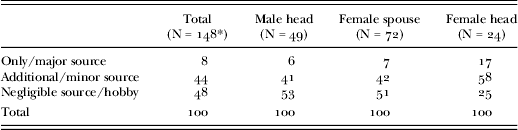
Much like its perceived value as a food source, livestock keeping was considered by a large majority of respondents to have made either only marginal or no contribution to household incomes (Table 7). Only 8% of the respondents considered it as a major source of household income. On the whole, the contribution of livestock keeping to household incomes was perceived in more or less the same way by men and their spouses (but not by the female heads of households; see below).
Perception of the importance of livestock keeping as a source of household income, by relationship to household head (%)
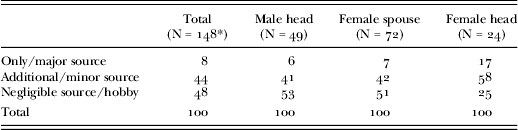
* Total number of respondents from the 117 livestock-keeping households, including three single-male heads that do not appear in the right-hand side of the table.
Chi-square: χ2 = 6·889, df = 4, p = 0·142 > 0·05.
That livestock keeping accounted for insignificant proportions of household incomes owes to the fact that livestock sales were a rare occurrence and only happened at critical moments. The sale of live animals and birds was indeed a particularly important and sometimes only way of raising ‘quick money’ to attend to urgent financial needs. Sheep, pigs, chickens and, to a lesser extent, cows were the most important liquid assets among the livestock. Fifty-seven per cent of the pig keepers and 27% of the sheep owners had at one time or another sold their animals to earn some income. Although cows were rarely sold, cow milk earned some income for 55% of the cattle-keeping households (in each case over several months). Among the small stock, live chickens and chicken eggs were the most important sources of income. Forty-four per cent of the chicken farmers had at one time or another sold chicken eggs and another 46% had sold live birds, although the former was done with greater frequency than the latter.
Though limited overall, the value of livestock keeping as a source of income during critical moments can be illustrated by the following instances:
When Mudavadi's children were once sent home for school fees when his main business had not earned him any money for several months, he decided to sell three of his four dairy cows to send the children back to school because he did not want them to miss school ‘for even one day’ (1 July 2009 int.). Similarly, Muraya (19 August 2009 int.) recounted how his mother died in their rural home at a time he had no money in his pocket, and neither did his close friends. Yet, as the first-born of his family and with his father already deceased, Muraya was expected to play a key role in his mother's funeral arrangements. Although he had 19 rental rooms – his main source of income – his mother's death occurred mid-month and so he could not ask his tenants for rent. Chickens were the only liquid assets he had. He sold four big ones to a local food kiosk and raised Kshs. 900 (about US$ 10), which enabled him to travel to the rural home and thereby avoid ‘the embarrassment of not making it for [his] mother's funeral on time’.
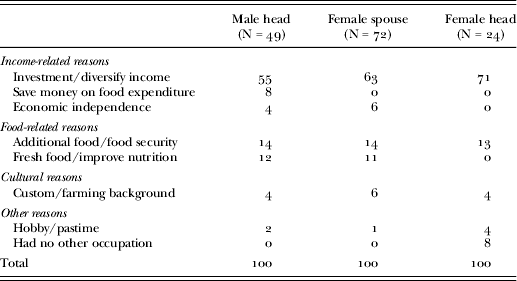
Indeed, compared with the need for food – and given the significance of livestock as important liquid assets that were easily convertible into cash to meet household expenditure – the income motive was by far a more important factor for taking up livestock keeping among both men and women (Table 8). For instance, whereas only 14% of both men and women took up livestock keeping as a source of additional food, 55% of men and 65% of women kept livestock as an investment or to diversify their income sources. However, while women – and to a greater extent, female household heads – were more concerned with prospects for earning and/or diversifying income than men, only men (although a small minority, 8%) cited the need to save money on food expenditure as the reason for choosing to rear livestock. Such men (e.g. Obachi, above) tended to cede to their wives the power to make decisions about the use of income from the sale of livestock products – mostly milk – often on condition that the women did not ask for regular household budgetary support.
Main reason for livestock keeping, by relationship to household head (%)
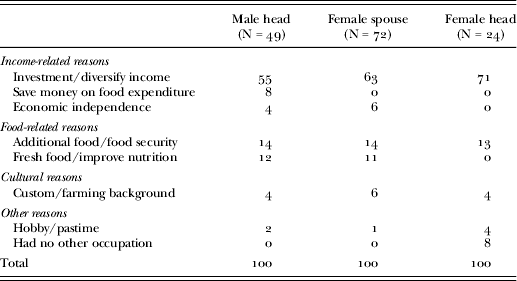
The importance of livestock keeping as a source of income for women could be attributed to women's relatively limited alternative income sources, and to a lack of asset-building opportunities. On the other hand, the limited influence of ‘economic independence’ (mentioned by only 4% of women) as a factor in women's decision to keep livestock relates to the fact that unlike income from gardening (see Simiyu & Foeken Reference Simiyu and Foeken2013) it is more difficult for women to conceal income from the sale of livestock products, especially large stock that were the most significant income sources.
While large livestock constituted an important fallback for households with regard to meeting lump sum expenditures, at a personal level men and women benefited from livestock keeping differently and unequally. Large livestock – being largely under the ownership and control of men – held greater significance as ‘cash reserves’ for men than for women. Moreover, cultural norms seemed to also limit women's freedom to sell large stock over which they had ownership rights, as Mama Sella's story above illustrated. And although women enjoyed more freedom over the sale of small livestock and related products as well as cow milk, such livestock products generated more limited incomes that were in any case mostly used for household expenditure.
It must be pointed out, however, that unmarried women were not as restricted as their married counterparts regarding ownership of large livestock and access to income from livestock sales. Thus, whereas Mama Sella contended that women from her Kikuyu ethnic community traditionally did not sell sheep (and cows), it was the case that many unmarried Kikuyu women in Langas kept sheep and were personally responsible for sales whenever they wanted to. One such woman, Nyambura (28 May 2009 int.), put it this way: ‘Any time I have an urgent problem that needs money, I personally walk to the butchery and the butcher will come running. They know I keep good quality sheep and the demand for sheep is so high that I will always get the right price.’
On the whole, female household heads generally exercised greater control over household assets and enjoyed greater autonomy and decision-making power even when they had grown-up sons and other adult males in their households. This may partly explain – besides the fact that female-headed households were generally poorer than male-headed onesFootnote 6 – why the proportion of female household heads (71%) was higher than married women (63%) among farmers who took up livestock keeping as an investment or as a means to diversify their income (Table 8), and why female household heads perceived livestock keeping as a source of household income more favourably than married women (Table 7). Furthermore, as alluded to in Nyambura's comments above, freedom of mobility also meant that female heads of households had better access to market information and could therefore appropriate available market opportunities, including selling their livestock, without recourse to male patronage.
However, as has already been noted, despite men's control over large livestock, the high labour requirements involved in rearing the livestock necessitated greater consultations and responsibility-sharing between spouses and, as a consequence, some women were able to use their labour contribution to negotiate access to income from livestock sales. The implication of this – in addition to the fact that married women were restricted by gender norms from selling large livestock by themselves and often relied on their husbands to access the market – is that both spouses came to understand the real economic value of what in most instances were more or less joint ventures regardless of livestock ownership claims. It is not surprising therefore that the perceptions of married women and male household heads as to the contribution of livestock keeping to household incomes were comparable (Table 7).
CONCLUSIONS
This study has shown that urban residents took up livestock keeping mostly as a means of earning additional income but also for additional food. And although the contribution of livestock keeping to overall household incomes and food needs was only modest, livestock constituted important liquid assets to be converted into cash income during cash flow crises whenever the need for lump sum expenditures beckoned. As a food source, livestock keeping mattered most for its nutritional and cultural value. The modest contribution of livestock to household livelihoods is attributable to urban farmers reliance on traditional, low-value and small-scale production systems and lack of official support and facilitation.
Regarding the gender aspects of urban livestock keeping in Eldoret, the study showed that men and women played different but complementary roles in livestock keeping. The roles were influenced by social norms and gender roles, household composition, and by the type of livestock involved, relative control over the livestock, the main reason for which it was kept, and anticipated household and personal benefits. Consistent with findings from other sub-Saharan urban contexts (see Amar-Klemesu & Maxwell Reference Armar-Klemesu, Bakker, Dubbeling, Guendel, Sabel-Koschella and de Zeeuw2000; Mbaye & Moustier Reference Mbaye, Moustier, Bakker, Dubbeling, Guendel, Sabel-Koschella and de Zeeuw2000; Ishani Reference Ishani, Hovorka, de Zeeuw and Njenga2009) and with social expectations, and owing to their relatively better entitlements, men showed preference and took greater responsibility for and played a bigger decision-making role involving large livestock – more so when the livestock was kept primarily for income. They also performed tasks of an out-door nature and/or which required considerable technical knowledge and information. On the other hand, because of their reproductive and home-keeping responsibilities and limited entitlements and capabilities, women preferred and exercised greater control over small livestock, made the most decisions about consumption use of large livestock products, and performed home-based routine tasks and those tasks undertaken for home consumption purposes. However, men and women took responsibility for livestock and performed tasks ordinarily associated with the opposite gender where labour of the opposite gender was absent in the household, or as a strategy to control benefits accruing to the activities.
Women's control over small livestock and their enhanced decision-making role in the consumption use of large livestock products (mainly milk) and in the marketing of the products translated into nutritional benefits (milk and egg consumption) for many livestock keeping households, but also (to a limited extent) incomes for household use. On the other hand, men's role in livestock keeping – especially involving large livestock kept primarily for income – was mostly geared towards achieving personal rather than household benefits even where women's and other household members’ contributions were significant. It should be remembered, for instance, that Muhonja's husband prioritised selling milk to his customers over leaving some for consumption by his household, and that it was a common practice in Langas, as recounted by Njoroge, for men to receive money from potential pig buyers and squander it without the knowledge of their wives. It was evident though that in circumstances where women's labour was critical to the success of income-oriented large livestock enterprises, it constituted an important fall-back position for women in the household bargaining process. However, as Apusigah (Reference Apusigah2009) has pointed out in a different sub-Saharan African context, the consequence of gender inequalities and the socialisation process that produces them is that threats of labour withdrawal – as recounted by Njoroge – often yield limited gains, as women ‘negotiate and bargain within prescribed limits’ and with little else (beyond labour) in terms of fall-back position. This is reflected in Mhubiri's explanation as to why he often sold sheep by force whenever there was need despite knowing that his wife would protest and feel bad about it.
Thus, policy interventions in support of urban livestock keeping must take cognisance of intra-household power asymmetries and the possibilities and opportunities they engender for equitable livelihood outcomes for men and women. For instance, from the findings of this study, it would seem that interventions in support of (small-scale) small livestock enterprises as well as large livestock enterprises that contribute to both household food supply and income, will be more beneficial for household livelihoods and individual well-being of women (in particular). As for large livestock, support for dairy farming would more probably enhance more co-operative arrangements between men and women, improve household welfare (in terms of milk consumption), and derive equitable benefits for both men (in terms of saving on food expenditure) and women (in terms of enhanced ability to performing their gender roles, economic independence, and greater role in decision-making related to use and sale of milk) than, say, pig production.