Subclinical hypothyroidism, also called mild thyroid failure, is diagnosed when peripheral thyroid hormone levels are within normal reference laboratory range, but serum thyroid-stimulating hormone levels are elevated – mildly elevated if thyroid-stimulating hormone concentration is between 5.5 and 10 mU/L, and marked elevated if thyroid-stimulating hormone elevation is above 10 mU/L.Reference Klee and Hay 1 , Reference Meyerovitch, Rotman-Pikielny and Sherf 2 Although subclinical thyroid disease is common in the general population, screening and treatment recommendations are still controversial.Reference Hollowell, Staehling and Flanders 3
Although the natural history of subclinical hypothyroidism depends on the underlying cause and the population studied, little is known about congenital heart disease (CHD) patients.Reference Martínez-Quintana, Rodríguez-González and Nieto-Lago 4 The purpose of the study is to analyse the prevalence of under-recognised hypothyroidism and its metabolic impact, if any, on CHD patients whether or not they received levothyroxine therapy.
Methods
Data were collected on all consecutive clinically stable CHD patients observed in our Adolescent and Adult Congenital Heart Disease Unit of the Complejo Hospitalario Universitario Insular-Materno Infantil of Gran Canaria, between January, 2006 and January, 2013. All patients included in the study, or their parents, gave informed consent for routine serum analytical determinations. The inclusion criteria specified patients older than 14 years with a structural CHD. Meanwhile, exclusion criteria were patients who had an active inflammatory disease, had undergone cardiac surgery during the previous 6 months with the intention of avoiding the sick euthyroid syndrome, or did not give prior authorisation for analytical extraction. In those patients with thyroid-stimulating hormone levels above 5.5 mIU/L, a new serum analytical extraction was requested, after seeking informed consent, to determine thyroid-stimulating hormone, thyroxine, cholesterol, creatinine, glucose, uric acid, N-terminal pro b-type natriuretic peptide, C-reactive protein, and anti-thyroid peroxidase and anti-thyroglobulin antibody concentrations.
CHD was verified by echocardiography, cardiovascular magnetic resonance, and/or cardiac catheterisation. Patients were classified into diagnostic groups according to the underlying cardiac anatomy. Patients with more than one defect were classified according to the prevalent lesion from a clinical and/or haemodynamic point of view. An additional clinical subgroup of CHD patients was created according to whether or not the patient had hypoxaemia, and patients were classified as hypoxaemic when basal oxygen haemoglobin saturation was ⩽92%. Subclinical hypothyroidism was established as a serum thyroid-stimulating hormone ⩾5.5 mIU/L.Reference Klee and Hay 1 , Reference Meyerovitch, Rotman-Pikielny and Sherf 2 In those CHD patients who were under thyroid replacement hormonal treatment, thyroid-stimulating hormone level determination was obtained before the beginning of the medical treatment. All the patients were Caucasian, and the protocol of the study was approved by the hospital’s Ethics Committee.
Body weight and height were measured with the patients wearing light clothes and barefoot. Body mass index was determined according to the equation: weight/height2 in kg/m2. Blood samples were collected for subsequent laboratory analysis after an overnight fast of at least 10 hours. Serum analytical determinations were obtained for thyroid-stimulating hormone (normal values: 0.34–5.6 mIU/L), serum glucose (70–110 mg/dl), creatinine (0.84–1.25 mg/dl), uric acid (2.6–6.0 mg/dl), total cholesterol (20–220 mg/dl), low-density lipoprotein cholesterol (10–155 mg/dl), high-density lipoprotein cholesterol (45–75 mg/dl), C-reactive protein (0–0.5 mg/dl), and N-terminal pro b-type natriuretic peptide (0–125 pg/ml) concentrations. In addition, thyroxine (0.6–1.6 ng/dl), anti-thyroid peroxidase (0–9 IU/ml), and anti-thyroglobulin (0–115 IU/ml) antibodies were measured in those CHD patients who had a thyroid-stimulating hormone level higher than 5.5 mIU/L. Serum creatinine, uric acid, cholesterol, and C-reactive protein were measured by spectrophotometry with an Olympus AU 2700 equipment (Olympus Diagnostic, Hamburg, Germany), N-terminal pro b-type natriuretic peptide levels were determined by immunoassay using the Siemens Stratus CS Acute Care Diagnostic System (Siemens Healthcare Diagnostics, Inc., Newark, Delaware, United States of America), thyroid-stimulating hormone, thyroxine, and anti-thyroid peroxidase antibody concentrations were calculated with an UniCel DXi 800 imunoassay system (Beckman Coulter, Brea, California, United States of America), and anti-thyroglobulin antibody levels were measured using a Cobas e411 analyser (Roche Diagnostics, Sussex, United Kingdom). The low-density lipoprotein-cholesterol (in mg/dl) was determined with the Friedewald formula (low-density lipoprotein=total cholesterol−[high-density lipoprotein+triglycerides/5]). The diagnosis of pulmonary arterial hypertension was made if there was a resting mean pulmonary artery pressure of ⩾25 mmHg. Pulmonary artery pressure was calculated invasively by means of cardiac catheterisation or non-invasively using Doppler echocardiography.Reference Quiñones, Otto and Stoddard 5 Indication to start hormone replacement therapy was taken by the primary care physician or the endocrinologist according to thyroid-stimulating hormone concentration but without an unique action criterion.
Quantitative variables were expressed as mean±standard deviation or median and 5th and 95th (5; 95) percentiles. Qualitative variables were expressed as counts (percentages). Possible associations between categorical variables were evaluated using the Pearson χ2-test or the Student’s t-test for continuous data. The non-parametric Mann-Whitney U-test was used to compare two independent samples when the assumption of normality or homogeneity of variance was not met. A related-samples Wilcoxon test was used to determine the relationship between variables obtained at different times. Serum thyroid-stimulating hormone concentrations, in the different subgroups of age, were evaluated using a univariate general linear model adjusted for a p-value level of 0.05. Data analysis was carried out using SPSS 20.0 (SPSS, Chicago, Illinois, United States of America).
Results
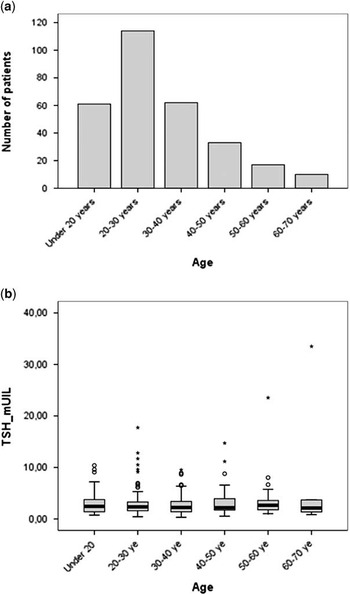
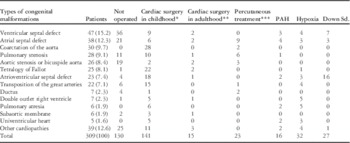
Of a total of 559 CHD patients followed up in our unit, 309 patients, of which 181 were male and 128 female, with ages ranging from 14 to 80 years (median 23.9 years) fulfilled the inclusion criteria. Table 1 shows the most frequent types of CHDs and the number of patients who did not undergo surgery, were operated in childhood or in adulthood, who underwent percutaneous treatment, and those with congenital heart abnormalities that had associated arterial hypoxaemia or Down syndrome. Of the CHD patients, 35 (11.3%) showed thyroid-stimulating hormone concentration above 5.5 mIU/L, and 9 of them (25.7%) had thyroid-stimulating hormone concentrations higher than 10 mIU/L. No significant differences were obtained in serum thyroid-stimulating hormone concentrations in the different subgroups of age (p=0.77) (Fig 1).
( a and b ) Histogram showing the distribution of congenital heart disease patients by different age groups. Box-and-whisker diagram showing the distribution of thyroid-stimulating hormone (TSH) concentrations in the different age groups of CHD patients.

Types of congenital abnormalities in CHD patients.

PAH=pulmonary arterial hypertension; Sd.=syndrome
* Childhood age group: birth to year 14
** Adulthood age group if older than 14 years old
*** Percutaneous treatment as the most important intervention in correcting the congenital heart defect. Other cardiopathies include the following CHDs: mitral valve prolapse or mitral regurgitation (five patients), Eibstein anomaly (4 patients), anomalous pulmonary venous connection (3 patients), tricuspid atresia (3 patients), aortic regurgitation (3 patients), truncus arteriosus (2 patients), hypertrophic cardiomiopathy (2 patients), and other different congenital heart abnormalities (17 patients). Within the group of CHD patients with associated hypoxemia, there were also, besides those included in the table, two patients with triscuspid atresia, one patient with Ebstein anomaly, and one patient with pulmonary arteriovenous fistulae. In the group of patients with atrioventricular septal defect, 11 were complete and 12 were partial. All patients with complete atrioventricular septal defect had Down syndrome, of whom three had associated hypoxemia. In the subgroup of patients with transposition of the great arteries, 14 had dextro- or d-looped transposition of the great arteries, and 8 had Levo- or l-looped transposition of the great arteries. Of the patients, three with dextro transposition of the great arteries and one patient with levo transposition of the great arteries had associated hypoxemia
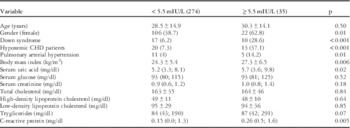
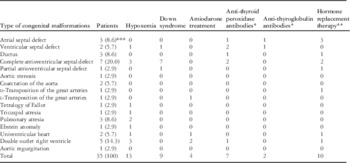
Table 2 shows demographic, clinical, and analytical data in CHD patients with thyroid-stimulating hormone levels below and above 5.5 mIU/L. Down syndrome and hypoxaemic CHD patients showed higher thyroid-stimulating hormone concentrations than the rest of the congenital patients (p<0.001). Table 3 shows CHD patients with subclinical hypothyroidism, specifying those who had associated hypoxaemia, Down syndrome, amiodarone treatment, or positive antibody titres. No statistical significances were observed between hypoxaemic and non-hypoxaemic CHD patients in relation to the number of patients under amiodarone treatment (p=0.57) or with Down syndrome (p=0.59). Of the 35 patients with subclinical hypothyroidism, 27 were followed up during a mean follow-up period of 2.4±1.2 years – 10 patients were under thyroid hormone replacement treatment, and 17 patients were not – and 8 patients were excluded from the follow-up – 2 patients died, 3 patients lived outside the island, and 3 patients did not give their consent to participate in the follow-up. Of the 17 patients with an initial thyroid-stimulating hormone concentration >5.5 mlU/L and without thyroxine treatment, 8 (47%) patients returned to normal thyroid-stimulating hormone values. However, among patients with an initial thyroid-stimulating hormone concentration above 10 mlU/L, none of them returned to normal levels.
Demographic data and laboratory test results from CHD patients with thyroid-stimulating hormone <5.5 mIU/L and <5.5 mIU/L.

Patients included in the statistical analysis had 30 or more years. Quantitative variables are expressed as mean±standard deviation or median and 5th and 95th (5; 95) percentiles; qualitative variables are expressed as percentages of total
Types of CHDs in CHD patients with thyroid-stimulating hormone concentration ⩾5.5 mIU/L.

* Number of patients with positive anti-thyroid peroxidase and/or anti-thyroglobulin antibodies. Antibody determination was performed in 27 of the 35 patients with subclinical hypothyroidism. Median and 5th and 95th (5; 95) percentiles of anti-thyroid peroxidase [1.4 (0.0; 720.3)] and anti-thyroglobulin [15.4 (0.0; 592.4)] antibody concentrations
** Patients under thyroid hormone replacement therapy (levothyroxine)
*** Only one patient with atrial septal defect developed subclinical hypothyroidism in relation to a previous treatment for hyperthyroidism
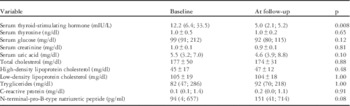
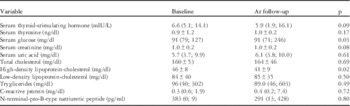
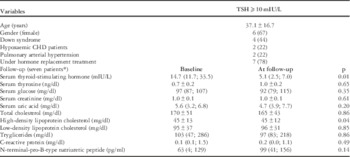
Tables 4 and 5 summarise laboratory test results from CHD patients, with and without thyroid hormone replacement therapy, respectively, at the beginning and at the end of the study. Table 6 shows the demographic and laboratory test results from the nine CHD patients with subclinical hypothyroidism and a thyroid-stimulating hormone ⩾10 mIU/L. None of the untreated patients developed signs of hypothyroidism during their follow-up, and none of the patients under thyroxine treatment developed adverse effects in relation to replacement therapy.
Laboratory test results from the 10 CHD patients with subclinical hypothyroidism and hormone replacement therapy.

Quantitative variables are expressed as mean±standard deviation or median and 5th and 95th (5; 95) percentiles; qualitative variables are expressed as percentages of total. Thyroid replacement therapy treatment with oral levothryoxine (66.6±38.6 µg every 24 hours)
Laboratory test results from the 17 CHD patients with subclinical hypothyroidism and no hormone replacement therapy.

Quantitative variables are expressed as mean±standard deviation or median and 5th and 95th (5; 95) percentiles; qualitative variables are expressed as percentages of total. Ten out of 17 (58.8%) CHD patients persisted with thyroid-stimulating hormone concentrations above 5.5 mIU/L at the end of the follow-up
Demographic and laboratory test results from the nine CHD patients with subclinical hypothyroidism and a TSH ⩾10 mIU/L.

TSH=thyroid-stimulating hormone
Quantitative variables are expressed as mean±standard deviation or median and 5th and 95th (5; 95) percentiles; qualitative variables are expressed as percentages of total
* Of the patients, two were lost in the follow-up: one due to death and another because the patient lived outside the island. None of them were under amiodarone treatment. Thyroid replacement therapy treatment with oral levothryoxine was of 73.0±12.4 µg every 24 hours. Mean follow-up of 2.2±0.9 years
Discussion
Mild thyroid failure is a common biochemical finding in 3–8% of the general population, although prevalence varies depending on the characteristics of the populations studied and the upper limit set for thyroid-stimulating hormone measurements. However, we can state that subclinical hypothyroidism is especially high in populations with high iodine intake, older age groups, women, and Caucasians.Reference Karmisholt, Andersen and Laurberg 6
The aetiology of subclinical hypothyroidism appears to be multifactorial, and autoimmune thyroiditis (Hashimoto’s disease) and previous treatment for hyperthyroidism with radioactive iodine or surgery appear among the most common causes. However, other abnormalities such as radiotherapy to the head or neck, obesity, amiodarone treatment, or the existence of pulmonary arterial hypertension may favour its appearance. In relation to the latest, a significant percentage of patients with pulmonary arterial hypertension have concomitant thyroid dysfunction,Reference Curnock, Dweik, Higgins, Saadi and Arroliga 7 suggesting, hypothetically, that these patients had at some time experienced an autoimmune thyroiditis with participation of the immune system in the pathogenesis of pulmonary arterial hypertension.Reference Bogaard, Al Husseini, Farkas, Farkas, Gomez-Arroyo, Abbate and Voelkel 8
Autoimmune thyroiditis causes cellular damage and alters thyroid gland function by humoral and cell-mediated mechanisms. In fact, two antibodies, anti-thyroid peroxidase and anti-thyroglobulin, are mainly involved in this autoimmune response, increasing their concentrations over the years and can be associated with non-thyroid illnesses such as type 1 diabetes, rheumatoid arthritis, Addison’s disease, pernicious anaemia, or when the patients have Down or Turner syndrome.Reference Franklyn 9 , Reference Selikowitz 10
It has been suggested that anti-thyroid peroxidase antibodies may be a risk factor for future thyroid dysfunction.Reference Martino, Bartalena and Bogazzi 11 In this context, previous studies have shown an annual progression rate of subclinical to overt hypothyroidism of 2.6% if thyroid antibodies were negative, but 4.3% if anti-thyroid peroxidase antibodies were present.Reference Vanderpump, Tunbridge and French 12 In our series, 7 of the 27 patients (25.9%) with subclinical hypothyroidism had positive anti-thyroid peroxidase, of whom 5 were under hormone replacement therapy, with no significant changes in thyroid-stimulating hormone concentrations during the follow-up, and 3 (42.8%) patients with positive anti-thyroid peroxidase had Down syndrome. Meanwhile, the remaining patients with Down syndrome had negative anti-thyroid peroxidase and anti-thyroglobulin antibodies. This may be because thyroid abnormalities in Down syndrome patients may be transient and related to inappropriate secretion of thyroid-stimulating hormone or thyroid insensitivity to thyroid-stimulating hormone, rather than to auto-immune thyroiditis.Reference Selikowitz 10
On the other hand, C-reactive protein is also known as a reliable marker of systemic inflammation and tissue damage. However, results of studies that investigated changes in C-reactive protein and thyroid dysfunction are contradictory. In this context, some authors have reported an increase in C-reactive protein concentrations in patients with subclinical hypothyroidism,Reference Tuzcu, Bahceci and Gokalp 13 as seen in our series, whereas other authors have found no changes compared with control groups.Reference Hueston, King and Geesey 14 Nonetheless, what we could state was that treatment with thyroxine did not have any effect on C-reactive protein concentrations.
With regard to hypoxaemia, the relationship between thyroid hormones and oxygen consumption has long been recognised. Moshang et al,Reference Moshang, Chance and Kaplan 15 for example, showed that children with chronic hypoxia resulted in low serum thyroxine. The conclusions, reached by the authors, were that in chronically hypoxic patients there was a more rapid degradation of thyroxine to reverse triiodothyronine that would stimulate in those patients with an intact neuroendocrine feedback mechanism, thyroid-stimulating hormone production. Moreover, these authors stated that, as triiodothyronine (T3) and reverse triiodothyronine are largely extrathyroidal, serum thyroid abnormalities during hypoxia would be most likely due to alterations in extrathyroidal hormone metabolism.
Thyroid hormone also has multiple effects on the regulation of lipid synthesis, absorption, and metabolism, although the results on lipid concentrations are contradictory. We have previously reported that CHD patients have lower plasma cholesterol concentrations than the non-congenital ones.Reference Martínez-Quintana, Rodríguez-González and Nieto-Lago 16 However, some studies have shown that subclinical hypothyroidism can potentially contribute to a pro-atherogenic lipid profile, with effects being greater at higher thyroid-stimulating hormone levels.Reference Ineck and Ng 17 On the contrary, other studies have not shown, as occurred in our series, any effect of subclinical hypothyroidism on these lipid measurements.Reference Hueston and Pearson 18 In relation to the benefit that entails treating subclinical hypothyroidism patients with synthetic thyroxine, Danese et al,Reference Danese, Ladenson and Meinert 19 after a quantitative review of the literature in patients with mild thyroid failure, suggested that thyroxine therapy in individuals with mild thyroid dysfunction lowered mean serum total and low-density lipoprotein cholesterol concentrations, with the reduction in serum total cholesterol being larger in those patients with higher pretreatment cholesterol levels. Similarly, Meier et alReference Meier, Staub and Roth 20 in a double-blind study showed that physiological levothyroxine replacement in patients with subclinical hypothyroidism had a beneficial effect on low-density lipoprotein cholesterol levels and clinical symptoms of hypothyroidism. However, Surks et alReference Surks, Ortiz and Daniels 21 in a scientific review considered that there was insufficient evidence to show benefits of levothyroxine therapy on lipid levels. In fact, clinical trials to date have not consistently shown a beneficial effect of levothyroxine treatment on serum lipid levels in subclinically hypothyroid patientsReference Pearce 22 as also seen in our CHD patients. On the other hand, no significant differences were obtained in glucose concentrations between those patients under levothyroxine treatment, and no significant worsening on glycaemic control was observed between those patients with no hormone replacement therapy. On the contrary, other authors have showed a significant worsening of glucose levels at the follow-up supporting the role of subclinical hypothyroidism in glucose regulation.Reference Bilic-komarica, Beciragic and Junuzovic 23
In conclusion, in CHD patients with subclinical hypothyroidism, most of whom had a thyroid-stimulating hormone concentration between 5 and 10 mIU/L, no changes were seen in serum thyroxine, glucose, cholesterol, or C-reactive protein concentrations before and after the follow-up regardless of whether they were or not under thyroid hormone replacement therapy. Although our small sample size, non-randomised design, can limit the result of our study we must consider a proper follow-up, especially in CHD patients with thyroid-stimulating hormone concentration above 10 mIU/L, with heart failure,Reference Rhee, Curhan and Alexander 24 or at an increased risk for cardiovascular events.
Acknowledgements
This manuscript has not been submitted for publication nor has it been published in whole or in part elsewhere. We attest to the fact that all authors listed on the title page have contributed significantly to the work, have read the manuscript, and attest to the validity and legitimacy of the data and its interpretation. The authors of this manuscript have also certified that they comply with the Principles of Ethical Publishing.
Fin ancial Support
This research received no specific grant from any funding agency, commercial, or not-for-profit sectors.
Conflicts of Interest
None.