




No CrossRef data available.
Article contents
Genetic and environmental influences on antisocial behavior and alcohol dependence from adolescence to early adulthood
Published online by Cambridge University Press: 01 December 2004
Abstract
Genetic and environmental influences on symptoms of adult antisocial behavior (AAB) and alcohol dependence at ages 17, 20, and 24 were examined cross-sectionally and longitudinally in 188 monozygotic and 101 dizygotic male twin pairs. A moderate genetic influence on both AAB and alcohol dependence was found at each age, with a substantial proportion of this influence common to the two disorders, suggesting they share susceptibility genes. Biometrical models showed that continuity effects accounted for most of the stable variance in symptoms of both AAB and alcohol dependence, indicating that genetic and environmental effects associated with each of these disorders were similar at each age. Significant cross-lag effects (effects of alcohol dependence contributing to variance in AAB and vice versa) were observed at ages 20 and 24 for both disorders. The largest and theoretically most interesting of these effects indicated that one sixth of the genetic influence on AAB at age 20 was due to genetic effects associated with alcohol dependence at age 17. Thus, alcohol dependence symptoms at age 17 in particular had an effect on antisocial behavior symptoms at age 20, suggesting that alcohol involvement in adolescence may ensnare otherwise desisting youth in persistent antisocial behavior.The present study was supported in part by grants from the National Institute of Drug Abuse (DA 05147) and the National Institute on Alcohol Abuse and Alcoholism (AA09367). We are grateful to a number of individuals for their assistance in coding and entering data that were not previously available. Our special thanks are due to Irene Elkins, Linda Springer, Kari Melchert, and Kristen Abernethy for their gracious and timely help.
Information
- Type
- Research Article
- Information
- Copyright
- © 2004 Cambridge University Press
The transition from adolescence to early adulthood is marked by changes in biological, environmental, and social domains. The degree of success with which these transitions are negotiated places some individuals on trajectories toward healthy adulthoods while placing others on trajectories marked by difficulties in adjustment and even psychopathology. Because of the many emerging demands and the multiple adjustments that must be made, it is not surprising that this developmental period is a risky one for the onset and persistence of several forms of psychopathology, including alcohol use disorders and antisocial behavior problems. Problems that continue through the young adult period are likely to reduce a person's chances for adaptive adult functioning, whereas those that are successfully avoided or are limited to the adolescent period may have less influence on a person's later adjustment. For this reason, factors affecting the onset and persistence of psychopathology during the transition from adolescence to early adulthood merit significant attention from researchers.
Antisocial behavior is distinctive in that it frequently begins at a relatively early age (e.g., Kim–Cohen, Caspi, Moffitt, Harrington, Milne, & Poulton, 2003) and it involves behavior that may be relatively normative at some points in development. Moffitt's (1993) taxonomy of antisocial behavior delineated two distinct types: adolescence limited (which both begins and desists during the adolescent period and may be relatively normative) and life-course persistent (which begins early in life, persists past adolescence, and is considered pathological). According to this theory, it is during the transition from adolescence to young adulthood that adolescence-limited youth should desist in their antisocial behavior (while the life-course persistent youth persist). Supporting this notion, White, Bates, and Buyske (2001) found that adolescence-limited delinquents, persistent (childhood onset) delinquents, and nondelinquents follow different trajectories of delinquency during the transition from adolescence to early adulthood. Moffitt specified, however, that substance dependence may act as a “snare” that maintains continuity in antisocial behavior past the end of adolescence, even for youth whose antisocial behavior emerges relatively late and who would otherwise have desisted.
Several recent studies support the idea that both childhood-onset and adolescent-onset delinquents are at high risk for substance dependence, both during adolescence and into early adulthood. For example, Loeber, Stouthamer–Loeber, and White (1999) found that persistent delinquency both in preadolescence (childhood-onset antisocial behavior) and in adolescence (adolescent-onset antisocial behavior) predicts persistent substance use during both developmental periods in boys. Taylor, Malone, Iacono, and McGue (2002) reported that both early-onset and adolescent-onset delinquent boys are prone to more rapid increases in alcohol problems during adolescence than are controls. In a study focusing specifically on the time period from adolescence through early adulthood, Moffitt, Caspi, Harrington, and Milne (2002) found that both childhood- and adolescent-onset antisocial behavior in males were associated with substance dependence during early adulthood (age 26). In addition, in a retrospective study of an adult sample, Ridenour, Cottler, Robins, Compton, Spitznagel, and Cunningham–Williams (2002) reported that alcohol and drug misuse during adolescence predicts antisocial behavior during adulthood, regardless of the history of antisocial behavior during childhood or adolescence. After controlling for several confounding variables, these researchers concluded that their results were consistent with the notion that adolescent alcohol and drug misuse plays a causal role in the development of adult antisocial behavior (AAB). Similarly, Hussong, Curran, Moffitt, and colleagues (cited in Curran & Hussong, 2003) found that the number of alcohol dependence symptoms significantly influenced growth curves in antisocial behavior in a sample of young men followed from 18 to 26 years of age. Thus, it seems reasonable to expect that substance use problems may influence whether an individual persists or desists in his or her antisocial behavior during the transition from adolescence to young adulthood, although important longitudinal work remains to be done to understand the causes of the relationship between these two types of problems during this developmental transition.
In addition to the possibility that substance use problems complicate the course of antisocial behavior, the two types of problems appear to have similar etiological influences. Although most examinations of the genetics of alcoholism have used adult samples (e.g., Kendler, Prescott, Neale, & Pedersen, 1997; McGue, 1999), findings from the Virginia Twin Study of Adolescent Behavioral Development (Maes et al., 1999) and the Minnesota Twin Family Study (MTFS; Han, McGue, & Iacono, 1999) suggest that alcohol use among adolescent boys and girls is strongly heritable, with a moderate shared environmental effect as well. Neither study examined alcohol use disorders, leaving unanswered questions about the influence of genetic and environmental factors on alcohol problems over time. Conduct disorder is also influenced by genetic factors (e.g., Slutske, Heath, Dinwiddie, Madden, Bucholz, Dunne, Statham, & Martin, 1997); this genetic influence on antisocial behavior increases from childhood through adulthood (Lyons, True, Eisen, Goldberg, Meyer, Faraone, Eaves, & Tsuang, 1995), and may be greater for early-onset delinquency, relative to later onset delinquency (Taylor, Iacono, & McGue, 2000). Shared environmental factors (i.e., those environmental factors that contribute to twin similarity) are also associated with childhood antisocial behavior disorders, accounting for 26–30% of the variance in them (Krueger, Hicks, Patrick, Carlson, Iacono, & McGue, 2002; Lyons et al., 1995).
Similar genetic and environmental factors may underlie both alcohol problems and antisocial behavior. In 1982, Cloninger, Sigvardsson, Bohman, and von Knorring reported that certain postnatal environmental variables predicted both antisocial behavior and alcoholism. More recently, Slutske, Heath, Dinwiddie, Madden, Bucholz, Dunne, Statham, and Martin (1998) found that the association between conduct disorder and alcohol dependence could be largely explained by genetic factors. In addition, recent research supports the notion that a genetically mediated general externalizing factor unites substance dependence and antisocial behavior, while both genetic and environmental factors account for differences in the specific type(s) of externalizing behavior (alcoholism, antisocial behavior, or other forms) exhibited by individuals (Krueger et al., 2002). Unfortunately, this research concerning the overlapping etiology of antisocial behavior problems and alcoholism has been cross-sectional and much of it has relied on retrospective reports. Further, although data suggest a connection in the etiology of antisocial behavior and alcohol dependence, the nature of the relationship between these types of problems has not been fully examined.
Various etiological models are viable for explaining the relations among antisocial behavior and alcohol dependence over time. Recent evidence suggests that alcohol dependence and antisocial behavior share significant genetic variance and may represent two psychopathological manifestations of an underlying dimension, or common factor, characterized by a lack of appropriate behavioral restraint (Krueger et al., 2002). These findings suggest that a common factor model is appropriate for characterizing alcohol dependence and antisocial behavior over time. Univariate factor models describing stability over time are often called simplex models (e.g., Hewitt, Eaves, Neale, & Meyer, 1988), and the common factor version of such models may be called simplex common factor models. This model presumes that antisocial behavior and alcohol dependence are associated because they reflect a common liability, represented as a factor and influenced by genes and environment. It is also stable over time, which accounts for stability in the individual disorders represented by the common factor. The common factor also mediates correlations between antisocial behavior and alcohol dependence, whether at a given time or across time. In addition, there may be specific genetic and environmental influences on each disorder independent of the common factor.
A second viable model is a cross-lag regression (or panel) model, which has been widely used in social science research. A cross-lag model suggests that etiological factors contribute to individual differences in each disorder across multiple points in development and allows for the possibility that etiological factors associated with one disorder are also associated with the other disorder (which contributes to any observed association between disorders). For example, genetic factors associated uniquely with antisocial behavior likely contribute to the maintenance of that behavior from adolescence to early adulthood. In addition, however, genetic factors associated uniquely with alcohol dependence may influence subsequent levels of antisocial behavior. Studies comparing etiological models would provide insights into the development and maintenance of antisocial behavior and alcohol dependence during adolescence and early adulthood.
We are unaware of any published research that addresses the potentially reciprocal etiological influences on antisocial behavior and alcohol problems during the transition from adolescence to early adulthood, including reciprocal genetic influences. This developmental period is likely to be crucial in setting the course for either the persistence of these problems into adulthood, or the desistence of these problems and the subsequent emergence of a healthy pathway into adult roles and responsibilities. Research using a prospective design to examine this issue is particularly useful because of the potential biases inherent in retrospective reporting. Further, a genetically informative design can be beneficial because both genetic and environmental factors are associated with individual differences in antisocial behavior and alcohol use problems as well as with the covariance of these problems. In fact, Waldman and Slutske (2000), in a recent review of research on comorbidity between antisocial behavior and alcoholism, pointed out that longitudinal twin studies on antisocial behavior and alcohol use disorders may help further clarify the causes of the association between these problems.
In light of these gaps in the literature, the purpose of the present study was to examine genetic and environmental contributions to both alcohol problems and antisocial behavior (and to their association) from late adolescence into early adulthood. With this rationale in mind, the present study addressed three interrelated questions: (a) To what extents do genes and environment influence individual differences in antisocial behavior problems and alcohol dependence during late adolescence and early adulthood? (b) How are the development and maintenance of antisocial behavior problems and alcohol dependence from adolescence through early adulthood affected by genetic and environmental factors? (c) How do genetic and environmental factors affect associations between one problem (e.g., alcohol dependence) in adolescence and the other problem (e.g., antisocial behavior) in early adulthood?
Data from the MTFS were used to address the aims of this investigation and offered several advantages. First, the MTFS is a community-based study of substance use disorders and related behaviors, thus providing data that are representative of the general population. Second, the MTFS is a longitudinal study with data from three time points spanning 7 years from late adolescence to early adulthood, thus allowing an examination of etiological effects on the development of antisocial behavior and alcohol dependence during this critical life transition. Third, the MTFS is a twin study, which provides genetically informative data, and is therefore specifically designed for answering questions regarding the relative influence of genes and environment on behavior. The availability of longitudinal data on twins allowed us to examine the relative influence of genetic and environmental factors on individual differences in alcohol dependence and antisocial behavior symptoms during the transitional period from adolescence to adulthood, something that has not been done previously. Fourth, alcohol dependence and antisocial behavior are commonly co-occurring problems that may share an etiology and the MTFS data set allowed us to compare different etiological models, providing novel insights into the nature of the relationship between alcohol dependence and antisocial behavior problems.
Based on previous research, we expected that genetic and nonshared environmental factors (that is, those environmental factors that contribute to twin differences) would be associated with variance in alcohol dependence and antisocial behavior symptoms during adolescence and early adulthood. Because genes appear to affect the covariation between alcohol problems and antisocial behavior (Krueger et al., 2002; Slutske et al., 1998), we expected genetic factors associated with antisocial behavior symptoms in adolescence to be associated with alcohol dependence symptoms in early adulthood, and genetic factors associated with alcohol dependence in adolescence to be associated with variance in antisocial behavior in early adulthood. Alcohol dependence and antisocial behavior problems, while correlated, show divergence in their relative prevalence during the transition from adolescence to early adulthood. That is, antisocial behavior is relatively common in adolescence and tends to desist in early adulthood, while alcohol problems are found at relatively low rates in adolescence and peak in early adulthood. This staggered relationship in the onset and course of these disorders suggests to us that a cross-lag model will likely better account for the data than a simplex model (which presumes a stable common factor underlying both disorders). Shared environmental factors were expected to account for variance in alcohol dependence and antisocial behavior symptoms in adolescence with a decreasing effect into early adulthood.
Method
Participants
Participants were the 578 reared-together adolescent male monozygotic (MZ) and dizygotic (DZ) twins making up the MTFS older male cohort. They were 16.5–18.5 years old (M = 17.5, SD = 0.4) at the intake assessment, referred to hereafter as the age-17 assessment for ease of exposition. The mean number of years of education in parents of these twins was 13.7 (SD = 2.2). Although female twins are included in the MTFS, their assessment cycle lags behind the males by approximately 3 years, and data were complete only on males for the assessment points included in this study. A comprehensive description of the MTFS recruitment for the adolescent male twin cohort can be found in Iacono, Carlson, Taylor, Elkins, and McGue (1999). Briefly, twins were ascertained through a search of birth records in Minnesota and were excluded from recruitment only if (a) they had a mental or physical handicap that would preclude the day-long assessment, (b) their family was not within driving distance to Minneapolis, or (c) they were adopted. The sample demographics (98% Caucasian) reflect those of Minnesota during the birth years sampled. Informed written consent was given by twins aged 18 and older and by parents for their own and for their minor child's participation in the study; twins under the age of 18 gave written assent to participate. Twins and their parents were paid for participation.
The first follow-up assessment occurred approximately 3 years after the intake assessment and the second follow-up occurred approximately 7 years afterward. Participants ranged in age from 19.5 to 22.5 years (M = 20.7, SD = 0.5) at the first follow-up and 22.6 to 29.1 years of age (M = 24.2, SD = 1.0) at the second. Although there was inevitably greater variability in assessment age for the two follow-up assessments, at least 75% of individuals were assessed within 1 year of the target age. We therefore refer to the follow-up assessments as the age-20 and age-24 assessments, respectively.1
By design, twins visited together at the age-17 assessment, when they were still in high school and living at home. Although this was not necessarily true at the follow-up visits, twin pairs were nevertheless highly likely either to visit together or within 0.5 years of each other, and MZ and DZ twins were identical in this respect. At the age-20 assessment, more than 80% of all twins visited contemporaneously and 95% visited within 0.5 years of each other, regardless of zygosity; at the age-24 assessment, approximately 60% of all twins visited at the same time and 84% of MZ twins and 90% of DZ twins visited within 0.5 years of each other.
Twin participation rates
The sample for the present analysis consisted of 289 twin pairs (188 MZ). Of the 289 pairs, 251 twin pairs (162 MZ) had age-20 data (21 of those pairs were unmatched, with data available for just one member of the pair), and 264 (170 MZ) twin pairs had age-24 data (33 of them unmatched). MZ and DZ twins were equally likely to complete all three assessments, with approximately 75% of the participants in each zygosity group having complete data. Analytic techniques that allow the use of all available data (including those from unmatched twins) were used to minimize bias in parameter estimates, and to maximize power by not excluding entire twin pairs when data were available for one member of the pair.
Determination of zygosity
Following a procedure outlined by Lykken (1978) for accurately determining zygosity, the following three methods were used in the MTFS to establish zygosity: (a) parents completed a zygosity questionnaire regarding the twins' physical similarity and the frequency with which people confused them, (b) staff rated the zygosity of the twins based on various points of physical similarity (e.g., eye color and ear shape), and (c) zygosity was determined using an algorithm based on ponderal index (height divided by the cube root of weight), cephalic index (head breadth divided by length), and fingerprint ridge count. The use of questionnaires to determine zygosity is common, and such methods have shown classification accuracy rates of 96–98% (Peeters, Van Gestel, Vlietinck, Derom, & Derom, 1998). Moreover, serological analysis on 50 adolescent pairs who showed agreement across the three methods validated this method in the MTFS, confirming zygosity in every case. Any discrepancy among the three methods for MTFS twins is resolved through a serological analysis of 12 blood group antigens and protein polymorphisms.
Measures
The focus of the present study was on continuity and change in antisocial behavior and alcohol dependence from adolescence to young adulthood. Antisocial behavior was operationalized as a disorder comprising the AAB symptoms of the antisocial personality disorder (ASPD) criteria, because the AAB portion of the ASPD diagnosis is the only portion that can change or continue into adulthood. The decision to focus on AAB is supported by research showing marked similarity between adults diagnosed with ASPD and those with AAB with respect to rates of comorbid psychopathology (Cottler, Price, Compton, & Mager, 1995) and to occupational attainment and personality trait profiles (Elkins, Iacono, Doyle, & McGue, 1997).
The DSM-III-R was the standard diagnostic system at the time of the age-17 assessment and was used again at the age-20 and age-24 assessments for continuity in measurement, which is essential for assessing growth or change. ASPD (conduct disorder and AAB) was assessed with the Structured Clinical Interview for DSM-III-R personality disorders (SCID-II; Spitzer, Williams, Gibbon, & First, 1987), with added probes for obtaining additional details relevant to the symptom questions. The expanded substance abuse module (SAM; Robins, Babor, & Cottler, 1987) for the Composite International Diagnostic Interview (Robins et al., 1988) was used to assess criteria for alcohol abuse and dependence at each age. The SAM was modified slightly to include items related to quantity and frequency of substance use. All interview data were based on participant self-report.
At age 17, lifetime criteria of AAB and alcohol dependence were assessed. Different time periods were covered by the AAB and alcohol dependence assessments at the age-20 and age-24 assessments. Nevertheless, it was possible to use information provided by participants regarding symptom onset and offset to establish, for each follow-up assessment, which symptoms were new or ongoing and which had desisted. However, for 46 participants, information on ages of onset and offset was missing and could not be used to determine continuity and desistence of these symptoms. Symptom counts for these relatively few participants were lifetime totals.2
In supplemental analyses, we treated these data as missing for the follow-up assessments and repeated all analyses. The results were highly similar to those reported in the text; estimates of twin correlations, the pattern of phenotypic correlations, heritability of symptom totals, and path coefficients in the biometric models were minimally affected. Intraclass correlations for AAB symptoms showed less influence of shared environment, in that the DZ correlation was close to half the MZ correlation, and the effect of alcohol at age 20 on AAB at age 24 and the nonshared environmental correlation at age 24 in the cross-lag model were somewhat less in magnitude.
After the interviews, a team of at least two advanced graduate students trained in descriptive psychopathology considered all clinical data from the interviews and assigned symptoms of disorders based on consensus of the team. Teams worked without any prior knowledge of the participant or of the diagnostic status of the participant's twin. Symptoms were entered into a database by two different individuals and any discrepancies resolved to ensure the accuracy of the data. Computer algorithms were used to compute diagnoses based on the symptoms entered for each disorder, and the consensus procedure produced diagnostic reliability coefficients (kappa) of .75 or greater for AAB and alcohol use disorders. The phenotypic variables for the present study were the symptom counts for AAB and alcohol dependence. We specifically excluded from the AAB total the symptom reckless disregard for safety, which can be assigned based on repeated drinking and driving (an alcohol use disorder symptom) to minimize overlap between disorders. Although categorical diagnoses provide perhaps an optimal level of analysis because of their clinical relevance, rates of AAB and alcohol dependence diagnoses were low at the age-17 assessment and clinically significant problems with alcohol and antisocial behavior were better captured with a symptom count. In addition, biometrical analyses of dichotomous data (such as diagnoses) have less power than those of continuous data (such as symptom counts), a significant consideration given the complexity of the longitudinal models to be fitted. Finally, the analyses required a consistent metric, and symptom counts provided the best information across the assessment ages for this investigation.
As indicated above, we recoded as absent those symptoms that the participant reported had desisted prior to the previous assessment. Hence, symptom counts were for the participant's lifetime at the age-17 assessment but for the preceding 3 and 4 years, respectively, for the age-20 and age-24 assessments. Although the vast majority of participants had complete data for a given assessment, some data were missing for a minority, who comprised two distinct groups: those missing one or two answers to symptom questions and those missing most or all data. We therefore prorated symptom counts for those missing one or two answers, and treated as missing counts for participants with more than two answers missing. The SAM and ASPD interview items were coded present versus absent; frequency information was gathered as needed to code an item but was not systematically recorded by interviewers. The present study therefore used unweighted symptom counts representing the dimension of symptoms that would underlie a clinical diagnostic decision when coupled with other necessary criteria (such as duration).
Analyses
Twin correlations
Twin data provide an estimate of the magnitude of additive genetic, shared environmental, and nonshared environmental effects associated with the variance in an observed variable. Phenotypic similarity between family members results from additive genetic and shared environmental influences, whereas phenotypic differences result from nonshared environmental influences. Measurement error, by definition, is uncorrelated across subjects. It is therefore necessarily included in nonshared environment, which comprises everything that makes twins dissimilar.
Intraclass correlations, commonly used to estimate twin similarity, were computed separately for MZ and DZ twins for AAB and alcohol dependence symptom counts at each assessment. Comparing MZ and DZ correlations yields a rough estimate of genetic and environmental influence. Genetic influence is indicated when the magnitude of the MZ intraclass correlation exceeds the magnitude of the DZ correlation. Shared environmental influence is indicated when the DZ correlation is greater than half the magnitude of the MZ correlation, which is the expected correlation if additive genes are the only source of twin similarity. That our design included two variables additionally allowed us to estimate cross-twin, cross-trait correlations, which quantify the association of the score on one variable for twin A with the score on the second variable for twin B (and vice versa), thus giving an indication of the genetic and environmental influence associated with the covariance of the disorders. The cross-twin cross-trait correlations are interpreted like intraclass correlations by comparing the magnitude of the MZ correlation to the DZ correlation (e.g., greater MZ than DZ cross-twin cross-trait correlation indicates genetic influence on the covariance between variables). Within-person (Pearson) correlations between AAB and alcohol dependence symptom counts were also estimated at each assessment and across assessments to index phenotypic association between variables within each assessment and across assessments.
Because not all participants completed all assessments, we computed intraclass correlations by means of two multilevel models, which use all available data, with AAB symptoms and alcohol dependence symptoms serving as the respective dependent measures. Individuals were treated as nested within twin pairs. Such models permit variance in the dependent measure to be decomposed into different sources. We derived estimates of among-twin pair variance in each dependent measure as well as of total variance. Because assessment wave (ages 17, 20, or 24) was included as an independent variable, intraclass correlations derived from these variance components were adjusted for age differences in mean numbers of AAB and alcohol dependence symptoms. Pearson correlations were estimated using PROC MI in SAS/STAT® software (Version 8.2) of the SAS System for Windows (SAS Institute Inc., 2001), employing a Markov chain Monte Carlo method for multiple imputation, which is most appropriate when patterns of missing data are arbitrary. Correlations derived in this manner were averaged across 10 imputations, separately for each zygosity group.
Univariate biometrical models
Biometrical models were fit to the raw data using full information maximum likelihood as implemented in the Mx software program for Windows (Neale, Xie, & Boker, 1998), which allowed for all available data to be included in the analyses. We first fit univariate models to the AAB and alcohol dependence symptom count data separately using a Cholesky (or triangular) decomposition to estimate symptom variances at each assessment (17, 20, and 24) and their covariances over time. The univariate biometrical model decomposes the total variance in a variable into components associated with additive genetic factors (A) and shared (C) and nonshared environmental (E) factors:

Because MZ twins are genetically identical, whereas DZ twins share half of their segregating genes, on average, expected covariances in the biometrical models are as follows:

Fitting models to raw data minimizes minus twice the log-likelihood (−2LL) of the model. Unlike fitting covariance matrices, this does not yield a chi-square goodness of fit statistic. However, the difference in log likelihoods between nested models is distributed as a chi square, and the relative fit of the two models can be tested by comparing it to the chi-square distribution with degrees of freedom equal to the difference between models in the number of parameters estimated. A nonsignificant chi-square difference indicates that the reduced model may be accepted over the full model without a substantial loss of fit. In addition, the Bayesian Information Criterion (BIC; Schwartz, 1978) can also be used to assess the relative fit of models, whether nested or not (Raftery, 1995). The BIC balances model fit with parsimony, with smaller values indicating better model fit. A difference of 10 between models indicates that the posterior odds are 150:1 in favor of the model with the smaller value being correct and is considered strong evidence in favor of it (Raftery, 1995). We used Draper's (1995) formula for BIC, which includes a correction term that can be important in samples of finite size.
Longitudinal biometrical models
To the extent that there are specific effects of one disorder on the other at the subsequent time point, a cross-lag regression model is reasonable to account for patterns of influence of each disorder on itself and on the other over time. This model expresses the data from the three assessments in terms of both latent and observed relations. The observed relations consist of regression parameters predicting symptom levels at age 20 from symptoms at age 17 and predicting symptom levels at age 24 from symptoms at age 20. These include autoregressive effects of a disorder on itself (e.g., the effects of AAB at age 17 on AAB at age 20) as well as cross-lag effects (e.g., effects of AAB at age 17 on alcohol dependence at age 20) and effects that are common to the two disorders. The latent relations consist of the effects of genetic and environmental factors on the observed disorders. At age 17, the initial assessment, these influences account for all of the variance in each disorder. At each follow-up assessment (age 20 and age 24), some of the variance in a given disorder is due to the person's previous state, that is, influences from the previous age affecting the person's current psychopathology through the regression effects. In addition, there are new sources of genetic and environmental influence, often called innovations, on the disorders at age 20 and 24.
The findings of Krueger et al. (2002) and similar findings of Young, Stallings, Corley, Krauter, and Hewitt (2000) suggest that a common vulnerability underlies AAB and alcohol dependence (as well as other similar characteristics). Thus, an alternative model for capturing the within- and cross-disorder associations over time would treat antisocial behavior and alcohol dependence as indicators of a common underlying factor, and this common factor is likely to be relatively stable over time. In such a model, effects of one disorder at a given time on another at a subsequent time are be mediated by continuity in the underlying factor. For example, AAB at 17 would be associated with alcohol dependence at 20 because they share variance at each time point but only if this shared variance, modeled as a common factor, is at least somewhat stable over time. We therefore fit a simplex common factor model. Because the sample is genetically informative, variance can be further decomposed into genetic and environmental sources, which can be partitioned into those that influence the common factor at each time point and those that have specific influence on each symptom total at a given time.
Results
Patterns of available data
Four hundred thirty-eight participants completed all three assessments; 43 completed the age-17 and age-20 assessments only; 57 completed the age-17 and age-24 assessments only; and 40 completed only the age-17 assessment. As one might expect, participants who completed all three assessments had fewer symptoms of both disorders, on average, than those with incomplete data. To assess bias attributable to selective attrition, we conducted a mixed-effects analysis of variance (ANOVA) for each dependent variable. Because both the alcohol dependence and AAB symptom counts were positively skewed, each was transformed (natural log[x + 1]) prior to these and all other analyses. Participation group was the independent variable and comprised four levels: those completing only the age-17 assessment; those completing the age-17 and age-20 assessments; those completing the age-17 and age-24 assessments; and those completing all three assessments. To accommodate having twins in the sample, individuals were treated as nested within twin pair. The mean number of symptoms of AAB at age 17 significantly varied among groups, F (3, 45) = 2.82, p = .050. There was a tendency for individuals completing two assessments, whether the first two, F (1, 45) = 4.84, p = .033, or the first and third, F (1, 45) = 4.00, p = .052, to have a greater mean number of AAB symptoms at age 17 than those completing all three assessments. However, those participants completing only the age-17 assessment, who might have been expected to be highest on measures of psychopathology, had the smallest mean total for AAB. The mean number of alcohol dependence symptoms did not significantly vary among participation groups, F (3, 43) = 1.40, p > .25. These analyses suggest that bias due to selective attrition was unsystematic and that participation patterns were not predictably related to the measures under study. The data can therefore reasonably be treated as missing at random (Little & Rubin, 1987).
Mean number of alcohol dependence and antisocial behavior symptoms over time
Our biometric longitudinal models are based on decomposing variances and covariances and thus on individual differences. To examine change in mean number of symptoms, we conducted two mixed-effects ANOVAs. The mean number of AAB and alcohol dependence symptoms served as dependent variables and assessment (age 17, age 20, or age 24), the independent variable. We included two random effects to accommodate having twins in the sample, treating assessments as nested within individual and individual as nested within twin pair.
The means for AAB and alcohol dependence from the multilevel model are presented in Figure 1. Results indicated that there were significant (p < .001) age-related differences in the mean number of symptoms of each disorder, F (3, 502) = 105.24 and F (3, 510) = 199.77 for AAB and alcohol dependence, respectively. However, the pattern of change differed between disorders. Symptoms of alcohol dependence increased significantly between the age-17 and age-20 assessments, F (1, 510) = 154.03, p < .001, but leveled off somewhat thereafter, with a small and nonsignificant increase in symptoms between age 20 and age 24, F (1, 510) = 1.32, ns. Mean number of AAB symptoms also increased significantly between age 17 and age 20, F (1, 502) = 13.44, p < .001, but declined significantly from the age-20 to the age-24 assessment, F (1, 502) = 31.19, p < .001, to a level significantly lower than it had been at the age-17 assessment, F (1, 502) = 4.71, p = .030.

The mean number of (log-transformed) symptoms of antisocial behavior (AAB) and alcohol dependence at each of the three assessments, with standard errors derived from multilevel models to account for the presence of related individuals in the sample.
Equal environments assumption
A major assumption of twin research is that MZ and DZ twins are treated similarly within the environment. Thus, it is assumed that greater similarity of MZ twins relative to DZ twins with respect to an observed characteristic owes to greater genetic similarity rather than greater similarity in the environment. When this assumption is violated, mean and variance differences between MZ and DZ twins may exist. Differences between MZ and DZ twins in exposure to environmental challenges and opportunities may lead to differences in overall levels of an observed phenotype, and to the extent that DZ twins are treated differently within the environment (in ways that are pertinent to the phenotype), then phenotypic variance will be greater for DZ than for MZ twins. In fact, DZ twins tended to have somewhat greater means and standard deviations than MZ twins. We therefore assessed whether means and variances differed significantly between MZ and DZ twins for AAB and alcohol dependence together, in a kind of omnibus test. We first fit a model constraining MZ and DZ means to be equal followed by a model that constrained variances to be equal. Both constrained models yielded BIC values that were substantially smaller (20–30 units) than the BIC value from a model in which means and variances were freely estimated. The superior overall fit of the constrained models indicates that MZ and DZ means and variances were not significantly different and provides support for the equal environments assumption. This conclusion is consistent with other reports on the validity of the equal environments assumption for alcohol use disorders in men, where specific factors such as perceived zygosity (LaBuda, Svikis, & Pickens, 1997) and physical and emotional closeness (Xian, Scherrer, Eisen, True, Heath, Goldberg, Lyons, & Tsuang, 2000) have been assessed, as well as with findings concerning the validity of the equal environments assumption in general (Kendler, Neale, Kessler, Heath, & Eaves, 1993; Plomin, Willerman, & Loehlin, 1976).
Twin correlations
The within-person correlation between the AAB and alcohol dependence symptom counts was .44 at age 17, .45 at age 20, and .32 at age 24 in the entire sample (independent of zygosity). Table 1 presents the within-person, twin intraclass, and cross-twin correlations sepa-rately by zygosity for the alcohol dependence and AAB symptom counts at each assessment. “Stability correlations” (correlations of a variable with itself over time) were generally moderate in magnitude for both AAB and alcohol dependence, ranging from .29 to .62. Cross-twin correlations, whether within-trait (i.e., intraclass correlations, given on the main diagonal in the lower panel of Table 1) or cross-trait correlations, were almost uniformly greater for MZ twins compared to DZ twins, indicating the importance of genetic effects on each disorder separately and on the covariation between them, both cross-sectionally and over time.
Within-person, intraclass, cross-twin, and cross-trait correlations for AAB and alcohol dependence symptom counts by zygosity

Univariate biometrical models
We fit models for each phenotype using a Cholesky decomposition of data from all three assessments. Using all available data avoids bias due to changes in the exact makeup of the sample at each assessment. For each phenotype we fit a baseline model, which estimated all means, variances, and covariances, separately by zygosity group. This model fully reproduces the data, providing a standard against which the biometric models can be compared. We then fit a model containing A, C, and E (the full ACE model), followed by reduced models (AE, CE, and E). Because all data were used in fitting the models, all such models were for the three ages considered jointly. For instance, the AE model tested the significance of C for all three ages simultaneously. Tables 2 and 3 present the results of fitting these models. As indicated in Table 2, the ACE model was a reasonable fit to the data for both phenotypes, yielding values of BIC more than 50 units smaller than the baseline model (1840.1 compared to 1893.8 for AAB and 2637.2 compared to 2695.9 for alcohol dependence). For both AAB and alcohol dependence, the AE reduced model could be accepted over the full (ACE) model by virtue of the nonsignificant change in chi square for this model relative to the full model and by its smaller BIC values, which yielded strong evidence in favor of the AE model.3
Tests of the significance of A and C at each age corroborated these “omnibus” tests of the significance of each factor at all three ages jointly. All specific genetic influences were significant (p < .01), whereas none of the specific shared environmental influences was significant (p > .15).
Results of univariate biometric models of adult antisocial behavior and alcohol dependence symptom counts

Estimates of latent factor influences on adult antisocial behavior and alcohol dependence at ages 17, 20, and 24

Table 3 presents parameter estimates and confidence intervals around them for the ACE and best-fitting reduced models. For both disorders, ACE models indicated moderate genetic influence. There was a decline in the magnitude of shared environmental influence on alcohol dependence over time and a small influence of shared environment on AAB, which was greater in magnitude at the follow-up assessments. Nevertheless, confidence intervals around parameter estimates of C included zero in all cases, indicating that this parameter was not significant in any of the models and could be dropped. These results were consistent with the pattern of twin correlations, which suggested moderate genetic influence and relatively little effect of C overall. Between one third and nearly two thirds of the variance in AAB and alcohol dependence symptoms was associated with additive genetic factors in the AE models.
Longitudinal biometrical models
Before fitting longitudinal biometrical models, we again fit a baseline model that estimated means and covariances of all variables at all assessments, separately by zygosity group. This yielded a value of −2LL of 3914.1 on 2883 df and a BIC value of 4603.2 (again using Draper's formula). Because our univariate analyses indicated that A and E were the significant influences on both phenotypes, we included only these latent factors in the longitudinal models to simplify presentation and interpretation of the results.
Simplex common factor model
The fit of this model was clearly superior to the baseline model by BIC, yielding a value more than 240 units smaller than that of the baseline model (4359.5 compared to 4603.2). We tested the significance of each parameter in the model by constraining it to zero. Because each such constraint constitutes a reduced model nested within the freely estimated model, its significance can be assessed by means of a likelihood-ratio test and by differences in the BIC. All parameters were significant except two: the specific genetic influence on AAB at age 17 and age 20. Constraining each to zero resulted in nonsignificant likelihood-ratio tests (p > .10) and smaller values of the BIC. Parameter estimates for this model, all of which are standardized, are presented in Figure 2. Significant influences are drawn in black, and the two nonsignificant influences are shown by dashed gray lines.

The standardized path coefficients for the simplex common factor model. The common factor is represented as F17, F20, and F24. Stability over time is due to autoregressive effects of the factor on itself, represented as b1 and b2. Standardized loadings of each phenotype on the common factor are represented by λ1 to λ6. Squaring each loading gives the proportion of variance in the phenotype accounted for by the common factor. The upper portion of the figure illustrates the genetic (A) and environmental (E) influences on the common factor. The bottom portion of the figure illustrates specific A and E influences on each phenotype at a given age. Standardized variance components associated with each appear below the circles representing the specific latent factors; the double-headed circular arrows represent these variances, which give the proportion of variance in the phenotype associated with specific A or E influence. The specific factors represented by grey dashed arrows were not significant.
As Figure 2 illustrates, the common factor was exceptionally stable over time. It was also highly heritable. Squaring the path coefficient from A to the relevant factor gives the factor's heritability, which was thus .90 (.952) at age 17 and .81 at ages 20 and 24. Standardized loadings of AAB symptoms on the common factor were relatively constant across assessment ages. Loadings of alcohol symptoms were constant at 17 and 20 but smaller in magnitude at 24. Squaring these loadings gives the proportion of variance in the phenotype accounted for by the common factor. Whereas the common factor accounted for approximately 45% of the variance in alcohol dependence symptoms at ages 17 and 20 (.662 and .672, respectively), it accounted for only 27% of the variance in alcohol dependence at age 24. Specific genetic variance in alcohol dependence symptoms was constant across age. Specific nonshared environmental influence on alcohol dependence symptoms, however, was substantially greater at age 24 than at the previous two ages, accounting for fully half the total variance. Specific genetic variance in AAB symptoms was significant, albeit modest, only at age 24.
Cross-lag biometrical model
The fit of this model was also superior to that of the baseline model, yielding a value of BIC that was 319 units smaller than that of the baseline model (4284.2 compared to 4603.2). The cross-lag model also fit better than the simplex model (ΔBIC = −75.3).4
One might wish to allow the specific A and E influences to be correlated with themselves over time. This would be analogous to specifying a model with an AAB factor and an alcohol dependence factor, representing stable genetic and environmental influences specific to each phenotype, in addition to a common factor, which represents influences common to both. This was not possible for the present model, however, because there would be too many unknown parameters to estimate.

The standardized path coefficients from the best-fitting cross-lag model. The left side of the model presents the magnitude of the latent effects of additive genetic (A) and nonshared environmental (E) influences on adult antisocial behavior (AAB) and alcohol dependence (Alc) at age 17. The curved solid arrows show the correlated A effects (the shared variance in A effects on both disorders, e.g., rA17) and correlated nonshared E effects (the shared variance in nonshared E effects on both disorders, e.g., rE20) at each age (at ages 20 and 24, those correlations are between new effects of A or E on the phenotypes). The center of the model presents the magnitude of new effects at age 20 on each disorder (e.g., paths a3, e3, etc.) and the right side of the model presents such effects at age 24. The center of the model also presents the cross-lag and continuity regression paths, both from age 17 to 20 and from 20 to 24. For example, the variance in AAB at age 20 is decomposed in the model into that portion of variance associated with latent variable effects (A and E) on AAB at age 17 (path b11), effects on Alc at 17 (path b12), and new effects on AAB at age 20 (paths a3 and e3). Similar crosslag and continuity paths connect the disorders at age 24 to influences from earlier ages. Dashed grey arrows represent paths with nonsignificant coefficients.
The left side of Figure 3 presents the effects of A and E on each disorder at age 17 as well as the association between latent variables across disorders. The genetic effects on both disorders (paths a1 and a2) were substantial at age 17 as was the correlation between them (rA17 = .90). Squaring the regression paths of the latent genetic factors on each phenotype at age 17 gives an estimate of heritability (e.g., the heritability of AAB symptom totals at age 17 is 0.612 = 0.38).
Variance in AAB and alcohol dependence symptoms at age 20 is accounted for in part by three sources of continuing influence: stability in each disorder between age 17 and age 20, the effects of one disorder on the other across time (the cross-lag effects), and the common effects associated with both disorders at age 17. In addition, there are new effects, or influences not present at 17. Autoregressive, or stability, effects were moderate for AAB (b11 = .40) and alcohol dependence (b22 = .46). Squaring the standardized regression coefficients yields the proportion of variance accounted for by each path. Therefore, 16% (.402) and 21% (.462) of the total variance in AAB and alcohol dependence, respectively, was stable between age 17 and 20. As one would expect, the cross-lag effects were substantially smaller in magnitude. However, alcohol dependence at 17 accounted for approximately 5% of the total variance in AAB symptoms at age 20, net AAB's effect on itself over time (the autoregressive effect, b11). The third source of continuing influence on each phenotype, which is variance attributable to common effects at age 17, can be derived by means of the product of the two regression paths pointing to the phenotype at age 20 and twice the correlation between them at age 17. Hence, approximately 8% of the phenotypic variance in AAB symptoms at age 20 (0.40 × 0.22 × 2 × 0.44) and 4.5% of the variance in alcohol dependence symptoms at age 20 (0.46 × 0.11 × 2 × 0.44) is due to common age-17 influences.
Innovation variance in the phenotypes at age 20, or individual differences in new influences on them, can be decomposed into genetic and environmental components. The correlation between genetic innovations on the two phenotypes was modest (rA20 = .40). Nevertheless, this correlation was significant, which indicates that there was important overlap between new genetic influences on the two disorders. The correlation between environmental innovations was smaller still (rE20 = .23) but also significant, suggesting that there was a modest association between new nonshared environmental factors contributing to the correlation between AAB and alcohol dependence at age 20.
The right-hand side of Figure 3 shows the effects contributing to variance in alcohol dependence and AAB symptoms at the age-24 assessment. Autoregressive effects (paths c11 and c22) were larger in magnitude than the corresponding paths between age 17 and 20. Twenty-six to 30% of the total variance in alcohol dependence and AAB, respectively, was stable between 20 and 24. The cross-lag effects of AAB on alcohol dependence from 20 to 24 were similar in magnitude to those from 17 to 20, indicating that the effects associated with AAB that influence alcohol dependence symptoms over time remain relatively stable in magnitude. The cross-lag effect of alcohol dependence at 20 on AAB at 24, on the other hand, was less than half as large (c12 = .10) as the corresponding effect from 17 to 20 (b12 = .22). Approximately 5% percent of the variance in symptoms of each disorder at age 24 was due to age-20 influences common to the two phenotypes (0.55 × 0.10 × 2 × 0.45 = 0.050 for AAB symptoms and 0.51 × 0.10 × 2 × 0.45 = 0.046 for alcohol dependence symptoms). The correlation between genetic innovations on the two disorders was not significant at age 24, indicating that there are no new genetic influences on the covariation between alcohol dependence and AAB symptoms at age 24. Whatever overlap in genetic influences on the two disorders exists at age 24, therefore, must be wholly due to earlier genetic influences. The nonshared environmental correlation was marginally significant, suggesting slight overlap between environmental factors influencing the two disorders.
Etiological factors affecting change and continuity
The value of the biometric cross-lag model is its ability to determine the magnitude of etiological factors affecting change and continuity in a disorder, which is made possible by virtue of having a genetically informative sample. The cross-lag model represents each disorder at the follow-up assessments in terms of effects of variables “upstream” from it, with the causal influences of these upstream effects carried by the regression paths connecting variables, as well as new influences (innovations). We decomposed significant effects in the cross-lag model into additive genetic (A) and nonshared environmental (E) components, separately for the age-20 and age-24 assessments.
For both AAB and alcohol dependence, the majority of genetic variance at age 20 was due to new influences (genetic innovations), which accounted for 59 and 50% of the total age-20 genetic variance, respectively. The causes of stability in genetic variance (variance due to age-17 influences) differed between phenotypes. For alcohol dependence, stability was due primarily to genetic effects specific to alcohol dependence, which accounted for 29% of the total age-20 genetic variance. The remaining genetic variance was due to genetic influences common to the two phenotypes (10%) and to genetic effects on AAB at age 17 (1%). For AAB symptoms, on the other hand, stability was due primarily to genetic influences common to the two phenotypes at age 17, which accounted for 19% of the total genetic variance. Fifteen percent of the genetic variance in AAB symptoms at age 20 was due to genetic effects associated with AAB at age 17 and 7% was due to genetic influences on alcohol symptoms at age 17. Thus, approximately one-sixth of the stable genetic variance in AAB symptoms at age 20 (7%/41%) was due to earlier genetic influences on alcohol symptoms.
The vast majority of environmental variance in the two phenotypes at age 20 (80 and 85% for AAB and alcohol dependence, respectively) was accounted for by new influences (environmental innovations). A small proportion of variance in each phenotype was due to earlier influences of the other phenotype (3 and 1% for AAB and alcohol dependence, respectively). Because there was no common environmental variance at age 17, the remaining stable variance was disorder-specific; 17% of the total age-20 environmental variance in AAB symptoms and 14% of the variance in alcohol dependence symptoms, respectively, was due to earlier influences specific to each phenotype.
Decompositions of the age-24 genetic and environmental variance yielded very similar results for the two phenotypes. For both, the vast majority of stable variance was due to disorder-specific influences, which accounted for 38 and 40% of the total age-24 genetic variance in AAB and alcohol dependence symptoms, respectively, and 20 and 26% of the total age-24 environmental variance in the two phenotypes. A smaller proportion was due to effects common to the two phenotypes at age 20, which accounted for 9 and 10% of the genetic variance and 3 and 2% of the environmental variance in AAB and alcohol dependence, respectively. One percent of both the genetic and environmental variance in each disorder was due to age-20 influences. Approximately half the total age-24 genetic variance in each disorder was due to new genetic influences, whereas 70 (AAB) and 77% (alcohol dependence) of the age-24 environmental variance was due to new environmental influences. These results thus paralleled those describing relations between age 17 and age 20, yielding evidence of substantial stability in genetic and environmental effects on each disorder as well as new genetic and environmental influences. Stability effects were somewhat greater and cross-lag effects somewhat smaller than for the relations between age-17 and age-20 assessments.
Discussion
The period from late adolescence through early adulthood represents a particularly important time in a young person's life. Successfully negotiating this developmental transition may place some individuals on trajectories toward healthy adulthoods, while difficulties adapting to changing demands may place others on trajectories toward adulthoods marked by troubled adjustment, including psychopathology. Previous research has made clear that the transition from adolescence to early adulthood represents a high-risk period for the development or persistence of alcohol problems and antisocial behavior. The purpose of the present study was to examine genetic and environmental influences on the continuity and change in antisocial behavior and alcohol dependence problems during this particularly important developmental transition.
Similar etiological influences on antisocial behavior and alcohol dependence
As expected, there was significant genetic influence on both antisocial behavior and alcohol dependence throughout the time from late adolescence (age 17) to early adulthood (age 24). Although shared environmental influence could not be completely ruled out, estimates of the magnitude of these influences were nonsignificant, indicating that the important environmental influence on these disorders during the transition period from adolescence to adulthood are those that make twins dissimilar. Contrary to expectation, the magnitude of genetic influence did not systematically increase over time, but was instead relatively constant. Taken together, these results indicate that genetic influences on antisocial behavior and alcohol dependence were significant and moderate in magnitude during this important transitional period, despite changes in environmental contexts, thus extending previous work examining the heritability of childhood antisocial behavior over time (Lyons et al., 1995) and work establishing the heritability of both disorders in cross-sectional designs with adult samples (Kendler et al., 1997; McGue, 1999; Slutske et al., 1997). The small influence of shared environment on antisocial behavior symptoms is consistent with findings of a shared environmental influence on conduct disorder (Krueger et al., 2002; Lyons et al., 1995), although this influence appears to decline in magnitude in early adulthood. The present results also extend previous work on the heritability of alcohol use among adolescents by examining symptoms of alcohol dependence, which appear to be somewhat more strongly genetically influenced (see also Iacono, Malone, & McGue, 2003).
Covariation of antisocial behavior and alcohol dependence
Cross-twin, cross-trait correlations suggested that essentially all of the covariance between antisocial behavior and alcohol dependence at the age-17 assessment owed to genetic factors (see Table 1). This finding is consistent with the idea that there is a common genetic vulnerability underlying antisocial behavior and alcohol dependence (Slutske et al., 1998) as well as other related disorders (Krueger et al., 2002). We estimated a simplex model, in which the variance shared by these two phenotypes is represented as a latent common factor that is stable over time, and a cross-lag regression model, in which there are specific influences of one phenotype on the other over time, in addition to influences serving to maintain stability in each phenotype, to understand the etiology of these disorders. In the cross-lag model, which accounted for the observed data better than the simplex model, shared genes accounted for all of the covariance between antisocial behavior and alcohol dependence at age 17. This confirms the implication of the cross-twin, cross-trait correlations and indicates that there are susceptibility genes shared by the two disorders, a finding that has important implications. In Krueger et al. (2002) these two disorders load on a common factor with a personality measure characterized by impulsiveness, risk taking, and lack of appropriate behavioral restraint. On this model, then, the susceptibility genes shared by alcohol dependence and antisocial behavior are likely related to these personality traits.
Moreover, the genetic correlation between disorders at the subsequent assessments, representing new variance common to antisocial behavior and alcohol dependence, was modest at the age-20 assessment and not significantly different from zero at the age-24 assessment. These results thus indicate that the genetic variance common to antisocial behavior and alcohol dependence at age 20 is largely explained by “upstream” effects, or effects on them occurring earlier in development. At age 24, the genetic variance common to the disorders is wholly explained by such effects. Especially by age 24, then, there are no new genetic effects common to these disorders, indicating substantial continuity in genetic influence on the covariation between these disorders and indicating that genetic influences on the tendency for antisocial behavior and alcohol dependence to covary in the present study were complete, at least up to age 24.
Common genetic effects appear particularly important in “driving” antisocial behavior, at least during the earlier part of the transition from adolescence to adulthood. Common age-17 genetic variance accounted for more genetic variance in antisocial behavior at 20 (19%) than did genetic variance unique to antisocial behavior itself (15%), representing nearly half of the age-20 variance predicted by age-17 effects. The genetic vulnerability shared by antisocial behavior and alcohol dependence, or perhaps externalizing disorders in general (cf. Krueger et al., 2002), thus seems especially influential in accounting for levels of antisocial behavior, at least early in the transition to adulthood. The situation with respect to alcohol dependence is somewhat different. Although common influences were still important, accounting at each time point for 10% of the subsequent variance in alcohol dependence, they were far outweighed by genetic influences specific to alcohol dependence, which accounted for 29–40% of the variance in subsequent levels of alcohol symptoms. Thus, the data indicate somewhat greater specificity in genetic influence on the stability of alcohol dependence than on antisocial behavior. Consistent with this, the simplex common factor model also indicated that there is specific genetic variance in alcohol dependence symptoms independent of variance shared with antisocial behavior at all three ages, similar to findings of Heath and colleagues (Heath et al., 1997).
Continuity and cross-lag influences on antisocial behavior and alcohol dependence
In addition to pointing to the importance of shared genetic influences on antisocial behavior and alcohol dependence jointly, the results of this investigation suggest substantial stability for each disorder. For example, the autoregressive effects (effects of a disorder on itself over time) in the cross-lag model accounted for 10–20% of the variance in antisocial behavior and alcohol dependence symptoms at age 20 and 15–30% of the variance in the two disorders at age 24. The stability of individual differences in levels of each disorder also increased over time. This was especially true of antisocial behavior; its autoregressive coefficient increased in magnitude by 38%, with antisocial behavior at 20 accounting for twice as much variance in antisocial behavior at 24 (30%) as antisocial behavior at 17 accounted for at 20 (16%). Because we modeled mean change and individual differences separately, continuity in this context refers to stability of individual differences. Although an important aspect of continuity, this is clearly incomplete. Nevertheless, the present approach complements that of Curran and Hussong (2003), who modeled growth curves in antisocial behavior, and thus changes in mean level over time. Moreover, it may be that the increases in the stability of individual differences with respect to the two phenotyopes we observed in the present study were related to differences between them in mean age-related change; whereas the two phenotypes “tracked” each other between 17 and 20, with the mean number of symptoms increasing significantly for both, they diverged subsequently, with the mean number of alcohol dependence symptoms remaining elevated but the mean number of antisocial behavior symptoms showing a significant decline.
By definition, because the effects of the latent factors on the measured variables over time are mediated by the regression effects in the cross-lag model, continuity was evident at the level of genetic and nonshared environmental influences on the two disorders as well. In fact, between 14 and 26% of the disorder-specific environmental variance was stable across consecutive assessments and by the age-24 assessment, disorder-specific genetic influences accounted for fully 38–40% of the total genetic variance in both antisocial behavior and alcohol dependence symptoms. That is, genetic influences on antisocial behavior and alcohol dependence observed in late adolescence, and to a lesser extent environmental ones as well, continued to exert causal effects on these same disorders into early adulthood, and these effects became increasingly strong over time. Moreover, the genetic influence specific to antisocial behavior was significant only at age 24. Thus, disorders that originate to a significant degree in a common genetic liability become increasingly distinct during the transition to adulthood.
The cross-lag model also indicated, however, that there were small but significant reciprocal effects over time between disorders, independent of the substantial autoregressive effects. That is, antisocial behavior at age 17 had a measurable effect on alcohol dependence assessed at age 20, which in turn, had a significant effect on antisocial behavior assessed at age 24, and the reverse was also true. Indeed, the effect of antisocial behavior assessed at 17 on alcohol dependence at 20 is likely underestimated in this model by virtue of the fact that we did not include symptoms of conduct disorder, which is a robust risk factor for alcohol problems (Robins, 1991; Weinberg, Rahdert, Colliver, & Glantz, 1998). Even still, our finding of significant cross-lag effects of antisocial behavior on symptoms of alcohol dependence measured subsequently is consistent with findings that antisocial behavior in adolescence predicts substance dependence in early adulthood (Moffitt et al., 2002).
The fit of the cross-lag model relative to the simplex factor model corroborates the importance of the specific effects of one disorder on the other over time. In fact, alcohol dependence at age 17 accounted for 7% of the genetic variance and 5% of the total variance in antisocial behavior at age 20. This can be expressed another way: 17% (7% out of 41%) of the total genetic variance (i.e., its heritability) in antisocial behavior at this age is due to earlier genetic influence on alcohol dependence symptoms. Moreover, this effect is independent of antisocial behavior's substantial autoregressive effects. In addition to being statistically significant, then, this effect of alcohol dependence at 17 on antisocial behavior at age 20 is not trivial. This finding is consistent with the findings of Ridenour et al. (2002) using retrospective reports that alcohol use and misuse in adolescence predicted antisocial behavior in adulthood, independent of earlier antisocial behavior. It is also consistent with Moffitt's (1993) proposal that involvement with substances, or in this case the development of clinically significant alcohol problems, can act as a “snare” that maintains antisocial behavior which might ordinarily be limited to adolescence, and with recent findings of Curran and Hussong (2003) that levels of alcohol dependence symptoms moderate growth curves in antisocial behavior, and thus levels of antisocial behavior, during this age range.
Taken together, these findings suggest that the transition to adulthood is indeed a vitally important time with respect to these two forms of psychopathology. The cross-lag paths, which declined in magnitude over time, can be viewed as “coupling” parameters (McArdle & Hamagami, 2003), a term that derives from control systems theory: to the extent that two phenomena are coupled over time, influencing one results in direct change in the other, independent of autoregressive effects. However, our data suggest that the opportunity for this type of influence is greatest between 17 and 20 and is substantially reduced between 20 and 24. At the same time, autoregressive effects increase in magnitude, indicating that individual differences in antisocial behavior and alcohol dependence symptoms become more stable from adolescence to adulthood. One's interpretation of changes in the relative magnitude of path coefficients must be tempered by knowledge that panel models represent a closed system; increases in the stability coefficients are necessarily accompanied by decreases in cross-lag coefficients. Nevertheless, these data suggest that the transition to adulthood represents a potentially important opportunity for altering individual developmental trajectories. To the extent that one can affect alcohol problems among high school students, in particular, one may be able to reduce the level of antisocial behavior observed subsequently owing to the coupling between these two disorders. However, this window of opportunity appears to be small, as individual differences in antisocial behavior in particular become increasingly stable.
The emergence of new etiological influences in early adulthood
Although continuity in antisocial behavior and alcohol dependence was substantial, there were also new genetic and environmental effects on these disorders. The latent genetic factors in the cross-lag model, which for the age-20 and age-24 assessments represent new genetic influences on each disorder, accounted for substantial variance, especially at age 20. Residual nonshared environmental variance was also significant at those assessments. Because these are new influences, they likely represent true environmental influences rather than measurement error, which would be shared with the age-17 assessment. Moreover, the pattern of correlations between nonshared latent factor influences on each disorder suggest a transition between 17 and 20 in that there is no shared variance between antisocial behavior and alcohol dependence due to environmental influence at 17 but modest common nonshared environmental influence on these problems in early adulthood.
Thus, these results suggest that there are important new influences on antisocial behavior and alcohol dependence in addition to substantial continuity effects. These new influences occur when most young people begin living away from the family home and come to have a new legal status. Neural maturation appears not to be complete among adolescents, particularly in areas vital for adaptive self-regulation such as the prefrontal cortex (e.g., Sowell, Peterson, Thompson, Welcome, Henkenius, & Toga, 2003), and genes related to neural changes may be an important source of individual differences in successful adaptation to changing developmental demands. It has been suggested that heavy drinking during these years, when many individuals are in college, represents a relatively normative developmental response to the freedom of being on one's own (Schulenberg & Maggs, 2002). Part of the developmental task (e.g., Erickson, 1993) consists in learning what is appropriate. Heavy underage drinking is undoubtedly correlated with actions that violate social norms, whether due to alcohol's effects on behavioral inhibition or to the contexts in which heavy drinking is likely to occur. For instance, heavy drinking at an athletic event may lead one to participate in acts of vandalism if the home team loses (or even if the team wins). New environmental contexts thus may influence alcohol dependence symptoms and antisocial behavior jointly as well as separately. The cross-lag model indicated that new environmental effects become increasingly important with age. The simplex factor model also indicated an increase in environmental influences specific to alcohol dependence at age 24. These are environmental influences not shared by twins. Many individuals are likely beginning fulltime employment and starting on career paths at this time, and this transition thus appears to comprise important new environmental influences on alcohol dependence symptoms in particular, consistent with findings that the transition to fulltime employment is often associated with changes in drinking patterns (Gotham, Sher, & Wood, 2003). Other individuals may enter committed relationships and even marry during these years, which also tends to have a moderating influence on drinking (e.g., Miller–Tutzauer, Leonard, & Windle, 1991).
Changes in legal status and living situation associated with becoming an adult may also elicit genetically influenced individual differences in behavior. Some individuals may respond to the higher rates of heavy drinking in college environments or to the stress of being on one's own, for instance, by drinking heavily and developing symptoms of alcohol dependence, and this may reflect a specific genetic disposition or vulnerability. Becoming responsible for oneself and free from parental oversight may also effectively unmask genetically influenced antisocial tendencies that had previously been controlled. Some individuals may respond to becoming emancipated by selling drugs or behaving recklessly, and this too may reflect a specific genetic disposition or a genetically influenced characteristic.
Limitations
The present investigation is limited in examining males only, and future work should address gender similarity and difference in change in antisocial behavior and alcohol dependence during the transition to adulthood in general and with respect to reciprocal relations between the two disorders. In addition, the biometrical cross-lag model we used decomposes genetic and environmental variance separately and hence explicitly precludes assessing gene–environment interactions or correlations. These may become especially important during the transition to adulthood, as individuals are increasingly able to selectively choose environmental niches that represent comfortable fits with their genetic predispositions (cf. Scarr & McCartney, 1983). Our decision to use symptom counts instead of diagnoses, although practical, limits interpretations of the results to understanding clinically significant problems with alcohol and antisocial behavior, but not necessarily clinical diagnoses. Finally, this investigation was based on data from the MTFS, which was designed to address the development of substance abuse and related psychopathology in general and not to understand specific life transitions. Research designed to specifically address such life transitions would presumably permit more specific inferences.
Furthermore, our use of symptom counts, while reasonable, is only one possible approach and is not without limitations. Unweighted counts ignore potential differences among different symptoms in severity (although the DSM does as well with respect to these two disorders) and do not permit finer grained analyses of stability or change in individual symptoms. In addition, to avoid overlap between symptom totals, we did not include the symptom, reckless disregard for personal safety in the antisocial behavior count, which may have led us to underestimate the influence of antisocial behavior on alcohol dependence.
Summary and Conclusions
This investigation had numerous strengths, including its use of a prospective design with a population-based sample that was also genetically informative. This permitted us to determine that genes are important sources of individual differences in antisocial behavior and alcohol dependence during the transition from adolescence to adulthood. Moreover, all of the covariance between disorders at the age-17 assessment was due to common genes, indicating that there are important susceptibility genes shared by the two disorders. In addition, the present investigation specifically compared two viable alternative models for describing longitudinal change in antisocial behavior and alcohol dependence. The clearest result from these longitudinal analyses is that there is substantial stability in individual differences in antisocial behavior and alcohol dependence, and in genetic and environmental influences on the two disorders, which increases over time during the early adult years. Nevertheless, there were also important specific effects of each disorder on the other at subsequent measurement points. Alcohol dependence symptoms at age 17, in particular, had an effect on antisocial behavior symptoms at age 20, which is consistent with the notion that alcohol involvement in adolescence may ensnare youth in persistent antisocial behavior that might ordinarily be limited to adolescence (Moffitt, 1993). Yet the coupling between alcohol dependence and antisocial behavior problems over this time period also suggests that late adolescence offers an opportunity to intervene in young lives and influence specific developmental trajectories.
References
REFERENCES
Cloninger, C. R.,
Sigvardsson, S.,
Bohman, M., &
von Knorring, A.
(1982).
Predisposition to petty criminality in Swedish adoptees. II.
Cross-fostering analysis of gene–environment interaction.
Archives of General Psychiatry
39,
1242–1247.Google Scholar
Cottler, L. B.,
Price, R. K.,
Compton, W. M., &
Mager, D. E.
(1995).
Subtypes of adult antisocial behavior among drug abusers.
Journal of Nervous and Mental Disease
183,
154–161.Google Scholar
Curran, P. J., &
Hussong, A. M.
(2003).
The use of latent trajectory models in psychopathology research.
Journal of Abnormal Psychology
112,
526–544.Google Scholar
Draper, D.
(1995).
Assessment and propagation of model uncertainty.
Journal of the Royal Statistical Society: Series B (Methodological)
57,
45–97.Google Scholar
Elkins, I. J.,
Iacono, W. G.,
Doyle, A. E., &
McGue, M.
(1997).
Characteristics associated with the persistence of antisocial
behavior: Results from recent longitudinal research.
Aggression and Violent Behavior
2,
101–124.Google Scholar
Erickson, E. H.
(1993).
Childhood and society.
New York:
W. W. Norton.
Gotham, H. J.,
Sher, K. J., &
Wood, P. K.
(2003).
Alcohol involvement and developmental task completion during young
adulthood.
Journal of Studies on Alcohol
64,
32–42.Google Scholar
Han, C.,
McGue, M. K., &
Iacono, W. G.
(1999).
Lifetime tobacco, alcohol and other substance use in adolescent
Minnesota twins: Univariate and multivariate behavioral genetic
analyses.
Addiction
94,
981–993.Google Scholar
Heath, A. C.,
Bucholz, K. K.,
Madden, P. A.,
Dinwiddie, S. H.,
Slutske, W. S.,
Bierut, L. J.,
Statham, D. J.,
Dunne, M. P.,
Whitfield, J. B., &
Martin, N. G.
(1997).
Genetic and environmental contributions to alcohol dependence risk
in a national twin sample: Consistency of findings in women and
men.
Psychological Medicine
27,
1381–1396.Google Scholar
Hewitt, J. K.,
Eaves, L. J.,
Neale, M. C., &
Meyer, J. M.
(1988).
Resolving causes of developmental continuity or
“tracking”: I. Longitudinal twin studies during
growth.
Behavior Genetics
18,
133–151.Google Scholar
Iacono, W. G.,
Carlson, S. R.,
Taylor, J.,
Elkins, I. J., &
McGue, M.
(1999).
Behavioral disinhibition and the development of substance use
disorders: Findings from the Minnesota Twin Family Study.
Development and Psychopathology
11,
869–900.Google Scholar
Iacono, W. G.,
Malone, S. M., &
McGue, M.
(2003).
Substance use disorders, externalizing psychopathology, and P300
event-related potential amplitude.
International Journal of Psychophysiology
48,
147–178.Google Scholar
Kendler, K. S.,
Neale, M. C.,
Kessler, R. C.,
Heath, A. C., &
Eaves, L. J.
(1993).
A test of the equal-environment assumption in twin studies of
psychiatric illness.
Behavior Genetics
23,
21–27.Google Scholar
Kendler, K. S.,
Prescott, C. A.,
Neale, M. C., &
Pedersen, N. L.
(1997).
Temperance board registration for alcohol abuse in a national
sample of Swedish male twins, born 1902 to 1949.
Archives of General Psychiatry
54,
178–184.Google Scholar
Kim–Cohen, J.,
Caspi, A.,
Moffitt, T. E.,
Harrington, H.,
Milne, B. J., &
Poulton, R.
(2003).
Prior juvenile diagnoses in adults with mental disorder:
Developmental follow-back of a prospective-longitudinal cohort.
Archives of General Psychiatry
60,
709–717.Google Scholar
Krueger, R. F.,
Hicks, B. M.,
Patrick, C. J.,
Carlson, S. R,
Iacono, W. G., &
McGue, M.
(2002).
Etiologic connections among substance dependence, antisocial
behavior, and personality: Modeling the externalizing spectrum.
Journal of Abnormal Psychology
111,
411–424.Google Scholar
LaBuda, M. C.,
Svikis, D. S., &
Pickens, R. W.
(1997).
Twin closeness and co-twin risk for substance use disorders:
Assessing the impact of the equal environments assumption.
Psychiatry Research
70,
155–164.Google Scholar
Little, R. J. A., &
Rubin, D. B.
(1987).
Statistical analysis with missing data.
New York:
Wiley.
Loeber, R.,
Stouthamer–Loeber, M., &
White, H. R.
(1999).
Developmental aspects of delinquency and internalizing problems and
their association with persistent juvenile substance use between ages 7
and 18.
Journal of Clinical Child Psychology
28,
322–332.Google Scholar
Lykken, D. T.
(1978).
The diagnosis of zygosity in twins.
Behavior Genetics
8,
437–473.Google Scholar
Lyons, M. J.,
True, W. R.,
Eisen, S. A.,
Goldberg, J.,
Meyer, J. M.,
Faraone, S. V.,
Eaves, L. J., &
Tsuang, M. T.
(1995).
Differential heritability of adult and juvenile antisocial traits.
Archives of General Psychiatry
52,
906–915.Google Scholar
Maes, H. H.,
Woodard, C. E.,
Murrelle, L.,
Meyer, J. M.,
Silberg, J. L.,
Hewitt, J. K.,
Rutter, M.,
Simonoff, E.,
Pickles, A.,
Carbonneau, R.,
Neale, M. C., &
Eaves, L. J.
(1999).
Tobacco, alcohol and drug use in eight- to sixteen-year-old twins:
The Virginia Twin Study of Adolescent Behavioral Development.
Journal of Studies on Alcohol
60,
293–305.Google Scholar
McArdle, J. J., &
Hamagami, F.
(2003).
Structural equation models for evaluating dynamic concepts within
longitudinal twin analyses.
Behavior Genetics
33,
137–159.Google Scholar
McGue, M.
(1999).
The behavioral genetics of alcoholism.
Current Directions in Psychological Science
8,
109–115.Google Scholar
Miller–Tutzauer, C.,
Leonard, K. E., &
Windle, M.
(1991).
Marriage and alcohol use: A longitudinal study of “maturing
out.”
Journal of Studies on Alcohol
52,
434–440.Google Scholar
Moffitt, T. E.
(1993).
Adolescence-limited and life-course-persistent antisocial behavior:
A developmental taxonomy.
Psychological Review
100,
674–701.Google Scholar
Moffitt, T. E.,
Caspi, A.,
Harrington, H., &
Milne, B. J.
(2002).
Males on the life-course persistent and adolescence-limited
antisocial pathways: Follow-up at age 26 years.
Development and Psychopathology
14,
179–207.Google Scholar
Neale, M. C.,
Xie, G., &
Boker, S. M.
(1998).
Introduction to the Mx graphical user interface [Computer
software].
Richmond, VA:
Virginia Commonwealth University, Department of Psychiatry.
Peeters, H.,
Van Gestel, S.,
Vlietinck, R.,
Derom, C., &
Derom, R.
(1998).
Validation of a telephone zygosity questionnaire in twins of known
zygosity.
Behavior Genetics
28,
159–163.Google Scholar
Plomin, R.,
Willerman, L., &
Loehlin, J. C.
(1976).
Resemblance in appearance and the equal environments assumption in
twin studies of personality traits.
Behavior Genetics
6,
43–52.Google Scholar
Raftery, A. E.
(1995).
Bayesian model selection in social research.
Sociological Methodology
25,
111–163.Google Scholar
Ridenour, T. A.,
Cottler, L. B.,
Robins, L. N.,
Compton, W. M.,
Spitznagel, E. L., &
Cunningham–Williams, R. M.
(2002).
Test of the plausibility of adolescent substance use playing a
causal role in developing adulthood antisocial behavior.
Journal of Abnormal Psychology
111,
144–155.Google Scholar
Robins, L. N.
(1991).
Conduct disorder.
Journal of Child Psychology & Psychiatry & Allied
Disciplines
32,
193–212.Google Scholar
Robins, L. N.,
Babor, T.,
Cottler, L. B.
(1987).
Composite International Diagnostic Interview: Expanded substance
abuse module.
St. Louis, MO:
Author.
Robins, L. N.,
Wing, J.,
Wittchen, H. U.,
Helzer, J. E.,
Babor, T. F.,
Burke, J.,
Farmer, A.,
Jablenski, A.,
Pickens, R.,
Regier, D. A.,
Sartorius, N., &
Towle, L. H.
(1988).
The Composite International Diagnostic Interview.
Archives of General Psychiatry
45,
1069–1077.Google Scholar
SAS Institute.
(2001).
SAS/STAT®: Changes and Enhancements, Release 8.2
[Computer software].
Cary, NC:
Author.
Scarr, S., &
McCartney, K.
(1983).
How people make their own environments: A theory of genotype
greater than environment effects.
Child Development
54,
424–435.Google Scholar
Schulenberg, J. E., &
Maggs, J. L.
(2002).
A developmental perspective on alcohol use and heavy drinking
during adolescence and the transition to young adulthood.
Journal of Studies on Alcohol, Supplement
14,
54–70.Google Scholar
Schwartz, G.
(1978).
Estimating the dimension of a model.
Annals of Statistics
6,
461–464.Google Scholar
Slutske, W. S.,
Heath, A. C.,
Dinwiddie, S. H.,
Madden, P. A. F.,
Bucholz, K. K.,
Dunne, M. P.,
Statham, D. J., &
Martin, N. G.
(1997).
Modeling genetic and environmental influences in the etiology of
conduct disorder: A study of 2,682 adult twin pairs.
Journal of Abnormal Psychology
106,
266–279.Google Scholar
Slutske, W. S.,
Heath, A. C.,
Dinwiddie, S. H.,
Madden, P. A. F.,
Bucholz, K. K.,
Dunne, M. P.,
Statham, D. J., &
Martin, N. G.
(1998).
Common genetic risk factors for conduct disorder and alcohol
dependence.
Journal of Abnormal Psychology
107,
363–374.Google Scholar
Sowell, E. R.,
Peterson, B. S.,
Thompson, P. M.,
Welcome, S. E.,
Henkenius, A. L., &
Toga, A. W.
(2003).
Mapping cortical change across the human life span.
Nature Neuroscience
6,
309–315.Google Scholar
Spitzer, R. L.,
Williams, J. B. W.,
Gibbon, M., &
First, M. B.
(1987).
Structured Clinical Interview for DSM-III-R personality disorders
(SCID II).
New York:
New York State Psychiatric Institute, Biometrics Research Division.
Taylor, J.,
Iacono, W. G., &
McGue, M.
(2000).
Evidence for a genetic etiology of early-onset delinquency.
Journal of Abnormal Psychology
109,
634–643.Google Scholar
Taylor, J.,
Malone, S.,
Iacono, W. G., &
McGue, M.
(2002).
Development of substance dependence in two delinquency subgroups
and nondelinquents from a male twin sample.
Journal of the American Academy of Child and Adolescent Psychiatry
41,
386–393.Google Scholar
Waldman, I. D., &
Slutske, W. S.
(2000).
Antisocial behavior and alcoholism: A behavioral genetic
perspective on comorbidity.
Clinical Psychology Review
20,
255–287.Google Scholar
Weinberg, N. Z.,
Rahdert, E.,
Colliver, J. D., &
Glantz, M. D.
(1998).
Adolescent substance abuse: A review of the past 10 years.
Journal of the American Academy of Child and Adolescent Psychiatry
37,
252–261.Google Scholar
White, H. R.,
Bates, M. E., &
Buyske, S.
(2001).
Adolescence-limited versus persistent delinquency: Extending
Moffitt's hypothesis into adulthood.
Journal of Abnormal Psychology
110,
600–609.Google Scholar
Xian, H.,
Scherrer, J. F.,
Eisen, S. A.,
True, W. R.,
Heath, A. C.,
Goldberg, J.,
Lyons, M. J., &
Tsuang, M. T.
(2000).
Self-reported zygosity and the equal-environments assumption for
psychiatric disorders in the Vietnam Era Twin Registry.
Behavior Genetics
30,
303–310.Google Scholar
Young, S. E.,
Stallings, M. C.,
Corley, R. P.,
Krauter, K. S., &
Hewitt, J. K.
(2000).
Genetic and environmental influences on behavioral disinhibition.
American Journal of Medical Genetics
96,
684–695.Google Scholar
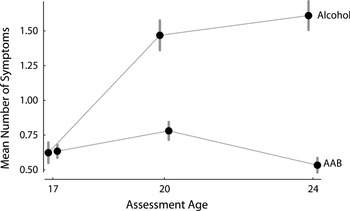
The mean number of (log-transformed) symptoms of antisocial behavior (AAB) and alcohol dependence at each of the three assessments, with standard errors derived from multilevel models to account for the presence of related individuals in the sample.
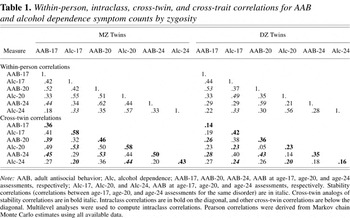
Within-person, intraclass, cross-twin, and cross-trait correlations for AAB and alcohol dependence symptom counts by zygosity
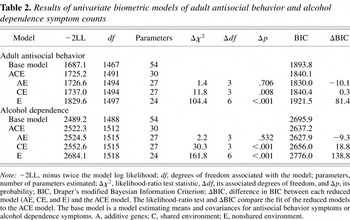
Results of univariate biometric models of adult antisocial behavior and alcohol dependence symptom counts
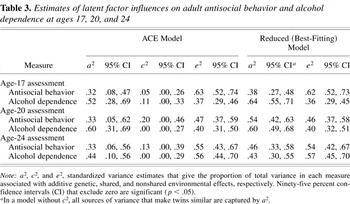
Estimates of latent factor influences on adult antisocial behavior and alcohol dependence at ages 17, 20, and 24
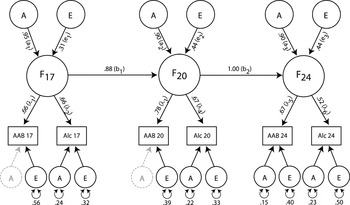
The standardized path coefficients for the simplex common factor model. The common factor is represented as F17, F20, and F24. Stability over time is due to autoregressive effects of the factor on itself, represented as b1 and b2. Standardized loadings of each phenotype on the common factor are represented by λ1 to λ6. Squaring each loading gives the proportion of variance in the phenotype accounted for by the common factor. The upper portion of the figure illustrates the genetic (A) and environmental (E) influences on the common factor. The bottom portion of the figure illustrates specific A and E influences on each phenotype at a given age. Standardized variance components associated with each appear below the circles representing the specific latent factors; the double-headed circular arrows represent these variances, which give the proportion of variance in the phenotype associated with specific A or E influence. The specific factors represented by grey dashed arrows were not significant.
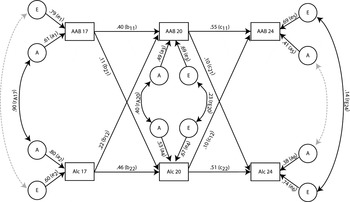
The standardized path coefficients from the best-fitting cross-lag model. The left side of the model presents the magnitude of the latent effects of additive genetic (A) and nonshared environmental (E) influences on adult antisocial behavior (AAB) and alcohol dependence (Alc) at age 17. The curved solid arrows show the correlated A effects (the shared variance in A effects on both disorders, e.g., rA17) and correlated nonshared E effects (the shared variance in nonshared E effects on both disorders, e.g., rE20) at each age (at ages 20 and 24, those correlations are between new effects of A or E on the phenotypes). The center of the model presents the magnitude of new effects at age 20 on each disorder (e.g., paths a3, e3, etc.) and the right side of the model presents such effects at age 24. The center of the model also presents the cross-lag and continuity regression paths, both from age 17 to 20 and from 20 to 24. For example, the variance in AAB at age 20 is decomposed in the model into that portion of variance associated with latent variable effects (A and E) on AAB at age 17 (path b11), effects on Alc at 17 (path b12), and new effects on AAB at age 20 (paths a3 and e3). Similar crosslag and continuity paths connect the disorders at age 24 to influences from earlier ages. Dashed grey arrows represent paths with nonsignificant coefficients.
 You have
Access
- 57
- Cited by