People diagnosed with borderline personality disorder (BPD) are at high risk of dying by suicide: almost all report chronic suicidal ideation (SI), 84% of patients with BPD engage in suicidal behavior, 70% attempt suicide, with a mean of 3.4 lifetime attempts per individual, and 5–10% die by suicide (Black, Blum, Pfohl, & Hale, Reference Black, Blum, Pfohl and Hale2004; McGirr, Paris, Lesage, Renaud, & Turecki, Reference McGirr, Paris, Lesage, Renaud and Turecki2007; Soloff, Lis, Kelly, Cornelius, & Ulrich, Reference Soloff, Lis, Kelly, Cornelius and Ulrich1994).
Although correlates of suicidal behavior have been studied extensively in the past 30 years (Turecki et al., Reference Turecki, Brent, Gunnell, O'Connor, Oquendo, Pirkis and Stanley2019), prediction of suicide attempts remains close to chance (Franklin et al., Reference Franklin, Ribeiro, Fox, Bentley, Kleiman, Huang and Nock2017). One important reason for this lack of progress is that most studies have focused on between-person differences, or have employed long follow-up intervals, missing the temporal dynamics of suicide risk that requires more frequent assessments.
Given the high rate and potential lethality of suicide attempts in BPD, we need a better understanding of proximal and potentially modifiable factors that predict short-term surges in ideation and catalyze suicidal crises (Galynker et al., Reference Galynker, Yaseen, Cohen, Benhamou, Hawes and Briggs2017). Accordingly, we investigate how interpersonal triggers elicit momentary surges in SI – either directly or indirectly via affective or impulsive processes – among people diagnosed with BPD and a history of suicide attempts.
Two key observations emerge from recent studies using ambulatory assessment of the real-time occurrence of SI in daily life. First, SI severity varies considerably from hour to hour (Ben-Zeev, Young, & Depp, Reference Ben-Zeev, Young and Depp2012; Hallensleben et al., Reference Hallensleben, Glaesmer, Forkmann, Rath, Strauss, Kersting and Spangenberg2019; Husky et al., Reference Husky, Swendsen, Ionita, Jaussent, Genty and Courtet2017; Witte et al., Reference Witte, Fitzpatrick, Warren, Schatschneider and Schmidt2006) and covaries with well-known precipitants, which are limited in their ability to predict prospective changes in SI (Kleiman et al., Reference Kleiman, Turner, Fedor, Beale, Huffman and Nock2017; Victor, Scott, Stepp, & Goldstein, Reference Victor, Scott, Stepp and Goldstein2019). Second, episodes of SI tend to be brief, with participants reporting most episodes to be shorter than an hour (Nock et al., Reference Nock, Hwang, Sampson, Kessler, Angermeyer, Beautrais and De Graaf2009a; Nock, Prinstein, & Sterba, Reference Nock, Prinstein and Sterba2009b). This descriptive work aligns well with prior theory. The Three Step-Theory, for instance, posits that negative affective states motivate suicidal desire contemporaneously or over seconds to minutes (Klonsky, Saffer, & Bryan, Reference Klonsky, Saffer and Bryan2018). More specifically, the theory suggests that pain, hopelessness, and suicidal desire are reciprocally influential within a situation, rather than unfolding over longer periods of time. Similarly, Fluid Vulnerability Theory's concept of a suicidal mode suggests that suicidal crises represent a sudden and intense departure from a baseline state, resulting from complex interactions of mutually influential affective, cognitive, behavioral, and physiological processes (Rudd, Reference Rudd and Ellis2006).
In BPD, interpersonal stressors often exacerbate emotional instability (Tragesser, Lippman, Trull, & Barrett, Reference Tragesser, Lippman, Trull and Barrett2008), yet it is unclear how interpersonal stressors contribute to suicidal crises as they emerge in daily life. On a momentary and daily timescale, interpersonal perceptions of hostility, disaffiliation, and rejection are linked to increases in negative affect (NA) (Kaurin et al., Reference Kaurin, Wright, Pilkonis, Scott, Woods, Stepp and Beeney2020; Lazarus et al., Reference Lazarus, Scott, Beeney, Wright, Stepp and Pilkonis2018; Sadikaj, Moskowitz, Russell, Zuroff, & Paris, Reference Sadikaj, Moskowitz, Russell, Zuroff and Paris2013; Sadikaj, Russell, Moskowitz, & Paris, Reference Sadikaj, Russell, Moskowitz and Paris2010), aversive tension (Stiglmayr et al., Reference Stiglmayr, Grathwol, Linehan, Ihorst, Fahrenberg and Bohus2005), affective instability, severe anger (Miskewicz et al., Reference Miskewicz, Fleeson, Arnold, Law, Mneimne and Furr2015), and impulsivity (Coifman, Berenson, Rafaeli, & Downey, Reference Coifman, Berenson, Rafaeli and Downey2012; Koenigsberg et al., Reference Koenigsberg, Harvey, Mitropoulou, New, Goodman, Silverman and Siever2001). Although previous studies have largely suggested that the amplification of affect in BPD is specific to NA, some evidence indicates that individuals with BPD also report smaller increases in positive affect in response to agreeable behavior of interaction partners (Sadikaj et al., Reference Sadikaj, Russell, Moskowitz and Paris2010). Overall, this pattern of reactivity is particularly striking in comparison to healthy controls (Berenson, Downey, Rafaeli, Coifman, & Paquin, Reference Berenson, Downey, Rafaeli, Coifman and Paquin2011) or depressed patients (Hepp, Lane, Wycoff, Carpenter, & Trull, Reference Hepp, Lane, Carpenter, Niedtfeld, Brown and Trull2017).
Because impulsivity accelerates the transition from thoughts to action, it has long been conceptualized as a central risk factor for suicide attempts in general (Bryan & Rudd, Reference Bryan and Rudd2006), and in BPD in particular (Brodsky, Groves, Oquendo, Mann, & Stanley, Reference Brodsky, Groves, Oquendo, Mann and Stanley2006; Soloff, Lynch, Kelly, Malone, & Mann, Reference Soloff, Lynch, Kelly, Malone and Mann2000). Meta-analytic evidence, however, suggests that the predictive validity of impulsivity for suicide attempts is paradoxically rather modest (Anestis, Soberay, Gutierrez, Hernández, & Joiner, Reference Anestis, Soberay, Gutierrez, Hernández and Joiner2014), with little discriminatory value for the differentiation of suicide ideation and attempt (Klonsky & May, Reference Klonsky and May2010; May & Klonsky, Reference May and Klonsky2016). However, some evidence derived from a 6-day ecological momentary assessment protocol suggests that impulsivity is related to the likelihood of suicidal behavior and particularly to within-person fluctuations in SI, but not to the general tendency to think about suicide (Hadzic et al., Reference Hadzic, Spangenberg, Hallensleben, Forkmann, Rath, Strauß and Glaesmer2020). More importantly, previous work has predominantly focused on self-reports of impulsiveness, which are likely relevant to determining long-term suicide risk. State-sensitive indices of impulsivity, in contrast, have the potential to reveal more proximal risk factors for SI as it emerges in daily life (Liu, Trout, Hernandez, Cheek, & Gerlus, Reference Liu, Trout, Hernandez, Cheek and Gerlus2017).
In contrast, negative affectivity has been more consistently related to the emergence of SI (Hallquist & Pilkonis, Reference Hallquist and Pilkonis2012; Linehan, Heard, & Armstrong, Reference Linehan, Heard and Armstrong1993; McGirr et al., Reference McGirr, Paris, Lesage, Renaud and Turecki2007; Soloff, Fabio, Kelly, Malone, & Mann, Reference Soloff, Fabio, Kelly, Malone and Mann2005; Wedig et al., Reference Wedig, Silverman, Frankenburg, Reich, Fitzmaurice and Zanarini2012; Yen et al., Reference Yen, Shea, Sanislow, Grilo, Skodol, Gunderson and Morey2004; Reference Yen, Shea, Sanislow, Skodol, Grilo, Edelen and Gunderson2009). Links et al. (Reference Links, Eynan, Heisel, Barr, Korzekwa, McMain and Ball2007) found that in participants with BPD and a history of suicidal behavior, negative mood intensity was significantly related to the intensity of self-reported suicide ideation and to the number of suicidal behaviors during the past year. More recent work further suggests that the within-person link between NA and SI is enhanced among patients with BPD compared to those without (Mou et al., Reference Mou, Kleiman, Fedor, Beck, Huffman and Nock2018). These findings are consistent with the notion that suicidal behaviors reflect efforts to escape intense aversive arousal or distress in response to acute stressors (Gratz, Rosenthal, Tull, Lejuez, & Gunderson, Reference Gratz, Rosenthal, Tull, Lejuez and Gunderson2006; Millner et al., Reference Millner, den Ouden, Gershman, Glenn, Kearns, Bornstein and Nock2019), and that the BPD-specific association among both is reinforced by reductions in NA (Kleiman et al., Reference Kleiman, Coppersmith, Millner, Franz, Fox and Nock2018; Selby, Anestis, Bender, & Joiner, Reference Selby, Anestis, Bender and Joiner2009).
Though negative emotions are clearly related to SI, positive affect may have incremental predictive value. For instance, Yen et al. (Reference Yen, Weinstock, Andover, Sheets, Selby and Spirito2013) found that over a period of 6 months low positive affectivity was a stronger prospective predictor for suicidal acts than negative affectivity. Similarly, Hirsch, Duberstein, Chapman, and Lyness's (Reference Hirsch, Duberstein, Chapman and Lyness2007) cross-sectional study found that dispositional positive affectivity differentiated older primary care patients with increased levels of SI from those without, independently of trait NA. In BPD, positive affect may be essential for research on interpersonal precipitants of SI, because perceptions of others' warmth do not necessarily translate to the same amount of increases in positive affect in BPD as in community controls (Sadikaj et al., Reference Sadikaj, Russell, Moskowitz and Paris2010).
Though a vast body of work has consistently reported momentary contingencies among interpersonal perceptions and affect or state impulsivity in BPD, no study has illustrated how those processes propel real-life suicidal crises. The evidence reviewed above suggests at least two different pathways through which SI in BPD may emerge in daily interpersonal interactions. First, interpersonal perceptions of disaffiliation may be directly linked to increased momentary SI (Brodsky et al., Reference Brodsky, Groves, Oquendo, Mann and Stanley2006). Alternatively, SI may arise via a cascade of socio-affective processes, where the effect of interpersonal perceptions on momentary SI is indirect, depending on enhanced affective reactivity (both positive and negative) or increased impulsivity in response to interpersonal stressors (Sadikaj et al., Reference Sadikaj, Moskowitz, Russell, Zuroff and Paris2013; Selby et al., Reference Selby, Anestis, Bender and Joiner2009).
We test these pathways from the viewpoint of transactional models of suicidal surges that emphasize within-person links among interpersonal perception, affect, impulsivity, and SI. This approach can delineate momentary processes that potentially conduce to suicide. Serious suicidal thoughts are rare, episodic events, and will manifest infrequently during a 21-day ecological momentary assessment (EMA) protocol, even in a high-risk population, which makes achieving adequate power particularly difficult. Therefore, our analyses are based on a case-control sample enriched for the history of high-lethality suicide attempts, which are among the most powerful long-term predictors of lethal suicidal behavior (Christiansen & Frank Jensen, Reference Christiansen and Frank Jensen2007; Gibb, Beautrais, & Fergusson, Reference Gibb, Beautrais and Fergusson2005; Haw, Bergen, Casey, & Hawton, Reference Haw, Bergen, Casey and Hawton2007; Suominen et al., Reference Suominen, Isometsä, Suokas, Haukka, Achte and Lönnqvist2004). Thus, for the purpose of the current study, healthy controls, non-attempters, and attempters were pooled to represent a range of SI severity consistent with dimensional conceptualizations of psychopathology (Stanton, McDonnell, Hayden, & Watson, Reference Stanton, McDonnell, Hayden and Watson2020).
Methods
All study procedures were approved by the Institutional Review Boards of the University of Pittsburgh (STUDY19050210).
Sample
Participants were drawn from a longitudinal study (Soloff & Chiappetta, Reference Soloff and Chiappetta2017) and recruited from in- and outpatient clinics or the nearby community by advertisement. At enrollment, participants had to be between 18 and 45 years. Exclusion criteria included a lifetime diagnosis of any psychotic or bipolar disorder, clinical evidence of organic brain disease, physical disorders or treatments with a known psychiatric consequence, and IQ < 70 measured by the Wechsler Test of Adult Reading (Wechsler, Reference Wechsler2001).
The sample comprised 153 individuals diagnosed with BPD and 52 healthy control participants (M age: 33.71, s.d. = 9.43; 80% female). Of these 153 individuals with BPD, 105 had a history of non-zero lethality suicide attempts; 48 reported no past suicide attempts. To increase the reliability of our EMA measurements, participants with fewer than 10 reported interactions (N = 19) were excluded. This resulted in a final sample size of 186 participants. The majority of the sample identified as White/Caucasian (76%), followed by Black/African American (15%), Asian (4%), Pacific Islander (3%), or other/did not report racial demographics (2%).
BPD diagnoses were based on the International Classification of Diseases-l0-based International Personality Disorder Examination (Loranger et al., Reference Loranger, Sartorius, Andreoli, Berger, Buchheim, Channabasavanna and Jacobsberg1994). Non-suicidal participants with BPD had no lifetime history of suicide attempts, healthy control participants had no lifetime history of psychiatric disorders, nor suicide attempts, as determined by the Structured Clinical Interview for the Diagnostic and Statistical Manual for Mental Disorders (fourth edition).
Suicide attempters had a history of a self-injurious act with the intent to die within a 1-month period prior to completing the study assessments or had a history of a past suicide attempt with strong current SI at the time of study enrollment. Attempters were required to have medically significant attempts, defined by a score of >1 on the Beck Lethality Scale (Beck, Beck, & Kovacs, Reference Beck, Beck and Kovacs1975). High-lethality attempts were defined by a score of >3. For participants with multiple attempts, data for the highest-lethality attempt were used. High-lethality attempts resulted in coma, need for resuscitation, unstable vital signs, penetrating wounds of abdomen or chest, third-degree burns, or major bleeding.
Power estimations
Power calculations were based on Monte Carlo simulations of fully specified multilevel structural equation modeling (MSEM) models with plausible values taken from previous 21-day studies with similar sampling schemes (Lazarus et al., Reference Lazarus, Scott, Beeney, Wright, Stepp and Pilkonis2018; Sadikaj et al., Reference Sadikaj, Moskowitz, Russell, Zuroff and Paris2013). These simulations indicated that power would exceed 0.80 at an alpha level of 0.05 for each individual within-person effect with person-level sample sizes of N > 50, including tests of main effects and variance components.
Momentary assessments
Participants completed a 21-day EMA protocol within pre-defined time windows, using the MetricWire smartphone application, which reminded them to complete surveys via push notifications. If participants indicated that an interaction occurred, they were asked to report on the behavior of one of their interaction partners along with features of the situation. This resulted in N = 9009 reported interactions, with an average number of 48 interactions per participant, ranging from 10 to 116 observations overall. On 12% of days, participants reported SI at least once during the day, which corresponds to a total of 4% of observations that were characterized by SI. Participants rated the behavior of their interaction partner/s regarding dominance or warmth, on a sliding scale from −50 to +50. The dominance scale ranged from ‘Accommodating/Submissive/Timid’ to ‘Assertive/Dominant/Controlling’ and the warmth scale ranged from ‘Cold/Distant/Hostile’ to ‘Warm/Friendly/Caring.’
Participants also rated the degree to which they felt negative (i.e. nervous, sad, irritated, angry) or positive emotions (i.e. happy, content, excited) derived from the Positive and Negative Affect Schedule (Watson, Clark, & Tellegen, Reference Watson, Clark and Tellegen1988). Items read ‘How [ADJECTIVE] did you feel during the interaction?’, and ratings were made on a slider scale from 0 (‘Not at All’) to 100 (‘Extremely’) for each adjective and an additional item asking about their impulsivity (i.e. ‘How would you describe your behavior during the interaction?, 0 (‘In Control’) to 100 (‘Impulsive’).
SI was assessed with two dichotomous items: ‘Since the interaction,’ ‘Have you wished you were dead or wished you could go to sleep and not wake up?’ and ‘Have you actually had any thoughts of killing yourself?’, derived from the SI subscale of the Columbia-Suicide Severity Rating Scale (Posner et al., Reference Posner, Brent, Lucas, Gould, Stanley, Brown and Mann2008).
Data analysis
Because we repeatedly sampled social interactions from participants, our data had a hierarchical structure, such that interactions (within-person level) were nested within individuals (between-person level). Therefore, we used MSEM, which accommodates this data structure. Variables can be between-person (e.g. gender), which only include variance at the between-person level, or within-person (e.g. interpersonal interaction variables), which include variance at both levels. The total variability in interaction variables are partitioned into the between-person variance, reflecting individual differences in average (or trait-level) responses, and within-person variance, reflecting moment-to-moment fluctuations from an individual's average level. At each level, MSEM can be used to examine associations among variables (Sadikaj, Wright, Dunkley, Zuroff, & Moskowitz, Reference Sadikaj, Wright, Dunkley, Zuroff and Moskowitz2019). The between-person portion of the model estimates associations among individual differences in each observed variable. For instance, the correlation or regression path between how suicidal a person tends to be with how much NA they typically tend to experience. In contrast, within-person associations reflect how strongly variables are coupled together as they fluctuate from interaction to interaction. Thus, within-person associations reflect dynamic processes (e.g. how much NA arises at the time of an interpersonal stressor). MSEM also allows for the estimation of random slopes (i.e. slopes that vary across individuals), such that individuals can differ in the strength of their within-person associations among variables that are repeatedly assessed in the EMA protocol. That is, some individuals may have a strong within-person link among variables, but others may have a weaker one, or one of an opposite sign. The fixed effects of these slopes represent the average association in the sample and at the random effects represent individual differences in the extent to which those situational features co-occur across participants.
Importantly, the within-person coefficients reported here represent contemporaneous associations (i.e. within the same wave), although the suicidality items were referenced to ‘since the interaction.’ This modeling decision was based on theoretical and empirical work suggesting that when the variables assessed fluctuate substantially over the frequency in which they are being monitored, prioritizing lagged associations is not more valuable (Granger, Reference Granger1969).
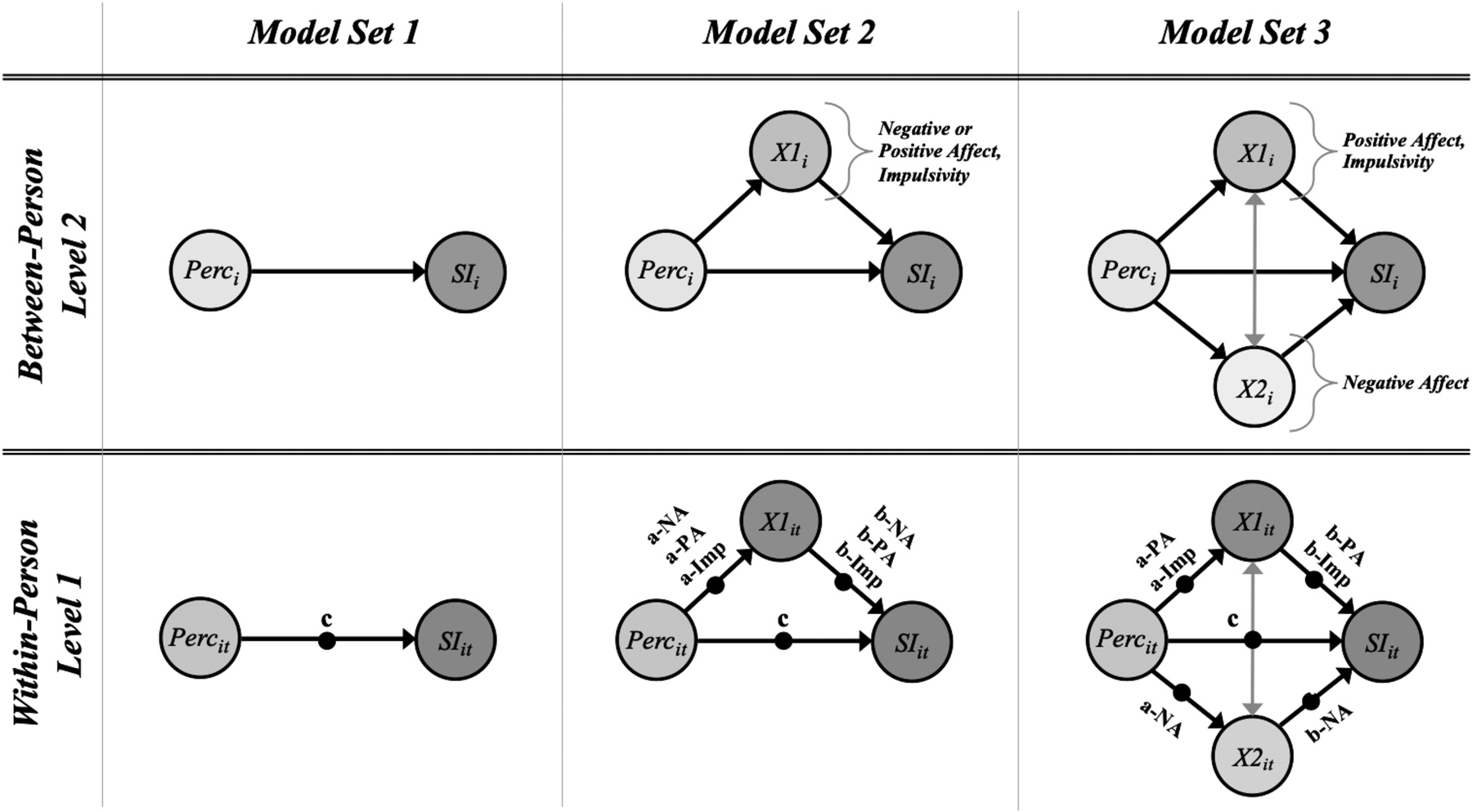
Figure 1 provides a schematic overview of the estimated models, along with path annotations as referenced in the results section. Three sets of models were estimated with perceptions of other behavior (i.e. warmth/dominance) predicting SI. Model 1 regressed momentary SI on perceptions of interaction partner's behavior at the within-person level (i.e. fluctuations in momentary interpersonal perceptions predicting fluctuations in momentary SI) and the between-person level (i.e. individual differences in average perceptions and SI). Model 2 introduced negative or positive affect or impulsivity as additional predictors of momentary SI at each level, each variable was also regressed on interpersonal perceptions. Finally, Model 3 simultaneously introduced two of the three intermediate variables (i.e. negative and positive affect, impulsivity) as correlated predictors/covariates of momentary SI at each level, which permitted the evaluation of unique associations of each predictor with SI.
Overview of model sets used for all analyses of suicidal surges including decomposition of observed momentary variables into between (subscript i) and within-person (subscript t) variance. Note, not all parameters are diagrammed (e.g. residual variances are not depicted). In Model Set 3, at the within-person level, a process was modeled in which perceived warmth or dominance was associated with negative affect and impulsivity or negative and positive affect. In these models, all three variables were independently associated with momentary suicidal ideation and were allowed to covary. All models controlled for age and gender at the between-person level, and for time and weekday at the within-person level. Coefficients for covariates are not presented for parsimony. Single-headed arrows indicate regression paths. Filled dots represent random effects. Perc, interpersonal perceptions of warmth or dominance; NA, negative affect; PA, positive affect; Imp, impulsivity; SI, suicidal ideation.

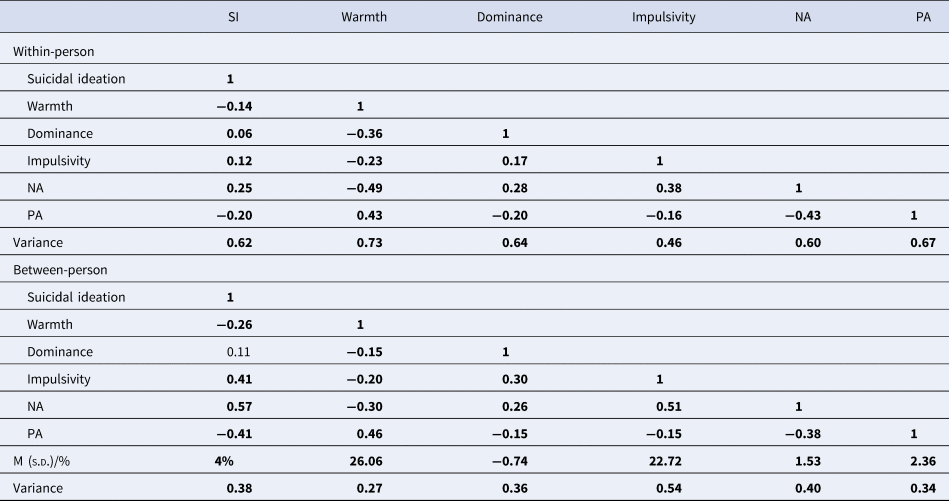
Table 1 summarizes pooled within-person correlations among the variables along with correlations among the random intercepts at the between-person level. Sex (0 = female; 1 = male) and age (centered on mean age) were also included as covariates in all models at the between-person level. Within-person variables were adjusted for observation number (time centered on mean of observations) and whether the interaction occurred on a weekend to account for possible changes over time and weekly cycles. Along with other parameters not reported in the tables (e.g. residual variances, coefficients for covariates) full specifications and detailed output from all models can be found online at https://osf.io/zpc3u/. All models were estimated in Mplus (version 8.4; Muthén & Muthén, Reference Muthén and Muthén1998–2019). Bayesian estimation was used because it provides a latent decomposition into within- and between-person variance for both the predictors and outcome variables when random effects are specified. Significance for all model parameters was based on 95% Credibility Intervals (CIs), with CIs that excluded zero indicative of a parameter that differed significantly from zero.
Correlations among study variables at within- and between-person levels

NA, negative affect; PA, positive affect; SI, suicidal ideation.
Note: N = 189 (between), N = 9100 (within); Between-person variance was calculated as the intraclass correlation coefficient (ICC), which can be interpreted as the proportion of total variance accounted for at the between-person level. Within-person variance is therefore calculated as 1.0–ICC. Bolded values indicate the credibility interval does not contain zero.
Results
Model Set 1
For models examining the effects of others' perceived warmth on SI (Model 1), we found no significant fixed effect at the within-person level [c = 0.187, CI (−0.017 to 0.404), but did at the between-person level (β SI.W = −0.184, CI −0.357 to 0.000)]. Similarly, perceiving interaction partners as more dominant was not associated with SI at the within-person [c = −0.014, CI (−0.167 to 0.145)], but was at the between-person level [β SI.D = 0.185, CI (0.029 to 0.331)]. Note that for these and all subsequently reported within-person paths, we found significant random effects indicative of individual differences in these associations.
Model Set 2
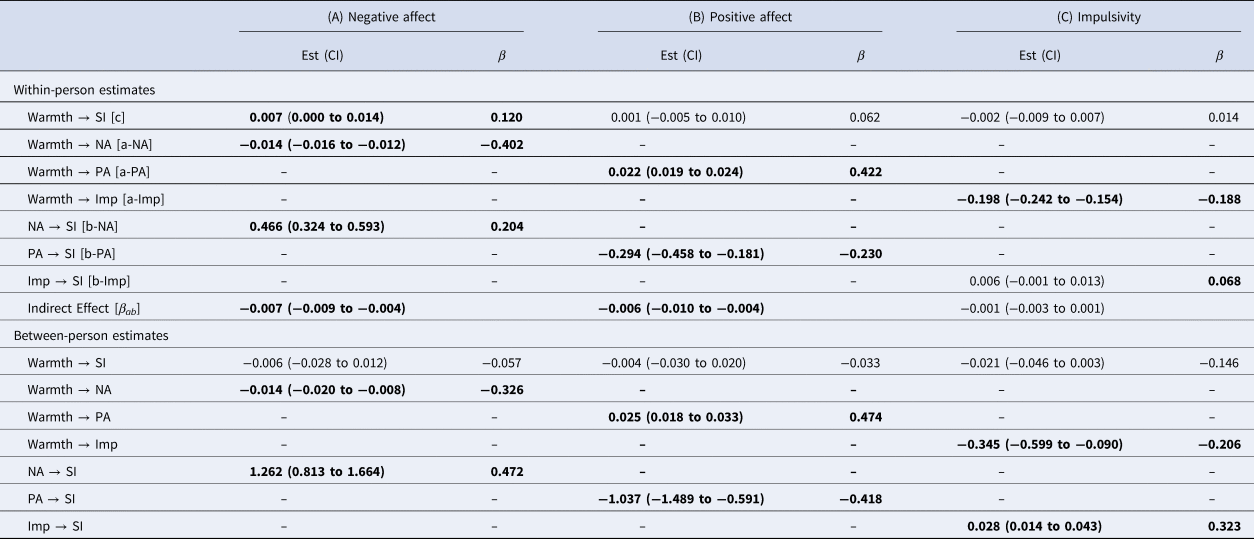
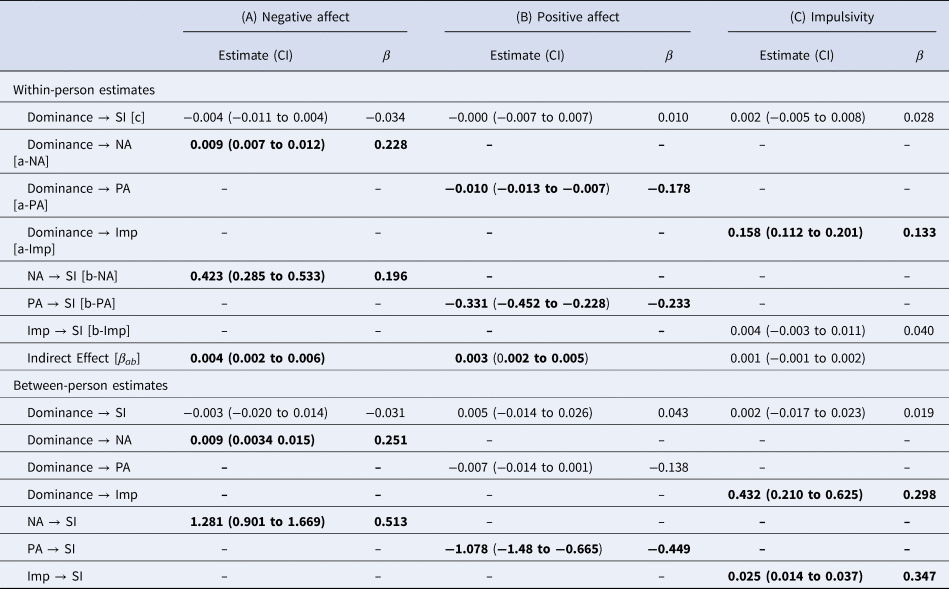
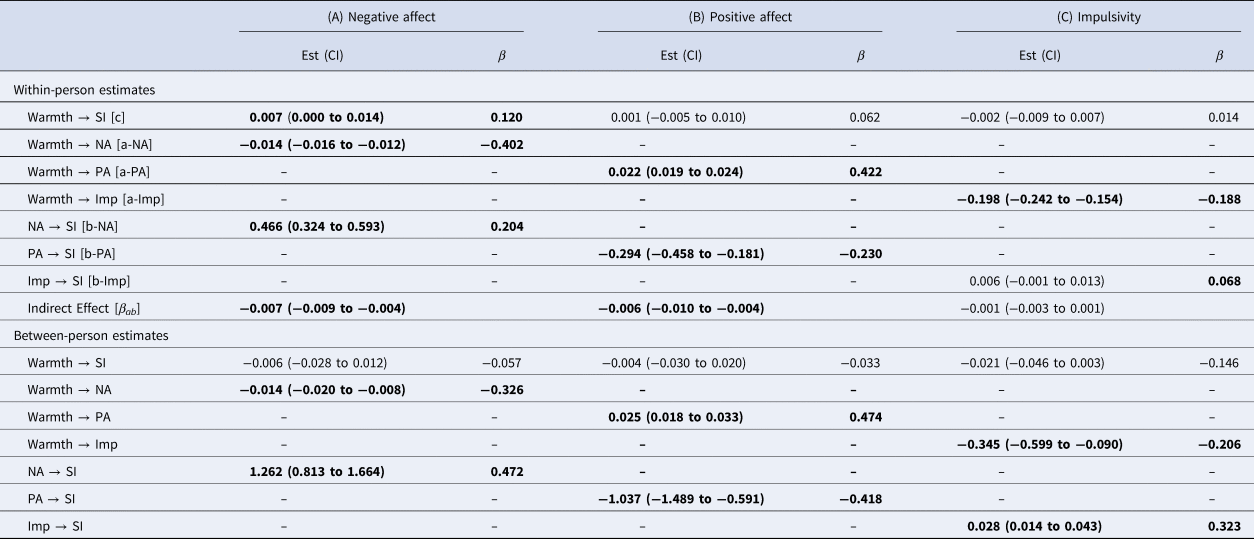
Next, momentary affect and impulsivity were added as additional intervening predictors of SI to our model. Table 2 provides a detailed overview of estimates for models including perceptions of interpersonal warmth, and Table 3 for estimates based on models including perceptions of dominance.
Key estimates from three individual multi-level structural equation models showing associations among suicidal ideation, negative affect, positive affect, or impulsivity, and perceived warmth of others during interactions (Model Set 2)
Warmth, perceived warmth of interaction partner; NA, negative affect; PA, positive affect; Imp, impulsivity; SI, suicidal ideation.
Note: N = 186 (between), N = 9009 (within); → indicates regression; β parameter estimates are standardized. 95% credibility intervals of unstandardized parameter estimates are in parentheses. Bolded values indicate the credibility interval does not contain zero
Key estimates from three individual multi-level structural equation models showing associations among suicidal ideation, negative affect, positive affect, or impulsivity, and perceived dominance of others during interactions (Model Set 2)

Dominance, perceived dominance of interaction partner; NA, negative affect; PA, positive affect; Imp, impulsivity; SI, suicidal ideation.
Note: N = 186 (between), N = 9009 (within); → indicates regression; β parameter estimates are standardized. 95% credibility intervals of unstandardized parameter estimates are in parentheses. Bolded values indicate the credibility interval does not contain zero..
Negative affect
At the within-person level, the fixed effect of perceptions of others' warmth negatively predicted NA (a-NA), and NA predicted SI (b-NA), while warmth now predicted SI (c; Table 2A). The indirect effect (ab) was also significant, suggesting that NA accounted for the link between perceived coldness and momentary SI. At the between-person level, lower average perceptions of warmth were associated with experiencing more NA on average, and higher average levels of NA were associated with an increased likelihood for SI; the link between perceptions of warmth and SI, however, was no longer significant, suggesting individual differences in NA accounted for this association.
Relationships with perceived dominance were similar but somewhat weaker (Table 3A): interpersonal perceptions predicted NA (a-NA), and NA predicted SI (b-NA). Although the total of the c path was not significant, an indirect effect (ab) emerged, suggesting that NA accounted for the link between perceived dominance and momentary SI. The same pattern emerged at the between-person level.
Positive affect
A very similar pattern with opposing signs emerged for the model including positive affect (Table 2B), such that at the within-person level interpersonal warmth was positively associated with positive affect (a-PA), and positive affect negatively with SI (b-PA). Again, the indirect effect (ab) was significant, while the c path did not reach significance. The same pattern emerged at the between-person level.
Models including perceived dominance (Table 3B) revealed a similar pattern of results, with the only exceptions being an expectedly negatively association with positive affect (a-PA), and no between-person level association between perceived dominance and positive affect.
Impulsivity
For models that included impulsivity (Table 2C), we found a significant negative within-person link between perceptions of warmth and impulsivity (a-Imp), while the effects for the b-Imp path and the c path were not significant. At the between-person level, lower average perceptions of warmth were associated with feeling more impulsive on average, and that higher average levels of impulsivity were associated with an increased likelihood for SI.
In models where impulsivity was included to account for the link between dominance and SI (Table 3C), only a significant link between interpersonal perceptions and impulsivity emerged (a-Imp). At the between-person level, however, higher average perceptions of dominance were associated with experiencing more impulsivity, and higher average levels of impulsivity were associated with an increased likelihood for SI.
Model Set 3
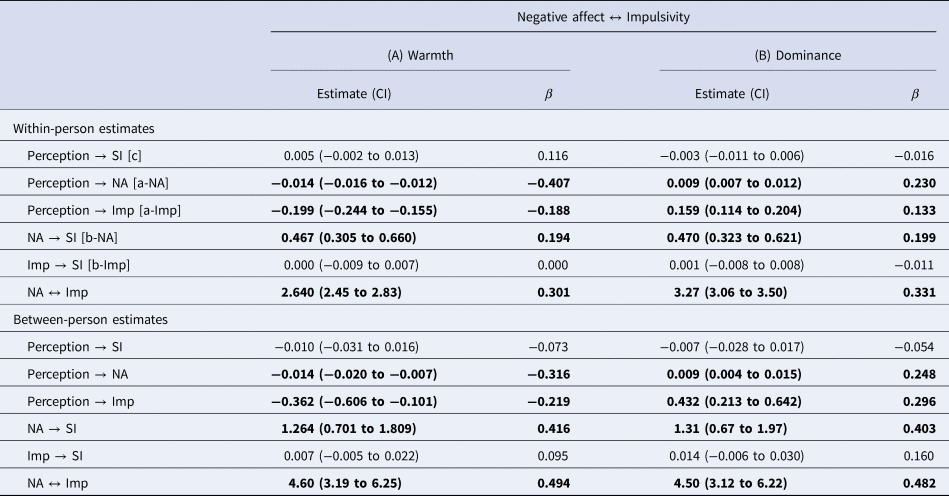
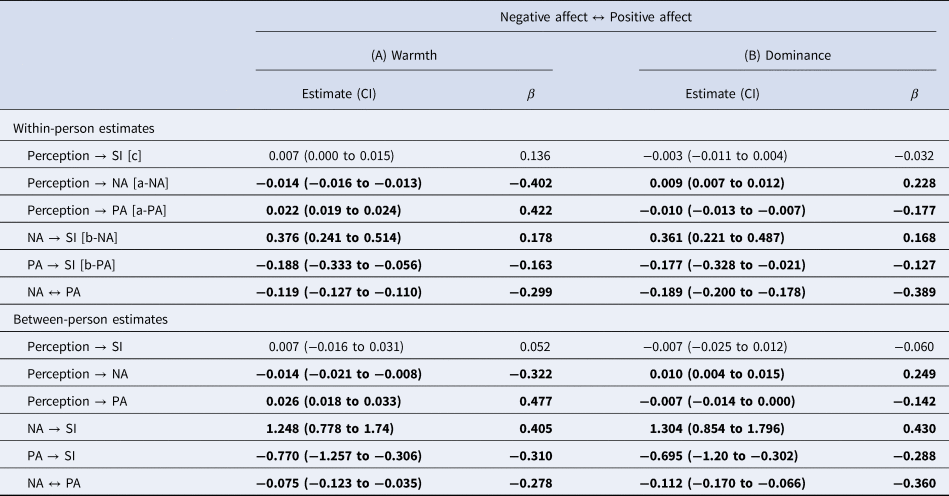
Finally, to test the robustness of our indirect effects, we added NA and impulsivity (and negative with positive affect, respectively) simultaneously as covarying predictors of SI to our models. Table 4 provides estimates for models including NA and impulsivity, and Table 5 summarizes estimates for models including negative and positive affect.
Key estimates from multi-level structural equation models simultaneously estimating associations among suicidal ideation, negative affect and impulsivity, and perceptions of others during interactions (Model Set 3)

Perception, degree to which interaction partners' behavior is perceived to be warm/dominant; NA, negative affect; Imp, impulsivity; SI, suicidal ideation.
Note: N = 186 (between), N = 9009 (within); → indicates regression, ↔ indicates correlation between variables; β parameter estimates are standardized. 95% credibility intervals of unstandardized parameter estimates are in parentheses. Bolded values indicate the credibility interval does not contain zero
Key estimates from multi-level structural equation models simultaneously estimating associations among suicidal ideation, negative and positive affect, and perceptions of others during interactions (Model Set 3)

Perception, degree to which interaction partners' behavior is perceived to be warm/dominant; NA, negative affect; PA, positive affect; SI, suicidal ideation.
Note: N = 186 (between), N = 9009 (within); → indicates regression, ↔ indicates correlation between variables; β parameter estimates are standardized. 95% credibility intervals of unstandardized parameter estimates are in parentheses. Bolded values indicate the credibility interval does not contain zero
Negative affect and impulsivity
At the within-person level, perceptions of others' warmth negatively predicted NA (a-NA), and impulsivity (a-Imp). Moreover, NA (b-NA), but not impulsivity (b-Imp), was related to SI. The path between perceived warmth and SI, however, was not significant (c). At the between-person level, the same pattern of results emerged, and impulsivity and NA were positively associated with each other (Table 4A).
Perceptions of others' dominance were positively related to NA (a-NA), and impulsivity (a-Imp) at the within-person level (Table 4B). Again, NA (b-NA), but not impulsivity (b-Imp), was related to SI, while the path between perceived dominance and SI was not significant (c). At the between-person level, the same pattern of results emerged, and impulsivity and NA were positively associated with each other.
Negative and positive affect
Finally, when both positive and NA were simultaneously added as predictors of SI (Table 5A), we found that perceptions of others' warmth negatively predicted NA (a-NA), and positively positive affect (a-PA). Both were uniquely related to SI (b-NA; b-PA), albeit in different directions, and positive and NA were negatively associated with each other. The path between perceived warmth and SI, was not significant. At the between-person level, the same pattern of results emerged. For the a-NA and a-PA paths, a converse pattern emerged for our model including perceptions of dominance (Table 5B).
Discussion
We administered intensive longitudinal assessments to BPD patients, many of whom had a history of high-lethality suicide attempts, over several weeks to evaluate relationships between interpersonally stressful encounters, and suicidal surges (i.e. within-person links of affective dysregulation and SI) in the moment-to-moment stream of individuals' daily lives. When aggregated across all interactions, an association between perceived coldness and SI emerged, supporting the notion that interpersonal experiences are meaningfully related to SI in BPD (Brodsky et al., Reference Brodsky, Groves, Oquendo, Mann and Stanley2006; Brown, Comtois, & Linehan, Reference Brown, Comtois and Linehan2002). However, this between-person association did not extend to the within-person momentary timescale. Instead, the triggering effect of interpersonal conflicts was indirect, such that greater NA or lower PA in the context of perceived conflict or withdrawal was associated with SI. The present study suggests that in people diagnosed with BPD at high risk for suicide, situational interpersonal triggers do not directly elicit suicidal thoughts. Instead, the effect of negative interpersonal experiences on SI unfolds indirectly via affective dysregulation.
Moreover, positive and NA each uniquely accounted for the link between interpersonal stressors and SI, even after adjusting for their covariation, both at the within- and between-person level. This pattern of incremental effects supports theoretical assumptions that affective manifestations of BPD encompass positive as well as negative mood states (Linehan et al., Reference Linehan, Heard and Armstrong1993; Russell, Moskowitz, Zuroff, Sookman, & Paris, Reference Russell, Moskowitz, Zuroff, Sookman and Paris2007). It also underlines the notion that SI in BPD is driven not only by distress (NA) giving rise to escape motivations (Millner et al., Reference Millner, den Ouden, Gershman, Glenn, Kearns, Bornstein and Nock2019), but also by low PA, which may undermine a persons' ability to find alternative solutions or put the current crisis in perspective (Baumeister, Reference Baumeister1990).
Ratings of impulsivity were unassociated with ideation within-person, and as such, they did not explain the indirect effect of NA. However, impulsivity did exhibit a momentary relationship with interpersonal perception, consistent with previous work (Coifman et al., Reference Coifman, Berenson, Rafaeli and Downey2012). Average impulsivity was associated with average SI, but not after adjusting for NA consistent with a vast body of work indicating that maladaptive interpersonal behaviors and impulsive coping are related to affective instability among individuals with BPD (Bradley, Conklin, & Westen, Reference Bradley, Conklin, Westen, O'Donohue, Fowler and Lilienfeld2007) though longitudinally affective instability is a stronger predictor of suicidal behavior than impulsivity (Yen et al., Reference Yen, Shea, Sanislow, Grilo, Skodol, Gunderson and Morey2004). Although widely in line with previous work, we note that characteristics of our sample (e.g. mean age) may have attenuated the effect, because impulsive suicidal acts become less common as BPD patients transition into midlife (Wedig et al., Reference Wedig, Silverman, Frankenburg, Reich, Fitzmaurice and Zanarini2012; Zanarini, Frankenburg, Reich, & Fitzmaurice, Reference Zanarini, Frankenburg, Reich and Fitzmaurice2016).
Additional considerations of our study include that, the direct link between interpersonal perceptions and SI was not significant at the within-person level, though the indirect effect through affect was. Although this circumstance has traditionally been discussed to preclude indirect-effect models, more recent writings note that inferences on intervening relationships are justified if the indirect effect carried by the X→M and M→Y paths is significant (MacKinnon, Fairchild, & Fritz, Reference MacKinnon, Fairchild and Fritz2007), regardless of whether the bivariate association between X and Y was significant.
Additionally, our study primarily included people diagnosed with BPD and follow-up studies replicating our findings of the socio-affective dysregulation-SI nexus in clinically more diverse samples are needed to corroborate our findings. Yet, BPD is a particularly informative population for the study of SI, because it reflects a confluence of internalizing and externalizing psychopathology (Crowell, Beauchaine, & Linehan, Reference Crowell, Beauchaine and Linehan2009; Eaton et al., Reference Eaton, Krueger, Keyes, Skodol, Markon, Grant and Hasin2011; James & Taylor, Reference James and Taylor2008): Diagnostic criteria such as affective instability relate more strongly to internalizing, while others, such as marked impulsivity, relate more strongly to externalizing forms of psychopathology. Such heterogeneity may imply generalizability to other clinical disorders.
A key question arising from our analyses is whether suicidal surges are a cause, in and of themselves, of suicide attempts. High negative and low positive affect could provide the emotional substrate for SI as a proximal risk factor, potentially informing treatment. Alternatively, affective dysregulation may represent a reliable correlate, but not a causal component of SI. It could be, for example, that both SI and NA share risks. For instance, a growing literature suggests that Pavlovian escape biases (from NA) invigorate suicidal behavior (Millner et al., Reference Millner, den Ouden, Gershman, Glenn, Kearns, Bornstein and Nock2019) while disrupted decision processes undermine the consideration of deterrents and alternatives (Brown, Wilson, Hallquist, Szanto, & Dombrovski, Reference Brown, Wilson, Hallquist, Szanto and Dombrovski2020; Dombrovski, Szanto, Clark, Reynolds, & Siegle, Reference Dombrovski, Szanto, Clark, Reynolds and Siegle2013). Future computational studies could help disentangle the role of affective states from dispositional deficits.
Future intensive longitudinal research on suicidal processes should also consider both the assessment schedule and statistical modeling alternatives. SI is infrequent and episodic, severely complicating its assessment. Although EMA-based sampling strategies seem uniquely capable of capturing meaningful variation in suicidal thought and behavior (Gratch et al., Reference Gratch, Choo, Galfalvy, Keilp, Itzhaky, Mann and Stanley2020), how best to balance intensity and duration of assessment to capture this meaningful variation is challenging. Relatedly, a recurring debate is whether lagged associations should be prioritized over contemporaneous associations. Although contemporaneous and cross-sectional associations are often treated as the same, in intensive longitudinal data contemporaneous associations imply dynamic processes, which refer to the systematic covariation of variables as they fluctuate from measurement occasion to occasion. Contemporaneous associations capture processes that are assumed to be shorter than the time between assessments, while lagged associations provide a statistical model for processes that are likely to be longer than the sampling frequency (Granger, Reference Granger1969). If the process assessed is faster than the assessment interval, prioritizing lagged associations may not be inherently more valuable, particularly when measurements were not evenly spaced in time (e.g. when assessments are randomized throughout the day). Thus, the choice of an assessment and data analytic approach requires theoretical justification and should be based on estimates of how long episodes of suicidal thinking may last. Research has just begun to estimate the true timescale of an emergent suicidal crisis and future studies should, therefore, systematically examine theoretically informed real-time sampling and modeling strategies of SI.
This is the first reported study using EMA to characterize differential associations among affect and impulsivity with SI, contextualized within stressful interpersonal interactions. Our study uncovers how momentary links among socio-affective processes and suicidal thoughts may drive the progression of suicidal crises in daily life: In people diagnosed with BPD at high risk for suicide, situational triggers do not directly elicit suicidal thoughts but unfold indirectly via affective dysregulation.
Acknowledgements
We are grateful to the patients who took part in this study and to the clinical and research teams who made this work possible. The study was supported by the National Institute of Mental Health (R01 MH048463).
Conflict of interest
The authors certify that they have no affiliations with or involvement in any organization or entity with any financial interest, or non-financial interest in the subject matter or materials discussed in this manuscript.
Ethical standards
The authors assert that all procedures contributing to this work comply with the ethical standards of the relevant national and institutional committees on human experimentation and with the Helsinki Declaration of 1975, as revised in 2008.