The study of how citizens’ issue considerations influence their votes has prompted two (related) research agendas. The first, which is emphasized by spatial modelers and by many behavioral researchers, is that parties offer competing issue positions to voters, whose decisions are based on matching their own policy beliefs and parties’ positions.Footnote 1 This positional perspective prompts scholars to emphasize the electoral benefits political parties gain by presenting policy positions that reflect public opinion. The second perspective is that parties compete by emphasizing different issues pertaining to domains over which they enjoy issue ownership, in the sense that voters associate a focal party with a particular issue that they believe the party can competently address.Footnote 2 This perspective implies that parties may talk past each other, with parties that enjoy reputations for wise economic stewardship emphasizing the economy, while those with strong reputations for fighting crime highlight the crime issue and so on.
With respect to positional issue voting, a lively empirical literature investigates whether citizens choose parties on the basis of their policy positions or whether parties reciprocally cue their pre-existing partisans to adopt the parties’ positions.Footnote 3 To date, however, we are unaware of parallel research that evaluates the reciprocal influences of citizens’ party support and their issue salience, which are the micro-foundations of parties’ issue ownership. In recent years, the focus has shifted to the conditional effect of issue salience, given research that concludes that issue ownership only matters to voters who prioritize the focal issue.Footnote 4 However, we still do not know whether citizens’ issue salience is an exogenous factor that drives their partisanship, or vice versa. That is the question we address here. Specifically, we analyze German and British panel survey data to evaluate the extent to which the salience citizens ascribe to different issue areas influenced their subsequent party support – a partisan updating effect – and the extent to which, reciprocally, citizens’ party support shaped their subsequent issue priorities, an issue cueing effect.
We advance three arguments about the reciprocal relationships between citizens’ issue priorities and their party support. First, building on previous findings that citizens’ issue saliences are more malleable than their issue positions,Footnote 5 we argue that citizens’ issue salience shapes their party support and that their party support shapes their issue priorities (the reciprocal effects hypothesis). Secondly, we argue that the direction of the effects we identify – that, for instance, environmental concerns drive citizens toward green parties but away from the center-right parties that prioritize economic growth over environmental protection – is linked to parties’ long-term associative issue ownership, as reflected in the issues parties emphasize in their election manifestos (the associative issue ownership hypothesis). We thereby tie our research to a debate on whether issue ownership is a competence-based or an associative dimension.Footnote 6 Competence-based issue ownership is believed to be highly endogenous to partisanship.Footnote 7 We are testing here whether the same is true for associative issue ownership. Thirdly, we advocate a niche party hypothesis: that mass–elite linkages with respect to citizens’ issue salience are far stronger for issue-oriented niche parties, such as the German Greens, than for mainstream parties.
Below we report empirical analyses of German and British panel survey data on citizens’ issue concerns and their party support, which consistently support our hypotheses. The fact that we identify the same individual-level patterns across Germany and Britain – one a multiparty, PR-based political system that features coalition governments, the other a two-and-a-half-party, plurality-based system that typically features a single-party government – suggests that our findings may apply generally across Western European electorates.
Our results have three notable implications. First, our findings in support of the reciprocal effects hypothesis pertain to the argument that parties’ issue ownership affects party support only among individuals who prioritize the issue.Footnote 8 However, we demonstrate that citizens’ issue priorities and their party support reciprocally influence each other.
Secondly, our empirical support for the issue ownership hypothesis – that individual-level partisan updating and issue cueing effects reflect the issues that citizens associate with the German and British parties (which in turn reflect the issues parties emphasize in their election manifestos) – illustrates how parties’ associative issue ownership can attract partisan support. Our study of citizens’ reactions to parties’ issue emphases thereby extends earlier manifesto-based studies on the electoral effects of parties’ issue positions.Footnote 9
Thirdly, our findings in support of the niche party hypothesis extend the remarkable research of Meguid and Spoon,Footnote 10 who conclude that mass–elite linkages involving niche parties – specifically green and radical right parties – differ from those involving mainstream parties. Meguid and Spoon highlight differences in the types of issues niche parties emphasize, and we extend this perspective to show, via our analyses of the German Green Party how citizens’ reactions to this party’s issue emphases – namely the reciprocal partisan updating and issue cueing effects we identify – are far stronger for the Greens than for mainstream parties.
The Reciprocal Relationships Between Citizens’ Issue Salience and Their Party Support: Hypotheses
In the United States, the debate over the reciprocal influences of citizens’ partisanship and their issue positions has intensified in recent years. The conventional wisdom of the 1970s and 1980s – that mass partisanship was weakening and was largely driven by other political evaluations, including policy-based considerationsFootnote 11 – has been challenged by research that documents strengthening partisan ties.Footnote 12 Scholars have extended this debate by analyzing the reciprocal influences of citizens’ issue positions and their partisanship,Footnote 13 concluding that partisanship influences American citizens’ issue positions and political values. By contrast, studies find that European citizens’ partisanship is less central to their self-images than are their issue positions, in particular that partisanship is more volatile in Europe than in the United States, which implies that partisanship may not represent a salient identity to Europeans.Footnote 14 Empirical research by Milazzo, Adams and Green supports this perspective that European voters are ‘Downsian’ in that their issue positions influence – but are not influenced by – their party attachments.Footnote 15
The studies summarized above support the primacy of European citizens’ issue positions vis-à-vis their partisanship. However, one might doubt that citizens’ issue salience unidirectionally influences their partisanship, because previous research suggests that citizens’ issue attention (that is, salience) is more malleable than their issue positions.Footnote 16 Voters’ issue salience is central to issue ownership theory, which is an alternative theory of electoral choice beyond spatial models that emphasize issue positions. In particular, Budge and Farlie advance a saliency theory of party competition: that political parties selectively emphasize issues on which they enjoy a public image for competence rather than directly engaging with rival parties’ policy positions.Footnote 17 Issue ownership theory posits that voters support the party that ‘owns’ the issue the voter prioritizes, so that – for example – a voter preoccupied with crime will support (all else equal) the party perceived to be the most competent with respect to law and order. Extensive research argues that citizens’ issue salience shapes their party support,Footnote 18 which we label a partisan updating effect.
However, a recent study by Walgrave, Lefevere and Tresch documents that party identification constrains citizens’ abilities to receive and accept party messages, which meshes with the argument that partisanship functions as a perceptual screen.Footnote 19 Moreover, Hobolt, Klemmensen and Pickup document that party leaders’ annual speeches in Denmark and Britain shape the diversity of the mass public’s issue priorities – that is, that political elites in these countries can convey issue-based salience cues to rank-and-file voters.Footnote 20 Based on this research, we expect citizens’ party support to reciprocally shape their issue salience, an issue cueing effect. These considerations motivate our first hypothesis:
Hypothesis 1 (Reciprocal Effects Hypothesis): Citizens’ issue saliences both influences, and is influenced by, their partisan affiliations.
Reciprocal Effects of Issues and Partisanship: The Case for Issue Ownership
The reciprocal effects hypothesis pertains to how citizens’ issue salience affects their party support, and vice versa. This link, however, is moderated by the extent to which different parties ‘own’ different issues. The key to this connection is the nature of issue ownership. In recent years, the focus on competence as a key component of parties’ issue ownership has shifted to a second dimension of associative ownership. Issue competence is defined as ‘the belief that a party is best placed to tackle the issue’, whereas associative issue ownership is ‘the spontaneous association between issues and parties in the minds of voters resulting from a history of attention’.Footnote 21 The two concepts differ in that competence-based issue ownership is believed to be endogenous to party identification (that is, party supporters tend to project positive issue-based competence evaluations onto their preferred party),Footnote 22 whereas associative ownership develops from a long and persistent history of party attention to a specific issue. Crucially, Walgrave, Lefevere and Tresch demonstrate that associative issue ownership is not strongly shaped by partisanship, in that all parties’ supporters tend to associate the same parties with the same issues.Footnote 23 The authors demonstrate in an experimental study that parties cannot ‘steal’ associative issues from another party, and conclude that associative issue ownership ‘could, more than competence ownership, act as a “filter” on how parties are perceived’.Footnote 24 These findings on associative issue ownership recall Petrocik’s argument that a persistent history of party attention and commitment to an issue is a prerequisite to becoming an associative issue owner.Footnote 25 In sum, associative issue ownership is a connection that citizens make regardless of party preference, which is desirable for testing our reciprocal effects hypothesis. We hence argue that parties’ long-term associative issue ownership moderates individual-level partisan updating and issue cueing effects by making information easily retrievable for voters. These considerations motivate our second hypothesis:
Hypothesis 2 (Associative Issue Ownership Hypothesis): Citizens’ issue priorities and their party support reflect parties’ long-term associative issue ownership.
Below we evaluate this hypothesis by analyzing how the individual-level issue cueing and partisan updating effects we identify match the issues parties emphasize in their election manifestos.
Reciprocal Effects of Issues and Partisanship: The Case for Niche Parties
Our third hypothesis pertains to the empirical work of Kitschelt and Tarrow, as well as Adams et al.,Footnote 26 who analyze the attitudes of political elites belonging to niche parties, specifically small, issue-focused parties such as green and radical right parties, along with the characteristics of these parties’ rank-and-file supporters.Footnote 27 These studies find that niche party elites, activists and their supporters prioritize issue debates more than their counterparts from mainstream parties, who frequently emphasize their party’s superior competence to govern. Niche party supporters are also more likely to perceive and react to their preferred party’s policy shifts, and are more politically engaged and policy oriented than mainstream parties’ partisans. Although these studies pertain to positional issues, to the extent that these patterns extend to issue salience, they imply that mass–elite linkages should be disproportionately strong with respect to niche parties. These considerations motivate our third hypothesis:
Hypothesis 3 (Niche Party Hypothesis): The reciprocal influences of citizens’ issue salience and partisanship is stronger with respect to niche parties than for mainstream parties.
Here we follow Wagner’s definition of niche parties as those ‘that compete primarily on a small number of non-economic issues’.Footnote 28 The German Green Party – a small party that prioritizes the environment – is the only prominent niche party in our two cases, Great Britain and Germany.Footnote 29 There is, however, comparative evidence that the German Green Party might be a useful case study, as green parties are considered to be prototypical niche parties.Footnote 30 In Belgium, for example, Walgrave, Lefevere and Tresch find the strongest associative issue ownership between the Green Party and the issue of the environment.Footnote 31
The German Party System and Issue Emphases
We evaluate our three hypotheses in the context of German and British politics, for both theoretical and practical reasons. Theoretically, Germany is an appropriate setting because it features a prominent green party, which allows us to evaluate our niche party hypothesis, and the multiparty and proportional character of German politics allows us to evaluate issue ownership theory outside the majoritarian contexts of the United States and Britain, where it has previously been tested. Practically, Germany and Britain are the only Western European polities for which long-term panel survey data is available that includes detailed questions about respondents’ issue priorities and their party support, which we require in order to test our hypotheses. This comparison is also fortuitous given the differences between the majoritarian, plurality-based British political system and the multiparty, PR-based German system, which allow us to parse out the individual-level effects that interest us in starkly different political contexts.
Since the establishment of the West German democratic state in 1949, the German system has featured four major parties. The Christian Democrats (CDU/CSU; hereafter CDU)Footnote 32 are a large, moderate, mainstream party that supports business-friendly, free-market economic policies, prioritizes economic growth over environmental protection, emphasizes law and order issues, and presents conservative positions on social issues along with a skeptical attitude toward immigration and multiculturalism.Footnote 33 The Free Democrats (FDP) are a smaller market-liberal party that, like the CDU, advocates pro-business policies and which served as a junior partner in coalition government with the CDU from 1949–57, 1961–66, 1982–98 and 2009–13. The major differences between the FDP and the CDU are that the FDP is even more strongly pro-business than the CDU, while de-emphasizing law and order, multiculturalism and social issues.
The two major leftist German parties over the past thirty years are the Social Democratic Party (SPD) and the Green Party, which formed an alternative leftist governing coalition between 1998 and 2005. The SPD is a large, moderate, center-left party that typically supports expanding social welfare programs, takes a mixed position on the trade-off between prioritizing the economy versus the environment,Footnote 34 and de-emphasizes law and order issues compared to its right-wing competitors. The Green Party, meanwhile, are a prototypical niche party that predominantly emphasizes environmental issues, and which takes more positive stances on multiculturalism than do the mainstream parties.
Associative Issue Ownership and Parties’ Election Manifestos
In order to test our Associative Issue Ownership Hypothesis (Hypothesis 2) we follow the measurement strategies of Budge and Farlie as well as Walgrave and De Swert, who use content analysis of parties’ election manifestos to assess parties’ differential attention to various issue areas.Footnote 35 There are several reasons to believe that parties’ manifestos capture their long-term issue emphases. First, the lengthy intraparty discussions and consultations involved in composing these documents, along with the extensive media coverage of manifestos, testify to their central role in national election campaigns.Footnote 36 In addition, Adams, Ezrow and Somer-Topcu report interviews with party elites from Germany, the Netherlands and Austria, in which these politicians consistently assert that their party makes determined efforts to campaign based on its election manifesto, while Baumgartner et al. report that the issues parties prioritize in their manifestos correlate with the issue domains they prioritize in other venues including parliamentary debates, legislative behavior and government budgets.Footnote 37 We therefore expect these documents to roughly capture parties’ long-term associative issue ownership.
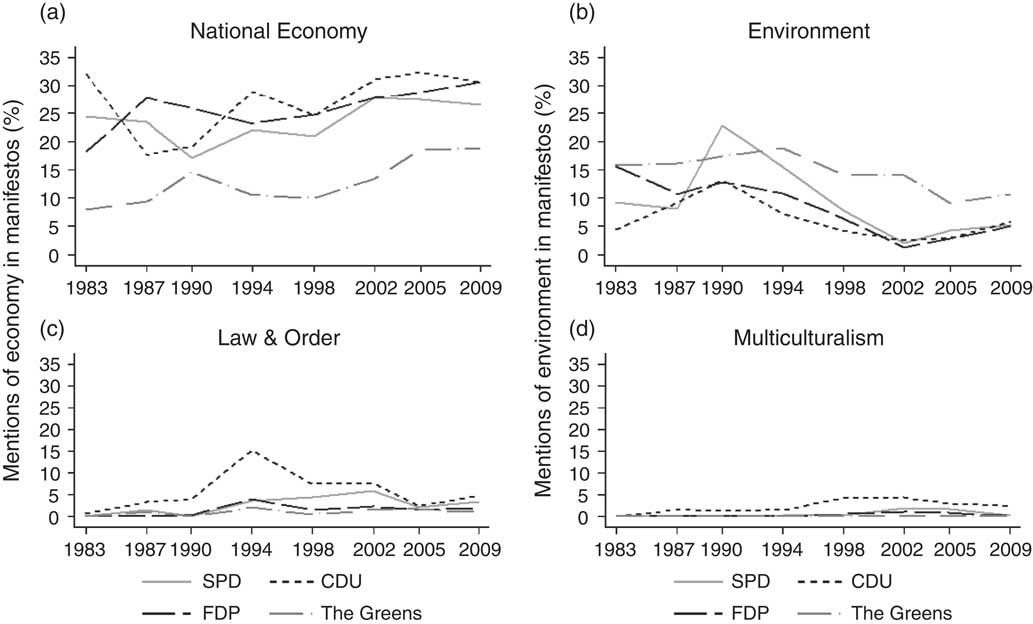
Figure 1 displays data collected by the Comparative Manifesto ProjectFootnote 38 (CMP), which plots the proportions of quasi-sentences in each German party’s election manifesto devoted to economic issues (Figure 1A), the environment (Figure 1B), law and order (Figure 1C), and the sum of the party’s negative references to multiculturalism and their positive references to the national way of life, which appear relevant to immigration issuesFootnote 39 (Figure 1D) for each election held between 1983 and 2009, the time period covered in the individual-level analyses presented below. Based on the long-term issue emphasis trends displayed in the figures, we can identify the associative issue owner of our four analyzed issues. For the economy, Figure 1A documents that the three mainstream parties all emphasized economic issues, that is, there is no clear issue owner on the economy but the Green Party is the clear associative issue ‘loser’. Regarding the environment, the patterns in Figure 1B confirm that – as expected – the Greens are the associative issue owner, emphasizing this issue over 50 per cent more than any mainstream party. Figures 1C and 1D document that the CDU disproportionately emphasized law and order issues while making more negative references to multiculturalism (and positive references to the national way of life) than the other parties, thus it appears to be the associative issue owner of law and order and immigration. These patterns across the different issue domains comport well with experts’ understanding of German parties’ long-term issue emphases.Footnote 40 We expect German citizens’ issue salience and partisanship linkages to reflect the associative issue ownership patterns implied by the German parties’ long-term issue emphases.
Proportions of the German parties’ election manifestos devoted to four policy issues Note: the figures display the proportions of quasi-sentences in each German political party’s election manifesto that pertained to four different political issues, as coded by the Comparative Manifesto Project, for each election manifesto published between 1983 and 2009.

Empirical Analysis
We evaluate our hypotheses by analyzing data from a unique twenty-six-wave German panel study, the German Socio-Economic Panel (GSOEP), which tracks citizens’ party support and issue salience between 1984 and 2009 through annual face-to-face interviews.Footnote 41 We analyze 19,777 respondents with at least three observations on the party support and issue priority variables, the minimum number required to estimate our models.Footnote 42 We conducted supplementary analyses using higher cut-off points, which supported substantive conclusions identical to those we report below.
The key variables in our analyses pertain to respondents’ partisanship and issue salience. The partisanship question reads: ‘Many people in Germany are inclined to a certain political party, although from time to time they vote for another political party. What about you: Are you inclined – generally speaking – to a particular party?’. Those who responded ‘Yes’ were then asked ‘Which one?’ and handed a card that listed all the parties. Those giving ‘no answer’ or ‘don’t know’ were marked as missing. The dependent variable was measured by distinguishing the supporters of the four major parties – the SPD, CDU, FDP and the Green Party – from independents and partisans of smaller parties.
Issue salience was measured by the degree of concern respondents expressed with respect to a series of issues. The question wording was: ‘What about the following areas: Are you concerned about them? […] 1. Very concerned; 2. Somewhat concerned; 3. Not concerned at all’.Footnote 43 We believe that the statement that somebody is ‘very concerned’ denotes that the respondent prioritizes the issue, and we dichotomize the issue concern variable accordingly.Footnote 44 We analyzed respondents’ concerns about environmental protection, general economic development, crime and immigration; the latter issue is plausibly related to concerns about multiculturalism and the national way of life, the relevant issue domains that are included in the CMP codings.Footnote 45 The issue salience questions pertaining to the economy and the environment were asked across all twenty-six waves of the 1984–2009 GSOEP survey, and those pertaining to crime and immigration were asked between 1999 and 2009.
Exploring Citizens’ Issue Salience
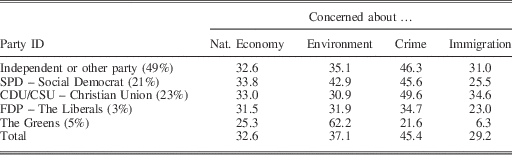
Table 1 reports the proportions of respondents that expressed concern about the four issue areas, stratified by party support. We see that partisans’ issue concerns reflected their preferred party’s manifesto-based emphases, in that the proportion of Green supporters that expressed environmental concerns (62 per cent) far exceeded the corresponding proportions for mainstream parties’ supporters and for independents (none of these groups exceeded 43 per cent), while Green partisans expressed far less concern over the economy, crime and immigration than did other respondents. This supports the view of the Green Party as a single-issue niche party associated with the environment. In addition, consistent with the CDU’s manifesto-based emphases, CDU supporters expressed the most concern about both crime and immigration.
German Partisanship and Issue Salience (in %)

Note: the table reports the proportions of partisans (and independents) that stated they were concerned about each issue. The percentages are computed over the set of 14,912 respondents who gave valid responses in at least three waves of the German Socio-Economic Panel (GSOEP) that tracked respondents’ party support and issue priorities between 1999 and 2009. The GSOEP questions relating to respondents’ issue priorities and their party support are given in the text. Of the 49 per cent of respondents that is grouped as independent, 2.3 per cent identified with smaller parties.
Statistical Specifications Using Cross-lagged Markov Chain Models
While the figures in Table 1 are suggestive, they do not allow us test the causal order of issue salience and partisanship. Do citizens take issue priority cues from their preferred party, or do their party evaluations drive their pre-existing issue priorities? Moreover, how do these links connect to the issues each party emphasizes in its election manifesto? To evaluate these effects we model the dynamics of GSOEP respondents’ party support and issue salience using cross-lagged Markov Chain modeling, which allows us to consider autocorrelation in repeated observations and include lagged time-varying effects of issue salience on partisanship, and vice versa. Markov models employ a first-order Markovian structure allowing sequences of individual observations to be correlated, and recent studies by Clarke and McCutcheon as well as Neundorf, Stegmueller and Scotto demonstrate that these models correctly specify the dynamics of individual-level partisanship.Footnote 46
Specifying the impact of respondents’ lagged issue salience on their current partisanship (partisan updating effects)
We model party support via a series of multinomial logit equations. Specifically, the probability that respondent i states that she is a partisan of party k at time t, relative to the probability that i is classified as an independent, is estimated as a function of overall intercepts, i’s reported partisanship at the previous panel wave at time t−1 (the effect of which is allowed to vary over time),Footnote 47 and i’s expressed concerns about the economy, the environment, crime or immigration at time (t−1). We estimated four different models to include one issue at a time. In the case of West Germany, which features four major parties and the example of environmental concerns, this model is specified as follows:Footnote 48
 $$\eqalignno{ \log \left[ {{{P(Greens_{i} (t){\,=\,}1)} \over {P(Nonpartisan_{i} (t){\,=\,}1)}}} \right]{\,=\,} \beta _{{0G}} {\plus}\beta _{{1Gt}} Greens_{i} (t{\minus}1){\plus}\beta _{{2Gt}} SPD_{i} (t{\minus}1){\plus}\beta _{{3Gt}} CDU_{i} (t{\minus}1){\plus} \cr \beta _{{4Gt}} FDP_{i} (t{\minus}1){\plus}\beta _{{5G}} environment_{i} (t{\minus}1) $$
 $$\eqalignno{ \log \left[ {{{P(SPD_{i} (t){\,=\,}1)} \over {P(Nonpartisan_{i} (t){\,=\,}1)}}} \right]{\,=\,} & \beta _{{0S}} {\plus}\beta _{{1St}} Greens_{i} (t{\minus}1){\plus}\beta _{{2St}} SPD_{i} (t{\minus}1){\plus}\beta _{{3St}} CDU_{i} (t{\minus}1){\plus} \cr & \beta _{{4St}} FDP_{i} (t{\minus}1){\plus}\beta _{{5S}} environment_{i} (t{\minus}1) $$
 $$\eqalignno{ \log \left[ {{{P(CDU_{i} (t){\,=\,}1)} \over {P(Nonpartisan_{i} (t){\,=\,}1)}}} \right]{\,=\,} & \beta _{{0C}} {\plus}\beta _{{1Ct}} Greens_{i} (t{\minus}1){\plus}\beta _{{2Ct}} SPD_{i} (t{\minus}1){\plus}\beta _{{3Ct}} CDU_{i} (t{\minus}1){\plus} \cr & \beta _{{4Ct}} FDP_{i} (t{\minus}1){\plus}\beta _{{5C}} environment_{i} (t{\minus}1) $$
 $$\eqalignno{ \log \left[ {{{P(FDP_{i} (t){\,=\,}1)} \over {P(Nonpartisan_{i} (t){\,=\,}1)}}} \right]{\,=\,} & \beta _{{0F}} {\plus}\beta _{{1Ft}} Greens_{i} (t{\minus}1){\plus}\beta _{{2Ft}} SPD_{i} (t{\minus}1){\plus}\beta _{{3Ft}} CDU_{i} (t{\minus}1){\plus} \cr & \beta _{{4Ft}} FDP_{i} (t{\minus}1){\plus}\beta _{{5F}} environment_{i} (t{\minus}1) $$
In Equation 1, β 1Gt , β 2Gt , β 3Gt , β 4Gt are stability coefficients that denote how i’s lagged partisanship affects her current likelihood of supporting the Green Party (relative to her likelihood of being independent), where Greens i (t−1), SPD i (t−1), CDU i (t−1), FDP i (t−1) are dummy variables that equal 1 if i supported the focal party at time (t−1) and 0 otherwise. Of course, we expect that respondents who supported the Greens at time (t−1) are likely to support the Greens at time t (that is, we expect a positive coefficient estimate on β 1Gt ). Note that we also estimate the effects on Green Party support of respondents’ lagged support for the SPD, CDU and FDP, to evaluate whether different parties’ elites provide differing cues with respect to the Green Party. For instance, we might expect SPD elites to cue their supporters to positively evaluate the Greens, given these parties’ history of collaboration in national government.
The coefficient β 5G in Equation 1 denotes the impact of i’s lagged environmental concerns – represented by the dummy variable environment i (t−1) – on i’s partisanship at time t. A positive (negative) cross-lagged coefficient estimate on β 5G denotes that i’s lagged environmental concerns enhance (depress) her likelihood of currently supporting the Green Party, which would be evidence of a partisan updating effect with respect to the Greens.
Specifying the impact of respondents’ lagged partisanship on their current issue salience (issue cueing effects)
We specify the probability that a respondent will prioritize a focal issue at time t as a function of overall intercepts, her lagged issue salience at time (t−1) as time-varying period effects and her lagged partisanship. Below we present the specification for citizens’ environmental salience; the specifications for the remaining issues (the economy, crime and immigration) display the same functional form:
 $$\eqalignno{ \log \left[ {{{P(environment_{i} (t){\,=\,}1)} \over {P(environment_{i} (t){\,=\,}0)}}} \right]{\,=\,} & \alpha _{0} {\plus}\alpha _{{1t}} environment_{i} (t{\minus}1){\plus}\alpha _{2} Greens_{i} (t{\minus}1) \cr & {\plus}\alpha _{3} SPD_{i} (t{\minus}1){\plus}\alpha _{4} CDU_{i} (t{\minus}1){\plus}\alpha _{5} FDP_{i} (t{\minus}1). $$
In Equation 5, α 1t is a stability coefficient that influences respondents’ environmental concerns,Footnote 49 while the cross-lagged coefficients α 2, α 3, α 4 and α 5 capture the partisan updating effects of lagged partisanship. Thus a positive estimate on α 2, the coefficient on the Greens i (t−1) variable, will denote that respondents who supported the Green Party at time (t−1) were more likely to express environmental concerns at time t, when controlling for lagged environmental concerns – an est i mate that would imply that the Greens cue their supporters to prioritize the environment. The coefficients α 3, α 4 and α 5 represent parallel estimates of environmental cues associated with lagged support for the SPD, CDU and FDP.
Control variables on partisanship and issue salience
Our specifications included individual-level covariates to capture factors that affected respondents’ partisanship and issue salience when they first entered the panel.Footnote 50 We expect education, occupation, age, gender, church attendance, and political interest to affect respondents’ initial partisanship and issue salience. For example, our estimates – reported in the online appendix – imply that politically interested respondents were more likely to be partisans and to prioritize political issues.
Results
The Reciprocal Impact of Issue Salience and Partisanship
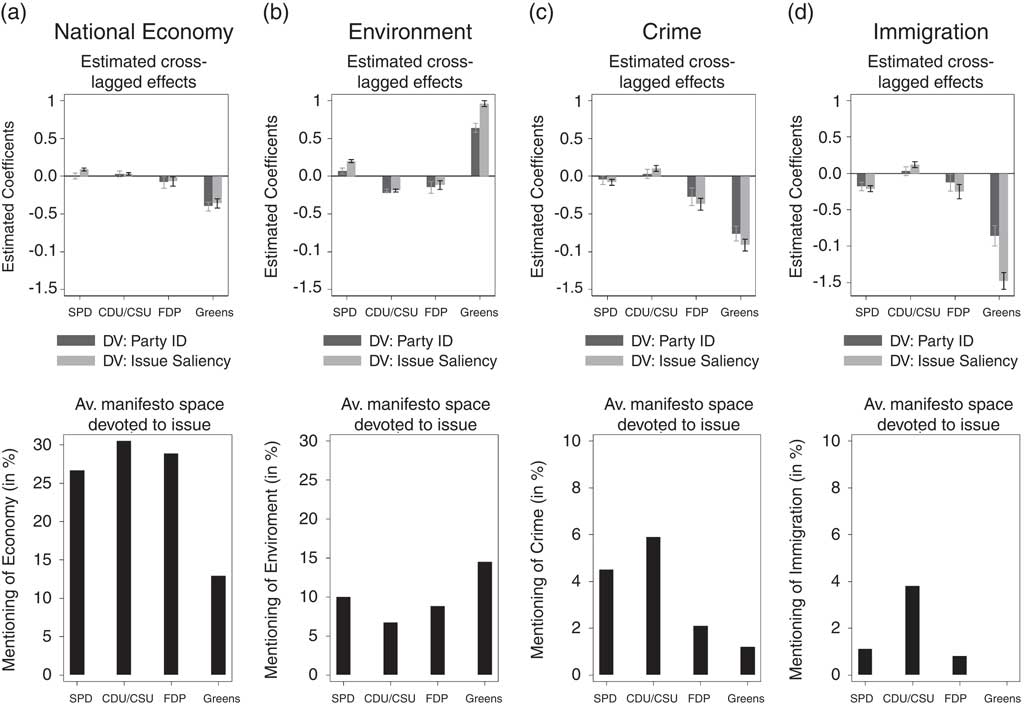
The upper panels (gray bars) of Figures 2A–2D display the estimated logit coefficients for Equations 1–5, along with the 95 per cent confidence intervals for these estimates.Footnote 51 The dark gray bars represent the partisan updating effects of respondents’ lagged issue salience on their current party support for the four issue areas we analyze, while the light gray bars display the coefficients of lagged partisanship on current issue priorities, that is, issue cueing effects.
Comparing averaged German parties’ manifestos (1983–2009) and estimated cross-lagged effects Note: the upper figures (gray bars) display the estimated cross-lagged logit coefficients and the corresponding 95 per cent confidence intervals. The dark gray bars in Figures 2A–D display the estimates of the partisan updating effects (DV=partisanship) and are based on a multinomial logistic regressions in which the base category is no (or other) party identification (see Equations 1–4 in the text). The light gray bars display the estimates of the issue cueing effects (DV=issue saliency) and are based on a logistic regression in which the base category is not being concerned with the focal issue (see Equation 5 in the text). The lower figures (black bars) display the average proportion of quasi-sentences in party manifestos measured by the CMP devoted to the issue.

The results displayed in the upper panels of Figures 2A–2D support the Reciprocal Effects Hypothesis (Hypothesis 1), that citizens’ issue salience both influences and is influenced by their party support. The estimates in Figure 2B denote that, holding lagged partisanship constant, respondents with lagged environmental concerns were more likely to support the Green Party and the SPD – and less likely to support the CDU and the FDP – in the current panel, that is, the coefficients on lagged environmental concerns are positive for the Greens and the SPD and negative for the CDU and the FDP (p<0.01 in all cases). Reciprocally, we estimate that lagged support for the Greens and the SPD cued respondents to prioritize the environment in the current panel, while lagged CDU and FDP support cued respondents to de-emphasize this issue (p<0.01). For the economy (Figure 2A), we estimate that lagged support for the CDU and the SPD cued respondents to prioritize this issue in the current panel, while lagged Green Party support cued respondents to de-emphasize the issue (p<0.01 in all cases). Finally, Figures 2C–2D display estimates that lagged crime and immigration concerns prompted respondents to support the CDU but to withdraw support from the FDP, the SPD and the Greens in the current panel wave (p<0.01), and, reciprocally, that respondents who reported lagged support for the FDP, SPD and the Green Party de-emphasized these issues in the current panel (p<0.01). These estimates support the Reciprocal Effects Hypothesis (Hypothesis 1).
The results displayed in Figures 2A–2D also suggest that issue cueing effects were generally larger than partisan updating effects. We see that especially for the Green Party, green partisanship strongly cues voters to prioritize the environment while de-emphasizing the economy, crime and immigration, which supports the Green Party’s profile as a single-issue niche party. We also estimate stronger issue cueing effects for SPD supporters for the economy and the environment, compared to the reciprocal partisan updating estimates.Footnote 52
The question arises: Can we infer causal relationships from our statistical estimates – that is, that citizens’ party support and issue saliences reciprocally influence each other? We see strong reasons to infer such causal effects. With respect to issue cueing, we uncover strong associations between survey respondents’ lagged party support and their current issue salience, even when controlling for respondents’ lagged party support. Given our theoretical reasons to expect citizens to take issue-based cues from parties, and given that we also control for respondents’ education, occupation, age, gender, church attendance and political interest – factors that might jointly influence citizens’ issue priorities and their party support – we infer that citizens’ party support indeed influences their issue salience. This inference is strengthened by the empirical analyses we report below, which directly link the individual-level issue cueing processes we estimate to parties’ associative issue ownership, as measured by their manifesto-based issue emphasis.
Linking Individual-level Issue Effects to Parties’ Issue Ownership
Next, we evaluate whether the issue-based effects we estimate reflect parties’ associative issue ownership as exhibited in their election manifestos. The lower panels of Figures 2A–2D display the parties’ long-term issue emphases, averaged over the period 1983–2009, based on the CMP manifesto codings presented in Figure 1. These party-level issue emphases strongly correlate with the individual-level partisan updating and issue cueing effects we estimate from the German panel data.Footnote 53 For example the Green Party, followed by the SPD, most strongly emphasized environmental issues in their manifestos from 1983–2009 (see the lower panel of Figure 2B), and we estimate positive individual-level partisan updating and issue cueing effects on this issue with respect to these two parties, that is, that lagged environmental concerns enhance citizens’ support for the Greens and the FDP, and that lagged support for these parties reciprocally cues citizens to prioritize the environment. Meanwhile, we estimate negative partisan updating and issue cueing effects on the environment with respect to the CDU and the FDP, the two parties that de-emphasize this issue (see the lower panel of Figure 2B). Overall, the correlation between the parties’ manifesto-based environmental emphases and our estimates of individual-level partisan updating effects for each party is 0.98 (p=0.001).Footnote 54 These strong associations extend to the remaining issues: the CDU places the strongest manifesto-based emphasis on crime and immigration (see the bottom panels of Figures 2C–2D), and it is the only party for which we estimate positive individual-level partisan updating and issue cueing effects on these issues, while we estimate strongly negative individual-level effects with respect to the Greens, the party that devotes the least attention to these issues. The correlation between the parties’ manifesto-based crime emphases and our estimates of individual-level partisan updating effects is 0.90 (p=0.001), while the correlation between the parties’ crime emphases and our estimates of individual-level issue cueing effects on this issue is 0.94 (p=0.001); the correlations on the immigration issue are 0.74 (p=0.001) for individual-level partisan updating effects and 0.75 (p=0.001) for issue cueing effects. Finally, the correlation between the parties’ manifesto-based economic emphases and our estimates of individual-level partisan updating effects is 0.71 (p=0.01), and the correlation between the parties’ manifesto-based economic emphases and our estimated issue cueing effects is 0.63 (p=0.01). These strong links support the Associative Issue Ownership Hypothesis (Hypothesis 2), that citizens’ issue salience and partisanship reflect parties’ long-term associative issue ownership.
Issue Salience, Partisanship and the Niche Party Hypothesis
The estimates displayed in Figure 2 also support the Niche Party Hypothesis (Hypothesis 3), that individual-level partisan updating and issue cueing effects are far stronger for the Greens than for mainstream parties. Specifically, for all four issue areas that we analyze, the coefficient estimates on the Green Party – with respect to both partisan updating and issue cueing – are over three times the magnitudes of the estimates for any mainstream party. (In all cases, the differences between the estimates on the Greens versus mainstream parties are statistically significant, p<0.01.) This striking difference suggests that mass–elite linkages involving the Green Party differ fundamentally from those involving the mainstream parties. Simply put, German citizens’ issue priorities strongly influence – and are influenced by – their support for the Greens, while the parallel effects are modest for mainstream parties. And, we emphasize that this pattern extends to every issue we examine, not only the environment, for which we find – as expected – that environmental concerns push citizens toward the Green Party (and vice versa): we also estimate that lagged concerns over the economy, crime and immigration drive citizens sharply away from the Greens – to a much greater extant than such concerns push citizens toward (or away from) any mainstream party – and that lagged Green Party support sharply depresses the likelihood that a respondent will prioritize these issues.
Illustrating the Reciprocal Effect of Partisanship and Issue Salience
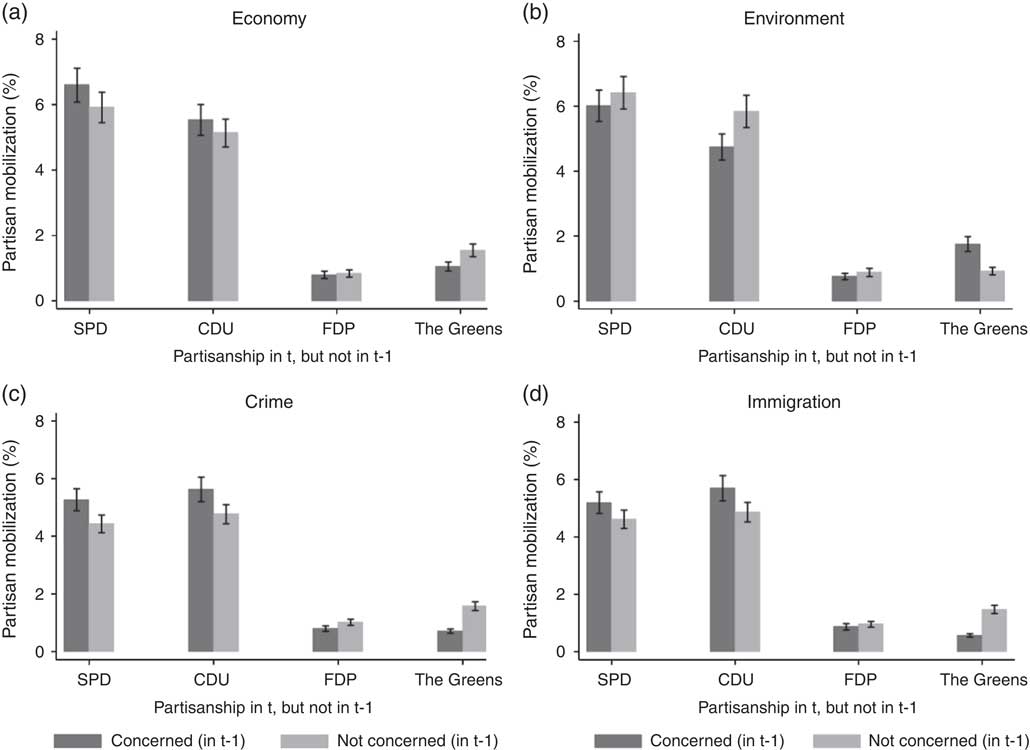
Figure 3 displays the impact of partisan updating on political parties’ ability to attract new supporters from one panel wave to the next, an effect we label partisan inflow. Figure 3 displays the predicted probabilities that lagged independents, that is, respondents who self-identified as independents in the previous panel wave, would switch their partisanship to each party in the current wave, stratified by the respondent’s lagged concerns about the economy (Figure A), the environment (Figure B), crime (Figure C) and immigration (Figure D). The figure shows that the Green Party significantly boosts its partisan inflow among respondents who reported lagged environmental concerns (see Figure 3B), while lagged independents’ concerns about the economy, crime and immigration substantially depress these respondents’ likelihoods of switching their support to the Greens in the current panel (see Figures 3A, 3C and 3D). Meanwhile, the partisan updating processes are precisely the opposite with respect to the CDU: independents’ lagged concerns about the environment substantially depress the probability that they will switch to the CDU in the current panel wave, while lagged concerns about the remaining issues enhance the likelihood that a lagged independent will switch her support to the CDU.
Predicted partisan inflow as a function of respondents’ lagged issue salience Note: this figure displays the computed partisanship inflow (including 95 per cent confidence intervals), stratified by lagged issue salience. These computations are based on the parameter estimates reported in Figure 2.

Our estimates on the electoral effects of parties’ issue emphases – for both the mainstream German parties and the niche Green Party – are of comparable magnitudes to the electoral effects of their issue positions, as estimated in previous research. In particular, previous research by Adams et al. suggests that realistic changes in European parties’ left-right issue positions only moderately influence citizens’ party support.Footnote 55 While our estimates on the electoral effects of German parties’ issue emphases are not trivial – given that a vote-share shift of 2 or 3 percentage points can easily shift the balance of power between rival proto-coalitions of German parties – the modest magnitudes of these estimates underline the fact that national election outcomes in Germany (and elsewhere) turn on many factors in addition to the parties’ issue emphases, including their issue positions, national economic conditions, short-term political crises and scandals, party leaders’ images and the effectiveness with which parties communicate their messages during election campaigns.
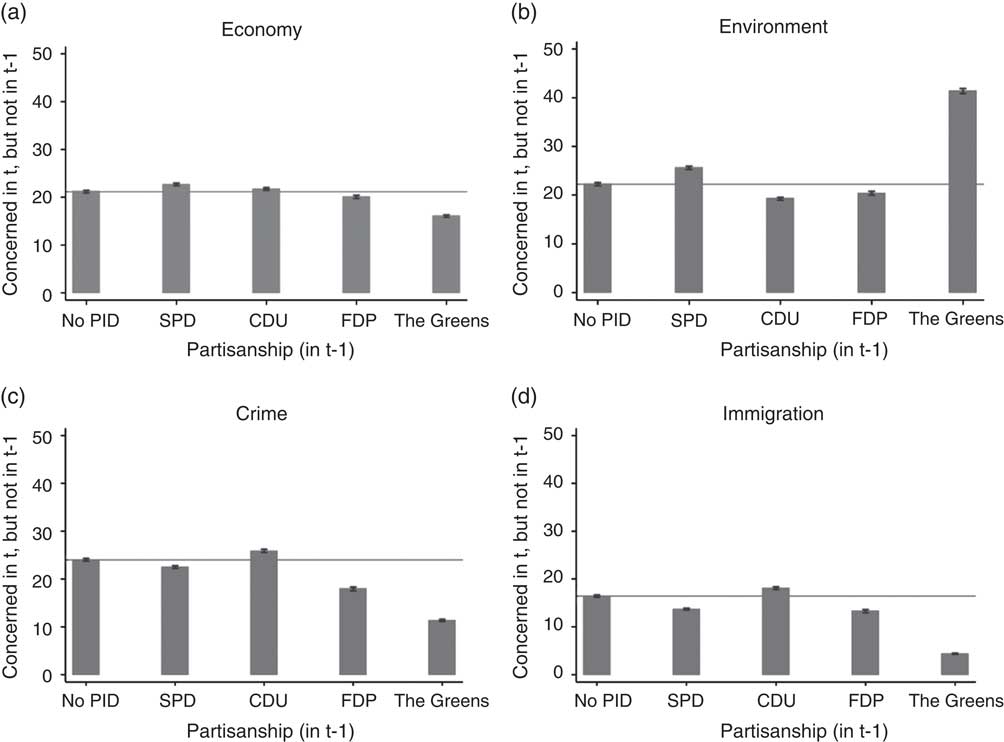
Figure 4 displays the substantive impact of our estimated issue cueing effects, by plotting the computed probabilities that respondents who did not prioritize the focal issue (the economy, the environment, crime or immigration) in the previous panel wave would prioritize this issue in the current wave, as a function of lagged partisanship. Consistent with the niche party hypothesis, we see that lagged Green Party support strongly cued respondents’ current issue priorities. Figure 4B illustrates that, among respondents who did not report lagged environmental concerns, those who were political independents in the previous panel had a computed 22.2 per cent probability of prioritizing the environment in the current panel wave, while for lagged Green Party supporters this probability jumped to 41.3 per cent, nearly double that of independents. The figure also displays how strongly the Green Party cued its supporters to de-emphasize other issue areas: Figures 4A, 4C and 4D display computations that, among respondents who did not prioritize the economy, crime or immigration in the previous panel wave, lagged independents had computed probabilities of 21.1 per cent, 23.8 per cent and 16.4 per cent, respectively, of prioritizing these issues in the current panel, while lagged Green Party supporters’ probabilities of prioritizing these issues were only 16.4 per cent, 11.3 per cent and 4.3 per cent. These estimates imply that the Green Party strongly cued its supporters’ attention toward the environment, and away from all other issues. This suggests that the dramatic differences in Green Party supporters’ issue priorities vis-à-vis mainstream partisans’ priorities, presented in Table 1, reflect in part Green Party elites’ abilities to shape their supporters’ issue priorities.
Predicted issue salience inflow as a function of respondents’ lagged partisanship Note: this figure displays the computed issue salience inflow (including 95 per cent confidence intervals), stratified by lagged partisanship. These computations are based on the parameter estimates reported in Figure 2, of the effects of lagged partisanship on German Socio-Economic Panel respondents’ issue salience. The vertical lines correspond to the mean issue salience inflow among independents.

Figures 4A–4D also display computations on the mainstream parties’ (more modest) abilities to shape their supporters’ issue salience. On crime and immigration, Figures 4C–4D illustrate that lagged support for the CDU – the party that most strongly highlighted these issues in its manifestos – increased respondents’ likelihood of prioritizing crime and immigration in the current panel wave by 2–4 percentage points (compared to lagged independence), while lagged support for the SPD and the FDP decreased respondents’ likelihood of prioritizing these issues by 2–6 percentage points. With respect to the environment, Figure 4B illustrates that lagged support for the SPD – which emphasized environmental issues more strongly than the CDU and FDP (see the bottom panel of Figure 2D) – increased respondents’ likelihood of prioritizing the environment by about 3 percentage points, while lagged CDU and FDP support depressed the likelihood of subsequent environmental concerns by 2–3 percentage points.
Robustness Checks
We conducted several analyses to assess the robustness of our conclusions, which we report in the online appendix. First, we analyzed whether our findings varied depending on which parties were currently in the national governing coalition, and we also estimated the parameters of specifications with longer time lags for the reciprocal relationships modeled in the article, compared to the one-year lags specified above. In addition, to investigate the effects of possible measurement error, we replicated our models while specifying partisanship as a latent variable. These analyses continue to support our substantive conclusions: we found that mass–elite linkages varied only modestly depending on the governing coalition, and our conclusions are robust to specifications with longer time lags and those that account for measurement error.
British Issue Ownership and Citizens’ Partisanship–Issue Saliency Linkage
We extend our study of mass–elite issue linkages to Britain by analyzing data from the British Household Panel Study (BHPS), an annual survey of British households that began in 1991.Footnote 56 We investigate two issue areas covered in the BHPS that parallel the issues we analyzed for Germany. From 1992–96 the BHPS included a battery of questions three times asking respondents how much they were concerned about ‘unemployment’ (welfare) and ‘the destruction of the ozone layer’ (environment). Respondents could answer 1 (a great deal), 2 (fair amount), 3 (not very much) or 4 (not at all). We ascribed issue salience to those who responded ‘a great deal’.Footnote 57
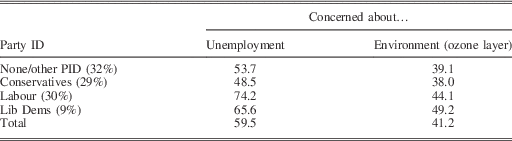
The three major British parties during the 1992–96 period of our study were the Conservatives, Labour and the smaller Liberal Democrats. We distinguish the partisans of these parties from independents and smaller parties’ supporters (only 1.3 per cent of BHPS respondents identified with any other party during this period).Footnote 58 Table 2 reports the proportions of respondents that stated they were concerned with each of the issue areas listed above, stratified by party support. The patterns displayed in this table match the parties’ long-term issue emphases (discussed below): Labour partisans expressed the most concern about unemployment, while Liberal Democrats expressed the most concern about the environment.
British Partisanship and Issue Saliency (in %)

Note: the table reports the proportions of partisans and independents that stated they were concerned about each issue. The wordings and codings of the issue concern and the party support questions are given in the text. Source: British Household Panel Study, 1991–96.
To evaluate the reciprocal linkages between British citizens’ party support and their issue salience, we estimated the same types of cross-lagged Markov Chain models that we applied to the German panel data. To estimate partisan updating effects, we specified respondents’ party support using a series of multinomial logit equations that parallel Equations 1–4 above: the independent variables included the respondent’s lagged partisanship and lagged concern about the focal issue (unemployment or the environment).Footnote 59 To estimate issue cueing effects, we specified respondents’ issue salience via a series of multinomial logit equations that parallel Equation 5 above, in which the dependent variable was the respondent’s expressed concern about the focal issue area, and the key independent variables included the respondent’s lagged concern about this issue and lagged partisanship.
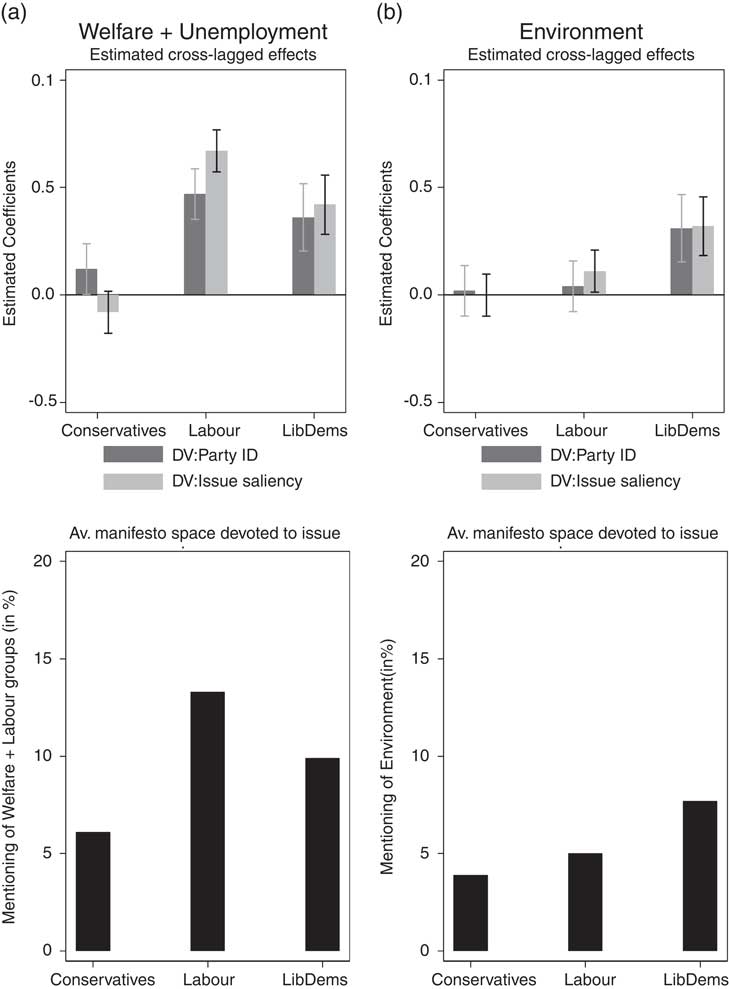
Figure 5 displays our estimates of the issue cueing and partisan updating effects that interest us, which reveal significant evidence of reciprocal linkages between British citizens’ issue priorities and their party support. The parameter estimates displayed in the top panel of Figure 5A denote that BHPS respondents’ lagged support for the Labour and Liberal Democratic parties enhanced their concern about unemployment in the current panel wave, and, reciprocally, that respondents’ lagged welfare concerns enhanced their probability of supporting the Labour and Liberal Democratic parties in the current panel. The parameter estimates displayed at the top panel of Figure 5B imply similar positive issue cueing and partisan updating effects with respect to the Liberal Democratic Party over the environmental issue. These estimates support the Reciprocal Effects Hypothesis (Hypothesis 1), that citizens’ issue salience both influences and is influenced by their partisan affiliations. Furthermore, consistent with our Associative Issue Ownership Hypothesis (Hypothesis 2), the reciprocal effects we estimate match the British parties’ issue emphases. The bottom panel of Figure 5A shows that Labour most strongly emphasized welfare issues in their 1992 and 1997 election manifestos, while the Liberal Democrats most strongly emphasized the environment (see the bottom panel of Figure 5B).
Comparing estimated cross-lagged effects and averaged British parties’ manifestos (1992–96) Note: the upper figures (gray bars) display the estimated cross-lagged logit coefficients and the corresponding 95 per cent confidence intervals. The dark gray bars display the estimates of the partisan updating effects and are based on a multinomial logistic regression in which the base category is no (or other) party identification. The light gray bars display the estimates of the issue cueing effects and are based on a logistic regression in which the base category is not being concerned with the focal issue. The coefficient estimates in Figures 5A and 5B are computed over the set of respondents that gave valid responses in all three waves; these questions were included in the British Household Panel Study over the period 1992–96. The specifications also included individual-level covariates to account for factors that affected respondents’ partisanship and issue concerns when they first entered the panel. The estimates on these coefficients are available upon request. The lower figures (black bars) display the average proportion of quasi-sentences in party manifestos measured by the CMP devoted to the welfare + Labour groups (A), environment (B) averaged across the two elections in 1992 and 1997. These time points correspond to the individual-level data availability.

In summary, while the British party system does not feature a prominent niche party, and thus we cannot evaluate the niche party hypothesis, our analyses of individual-level survey data from the BHPS – in conjunction with the CMP codings of British parties’ election manifestos – continue to support the Reciprocal Effects Hypothesis and the Associative Issue Ownership Hypothesis. Therefore we conclude that: (1) British citizens’ issue priorities both influence and are influenced by their partisan affiliations and (2) British parties’ manifesto-based issue emphases are associated with citizens’ issue priorities and their party support. These findings on Britain, a political system that differs from Germany’s in that it features fewer major parties, plurality-based elections and (typically) single-party governments, suggest that the reciprocal issue cueing and partisan updating effects we identify – along with the links between citizens’ issue priorities and parties’ associative issue ownership – may constitute a general pattern across Western European party systems.
Discussion and Conclusion
We believe our findings have several implications for issue ownership theory and for mass–elite issue linkages. First, our results support the micro-foundation of issue ownership theory. We have presented theoretical arguments and empirical evidence that German and British citizens reward parties that emphasize the issue areas that voters consider salient, a partisan updating effect. However, we also present evidence of an issue cueing effect, that citizens reciprocally update their issue salience in response to their preferred party’s issue emphases.
Furthermore, we have identified two party-level factors that moderate the individual-level partisan updating and issue cueing effects that we identify. First, we present empirical support for an Associative Issue Ownership Hypothesis, that parties’ issue emphases as articulated in their election manifestos are associated with citizens’ tendencies to update their party support to fit their pre-existing issue priorities, and to reciprocally update their issue priorities to fit with their pre-existing party support. Secondly, our findings supporting the Niche Party Hypothesis imply that the German Greens not only emphasize different issues from the mainstream parties, but that issue linkages between the Green Party and its supporters are far stronger than the mass–elite linkages involving the CDU, SPD and FDP. This implies that the Greens’ electoral fortunes disproportionally rise or fall based on their success in establishing the ‘terms of the debate’ in German national elections, that is, that the issue emphasis model of electoral competition advanced by scholars such as Petrocik as well as Belanger and Meguid is especially relevant to the Green Party.Footnote 60 Furthermore, our findings suggest that Green Party supporters’ strong environmental concerns – and their lack of concern about the economy, crime and immigration – reflect not only German citizens choosing the Green Party on the basis of their issue priorities, but the party’s success in shaping their supporters’ issue priorities.
Our findings raise several questions for future research. The first is: To what extent do our findings for the German Green Party generalize to green parties outside of Germany, and to niche parties more generally? We are cautious about answering this question for two reasons. First, since the British party system does not feature a prominent green party (or any other niche party), we cannot evaluate the niche party hypothesis in this context. Secondly, while we have presented several alternative theoretical arguments to support our hypothesis, including arguments pertaining to niche parties’ organizational characteristics, the policy focus of niche parties’ political elites and the greater political engagement of niche party supporters, our empirical analyses of the German Green Party do not allow us to parse out these alternative explanations. Hence while we believe we present a convincing case for the niche party hypothesis, we defer consideration of the generalizability of this finding to future research.
Other issues that we plan to explore in future research include the character of mass–elite issue linkages with respect to the small, far-left German party Die Linke (formerly the Party of Democratic Socialism), which only become relevant in West German politics after 2004; whether parties’ issue emphases respond to their supporters’ issue concerns even as these parties reciprocally cue their supporters’ concerns (as we demonstrate in this article); whether parties can cue citizens’ issue concerns in the wider public (that is, beyond those who are their current supporters);Footnote 61 and how the reciprocal partisan updating and issue cueing processes we identify are mediated by citizens’ levels of education and political interest.
Finally, in future research we will explore the linkages between parties’ issue emphases and their issue positions. While here we treat parties’ issue emphases as distinct from their positions, for some issue areas that we analyze, parties’ issue emphases correlate with their positions, in that parties that emphasize the environment (such as the German Green Party) or crime (such as the German CDU) also take distinct positions on these issues – and the same pattern plausibly holds at the level of the mass public. Determining how the individual-level effects we estimate jointly depend on citizens’ positional- and emphasis-based considerations will require individual-level panel data that incorporates positional and salience items in the same survey – data that to our knowledge are not currently available. Such analyses could allow us to enhance our understanding of how salience- and position-based considerations reciprocally influence citizens’ party support.