Introduction
Crucial questions in understanding the origins of antisocial and criminal behavior (CB) include (i) the magnitude of the genetic contributions to these traits, (ii) the relationship between genetic risk factors in men and women, and (iii) the specificity of these risk factors for subtypes of antisocial behavior and CB. A long tradition of twin research dating back to the early years of the 20th century has examined the role of genetic factors in CB (Lange, Reference Lange1929; Rosanoff et al. Reference Rosanoff, Handy and Plesset1934). Classic twin studies performed using national registers in both Denmark (Christiansen, Reference Christiansen and Hood1974) and Norway (Dalgard & Kringlen, Reference Dalgard and Kringlen1976) found heritable influences on broadly defined officially recorded CB (including violent and non-violent forms). Several studies have compared genetic and environmental effects of antisocial behaviors in men and women (Rhee & Waldman, Reference Rhee and Waldman2002; Ferguson, Reference Ferguson2010), and found little evidence for quantitative differences. However, there are far fewer genetically informative studies that examine whether genetic and familial environmental risk factors for antisocial behavior and crime are the same in men and women. This may be due, in part, to the relatively low base rates of serious criminal offending in women compared to men (Barker et al. Reference Barker, Seguin, White, Bates, Lacourse, Carbonneau and Tremblay2007; Burt, Reference Burt2012). Existing literature on differences in antisocial behavior and criminal offending among males and females indicates that males exhibit higher rates of antisocial and criminal behavior, even compared to active female offenders, and there is greater similarity between males and females in self-reported drug and alcohol-related behaviors (Moffitt et al. Reference Moffitt, Caspi, Rutter and Silva2002). Additionally, as noted by Burt (Reference Burt2012), the vast majority of relevant studies tend to use a unitary construct of antisocial and criminal offending, thus obscuring any possible differences between subtypes of behaviors.
More recent research has progressed to examining broad subtypes that reflect related but distinct forms of antisocial and criminal offending behaviors, dividing specific antisocial and criminal offending behaviors into two categories reflecting overt and covert behavior (Loeber & Schmaling, Reference Loeber and Schmaling1985; Tremblay, Reference Tremblay2010; Burt, Reference Burt2012). Overt antisocial and criminal offending behaviors refer to acts such as physical aggression, fighting, oppositional-defiance, and all forms of violent crime (e.g. robbery, rape, homicide). Covert behaviors generally refer to rule-breaking behaviors such as lying, cheating, stealing, all property crimes (e.g. theft, burglary), social disorder crimes (e.g. vandalism, trespassing) and also substance use. Prior twin studies based on self-reports or informant reports also suggest differences in genetic and environmental influences on these subtypes of antisocial behavior (Burt, Reference Burt2009; Kendler et al. Reference Kendler, Aggen and Patrick2012, Reference Kendler, Aggen and Patrick2013a ). For example, Burt's (Reference Burt2009) meta-analysis of 103 twin and adoption studies reported that genetic influences accounted for 65% of the variance in heritability for overt antisocial behavior, such as physical aggression. With regard to the heritability of covert behaviors that reflect rule breaking, genetic influences were found to account for 48% of the variance. There is also considerable research examining the specificity in the genetic and environmental risk for these subtypes of antisocial and criminal offending behaviors (Bartels et al. Reference Bartels, Hudziak, van den Oord, van Beijsterveldt, Rietveld and Boomsma2003; Monuteaux et al. Reference Monuteaux, Fitzmaurice, Blacker, Buka and Biederman2004; Barker et al. Reference Barker, Larsson, Viding, Maughan, Rijsdijk, Fontaine and Plomin2009; Burt, Reference Burt2012). Using parent reports for a sample of 3000 adolescent twins, Bartels et al. (Reference Bartels, Hudziak, van den Oord, van Beijsterveldt, Rietveld and Boomsma2003) found that the correlation between overt and covert antisocial behaviors was largely the result of shared genetic influences. Burt (Reference Burt2012) reviewed other studies that addressed this question using interview or questionnaire data and found varying results ranging from fairly modest to substantial levels of overlap in genetic risk for what was termed ‘physically aggressive’ versus ‘non-aggressive rule breaking’ antisocial behavior.
In this report, we build upon the existing literature examining genetic and environmental influences on antisocial and criminal behavior among twins by examining officially recorded criminal convictions among a population-based sample of Swedish twins. We examine results from matching the Swedish National Twin Registry (Pedersen et al. Reference Pedersen, Lichtenstein and Svedberg2002) to the Swedish Crime Register to address the following questions. First, to what extent do genetic and shared environmental risk factors contribute to liability to total CB? Second, by including both males and females in these analyses, can we examine the degree to which genetic and familial environmental risk factors for crime are similar or different across the sexes?
In male–male twin pairs only, we then examine overt and covert forms of CB by focusing on convictions for violent (VCB), white-collar (WCCB) and property criminal behavior (PCB), and address two further questions. First, how similar is the overall importance of genetic and environmental risk factors for these subtypes of crime? Second, do these criminal subtypes differ in the degree to which these risk factors are common to all CB versus subtype specific?
Method
Sample
We linked nationwide Swedish registers using the unique 10-digit identification number assigned at birth or immigration to all Swedish residents. The identification number was replaced by a serial number to ensure anonymity. From the Swedish Twin Registry, we selected all twin pairs with birth years from 1958 to 1991 with known zygosity (n = 21 603). These were matched to the Swedish Crime Register containing all criminal convictions in lower court from 1973 to 2011. We constrained the population to individuals born at the latest 1991, as the age for criminal responsibility in Sweden is 15.
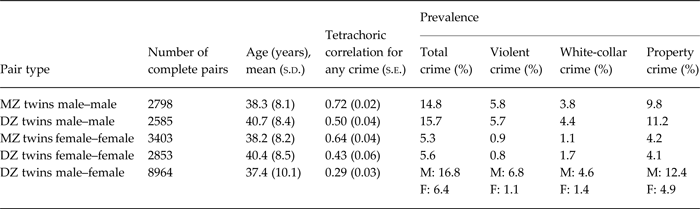
As detailed elsewhere (Lichtenstein et al. Reference Lichtenstein, de Faire, Floderus, Svartengren, Svedberg and Pedersen2002), zygosity in the same-sex pairs from the twin registry was assigned using standard self-report items from mailed questionnaires, which, when validated against biological markers, were 95–99% accurate. As shown in Table 1, the prevalence of CB is slightly lower in both males and females in monozygotic (MZ) and same-sex dizygotic (DZ) pairs versus opposite-sex twin pairs. This is probably because the former but not the latter were screened for level of cooperation because at least one of the pair had to return a questionnaire to the twin registry and cooperation was lower in subjects with CB.
Descriptive statistics of twin pairs

MZ, Monozygotic; DZ, dizygotic; s.d., standard deviation; s.e., standard error; M, male; F, female.
Measures
Our measure of CB was taken from officially recorded data on criminal convictions. We acknowledge that our measure of ‘criminal behavior’ is biased toward the most severe types of offending and does not reflect criminal offending that goes undetected by the criminal justice system. For the purposes of simplicity, we refer to criminal convictions as CB throughout the paper. However, we return to this issue in the discussion section to consider the limitations of using a measure of criminal convictions. We assessed all CB and three subtypes based on the following criminal conviction types: (i) VCB: (aggravated) assault, illegal threats, intimidation and illegal coercion, threats or violence against a police officer, (aggravated) robbery, murder, manslaughter or filicide, kidnapping, arson, sexual crimes (excluding prostitution and the buying of sexual services but including child pornography); (ii) WCCB (fraud, forgery and dishonesty, and embezzlement); and (iii) PCB (theft, vandalism, vandalism causing danger to the public, and trespassing). Our measure of VCB is most conceptually similar to existing measures of overt antisocial behavior and CB whereas our measures of PCB and WCCB are most conceptually consistent with covert measures of behavior.
Statistical methods
We used a classical twin model assuming three sources of liability to CB: additive genetic (A), shared environment (C) and unique environment (E). The model assumes that MZ twins share all their genes and DZ twins share on average half of their genes identical by descent, and that the shared environment, reflecting family and community experiences, is the same within each twin pair. Unique environment includes stochastic developmental effects, environmental experiences not shared by siblings, and random error. In a second step of the analyses, we modeled three different phenotypes (VCB, WCCB and PCB) to investigate to what extent genetic and environmental factors are the same for these three phenotypes. In an independent pathway model, we assume that each of the three variance components (A, C and E) consists of two parts: one that is common to all three phenotypes (denoted AC, CC and EC, where the subscript ‘C’ indicates ‘common’) and one that is specific to each one of them (AS, CS and ES, where the subscript ‘S’ indicates ‘specific’ to an individual form of CB). As the tetrachoric correlation is a parameter in a multivariate normal distribution, it is straightforward to set up the likelihood function. The parameter estimates are the values giving the maximum value. Standard errors are derived from an approximation of the Hessian matrix and confidence intervals (CIs) are likelihood based.
Our univariate twin model of CB used both sexes and we tested for qualitative sex effects. That is, are the same genetic and environmental factors influencing risk of CB in both sexes? Qualitative sex effects are captured by the parameters r g and r c that reflect respectively the degree to which the genetic or shared environmental risk factors are correlated in the two sexes. However, in samples with both A and C effects, r g and r c are confounded and cannot be separately estimated. Here we fit a qualitative sex model with r g = r c.
The prevalence of criminal registration for the twins declined in more recent birth years (data not shown). We know this is a result of right censoring rather than a true decrease in rates of CB because government data for period prevalence in the entire population show a slight increase in total CB over these years (Brå, 2014). To account for this effect, we included an age regression parameter in all of our models.
Although our sample size of twins is considerable, the models include relatively rare phenotypes (CB in females, and VCB and WCCB in males) and have limited statistical power. As the objective was to quantify the magnitude of the variation in the population coming from various sources, we chose to present measures of accuracy of the estimates and avoid hypothesis testing. This is in line with the recommendations based on simulations that show that, in such situations, parameter estimates from the full model are typically more accurate than those from submodels even if the latter provide a better model fit (Sullivan & Eaves, Reference Sullivan and Eaves2002). Models were fit in the OpenMx software (Boker et al. Reference Boker, Neale, Maes, Wilde, Spiegel, Brick, Spies, Estabrook, Kenny, Bates, Mehta and Fox2011).
Results
Analysis of criminal behavior (CB) in both sexes
As outlined in Table 1, across zygosity groups, the frequency of CB was approximately three times greater in males than females. The tetrachoric correlations for CB were substantially higher in MZ than in DZ twins and higher in the same-sex than opposite-sex pairs (Table 1).
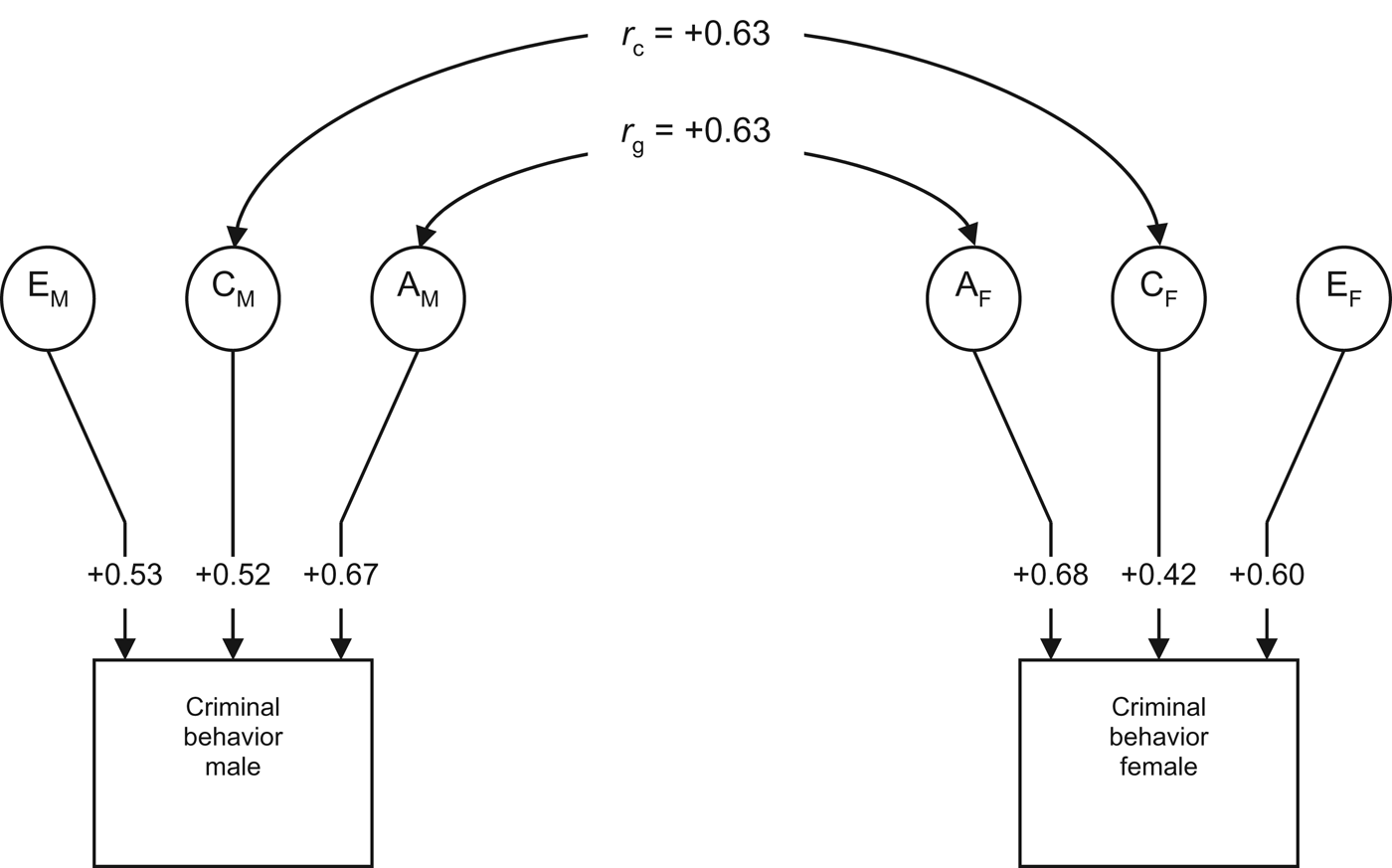
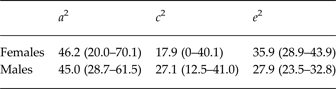
The results of the full model, shown in Fig. 1 and Table 2, have three noteworthy features. First, heritability of CB is moderate (~45%) and similar in the two sexes. Second, shared environmental effects also impact appreciably on risk for CB and account for 27% and 18% of the variance in liability in males and females respectively. Third, r g and r c (set to equality) are estimated at +0.63, suggesting that many, but not all, familial risk factors for CB are shared across the sexes.
Parameter estimates from the full model fitted to total criminal behavior (CB) in male and female Swedish twins. A, Additive genetic effects; C, shared or ‘common’ environment; E, individual specific or unique environment. r g and r c are respectively the genetic and shared environmental correlation between the sexes.

Parameter estimates from the full model a with age regression for females and males for all criminal convictions

a 2, c 2 and e 2 are the additive genetic effects, shared or ‘common’ environmental effects and individual specific or unique environmental effects respectively.
a Estimate of r g = r c = +0.63 ± 0.09.
Values given as percentage (95% confidence interval).
Analysis of violent (VCB), white-collar (WCCB) and property criminal behavior (PCB) in male–male twins
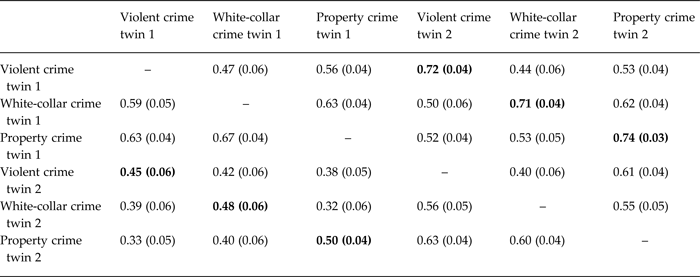
The frequency of registration for VCB, WCCB and PCB in the twin pairs is shown in Table 1. Rates of VCB and WCCB were too low in female twins to permit meaningful analysis so subtype analyses were only undertaken in male–male pairs. The tetrachoric correlations for these three CB subtypes within and between these twin pairs are shown in Table 3. Three results are noteworthy. First, all three criminal subtypes were substantially inter-correlated within individuals. The highest correlation was typically between WCCB and PCB, which represent our covert behavior categories, and the lowest between VCB and WCCB (overt and covert). Second, the correlations for VCB, WCCB and PCB were consistently higher between MZ twins (+0.71 to +0.74) than between DZ twins (+0.45 to +0.50). Third, the tetrachoric correlations across both twin pairs and crime subtypes were consistently lower than the within-subtype correlations (+0.44 to +0.62 in MZ and +0.32 to +0.42 in DZ pairs) and higher in MZ than in DZ twins.
Tetrachoric correlations (and standard errors) for registration for violent, white-collar and property crime within and between monozygotic (MZ) twins (above the diagonal) and dizygotic (DZ) twins (below the diagonal) a

a Correlations for the criminal subtypes within twin pairs are in bold.
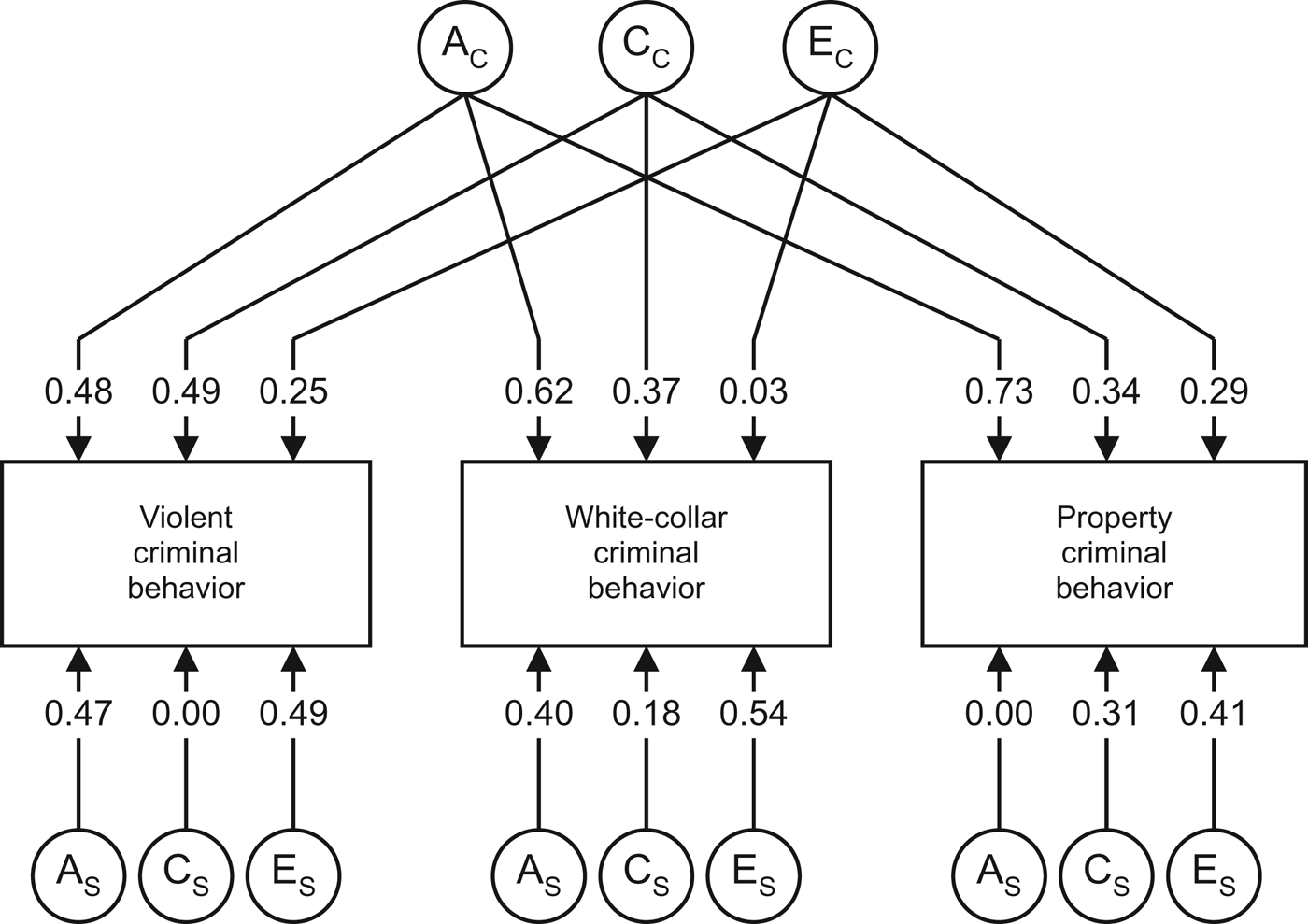
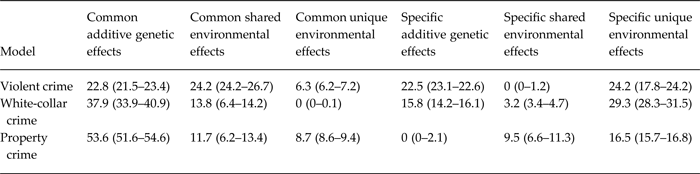
Parameter estimates for the full model are shown in Fig. 2 as path estimates, Table 4 as proportions of variance for shared and specific effects, and Table 5 as sums of total genetic and environmental influences and the proportions that are common across versus specific to individual CB subtypes. Three results are worthy of comment. First, genetic effects are substantial for VCB, WCCB and PCB, with estimates of heritability ranging from 45% to 54%. Second, shared environment is also important for all three subtypes, again accounting for a similar proportion of variance (17–24%). Third, the three criminal subtypes differ markedly in the degree to which their genetic influences are shared with the other subtypes versus unique. About half of the genetic influences on VCB are unique to that crime subtype. The parallel figure for WCCB is around a third and for PCB is zero. The opposite pattern is seen for shared environment, where nearly half of the variance for PCB is unique whereas the parallel figures for WCCB and VCB are less than one-fifth and zero respectively.
Parameter estimates from the full multivariate independent pathway model fitted to violent (VCB), white-collar (WCCB) and property criminal behavior (PCB) in male Swedish twins. A, Additive genetic effects; C, shared or ‘common’ environment; E, individual specific or unique environment. Subscripts ‘c’ and ‘s’ refer respectively to genetic and environmental factors that are common to all three criminal subtypes versus specific to individual subtypes.

Variance components from the full independent pathway model with age regression

Values given as percentage (95% confidence interval).
Proportion of variance in liability for criminal subtype due to genetic, shared environmental and unique environmental factors and the proportion of these risk factors that are specific to the criminal subtype

Discussion
We sought to address four major questions in these analyses of criminal convictions in a national Swedish twin sample. Our first question was a basic one: to what extent do genetic and shared environmental risk factors contribute to liability to CB? We estimated the heritability of all criminal convictions to be about 45% in both males and females. These results are reassuringly similar to estimates for the heritability of ‘antisocial behavior’ (Rhee & Waldman, Reference Rhee and Waldman2002) and ‘antisocial personality and behavior’ (Ferguson, Reference Ferguson2010) from two recent meta-analyses: 41% and 56% respectively. Consistent with the prior literature, we found only slight differences in the heritability estimates in males and females as neither of these meta-analyses found evidence for heterogeneity of heritability estimates across sexes (Rhee & Waldman, Reference Rhee and Waldman2002; Ferguson, Reference Ferguson2010). We found shared environmental effects to be modestly stronger in males (27%) than females (18%) and also somewhat higher than the aggregate estimates obtained in the two-meta-analyses: 16% (Rhee & Waldman, Reference Rhee and Waldman2002) and 11% (Ferguson, Reference Ferguson2010). Our results suggest that, in Sweden, approximately two-thirds of the familial aggregation of crime results from genetic factors shared in relatives and one-third from the impact of the shared environment. Our results are congruent with our prior findings from a Swedish national adoption study of CB in which we found that adoptee CB was predicted by a history of CB in both biological and adoptive relatives (Kendler et al. Reference Kendler, Larsson Lönn, Morris, Sundquist, Långström and Sundquist2013b ). Broadly analogous to our findings, in the adoption sample, an aggregate measure of genetic risk from biological relatives was approximately twice as strong at predicting adoptee CB as measures of adoptive family environmental risk. That is, both national twin and adoption studies in Sweden suggest that familial aggregation of CB arises from both genetic and familial environmental factors, with the genetic factors being somewhat more influential.
Our second question was to clarify the degree to which familial risk factors for crime were similar in males and females, a question not examined in prior meta-analyses (Rhee & Waldman, Reference Rhee and Waldman2002; Ferguson, Reference Ferguson2010). Our estimate of r g and r c (+0.63 ± 0.09) suggested substantial but far from complete sharing of the genetic and environmental risk factors in men and women. We could locate only a single study that examined this question for criminal convictions and found in the Danish Twin Registry a very similar result, although less precisely known: +0.61 ± 0.28 (Cloninger et al. Reference Cloninger, Christiansen, Reich and Gottesman1978). Information to estimate r g and r c in twin studies derives from comparing correlations in same-sex and opposite-sex DZ twins. To determine the generalizability of this finding, we estimated the tetrachoric correlations for any conviction in full siblings in Sweden (within 10 years of age of each other and a maximum of four per sibship). They were also lower in DZ opposite-sex pairs [n = 972 985, r = 0.30 (0.002)] than in male–male [n = 513 580, r = 0.44 (0.002)] or female–female same-sex pairs [n = 458 760, r = 0.33 (0.004)]. Although gender differences in CB have been examined frequently, the vast majority of prior studies have looked at quantitative rather than qualitative differences. For example, substantial evidence indicates that males engage in more serious offending than females, are more likely to convicted of such crimes than females and also differ in risk factors associated with serious criminal offending. Moffitt et al. (Reference Moffitt, Caspi, Rutter and Silva2002) have argued that the difference in serious delinquency and offending between males and females is largely due to gender differences in levels of individual risk factors, such as differences in levels of nervous system dysfunction, difficult temperament, hyperactivity, and cognitive and executive functioning (Gorman-Smith & Loeber, Reference Gorman-Smith and Loeber2005; Lahey et al. Reference Lahey, Van Hulle, Waldman, Rodgers, D'Onofrio, Pedlow, Rathouz and Keenan2006; Messer et al. Reference Messer, Goodman, Rowe, Meltzer and Maughan2006). Deficits in executive functioning are also more related to serious forms of criminal offending, such as overt, aggressive and violent criminal offending (Burt, Reference Burt2012). Females are less likely to have such risk factors and more likely to have risk factors such as contact with delinquent peers that is associated with less serious forms of covert, criminal offending (adolescent-limited delinquency) that are less likely to lead to arrest and ultimately, convictions (Moffitt & Caspi, Reference Moffitt and Caspi2001).
Our third question was whether the major criminal conviction subtypes, reflecting overt and covert antisocial behavior and CB categories, differed in the importance of genetic and shared environmental effects. Here the prior literature suggested that large differences might be found (Christiansen, Reference Christiansen and Hood1974; Mednick et al. Reference Mednick, Gabrielli and Hutchings1984; Tremblay, Reference Tremblay2010; Burt, Reference Burt2012). In the Danish twin sample, Christiansen (Reference Christiansen and Hood1974, p. 75) noted higher twin concordance for ‘the most serious types of offenders and recidivists’ compared to ‘more petty offenders’. By contrast, in the Danish adoption sample, Mednick et al. (Reference Mednick, Gabrielli and Hutchings1984) found genetic effects for PCB but not for VCB. In the Stockholm adoption cohort, Bohman et al. (Reference Bohman, Cloninger, Sigvardsson and von Knorring1982) found broadly similar results. After accounting for the effects of alcohol use disorders, VCB was not heritable but PCB (termed in their report ‘petty criminality’) was significantly transmitted from biological parents to adoptees. Similar results are reported by those studies examining self-report antisocial and criminal behavior (Barker et al. Reference Barker, Seguin, White, Bates, Lacourse, Carbonneau and Tremblay2007; Burt, Reference Burt2009, Reference Burt2012). Based on a meta-analysis of prior studies of self- and informant-reported antisocial behavior, Burt (Reference Burt2009) concluded that aggressive antisocial behavior was more heritable and less influenced by shared environmental factors than was ‘rule-breaking’ antisocial behavior. Contrary to much of this earlier literature, our results suggest that the etiologic roles of aggregate genetic and environmental influences are very similar across different types of CB convictions. Our modeling results for VCB are reassuringly similar to those obtained from a prior analysis of Swedish twins by Frisell et al. (Reference Frisell, Pawitan, Långström and Lichtenstein2012). Furthermore, our findings are consistent with our prior adoption study of CB in Sweden, where the genetic risk scores derived from biological parents predicted adoptee risk for VCB and non-violent CB (WCCB + PCB) to a similar extent (Kendler et al. Reference Kendler, Larsson Lönn, Morris, Sundquist, Långström and Sundquist2013b ).
Having shown that the quantitative estimates for genetic and shared environmental influences were similar across the criminal subtypes, we lastly addressed the degree to which these influences on VCB, WCCB and PCB were shared across subtypes or were subtype specific in their effect. Our findings differed strikingly across the three subtypes. Approximately half and one-third of the genetic influences on VCB and WCCB respectively were unique to that subtype. By contrast, our model estimated that none of the genetic risk factors for PCB were subtype unique. The pattern was, however, very different for shared environmental effects. Almost half of the shared environmental influences of PCB were unique to that subtype. For WCCB, only about 19% of such influences were subtype unique and the parallel figure for VCB was zero. These results suggest that the etiological factors that distinguish VCB from other CB are largely genetic whereas the unique etiological features of PCB are a result of some aspect of shared environmental experiences. This is also in line with existing research indicating that shared environmental influences are more strongly related to covert than overt antisocial behaviors (Burt, Reference Burt2012). The unique causal pathways to WCCB are largely genetic with a small contribution of shared environmental influences. However, consistent with our findings here, our national adoption study showed moderate specificity in the transmission of genetic risk for VCB and non-violent CB between biological parents and siblings and adoptees (Kendler et al. Reference Kendler, Larsson Lönn, Morris, Sundquist, Långström and Sundquist2013b ).
The evidence for genetic influences specific to two criminal subtypes (VCB and WCCB) is consistent with prior studies showing that externalizing psychiatric disorders and traits reflect distinctive aggressive and rule-breaking factors (Tackett et al. Reference Tackett, Krueger, Sawyer and Graetz2003), which are reflected in multiple dimensions of genetic risk (Blonigen et al. Reference Blonigen, Hicks, Krueger, Patrick and Iacono2005; Kendler et al. Reference Kendler, Aggen and Patrick2012, Reference Kendler, Aggen and Patrick2013a ). For example, among Virginia twins, conduct disorder results from two distinct genetic dimensions, characterized respectively by criteria such as ‘playing hooky and telling lies’ and ‘hurting people and getting into fights’ (Kendler et al. Reference Kendler, Aggen and Patrick2013a ). In the same twin sample, antisocial personality disorder also showed two distinct genetic dimensions. The first reflects criteria such as irritability, repeated fights and reckless disregard for the safety of others, and the second by criteria such as irresponsibility and deceitfulness (Kendler et al. Reference Kendler, Aggen and Patrick2012). Furthermore, a range of other studies using self- and parental reports find substantial genetic effects on human aggression in childhood and adolescence (Eley et al. Reference Eley, Lichtenstein and Stevenson1999; van Beijsterveldt et al. Reference van Beijsterveldt, Bartels, Hudziak and Boomsma2003) and in adulthood (Coccaro et al. Reference Coccaro, Bergeman, Kavoussi and Seroczynski1997; Miles & Carey, Reference Miles and Carey1997; Tuvblad & Baker, Reference Tuvblad and Baker2011). Similarly, research examining the risk factors associated with serious, life-course persistent criminal offending and less serious adolescent-limited delinquency has indicated that individual-level risk factors such as neurocognitive and executive functioning vulnerabilities and difficult temperament (negative emotionality) are more strongly associated with the former than the latter pathway (Moffitt, Reference Moffitt1993; Moffitt & Caspi, Reference Moffitt and Caspi2001; Gorman-Smith & Loeber, Reference Gorman-Smith and Loeber2005; Lahey et al. Reference Lahey, Van Hulle, Waldman, Rodgers, D'Onofrio, Pedlow, Rathouz and Keenan2006; Messer et al. Reference Messer, Goodman, Rowe, Meltzer and Maughan2006; Odgers et al. Reference Odgers, Moffitt, Broadbent, Dickson, Hancox, Harrington, Poulton, Sears, Thomson and Caspi2008). Life-course persistent offenders display versatility and generally more severity and violence in their criminal offending behaviors, whereas the adolescent-limited pathway is characterized by minor delinquency and rule breaking primarily in adolescence. We suspect that the genetic influences specific to VCB reflect a genetic predisposition to aggression and life-course persistent offending that is partially distinct from the general liability to externalizing traits and less severe CB. By contrast, the genetic influences unique to WCCB might reflect a genetic predisposition to ‘rule breaking’.
PCB was the only criminal subtype substantially influenced by specific shared environmental risk factors. PCB may be more influenced by familial or environmental factors shared between siblings because both are exposed to criminal definitions and reinforcements within the home and by family members. Many researchers suggest that less serious forms of criminal offending, such as seen with adolescent-limited delinquency, is most associated with exposure to delinquent peers and reinforcements for delinquency (Moffitt, Reference Moffitt1993; Burt, Reference Burt2009, Reference Burt2012), whereas more serious criminal offending is related to individual-level risk factors that have genetic origins. Our measure of PCB reflects fairly minor property-based offenses such as theft, and also includes measures that reflect social disorder, such as vandalism, vandalism causing danger to the public and trespassing. In this regard, our measure of PCB reflects a covert antisocial and criminal behavior that may be less serious as compared to our VCB measure, which reflects more serious, overt CB.
Limitations
These results should be interpreted in the context of five potential methodological limitations. First, the Swedish Crime Register contains only data on criminal convictions. In Sweden, as in most other countries, the majority of crimes are not officially reported or do not result in a conviction. In the 2008 National Swedish Crime Victim Survey, the proportion of crimes reported to the police ranged from 14% for sexual offenses to 55% for serious assaults (Brå, 2008). Bias might arise if the probability that a committed crime is reported, or that a reported crime leads to a conviction, differs across social strata or between members of pairs of MZ versus DZ twins. Using criminal convictions will underestimate the true rate of antisocial and criminal offending for the entire sample, and may potentially impact our results concerning gender differences, as males are more likely to engage in offenses that lead to conviction.
Second, we were unable to study the subtypes of crime in female and opposite-sex pairs. Despite the substantial sample size, prevalence for VCB was too low in females for us to obtain stable statistical results. This is common in many studies that have attempted to measure differences in covert and overt behavior across females and males (Burt, Reference Burt2012).
Third, with standard twin studies where both genetic and shared environmental effects are present, it is not possible to estimate r g and r c independently. In the absence of strong prior information, we considered it unwise to set a priori r g and r c either to zero or to unity. We judged the most appropriate approach was to constrain them to equality.
Fourth, as is typical for twin studies, we were only able to include same-sex twins whose zygosity was known as a result of at least one member responding to a mailed questionnaire. (This was not needed for opposite-sex twins.) As expected, CB was associated with a reduced probability of returning questionnaires so the rate of CB was lower in both males and females from same-sex versus opposite-sex pairs. This is a form of ‘concordance-dependent’ ascertainment, where the probability of known zygosity will be lowest in pairs concordant for CB, intermediate in those discordant for CB and highest in those where neither twin has CB. Simulations suggest that with the moderate level of differential ascertainment expected in our data given the observed prevalence differences, biases in parameter estimates are likely to be modest, with slight underestimations of a 2 and c 2 and overestimation of e 2 (Kendler & Eaves, Reference Kendler and Eaves1989).
Fifth, we conducted our main analyses using a dichotomous measure of any versus no criminal conviction. We compared the pattern of twin correlations obtained with this dichotomy and using a polychotomous measure of the number of convictions. The results were very similar.
Acknowledgments
This project was supported by the Ellison Medical Foundation (K.S.K.), the Swedish Research Council (K.S., grant number K2012-70X-15428-08-3; J.S., grant number 2012-2378), the Swedish Research Council for Health, Working Life and Welfare (K.S., grant number 2013-1836) and Access to Learning Fund (ALF) grants from Region Skåne (J.S. and K.S.).
Declaration of Interest
None.