Introduction
The optimal management of chronic rhinosinusitis with purulence is controversial. Most cases are treated with nasal saline irrigation and intranasal corticosteroids.Reference Fokkens, Lund, Mullol, Bachert, Alobid and Baroody1 Functional ethmoidectomy can be performed if such treatments fail. Some authors have recommended: long-term low-dose antibiotic therapy to treat uncontrolled chronic rhinosinusitis,Reference Hellings, Fokkens, Akdis, Bachert, Cingi and Dietz de Loos2 macrolides to treat chronic rhinosinusitis without nasal polyps, and cycline to treat chronic rhinosinusitis with nasal polyps.
The problems become more pressing when macroscopic signs of infection (purulent secretion or crusting) are apparent. Long-term low-dose antibiotics have been suggested to be appropriate under these circumstances.Reference Videler, van Hee, Reinartz, Georgalas, van der Meulen and Fokkens3, Reference Cervin and Wallwork4 However, evidence of the utility of such treatment is limited and weak.Reference Piromchai, Thanaviratananich and Laopaiboon5 The present study aimed to explore whether long-term low-dose trimethoprim/sulfamethoxazole is effective in managing chronic rhinosinusitis with purulence.
Materials and methods
Type of study
A prospective study was conducted.
Inclusion criteria
We included patients referred to our tertiary care medical centre with a diagnosis of chronic rhinosinusitis with purulence. Clinical or radiological signs of chronic rhinosinusitis had been present for at least three months. Endoscopy of the nasal cavity revealed purulent secretions. Nasal polyposis patients were included if they met all other inclusion criteria. In all patients, primary treatment (nasal douche, topical steroids and functional endoscopic sinus surgery for those with chronic rhinosinusitis and polyposis; and nasal douche and topical steroids for those with chronic rhinosinusitis without polyposis) had failed.
Exclusion criteria
We excluded patients with symptoms of less than three months in duration, those with contraindications to trimethoprim/sulfamethoxazole treatment and those who were pregnant. We also excluded patients who were culture-positive for bacteria resistant to trimethoprim/sulfamethoxazole and those suffering from single-sinus chronic disease (e.g. a chronic and isolated infection of the maxillary sinus). Patients suffering from ciliary dyskinesia or systemic diseases were also excluded.
Primary outcome
We documented sinonasal complaints using a validated French adaptation of the 22-item Sino-Nasal Outcome Test (SNOT-22) questionnaire.Reference de Dorlodot, Horoi, Lefebvre, Collet, Bertrand and Eloy6 Symptoms are rated from 0 (no problem) to 5 (as bad as possible). The scores range from 0 to 110; higher scores indicate poorer nasal function or more troublesome symptoms. We gathered questionnaire data on several occasions: at 0 and 3 months (the end of the antibiotic course), and at 6, 9 and 12 months. Patients were blinded to their pre-therapeutic scores at all subsequent visits.
Secondary outcome
We compared bacteriological data obtained before and three months after the end of treatment. We used a five-point scale to score the abundance of purulent secretion evident on rigid nasal endoscopy; scores ranged from 1 (no secretion) to 5 (secretion as extensive as ever observed). An independent observer analysed the data.
Study design
At the initial consultations, we determined if the patients met all of the inclusion criteria. A sample was taken from each middle meatus for culture analysis.
Each patient underwent a complete diagnostic investigation to examine factors that can promote chronic infection. This included: a complete blood cell count; assays for C-reactive protein, glucose and ferritin; human immunodeficiency virus serology; serum protein electrophoresis; immunoglobulin assays; and measurement of anti-nuclear and anti-neutrophil cytoplasmic antibody levels.
Symptoms and nasal endoscopic findings were scored before the antibiotic course, at the end of the antibiotic course, and three, six and nine months later. In terms of antibiotic tolerance, liver and renal functions were monitored every four weeks. Our team members performed all examinations.
Trimethoprim/sulfamethoxazole was prescribed at 960 mg/day (800 mg of trimethoprim and 160 mg of sulfamethoxazole) for three months. All patients were advised to rinse the nose with saline twice daily. Topical steroids were not allowed.
Ethical consideration
The study was approved by our local ethics committee.
Statistical analysis
All data were entered into a computerised database, and analysed with the aid of statistical software GraphPad Prism (GraphPad Software, La Jolla, California, USA) and Microsoft Excel spreadsheet software (Microsoft, Redmond, Washington, USA). A medical statistician advised that quantitative values should be expressed as means with standard deviations. A p-value of less than 0.05 was considered to reflect statistical significance. Non-parametric between-group comparisons were made using the Mann–Whitney U test, to evaluate the effect of antibiotic treatment at different time points.
Results
Patient characteristics
Nineteen patients underwent the initial investigation. Two patients were excluded because their bacterial cultures contained abundant staphylococci resistant to trimethoprim/sulfamethoxazole. Two others were excluded because an aetiology was found.
A total of 15 patients (9 males and 6 females) met all inclusion criteria and were enrolled in the study. The patients’ mean age was 50 years. The patients’ characteristics are summarised in Table 1. Most patients had a history of prior sinus surgery: ethmoidectomy in eight cases, middle meatus antrostomy in one, and a sinus lift using the parietal bone to place maxillary dental implants in one. Two patients suffered from arthritis and took tumour necrosis factor inhibitors. The mean length of the trimethoprim/sulfamethoxazole course was 83 days (range, 45–102 days). Two patients ceased treatment before the end of the antibiotic course (one after 45 days because of digestive disorders and the other after 70 days).
Patients’ characteristics

*Etanercept. †Methotrexate. M = male; F = female
Post-treatment functional outcomes
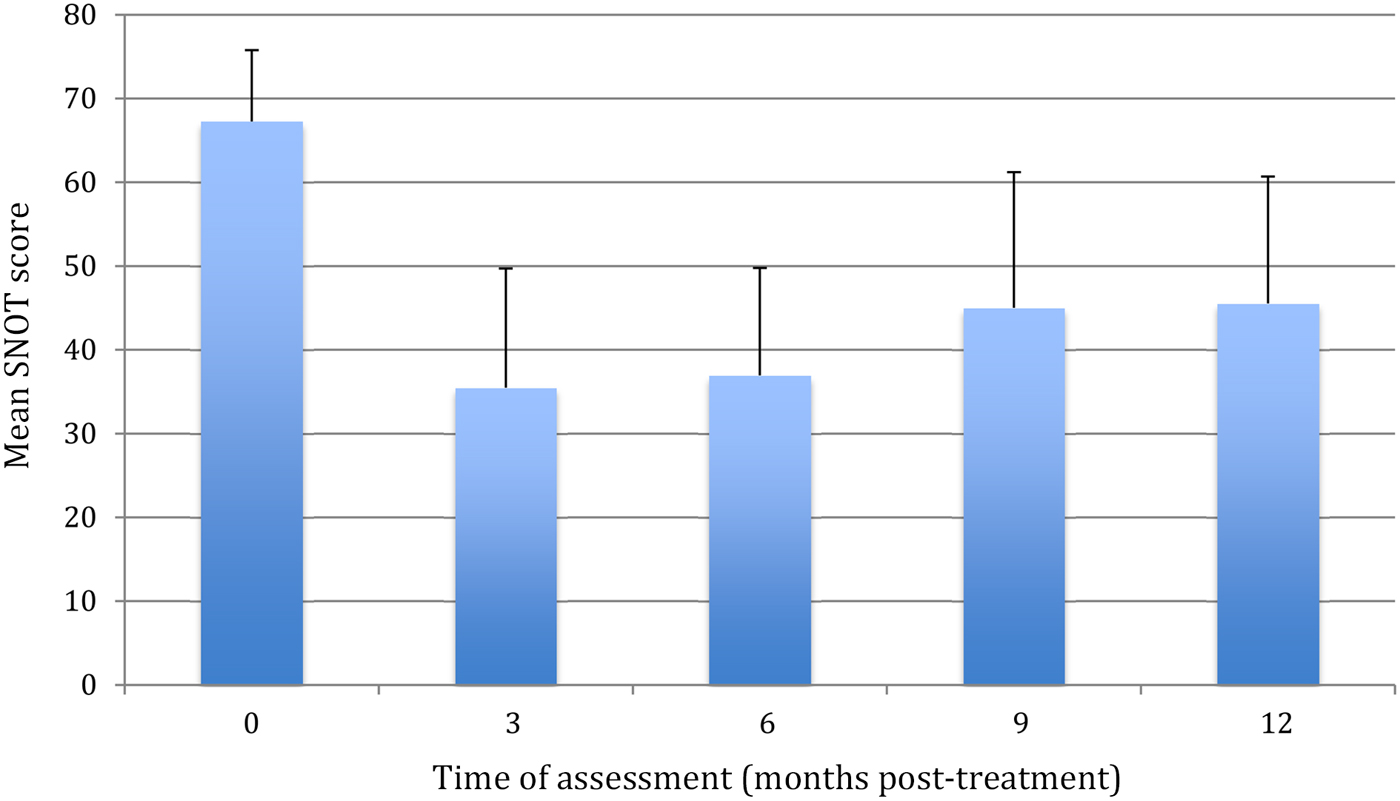
Figure 1 summarises the pre- and post-treatment SNOT-22 scores. The mean pre-therapeutic score was 67.2. The mean post-therapeutic scores were 35.5, 36.9, 45 and 45.5 at 3, 6, 9 and 12 months, respectively (Figure 1). Improvement as measured by the SNOT-22 scores was highly significant at 3 months (p < 0.0005), and remained significant at 6, 9 and 12 months.
Post-treatment functional outcomes: mean 22-item Sino-Nasal Outcome Test (SNOT-22) scores with standard deviations at 3, 6 and 9 months (p < 0.0005), and at 12 months (p < 0.005).

Post-treatment endoscopic findings
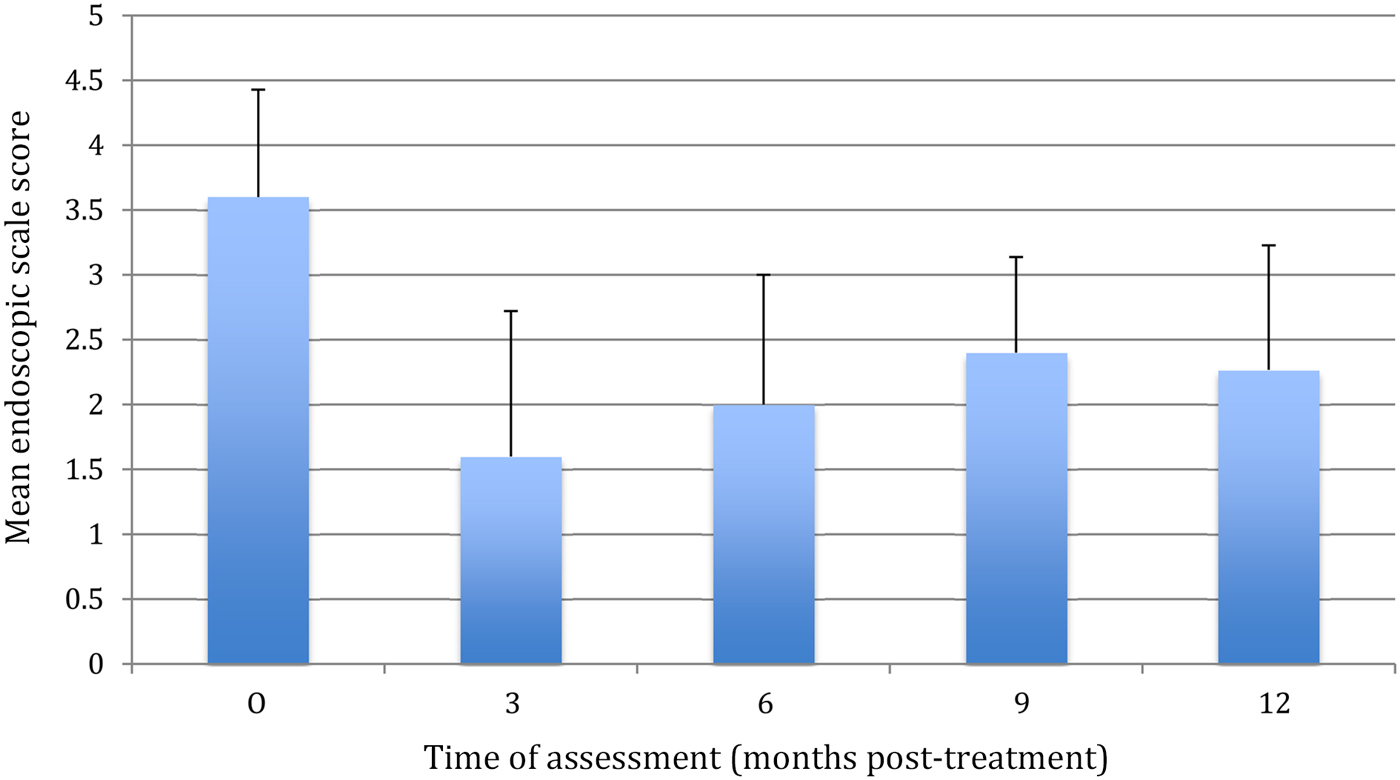
The average nasal endoscopic score was 3.6 prior to the antibiotic course. The mean post-therapeutic scores were 1.6, 2, 2.4 and 2.2 at 3, 6, 9 and 12 months, respectively (Figure 2). Improvement as measured by endoscopy scores was highly significant at 3 months (p < 0.0005), and remained significant at 6, 9 and 12 months.
Post-treatment endoscopic findings: mean endoscopic scores with standard deviations at 3 and 6 months (p < 0.0005), and at 9 and 12 months (p < 0.05).

Patients with chronic rhinosinusitis of no obvious aetiology, and those who had undergone sinonasal surgery, exhibited the greatest improvements in terms of both symptoms and endoscopic findings.
Bacteriological data
Table 2 summarises the bacteriological findings before and three months after treatment.
Bacteriological data before and three months after antibiotic course

Level of abundance of bacteria: + = poor level, ++ = mild level and +++ = high level of abundance.
Staphylococcus aureus was the most common bacterium cultured (87 per cent), followed by Haemophilus influenzae (27 per cent), and Streptococcus pneumoniae and Klebsiella oxytoca (both 20 per cent). Three months after the end of the antibiotic course, most patients exhibited reduced bacterial numbers; some samples were sterile. After three months, we did not observe any change in terms of antibiotic resistance.
Discussion
No single modality is clearly superior when treating patients with purulent recalcitrant chronic rhinosinusitis. Management is difficult; thus, many patients are referred to tertiary care medical centres. The various treatments include revision surgery, antibiotic therapy and aerosol therapy. Long-term low-dose antibiotic therapy has not hitherto been very successful.
The aetiologies of some cases of chronic rhinosinusitis are unclear; however, various theories have been put forward. These include the ‘superantigenic’ theory,Reference Rott, Mignon-Godefroy, Fleischer, Charreire and Cash7 infection of the underlying bone,Reference Khalid, Hunt, Perloff and Kennedy8 fungal infections,Reference Davis and Kita9 biofilm formationReference Post, Stoodley, Hall-Stoodley and Ehrlich10 and chronic bacterial infection. Immunodeficiency or mucociliary abnormalities are risk factors for the development of recalcitrant chronic rhinosinusitis. Long-term low-dose antibiotics are usually prescribed in such cases, especially at tertiary care medical centres. However, the evidence that such management is appropriate is both limited and weak; better data are required.
Most prior studies using low-dose antibiotics were uncontrolled and evaluated macrolides only.Reference Pynnonen, Venkatraman and Davis11–Reference Wallwork, Coman, Mackay-Sim, Greiff and Cervin14 Some reports support the view that macrolides are likely to be of benefit in most patients.Reference Cervin, Kalm, Sandkull and Lindberg12, Reference Hashiba and Baba13 However, two prospective, randomised, double-blind, placebo-controlled trials of three-month courses of macrolides in chronic rhinosinusitis patients found no significant differences between the macrolide and placebo groups.Reference Wallwork, Coman, Mackay-Sim, Greiff and Cervin14, Reference Videler, Badia, Harvey, Gane, Georgalas and van der Meulen15 Recently, Van Zele et al. showed that doxycycline significantly reduced nasal polyp size, nasal symptoms and the levels of systemic markers of inflammation.Reference Van Zele, Gevaert, Holtappels, Beule, Wormald and Mayr16
Long-term low-dose treatment is probably indicated in selected patients. Videler et al. conducted the only retrospective analysis of the effects of long-term low-dose trimethoprim/sulfamethoxazole and macrolides.Reference Videler, van Hee, Reinartz, Georgalas, van der Meulen and Fokkens3 Both treatments improved sinonasal complaints and endoscopic findings to similar extents. With trimethoprim/sulfamethoxazole, sinonasal symptoms decreased in 79 per cent of patients at the end of the antibiotic course, and decreased in 70 per cent at the end of follow up (mean, 4.9 months). Nasal endoscopic findings improved in 84 per cent of patients at the end of the antibiotic course, and improved in 72 per cent at the end of follow up (mean, 4.9 months). Only 12 per cent of patients were considered cured at the end of follow up.
The current study is the first prospective investigation of the utility of trimethoprim/sulfamethoxazole to treat chronic rhinosinusitis with purulence. Only retrospective works have appeared previously. We used a validated questionnaire to assess improvements in nasal function.Reference de Dorlodot, Horoi, Lefebvre, Collet, Bertrand and Eloy6 We also ran bacteriological tests before and after treatment. We agree with Videler et al. that the responses decreased slightly over time after the antibiotic course ended.Reference Videler, van Hee, Reinartz, Georgalas, van der Meulen and Fokkens3 Moreover, only two of our patients (13 per cent) considered themselves cured at the end of follow up.
Not all of our patients exhibited the same response to long-term low-dose antibiotics. We suggest that such treatment be reserved for select patients. The outcomes of patients suffering from post-operative suppuration, or who were immunodeficient, were promising. This type of chronic rhinosinusitis seems to be increasing in prevalence; such treatment is becoming more commonly prescribed.Reference Yoshihara, Kondo, Kanaya, Suzukawa, Baba and Toma-Hirano17
It is essential to perform the initial investigation systematically; this often allows the aetiology of recalcitrant chronic rhinosinusitis to be determined. Two different mechanisms could explain the improvement in functional scores: antibacterial properties and an anti-inflammatory effect.
Long-term low-dose antibiotic therapy is associated with two principal problems: side effects and bacterial resistance. In terms of side effects, we monitored both liver and renal function, and noted no adverse events. Videler et al. reported similar data.Reference Videler, van Hee, Reinartz, Georgalas, van der Meulen and Fokkens3 Long-term low-dose antibiotic therapy with trimethoprim/sulfamethoxazole is thus considered safe.
The development of bacterial resistance is a bigger problem. The beneficial effects of long-term antibiotic therapy may be attributable not only to an antibacterial effect, but also to the fact that antibiotics have anti-inflammatory properties.Reference Harvey, Wallwork and Lund18 Although culture is the easiest way to explore the microbiome of chronic rhinosinusitis patients, molecular biological methods are more reliable.Reference Chalermwatanachai, Velásquez and Bachert19 Furthermore, we cannot conclude if isolated bacteria, especially S aureus, are primary infective agents for chronic rhinosinusitis or colonisers. We noted significant changes in the upper airway microbiome at the end of the treatment. Two patients had trimethoprim/sulfamethoxazole-resistant strains in their initial bacteriological samples, and were excluded. No bacterial resistance was noted at the end of the antibiotic course. However, such resistance must always be monitored.
ENT procedures must be performed very carefully in patients suffering from ciliary dyskinesia, especially those with cystic fibrosis or immunodeficiencies. In case of doubt, a multidisciplinary approach, including a microbiological consultation, is necessary. A few alternatives are available. A nasal douche is always given, and revision surgery is often proposed for patients with recalcitrant chronic rhinosinusitis. However, some patients who have undergone several previous surgical procedures refuse novel interventions. Antibiotic inhalation (especially macrolides) has been studied, with varying results.Reference Desrosiers and Salas-Prato20 The antibiotics used and the pathologies were varied; such treatments are currently favoured for cystic fibrosis patients only.
Our patient numbers were quite low, but our inclusion criteria were strict. In addition, we focused on patients with chronic rhinosinusitis who had macroscopic or biological signs of infection (purulent secretions, crusting or inflammatory syndromes). As is true of most similar studies, the absence of a control group renders it difficult to draw strong conclusions. There duration of treatment with trimethoprim/sulfamethoxazole varied widely (45–102 days). This is an issue, as the treatment is heterogeneous. Thirteen patients completed their treatment because we highly encouraged them. We do believe that there was finally a good adherence to treatment. The compliance of patients with that kind of therapy will probably be lower in clinical practice because of the high number of doses prescribed and the potential side effects.
• Effectiveness of long-term low-dose trimethoprim/sulfamethoxazole for uncontrolled chronic rhinosinusitis was explored
• Trimethoprim/sulfamethoxazole was prescribed, at 960 mg/day for 3 months, for 15 patients
• Sinonasal complaints and endoscopic findings were documented, and bacteriological data were compared
• Sino-Nasal Outcome Test scores were: 67.2 pre-therapy, and 35.5, 36.9, 45 and 45.5 at 3, 6, 9 and 12 months post-therapy
• Long-term low-dose trimethoprim/sulfamethoxazole appears promising and safe for selected patients
Long-term low-dose trimethoprim/sulfamethoxazole therapy seems to be a promising and safe option for selected patients. This treatment improved nasal function in patients suffering from recalcitrant chronic rhinosinusitis. This work constitutes a preliminary study owing to the low number of patients and the lack of a control group. It will be shortly complemented by an additional controlled multicentre study. This kind of study is necessary to definitively conclude that long-term low-dose antibiotic therapy is useful.
Competing interests
None declared.