Significant outcome
-
∙ Amygdalar increase in [11C]Ro-154513 binding to GABAA α1+5 receptor subtypes after prenatal valproic acid (VPA) exposure.
-
∙ Hemisphere asymmetry in [11C]Ro-154513 binding after prenatal exposure to VPA.
Limitations
-
∙ The number of animals (n=6–7) in each group may have been too low to detect significant differences.
-
∙ Only male rats were studied due to the higher incidence of autism spectrum disorders in males in the human clinic.
Introduction
Autism spectrum disorders (ASD) are a heterogeneous set of neurodevelopmental disorders characterised by impaired social interaction and communication as well as by restricted, repetitive behaviour (1). Epidemiological research has shown a strong genetic component and several environmental risk factors have also been identified including prenatal exposure to antiepileptic drugs, as underlying causes of ASD (Reference Bailey, Le Couteur and Gottesman2,Reference Christensen, Gronborg and Sorensen3). The neuropathology, physiology and biochemistry are not fully understood but several lines of evidence from animal models and the human clinic suggest abnormal GABAergic function as one of the pathways contributing to ASD. At early developmental stages, gamma-aminobutyric acid (GABA) acts as a trophic factor and mediates several essential neurodevelopment processes, including proliferation, differentiation and migration of immature neurons (Reference Ben-Ari, Gaiarsa, Tyzio and Khazipov4). In the brain, GABA acts primarily through the GABAA receptors and genetic observations have linked ASD to genes encoding GABAA receptor subunits in loci 15q11-q13 (Reference Shao, Cuccaro and Hauser5). Post-mortem studies found reduced GABAA receptors in hippocampus and cingulate cortex of ASD patients (Reference Blatt, Fitzgerald, Guptill, Booker, Kemper and Bauman6–Reference Oblak, Gibbs and Blatt8). In vivo pilot single-photon emission computed tomography and positron emission tomography (PET) studies demonstrated a decrease in GABAA receptor binding in the superior and medial frontal cortex in children (Reference Mori, Mori and Fujii9) and in the nucleus accumbens, amygdala and subcallosal area in adults with ASD (Reference Mendez, Horder and Myers10).
Autoradiography is a powerful tool to investigate the distribution of receptors in vitro and several ligands have proven useful to investigate GABAA receptors, including [3H]muscimol and [11C]Ro15-4513. Muscimol, a selective agonist at GABAA receptors, binds to the same site as GABA, and can reveal the overall levels of GABAA receptors. In human and rodents, the inverse agonist Ro15-4513 binding to the benzodiazepine site of GABAA receptors, has a 10-fold higher affinity to the α5 subtype of the GABAA receptor than to the other subtypes (Reference Mendez, Horder and Myers10). Moreover, due to the high abundance of α1 subunits in the brain, Ro15-4513 binding can reveal possible abnormalities in both α1 and α5 subtypes (Reference Mendez, Horder and Myers10).
Here we investigated GABAA receptor binding in amygdala, hippocampus and thalamus in the offspring of pregnant rats treated with low, subchronic doses of VPA, a drug used for epilepsy and neuropsychiatric disorders. In human, VPA exposure during pregnancy increases the risk of ASD in the children (Reference Christensen, Gronborg and Sorensen3). Rodents exposed to one high dose of VPA (350–800 mg/kg) exhibit several ASD-like symptoms including reduced social behaviour and increased repetitive behaviour (Reference Dufour-Rainfray, Vourc’h, Tourlet, Guilloteau, Chalon and Andres11–Reference Rodier, Ingram, Tisdale and Croog13). We previously have demonstrated that a milder dosing scheme of 20 mg/kg results in deficits relevant to ASD such as increased neocortical cell number (Reference Sabers, Bertelsen, Scheel-Kruger, Nyengaard and Moller14), suppressed play behaviour and reductions in oxytocin receptor binding in the amygdala (Bertelsen et al., submitted 2016).
The aim of the current study is to further investigate changes relevant to ASD in the low dose VPA model with two GABA radioligands to evaluate changes in (1) overall GABAA levels and (2) specific GABAA α1+5 binding in the offspring after subchronic prenatal administration of VPA.
Method
Animals and treatment
All housing and procedures were performed according to the Convention ETS 123 of the Council of Europe and Danish Animal Experimentation Act on a license (2008/561-I5I6). Pregnant rats (n=12) were single housed and randomised into two groups. At embryonic day 12 (E12), they received daily ip injections of saline or VPA (20 mg/kg) until the end of pregnancy. After weaning at day 22, male pups were housed in groups of three to four rats according to gender and treatment.
Tissue preparation
At 50 days of age, 14 adolescent male rats ([3H]muscimol: n control=7, n 20 mg/kg=7) [11C]Ro15-4513: n control=6, n 20 mg/kg=6) were anesthetised by inhalation of isoflurane and decapitated. The brains were removed, frozen and stored at −80°C. The brains were cut in 20 μm coronal slices using a Cryostat (HM 500 OM Cryostat, Microm, Walldorf, Germany) at −20°C. Three consecutive sections were mounted on each Thermo Scientific Polysine Adhesion Slides (Braunschweig, Germany) and then stored at −80°C.
GABAA receptor autoradiography
Using the stereotaxic coordinates of the rat brain atlas (Reference Paxinos and Charles15), slices of the dorsal hippocampus, amygdala and thalamus (Bregma −3.72 mm) were chosen. [11C]Ro15-4513 binding was performed according to a modified version of the method of (Reference Noguchi and Suzuki16). Briefly, slides were thawed at room temperature (22°C) and pre-incubated in a 50 mM Tris HCl buffer (pH 7.4) for 20 min. To assess total binding two consecutive slides from each animal (containing three brain sections on each slide) were incubated in Tris-HCl buffer containing 4.9 nM [11C]Ro15-4513 for 30 min. To measure the effect of non-specific binding, one slide from each animal was incubated in the buffer with the same concentration of tracer, but in the presence of 10 μM unlabelled Ro15-4513. Slides were then washed twice in cold buffer, dipped in distilled water and dried under a stream of cool air. Two [11C] standard slides were prepared using known concentrations of tracer in order to calibrate binding values. All slides were placed in cassettes with phosphor-imaging plates (Fujifilm SR2025, Tokyo, Japan) for 30 min and scanned using a BAS-5000 Image Reader (Fuji).
[ 3 H]muscimol binding was performed according to the methods previously described (Reference Verdurand, Fillman, Weickert and Zavitsanou17). Briefly, slides were pre-incubated three times for 5 min in cold 50 mM Tris citrate buffer (pH 7.0). For total binding, two consecutive slides (six sections) from each animal were incubated for 60 min in buffer containing 20 nM [3H]muscimol (SA 36.9C i/mmol; Perkin Elmer, Skovlunde, Denmark). Non-specific binding in an adjacent slide from each animal was measured by the addition of 100 μM GABA (Sigma, Brøndby, Denmark). After tracer incubation, all slides were washed twice for 1 min in cold buffer, left to dry overnight and placed in cassettes with a 3H-standard (American Radiolabeled Chemicals Inc., St. Louis, MO, USA) and covered with a BAS-TR 2025 imaging plate (Fuji). After 4 days, the plates were scanned using a BAS-5000 Image Reader.
GABAA receptor autoradiography analysis
The images were analysed with Image Gauge 4.0 (Image Gauge 4.0/BAS Phosphorimager, Fujifilm, Tokyo, Japan) by a researcher who was blind to the grouping of the animals. The total binding was obtained in manually drawn regions of interest including dorsal hippocampus, thalamus and medial amygdala according to the stereotaxic coordinates (Bregma −3.72) of the rat brain atlas (Reference Paxinos and Charles15). The specific binding was calculated by subtracting the non-specific binding from the total binding. Background radiation values were subtracted from each slide and binding values were calibrated using known radioactivity concentrations obtained by the appropriate standard slides.
Statistical analysis
Unpaired student t-tests were used to compare rats treated with saline versus VPA in each of the three brain regions for both tracers. Differences were considered significant when p<0.05.
Results
There were no obvious toxicological effects in VPA-treated animals as no changes in litter size, pregnancy length, mortality or birth weight in pups, were observed.
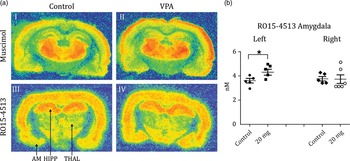
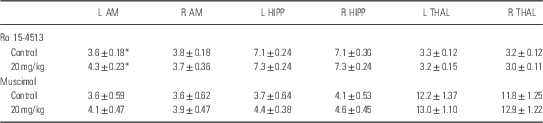
Administration of 20 mg/kg/day prenatal VPA significantly increased [11C]Ro15-4513 binding in left amygdala compared with controls (p<0.05) (Fig. 1). This difference was not observed in either hippocampus, thalamus or in the right amygdala (Table 1).
(a) A representative illustration of [3H]muscimol binding in control (i) and valproic acid (VPA)-treated animals (ii) and [11C]Ro15-4513 binding in control (iii) and VPA-treated animals (iv). (b) Graphical representation of [11C]Ro15-4513 binding (nM) in left and right amygdala in controls and rats exposed prenatally to 20 mg/kg VPA (n control=6, n 20 mg/kg=6). Error bars represent standard error of mean. *p<0.05. AM, amygdala; HIPP, hippocampus; THAL, thalamus.

Data are represented as mean binding of [11C]Ro15-4513 (nM) and [3H]muscimol (μCi/g) ±SEM

L, left; R, right; AM, amygdala; HIPP, hippocampus; THAL, thalamus.
*p<0.05
No significant differences in GABAA [3H]muscimol receptor binding were observed after exposure to prenatal VPA. However, there was a trend towards an increase (13.9%) in [3H]muscimol binding in the left amygdala in the offspring of VPA-treated animals (Table 1). Furthermore, a trend towards an increase in [3H]muscimol binding was also observed in the hippocampus in VPA compared with saline-injected animals (left: 18.9%, right: 12.2%).
Discussion
We analysed potential changes in the GABAA receptor with autoradiography using the radioligands [11C]Ro15-4513 and [3H]muscimol in rats prenatally exposed to VPA. VPA-treated rats had a significantly higher [11C]Ro15-4513 binding in the left amygdala compared with saline-treated rats. Furthermore, no significant changes were seen in either amygdala, hippocampus or thalamus in [3H]muscimol binding although a non-significant increase was observed in left amygdala and hippocampus in [3H]muscimol binding. [3H]muscimol binds to all GABAA receptors and [11C]Ro15-4513 is selective to the α5 subtypes (high affinity) and α1 subtypes (high abundance) (Reference Mendez, Horder and Myers10), we can therefore speculate that the change seen here in amygdala is primarily a result of changes in the GABAA α1+5 subtypes.
A limited number of studies exist investigating changes in the GABA system in ASD. Animal studies demonstrated that GABAergic neurotransmission was severely compromised in rats treated prenatally with one high dose of VPA (600 mg/kg) (Reference Banerjee, Garcia-Oscos and Roychowdhury18). Moreover, the oxytocin-mediated excitatory-inhibitory shift occurring during delivery is abolished in VPA-treated rats due to a persistent depolarising effect of GABA (Reference Tyzio, Nardou and Ferrari19). To our knowledge, the only in vivo study directly investigating the α1 and α5 subtypes of the GABAA receptor was a pilot PET study with one of the same ligands used here, [11C]Ro15-4513 (Reference Mendez, Horder and Myers10). The three adult male ASD patients included in the study had significantly decreased [11C]Ro15-4513 binding in limbic subcallosal area, nucleus accumbens and amygdala compared with controls. Our results demonstrated increased [11C]Ro15-4513 binding in amygdala after prenatal exposure to 20 mg VPA/kg/day. Post-mortem studies like autoradiography reflect different processes than in vivo PET studies. As autoradiography is performed in post-mortem tissue, confounds of tracer metabolism, blood flow, passage through the blood brain barrier and plasma protein binding are avoided. Endogenous ligands are washed away in tissue processed for autoradiography, where as they play an important role in PET measurements. The decrease in amygdalar binding seen in patients using PET (Reference Mendez, Horder and Myers10) could reflect decreased number of receptors or increased levels of endogenous benzodiazepines and GABA competing with the radioligand for binding sites leading to an apparent decreased binding. Data presented in this autoradiography study represents the number of available receptors, not their functional state. Therefore differences in binding in the rat versus human data could be due to different methodology or even species or age differences.
Structural amygdala abnormalities such as increased cell density (Reference Bauman and Kemper20), reduced neuron number (Reference Schumann and Amaral21) and changes in volume (Reference Schumann, Hamstra and Goodlin-Jones22) have been observed in ASD and at least some of these changes are age-related. Amygdala in neurotypical individuals undergoes an age-related increase and this increase seems to be abnormal/absent in ASD patients. Magnetic resonance imaging studies have found larger amygdala volume in children with ASD, which is not seen later in life (Reference Schumann, Hamstra and Goodlin-Jones22). Direct comparison between studies of different species, ages and methods are problematic.
We unexpectedly found a regional asymmetry in Ro15-4513 binding between the two brain hemispheres; significant alterations in GABA binding were only observed in the left amygdala. Abnormal regional asymmetry is observed in several neuropsychiatric disorders such as depression and schizophrenia. Asymmetry has previously been found to be present in mice treated with VPA as they showed an asymmetric reduction of neocortical parvalbumin cells (Reference Gogolla, Leblanc, Quast, Sudhof, Fagiolini and Hensch23). Moreover Ichijo et al. demonstrated brain asymmetry and lateralisation during neurodevelopment and after stress exposure in transgenic mice (Reference Ichijo, Hamada and Takahashi24). We speculate that asymmetry in GABAA receptor distribution may represent lateralised specialisation and may relate to abnormal behaviours observed in rats treated prenatally with VPA. More studies are required to further investigate the possible consequences of this asymmetry and to clarify if VPA can induce asymmetric dysregulation of proliferation into enhanced number of GABAA α1+5 receptors or is a result of downstream neural adaption to other pathological processes, such as alteration in neuron numbers. Apart from one study showing increased rightward cortical asymmetry in ASD (Reference Herbert, Ziegler and Deutsch25), asymmetry has not been well studied in human ASD. Therefore data from animal studies may provide important translational value to the abnormal behaviours observed in human ASD. We hope the current study sheds light on the importance of investigating both hemispheres as many studies to date treat the hemispheres indiscriminately.
Amaral and his group have studied the amygdala in relation to ASD extensively. They suggest among others a concept of ‘allostatic load’ in amygdala in ASD patients (Reference Schumann and Amaral21,Reference Schumann, Hamstra and Goodlin-Jones22) which exists when the brain is exposed to chronic and persistent stressors leading to damage (Reference Schumann and Amaral21). In children with ASD there is a larger and more active amygdala, which induces increased fear, levels, anxiety and heightened stress response. Due to the allostatic load this could later in life lead to reduced neuron numbers and volume. Amaral and his group suggest that amygdala abnormalities may not be essential for social behaviour deficits but studies performed in macaque monkeys led to the conclusion that amygdala is involved in treat detecting and amygdala lesion led to inappropriate behavioural responses to fear (Reference Amaral, Bauman and Schumann26,Reference Amaral27). The changes in [11C]Ro15-4513 binding seen in human ASD (Reference Mendez, Horder and Myers10) and in this study may therefore represent GABAergic deficits related to abnormal fear and anxiety observed in ASD.
In summary, prenatal exposure to even low doses of VPA alters GABAA receptor binding in amygdala. As we only observed significant changes with [11C]Ro15-4513, we speculate that changes are primarily in the subtypes containing the α1 and α5 subunits. Further studies are needed to further investigate the asymmetry and consequences of the changes on the pathological mechanisms of ASD.
Acknowledgements
The authors thank Emilie M. Sørensen, Mette M. Busck and Pavel J. P. Mariager for technical assistance during the execution of the study and Pia Weikop, Michael Winterdahl and Kim Mouridsen for scientific advice.
Authors Contributions: A.M., J.S.K., A.M.L., K.R.D. and F.B. designed the study. F.B. and D.F. executed the study under supervision of A.M.L. F.B. analysed the data and prepared the first draft of the manuscript together with A.M.L. All authors commented and later approved the final version of the manuscript.
Financial Support
This work was supported by the Department of Nuclear Medicine and PET Centre, Aarhus University.
Conflicts of Interest
None.
Ethical Standards
Experiments were performed in accordance with the Danish Animal Experimentation Act on a license (2008/561-I5I6) granted by the Animal Experiments Inspectorate.