INTRODUCTION
Mexico’s 1917 Constitution is the second most amended in modern constitutionalism: it has gone through 737 reforms.Footnote 1 No other codified constitution has been subjected to such a constant pattern of renewal through amendment.Footnote 2 Like the ship of Theseus that over a period of one hundred years had all of its parts replaced one by one, the Mexican Constitution’s combination of endurance and hyper-reformism poses fundamental questions about change and identity. We argue that Mexico’s Constitution is a case that offers important theoretical insights for the study of constitutional change by calling into question the generalizability of a widely shared view in the literature of this field: that constitutional amendment and constitutional interpretation have a substitutive relation as means of constitutional modification and revision (Lutz Reference Lutz1994).Footnote 3
While providing stability is an important goal of constitutions, they also need to change to preclude constitutional obsolescence. They must not only guarantee their adaptation to social and political changes, but also have means for “responding to imperfection” (Levinson Reference Levinson and Levinson1995), correcting mistakes and inefficiencies. Moreover, constitutional plasticity has been considered essential to maintaining the “sovereignty of the present generation” (Jefferson Reference Jefferson1958). If codified constitutions are to be more than pieces of paper, and if they are to enjoy democratic legitimacy, they need regular modification. Hence, a question naturally emerges: what are the different means of achieving constitutional change and revision, and what is the relation between them?
Constitutional amendment and judicial interpretation are two salient ways in which codified constitutions are changed without being formally replaced. Each has been the focus of extensive empirical research that has stressed that both are context-sensitive (Shapiro Reference Shapiro1981; Ginsburg Reference Ginsburg2003; Helmke and Ríos-Figueroa Reference Helmke, Ríos-Figueroa, Helmke and Ríos-Figueroa2011; Ginsburg and Melton Reference Ginsburg and Melton2015). However, the relation between those two modalities of constitutional change remains underexplored in comparative constitutional scholarship. The central way in which the literature on constitutional amendment has focused on judicial interpretation is the thesis—famously advanced by Donald Lutz in his 1994 article, and echoed in many later works—that amendment and interpretation may be seen as substitute means for updating the constitution (Lutz Reference Lutz1994). As suggested by the “hydraulics” metaphor crafted by Heather Gerken (Reference Gerken2007), it has been assumed that where amendment is frequent, courts have less space to make interpretative decisions that change or revise the way the constitution is understood, while in contexts of low rates of constitutional amendment, such a space is broader (Elkins, Ginsburg, and Melton Reference Elkins, Ginsburg and Melton2009).
Lutz’s substitutive thesis has been extremely influential in both academic and nonacademic texts. For instance, in a recent book Alec Stone Sweet and Jud Mathews (2019) endorse the thesis according to which “the more onerous the procedures for amendment, of course, the more one can expect adjudication, rather than amendment, to be the usual mechanisms for ‘normal’ constitutional change” (26). Moreover, the widespread belief in the hydraulic thesis has also permeated the advice on constitutional design given by important international actors such as the Venice Commission in its Report on Constitutional Amendment (2009, quoted in Marshfield (Reference Marshfield2018)).
This article seeks to explore the interplay between patterns of constitutional amendment and the Mexican Supreme Court’s interpretive dynamics. The findings we present suggest that Mexico is a deviant case (Gerring Reference Gerring2006) vis-à-vis the widespread hydraulic thesis. In other words, we claim that the relation between judicial interpretation and constitutional amendment in Mexico entails important anomalies vis-à-vis that widely shared view in the literature. Hence, its study is not only interesting in itself, but can arguably contribute to a better understanding of such a relation by calling into question the generalizability of those views, pointing to new hypotheses for further research. Interestingly our empirical results are consistent with those presented by Marshfield (Reference Marshfield2018), who studies the relation between amendment and interpretation at the state level in the United States and finds that at high rates of amendment Lutz’s thesis does not hold.
Our research is grounded on the construction of an original data set of all precedents on constitutional matters (5,119 tesis), issued by the Mexican Supreme Court from 1917 to December 2020,Footnote 4 and a data set of all constitutional reforms in the same period, complemented by qualitative analysis in the areas in which most of the interpretative activity by the Court has been concentrated.
Our central finding is that the relation between interpretation and amendment in Mexico is inconsistent with the expectations set by Lutz’s theory. On the one hand, we find that hyper-reformism in Mexico is correlated to a steep increase in the number and diversity of binding constitutional precedents. On the other hand, we show that in key constitutional areas such an extreme rate of amendment has been accompanied by Supreme Court interpretations that have substantively revised the meaning of the Constitution.
Moreover, our account suggests that in Mexico the extreme intensity of amendment dynamics has not only not inhibited constitutional change and revision through interpretation but has actually led the Court to generate innovative constitutional criteria to cope with the effects of hyper-reformism. We discuss how in Mexico a strong and creative judicial interpretation was made necessary by the effects hyper-reformism had on the Constitution: it made it a very long, complex, and at times inconsistent text. Under this constitution creative judicial interpretation was required for solving the many conflicts created by the very nature of the text.
The article is organized in five sections. First, we briefly present Lutz’s thesis that predicates the existence of a substitutive relation between constitutional amendment and constitutional interpretation as channels of constitutional modification and revision. Second, we document how the dynamics of hyper-reformism have unfolded in Mexico and place it in historical and comparative perspective. Third, we present the empirical data we have gathered on the Supreme Court’s constitutional interpretation, based on the study of all binding and nonbinding constitutional precedents issued over the last one hundred years,Footnote 5 and highlight some of the trends it reveals in the relation between hyper-reformism and constitutional interpretation. Fourth, we analyze the Supreme Court’s decisions in the constitutional areas in which most of the interpretative activity has been concentrated: human rights, federalism, and property rights. This analysis reveals a Court engaged in significant constitutional revisions. Finally, we discuss the theoretical and comparative insights this case can offer for better understanding the relation between constitutional amendment and constitutional interpretation. In this connection, we briefly discuss the case of Brazil, which is also a case of a high amendment rate accompanied by a very active constitutional court but, as we will argue, with a pattern with relevant differences from the one we find in Mexico.
A WIDELY HELD VIEW ON AMENDMENT RATE AND CONSTITUTIONAL INTERPRETATION
Donald Lutz’s influential text, “Toward a Theory of Constitutional Amendment,” put forward much of the contemporary empirical research on constitutional change. In this piece he identifies four channels of constitutional modification: “(1) formal amendment process, (2) periodic replacement of the entire document, (3) judicial interpretation, and (4) legislative revision” (1994, 355). Lutz defines amendment rate as “the average number of formal amendments passed per year since the constitution came into effect” (357). Lutz first states the relation between constitutional amendment and judicial review in the following way: “Proposition 6. In absence of a high rate of constitutional replacement, the lower the rate of formal amendment, the more likely the process of revision is dominated by a judicial body” (358). As he readily acknowledges, however, he offers only indirect evidence to support this statement (365).
Later on, in Principles of Constitutional Design (2006), Lutz formulates the substitutive or “hydraulic” relation between constitutional amendment and judicial review in a more explicit fashion. Proposition 6 is restated and accompanied by Proposition 5, which claims that: “[a] low amendment rate associated with a long average constitutional duration strongly implies the use of some alternative means of revision to supplement the formal amendment process” (Lutz Reference Lutz2006, 156).Footnote 6
Moreover, it is noteworthy that Lutz’s constitutional design recommendations assume the general existence of a substitutive relation between amendment and judicial interpretation. This assumption also is present in Lutz’s (Reference Lutz2006, 162) normative evaluation of the amendment rate in general and in the context of the United States in particular. What he certainly questions, however, is the extent to which constitutional amendment and judicial interpretation can be deemed perfect substitutes in a normative sense:
[T]he three prominent methods of constitutional modification other than complete replacement – formal amendment, legislative revision, and judicial interpretation – reflect declining degrees of commitment to popular sovereignty, and the level of commitment to popular sovereignty may be a key attitude for defining the nature of the political system. (Lutz Reference Lutz2006, 153)
In Lutz’s view, framers therefore face two options. For those who normatively prefer a “stronger supreme or constitutional court intervening at higher rates in future constitutional revision” (Lutz Reference Lutz2006, 224), the best institutional choice would be setting down a difficult amendment process—an option that, in any case, implies risks for the longevity of the constitution and for its “legitimacy under conditions of popular sovereignty.” For those far more concerned with these latter questions—longevity and popular legitimacy—who would therefore prefer less participation of the judiciary, the best institutional choice would be setting down a scheme leading to a higher amendment rate (Lutz Reference Lutz2006, 224–25).
Remarkably, however, the substitute empirical relation between judicial interpretation and constitutional amendment is not called into question by the author—it is just assumed. In other words, he acknowledges that judicial interpretation and constitutional amendment are not perfect substitutes normatively speaking, but empirically states as a general rule that the higher the amendment rate, the lower the expectation that the judiciary will play a leading role in constitutional modification and vice versa.
As we have claimed, Lutz’s substitutive thesis has been extremely influential. It has been a recurring presence in the literature of constitutional change,Footnote 7 and has also permeated advice on constitutional design given by important international actors.Footnote 8 Arguably, the fact that this relation holds in the United States at the federal level has influenced theorization in this area—there is a tendency to generalize from American experience, but this tendency may lead to overgeneralizations.
In their pathbreaking book, Elkins, Ginsburg, and Melton (Reference Elkins, Ginsburg and Melton2009) predicted that in Mexico the decline of the Institutional Revolutionary Party’s (PRI for its Spanish abbreviation) hegemony would generate a lower rate of amendment and a turn toward constitutional change through judicial interpretation—in line with a tacit assumption of Lutz’s thesis:
If the methods of securing formal amendment are difficult … there will be pressure to adapt the constitution through judicial or other reinterpretation … If, on the other hand, formal constitutional amendment is relatively simple … where the legislature does not have to pass its amendments to the subnational units for approval, there may be less need for judicial or other institutional reinterpretation of the constitution. (Elkins, Ginsburg, and Melton Reference Elkins, Ginsburg and Melton2009, 74)
[In Mexico] with the decline of the PRI’s supermajority, the primary mechanism of constitutional change has shifted from formal constitutional amendment toward informal judicial amendment through interpretation. (198)
As we will see in the following sections, contrary to these expectations, in Mexico the decline of the PRI bolstered a wave of hyper-reformism (Pou-Giménez and Pozas-Loyo Reference Pou-Giménez, Pozas-Loyo, Albert, Bernal and Benvindo2019). Our claim, contra Lutz, is that in Mexico—a case singularized by hyper-reformism under conditions of political plurality—the relation between amendment rate and constitutional change through interpretation is not substitutive. We argue that this case warns us against overgeneralizing claims on constitutional change and opens up avenues and hypotheses that are worth exploring in order to improve our collective knowledge on this important question.
A CONSTITUTIONAL OUTLIER: MEXICO’S HYPER-REFORMISM
Continuous and extensive change via amendment has been the main feature of Mexico’s constitutionalism. From a quantitative stance, numbers are imposing. From its enactment in February 1917 to January 2021, there have been 737 amendments, contained in 245 decrees of constitutional reform, approved by following the not-negligible requirements of article 135.Footnote 9 Like other Mexican scholars, we track constitutional reforms by defining “one amendment” as a change in one article formally enacted at a particular moment in time.Footnote 10 This strategy underplays the amount of change, given the large number of subsections and paragraphs that most articles contain today.Footnote 11
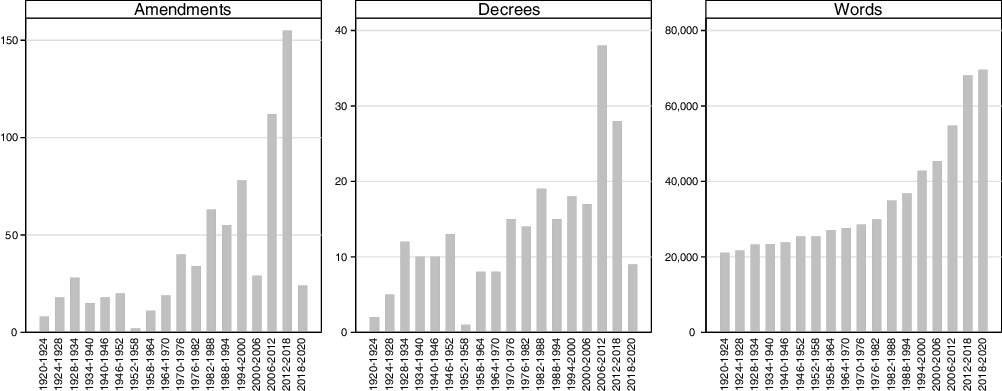
Figure 1 provides a snapshot of these imposing numbers, organizing all amendments by presidential term. This figure also registers increases in constitutional length, leaving out transitory provisions. If we do include the transitory provisions—as we probably should, given the amount of substantive regulation they contain—the dimension of constitutional change becomes more transparent: while in January 2010, the Constitution had 78,295 words, in September 2017 it had 126,241 words.Footnote 12 In 2010, transitory provisions represented 28 percent of the Constitution; by 2017, they made for 43.5 percent.Footnote 13
Constitutional Amendments, Decrees, and Length by Presidential Term (1921–May 2020).
Source: authors’ calculation with information from Fix-Fierro, Valadés, and Márquez (Reference Fix-Fierro, Valadés and Márquez2016), working with the data available at Mexico’s Chamber of Deputies website (https://www.diputados.gob.mx). For the period 2012–2018 we employed information available at the Supreme Court of Justice’s website (https://www.scjn.gob.mx). This is also the source used to calculate words from 1920 to 1958.
Note: following Fix-Fierro, Valadés, and Márquez (Reference Fix-Fierro, Valadés and Márquez2016), the calculation of words is based on the text in force at the end of the corresponding periods, leaving aside the preamble and the transitory provisions.

As we can see, the trends are unmistakable. Importantly, they represent a clear change of patterns vis-à-vis constitutional change in the nineteenth century and most of the twentieth century. The nineteenth century was dominated by constitutional replacement in the first decades after independence,Footnote 14 and by a moderate number of amendments under the 1857 Constitution, which was amended thirty-four times in the course of six decades.Footnote 15 The 1917 Constitution merged the liberal leanings of the 1857 Charter with the social justice demands endorsed by the revolutionary groups that had overthrown Díaz’s dictatorship (Córdova Reference Córdova1972; Díaz y Díaz Reference Díaz y Díaz2014a).
The enforcement of such an unorthodox document faced important challenges, from political instability because of unending armed conflict to tensions associated with the implementation of new social rights (Suarez-Potts Reference Suarez-Potts2012; James Reference James2013). Thus, the process of constitutional renewal via reform soon resumed. Yet for many decades, the amendment rate remained moderate, even during the period in which the PRI progressively concentrated power and secured political hegemony. Despite the PRI controlling all power sites necessary to amend the Constitution from 1917 until 1997 (when it lost its majority in the federal Congress),Footnote 16 the rate of change was not extreme: fifteen, eighteen, or twenty amendments over the six-year presidential term. In these seven decades a total of 129 decrees were enacted, producing a total of 354 amendments.
Against all expectations, it was from the 1980s onward, when political pluralism progressively grew, that amendment reached figures of a different order, with a record of 155 during President Peña Nieto’s term ending in 2018. While the passage of time naturally creates amendment pressures, one would have nonetheless expected a decline in the amendment rate under political pluralism, with three main parties incapable of amending the Constitution by themselves. Yet this was not the case. On the contrary, as political pluralism grew, the number of amendments also increased sharply. Seventy percent of the total number of amendments were passed post-1982, and almost 40 percent of them passed during President Calderón’s (2006–2012) and President Peña Nieto’s (2012–2018) terms. Moreover, changes have been substantive: during the first year of his presidency, Peña Nieto propelled six major reforms in the areas of education, telecommunications, energy, antitrust, transparency, and the electoral system. This set of amendments touched around 60 percent of the total number of constitutional sections and added an extraordinarily long and detailed body of transitory provisions that develop public policy in the areas concerned.
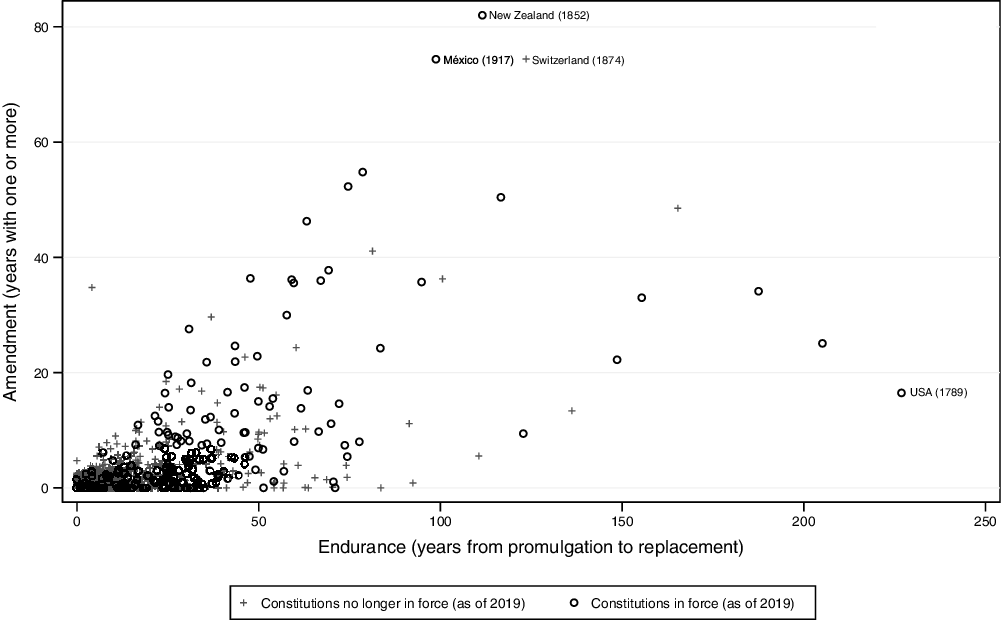
In terms of amendment and endurance, the 1917 Mexican Constitution is a constitutional outlier or, more precisely, following Gerring (Reference Gerring2006), a deviant case, that is, a case that lies far from the mean, and entails important anomalies vis-à-vis widely shared views in current theories. As Figure 2 shows, this constitution is the second most amended charter in modern constitutionalism, only after the flexible 1852 New Zealand Constitution. A similar conclusion emerges if we analyze endurance, as Mexico is far above the mean according to the data of the Comparative Constitutions Project (Elkins, Ginsburg, and Melton Reference Elkins, Ginsburg and Melton2014). Few constitutions have been more enduring than the 1917 Mexican one, and now no other codified constitution has been subjected to such a constant pattern of renewal through amendment. The study of Mexico’s Constitution is made all the more interesting by the fact that its hyper-reformism emerged under divided government (Pou-Giménez and Pozas-Loyo Reference Pou-Giménez, Pozas-Loyo, Albert, Bernal and Benvindo2019; Casar and Marván Laborde Reference Casar and Marván Laborde2014).
The 1917 Mexican Constitution in Comparative Perspective. Amendment and Endurance of National Constitutions, 1789–2019.
Source: authors’ calculations with data from Elkins, Ginsburg, and Melton (Reference Elkins, Ginsburg and Melton2020).

Yet as we will see in the following sections, Mexico is not only deviant because of the dynamics we have mentioned, but also because of the way the interplay between constitutional amendment and judicial interpretation plays out in the country.
HYPER-REFORMISM AND INTERPRETATION: A QUANTITATIVE VIEW
In Mexico, the Supreme Court and, since the 1960s, collegiate circuit courts select and publish relevant precedents in summaries or syllabi called tesis (theses). The body of tesis has been the source of constitutional and legal interpretation in Mexico. They are widely distributed and studied by the legal profession and are a central component of the examinations that must be taken to join or be promoted in the judicial career. An ever-increasing caseload led to a system where legal operators would not work on the basis of the rulings—which were not published until recently—but on the basis of the syllabi contained in the tesis, published in a weekly judicial newspaper. Tesis contain interpretation not only of the Constitution, but also of federal and state legislation.Footnote 17 Some of them are binding on lower courts—they are called tesis jurisprudenciales—and others only advisory—they are called tesis aisladas.
Since late nineteenth century, three methods for the creation of tesis jurisprudenciales have been established. In the first one, jurisprudencia by reiteration, according to rules originally set down in the 1880s, criteria derived from the resolution of writs of amparo become binding if reiterated in five consecutive rulings decided by a qualified majority.Footnote 18 In the second, jurisprudencia by contradiction, which emerged in 1930s when the Supreme Court began to operate in chambers—not only en banc—criteria pronounced in the process of resolving disagreements between the chambers are also binding; this procedure was later expanded to the resolution of interpretive conflicts between collegiate circuit courts. Finally, in jurisprudencia by reasons, introduced in 1994, criteria issued by the Supreme Court when deciding actions of unconstitutionality (abstract review of statutes) and constitutional controversies (horizontal and territorial division of powers disputes) become binding if approved by a qualified majority of eight votes out of eleven. The federal judiciary has issued more than 250,000 tesis since 1917; the Supreme Court, specifically, has produced 17,038 tesis, 6.7 percent of them binding and 93.3 percent aisladas (Saavedra-Herrera Reference Saavedra-Herrera2018).
As we have discussed, Lutz’s proposition establishes that a substitutive relation exists between amendment and interpretation as means of constitutional revision. To capture the dynamics of interpretation as means of constitutional revision in Mexico, we created a data set containing all constitutional tesis both jurisprudenciales and aisladas, that is, the universe of precedents on constitutional matters issued by the Supreme Court between 1917 and December 2020. It is important to stress that the Supreme Court itself identifies which precedents are constitutional. All precedents when published clearly establish their legal matter, and binding constitutional precedents specify the article(s) of the Constitution that they deal with.
To construct our data set, we employed a compilation developed by the Supreme Court.Footnote 19 As the information comes only in text format, we recodified every tesis to identify the year of issuance and the specific article interpreted, as signaled by the Court. Only 3 percent of all binding and nonbinding tesis are constitutional, according to the Court’s own classification, something explained by the fact that, from the last quarter of the nineteenth century up to the mid-1990s, it mostly performed a cassational role focused on reviewing the correct application of statutory law.Footnote 20
Out of all precedents on constitutional matters (5,119 tesis), our analysis pays special attention—in the second part of this section—to those that are binding (1,985 tesis jurisprudenciales), as they emerge through a harder-to-meet procedure. While tesis aisladas contain precedents considered relevant by higher courts, tesis jurisprudenciales summarize decisions that represent, as we explained above, the reiteration of criteria, the resolution of interpretive conflicts in the Court or lower courts, the outcome of abstract statutory review, or the resolution of federalism-related controversies. When the Court issues a tesis jurisprudencial, it therefore sends a strong signal that an important constitutional decision has been made—one that is binding on all lower courts and solves previous uncertainties as to the meaning and implications of the Constitution.
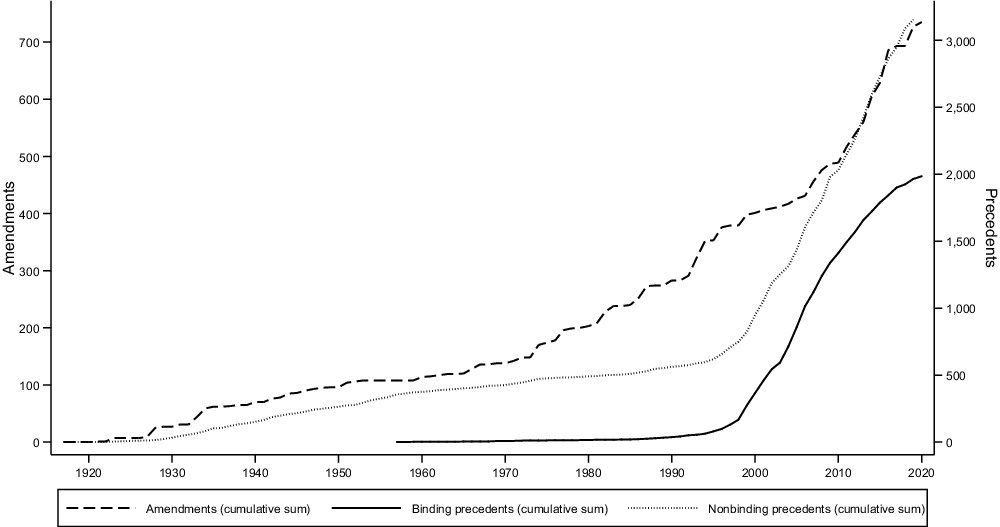
Let us now place our quantitative assessment of binding constitutional precedents in relation to the number of amendments. As we saw in the previous section, although constitutional renewal via amendment began in the 1920s, it remained limited until the 1970s when, as shown in Figure 3, the process accelerated, with special intensity from 1997 onward, in a context of divided governments. Almost half of the total number of amendments (359 out of 735) were passed between 1997 and 2020. Thus, amendments passed over the last twenty-three years amount to 48.9 percent of amendments passed over the entire century. In parallel, existing data on precedents show that constitutional interpretation also increased over the last twenty years: 85.2 percent of the 5,119 binding and nonbinding constitutional tesis issued by the Supreme Court in the course of a century correspond to those issued over the past twenty-three years. Figures become even more striking when we consider only binding precedents or tesis jurisprudenciales. Figure 3 additionally shows all binding precedents issued from 1957 (when the formulation of tesis became institutionalized) onward. Note that 95 percent of the 1,985 binding constitutional precedents were issued in the last twenty-three years.
Constitutional Reform and Interpretation, 1917–2020. Amendments and Precedents Issued by the Supreme Court of Justice.
Source: authors’ calculations with data from our own data sets created with information from the Supreme Court of Justice. For constitutional amendments we employed the Court’s compilation on constitutional reform decrees (available at https://www.scjn.gob.mx/constitucion-politica-de-los-estados-unidos-mexicanos/articulos/339) and for precedents the DVD La Constitución y su interpretación por el Poder Judicial de la Federación (to June 2016), as well as the electronic and updated version of this compilation (available at https://jurislex.scjn.gob.mx/#/1000/tab).

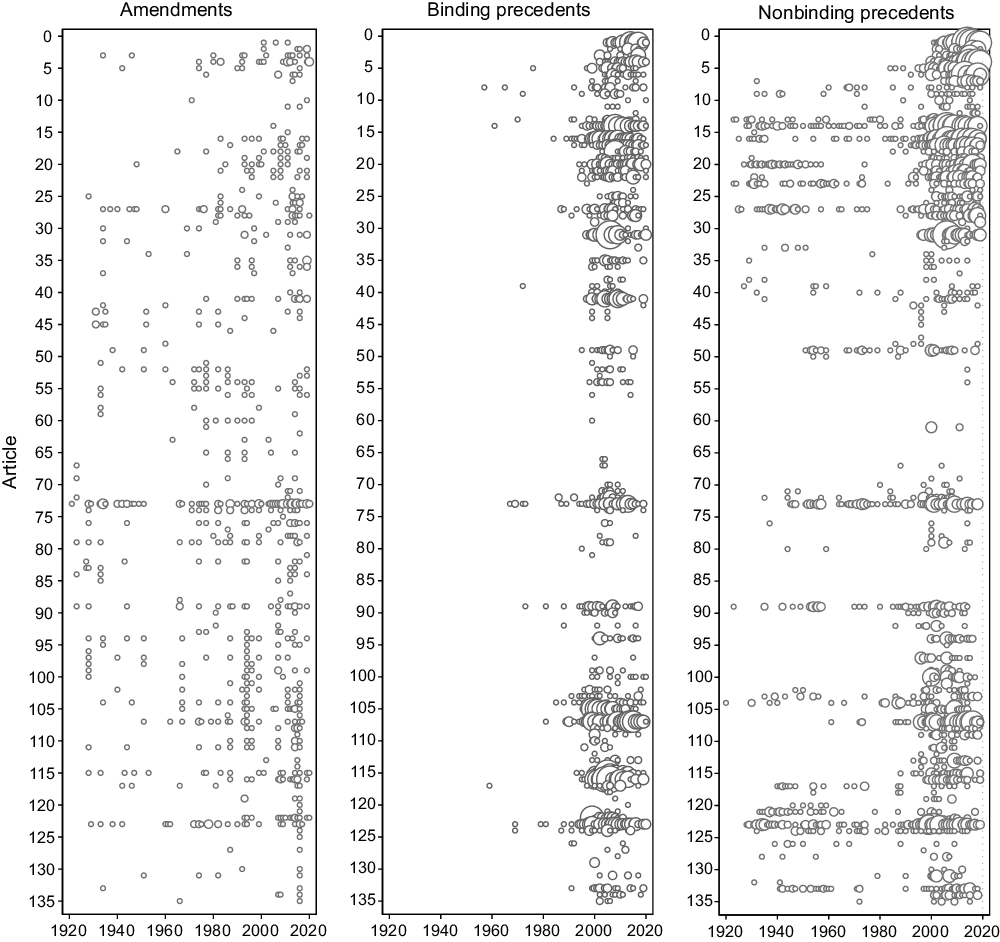
Let us now analyze the constitutional articles that are addressed in those binding constitutional precedents to gain a more substantive sense of the type of judicial interpretation involved—as a preliminary step to delving deeper into some of substantive constitutional areas to show, qualitatively, the kind of constitutional revisions and modifications that the Supreme Court has implemented through these interpretations. Our data show two important facts (see Figure 4). First, both amendment and interpretation have become more frequent in recent times. And second, the Court’s interpretative activity has progressively diversified. Before 1995, fifty-nine articles monopolized all nonbinding precedents and only twenty-four monopolized all binding precedents, whereas from 1995 to 2020, nonbinding precedents touch on 111 different articles and binding ones on ninety-nine.
Constitutional Reform and Interpretation, 1917–2020. Amendments and Constitutional Precedents Issued by the Supreme Court by Article and Year.
Source: authors’ calculations based on the tesis contained in the Supreme Court’s compilation La Constitución y su intepretación por el Poder Judicial de la Federación (updated to June 2016) and the electronic and updated version of this compilation (available at https://jurislex.scjn.gob.mx/#/1000/tab).
Note: the size of the circles reflects the number of amendments/precedents by article and year.

Moreover, before 1995, most binding precedents interpreted article 107, which regulates the writ of amparo (nine precedents); article 123, featuring the labor regime that emanated from the 1910 Revolution (eight precedents); and article 73, which lists the areas of jurisdiction of the federal Congress—the most amended article of the Constitution (eight precedents). After 1995, most binding precedents correspond to article 107, on amparo (217 precedents); article 14 and article 16, which enshrine the principles of nonretroactivity, exact application of the law, legality, and other safeguards on criminal matters (137 and 142 precedents, respectively);Footnote 21 article 116, which sets down principles that subnational constitutions are bound to follow (212 precedents); article 31, which establishes the obligations of Mexican nationals (129 precedents); article 1, which contains the basic provisions on the architecture of the Bill of Rights, the nondiscrimination clause, and the principles that since 2011 have governed the relation between domestic and international human rights sources (125 precedents); article 115, which regulates municipalities (125 precedents); and the aforementioned article 123, on labor rights (126 precedents).
In sum, constitutional interpretation has been increasingly frequent and diverse, and has dealt with fundamental constitutional matters. Such diversity is important since it signals that an important degree of constitutional change through amendment has occurred in Mexico. If amendments dealt only with a very limited number of articles, and those articles were mainly reglementary in nature, as we will argue is the case in Brazil, there would be grounds to believe that the rate of amendment has not translated in substantial constitutional change.
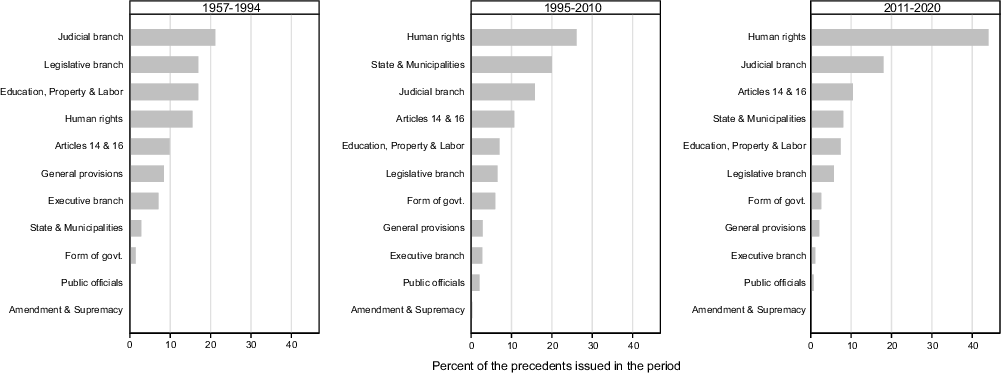
Arguably this frequency and diversity have been stimulated by different factors. For instance, litigation might have shaped these trends, since the Court’s decisions respond to the legal bases of the cases they rule on. Has the steep rise in amendment rates also played a role in the increasing frequency and diversity of the Supreme Court’s constitutional precedents? We explore this question following a two-step strategy: we first group the articles of the Constitution by topic and compare the distribution of binding constitutional precedents dealing with these articles in three temporal segments (1957–1994, 1995–2010, and 2011–2020), and we then compare these data with those related to the distribution of amendments. The first segment comprises the decades when jurisprudential creation was limited and the Court did not enjoy wide-ranging powers of constitutional review; the second corresponds to the first fifteen years after the 1994 judicial reform, which reinforced judicial independence and amplified the jurisdictional menu of the Court; and the third corresponds to the period after the enactment of the 2011 human rights reform, which conferred constitutional status to the rights contained in the international treaties ratified by Mexico.
In the first segment, as Figure 5 shows, the different groups of constitutional provisions are more evenly distributed in the precedents. Yet it is interesting to see how things play out in the second and third segments, which mark junctures where constitutional amendment gains traction and soon transforms into a pattern of hyper-reformism. In the second segment (1995–2010), the highest number of tesis jurisprudenciales is concentrated in human rights, an area where a long and intense succession of small-scale amendments were being passed.Footnote 22
Constitutional Interpretation, 1957–2020. Binding Precedents Issued by the Supreme Court by Category and Stage.
Source: authors’ calculations based on the tesis contained in the Supreme Court’s compilation La Constitución y su interpretación por el Poder Judicial de la Federación (updated to June 2016) and the electronic and updated version of this compilation (available at https://jurislex.scjn.gob.mx/#/1000/tab).

The second area of tesis concentration is state and municipalities (i.e., federalism), something we cannot help but relate to the 1999 constitutional amendment that liberated municipalities from the states’ grip, giving them exclusive areas of jurisdiction and sources of revenue, and to the parallel increase in federal jurisdiction thanks to repeated amendments to article 73—though states were granted standing before the Supreme Court to defend their jurisdiction or challenge statutes. The third area is the judicial branch, which was radically transformed by the December 1994 constitutional amendment.Footnote 23 Finally, the fourth area is articles 14 and 16 (associated, as we saw, with cassational amparo), which retain a stable presence over time. In contrast, the areas where fewer constitutional precedents are found (e.g., form of government, faculties of public servants and of the executive branch) correspond to areas where the number of amendments has been low.Footnote 24
We detect a similar pattern in the third segment (2011–2020). Tesis referring to human rights increase to almost 50 percent over this period, while on the amendment side of things we find the extremely consequential “wholesale” human rights amendment of June 2011, which not only welcomes into the Constitution the human rights listed in treaties, but also embraces notions (such as state obligations regarding rights or the pro persona principle) that multiply the enforceability potential of the Bill of Rights. Tesis on the judicial branch, which are second in number, are probably associated with the adjustments in amparo proceedings the Court has had to implement, by interpretive means, in facing the new litigation dynamics precipitated by the Bill of Rights, as well as to an increase in rights litigation, energized by the 2011 amendment. The remaining areas (excepting articles 14 and 16, whose relative weight remains largely the same) correspond to matters linked to the division of powers that are apparently now more settled and that—with the exception of the recent constitutional reform on Mexico City—have not been substantially modified via amendment.
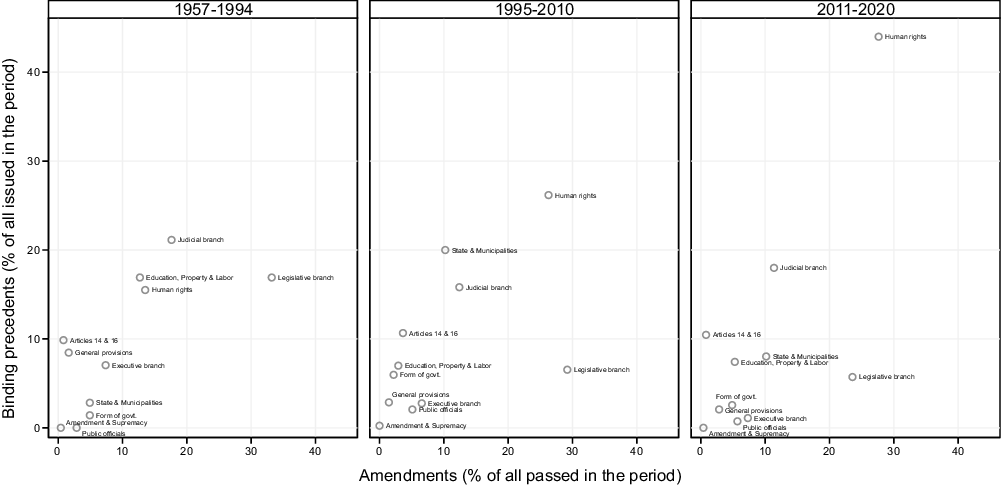
To explore the relation between amendment and interpretation, we first contrasted the distribution of binding constitutional precedents and amendments grouped according to the topics and segments explained above. Figure 6 shows that the relationship between amendment and interpretation has been largely positive: the issuance of precedents has been in general higher in the topic areas with more amendments. The most evident exceptions to this trend are the area concerning the legislative branch (particularly in the second and third segments), a topic that seems underinterpreted in face of its amendment rate, and the area concerning articles 14 and 16 (in the three segments), associated with amparo cassational litigation. Conversely, human rights stand out not only because, as already mentioned, a large proportion of precedents in the third segment belong to this category (43.9 percent), but also because this category is the one that accumulated more amendments in that segment (27.6 percent).
Constitutional Reform and Interpretation, 1957–2020. Amendment and Binding Precedents Issued by the Supreme Court by Category and Stage.
Source: authors’ calculations based on the tesis contained in the Supreme Court’s compilation La Constitución y su interpretación por el Poder Judicial de la Federación (updated to June 2016) and the electronic and updated version of this compilation (available at https://jurislex.scjn.gob.mx/#/1000/tab).

In conclusion, the data show that in Mexico the impressive increase in the rate of amendment has converged with an expansion in the frequency and diversity of constitutional interpretation by the Supreme Court. Of course, convergence does not imply causation or any sort of deterministic influence of formal amendment over interpretation, and other factors may be playing an important role.Footnote 25 Nevertheless, the path formal amendment has followed for an entire century, and the way it has overlapped with an expansion of constitutional interpretation, provides evidence that, in principle, runs against the empirical expectations implied by Lutz’s thesis. This fact is an invitation to analyze in more detail, with supplementary analytical tools, whether amendment has fostered constitutional creation by interpretation or not. As we discuss in the following section, in Mexico constitutional hyper-reformism has arguably boosted more constitutional revision and change through interpretation because the piecemeal amendment pattern has generated important inconsistency and heterogeneity within the constitutional text, therefore promoting and actually requiring active constitutional revision by judges.
HYPER-REFORMISM AND INTERPRETATION: A QUALITATIVE VIEW
Contemporary views on adjudication have little to do with the early-constitutionalism image of courts as the “mouth of the law” (Montesquieu 1777). Since legal texts are infiltrated by problems of vagueness, ambiguity, and open texture, the task of assigning them meaning and applying them to specific cases is often fraught with complexity. Sometimes courts go about the resolution of social controversies in light of identifiable preexisting standards and rules, and other times they more openly contribute to construction of existing law.
In this section we focus on the relation between amendments and Supreme Court case law in three areas: human rights, federalism, and property rights. We selected these areas because, as we explained above, they have accounted for most of the interpretative activity by the Court.Footnote 26 By focusing on the substantive changes introduced by the Court in these areas we show that in recent decades constitutional interpretation has not only been more frequent and diverse, but also substantively strong. The style and scope of the sort of judicial interpretation we describe provides additional evidence against the existence of a substitutive relation between amendment and interpretation as means of constitutional update in Mexico.
The Construction of the Bill of Rights
A first area where the Supreme Court has generated an important amount of substantial constitutional normativity concerns the architecture and mode of operation of the declaration of rights. Although the 1917 Constitution famously enshrined several social rights, even before the Constitution of Weimar (Grote 2017), in the 1990s the Mexican Bill of Rights lagged clearly behind those in other Latin American constitutions (Uprimny 2015). At that point in time, constitutional amendments in Mexico had changed the processes for accessing and exercising political power—creating, for instance, an independent electoral authority, an independent Judiciary Council—but had left the old Bill of Rights fundamentally untouched.
A pattern of continuous rights-focused amendments then started, and further accelerated during President Calderón’s term (2006–2012). Thus, in 1999, the right to an adequate environment was included, and Congress was given powers to legislate in the domain of sports. In 2000, children’s rights were incorporated, as were the rights of the victims in criminal proceedings. In 2001, a capacious antidiscrimination clause was added to article 1, and article 2 was amended to introduce a wide array of rights for indigenous communities and individuals. In 2002 and 2012, respectively, kindergarten and high school became part of state-funded public education. In 2004, a nationality reform was passed. In 2005, the death penalty was eliminated and a criminal system for teenagers was created. In 2007, the right to access public information and institutions to make it effective were created; later in the year, the right to reply was added. In 2008, there was a consequential criminal procedure reform changing the system from inquisitorial to adversarial. In 2009, the right of access to culture and the right to personal data control were added. In 2011, the right to food was included, and the right to water followed suit in 2012. Also in 2012, political rights were boosted by the introduction of popular statutory initiation, independent political candidacies, and popular consultations. In 2013, freedom of conscience and religion made an appearance. More recently, although the frequency of rights-related amendments has diminished, there have been changes in the right to education, the right to an identity and the rights of Afro-Mexican individuals and communities have been created, and gender-parity provisions have been added.Footnote 27
Amid this tsunami of changes, one amendment stands out: the June 2011 human rights reform—accompanied by a more modest amparo reform. This amendment conferred constitutional status to the human rights listed in treaties, and introduced interpretive and adjudication tools of great transformative potential—like states’ duties to respect, protect, and fulfill rights, and the duty to interpret rights under the principles of universality, indivisibility, interdependence, progressivity, nonretrogression, and pro persona.Footnote 28
What did not change—surprisingly, or not—were several constitutional provisions that were incompatible with the new amendments, or the treaty provisions that now enjoy constitutional status. Examples include article 36, which denies political rights to individuals under criminal process, contrary to the presumption of innocence and the more generous provisions of the American Convention;Footnote 29 article 19 providing for automatic preventive incarceration for several categories of crimes in violation of the American Convention’s prohibition of arbitrary deprivation of freedom;Footnote 30 and the provisions allowing for long-term pretrial detention without charges, which violate the American Convention right to be informed of the charges and to be presented before a judge.Footnote 31
The Supreme Court has confronted these contradictions. It took almost four years and significant back-and-forth for the Court to offer a reasonably clear picture of how the new Bill of Rights is really shaped. After issuing several criteria where the more generous treaty provisions were given preeminence,Footnote 32 the Court decided that where the Constitution contains “explicit rights restriction,” this must prevail over more generous treaty provisions on the same subject (CT 293/2011, decided in 2013).Footnote 33 The Court assembled this criterion out of an extraordinarily heterogenous collection of provisions: the ones in article 1 that welcome the rights of the treaties into the Constitution and enshrine the pro persona principle; those in article 133, which seem to place treaties above statutes but below the Constitution; those in a paragraph in article 1 that state that rights cannot be restricted or suspended except for in those cases and conditions set down in the Constitution; and those regulating exception powers in article 29.
What emerges from these rulings is, no doubt, the constitutional Bill of Rights, since the hyper-reformist dynamics at work provided the Court with elements sufficiently varied to build several highly contrasting versions of the rights constitution. It is a clear example of substantial constitutional change through interpretation. What the Court says is written down nowhere, but it is certainly one possible resulting architecture of the current constitutional text. The Court does in this way what political supermajorities repeatedly tinkering with the constitutional text through amendments had not: establishing a clear, coherent constitutional regulation and choosing to take political responsibility for it.Footnote 34 If tomorrow the Supreme Court changes its views, the contours of the Mexican Bill of Rights will effectively change, and with them, the core of the Mexican Constitution.
The Construction of Federalism
Another area where the effects of hyper-reformism have gone hand in hand with waves of judge-made constitutional creation is the territorial division of powers. In the nineteenth century, in parallel to the alternation between liberalism and conservatism, Mexico alternated between federalism and centralism. The Constitution of 1917, in harmony with its progressive core, adopted a federal system, not very different in its bones from the US one—a dual model based on the attribution of enumerated powers to the federation, all others being retained by the states. Municipalities, for their part, were subordinated political bodies, with administrative attributions closely constrained by state and federal legislation.Footnote 35
More than a century-long line of amendments altered this architecture. Principal among them are amendments to article 73—more than eighty-two at the time of writing—which have conferred ever more areas of jurisdiction to the federation, inverting the decentralizing logic of the original design and turning the federation into a multiheaded hydra that penetrates all political domains. Federal areas of jurisdiction, moreover, are described in article 73 using a most heterogeneous terminology, sometimes referring to subject matters, at other times to public powers or functions, and at still other times to fundamental rights. Moreover, while at the beginning the attribution of powers to the federation was made in exclusive terms, over time formulae alluding to the “coordination” or the “concurrence” of all levels of government “within the limits of their areas of jurisdiction,” or according to “general laws” distributing jurisdiction, have become common. Amendments to article 73 have been made at the impulse of the political agenda of the day, piecemeal, escaping all sorts of general organizing patterns.
Amendments have also radically altered the position of Mexico City, which after the 2016 reform is no longer the Federal District with diminished political autonomy but a city-state with its own constitution (article 122); recognized indigenous communities as political subjects, conferring on them rights and areas of jurisdiction (article 2); and transformed the status of municipalities (article 115). Amendments in this latter area—sixteen at the time of writing—are, again, paradigmatic examples of the sort of gradualist change that is ubiquitous in the country. The first amendment to article 115, in 1983, conferred municipalities powers of autonomous administration at a time when the PRI thought a measure of decentralization would help it retain its grip on political power. Another relevant step was taken by the 1994 judicial reform, which gave standing to municipalities for the defense of their constitutional attributions. Finally, in 1994 a robust amendment package to article 115 recognized municipalities as institutions of government (not of mere administration), provided for the existence of municipal regulations on all internal matters, listed the public services they were responsible for, and conferred on them additional normative powers within the limits of “state statutes on municipal matters.” The amendment reserved certain sources of revenue for the municipal treasuries and reinforced the municipalities’ power to freely manage them.
The Supreme Court has had an enormous impact in the area of federalism. Its rulings “expound” how the territorial distribution of power looks, and must operate, after so many episodes of deep reform. The Court has tried to give some rationality to the model by bringing in the principles of hierarchy and competence and explaining how they operate—against a historic background in which the principle of competence had played no role.Footnote 36 The Court has additionally distinguished between “cooperation,” “concurrence,” and “coordination” as different models for distributing jurisdiction; it has conceptualized “general statutes” (leyes generales) as those that, following a constitutional mandate, assign areas of jurisdiction to the different levels of government and are supra-ordained to both federal and state law; it has declared that the provisions in article 115 make it necessary to acknowledge municipal legality as a legal system that is independent from state legal systems within the larger Mexican legal order; it has provided criteria for solving conflicts of norms and identifying suppletory normativity when necessary; it has crafted the notion of “municipal treasury” and principles that fortify it (“reserve,” “integrity,” “free administration”); et cetera.Footnote 37
This is anything but noncreative adjudication under the Constitution. It is the Court that largely creates the federal system, among other reasons because there was no clear political program concerning the legal design of federalism in the country. For decades, Mexican federalism was not meant to operate on legal grounds, but politically, through informal norms and negotiation. As a rule, it has been short-term needs and the results of multiparty negotiations between the federation and the states on a variety of issues (including revenue) that have determined the modifications to the Constitution. The Supreme Court has therefore found itself once again in the position of trying to provide some coherence and operativity to the puzzle. No wonder the most recent assessment of Mexican federalism comes under a heading that evokes this precise image: “federalism(s): the current puzzle.”Footnote 38 The study in that book does three things that are deeply consistent with the nonsubstitute relation thesis we advance here: it documents the amount of amendments affecting—in multiple, crisscrossing ways—different areas in the domain of federalism; it identifies the landmark rulings where the Court crafts the main rules about the distribution of jurisdiction between the various levels of government; and it tracks down the detailed regime for several topic areas (the different “federalisms”) taking into account constitutional amendments, main legislative developments, and the Supreme Court doctrine.
Once again, we find a large area of constitutional law in which the substitute relation between amendment and judicial creation does not apparently obtain. In the domain of federalism, the acceleration of constitution-making activity leads to an increase in judicial activity, not only because new constitutional clauses give grounds to new opportunities of litigation, but also because the mere reality of massive but not well-articulated constitutional change pushes for more constitutional change—change that is naturally attempted by the Court as part and parcel of the task of making sense of and administrating a hyper-amended constitution.
The Construction of Property Rights
The Supreme Court has also been unmistakably creative with regard to property rights. We focus on the constitutional regulation of expropriation, which is crucial to any property regime but was certainly fundamental in the original 1917 constitutional program. We show that despite the fact that expropriation has not been the object of massive amendment, amendments in other constitutional areas have given the Supreme Court space to reconstruct the meaning of this pillar of constitutional identity.
Expropriation was a crucial tool for the construction of the hegemonic party regime that ruled Mexico for seven decades. PRI administrations employed it to nationalize entire sectors of the economy and implement the land redistribution program defined in the Constitution. Expropriation has also been highly salient since then, in democratic times: it played a key role in the case that grounded the impeachment of Mexico City’s former mayor and current president, Andrés Manuel López Obrador, in 2005; in the cancellation of the project to develop a new airport in Mexico City in 2002; and in the (unsuccessful) nationalization of sugar mills, to mention a few examples. All of them originated in exercises of expropriation.
The essential rules governing expropriation are contained in article 27, which regulates property. Under this article, the nation has the original ownership of all lands, waters, and natural resources. This ownership is then transferred to the state for regulation and administration. In fulfilling this responsibility, the state must observe the “social function of property” and promote a fair distribution of wealth, ensuring the preeminence of public interest over private. On behalf of the nation, the state is entitled to establish different “modalities” allowing private control of property. In practice, the notion of “property modalities” has materialized in two categories of property: individual—regulated by civil codes and statutes—and collective—regulated in agrarian laws on comunidades and ejidos (Azuela and Cancino Reference Azuela and Ángel Cancino2011).
Several features singularize the constitutional regulation of expropriation. First, expropriation is only authorized for reasons of public cause (causa de utilidad pública). Second, it requires economic compensation (mediante indemnización), but not necessarily beforehand (the administration can take control of the property and compensate the owner ex post), and it will be based on land registry values (catastros), not on market value. Third, there is no regulation addressing how the rights of the owners will be protected in the proceedings. And fourth, most notably, the Constitution says the judiciary cannot review expropriation episodes except for the calculation of compensation, within narrow preestablished parameters.Footnote 39
Despite this last restriction—which has not been amended as of this writing—federal courts have frequently adjudicated expropriation cases involving not only compensation but also other issues such as “public cause,” or the denial of a prior hearing. The absence of prior hearings was certainly one of the arguments that foreign companies raised when the oil industry was expropriated in 1938. From 1938 to 2006, the Supreme Court asserted that the right to prior hearing did not apply to expropriations (Herrera-Martin Reference Herrera-Martin2014).
In deciding two cases in 2006, however, the Supreme Court overrode this long-lasting criterion and declared for the first time that all public authorities must grant a hearing before taking property from private owners. The first step to this change was not formalized in a binding tesis jurisprudencial but in the ruling on the expropriation of twenty-seven sugar mills in 2001, under the presidency of Vicente Fox.Footnote 40 In the ensuing months, resorting to a specific procedure that allows for the ad hoc overriding of precedent, the Court issued a criterion explicitly determining that the right to prior hearing applies to expropriations.Footnote 41 The change culminated a liberalization process that had started a decade earlier. In 1992, in the context of the negotiations of the North American Free Trade Agreement (NAFTA), a major amendment to article 27 ended the land redistribution program defined in the original 1917 Constitution and eliminated the clause prohibiting collective property owners (ejidos and comunidades) from selling their land (Díaz y Díaz Reference Díaz y Díaz2014b). Because a prior hearing was created, however, commentators had observed that, before the creation of the 2006 precedent, Mexicans had fewer property guarantees than foreigners in the country.Footnote 42
As in many other decisions delivered by the Court throughout those years, the change in judicial interpretation was made possible by several collateral factors, such as the 1994 constitutional amendment that reinforced the institutional position of the Supreme Court and the more fragmented political context that emerged from democratization. But in the case of expropriation, the constitutional amendments on property and the new relationship between domestic and international law operated by NAFTA were also essential; as the justices observed when passing the new precedent, their goal was to rectify what they saw as contradictions between the Constitution and NAFTA.Footnote 43
Either way, the consequences of the new precedent were large, and powerfully changed the political status quo. Before 1935, only the state of Jalisco required administrative authorities to provide a prior hearing, and by 2006 only seven states conceded it. From 2007 to 2012, eight more states passed amendments to make room for this right in their legal systems (Saavedra-Herrera Reference Saavedra-Herrera2013).
DISCUSSION
In the previous sections we have claimed that Mexico is a deviant case vis-à-vis an important, widespread contention within the literature on constitutional change, and we have offered elements supporting this contention. In this section, we would like to discuss the theoretical and comparative insights that our analysis can offer for better understanding the relation between constitutional amendment and constitutional interpretation.
Let us start by briefly summarizing the findings so far. First, we have presented evidence that calls into question the generalizability of Lutz’s hydraulic thesis, according to which amendment and interpretation have a substitutive relation as means of constitutional modification, by showing that it does not hold in the Mexican context during the last three decades (Lutz Reference Lutz2006, Reference Lutz1994). In particular, we showed that the impressive increase in the rate of amendment has been accompanied by an expansion in the amount and diversity of constitutional interpretation by the Supreme Court that not only applies but also transforms the Constitution. Of course, this claim is perfectly consistent with a substitutive relation obtaining under other circumstances.
Moreover, we have contended that there are good reasons to claim that in Mexico piecemeal hyper-reformism has produced important inconsistencies within the constitutional text that in turn have promoted a very strong modality of constitutional interpretation. This evidence suggests the existence of a complementary relation between these two channels of constitutional mutation in Mexico.
Our findings also run contrary to a view shared by some Mexican scholars, who have argued that the Mexican Supreme Court has remained passive in the domain of amendments, refraining from controlling the constitutionality of reforms out of deference and consideration for the democratic pedigree of the amending political apparatus.Footnote 44 If our analysis is correct, the creative impact of the Supreme Court on the Constitution itself has been extensive; it has only remained dissimulated by the fact that it has been done in the course of resolving ordinary constitutional cases, without the monitoring and the political pressure that other constitutional courts experience when engaging in constitutional review of constitutional amendments.
What theoretical lessons can we learn from all this? How can Mexico’s deviant patterns contribute to constructing a better understanding of constitutional change? Let us first reflect on the mechanisms and assumptions that seem to sustain Lutz’s hypothesis, then analyze why they do not hold in Mexico, and finally suggest what this illuminates about the relation between amendment and judicial interpretation more broadly.
Arguably, the belief that judicial interpretation will be marginal in scenarios of high rates of amendment is associated with the false idea that high amendment rates are always explained by the existence of a political group that enjoys the capacity to unilaterally amend the constitution—either because, under a rigid constitution, it has political hegemony, or because, under a flexible constitution, it is the majority controlling the government. In other words, Lutz’s thesis assumes that a high amendment rate can only be obtained in scenarios where political power is highly concentrated. Both in cases where a hegemonic political group can unilaterally change a de jure rigid constitution and in cases where a majoritarian government can transform it into a de facto flexible one, judicial interpretation would tend to be marginal for two reasons: first, because such a government can respond to any undesired judicial ruling with an ad hoc constitutional amendment; and second, because, under those conditions, judges are vulnerable to retaliation and political attack. Hence, Lutz’s thesis seems to tacitly assume that the conditions that make high amendment rates possible simultaneously inhibit change through interpretation, because under those conditions judges will always fear having their decisions politically challenged and will expect these challenges to arrive if they dare to alter or update the meaning of the constitution.
By contrast, a cursory analysis of the conditions that have prevailed in Mexico over the last few decades dominated by constitutional hyper-reformism interestingly shows, in our view, why the modality of intensive judicial interpretation we have documented was possible, and even necessary.
Over the past twenty-five years Mexico has lived under hyper-reformism with neither a hegemonic political group nor a flexible constitution. Now, as the literature has extensively shown, in competitive political systems where power is not concentrated, politicians face important endogenous and exogenous incentives to maintain strong independent constitutional courts (Ramseyer Reference Ramseyer1994; Stephenson Reference Stephenson2004; Vanberg Reference Vanberg2015). In Mexico, political fragmentation has shielded the Court against political attack. As we discussed earlier, in this period not only was there no single political party that could pass a constitutional amendment alone, but often political parties had different views or interests before any Supreme Court ruling. For these reasons, Mexican justices did not expect their constitutional rulings to be stopped by an amendment (no party could do so alone), nor did they fear any serious harm at the hands of the government.
Moreover, the Court has diverted unwanted attention by not developing a doctrine of “unconstitutional constitutional amendments.”Footnote 45 While it is uncommon for a court confronted with a dynamic of massive reform not to “respond” by examining the procedural or substantive validity of amendments—the Supreme Courts of India, Colombia, and Brazil, among others, have famously done soFootnote 46 —the Mexican Court has progressively closed all doors in that direction.Footnote 47 Although to fully explain why the Mexican Court has refrained from reviewing amendments one would have to launch an inquiry that goes well beyond the scope of this article, our findings suggest nonetheless that its choice should not necessarily be interpreted as a sign of institutional modesty, but rather as evidence of the Court’s exercising functions (and power) by other means. In confronting the exceedingly complex text that has resulted from hyper-reformism, not operative by itself, the Court has chosen to leave the validity of the procedures and the substance of the amendments unaddressed, to concentrate rather on expounding (maybe postulating) their meaning and implications. Facing little pressure from the other branches, it has shaped the Constitution via interpretative adjudication in the course of assigning meaning to ever-changing constitutional textual grounds.Footnote 48
In sum, the Mexican case shows that in a context of political pluralism, the coexistence of hyper-reformism and constitutional interpretation as means of constitutional change has been possible. Yet if political competition and fragmentation have made constitutional change through interpretation in Mexico possible, what has made it necessary? In our view, hyper-reformism under political plurality creates by itself the necessity of an independent agent endowed with substantial powers of constitutional revision. Constant constitutional change produces uncertainties, internal tensions, and even inconsistencies that call for strong judicial reconstructive tasks. Judicial review operates as a palliative for this constitutional disease. Moreover, long, complex, and ever-changing constitutions in contexts of political fragmentation are sources of constant strife among political parties and institutions, and again, courts need to come forward to soften the deleterious effects. In sum, in Mexico, hyper-reformism coupled with political fragmentation and competition has made constitutionally innovating judicial interpretation both possible and necessary.Footnote 49
Mexico’s case could therefore also invite deeper inquiry into the views that have understood the drafting of highly specific constitutions that are often revised as a way of limiting the discretion of constitutional interpreters (Versteeg and Zackin Reference Versteeg and Zackin2016).Footnote 50 As we have argued, in Mexico hyper-reformism has been accompanied by a substantive increment of specificity, which has unfolded in the text of the Constitution’s 136 articles and an enlarging body of transitory provisions. Certainly, such a frenetic rate of constitutional reform and mounting specificity has created an extremely disorganized and internally incoherent constitution that, paradoxically, has increased the discretion of the Mexican Supreme Court.
If our analysis is correct, there are three theoretically important conclusions to draw from Mexico’s deviant case. The first one is that the relation between judicial interpretation and constitutional amendment, as two modalities of constitutional change, is context-dependent: no valid general conclusions can be drawn a priori on this relation. The Mexican case specifically would lead us to consider that if there is a high amendment rate, it matters whether a political force has the capacity to unilaterally transform and reform the constitution. If there is a high rate of amendment, and no political force can unilaterally amend the constitution, then we cannot assume that judicial interpretation will be marginal as a path to constitutional modification.
An important implication of this theoretical conclusion is that comparative research may prove particularly fruitful to understanding patterns of constitutional change. For instance, the fact that Marshfield’s research on amendment and interpretation at the state level in the United States (Marshfield Reference Marshfield2018) leads to results similar to those in our research on Mexico suggests that there may be an underlying pattern to explore. It may be the case that, after a tipping point, the relation between the rate of amendment and the amount of constitutional modification through interpretation is no longer substitutive but complementary. Of course, such a hypothesis would require strong comparative evidence in order to be tested.
For the same reasons, it would be particularly interesting to conduct comparative research on Brazil’s and Mexico’s patterns of constitutional change.Footnote 51 Both Mexico and Brazil have had, since their transitions to democracy, a very high rate of constitutional amendment in a context dominated by political plurality. Contrary to expectations, the dynamics of intense amendment have empowered their high courts. Not only they have produced, quantitatively, a very large number of rulings, but also rulings containing substantively important decisions and therefore becoming extremely relevant sources of constitutional normativity.
Nevertheless, the two cases have important differences. Unlike the situation in Mexico, Brazil’s high rate of constitutional amendment is largely driven by the need to make small adjustments to constitutionalized public policies (Arantes and Couto Reference Arantes, Couto, Nolte and Schilling-Vacaflor2012) without extensive substantive transformation (Benvindo Reference Benvindo2016). According to Couto and Arantes (Reference Couto and Arantes2008), 30.5 percent of Brazil’s provisions are related to public policies. Hence, to implement their policy agendas governments have been forced to operate by means of constitutional amendments. According to these authors, a pattern that could be labeled as “policy-driven hyperreformism” accelerated to reach astonishing levels during Cardoso’s and Lula’s governments, with 493 and 484 provisions amended respectively (Arantes and Couto Reference Arantes, Couto, Nolte and Schilling-Vacaflor2012). For instance, Cardoso’s tax reform required the amendment of 101 provisions, and the under his government constitutional amendments involved a ratio of 2.21 policy provisions to every “truly constitutional” provision (Arantes and Couto Reference Arantes, Couto, Nolte and Schilling-Vacaflor2012, 216).
Moreover, in contrast to the situation in Mexico, and despite the fact that Brazil’s Constitution does not explicitly endow it with jurisdiction to do so, from the early nineties Brazil’s Supremo Tribunal Federal asserted its powers to review the validity of amendments (and even mere proposals of amendment), ignited by actors that have readily challenged them.Footnote 52 According to Salgado and Alves das Chagas, 26.8 percent of all amendments have been challenged; 35 percent of those challenges have been dismissed, and in 40 percent of them the decision is still pending (Salgado and Alves das Chagas 2019, 6).Footnote 53 In sum, while our findings here are not generalizable to other cases, they invite further comparative research on the different patterns of constitutional change in general and of hyper-reformism in particular.
The second theoretical conclusion to draw from Mexico’s deviant case is that, to build an appropriate theory of constitutional change, its modalities, and the relations among them, it is important to account for the different social and political roles each modality plays in different contexts. As we have argued, in Mexico strong and creative judicial interpretation was made necessary by the effects of hyper-reformism on the Constitution: it progressively produced a very long, complex, and at times inconsistent constitution. Under such constitution, creative judicial interpretation was required to solve the many conflicts emerging from the very nature of the text, including those produced by the anomalous practice of adding and amending transitory provisions. In the same vein, as two of us have argued in detail elsewhere, hyper-reformism was socially and politically important in attaining the incremental and largely peaceful Mexican transition after seven decades of hegemonic party rule (Pou-Giménez and Pozas-Loyo Reference Pou-Giménez, Pozas-Loyo, Albert, Bernal and Benvindo2019). This important function is indispensable to understanding how such a high amendment rate obtained in a context of political fragmentation. If we are correct on this point, accounting for the different roles constitutional amendment and judicial interpretation play in different social and political contexts would be crucial to further our understanding of each modality of constitutional change and of their relation.
Finally, our account shows that not all constitutional courts react to a hectic constitutional amendment pushed forward by the other power branches by reviewing the constitutionality of amendments and developing a doctrine of unconstitutional constitutional amendments. Out of a willingness to avoid the high public profile of the task, which exposes justices and makes them easy targets of attacks, because of mandates of legal culture prompting them to simply take the letter of the constitution as a starting point, or for other reasons that future research could productively investigate, a powerful court may meaningfully refuse to vindicate this capacity while exerting significant constitutional change through “regular” interpretation. Such a refusal should not be seen as a weakness, or as a sign of deference toward the amending authorities, but as part of patterns of interaction around constitutional change whose diversity and nuance our analysis has tried to forecast.