

I. Introduction
In October 2021, a proposal to reform the United Kingdom's excise duty on alcohol was put out for consultation and, subject to amendments, is expected to take effect from February 2023. The proposal would change the tax base from volume of product to volume of alcohol, thus improving its effectiveness as a tax aimed at reducing alcohol consumption for health reasons. It would also tax all wines with more than 8.5% alcohol by volume (ABV) at the same rate per unit of alcohol (HM Treasury, 2021). That change too is an improvement over the current situation whereby all sparkling wines (including low-priced ones from Italy and Spain) are taxed at a much higher rate than still wines. The proposal would see a fall in the tax on sparkling wines (by about one-fifth), a rise in the tax on fortified wines (18% ABV, by about one-sixth), and table wines with more (less) than 11.5% ABV would become dearer (cheaper). With taxes on most beers unchanged and taxes on spirits lowered slightly, the pattern of UK wine consumption and imports would alter considerably. That would alter the bilateral pattern of UK wine imports as well—a pattern that has already recently been disturbed by Brexit and the subsequent signing of new bilateral free trade agreements (FTAs).
The United Kingdom is of interest as a case study of alcohol tax reform because it is currently the world's second-largest importer (after the United States) of both still and sparkling wines, accounting for about one-seventh of each in value terms. Furthermore, it is among the heaviest taxers on alcohol consumption in the OECD, and its taxes on wine are high relative to those on beer and spirits, again compared with other OECD member countries (Anderson, Reference Anderson2020).
This article seeks to estimate the effects on the UK's wine consumption, imports, and bilateral trade of this proposed reform to UK alcohol excise duties. It does so by drawing on a global model of national alcoholic beverage markets (Wittwer and Anderson, Reference Wittwer and Anderson2020) that incorporates the widely varying rates of taxation of alcohol consumption via excise duties and import tariffs. The United Kingdom's proposed policy reform would necessarily alter international trade in wine, but unevenly across bilateral trade patterns because of the different mixes of wine types and their varying alcohol levels. As part of that, these excise duty changes could immediately corrode the bilateral trade expansion associated with the United Kingdom's newest FTAs.
To illustrate the last of those possibilities, we compare the estimated wine trade effects of the UK excise duty proposal with new estimates of the wine trade effects of the UK-Australia and UK-New Zealand bilateral FTAs that came into force in early 2022 and which each allow tariff-free access to the UK wine market. How the impacts of those agreements on wine exporters will be altered by the proposed changes in UK excise duties will depend importantly on the types and alcohol content of the wines those two antipodean wine exporters each supply compared with those of major competitors.
Australia is especially concerned because the UK excise reform proposal comes shortly after punitive tariffs were imposed by China on its imports of Australian wine, causing those imports to shrink in 2021 by 97%, or more than US$700 million (40% of Australia's wine exports). With that huge loss of the China market, the United Kingdom became Australia's top-ranked market for its wine exports in 2021 in both value and volume terms (Wine Australia, 2022). That ranking is more likely to remain following the signing on December 17, 2021, of its bilateral FTA with the United Kingdom, although the projected benefit of the latter has been reduced somewhat by the signing two months later (on February 22, 2022) of a bilateral FTA between New Zealand and the United Kingdom.
The article is structured as follows. Section II provides pertinent details of the UK alcohol excise duty reform proposal. Section III outlines the modeling approach to be used and the specific questions to be addressed with it. Section IV discusses the empirical estimates generated by the model. They suggest the proposed reform to UK excise duties is likely to reduce wine exports from Australia more than from any other wine-exporting country, but by considerably less than the gain to Australian wine exporters projected to come from the UK-Australia FTA—even when the offsetting effects of the UK-New Zealand FTA are deducted. Section V concludes.
II. UK alcohol excise duty reform proposal
The proposal to reform the UK's excise duty on alcohol (HM Treasury, 2021) includes a change to tax all wines that have an ABV of between 8.5% and 22% at £25.88 per liter of pure alcohol. That would raise the duty on all still wines with more than 11.5% ABV. For example, a wine with a 14.5% ABV would become dearer by £0.77 per liter (from £2.98 to £3.75), or by 26%. Since virtually all wine imported from Australia is at least 11.5% ABV, and on average has a higher ABV than that of almost any other supplier of wine to the United Kingdom, its vignerons are likely to be more impacted than most. New Zealand, as an exporter of mostly white wines whose alcohol content is mostly in the 12.5% to 13.5% ABV range, would be harmed much less than Australia. Fortified wines of 18% ABV are currently taxed at the same high rate as sparkling wines, but their rate would rise under this proposal by about one-sixth, thereby harming Portugal and Spain. By contrast, a fall in the tax on sparkling wine (by about one-fifth) would boost their UK sales, notably those imported from Champagne, Veneto, and Catalonia, in addition to locally produced sparkling wines.
As with all wholesale taxes and import tariffs, the burden of an excise duty is shared along a value chain that includes not just domestic and foreign producers but also importers, wholesalers, retailers, pubs, bars, restaurants, and final consumers. Insofar as final consumers are asked to bear some of the burdens of a rate hike by paying more for table or fortified wines, whether in the bottle shop (off-premise) or in a restaurant or bar (on-premise), they will adjust their consumption downwards; and conversely for sparkling wines, because they will become cheaper. Hence, estimating the impact of the reform proposal requires a model that captures these differences across countries of origin in their sales destination (on- versus off-premise) as well as in their various ABVs.
III. Modeling UK beverage markets in an interconnected world
Since the United Kingdom is currently the world's second-largest importer of wine, as well as a significant market for beer and spirits, its policies that affect consumption of any of those three beverages, therefore, have spillover effects on UK markets for the other two beverages, as well as on the rest of the world's alcohol markets.
To analyze changes to UK excise duties empirically, therefore, requires a global model of national beverage markets connected through international trade, in which the interactions between each nation's producers and consumers of these three beverages, and among various types of wine, are recognized. Wittwer and Anderson (Reference Wittwer and Anderson2020) recently generated such a model, the GLOBAL-BEV model. It identifies three red still wine qualities, three white still wine qualities, and sparkling wine, in addition to having a beer sector and a spirits sector in each country. It also distinguishes on-premise from off-premise sales of each type of beverage, the former (pubs, restaurants, etc.) having much bigger retail mark-ups on the tax-inclusive wholesale prices of alcoholic beverages than the latter (sales for off-premise consumption). Unfortunately, data on the average ABV of each country's various wines are not available, so all wines are assumed to face, under the UK's reform proposal, an excise rise of 77 pence for still reds, a rise of 13 pence for still whites, and a fall of 72 pence for sparkling wines. This exaggerates the negative impact on red still wine sales in the United Kingdom insofar as it implies they are all 14.5% ABV, whereas that is probably only the case for Portugal and perhaps Australia (the implications of which are discussed at the end of the next section).
In the GLOBAL-BEV model, the world is divided into 44 individual nations, with all other countries being captured in seven composite residual regions. The primary sources of data for constructing the model's baseline database for 2016–2018 are Anderson and Pinilla (Reference Anderson and Pinilla2021) plus Anderson (Reference Anderson2020) for taxes on beverage consumption and imports, Holmes and Anderson (Reference Holmes and Anderson2017) for wine, beer, and spirits average consumer expenditure data, and the United Nations (2022) for volume and value of international trade in beverages. The model's database is projected forward to 2023 by drawing on World Bank, IMF, and OECD macro projections. That baseline is then compared with alternative scenarios involving changes in UK excise and import taxes.
The GLOBAL-BEV model has income- and price-responsive demand equations, price-responsive supply equations, and hence quantities and prices for each of the grape and wine products and for beer and spirits, plus for a single composite of all other products in each country, such that it has elements of an economy-wide model. Grapes are assumed to not be traded internationally, but other products are both exported and imported by each country from potentially every other country.
We shock the baseline of this model by changing the UK's wine excise rates as described earlier. The proposed changes to the beer excise rates are too small to affect aggregate beer consumption and so are ignored here, but the proposed small reduction in the spirits excise rate is included in the modeled shock. It turns out that most of the impacts occur within the wine sector, so we will focus on them in the next section.
We use the GLOBAL-BEV model to address three questions regarding the likely impacts of the proposed reform of the UK's alcohol excise duty regime:
1. What are its impacts on the UK's retail prices and volumes of consumption of various beverages?
2. What are its impacts on the United Kingdom's and the rest of the world's imports of wine from various wine-exporting countries?
3. How do those bilateral trade impacts of the proposed UK excise reform compare with the estimated trade effects of recently agreed UK-Australia and UK-New Zealand FTAs?
IV. Results
The answers to the first of the three questions, according to our model simulation results, are that average UK retail prices of still red wines rise by 3%, of still white wines hardly change, of spirits fall by 3.2%, and of sparkling wines fall by 3.6%. Projected UK consumption volumes change in the opposite directions: still red wine sales fall by 1%, still white wines change very little, spirits rise by 1.5%, and the volume of sparkling wines sold rises by 2.3%.
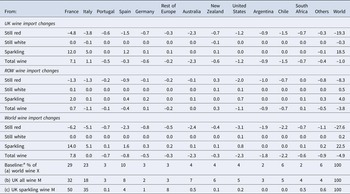
Turning to the second question, on the United Kingdom's and the rest of the world's imports of wines from various countries, the model's estimates are summarized in Table 1, in millions of U.S. dollars per year. Focusing first on global changes in the final column of Table 1, our results suggest the value of total UK wine imports falls by just $1.1 million, but that is made up of a fall in red wine imports of $19 million being almost exactly offset by a rise in sparkling wine imports. The reform reduces (raises) UK demand for still red (sparkling) wine, thereby pushing international prices in the same direction. But there are also changes in the proportions of bulk versus bottled still wines being imported by the United Kingdom and the rest of the world, and hence in their relative prices. The net effect is a fall in global still red wine imports of $28 million, a rise of $23 million per year in global sparkling wine imports, and a rise of just $0.2 million in global still white wine imports (final column of Table 1).
Impacts of proposed UK excise reform on the United Kingdom's and the rest of world's wine imports (US$ million per year)

Source: Authors’ model results.
a Exporter shares of the value of global wine exports (X) and UK total and sparkling wine imports (M).
As anticipated, the distribution of those global changes in the wine trade is quite uneven across countries, bearing in mind the various wine exporters’ shares in the value of global wine exports and of UK wine imports (shown in value terms in the final three rows of Table 1). Specifically, Australia loses more export revenue than any other wine-exporting country, in contrast to France, which gains substantially thanks to its high share of sparkling wine in its wine exports (row 4 of Table 1). Even though Australia's wine export value is only about one-seventh that of France in total, its share of UK wine imports is considerably higher (nearly one-fourth that of France), especially of still wines (one-third that of France) and even more so for high-alcohol red wines (since still reds make up more than 60% of Australia's wine export volume and value and have high ABVs). Australia's direct loss from the proposal is also much larger than New Zealand's, even though the latter's wine exports to the United Kingdom were almost as valuable in 2021 as Australia's ($307 million, compared with $364 million for Australian wine, each representing 22% of their total wine exports). Australia's projected loss is larger because New Zealand's exports are almost entirely still white wines with considerably lower alcohol content than Australia's wine on average. As a result, the estimated loss to New Zealand from the proposed excise duty reform is a small fraction of that for Australia.
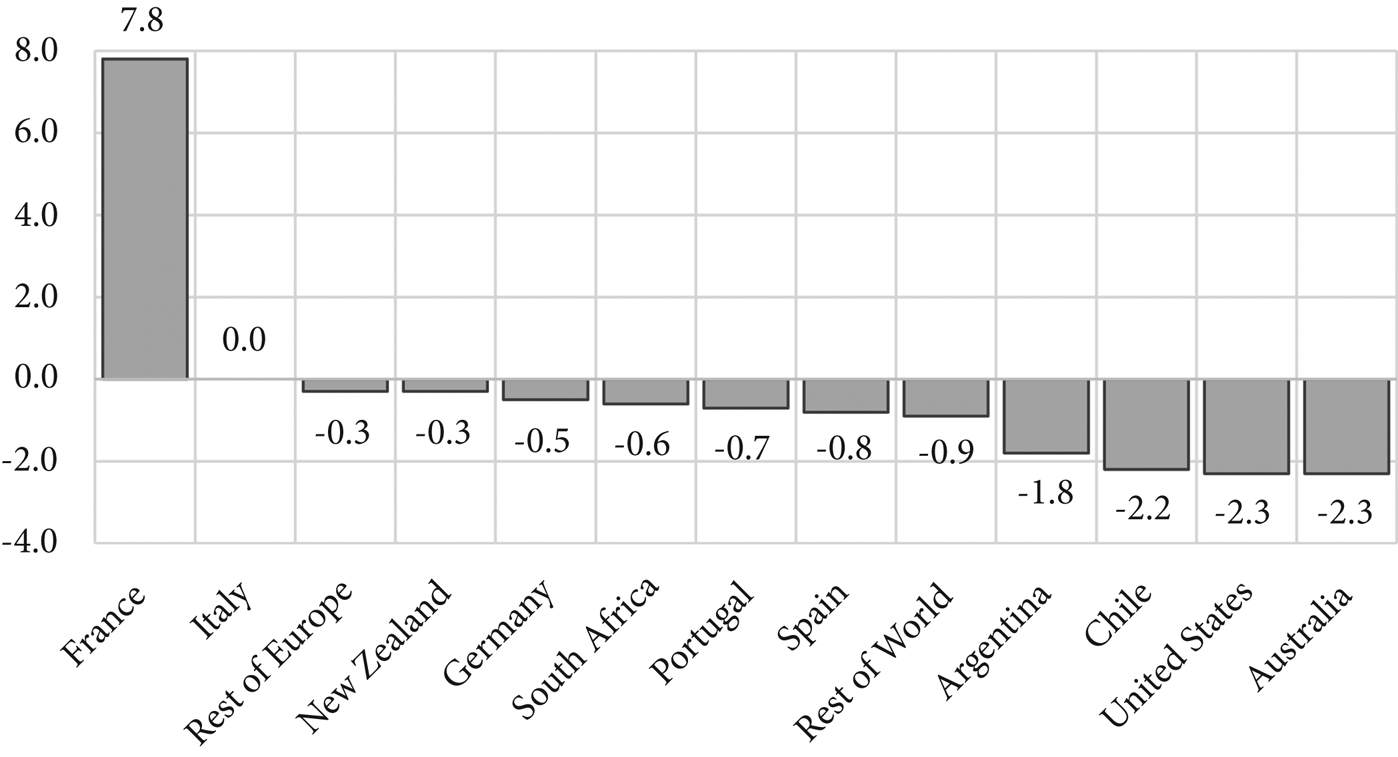
This is only part of the story, however, because wine imports by the rest of the world are also affected, and again to varying extents for the key wine-exporting countries; and they are not necessarily in the same direction as the direct effects on UK imports (rows 5–8 of Table 1). The losses in export sales to non-UK markets are relatively high for Argentina, Chile, and the United States, such that their total losses are almost the same as Australia's. Italy also loses export revenue in the non-UK markets, fully offsetting its gain in the United Kingdom. Thus, only France gains from the proposed UK excise duty reform (rows 9–12 of Table 1, with row 12 illustrated in Figure 1).
Impacts on wine export revenue of key countries due to UK excise reform (US$ million per year).
Source: Authors’ model simulation results.

These results do not take into account any response by vignerons to lower the alcohol content of the wines they export to the United Kingdom. We ignore that because such responses could take years to show up and, in any case, are likely to be small relative to the trends already under way in response to (a) a growing consumer demand for lower-alcohol wines and (b) the impact of climate change in raising the baume levels of winegrapes that have been pushing up wine alcohol levels globally (Alston et al., Reference Alston, Fuller, Lapsley, Soleas and Tumber2015).
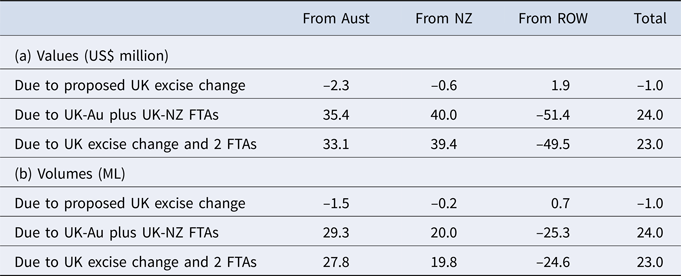
We turn now to the third question, on how those bilateral trade impacts of UK excise reform compare with the estimated effects on wine exporters of the recently agreed UK-Australia and UK-New Zealand FTAs. The first row of Table 2 summarizes row 4 of Table 1, while the second row of Table 2 summarizes the effects on UK wine imports of the United Kingdom's two new bilateral FTAs. Clearly, the benefits of the latter to Australia and New Zealand far outweigh the small projected costs to them of the UK's excise reform proposal. The two new FTAs’ trade gains for Australia and New Zealand are largely at the expense of the rest of the world's exporters, although there is a net increase in UK wine exports of $24 million per year. Similar directions of effects show up in volume terms, as shown in the lower half of Table 2.
Impacts on UK wine imports of excise reform and two UK bilateral FTAs (US$ million per year and ML)

Source: Authors’ model simulation results.
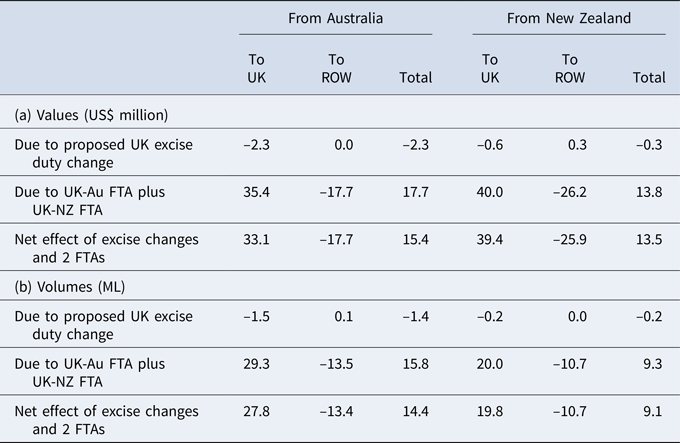
Table 3 looks at this from the viewpoint of wine exports in Australia and New Zealand. Its first row summarizes the estimates in the Australia and New Zealand columns of Table 1, and its first and fourth columns repeat the estimates in the first and second columns of Table 2. The second and fifth columns of Table 2 reveal in row 2 the extent to which Australia and New Zealand divert their exports away from non-UK wine markets: the net export gain is only half or less of the gross direct gain in extra sales to the United Kingdom. The same is true in volume terms, as shown in the lower half of Table 3. Bear in mind, though, that our modeling does not include any changes in stocks. That is not an issue for New Zealand, as it generally has a small stocks-to-sales ratio (most of its wine is sold within the year of production) and it has excess demand for its current vintage. Australia, by contrast, currently has one of its highest-ever stocks-to-sales ratios thanks to the loss of its access to the market in China, which was mostly for red wine that is often stored for one or more years before being exported. Thus, the projected diversion of sales of Australian wine from non-UK to UK markets may be much closer to zero in the first year or so, as surplus stocks are drawn down, than to the estimated annual $18 million shown in Table 3.
Impacts on wine exports of Australia and New Zealand of excise reform and two UK bilateral FTAs (US$ million per year and ML)

Source: Authors’ model simulation results.
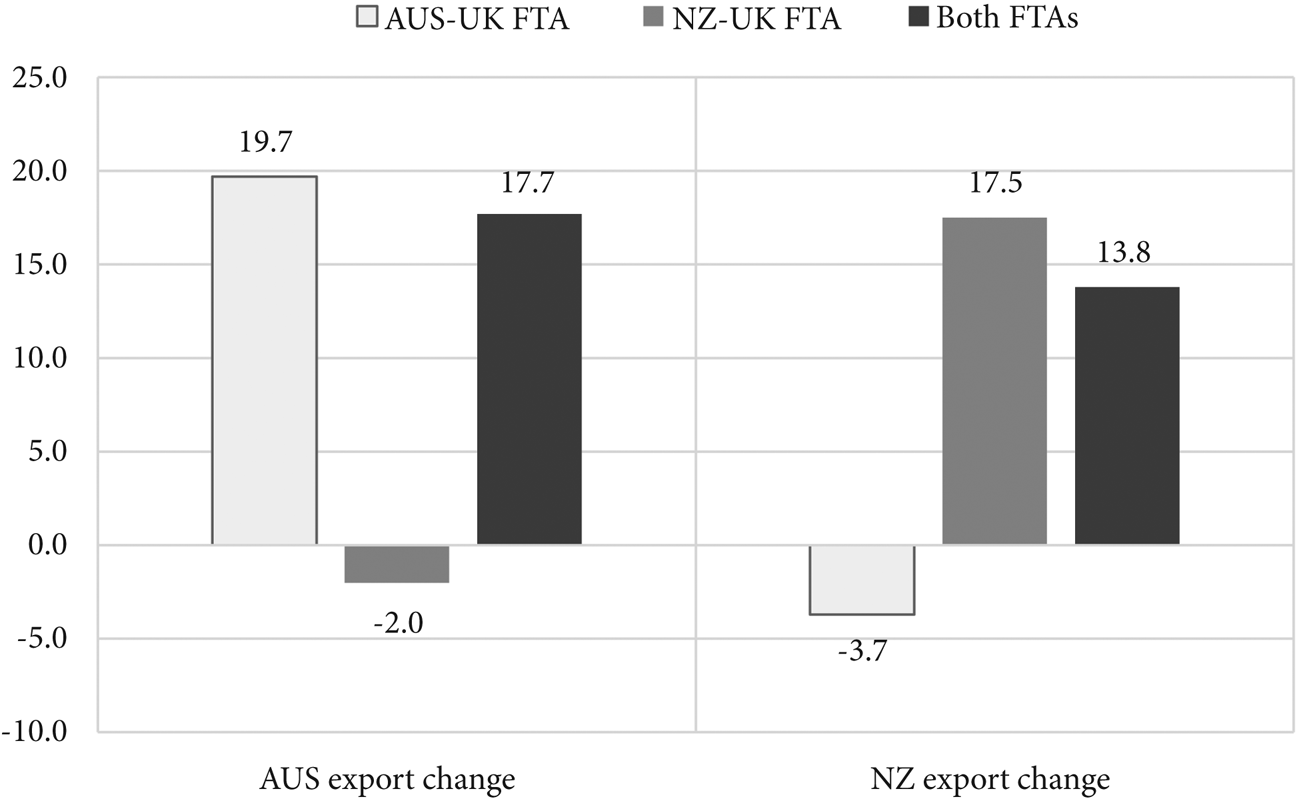
Another result that falls out of the FTA simulations is worth mentioning. Typically, when one bilateral hub-and-spoke FTA is followed by the signing of another, the trade benefits of the first FTA to the smaller party are weakened by the second FTA because its preferential access to the large hub market is now shared by the other small party. The extent of those offsets is small in this case, though, as can be seen in Figure 2: just 10% of Australia's gain from its FTA with the United Kingdom is eroded by New Zealand's FTA, and for New Zealand, its gain is just 21% less than it would have been had Australia not signed an FTA with the United Kingdom two months earlier. The reason the offsets are so minor in this case is because of the strong complementarity of the two exporting countries’ offerings: more than 60% of Australia's exports are red still wines, mostly Shiraz and/or Cabernet Sauvignon (Wine Australia, 2022), whereas more than 90% of New Zealand's exports are still white wines, mostly Sauvignon Blanc (New Zealand Winegrowers, 2022).
Impacts on wine exports of Australia and New Zealand due to their bilateral FTAs with the United Kingdom (US$ million per year). Source: Authors’ model simulation results.

Small though the estimated effects of UK excise reform are, the red wine impacts are exaggerated by our assumption that all still reds are 14.5% ABV from all sources, when in fact that is probably only true for Portugal and perhaps only a slight exaggeration for Australia. For all other suppliers, the adverse impact would be less than shown in Table 1. That means both France and Italy would gain more than shown in Figure 2, and the losses to all other exporters except Portugal would be smaller than shown in Figure 2—but least so for Australia, which would remain the most adversely affected country.
V. Conclusions
The UK's excise reform proposal would be more harmful to Australia's wine industry than to that of other wine exporters (including New Zealand) because Australian wines have higher ABVs than those of most other countries’ wines and because they export almost no sparkling wine, and so would not benefit from a lowering of the UK's excise duty on sparkling wine, in sharp contrast to France and, to a lesser extent, Italy. According to the simulation results described earlier, however, the damage of the proposed reform of UK excise duties to world wine exports would be very small, both in absolute terms and compared with the gain projected to flow from the new UK-Australia and UK-New Zealand FTAs. Also, the annual damage to Australia and other high-alcohol still wine exporters from the proposed UK excise reform would diminish over time as those producers respond by exporting lower ABV wines to the United Kingdom.
To ease the relatively heavy burden of the excise proposal on Australian exports, AGW (2022) has requested that the proposed very broad bracket (from 8.5% to 22% ABV) for taxing wine at a uniform rate per liter of pure alcohol be split into two brackets at 15% ABV, with the requested lower ABV range attracting a lower excise rate than the upper ABV range. That would ensure Australia is less of an outlier in terms of that reform's adverse impact on its exports. AGW (2022) also has some constructive suggestions for making the proposed excise reform more workable from a practical viewpoint, perhaps the most important of which is to base the excise to be paid on increments of 1% ABV rather than 0.5%.
Acknowledgments
The authors are grateful for helpful comments from referees and for financial support from Wine Australia, under Research Project UA1803-3-1, and from the University of Adelaide's Faculty of Arts, Business, Law and Economics and the School of Agriculture, Food and Wine.