1. Introduction
I investigate the structure of an argument that culture cannot be maintained in a population if each individual acquires a given cultural variant from a single person. I note two puzzling consequences of the argument: it appears to conflict with (1) many models of cultural transmission and (2) real-world cases of cultural transmission. I resolve the first puzzle by showing that one of the models central to the argument is conceptually analogous and mathematically equivalent to a model used to investigate the biological evolution of sexual reproduction. This analogy clarifies what assumptions are crucial to the argument concerning cultural transmission. I resolve the second puzzle by arguing that probabilistic models of epistemological coherence can be reinterpreted as models of mutual support between cultural variants. I develop a model of cultural transmission illustrating this idea.
Section 2 describes the first argument mentioned above, from Enquist et al. (Reference Enquist, Strimling, Eriksson, Laland and Sjostrand2010); section 3 describes the two puzzling consequences of Enquist et al.’s results. Section 4 describes Muller’s ratchet, a kind of model that motivates one of the proposed explanations of the evolution of sexual reproduction. I then argue that parallels between a version of Muller’s ratchet and one of Enquist et al.’s models help us to see why the latter has the surprising consequences it does. Section 5 then addresses the second puzzle by reinterpreting ideas from probabilistic models of coherence in epistemology as ideas about cognitive transitions from one cultural variant to another.
I assume that there are at least minor differences in beliefs, knowledge, behavior, attitudes, inclinations, and so on, between people within a society and that such characteristics—“cultural variants”—in one person sometimes promote similar variants in another. Such processes are called “cultural transmission” or “social learning.” “Individual learning,” by contrast, occurs when a person learns something on her own, whether through observation of the environment, trial and error, or some combination.
2. One Cultural Parent Makes No Culture
In this section I summarize arguments made by Enquist et al. (Reference Enquist, Strimling, Eriksson, Laland and Sjostrand2010). These authors argue that if a particular cultural variant is always acquired from a single individual—a single “cultural parent”—then it is very difficult for the cultural variant to be maintained in a population. Culture would usually disappear. Thus, the maintenance of culture in human populations seems to depend on the fact that we routinely learn from multiple individuals.
Suppose that a cultural variant C is either present or not, and assume that cultural transmission is imperfect. When individual a learns from individual b, there is a chance that a will fail to learn. Suppose then that each individual learns with probability p, from a randomly chosen member of a population in which those with C have relative frequency xt at time t. We assume that learning occurs in discrete time steps, or cultural “generations.”
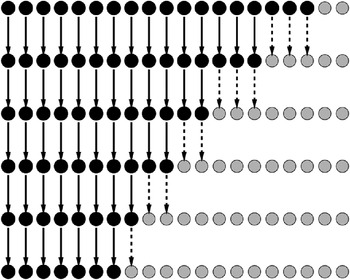
Enquist et al. note that the frequency of those with C will be ptx 0, which decreases to zero unless transmission is perfect.Footnote 1 Figure 1 illustrates this process. In each generation, a fraction p of those with the cultural variant C succeed in transmitting it, so the frequency of C decreases over time. Enquist et al. consider several variations on this model, including (1) models in which multiple learning trials from the same cultural parent are allowed, (2) models in which cultural parents can be chosen because they appear to be successful (“biased transmission”), (3) models in which social learning is combined with individual learning, and (4) models in which possession of a cultural variant confers a fitness advantage that makes the bearer more likely to be available to be chosen as a cultural parent. I will not review all of these models in detail. I note that Enquist et al. showed that option 1 merely slows down the eventual loss of culture. Option 2 can maintain culture, but only under some parameter values. With option 3, it turns out that under plausible parameter values, culture can only be maintained if individual learning alone could have maintained it. I turn now to option 4.
Cultural transmission from randomly chosen “parents” in discrete generations, with time moving from top to bottom. A cultural variant can only be acquired from those who have it (black circles), but transmission (arrows) sometimes fails (dashed arrows).

Suppose that having the cultural variant C provides a fitness benefit. For example, perhaps it makes survival more likely, thus allowing more time to influence others. Let α ≥ 1 be the ratio between the fitness of those with the cultural variant and the fitness of those without it. Under these assumptions, Enquist et al. argue that if the frequency in the current generation is x, the average frequency x′ in the next generation is

Here pαx is the frequency of successful cultural transmission: αx represents the frequency of C among chosen cultural parents, and p is the probability of successful transmission of C. The frequency of transmissions that do not occur, either because the (randomly) chosen parent lacks C or because the cultural transmission nevertheless failed, is 1 − px.
The frequency of C in the population will keep changing until an equilibrium is reached in which x′ = x. Enquist et al. show that this equilibrium

is

Enquist et al. argue that the equilibrium is nonzero only for parameter values that are rare in nature. For example, if the probability of successful transmission p is 0.9—a very high value—the ratio between fitnesses of those with and without C must be greater than about 1.112 in order for culture to be maintained. This is an unusually large fitness advantage.
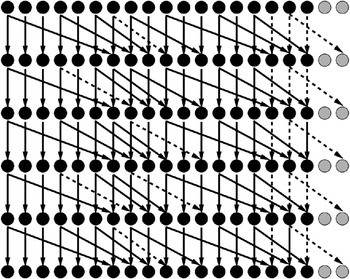
Enquist et al. show that allowing individuals to learn from two or more cultural parents can easily maintain culture, even without a fitness advantage. The reason is that even if a chosen cultural parent lacks the cultural variant C, there is the possibility that another randomly chosen cultural parent has C (fig. 2). For n randomly chosen cultural parents, the frequency x′ in the next generation isFootnote 2

Enquist et al. show that there is a nonzero equilibrium iff (if and only if) pn > 1.
Each diagonal arrow represents cultural transmission from a second cultural parent. See caption for figure 1 for the meaning of other components.

3. Two Puzzles
There are two implications of Enquist et al.’s argument that may seem puzzling. First, many mathematical models of cultural change seem to allow single-parent culture to be maintained. What is the crucial difference in Enquist et al.’s model that prevents this? Consider, for example, Rogers’s (Reference Rogers1988) model, which concerns two behaviors, each of which is better adapted to a different environment. Some individuals choose a behavior on the basis of individual learning. Others simply copy the behavior of a randomly chosen individual. Rogers shows that at equilibrium, the fitness of social learners is equal to that of individual learners. However, social learners do not fail to learn in Rogers’s model, nor do they all gravitate to one cultural variant, as in Enquist et al.’s single-parent models, if we consider the lack of C to be a variant. Rogers’s model and Enquist et al.’s clearly depend on different assumptions. What are the assumptions in Enquist et al.’s model that allow culture to disappear? A closely related question is this: If we view Enquist et al.’s model as a model of two cultural variants—the one I have called C and the other one, the absence of C, which Enquist et al. call N—then why not simply switch these labels in Enquist et al.’s model? Would it then be inevitable that culture would spread with single-parent transmission?
The second implication of Enquist et al.’s argument is that it seems to conflict with real-world cases of single-parent transmission. Is it really true, empirically, that culture is rarely maintained through single-parent transmission? Consider an example from the modern industrialized societies: From how many people did you learn long division? My guess is that the answer is “one.” And how many people do you think taught long division to your teacher? This is only anecdotal evidence, but it is a reason to wonder whether, or how, the real world might conflict with Enquist et al.’s conclusions. I address these two puzzles in the rest of the article.
4. Muller’s Ratchet
In this section I describe a widely investigated question concerning the evolution of sexual reproduction. I then describe Muller’s ratchet, a class of models that are central to one of several proposed answers to the question. I draw inferences concerning Enquist et al.’s argument about single-parent culture from close conceptual and mathematical parallels between a recent formulation of Muller’s ratchet and one of Enquist et al.’s models.
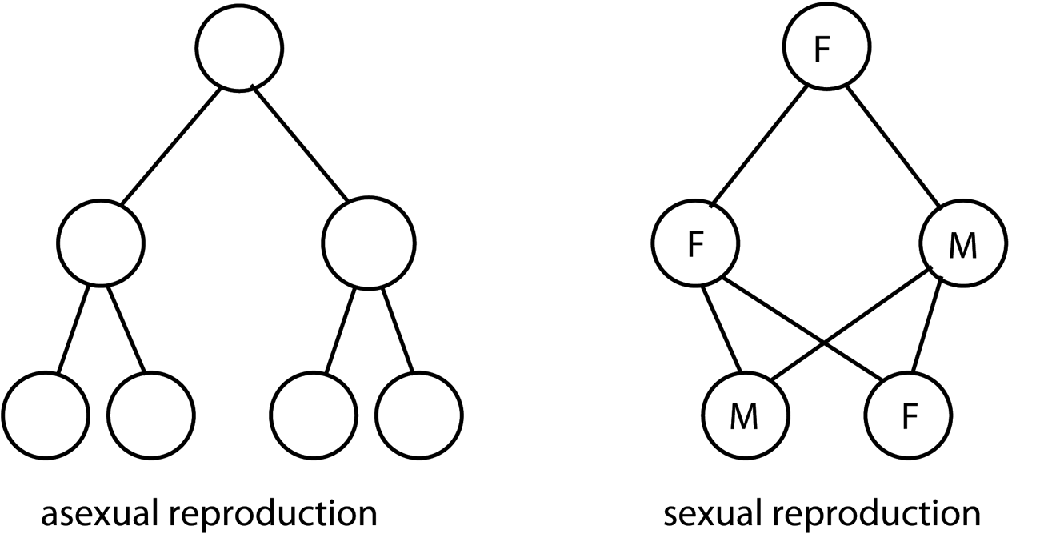
Sexually reproducing species evolved from asexual species, and in some species, both kinds of reproduction occur. Even in the case of organisms that simply leave their eggs behind, producing eggs requires significant energy and material resources, which limits the number of offspring that females or asexual organisms can produce. An argument by Maynard Smith (Reference Maynard Smith1978) showed that asexual organisms can have twice as many grandoffspring as sexually reproducing females, with no additional energy expenditure. This is illustrated in figure 3. Suppose, for example, that in a population of asexual reproducers, each organism can produce two offspring. Each organism will then have four grandoffspring. If one organism has a new mutation that causes offspring to reproduce sexually, and produces one male and one female, they must mate to produce offspring, producing only two offspring between them. This argument can be generalized (Maynard Smith Reference Maynard Smith1978). The upshot is that since sexual reproduction reduces the number of descendants of an organism by half, it must generate an enormous fitness benefit in order for it to have been selected for. There are a number of proposed explanations of the benefit of sexual reproduction that are under active investigation (Otto and Lenormand Reference Otto and Lenormand2002). I focus on one only.
Biological descendant relations in a species limited to two offspring per egg-producing organism. Circles represent individuals, and lines represent descent relations. “F” and “M” represent females and males, respectively.

Muller’s ratchet is based on the biologically plausible assumptions that beneficial mutations are rare, that strongly deleterious mutations will quickly be selected out of a population, and that back mutations that undo a mildly deleterious mutation are improbable. Over time, lineages accumulate different numbers of mildly deleterious mutations. Since the evolutionary costs of these mutations are small, lineages with the fewest deleterious mutations will occasionally be lost due to random genetic drift. At that point, all members of the population have more deleterious mutations than those (fitter) members that were lost, so there is almost no possibility of creating descendants with fewer deleterious mutations. We say that Muller’s ratchet has clicked. This process gradually leads to the accumulation of deleterious mutations and, ultimately, to the extinction of the population. Sexual reproduction with recombination provides an escape from the ratchet, though. Recombination combines different segments of two individuals’ chromosomes to produce an offspring’s chromosomes. This allows some offspring to have fewer deleterious mutations than either of their parents.Footnote 3
Most Muller’s ratchet models (e.g., Haigh Reference Haigh1978) divide the population into classes of organisms, each with a different number of deleterious mutations. Waxman and Loewe’s (Reference Waxman and Loewe2010) “truncated ratchet” model instead has only two classes: the class of individuals with the fewest deleterious mutations and a class containing all other individuals. A click of the ratchet is the loss of the fittest class, and a subset of the other class then becomes the new fittest class. Let μ be the per organism probability of a deleterious mutation; 1 − μ is then the probability that an individual will remain in the fittest class. Let σ be the average fitness cost from deleterious mutations due to being in the less fit class of organisms, and 1 the fitness of the members of the fitter class. The probability that a deleterious mutation will be undone by a back mutation is so small that it is reasonable to treat it as zero, and we ignore beneficial mutations as well.
Waxman and Loewe then derive the following frequency x′ of the fittest class in the next generation, starting from the frequency x in the current generation:

By equating x and x′, Waxman and Loewe derive the equilibrium frequency

of the fittest class:

I want to compare Enquist et al.’s model with selection and Waxman and Loewe’s model. Both models have a parameter representing the probability of error-free transmission. In Enquist et al.’s model, this is p, the probability of transmitting the cultural variant C without error. In Waxman and Loewe, 1 − μ is the probability of reproduction without a deleterious mutation. Both models also have a parameter representing the fitness difference between two states. Enquist et al.’s α is the ratio between the fitnesses of a cultural variant C and its absence, N. Waxman and Loewe instead represent the relationship between fitnesses of members of the fittest and less fit classes with a difference parameter σ. We can equate the two sets of parameters, with Enquist et al.’s parameters on the left and Waxman and Loewe’s on the right:

When we equate the parameters, it turns out that Waxman and Loewe’s truncated ratchet is mathematically equivalent to Enquist et al.’s single-parent model with fitness: equation (1) is equivalent to equation (4), and equation (2) is equivalent to equation (5). Thus, failing to learn from a single cultural parent is so closely analogous to acquiring a deleterious mutation in an asexual species that they can be modeled in the same way. Similarly, in both sets of models, the loss of beneficial characteristics can be avoided by allowing information to be transmitted from (at least) two parents.
This close relationship between Waxman and Loewe’s truncated ratchet and Enquist et al.’s selection model helps us see what assumptions are crucial to Enquist et al.’s models. As in other Muller’s ratchet models, Waxman and Loewe’s model assigns significant differences to the probability of a deleterious mutation (small but positive) and no mutation (large) and to the probability of a deleterious mutation and the probability of a back mutation that would undo it (zero). Analogously, in Enquist et al.’s models, it is relationships between transmission and failure to transmit, with no chance of reacquiring culture once lost, that allow single-parent transmission to lead to the loss of culture. By comparison, Rogers’s (Reference Rogers1988) model gives equal probability to learning either of two cultural variants.
5. Coherence
I noted above that it seems somewhat plausible that there are cases of single-parent transmission. In this section I suggest that probabilistic coherence measures inspired by Lewis’s (Reference Lewis1946) concept of congruence can, with a slight reinterpretation, be used to understand how a variant on single-parent cultural transmission can maintain culture indefinitely.
Lewis defined his coherence measure, known as congruence, as follows: “A set of statements, or a set of supposed facts asserted, will be said to be congruent iff they are so related that the antecedent probability of any one of them will be increased if the remainder of the set can be assumed as given premises” (Reference Lewis1946, 338). Two propositions C 1 and C 2 are thus congruent iff

For two propositions, this relationship can also be captured by requiring that Shogenji’s (Reference Shogenji1999) coherence measure

be greater than 1.
Lewis’s congruence does not fit all intuitions about the role of coherence in justification. Olsson (Reference Olsson2005) has shown, for example, that for coherence measures such as Shogenji’s, greater coherence does not consistently imply a higher probability of truth of the propositions considered. However, my concern below will not be with truth-conduciveness. I will treat the probabilities above as probabilities of believing one proposition given believing the other, or more generally, as probabilities of acquiring one cultural variant given the other. This in effect translates a justificatory relation into a cognitive or behavioral relation.
In real human cultural transmission, we do not only learn isolated bits of information; it appears that we remember and can use what we learn more effectively if it is systematically related to other things we learn—roughly, if different things we learn are related and mutually supporting, or if contexts are provided that make learning easier (Bransford and National Research Council Reference Bransford2000; Wimsatt and Griesemer Reference Wimsatt, Griesemer, Sansom and Brandon2007; Caporael, Griesemer, and Wimsatt Reference Caporael, Griesemer and Wimsatt2014; Kline Reference Kline2015). I will suggest that we can capture some aspects of this pattern with Lewis’s congruence notion and extensions of it. In what follows I focus on the simple case of two cultural variants C 1 and C 2 that influence each others’ adoption.
First note that Enquist et al.’s arguments can be applied simultaneously to two cultural variants C 1 and C 2: if either cultural variant is transmitted only by single cultural parents, it will eventually be lost from the population. This is true whether the two variants are both learned from the same parent or from distinct randomly chosen parents.
However, remarks above raise the possibility that some cultural transmission of coherent beliefs might help prevent the loss of culture. If C 1 and C 2 are congruent, so that each raises the probability of believing the other, could this prevent the loss of culture? The answer is no, if both beliefs must be acquired from the same cultural parent.
Suppose that a learner can acquire all or some of the cultural variants possessed by a randomly chosen cultural parent, where the probability of acquiring any one of the cultural variants is p. Suppose also that it is possible for an individual to infer (etc.; see below) a missing cultural variant Ci if she has the other cultural variant. We capture the probability of such an inference by

This is like congruence, or Shogenji’s coherence being greater than 1, since we are assuming that the probability of spontaneously acquiring C 1, that is, P(C 1 | ¬C 2), is zero (note that

iff

). These conditional probabilities in effect link C 1 and C 2, so that if a person fails to acquire one of them, but acquires the other, she will be able to acquire the first anyway, with probability r.
Let us focus on the best case for using such internal inference processes to maintain culture: let r be near 1. Then most individuals with either cultural variant will have the other. Those who have only one of C 1 and C 2 will nevertheless be able to produce cultural offspring who have both cultural variants. However, with large r, C 1 and C 2 are functioning almost as a unit. The process is roughly the same as what would happen in Enquist et al.’s single-parent model if we increased the transmission probability p: it would take longer for culture to disappear, but it would still do so eventually.
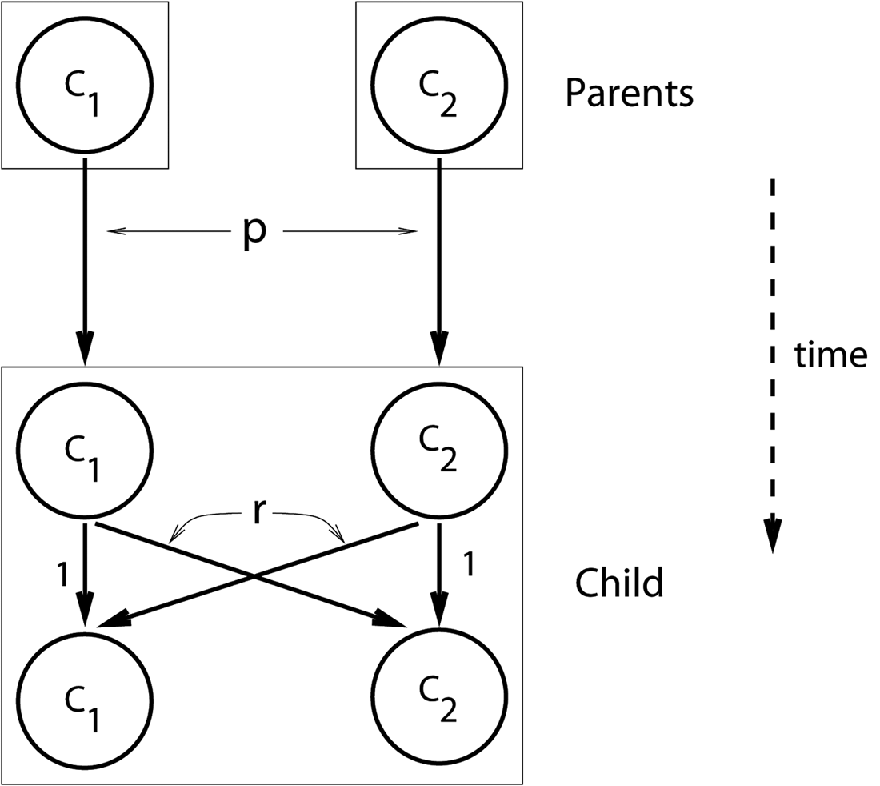
Suppose, however, that equation (6) holds but that the cultural parent for each of the two cultural variants is chosen independently for each cultural “child” (fig. 4). Different cultural variants are typically acquired from different cultural parents. Let r be as above, and assume that the parent-to-child transmission probability for each variant is p, as in Enquist et al.’s models. Then the probability of acquiring C 1 is similar to probability of acquiring C from either of two cultural parents in equation (3): let x be the relative frequency of C 1 in the population, and y the relative frequency of C 2. The frequencies x′ of C 1 and y′ of C 2 in the next generation are


The first equation, for example, is based on the following reasoning (cf. n. 2). One can acquire C 1 directly from the cultural parent chosen to transmit C 1, with probability px, or fail to do so with probability 1 − px. Similarly, one can acquire C 1 with probability r from C 2 if C 2 was acquired—which happens with probability py. So failing to succeed by this path is 1 − rpx. The probability of successful transmission of C 1 is then is the probability of failing to fail to acquire C 1 by one of the two probabilistically independent paths.
Causal relationships in the cultural variant model described in the text. Rectangles represent persons. Circles represent instances of cultural variant Ci held by a person at a time. Labels p, r, and 1 represent probabilities of successfully causing (via that path) an instance of a cultural variant to be held, conditional on the variant being held at the earlier time; p = probability of learning from a cultural parent, while r = the probability of “inferring” one cultural variant from the other.

The dynamics of this model are not identical to those of the simple two-parent transmission model characterized by equation (3). However, we can simplify the new model, because iterating equations (7) and (8) quickly causes C 1 and C 2 to have the same frequency. To see this, note that

Since p(1 − r) must lie between 0 and 1, the difference between the frequency x of C 1 and the frequency y of C 2 shrinks in every generation. Thus, for the long-term effects of cultural transmission of C 1 and C 2, we can ignore the difference between their initial frequencies and model the change in either frequency as

When r is high, this equation shares with (3) the property that when one fails to learn a cultural variant from a single chosen cultural parent, another parent is relatively likely to transmit that variant (cf. fig. 2). In this case, however, the transmission from the second parent is indirect, via the other cultural variant C 2.
The frequency of C 1 (or C 2) is at equilibrium when x′ − x = 0; that is, when

The right-hand side is equal to zero either when x = 0 or when

; that is, when x has the value

For example, this equilibrium frequency is approximately 0.9 when p = r = 0.83. This equation also shows that the equilibrium is greater than zero iff rp + p > 1; that is, iff

Thus, there is a nonzero equilibrium whenever the internal inference probability is greater than the ratio between the probabilities of direct transmission failure and success, which holds whenever p and r are not too small. When p and r are equal, they must be greater than about 0.62 for the cultural variants to stabilize at a nonzero value.Footnote 4
I suggest, then, that the fact that some cultural variants seem to be maintained by transmission from single cultural parents may be due to the fact that these variants are supported by transmission of other variants from other cultural parents. Long division, for example, is not learned in a vacuum. A variety of closely related mathematical concepts are usually learned first, and subsequent use in other contexts provides additional support for it. It may be that students are able to infer, or at least be reminded of, missing steps in long division when forgotten, because of what was learned from multiple cultural parents.
The preceding model considered only two related cultural variants, but real learning and real culture surely involve more complex relations of support between variants learned. Lewis’s (Reference Lewis1946) concept of congruence allows for probabilistic support involving more propositions. Shogenji’s (Reference Shogenji1999) measure of coherence does as well, but in a different way. Schupbach (Reference Schupbach2011) extends Shogenji’s measure to make it sensitive to additional relations of probabilistic support. Fitelson’s (Reference Fitelson2003, Reference Fitelson2004) coherence measure reflects all possible relations of probabilistic support between conjunctions of propositions in a given set. It may be that one of these coherence measures or a related one, although not designed to capture the degree to which a set of cultural variants allow restoration of one from others, will be useful for characterizing such a property.
6. Conclusion
Enquist et al. (Reference Enquist, Strimling, Eriksson, Laland and Sjostrand2010) argued that culture will usually disappear unless individuals learn from multiple “cultural parents.” The conceptual and mathematical analogy of one of Enquist et al.’s models to Waxman and Loewe’s truncated Muller’s ratchet model clarified that Enquist et al.’s models make the assumptions, unusual among cultural transmission models, that transmission probabilities are very asymmetric and that once a person loses a cultural variant, it can never come back among cultural “descendants.”
Modeling relations between cultural variants using ideas from probabilistic measures of coherence in philosophical epistemology provides a way of modeling the influence of one cultural variant on another. I showed that this allows learning C 2 from single parents to help maintain C 1 in the population, even if C 1 is also learned from single parents. Coherence in this sense captures what might be called “inferential robustness”: the ability to infer or otherwise learn cultural variants through multiple redundant paths (cf. Wimsatt Reference Wimsatt2007). In Abrams (Reference Abrams2015), I suggest that the idea of probabilities of learning conditional on learning other variants supports a useful conceptual framework for thinking about cultural transmission. For example, we can understand arguments that analogies have effects on cultural change (Thagard Reference Thagard and Sun2012; Abrams Reference Abrams2013) as claims about probabilities of transmission of certain groups of propositions.
Finally, note that the models discussed here assume that each individual has an equal chance of being a cultural parent of any “child.” Other models would be needed to take into account effects of social structure on cultural transmission (Young Reference Young1998; Alexander Reference Alexander2007; Wimsatt and Griesemer Reference Wimsatt, Griesemer, Sansom and Brandon2007; Abrams Reference Abrams2014; Caporael et al. Reference Caporael, Griesemer and Wimsatt2014; Smaldino Reference Smaldino2014; Grim et al. Reference Grim, Singer, Reade and Fisher2015).