Introduction
Folliculogenesis involves a sequential step in the development of a follicle from primordial to preovulatory. Normally, this step is highly regulated so that a follicle only contains one diploid female gamete which produces a haploid oocyte after completion of the first meiotic division. However, in rare situations, due to the failure of germ cell separation, a pair of conjoined oocytes may form in a follicle during the early stage of folliculogenesis (Fekete Reference Fekete1950; Gougeon Reference Gougeon1981, Reference Gougeon1996; Payan-Carreira and Pires, Reference Payan-Carreira and Pires2008). While it is rarely observed in natural cycles, it has been postulated that this phenomenon is more often observed in current assisted reproductive technology due to ovarian stimulation. Histological studies have also revealed the presence of multiovular follicles in human ovaries. Conjoined oocytes have recently garnered increasing attention regarding their utility in assisted reproductive outcomes (Edwards and Fowler, Reference Edwards, Fowler and Emery1970; Zeilmaker et al., Reference Zeilmaker, Alberda and van Gent1983; Rosenbusch, Reference Rosenbusch2012). However, the fate of these oocytes is not uniform universally. Some IVF laboratories utilize these conjoined oocytes and progress to fertilization, while others discard them. In this observational report, we propose a new protocol for the use of these conjoined oocytes using laser-cutting separation, preimplantation genetic diagnosis (PGD), cryopreservation, and frozen embryo transfer (FET) techniques. The aforementioned protocol may provide physicians with another option to offer to patients who have only a limited number of good quality oocytes.
Case #1
A 27-year-old female was seen at the Department of Reproductive Medicine at Jining Medical University due to 3 years of primary infertility and polycystic ovarian syndrome (PCOS). Her male partner’s semen analysis was within normal range for all parameters, according to the World Health Organization (WHO) 2009 reference values. Her Day 3 baseline laboratory tests were as follows: follicle-stimulating hormone (FSH) 4.62 mIU/ml, luteinizing hormone (LH) 3.47 mIU/ml, and oestradiol (E2) 41.00 pg/ml. A Lupron protocol was used for this patient. A GnRH-agonist (triptorelin, Ferring, Germany) was administered at 0.1 mg per day from the middle of the luteal phase during the previous menstrual cycle. After 14 days of downregulation, E2 was 35 ng/l, progesterone (P) was 0.3 mg/l and endometrial thickness (EMT) was 3.5 mm. The triptorelin dose was decreased to 0.05 mg per day until human chorionic gonadotropin (hCG) injection day, and recombinant human FSH (Gonal-F®, Serono, Switzerland) 100–225 IU daily was added according to follicular development and hormone levels. When more than three follicles had a diameter larger than 18 mm, hCG (Livzon Pharmaceutical Group, China) 10,000 IU was injected to trigger ovulation, and oocyte retrieval was performed 36–37 h later by transvaginal ultrasound-guided puncture of ovarian follicles.
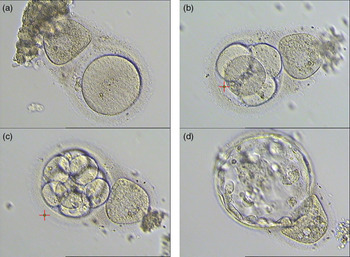
After the 22 oocytes were retrieved and fertilized by intracytoplasmic sperm injection (ICSI), 16 oocytes achieved normal fertilization with 2PN including one pair of conjoined oocytes (MIIx1, GVx1) and two oocytes that were found to be abnormal (3PN). All embryos derived from 2PN were cultured to Day 6. There were nine total acquired blastocysts, and we noticed that the blastocyst formed from the conjoined oocytes started to intrude into the connected germinal vesicle oocyte (Fig. 1). The embryo from the conjoined oocytes was ultimately discarded due to quality. The remaining eight blastocysts were vitrified and the couple acquired a live birth after single blastocyst transfer in a FET cycle.
Patient’s conjoined oocytes in case #1. (a) One MII and One GV oocytes. (b) Day 2 embryos with ICSI performed on MII oocyte. (c) Day 3 embryos with ICSI performed on MII oocyte. (d) Day 6 embryos and blastocyst starting to intrude into the connected GV oocyte.

Case #2
A couple was being seen at the Department of Reproductive Medicine at Jining Medical University due to severe oligoasthenospermia diagnosed in the husband. The 25-year-old female reported regular menstrual cycles with 2 years of primary infertility. Her medical history was otherwise unremarkable. Her Day 3 baseline laboratory tests were as follows: FSH 5.51 mIU/ml, LH 5.39 mIU/ml, and E2 34.00 pg/ml. The minimal stimulation protocol combining Gonal-F® and FSH was applied. In summary, clomiphene citrate (Beijing Double Crane Pharmaceutical Co., Ltd, China) 100 mg per day and Gonal-F® 150 IU/day were used for 5 days starting on the 2nd day of her cycle. Ovarian response and E2 levels were monitored. On the 7th day of her cycle, rFSH-β (Puregon, MSD, Hangzhou, China) was given for 2 days at 100 IU/day. On the 9th day, cetrorelix acetate (Cetrotide®, Baxter Oncology GmbH, Germany) 0.25 mg/day and Gonal-F® 75 IU/day, were given for 4 days. Follicle growth and E2 levels were continually monitored. On Day 12, 13 follicles were ≥18 mm and E2 was 12640 pg/ml. Oocytes were retrieved 38 h after triptorelin acetate administration (0.2 mg) by vaginal ultrasound-guided puncture of ovarian follicles.
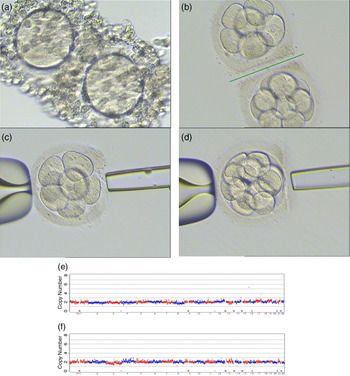
In total, 19 oocytes were collected, and subsequently denuded with hyaluronidase. Here, 18 of those collected were metaphase II (MII) oocytes. One set of conjoined oocytes with two equal sized MII oocytes was obtained. After ICSI, 14 oocytes achieved fertilization as evidenced by the presence of two pronuclei. The conjoined oocytes were injected individually with two sperm and each developed two pronuclei. On the 3rd day, four embryos were grade I including two conjoined embryos developed from conjoined oocytes. On Day 3, these two conjoined embryos were separated using a laser-cutting technique (Figure 2b). One blastomere from each conjoined oocyte derived embryo was biopsied and analyzed using next-generation sequencing (NGS) (Fig. 2c, d). These two separated embryos together with another two regular grade I embryos were then vitrified on Day 3 for future transfer. Other lower grade embryos were discarded. NGS results demonstrated that both embryos derived from the conjoined oocytes were normal (Fig. 2e, f).
Patient’s conjoined oocytes in case #2 (a) Oocytes after retrieval. (b) Day 3 embryos with ICSI. (c) Day 3 biopsy for embryo #1. (d) Day 3 biopsy for embryo #2. (e) NGS results for embryo #1. (f) NGS results for embryo #2. *Embryo’s sex was not shown in these results.

This patient underwent two FET cycles. During the first FET cycle, an oestrogen/progesterone protocol was used to prepare the endometrium, however pregnancy was not achieved after the initial transfer of two regular grade I embryos. The two separated embryos from the conjoined oocytes were then utilized for transfer during the second FET cycle. When there was one 9-mm follicle and three 8-mm follicles on the 19th day of menstrual cycle, Urofollitropin 75 U was administered for 3 days. On the 27th day of the cycle, HCG (LiZhu Group, China) 10,000 IU was administered when the largest follicle reached 17 mm and B type endometrium was observed. The two separated euploid embryos from the conjoined oocytes were then thawed and transferred. Beta-HCG was 344 mIU/ml at 14 days after embryo transfer, and one fetal sac was observed under ultrasound. A live birth of a normal female weighing 3.8 kg was achieved on 21 August 2015.
Discussion
Conjoined oocytes have historically been hypothesized to be the cause of chimeras by cell exchanges between two embryos attached by the zona pellucida (ZP) (Edwards and Fowler, Reference Edwards, Fowler and Emery1970). Zeilmaker and Aoki continued the discussion of conjoined oocytes, reporting the observation of their fertilization (Zeilmaker et al., Reference Zeilmaker, Alberda and van Gent1983; Aoki et al., Reference Aoki, Honma, Yada, Momoi and Iwamoto2006). There have been c. 20 reported cases of conjoined oocytes that did not result in successful pregnancies with IVF (Rosenbusch, Reference Rosenbusch2012; Cummins et al., Reference Cummins, Koch and Kilani2016). The occurrence of polyovular follicles seems to be more frequent in the immature ovary but the majority of them are lost due to atresia in late fetal and early neonatal life. Although they can also occur in adult females, it has been suggested that their incidence may increase with gonadotropic stimulation in treatment cycles (Safran et al., Reference Safran, Reubinoff, Porat-Katz, Werner, Friedler and Lewin1998). There are many hypotheses to explain the occurrence of two or more oocytes within a single ZP and the most widely accepted explanation is that a binovular ZP is likely to have been created when granulosa cells fail to separate into two distinct oocytes during the early stages of follicular formation (Zeilmaker et al., Reference Zeilmaker, Alberda and van Gent1983; Ben-Rafael et al., Reference Ben-Rafael, Mastroianni and Kopf1987; Safran et al., Reference Safran, Reubinoff, Porat-Katz, Werner, Friedler and Lewin1998). However, the presence of two equally, or slightly unequally, sized cells does not support the theory of an improper division during the first meiosis producing an abnormal first polar body, as was suggested by Ben-Rafael et al. (Reference Ben-Rafael, Mastroianni and Kopf1987). Safran et al. (Reference Safran, Reubinoff, Porat-Katz, Werner, Friedler and Lewin1998) also rejected the possibility of the two cells being products of immediate cleavage leading to the formation of two haploid cells (Safran et al., Reference Safran, Reubinoff, Porat-Katz, Werner, Friedler and Lewin1998). They reported two cases of a binovular ZP and performed a cytogenetic analysis by fluorescence in situ hybridization (FISH) in one case. After selective application of the larger mature oocyte and its fertilization and cleavage, they analyzed the chromosomal status of both the smaller uninjected oocyte and the cleavage-stage embryo obtained. The FISH result of the smaller oocyte showed a chromosome X and 18 disomy, consistent with a diploid GV. FISH analysis of the embryo was consistent with a diploid female, suggesting that the larger cell was indeed a chromosomally balanced, mature metaphase II oocyte (Safran et al., Reference Safran, Reubinoff, Porat-Katz, Werner, Friedler and Lewin1998). Both the aforementioned case, as well as our case, describing a larger cell appearing as metaphase II and a smaller one at the GV stage, favour the hypothesis that two oocytes from a binovular ZP are actually two oocytes that failed to be separated during the early stage of folliculogenesis.
Ben-Rafael et al. (Reference Ben-Rafael, Mastroianni and Kopf1987) and Ron-El et al. (Reference Ron-El, Nachum, Golan, Herman, Yigal and Caspi1990) also showed that one or two oocytes of a binovular ZP can successfully be fertilized and subsequently developed into an embryo by standard IVF (Ben-Rafael et al., Reference Ben-Rafael, Mastroianni and Kopf1987; Ron-El et al., Reference Ron-El, Nachum, Golan, Herman, Yigal and Caspi1990). However, such embryonic development may lead to the development of dizygotic twins due to the fertilization of both oocytes or the two conceptuses aggregating to form a diploid–triploid mosaic embryo (Zeilmaker et al., Reference Zeilmaker, Alberda and van Gent1983; Safran et al., Reference Safran, Reubinoff, Porat-Katz, Werner, Friedler and Lewin1998). To avoid this undesired consequence, Safran et al. (Reference Safran, Reubinoff, Porat-Katz, Werner, Friedler and Lewin1998) recommended the selective fertilization of only one of the two oocytes using ICSI, and they demonstrated that a chromosomally balanced embryo can be obtained after such an approach (Safran et al., Reference Safran, Reubinoff, Porat-Katz, Werner, Friedler and Lewin1998). We appreciated a similar result. The conjoined oocytes in the first case had one larger MII and one smaller GV. The MII oocytes developed to four cells on Day 2 and nine cells on Day 3 after ICSI. It formed a blastocyst on Day 5, but the GV degenerated. Without laser-cutting to separate them apart, this blastocyst was starting to intrude into the connected GV oocytes, as illustrated in Fig. 1(d). This phenomenon may explain why mosaic embryos may occur when two embryos grow together, a theory also supported in previous research (Zeilmaker et al., Reference Zeilmaker, Alberda and van Gent1983; Safran et al., Reference Safran, Reubinoff, Porat-Katz, Werner, Friedler and Lewin1998). After thorough review of the literature, we concluded that these conjoined oocytes should be separated in case of mosaicism as well.
A study by Cummins et al. (Reference Cummins, Koch and Kilani2016) reported the first live birth from a transfer Day 5 hatching blastocyst after confirmation using array comparative genomic hybridization (aCGH) (Cummins et al., Reference Cummins, Koch and Kilani2016). Cummins and colleagues presented conjoined oocytes that were unequal in size: one MII and one GV (Cummins et al., Reference Cummins, Koch and Kilani2016). Tanaka et al. (Reference Tanaka, Kumasawa, Tsutsui, Furuya, Kim, Koizumi and Kimura2016) reported on conjoined oocytes from a patient with PCOS (Tanaka et al., Reference Tanaka, Kumasawa, Tsutsui, Furuya, Kim, Koizumi and Kimura2016). Magdi showed that dizygotic twins were born from conjoined oocytes (Magdi, Reference Magdi2020) In her report, two blastocysts were neither separated nor tested before embryo transfer. This may lead to a concern of mosaicism similar to that demonstrated in our first case.
In this paper, we present a case of two equally sized MII oocytes that were fertilized using ICSI, and finally developed into two 8-cell embryos on Day 3. Next-generation sequencing (D3 biopsy) confirmed two euploid embryos and these two separated embryos were vitrified and thawed for transfer. Although we have provided an example of a live birth using FET transfer, we would like to emphasize the utility in this new protocol for conjoined oocytes, as it may provide an innovative alternative for patients.
Our case report showed that conjoined oocytes may be used for normal embryo production and transfer, and are capable of resulting in a live birth of a healthy baby. The key technique lies in the separation of conjoined oocytes using a laser-cutting technique. Additionally, the application of embryo vitrification and PGD may provide greater reassurance that normal euploid embryos are being transferred. By providing this evidence of a successful alternative to conjoined oocyte utilization, perhaps a more uniform approach to conjoined oocytes may be developed and such oocytes will no longer be routinely discarded. Therefore, our innovative protocol may especially benefit those patients with only a limited number of oocytes or embryos and provide a means to achieve a successful pregnancy.
Financial support
The research leading to these results received funding from the Natural Science Foundation Projects of Shandong Province (no. ZR2015HL002)
Conflicts of interest
The authors have no relevant financial or non-financial interests to disclose.
Ethical standards
The authors assert that all procedures contributing to this work comply with the ethical standards of the relevant national and institutional committees on human experimentation and with the Helsinki Declaration of 1975 as revised in 2008.
Consent for publication
The authors affirm that patients signed informed consent regarding publishing their data and photographs.