Previous studies have shown that ~385,000 healthcare-related needlestick and sharps injuries (NSSIs) occur annually, with a reporting rate of 43.4%. Reference Panlilio, Orelien and Srivastava1 Surgeons, in particular, have exceptionally poor compliance with NSSI reporting, Reference Au, Gossage and Bailey2,Reference Thomas and Murray3 and noncompliance is often secondary to time constraints and perceived low risk of transmission. Reference Kerr, Stewart, Pace and Elsayed4–Reference Voide, Darling, Kenfak-Foguena, Erard, Cavassini and Lazor-Blanchet6 A study of 2,778 hospital employees found that physicians performing invasive procedures accounted for 58.6% of all unreported NSSIs at that institution. Reference Voide, Darling, Kenfak-Foguena, Erard, Cavassini and Lazor-Blanchet6 When examining trainees, junior-level surgery residents have been shown to have an increased rate of injury compared to chief residents and fellows. Reference Brasel, Mol, Kolker and Weigelt7
As with many surgical subspecialties, orthopedic surgeons are frequently exposed to potentially injurious objects intraoperatively, increasing the opportunity for NSSI. Upon review of the literature, many studies have examined NSSI and have reported compliance in hospital staff and surgeons in general, but data regarding NSSI in orthopaedic surgeons, particularly trainees, are lacking. Folin et al Reference Folin and Nordström8 reported that a percutaneous injury occurred in 13% of orthopedic procedures at one institution. In a study by Bernard et al, Reference Bernard, Dattilo and Laporte9 83% of orthopedic surgery trainees at another institution had sustained a sharps injury. Reference Bernard, Dattilo and Laporte9 Orthopedic surgeons have also been shown to have poor compliance with NSSI event reporting; Wallis et al found that only 33% report all sharps injuries. Reference Wallis, Kim, Chaudhary and Henderson10
The purpose of this cross-sectional study was to examine the incidence of intraoperative NSSI among orthopedic surgery trainees in programs nationwide. In addition, we studied factors associated with NSSI, as well as respondents’ compliance with and perception of their institution’s reporting process.
Methods
An anonymous, 35-question, cross-sectional survey was designed. After review by our institutional review board, this survey was deemed exempt from approval because it examined anonymous work-related events and not identifiable patient health information. The questionnaire was distributed via e-mail to all US orthopedic surgery residency program coordinators on the Association of Residency Coordinators in Orthopaedic Surgery members list. The program coordinators were then requested to distribute the e-mail and survey to all trainees at their individual programs. The survey was accessible on www.surveymonkey.com from June 16 through September 24, 2015, and access was closed after 300 surveys were received.
Respondents were informed that the survey would take ~10 minutes to complete. Questions in the survey were constructed with required responses to help guide respondents to the next appropriate question in the logic tree. The first section identified each respondent’s training level and history of NSSI. Trainees with a positive NSSI history were directed to the second section, which examined the number of NSSIs and at what level of training they occurred in each respondent. Questions pertained to the type of surgery at the time of NSSI, the person deemed responsible for each NSSI, and the causative instrument or structure. This section also examined the reporting rate of NSSI and specific questions about the reporting process. All respondents answered questions in the third section, which identified double-glove and cut-resistant glove use as well as potential ways to improve NSSI reporting compliance and training. If respondents did not complete the entire questionnaire, only the completed questions were included in our analysis.
After survey completion, respondents were directed to a separate and unlinked second survey at www.surveymonkey.com that allowed participants to enter their e-mail into a randomized drawing for a $250.00 educational fund as an incentive for participation. Survey participants were asked to exclude themselves from participation in the incentive drawing if any statewide or institutional regulations prevented their participation. Participation in the survey and in the incentive drawing was voluntary.
Results
In total, 300 surveys were submitted; responses were obtained from 287 residents and 13 fellows. At time of survey submission, 75 (25%) respondents were postgraduate year 1 (PGY-1) of orthopedic surgery residency, 55 (18.3%) were PGY-2, 50 (16.7%) were PGY-3, 57 (19%) were PGY-4, 50 (16.7%) were PGY-5, and 13 (4.3%) were orthopedic surgery fellows (PGY-6).
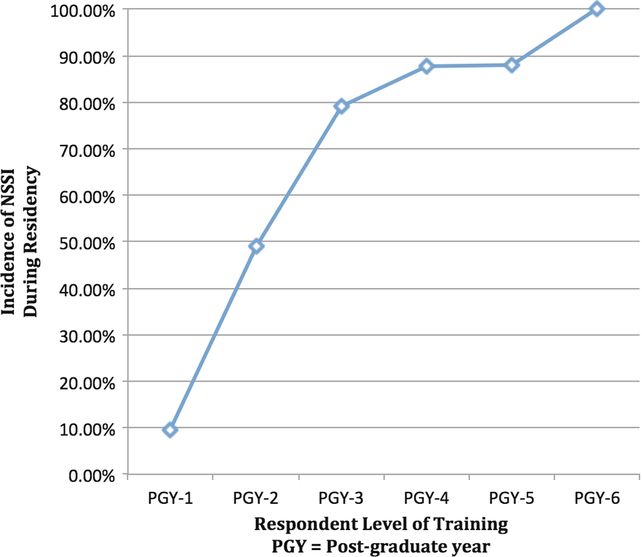
Of 223 trainees who had completed at least 1 year of residency, 172 (77.1%) had sustained an NSSI in the operating room since starting residency. Of 168 respondents in PGY-3 or above, 145 (86.3%) had sustained an NSSI in the OR, with an increase in NSSI incidence to 57 of 63 trainees PGY-5 and above (90.5%). Cumulative incidence rates of NSSI during residency separated by training level of respondent are presented in Fig. 1.
Cumulative incidence of needlestick and sharps injury (NSSI) during residency by training level of respondent.

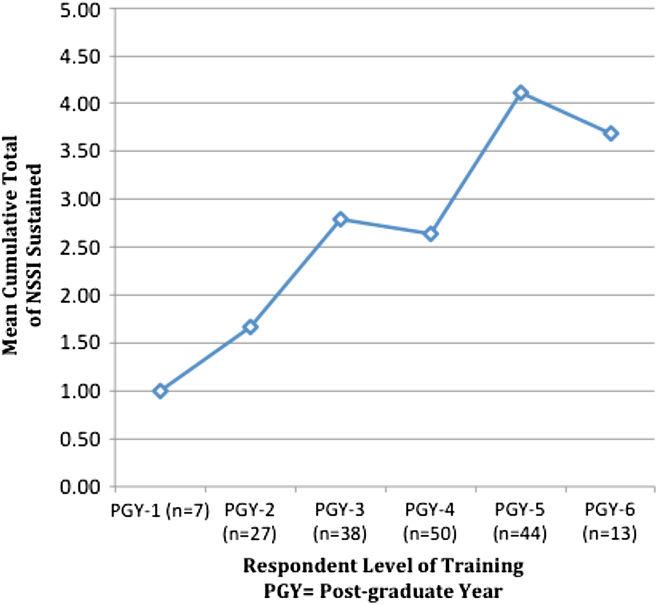
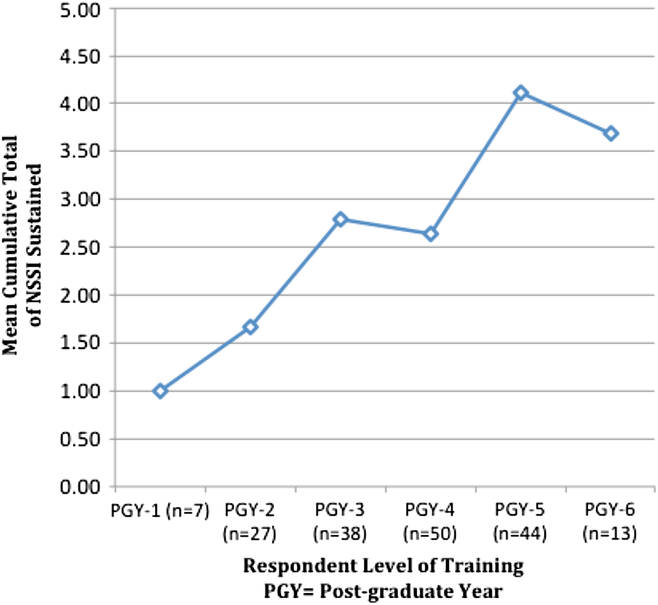
Examining respondents who had sustained at least 1 NSSI, 85 of 145 trainees PGY-3 and above (58.6%) were involved in an estimated 3 or more separate injuries. Furthermore, in respondents PGY-5 and above, the incidence increased to 45 of 57 (78.9%) having an estimated 3 or more separate NSSI events. PGY-5 residents and fellows who had sustained an NSSI estimated a mean of 4.0 separate events during residency. The mean cumulative total of NSSI events received by participants who had sustained at least 1 event during training is separated by training year of respondents in Fig. 2. When examining previously injured survey respondents who had completed at least 4 years of training, NSSIs occurred most often during both PGY-2 and PGY-4, with a 72.7% incidence rate (40 of 55) during each of those years of training.
Mean cumulative total of needlestick and sharps injury (NSSI) events received by participants who had sustained at least one event during training separated by training year of respondents.
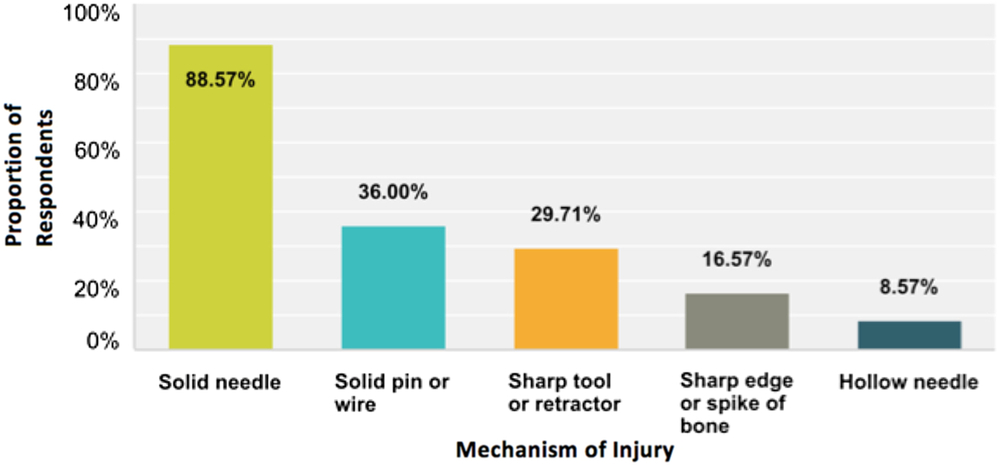
Upon examining factors associated with the NSSI events, we identified the most common physical cause of NSSI to be solid needles, with 155 of 175 of injured respondents (88.6%) having sustained an NSSI involving solid needles (Fig. 3). The second most common physical cause of NSSI that involved objects were solid pins or wires, with 63 of 175 previously injured trainees (36%) reporting pin or wire involvement in a prior NSSI. Of 175 respondents who had sustained an NSSI, 153 (87.4%) stated that they were personally at fault in a prior incident. Additionally, 62 of 175 respondents who had a prior NSSI (35.4%) reported sustaining an injury in which they felt the attending surgeon was most at fault.
Proportion of previously injured respondents who sustained 1 or more needlestick and sharps injury (NSSI) by described mechanism.

The surgical activity most commonly associated with NSSI was wound closure. Of 174 trainees who had been involved in an NSSI, 146 (83.9%) reported at least 1 incident at this point in a procedure. Surgical activity was followed by fracture reduction or fixation as the next most common surgical activity associated with NSSI; 59 of 174 previously injured respondents (33.9%) had been involved in an incident at this point of a procedure. The types of surgery most associated with NSSI were orthopedic trauma, followed by hip arthroplasty with 104 of 173 previously injured respondents (60.1%) having sustained an injury during this orthopedic procedure, and knee arthroplasty, with 62 of 173 trainees (35.8%) having sustained an injury during this procedure.
When scrubbed into a surgical procedure, 261 of 284 respondents (91.9%) stated that they always wear 2 pairs of gloves. Only 90 of 284 trainees (31.7%) knew of available cut-resistant or puncture-resistant gloves at their institution and, of those, 48 of 91 (52.7%) reported never utilizing them.
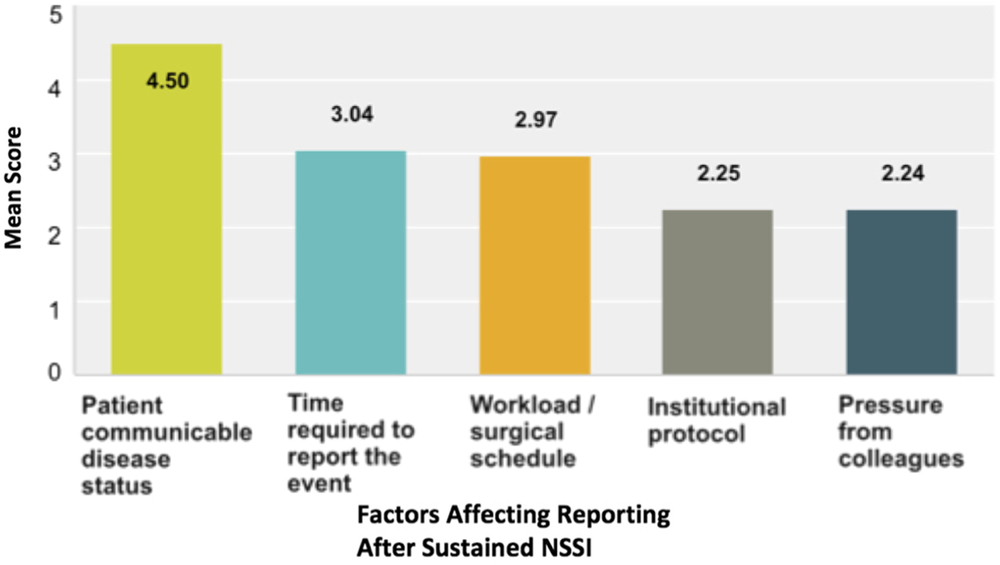
Of 177 trainees who sustained 1 or more NSSI, 99 (55.9%) failed to report all NSSI events to their institution’s occupational health department. Communicable disease status of the patient, time required to report an NSSI, and current workload were ranked by survey respondents as the most important factors when deciding whether to report an NSSI (Fig. 4). In addition, 141 trainees reported involvement in 1 or more NSSIs in which the source patient was confirmed to be free of communicable diseases via rapid testing and, of those, only 54 (38.3%) reported following up after all events with occupational health per their institution’s protocol.
Mean scores of factors ranked from greatest to least importance by respondents when determining whether to report a sustained needlestick and sharps injury (NSSI).

Of 173 respondents who had sustained a prior NSSI, 143 (82.7%) estimated that >15 minutes were needed to complete initial paperwork at their institution, and 121 of 173 (69.9%) estimated that ≥30 minutes were needed to complete initial blood collection at their institution. Of 275 trainees, 223 (81.1%) felt that having a satellite occupational health office near the operating rooms would have a positive effect on the reporting process.
Of 273 respondents, 233 (85.3%) reported having training or other education about the NSSI protocol at their institution. Furthermore, online modules were the most common NSSI protocol education technique; 188 trainees (68.9%) reported this method of education.
Discussion
In this cross-sectional study, we assessed the incidence of intraoperative NSSI in US orthopedic surgery trainees, as well as the factors associated with events and the injury-reporting process. Our survey revealed a high incidence of NSSI among trainees, with 9 of 10 trainees in their final year of residency or fellowship having sustained an NSSI during residency. Solid needles and wound closure were the factors most commonly associated with NSSI. Furthermore, most injured residents and fellows did not report all NSSIs according to their institution’s protocol, which raises concern about the current reporting process.
The nature of orthopedic surgery puts operative personnel at high risk for sharps injury; a study by Folin et al Reference Folin and Nordström8 reported that a percutaneous injury occurred in 13% of orthopedic procedures at one institution. Reference Folin and Nordström8 We found a 77% NSSI incidence in trainees having completed at least 1 year of residency and a 91% incidence in trainees PGY-5 and above. These results are similar to those of a study by Bernard et al, Reference Bernard, Dattilo and Laporte9 in which 83% of orthopaedic surgery trainees at a single institution had sustained a sharps injury. In our study, NSSIs occurred most often during orthopedic surgery during PGY-2 and PGY-4, which is likely related to increased surgical autonomy during those years of training. Vanhille et al Reference Vanhille, Maiberger, Peng and Reiter11 reported similar findings in otolaryngology residents, with a higher incidence of sharps injury during PGY-3 and PGY-4. A previous video analysis of junior surgical residents showed safe suture-needle manipulation and handling only 56% of the time. Reference Tso, Langer, Blair and Butterworth12
Upon examining NSSI-associated factors, we found that the vast majority of incidents are related to solid needles and are most often self-perceived to be the fault of the involved trainee. Not surprisingly, the most common time for NSSI to occur was during orthopedic surgery wound closure. Solid needles have been previously documented as the most frequent cause of surgical sharps injuries in orthopedic surgery trainees and attendings, Reference Bernard, Dattilo and Laporte9 as well as otolaryngology residents Reference Vanhille, Maiberger, Peng and Reiter11 and surgical personnel in general. Reference Tokars, Bell and Culver13
Double gloving has been shown to be an effective means of NSSI risk reduction, Reference DeGirolamo, Courtemanche, Hill, Kennedy and Skarsgard14–Reference Mischke, Verbeek, Saarto, Lavoie, Pahwa and Ijaz16 and a study of orthopedic surgeons by Ersozlu et al Reference Ersozlu, Sahin, Ozgur, Akkaya and Tuncay15 found an outer-glove perforation rate of 23% compared to an inner-glove perforation rate of 4% while double gloving. Although the percentage of surgeons not routinely double gloving has ranged from 57% to 73% in prior studies, Reference Au, Gossage and Bailey2,Reference Haines, Stringer, Herring, Thoma and Harris17 the encouraging results of our study showed that 92% of orthopedic surgery trainees reported always double gloving in surgery. Lipson et al Reference Lipson, Deardon, Switzer, de Gara, Ball and Grondin18 found that trainees double gloved more frequently than staff surgeons. Reasons reported for not double gloving included reduced tactile feedback and decreased manual dexterity. Reference Lipson, Deardon, Switzer, de Gara, Ball and Grondin18 However, when examining microsurgical skills in trainees who were single gloved versus double gloved, Hardison et al Reference Hardison, Pyon, Le, Wan and Coelho19 found no difference in procedural speed.
Although poor compliance with NSSI reporting has been shown in medical students, Reference Sharma, Gilson, Nathan and Makary20–Reference Choudhury and Cleator22 this trend continues into postgraduate training and beyond. In our study, only 44% of orthopedic surgery trainees had reported all NSSIs to their institution’s occupational health department. The noncompliance with reporting of NSSIs according to the institutional protocol has been consistently demonstrated among general surgeons; the percentage of surgeons reporting all NSSIs ranges from 9% to 26%. Reference Thomas and Murray3,Reference Kerr, Stewart, Pace and Elsayed4,Reference Kennedy, Kelly, Gonsalves and Mc Cann23 When examining orthopedic surgeons, Wallis et al Reference Wallis, Kim, Chaudhary and Henderson10 found that 33% reported all sharps injuries. Compliance with reporting is critical for appropriate evaluation and indicated treatment of the injured trainee, as well as accurate epidemiological analysis of NSSIs.
Communicable disease status of the involved patient was the most important factor for orthopedic surgery trainees deciding whether to report an NSSI. The second and third most important factors as reported by trainees were time required to report an NSSI and current workload. A previous study examining surgery residents that found lack of time was the main reason for not reporting injuries. Reference Makary, Al-Attar and Holzmueller24 Although decreasing the time required for the reporting process would increase compliance, reduction in time prior to administering postexposure prophylaxis is also believed to reduce the risk of seroconversion to HIV. Reference Diprose, Deakin and Smedley25
Our study has several limitations. Our survey-based study is that surveys were received from June 16 through September 24, 2015. Therefore, most respondents in their PGY-1 of training completed this survey during their first several months of residency, making it difficult to calculate an accurate incidence of NSSI at all levels of training. Also, we were unable to estimate a survey response rate because there was no way to determine how many surveys were ultimately distributed to target participants and with which programs the respondents were associated. Another limitation of the study was that 29 of the 300 respondents started but did not complete the survey in its entirety, decreasing the number of respondents for some questions. Finally, as with any survey-based study, all answers were subjective responses, and some inaccuracies may have occurred due to error of human memory and response bias. Because the survey was closed after 300 questionnaires were received instead of closing the survey on a set date, the survey may have been affected by respondent bias.
To our knowledge, this is the first multicenter study to examine the incidence of intraoperative NSSI, its associated factors, and the reporting process in orthopedic surgery trainees. We identified a high incidence of NSSI, with most occurring via solid needle during the wound-closure stage of orthopedic surgery. The vast majority of orthopedic surgery trainees are double gloving, and this practice should continue to be emphasized because it is a proven means of NSSI reduction. This study also identified a low NSSI reporting rate, which indicates the need for an improved reporting process.
Supplementary materials
To view supplementary material for this article, please visit https://doi.org/10.1017/ice.2019.262
Acknowledgments
Financial support
No financial support was provided relevant to this article.
Conflict of interest
All authors report no conflicts of interest relevant to this article.