In the year 816 ah, a Damascene religious scholar (faqīh), known as Ibn Thaqāla, claimed to be the long-awaited Sufyānī. He gathered some following in the region of Damascus and then took the oath of allegiance to himself and began to act as an independent sovereign: he granted fiefs (iqṭāʿāt), appointed his own governors, remitted the tax for that year, and abolished all landtax (kharāj) and excise (maks) – keeping only the modest “tenth” (ʿushr). Ibn Thaqāla adopted the grandiose titulature of “the great sultan and king, the Sufyānī” (al-sulṭān al-malik al-aʿẓam al-Sufyānī), and made his pietistic concerns clear in his official correspondence. He and his followers then left for Wādī al-Yābis, where, according to the tradition, the Sufyānī will make his parousia.Footnote 1 But his “sultanic, kingly, imāmī, majestic, godly, Muḥammadan, Sufyānid rule” came to a quick, and rather comic, end when government forces apprehended him, along with three of his acolytes, in the congregational mosque of ʿAjlūn and incarcerated them in the citadel of Ṣarkhad.Footnote 2
The Sufyānī is one of the principal antagonists of the Islamic drama of the end. An eschatological end-tyrant who resembles the Antichrist in his demonic monstrosity, unspeakable bestiality, and brazen contempt of God's religion, he despatches expeditions to all corners of the world, razes to the ground any city that falls in thrall to his army, orders children and the elderly killed and women raped, and, most outrageous of all, sacks and desecrates Medina, the prophet's city. But this seemingly unstoppable avalanche will be brought to an abrupt halt in a wasteland (baydāʾ) between Mecca and Medina through an ex machina intervention: en route to Mecca, the Sufyānī’s barbarian army will be swallowed up (yukhsafu) by the earth on divine orders, and he will himself be killed shortly thereafter by the Mahdī’s army.Footnote 3
The question that arises here is that why a faqīh concerned with fair treatment of the peasantry, and beseeching divine sanction for his cause, should claim to be this very embodiment of all evil? Ibn Thaqāla surely comes across as an eccentric personality, but the explanation of eccentricity alone does not suffice to answer this question.
Modern scholars have offered variegated answers to this question. The earliest generation of scholars who wrote on the Sufyānī came to the conclusion that he was originally a messianic reviver of the lost glory of the old Umayyad metropolis, who was awaited in some Syrian circles and whose image later transmogrified into an Antichrist-like figure at the hands of Iraqi and Ḥijāzī traditionists. Of these scholars, Henri Lammens, taking his cue from an earlier proposal of Julius Wellhausen's, posited that the origins of this legend should be sought in the anti-ʿAbbāsid revolt of the Umayyad prince Abū Muḥammad Ziyād ibn ʿAbd Allāh ibn Yazīd ibn Muʿāwiya ibn Abī Sufyān al-Sufyānī in 132 ah.Footnote 4 Richard Hartmann, following the passing remarks of Christiaan Snouck Hurgronje and Theodor Nöldeke a generation earlier, was of the opinion that it was conceived in the aftermath of the Marwānid usurpation of the right of Yazīd's descendants to the caliphate in 65 ah.Footnote 5 Lammens and Hartmann pointed to elements in the Sufyānī’s career which, in their view, constituted evidence for the legend's Syrian provenance. Lammens particularly noted the Kalb's support for the SufyānīFootnote 6 and Hartmann singled out his campaign against the Ḥijāz. This campaign, Hartmann argued, was modelled on the campaigns of Yazīd's army there in 63-4 ah, thus casting the Sufyānī as a “Yazīd redivivus”.Footnote 7 Furthermore, both scholars produced reports on the expectation of a Sufyānid restorer of the Umayyad caliphate amongst the Syrians. But, apart from these, they had little evidence in support of their views, with Hartmann's more complex scenario hinging upon a single statement by the third-century genealogist Muṣʿab al-Zubayrī, then only known from a quotation in Abū al-Faraj al-Iṣfahānī’s Kitāb al-Aghānī.Footnote 8
However, in 1981 Wilferd Madelung published an influential study that cast serious doubt on these theses. In this paper, he discussed a well-known and decidedly early tradition put into circulation by partisans of ʿAbd Allāh ibn al-Zubayr which, in his view, later helped to shape the outline of the career of both the Mahdī and the Sufyānī. Although the tradition refers to neither of these two figures by name, its influence on the development of Islamic eschatology is undeniable. These findings robbed the theses of Lammens and Hartmann of their most important pieces of evidence: what they had taken to be Syrian elements in the legend turned out to actually belong to its “Zubayrid core”.Footnote 9
Madelung's own answer to our question – that why a faqīh should claim to be the Sufyānī – was formulated a few years later in another paper: it was this Zubayrid tradition that, despite its lack of any explicit invocation of the name, gave rise to the belief in the Sufyānī as the eschatological opponent of the Mahdī, as later generations of Muslims forgot about the original context of the tradition and took it to be about the “apocalyptic future”. In claiming that the Umayyad rebel Abū Muḥammad Ziyād ibn ʿAbd Allāh ibn Yazīd was the expected Sufyānī, Abū Muḥammad himself and his supporters merely intended to connect him with a figure prophesied in older traditions, as did those Sufyānīs who came later. Only “the fact of the Sufyānī having ‘been mentioned’. . . counted”, Madelung asserts.Footnote 10 Apart from this Zubayrid tradition, Madelung's conclusions are based on a close examination of a previously unavailable and hugely important source, the Kitāb al-Fitan of Nuʿaym ibn Ḥammād al-Marwazī (d. 228 ah). But the problem with his analysis is that his dating of Nuʿaym's traditions, of which most are impossible to date on either internal or external grounds, is, more often than not, arbitrary. Madelung thoroughly conducts his analysis within the framework of the mediaeval “science of men” (ʿilm al-rijāl), thereby falling prey to archaic preconceptions about individual transmitters in pinpointing the “forgers” of traditions.Footnote 11 Moreover, there exists no evidence in support of his presumption that “the Sufyānī. . . does not seem to have ever had an independent existence” and has been, from the very outset, associated with the Mahdī in the tradition.Footnote 12 As we will see presently, evidence to the contrary abounds. It is instructive to note that the idea of the Mahdī is usually considered to have developed independently of the aforementioned Zubayrid ḥadīth, with its protagonist having been equated with him only in later times.Footnote 13 Why, then, could the legend of the Sufyānī not have evolved along similar lines? His further contention that the Sufyānī is a wholly negative character in the tradition simply wishes away a rather substantial part of the evidence by arbitrarily branding those reports that portray a positive picture of him as later developments.Footnote 14
Yet another proposal has been advanced by Tilman Nagel who, drawing on a handful of traditions from Nuʿaym's Fitan, situates the rise of the Sufyānī as an eschatological personage in the uprising of Abū al-ʿAmayṭar ʿAlī ibn ʿAbd Allāh ibn Khālid ibn Yazīd al-Sufyānī during the Fourth Civil War, arguing that the first revolt under this name, that of Abū Muḥammad al-Sufyānī, lacked messianic dimension.Footnote 15 But while Nagel's dating method is reliable, the perfunctory nature of his investigation renders his conclusion tentative. The Sufyānī, it will be seen, indeed had a life as a major actor in the drama of the end before Abū al-ʿAmayṭar.
The foregoing must have made it evident that the fundamental issue in determining the origins of the Sufyānī’s myth is, as so often happens in the field of the history of ideas, the omnipresent problem of dating. Fortunately, a perennial element in apocalyptic traditions affords us a unique tool for dating them: the so-called vaticinia ex eventu, “prophecies from (after) the event”. An ex eventu prophecy is a narration of past history in the garb of a statement made before the actual occurrence of the event(s) in question. Such prophecies serve various purposes, ranging from literary topoi within the apocalypses in which they occur, to expressions of wider socio-theological concerns of the communities that produce them.Footnote 16 They usually take up at a particular point in history, and continue up to the time of writing, after which they become genuine prophecies that, not unexpectedly, go awry.Footnote 17 The dating of traditions based on this method is, therefore, far more secure than, say, taking the word of mediaeval ḥadīth-critics for the “reliability” or otherwise of tradents – which, in itself, proves nothing about the provenance of the tradition. The number of traditions that lend themselves to this method will naturally be very limited, but it has the plus side of ensuring methodological rigour. In what follows, I will first adduce reports concerning the Syrians’ expectation of a Sufyānid restorer of the Umayyad caliphate to show that this figure was indeed thought of as a messiah in the metropolitan province of the now-defunct Umayyad empire. This evidence, nevertheless, is not decisive, inasmuch as the bulk of it comes from the third century ah onwards – after all, the reverse scenario, that the Sufyānī might have been a Ḥijāzī antichrist-turned-messiah, could not be ruled out without examination. Accordingly, I will then turn to those eschatological traditions that place the rise of the Sufyānī in a particular historical context and date them with the help of their ex eventu pronouncements. Finally, I will adduce evidence from historiographical sources that Abū Muḥammad al-Sufyānī and his partisans propagated apocalyptic traditions in support of their cause, telling, in the future tense, of the coming of a Sufyānid vanquisher of the ʿAbbāsids.
I draw most of my testimonies from two compendia, Nuʿaym's Fitan and the small but valuable corpus of traditions on the Sufyānī in al-Sunan al-wārida fī al-fitan of Abū ʿAmr ʿUthmān ibn Saʿīd al-Dānī (d. 444), which has become available since the publications of Madelung. As will be seen, the traditions in these two early compendia happen to be our most important sources for the early history of the belief in the Sufyānī, though I will also make use of other sources wherever needed. But before moving on to the evidence, two caveats are in order. Firstly, when dealing with these traditions, it must be borne in mind that they may have undergone several stages of embellishment and redaction. In other words, a tradition is not necessarily a uniform, monolithic whole and so may not date from a particular point in time, but could be the end-product of several stages of development, a feature also known from the Judaeo-Christian apocalyptic tradition.Footnote 18 We thus need to approach them with an eye on their Redaktions- and Formgeschichte Footnote 19 and, so far as possible, date their various strata individually. Secondly, in some cases it is possible to approximately date a tradition to around the time of the ʿAbbāsid revolution, but, due to a lack of sufficient historical details, it is not possible to pronounce a definite verdict as to whether its Sufyānī should be identified as a historical personage (namely, Abū Muḥammad al-Sufyānī) or merely an eschatological figure. In these cases, I have taken the liberty of identifying him with Abū Muḥammad al-Sufyānī. Admittedly, it is not possible to defend this identification in the case of each individual tradition, but the overall picture that emerges by the end of this study makes it almost inevitable. The oldest traditions on the Sufyānī, as will be seen, date from the time of the ʿAbbāsid revolution and there is no trace of him in the Muslim tradition prior to this date. This indicates that his myth emerged around the same time, but to argue that this character was conceived at this juncture but not in the context of Abū Muḥammad al-Sufyānī’s uprising begs the question of how Abū Muḥammad and his partisans learnt of the myth so soon after its conception and were able to put it to use so effectively. In any case, while this remains an open possibility, Ockham's razor requires us to opt for the opposite, to wit, that the belief in the Sufyānī arose with Abū Muḥammad's insurrection. It is with this consideration in mind that I uniformly identify the Sufyānī of the traditions dating from this period with him.
I
1. In an anecdote recorded by Ibn Abī Ṭāhir Ṭayfūr (d. 280 ah), al-Ṭabarī (d. 310 ah), and Ibn ʿAsākir (d. 571 ah), a Syrian called Ibn Zurʿa al-JudhāmīFootnote 20 reproaches al-Maʾmūn for privileging the Khurāsānī ʿajams over the Syrian Arabs. In response, al-Maʾmūn presents him with a list of his grievances against various Syrian tribes and factions, one of them being that “the grandees of the Quḍāʿa await the Sufyānī and his advent, so that they may join him” (wa-ammā Quḍāʿa fa-sādatuhā tantaẓiru l-Sufyānī wa-khurūjahu fa-takūna min ashyāʿihi).Footnote 21
It is, as Paul Cobb points out, highly doubtful that these words go back to al-Maʾmūn himself, or that such an exchange ever took place, but there is no reason to doubt the authenticity of the background information it provides about Syria and its people.Footnote 22 It likewise hardly needs emphasising that Ibn Abī Ṭāhir and al-Ṭabarī are unlikely to have been responsible for the anecdote themselves; hence, we can push its origin to at least a generation earlier than the former's floruit of the mid-third century.Footnote 23 In simple terms, this report testifies that the Quḍāʿī chiefs’ expectation of the coming of a Sufyānīd saviour who would revivify the grandeur of their days of old was common knowledge in the first half of the third century ah.
2. The aforementioned Muṣʿab ibn ʿAbd Allāh al-Zubayrī (d. 236 ah) states in his genealogical composition that the Umayyad prince Khālid ibn Yazīd ibn Muʿāwiya (d. ca. 85 or 90 ah), “is thought to have invented the story of the Sufyānī and put it into circulation with the intention of sowing hope in [the hearts of] people for their [return]” (zaʿamū annahu huwa lladhī waḍaʿa dhikr al-Sufyānī wa-kaththarahu wa-arāda an yakūna li-l-nās fīhim ṭamaʿun) after Marwān ibn al-Ḥakam short-changed him by appointing his own sons as his successors.Footnote 24 Already in mediaeval times, this statement was dismissed as “a figment of Muṣʿab's imagination” (wahmun min Muṣʿab) by the Shīʿī writer Abū al-Faraj al-Iṣfahānī (d. 356 ah), on the grounds that the Sufyānī was also mentioned in several aḥādīth on the authority of the Shīʿī imām Muḥammad ibn ʿAlī al-BāqirFootnote 25 – although the Muʿtazilī writer Abū ʿAlī Muḥammad ibn ʿAbd al-Wahhāb al-Jubbāʾī (d. ca. 303 ah) had no qualms about accepting Muṣʿab's claim.Footnote 26
There has been much debate over the veracity of Muṣʿab's statement among scholars, but what has been overlooked in these discussions is what his words actually stand for: they unequivocally indicate that in Baghdad of the early third century ah the myth of the Sufyānī was associated with the Sufyānid branch of the Umayyads and their hopes for a restoration. The attribution of the idea to Khālid was most likely no more than a mere conjecture, but this attribution surely assumes an already-existing association between the Sufyānī and Umayyad interests. Otherwise, it would be hard to imagine how and why people came to associate an Antichrist-like figure with an Umayyad prince.
3. In the year 324 ah, the historian and geographer ʿAlī ibn al-Ḥusayn al-Masʿūdī (d. 345 ah) lit upon a treatise in the possession of a mawlā of the Umayyads in Tiberias, entitled Kitāb al-Barāhīn fī imāmat al-Umawiyyīn wa-nashr mā ṭawā min faḍāʾilihim. This mawlā was, as al-Masʿūdī puts it, an “ʿUthmānī”, and the book an account of the rule of the Umayyads and biographies of individual Umayyad caliphs beginning with ʿUthmān ibn ʿAffān down to the last Umayyad caliph, Marwān II, and continuing with the Umayyad amīrs of Cordoba, up to the year 310 ah. According to al-Masʿūdī, the book ended with an account of,
the forthcoming malāḥim and events which will happen in the future concerning the triumph of their [viz., the Umayyads’] cause and the restoration of their rule, the advent of the Sufyānī in Wādī al-Yābis in the territory of Shām, – accompanied by the Ghassān, Quḍāʿa, Lakhm, and Judhām – his raids and campaigns, and the coming of the Umayyads from Andalus to Shām (akhbārun min akhbār al-malāḥim wa-l-anbāʾ al-kāʾina mimmā yaḥduthu fī al-mustaqbal min al-zamān wa-l-ātī min al-ayyām min ẓuhūr amrihim wa-rujūʿ dawlatihim wa-ẓuhūr al-Sufyānī fī al-Wādī [sic] al-Yābis min arḍ al-Shām fī Ghassān wa-Quḍāʿa wa-Lakhm wa-Judhām wa-ghārātihi wa-ḥurūbihi wa-masīr al-Umawiyyīn min bilād al-Andalus ilā al-Shām).Footnote 27
So, after his advent, the Sufyānī will be accompanied by those Syrian tribes who had once been the mainstay of Umayyad power and the police force of the empire, and those Umayyads who had fled Syria for Spain in the wake of the ʿAbbāsid revolution will come back and make common cause with their Syrian kinsmen and allies to fight the ʿAbbāsid “usurpers”. This report is perhaps the best testimony that, by the late third century ah, there existed a sophisticated cult of the Sufyānī in Syria, one exclusively associated with Umayyad and Syrian interests.Footnote 28
4. In his treatise against the Bāṭiniyya, Abū Ḥāmid Muḥammad al-Ghazālī (d. 505 ah) teaches his readers as to how to best counter Bāṭinī numerological beliefs. Regarding the number seven, he suggests that, inter alia, the reader should resort to the statement of “imāmī Umayyads” (al-umawiyya min al-imāmiyya) with respect to the Umayyad caliphs Muʿāwiya, Yazīd, Marwān, ʿAbd al-Malik, al-Walīd, ʿUmar ibn ʿAbd al-ʿAzīz, Hishām, and “the seventh [sic], the expected one, who is called the Sufyānī” (thumma l-sābiʿ al-muntaẓar wa-huwa lladhī yuqālu lahu l-Sufyānī).Footnote 29 As Hartmann correctly observed, this “expected” Sufyānī, awaited in Umayyad loyalist circles, could not be a historical personage, but one who is yet to appear.Footnote 30 This report is, therefore, yet another witness to the salvific role the Sufyānī played in the quarters still loyal to the memory of the Umayyads.
5. Ibn ʿAsākir al-Dimashqī relates from a certain Kuthayyir ibn Abī Ṣābir al-Qinnasrīnī that once Isḥāq ibn Quḍāʿa al-Tanūkhī showed him some swords in his possession, reminiscing, “these are the swords with which our forefathers fought at Ṣiffīn, and they will remain with us until the qāʾim of the family of Abū Sufyān rises, so that we may fight with them alongside him” (hādhihi suyūf ābāʾinā allatī qātalū bihā yawma Ṣiffīn wa-hiya ʿindanā muddakharatun ḥattā yaqūma l-qāʾim min āl abī Sufyān fa-nuqātilua bihā maʿahu). According to Kuthayyir, when Abū al-ʿAmayṭar ʿAlī ibn ʿAbd Allāh ibn Khālid ibn Yazīd al-Sufyānī rose in revolt in 195 ah, Isḥāq and a group of his associates joined him.Footnote 31
The importance of this report cannot be overstated. It refers to the Sufyānī as “the qāʾim of the house of Abū Sufyān”. Qāʾim, or qāʾim āl Muḥammad, is a messianic appellation, with wholly positive connotations, usually reserved for the Mahdī. Literally meaning “riser”, it signifies the Mahdī’s act of rising to fight the corrupters of right religion and the usurpers of the rights of the prophet's family (ahl al-bayt).Footnote 32 It is also noteworthy that Abū al-ʿAmayṭar's supporters could claim both the titles of Mahdī and Sufyānī for him: they supposedly went about the marketplace of Damascus, calling on people to, “rise and pledge allegiance to the Mahdī of God” (qūmū bāyiʿū mahdī Allāh).Footnote 33 The epithet of qāʾim is applied here to the Sufyānī apparently to denote his act of rising against the enemies of the Syrians, as suggested by the use of the motif of “swords of Ṣiffīn”. This motif evidently symbolises the Syrians’ resentment at the supremacy of Iraq in the political arena and their yearning for a return to the pre-revolutionary order. So deep-seated had this regional animosity grown by the early third century that, when asked how he was, Abū Mushir al-Ghassānī, a half-hearted associate of Abū al-ʿAmayṭar's who later suffered persecution at the hands of al-Maʾmūn's inquisitors, replied: “pleased with God, but displeased with Dhū al-Qarnayn for not erecting a barrierFootnote 34 between us and the people of Iraq as he did between the people of Khurāsān and Gog and Magog!”Footnote 35
6. In another narrative, Ibn ʿAsākir claims that once it was reported to ʿAbd Allāh ibn ʿAlī, the conqueror and first ʿAbbāsid governor of Syria, that there was a descendant of Abū Sufyān who was “a leper and ill of body” (bihi waḍaḥun wa-maraḍun). This good-natured man had declared himself to be, “the Sufyānī who will put an end to the dominion of the ʿAbbāsids” (al-Sufyānī alladhī yudhhabu mulk banī al-ʿAbbās ʿalā yadihi), but apparently only as a means to catch the attention of the governor in order to present him with his grievances. The “unchivalrous” ʿAbd Allāh, we are given to know, took several Umayyad women hostage to force his surrender, but the would-be Sufyānī willingly gave himself up and was put to death for his audacity before the ʿAbbāsid strongman.Footnote 36
It is perhaps worth noting that the Jewish messiah is likewise described as a leper who dwells amidst those who “suffer illness” before the gate of Rome in some sources.Footnote 37 But the narrative related above is, in all likelihood, just another anecdotal expression of contempt at the alleged improprieties committed by the “iniquitous” ʿAbbāsids in Syria and appears to have a relatively late origin. In any event, it seems beyond doubt that this figure had considerable appeal for the Syrians in mediaeval times: no less than eight people are reported to have claimed to be the expected Sufyānī in Syria, the last of them in the mid-ninth century ah.Footnote 38 It goes without saying that these people could hardly have meant to claim to be the end tyrant who ushers in the era of tribulations leading to the eschaton; it is far more likely that their actual intention was to assume the role of messianic saviours of their people – familiar characters of subaltern uprisings from Bar Kokhba and Abū ʿĪsā al-Iṣfahānī to the Sudanese Mahdī.Footnote 39 This is evident from the motif of call to justice and al-amr bi-l-maʿrūf wa-l-nahy ʿan al-munkar reported for some of them in the sources. Ibn Thaqāla abolished all burdensome tax and the anonymous Sufyānī of 848 ah is said to have won the minds of the peasantry (iḥtawā ʿalā ʿuqūl al-fallāḥīn), presumably a reference to “populist” slogans.Footnote 40
But these are all late developments. We can safely assume that the earliest such revolts in the first decades of ʿAbbāsid rule were primarily concerned with restoring political supremacy to Syria and served as outlets for the Syrian elites’ hopes and aspirations for renewed ascendancy, which would have gone hand in hand with expectations of the coming of a Sufyānid redeemer in millenarian and messianist circles. It is only with the uprising of Abū Ḥarb al-Yamānī al-Sufyānī in the third century that one witnesses a concern for social issues in the revolts of these self-styled “Sufyānīs”. Be that as it may, this body of evidence does not settle the issue in favour of one of the above-discussed theses regarding the origins of the myth of the Sufyānī. It indeed demonstrates that he was regarded as a messianic restorer in Syria, but it does not offer any clues as to the matrix from which the myth emerged. Furthermore, it is possible, even if implausible, that this character was originally conceived as a diabolic figure and was later appropriated and redeemed in Syria as an anti-ʿAbbāsid saviour, a scenario implicitly advocated by Madelung. Hence, the origins of the myth still remain to be established, and for so doing I shall presently turn to those traditions in the fitan literature which make mention of the Sufyānī and, at the same time, contain a post factum historical allusion.
II
1. A tradition in Nuʿaym's Kitāb al-Fitan has it that once Muʿāwiya ibn Abī Sufyān asked ʿAbd Allāh ibn ʿAbbās, the ancestor of the ʿAbbāsids, most revered for his knowledge of religious matters, whether the rule will ever pass to his family. At first Ibn ʿAbbās was reticent, but upon Muʿāwiya's insistence he said, “yes, that will be at the end of time” (fī ākhir al-zamān). Then Muʿāwiya enquired as to who will help them to power. Ibn ʿAbbās replied, “the people of Khurāsān” (ahl Khurāsān). He then continued his mantic declaration: “the Banū Umayya will receive blows (naṭaḥāt) from the Banū Hāshim and the Banū Hāshim will receive blows from the Banū Umayya; afterwards the Sufyānī will rise” (thumma yakhruju l-Sufyānī).Footnote 41
This tradition expects a quick end to the world in the wake of the ʿAbbāsid revolution and must have been put into circulation shortly afterwards. If at all historical, its Sufyānī must then be identified with Abū Muḥammad Ziyād ibn ʿAbd Allāh ibn Yazīd al-Sufyānī, who led a counterrevolutionary uprising against the newcomers immediately after their triumph in 132 ah. Nuʿaym gives the following isnād for it: al-Walīd (ibn Muslim) < Abū ʿAbd Allāh (Nāṣiḥ)Footnote 42 < al-Walīd ibn Hishām al-Muʿayṭī < Abān ibn al-Walīd ibn Uqba ibn Abī Muʿayṭ.Footnote 43 One of the tradents, al-Walīd ibn Hishām ibn Muʿāwiya ibn Hishām ibn ʿUqba ibn Abī Muʿayṭ al-Muʿayṭī, had once served as governor of Qinnasrīn, the centre of Abū Muḥammad's rebellion, under ʿUmar II (r. 99-101 ah). Interestingly, in al-Balādhurī’s account of the revolt, we encounter the name of one al-Walīd who rallies support for Abū Muḥammad and writes to a certain Hishām ibn al-Walīd ibn ʿUqba ibn Abī Muʿayṭ, inviting him to join forces with Abū Muḥammad as well, but the latter refuses.Footnote 44
Could this Walīd be the same person as our tradent, al-Walīd ibn Hishām? Judging by the manner of al-Balādhurī’s presentation of the relationship between his Walīd and Hishām al-Muʿayṭī, it is conceivable that the former, too, was a member of the ʿUqba ibn Abī Muʿayṭ family, and thus very possibly the same person as al-Walīd ibn Hishām al-Muʿaytī, who would have had a considerable base of support in Qinnasrīn. Unfortunately, the sources do not provide us with enough information on al-Walīd ibn Hishām's life to substantiate or refute this identification – we only know that he governed Qinnasrīn for ʿUmar II, led the summer campaign (ṣāʾifa) against Byzantium on several occasions during the late 90s and early 100s ah, and was last reported alive during the caliphate of Marwān II (126-32 ah).Footnote 45 However, we are told that one of his sons, Yaʿīsh ibn al-Walīd, was killed by the ʿAbbāsid general ʿAbd Allāh ibn ʿAlī’s black-clad army (al-musawwida).Footnote 46 This could be taken as an indication of the family's support for anti-ʿAbbāsid agitations, – perhaps including that of Abū Muḥammad – thereby making the identification of al-Walīd ibn Hishām with the Walīd of al-Balādhurī’s account all the more likely. On the other hand, chronological constraints leave us with only two options for the tradition's fabrication: Abū ʿAbd Allāh Nāṣiḥ, who certainly flourished in early ʿAbbāsid times, and al-Walīd ibn Hishām.Footnote 47 In the light of the latter's possible role in Abū Muḥammad's movement, he is by far the stronger candidate, and this plausibly shows that Abū Muḥammad's propagandists attempted to foment support for him by arousing apocalyptic expectations among the Syrians.
2. In another tradition, after stating that the Mahdī will be from the progeny of his son al-Ḥasan,Footnote 48 ʿAlī ibn Abī Ṭālib is asked about the Sufyānī. He replies that he will be a descendant of Khālid ibn Yazīd (ibn Muʿāwiya) ibn Abī Sufyān, and, after giving a description of his looks and the manner of his advent (khurūj), he goes on detailing his exploits in Syria, the razing of Kūfa by his army, the massacre of the people of Medina, and how his army ends up being “swallowed up” in the Baydāʾ, en route to Mecca. The details of his exploits in Syria merit a closer inspection:
those of the people of the east (ahl al-mashriq) who are in Shām – at that time there will be a huge army of them there (wa-bihā yawmaʾidhin minhum jundun aẓīmun) – will fight him [scil., the Sufyānī] somewhere between Damascus and [. . .]Footnote 49 in a place called al-Bathaniyya (yuqātiluhum fīmā bayna Dimashq wa-fī mawḍiʿin yuqālu lahu l-Bathaniyya).Footnote 50 At the time the people of Ḥimṣ will be at war with the people of the east and their supporters (wa-ahl Ḥimṣ fī ḥarb ahl al-mashriq wa-anṣārihim),Footnote 51 and the Sufyānī will defeat them all.Footnote 52 Thereafter, those who are in Damascus and Ḥimṣ will go with the Sufyānī and join battle with the people of the east in a place known as al-Badiyya [?],Footnote 53 in the territory (to the east of)Footnote 54 of Ḥimṣ, adjacent to Salamya. Over sixty thousandFootnote 55 people will be killed there, three quarters of them from the people of the east. They [viz., the people of the east] will then be defeated (thumma takūnu l-dabra ʿalayhim).Footnote 56
This stratum of the tradition, which stands in stark contrast to the rest of it, is in virtually complete concord with the historical record and clearly hails from the time of ʿAbd Allāh ibn ʿAlī’s campaigns in Syria and the abortive revolt of Abū Muḥammad al-Sufyānī. Firstly, its report on insurrectionary activities in Damascus, al-Bathaniyya, and Ḥimṣ is in keeping with the course of events culminating in Abū Muḥammad's rebellion, which took place when ʿAbd Allāh ibn ʿAlī was suppressing the rebellious activities of the Umayyad general Ḥabīb ibn Murra al-Murrī in southern Syria, in the vicinity of al-Balqāʾ, Ḥawrān, and al-Bathaniyya.Footnote 57 On hearing of Abū Muḥammad's revolt, the people of Palmyra and Ḥimṣ, too, hoisted white banners, rose in revolt, and joined forces with Abū Muḥammad. In Damascus, the malcontents evicted the ʿAbbāsid governor and killed a large number of his men.Footnote 58 Abū Muḥammad's army, under the command of Abū al-Ward Majzaʾa ibn al-Kawthar ibn Zufar al-Kilābī, the driving force behind the uprising, initially defeated the ʿAbbāsids under ʿAbd al-Ṣamad ibn ʿAlī in Marj al-Akhram and killed several thousands of the revolutionary army. Up until this point, the tradition is extremely accurate in its details; even the seemingly unimportant reference to the “supporters” (anṣār) of the people of the east in it finds corroboration in the fact that the Khurāsānī revolutionaries were, throughout their Syrian campaign, augmented by the Syro-Iraqi yamaniyya.Footnote 59 It is only at this point that the tradition parts company with history: the revolt was ultimately put down by ʿAbd Allāh ibn ʿAlī and his musawwida. Abū al-Ward received a fatal blow in the final battle, but Abū Muḥammad escaped and made for the Ḥijāz, where he met his end some while later. Upon their defeat, the white-clothed opposition (al-mubayyiḍa) throughout Syria despaired of resistance and resigned themselves to ʿAbbāsid rule.Footnote 60
Lastly, the tradition locates the Sufyānī’s victorious engagement with the Khurāsānī army in a place whose name is garbled, but is located in the east of Ḥimṣ, near Salamya.Footnote 61 Al-Ṭabarī and, following him, Ibn ʿAsākir record the place of both encounters between the two camps as Marj al-Akhram, which is otherwise unknown. Dionysius of Tel-Maḥrē, who may have relied on the contemporary account of Theophilus of Edessa, seems to know of only one battle between ʿAbd Allāh ibn ʿAlī and Abū al-Ward (Abū Muḥammad is absent from the account) and records its location as Ḥamā, not far from Salamya, in a field called Margā Ḥurmā, to be identified with Marj al-Akhram – ḥurmā being the Syriacised feminine form of the Arabic masculine superlative akhram.Footnote 62 Agapius of Manbij, who explicitly cites Theophilus as his source for the history of this period, likewise mentions only one battle (and without any reference to Abū Muḥammad), in a field to the east of Ḥimṣ.Footnote 63 Ibn al-ʿAdīm produces a report identifying the place of the first battle as “Marj al-Akhram, in the hinterland of (min nāḥiya) Qinnasrīn”,Footnote 64 and then states that the second battle occurred somewhere between Ḥimṣ and Qinnasrīn.Footnote 65 Given the two armies’ base of operations (Ḥimṣ and Qinnasrīn), Marj al-Akhram was most likely located somewhere on the route connecting the two towns. This is confirmed by al-Ṭabarī’s report that ʿAbd al-Ṣamad ibn ʿAlī initially advanced towards Qinnasrīn, but after the defeat at Marj al-Akhram he had to fall back on Ḥimṣ,Footnote 66 as well as by al-Balādhurī’s account, in which the ʿAbbāsid army retreats to Ḥimṣ after its initial defeat, then Abū al-Ward and Abū Muḥammad march from Qinnasrīn towards Ḥimṣ until the two parties again encounter each other, at Marj al-Akhram.Footnote 67 All of this comports with our tradition's location of the battle.Footnote 68 This stratum of the tradition – historical up to the point where it speaks, in exaggerated terms, of the rout of the Khurāsānī army, whence it becomes a chimaera pure and simple – is, then, an ex eventu prognostication put into circulation when Abū Muḥammad's revolt was at its pinnacle.
There is no doubt that this tradition is composite: on the one hand, the motif of the “swallowing up” (khasf) of an army marching on the holy city of Mecca in the Baydāʾ, between Mecca and Medina, stems from propagandistic ḥadīths originally propagated by ʿAbd Allāh ibn al-Zubayr's supporters during and in the immediate wake of the Second Civil War.Footnote 69 On the other hand, the identification of the Sufyānī as a descendant of Khālid ibn Yazīd must be situated in the context of the rebellion of Abū al-ʿAmayṭar ʿAlī ibn ʿAbd Allāh ibn Khālid ibn Yazīd during the Fourth Civil War, as pointed out by Tilman Nagel;Footnote 70 and, as we have just seen, yet another stratum of the tradition dates back to the time of the ʿAbbāsid revolution. The tradition's isnād is of considerable help in further pinning down this process of redaction. Nuʿaym has received it from Abū al-Mughīra ʿAbd al-Quddūs ibn al-Ḥajjāj (ca. 130-212 ah),Footnote 71 who had in turn received it from Ismāʿīl ibn ʿAyyāsh al-Ḥimṣī (b. ca. 105-110 ah, d. 181 ah).Footnote 72
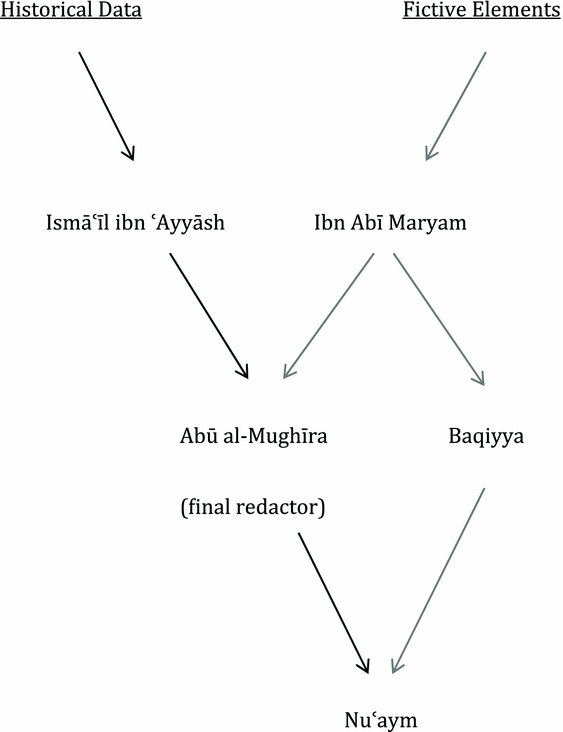
Elsewhere in his Fitan, Nuʿaym produces traditions on the authority of this Abū al-Mughīra from Abū Bakr ibn ʿAbd Allāh ibn Abī Maryam al-Ghassānī al-Shāmī (d. 156 ah)Footnote 73 concerning the Sufyānī’s advent which share almost all of the elements of the part on the mystifying manner of his appearance in the above tradition.Footnote 74 As Madelung observes, the two traditions must be related in some way, but he, neglectful of their historical context, concludes that it must have been Ibn Abī Maryam who was using earlier material in his tradition.Footnote 75 This judgment seems highly doubtful. There exists a shorter, less fanciful variant for Ibn Abī Maryam's tradition which Nuʿaym has received from another authority, Baqiyya ibn al-Walīd al-Ḥimṣī (d. ca. 197 ah).Footnote 76 This latter version is lacking in some details of the Sufyānī’s advent. The existence of this latter, independent line of transmission (Nuʿaym < Baqiyya < Ibn Abī Maryam) proves that the embellishments pertaining to the manner of the Sufyānī’s advent in the longer version of the Ibn Abī Maryam tradition (Nuʿaym < Abū al-Mughīra < Ibn Abī Maryam) must be the work of Abū al-Mughīra, the same embellishments that we find in the Ibn ʿAyyāsh tradition, also transmitted by Abū al-Mughīra. It thus stands to reason that, in a simplified scenario, Abū al-Mughīra would have received the historical core of our tradition from Ibn ʿAyyāsh and the speculative elements from Ibn Abī Maryam and combined them, along with further additions of his own, into the more elaborate form in which we now have it. The chart in the following page summarises the history of the fusion of this material into the final form of the tradition.
This reconstruction finds further vindication in the fact that some of the elements in Ibn ʿAyyāsh's ḥadīth (namely, the Sufyānī’s descent from Khālid ibn Yazīd) originate in a period (that is, the Fourth Civil War) when of all of its tradents only Abū al-Mughīra was alive. Indeed, Nuʿaym himself outs Abū al-Mughīra for tampering with traditions, if not forging them outright, at another point.Footnote 77 Ibn ʿAyyāsh, a native of Ḥimṣ who was in his twenties at the time of the ʿAbbāsid revolution, must have been an eyewitness to the historical events retailed in the ḥadīth. To recapitulate, our tradition comprises three parts: fanciful material about the Sufyānī’s activities, going back to Abū al-Mughīra, an ʿAbbāsid-era traditionist; nuggets of extremely accurate historical trivia about the rebellion of Abū Muḥammad, going back to Ibn ʿAyyāsh; and very late historical information about the events of the Fourth Civil War, also going back to Abū al-Mughīra. This stratification of the tradition not only dates it to no earlier than the time of the ʿAbbāsid revolution, but also shows that the accretion of diabolic characteristics around the figure of the Sufyānī was a relatively late development that gradually took place in the early ʿAbbāsid era.
The transmission history of the historical and speculative elements of tradition 2. Note that the independent transmission line on the right (pale) transmits only speculative material that could also be found as a distinct tradition in Nuʿaym.

3. A tradition from the time of the ʿAbbāsid revolution in al-Dānī’s Fitan thus reads:
there will be ten [signs] before the day of resurrection: the discord (ikhtilāf) among the Umayyads, the killing of the two lambs (qatl al-ḥamalayn), the black banners in the east (rāyāt [sic] al-sūd bi-l-mashriq), the sack (istibāḥa) of Kūfa, the rising of the Sufyānī, the deposition of a caliph (khalīfatun yukhlaʿu), the pledging of allegiance to a man between [the well of] Zamzam and the Maqām, an army that will be swallowed up (yukhsafu bihim) in the Baydāʾ, the battle with the Kalb (yawm Kalb), and [the battles of] the aʿmāq.Footnote 78
The order of the events adumbrated in the ḥadīth does not fully tally with their actual chronology, but this could simply be due to unintentional transpositions in the course of transmission and should not pose intractable problems for their identification. “The discord among the Umayyads” evidently refers to the Third Civil War, the only occasion when an Umayyad took up arms against another.Footnote 79 “The killing of the two lambs” is a reference to the murder, in 126 ah, of al-Ḥakam and ʿUthmān, the two young sons of the Umayyad caliph al-Walīd II ibn Yazīd II ibn ʿAbd al-Malik – whose own regicide less than a year earlier had helped to precipitate the civil war. The two had been designated as heirs apparent by their father and when he was murdered the putschists threw them into prison along with other opponents and potential rivals, among them Abū Muḥammad al-Sufyānī. The coup d’état installed Yazīd III ibn al-Walīd I as caliph, but he died shortly afterwards and was replaced by his brother, Ibrāhīm. The future caliph Marwān II then rose in revolt in the name of the two brothers, and when his army approached Damascus the panic-stricken leaders of the coup entered the dungeon of the royal palace and, in a last-ditch effort, killed the young brothers – Abū Muḥammad barely escaped their fate.Footnote 80 Maybe not coincidentally, it was Abū Muḥammad himself who, upon his release from prison, described them as “the two lambs” to Marwān, citing an apparently ex eventu prophecy. The version of the account in the only extant manuscript of Khalīfa ibn Khayyāṭ’s (d. 240 ah) Taʾrīkh, on which the critical edition is based, is somewhat cryptic, but it can be deciphered with the help of the variant reported for the same account by Ibn ʿAsākir, who quotes it from Khalīfa himself. In this latter version, Abū Muḥammad sternly warns, “we are doomed if the two were the two lambs who had been foretold of and described” (innā li-llāh in kānā al-ḥamalayn al-ladhayn yudhkarān wa-yūṣafān).Footnote 81 In the light of this, Khalīfa's version should be thus understood: “we are doomed if they were the two lambs who [it has been foretold that] will be deposed and devoured” (innā li-llāh in kānā al-ḥamalayn al-ladhayn yuʾkalān wa-yūḍaʿān).Footnote 82 A tradition in Nuʿaym also refers to the two sons of al-Walīd II as the “two lambs”: “their kingdom shall indeed fall when one of their caliphs is deposed and killed along with his two lambs” (wa-lā yasquṭu mulkuhum ḥattā yukhlaʿa khalīfatun minhum fa-yuqtalu wa-yuqtalu ḥamalāhu).Footnote 83 Ibn Qutayba (d. 276 ah), too, informs us, without further comment, that the two sons of al-Walīd, “are called the two lambs”.Footnote 84
“The sack of Kūfa” is most likely a reference to the capture of the town by al-Ḍaḥḥāk ibn Qays al-Shaybānī’s Khawārij in 127 ah. They are not reported to have pillaged Kūfa, but apparently a large number of the city's defenders were killed in the event.Footnote 85 This episode, however, could also be eschatological fantasy, but it must be noted that the tradition, in its present form, does not connect it with the advent of the Sufyānī. “The black banners in the east” obviously refers to the Khurāsānī musawwida.Footnote 86 Finally, the “deposed” caliph could be al-Walīd II, called al-khalīʿ in some sources,Footnote 87 and further identified as the father of the “two lambs”, who will all be murdered before the onset of the tumult leading to the downfall of the Umayyad caliphate, in another tradition cited above. But it is more likely an allusion to Ibrāhīm ibn al-Walīd, whose militarily constrained abdication of his pretension to the Umayyad throne (ca. 127 ah) earned him the sobriquet al-makhlūʿ, “the deposed”;Footnote 88 who is referred to as al-khalīʿ in a singular tradition,Footnote 89 where he is defeated by the “ass of Mesopotamia”, Marwān II; and whose “deposition” is referenced in another tradition, where he is clearly distinct from al-Walīd II, the caliph who gets murdered.Footnote 90 As is clear, this tradition hails from the late 120s and early 130s ah and, therefore, its Sufyānī ought to be identified with Abū Muḥammad al-Sufyānī.
The last four episodes of this tradition are all ahistorical. Interestingly, bar one, they all derive from the aforementioned Zubayrid propagandistic tradition. With the passage of time, the historical context of this propagandistic tradition sank into oblivion and it entered the corpus of the Muslim endtimes literature and was subsequently associated with the war between the Mahdī and the Sufyānī before the eschaton. Two motifs from this tradition were later conflated with each other and became staple items in the repertoire of Muslim speculations on the end: the “swallowing up” (khasf) of an army sent against Mecca in the Baydāʾ, historically the expedition of ʿAmr ibn al-Zubayr against his half-brother ʿAbd Allāh; and the defeat of a second expedition comprised of Kalbī tribesmen, historically the expedition of al-Ḥusayn ibn Numayr al-Sakūnī against Mecca.Footnote 91 The Muslim tradition conflated these two historical episodes already by the middle of the second century ah and identified the resulting amalgam as the apocalyptic khasf of the Sufyānī’s Kalbī army in the Baydāʾ.Footnote 92 However, as may be seen clearly, in this tradition the khasf in the Baydāʾ and the battle with the Kalb have neither been conflated nor associated with the Sufyānī, at least not in a self-evident manner. We thus have reason to think that these “signs” have just entered our tradition as mere eschatological tropes and have nothing to do with its Sufyānī.Footnote 93
“The pledging of allegiance to a man between the Zamzam and the Maqām” most likely derives from the historical traditions on Ibn al-Zubayr as well, though there the unnamed Ibn al-Zubayr is offered the bayʿa between the Rukn and the Maqām. “The battles of the aʿmāq” emanate from another strand of early traditions concerning eschatological battles between the Muslims and the Byzantines in the plains (aʿmāq) of northern Syria.Footnote 94
4. Yet another composite tradition situates the rise of the Sufyānī in the context of the chaos leading to the fall of the Umayyad dynasty. The full version of this tradition has been recorded by Muḥammad ibn al-Ḥasan al-Ṭusī (d. 460 ah); a shorter version could be found in the Fitan of his contemporary al-Dānī; and two even shorter ones are recorded by Nuʿaym, all with the same isnād. Here I will attempt to reproduce it based on these variant versions, but its final part (and latest stratum) will be investigated sub num. 5. It runs as follows:
(the rule of the family of your prophet will be at the end of time [fī ākhir al-zamān]. There will be several emirates for them [lahā imārātun]. When you see [those emirates?] do not move and bide your time until their emirates are established).Footnote 95 When the Turks pounce on you and armies are mobilised against you (idhā insābat ʿalaykum al-Turk wa-juhhizat al-juyūsh ilaykum) and that caliph of yours who amasses wealth dies, a weak man (rajulun ḍaʿīfun) will succeed him and will be deposed (yukhlaʿu) after two years. The Turks and the Byzantines will thereafter ally [against you] and warfare will plague the earth (wa-yuḥālifu l-Rūm wa-l-Turk wa-taẓharu l-ḥurūb fī al-arḍ) and a caller will call out on the walls of Damascus: “woe to the Arabs from the approaching evil!” The western side of its [grand] mosque will then be swallowed up so that its walls will be brought down (wa-yukhsafu bi-gharbī masjidihā ḥattā yakhirru ḥāʾiṭuhā). Three people will afterwards rise in Syria, all vying for the kingdom: the speckled one (al-abqaʿ), the flame-hued one (al-aṣhab), and a man from the house of Abū Sufyān, who will rise accompanied with the Kalb and will lay siege to the people in Damascus (rajulun min ahl bayt abī Sufyān yakhruju bi-Kalb wa-yaḥṣiru l-nās bi-Dimashq). (Their kingdom shall end where it began [yaʾtī halāk mulkihim min ḥaythu badaʾa]).Footnote 96 The people of the west will then descend upon Egypt, and their entrance [into Egypt] will mark [the beginning of] the rule of the Sufyānī (yakhruju ahl al-maghrib yanḥadirūna ilā Miṣr fa-idhā dakhalū fa-tilka imārat al-Sufyānī). But before that someone will rise who will summon [people] to the family of Muḥammad (wa-yakhruju qabla dhālika man yadʿū li-āl Muḥammad) and the Turks will thereafter pour into Mesopotamia (wa-tanzilu l-Turk al-Jazīra)Footnote 97 and the Byzantines will fall upon Palestine. Afterwards the ruler of the west (ṣāḥib al-maghrib) will come forth and will kill men and enslave women and will then return until Mesopotamia bows to the Sufyānī (thumma yarjiʿu ḥattā yanzilu l-Jazīra ilā al-Sufyānī).Footnote 98
The pouncing of the Turks could refer to any of the more-than-a-handful of Turkic incursions into the northern confines of the empire or Central Asia during Hishām ibn ʿAbd al-Malik's long reign. Armies mobilised against the Muslims also refers to incessant warfare on all fronts in the same period.Footnote 99 The caliph “who amasses wealth” is Hishām himself, notorious for his avarice and miserliness.Footnote 100 The “weak man” who succeeds him and gets deposed within two years is, again, al-Walīd ibn Yazīd – who ruled for a mere one year and a half. The Turco-Byzantine coalition spoken of perhaps refers to the alliance between Leo the Isaurian and the Khazar khāqān, sealed through the marriage of the former's son, Constantine V, to the latter's daughter in 732 ce (ca. 113 ah),Footnote 101 which during the Third Civil War gave Constantine, now emperor, a free hand in dealing with the Muslims – insofar as his own internal problems allowed him.Footnote 102
The khasf of the west of the grand mosque of Damascus has been recorded as “the dislodgement of a group from the west of its mosque” (saqaṭat ṭāʾifatun min gharbī masjidihā)Footnote 103 in other versions, and is very likely a reference to the manner in which Yazīd III and his men entered the royal palace and took control of it. It must be noted here that Yazīd, it seems, deliberately attempted to imbue his actions with messianic colouring: he entered Damascus riding on an ass,Footnote 104 reportedly accompanied by seven of his followersFootnote 105 also riding on asses, set out for the grand mosque of Damascus with twelve of his supporters,Footnote 106 and, according to most versions of the account, upon declaring him as caliph in the grand mosque his supporters asked him to stand up like a rāshid and mahdī (qum yā amīr al-muʾminīn rāshidan mahdiyyan).Footnote 107 After rounding up the grand mosque's guards, they entered the royal palace, by pretending to be al-Walīd's couriers, from the adjoining grand mosque – the gate opening to the royal palace was approximately on its western cornerFootnote 108 – and captured all the palace officials as well.Footnote 109
Of the three people said to rise in Syria the aṣhab is to be identified with Marwān, who in other traditions is referred to as “Marwān, the flame-hued ass of Mesopotamia” (ḥimār al-Jazīra al-aṣhab Marwān).Footnote 110 The man from the ahl bayt abī Sufyān who lays siege to Damascus is none other than Abū Muḥammad al-Sufyānī. The sources give us to know that, on hearing of the coup, al-Walīd II ordered Abū Muḥammad to march against his enemies with the ahl Ḥimṣ. He obliged and marched out with his forces and encamped outside Damascus, but was won over by Yazīd and pledged allegiance to him.Footnote 111 His recognition of Yazīd notwithstanding, when al-Walīd was murdered he rose in revolt, calling for his revenge, and once more marched with the ahl Ḥimṣ against the usurper, but, after defeat outside Damascus, was taken prisoner and thrown into the Green Palace's dungeon.Footnote 112 But it is more likely that there was only one expedition against Damascus, with our sources trying to make sense of seemingly contradictory reports by postulating two.Footnote 113 In either case, the Kalb seem to have cast their lot with their Sufyānid kinsman on neither occasion, though there is a passing mention of one branch of them as being among Abū Muḥammad's supporters in al-Ṭabarī’s narrative.Footnote 114 It was at this time that Marwān began marching towards Syria with his army of the Armenian frontier, but his advance came to a halt in Mesopotamia due to an outbreak of mutiny within the ranks of his own soldiers,Footnote 115 led by one Thābit ibn Nuʿaym al-Judhāmī, a perennial trouble-maker.Footnote 116 Yazīd III's sudden demise six months later and the succession of his brother Ibrāhīm, however, provided Marwān with the opportunity to launch a second bid for power. The abqaʿ of this tradition must, therefore, either refer to Yazīd or, less likely, to his brother Ibrāhīm,Footnote 117 and the statement “their kingdom shall end where it began” to the infighting in Syria. The first stratum of the tradition would have been composed at this very juncture (126 ah), for it continues by stating that the coming of the ahl al-maghrib to Egypt, “will mark the beginning of the Sufyānī’s rule”, two events of which none ever came to materialise. At the time the Great Berber Revolt (123-44 ah) was racking North Africa, but it never succeeded in wresting Egypt from the Caliphate – though, as it appears, it did succeed in inspiring fears that Egypt, too, might be lost.
The tradition was at some later point updated by the addition of the part beginning with “but before that”. The absence of the black banners motif rules out the ʿAbbāsids as a possible referent of the phrase “the person summoning to the family of Muḥammad”. Moreover, the ḥadīth plainly envisages a single person here, whereas the traditions on the ʿAbbāsid revolution never speak of their protagonists in the singular. This figure has thus to be identified with ʿAbd Allāh ibn Muʿāwiya ibn ʿAbd Allāh ibn Jaʿfar ibn Abī Ṭālib, the Ṭālibid who rebelled in 127 ah and, like the ʿAbbāsid duʿāt, called to “the chosen one of the family of Muḥammad”, al-riḍā min āl Muḥammad.Footnote 118 He initially managed to take control of large swathes of territory in western and southern Iran, but was eventually put to flight and forced to seek shelter with Abū Muslim al-Khurāsānī, in whose custody he perished, under mysterious circumstances.Footnote 119 The “several emirates” mentioned must be a reference to the several ill-fated Hāshimī revolts of this period, notably those of Zayd ibn ʿAlī (ca. 122 ah), his son Yaḥyā ibn Zayd (125 ah),Footnote 120 and the aforementioned ʿAbd Allāh ibn Muʿāwiya, but possibly others too.Footnote 121 This updated version must have been redacted at this very juncture, as the next episode, the coming of the Byzantines to Palestine and the Turks to Mesopotamia, is, likewise, ahistorical. If the sentence “the rule of the family of your prophet will be at the end of time” is indeed an allusion to the ʿAbbāsids, the tradition would have been again updated at the time of the revolution to take account of the latest developments, and this stratum may then be seen to reflect a pronounced pro-ʿAbbāsid posture. Yet, it is also possible that the statement is not a historical allusion, and reflects attempts to promote quietism (quʿūd) and dissuade the Shīʿa from associating with various late-Umayyad rebels who took up arms in the name of the family of the prophet.Footnote 122
5. As luck would have it, one of Nuʿaym's two mutilated versions more or less takes up where al-Dānī’s version leaves off, and consequently these two fragments complement each other to give the full version as recorded by al-Ṭūsī. It reads,
an ʿAbd Allāh will pursue another ʿAbd Allāh and the armies of the two will join battle in Qarqīsiyāʾ on the river. There will be a great battle between them and then the ruler of the west (ṣāḥib al-maghrib) will go and kill men and enslave women and will then return, accompanied by the Qays, until Mesopotamia bows to the Sufyānī. He [the Sufyānī?] will follow the Yamānī afterwards and massacre the Qays in Jericho. The Sufyānī will then seize for himself whatever forces they have mustered [?] and turn towards Kūfa.Footnote 123
The tradition then closes with the Sufyānī’s triumph over the three banners in Syria (which technically would require his also defeating his own forces!) and the stock accounts of his atrocities in Kūfa, as well as an expedition despatched against Khurāsān. This section apparently was added to our tradition during the abortive rebellion of ʿAbd Allāh ibn ʿAlī, the ʿAbbāsid governor of Syria (hence his moniker of ṣāḥib al-maghrib in our Iraqi tradition), against his nephew, the new caliph Abū Jaʿfar ʿAbd Allāh al-Manṣūr, in late 136-early 137 ah. Anti-ʿAbbāsid factions seem to have been filled with immense glee at the sight of the ʿAbbāsids fighting off each other, both at this time and during the Fourth Civil War six decades later, and anticipated the imminent fall of the new regime. Both occasions witnessed a proliferation of traditions prognosticating the proximity of their demise. These hopes are best expressed in a tradition found in the Kitāb al-Ghayba of the Shīʿī scholar Muḥammad ibn Ibrāhīm al-Nuʿmānī (d. 360 ah), ascribed to the fifth Shīʿī imām Muḥammad al-Bāqir, which clearly dates to this period:
when an internecine feud (ikhtilāf) erupts in the house of so-and-so, then wait for your redemption (faraj). Verily your redemption will be in the feud amongst the house of so-and-so. . . . The qāʾim will only rise and you will only see what you long for when their infighting begins. When that happens. . . the Sufyānī will rise. The family of so-and-so are bound to rule; but when they come to rule, they shall begin to quarrel (ikhtalafū) and their kingdom shall become fragmented (tafarraqa mulkuhum)Footnote 124 and their cause divided (wa-tashattata amruhum), until the Khurāsānī and the Sufyānī rise against them, the former from the east and the latter from the west, racing towards Kūfa. They shall meet their end at the hands of these two, and no doubt these two will not leave a single one of them alive.Footnote 125
“The family of so-and-so” has explicitly been referred to as “the ʿAbbāsid family” in an abridged version.Footnote 126 On the other hand, Kūfa is evidently the capital of the ruling dynasty in this ḥadīth, and this fact dates it to 132-46 ah, the only occasion, apart from ʿAlī ibn Abī Ṭālib's short-lived caliphate (35-40 ah), that the city served in that capacity.Footnote 127 The only internecine conflict of this period is the one between ʿAbd Allāh ibn ʿAlī and his nephew, thereby dating the ḥadīth precisely to early 137 ah. By the Khurāsānī, Abū Muslim al-Khurāsānī, the kingmaker who ruled the eastern lands of the empire as his personal fiefdom and was, accordingly, perceived as a menacing threat to the fledgling ʿAbbāsid state, is intended here.Footnote 128 The Sufyānī, co-opted by Shīʿī apocalyptic, appears as a grey figure in this ḥadīth: both he and the Khurāsānī are mere dogsbodies for the Shīʿī qāʾim, who are to pave the way for his parousia by destroying the ʿAbbāsids.Footnote 129 But the ʿAbbāsids proved to be more resilient than that.
Abū Muslim eventually decided to cast his lot with al-Manṣūr and marched against ʿAbd Allāh ibn ʿAlī with his khurāsāniyya. The Syro-Mesopotamian frontier force, which had come to be dominated by the Qays in the course of the civil war,Footnote 130 comprised the backbone of ʿAbd Allāh's troops – the divided loyalties of his Khurāsānī troops made them less reliable in a war with their fellow Khurāsānīs who constituted Abū Muslim's army. According to an unlikely account in al-Ṭabarī’s Taʾrīkh, he went so far as to massacre seventeen thousand Khurāsānīs among his troops.Footnote 131 Contrary to what our tradition reports, the sources record no major engagement between the two factions in Qarqīsiyāʾ, but, in his account of the event, al-Balādhurī does passingly mention a clash there.Footnote 132 ʿAbd Allāh ibn ʿAlī’s forces were ultimately crushed by Abū Muslim's crack troops in Nisibis,Footnote 133 further to the west of Qarqīsiyāʾ.Footnote 134 Hence, this part of the lengthy tradition recorded by al-Dānī, al-Ṭūsī, and Nuʿaym would have been added to it shortly before ʿAbd Allāh ibn ʿAlī’s retreat to Nisibis and appears to reflect hopes for an eventual destruction of the ʿAbbāsid state at the hands of the warring factions.Footnote 135
6. The following prophecy has been put into the mouth of the Jewish rabbi and seer Kaʿb al-Aḥbār:Footnote 136
ʿAbd Allāh ibn Marwān < Arṭāt (ibn al-Mundhir) < Tubayʿ < Kaʿb:
when the cause of the ʿAbbāsids triumphs [lit., “when their mill starts grinding”], and those with black banners tie their mounts by the olive tree of Syria, and God destroys the flame-hued one for them, and kills him and the whole of his family at their hands, – until there remains not a single Umayyad except on the run or in hiding – and the two branches, the Banū Jaʿfar and the Banū al-ʿAbbās, fall, and the son of the liver-eating woman ascends the pulpit of Damascus, and the Berbers pour into the navel of Syria, that will be the herald of the Mahdī’s advent (idhā dārat Footnote 137 raḥā banī al-ʿAbbās wa-rabaṭa aṣḥāb al-rāyāt al-sūd khuyūlahum bi-zaytūn al-Shām wa-yuhliku llāh lahum al-aṣhab wa-yaqtuluhu wa-ʿāmat ahl baytihi ʿalā aydīhim ḥattā lā yabqā Umawiyyun minhum illā hāribun aw mukhtafiyyun wa-yasquṭu l-saʿafatān banū Jaʿfar wa-banū al-ʿAbbās wa-yajlisu bn ākilat al-akbād ʿalā minbar Dimashq wa-yakhruju l-Barbar ilā surrat al-Shām fa-huwa ʿalāmat khurūj al-Mahdī).Footnote 138
This Syrian tradition is likely to be the work of Arṭāt (d. ca. 162 ah),Footnote 139 a native of Ḥimṣ who must have been an eyewitness to the events culminating in the fall of the Umayyads described herein – the ʿAbbāsid subjugation of Syria, the killing of Marwān II (again referred to as al-aṣhab), and the open season on the Umayyad family, particularly the incident on the banks of the Nahr Abī Fuṭrus.Footnote 140 The fall of the Banū Jaʿfar clearly references the meteoric rise and fall of the Jaʿfarid ʿAbd Allāh ibn Muʿāwiya (active 127-9 ah). Shīʿī apocalyptica of the period is acutely alive to the quick unravelling of the Jaʿfarid cause and the subsequent success of the ʿAbbāsids,Footnote 141 and occasionally also foresees the futile scrambles of the Ḥasanid family for power in early ʿAbbāsid times – the abortive rebellions of Muḥammad ibn ʿAbd Allāh ibn al-Ḥasan ibn al-Ḥasan ibn ʿAlī ibn Abī Ṭālib “al-Nafs al-Zakiyya” and his brother Ibrāhīm, and probably other Ḥasanids as well.Footnote 142 The traditionist seems to expect the rapid fall of the ʿAbbāsids immediately after their victory, apparently precipitated by the revolt of Abū Muḥammad al-Sufyānī, who is referred to as “the son of the liver-eating woman”, invoking the alleged outrageous act of his great grandmother, Hind bint ʿUtba, Abū Sufyān's wife, in biting Ḥamza ibn ʿAbd al-Muṭṭalib's liver after his fall on the field of Uḥud.Footnote 143 But, although this tradition expresses a marked disdain for the Sufyānī, it still does not depict him diabolically and he remains a human being in it.Footnote 144 What is more, it does not pit him against the Mahdī; rather, he is simply the Mahdī’s forerunner. Whether the Mahdī of this tradition is to be identified with the first ʿAbbāsid caliph, Abū al-ʿAbbās al-Saffāḥ, remains an open question.Footnote 145
7. A tradition warns of seven tribulations (fitan) that will afflict the Muslim community, prophesied by the prophet: “a fitna that shall come from Medina, another in Mecca, another from the Yemen, yet another from Syria, one from the east, still another from the direction of the west, and a [final] fitna from within Syria (min baṭn al-Shām) – that will be the fitna of the Sufyānī”.
One of the tradents (a certain al-Walīd ibn ʿAyyāsh) identifies these fitan with, respectively, those of Ṭalḥa and al-Zubayr, Ibn al-Zubayr, Najda (ibn ʿĀmir, the Khārijī leader), the Umayyads, and “these folks” (obviously meaning the then-ruling dynasty, the ʿAbbāsids).Footnote 146 But, more appropriately, the fitna of Medina must be identified with the whole of the First Civil War (35-61 ah), which broke out as a by-product of the murder of the caliph ʿUthmān in Medina in 35 ah; the fitna of Mecca, as al-Walīd ibn ʿAyyāsh correctly noted, with Ibn al-Zubayr's failed caliphate (64-73 ah), with its capital of Mecca; that of the Yemen, contra Ibn ʿAyyāsh, plausibly with the Yemeni revolt of the Kindī scion ʿAbd al-Raḥmān ibn Muḥammad ibn al-Ashʿath, who claimed to be the south Arabian messiah, al-Aṣfar al-Qaḥṭānī,Footnote 147 and his “peacock army” (jaysh al-ṭawāwīs), which nearly succeeded in bringing down the Umayyad regime (ca. 81-3 ah);Footnote 148 that of Syria with the Third Civil War (126-9 ah), despite the fact that Ibn ʿAyyāsh apparently took it to mean the rule of the Umayyads as a whole; that of the east with the ʿAbbāsid revolution (129-32 ah), although taken to refer to the rule of the ʿAbbāsids; that of the west with the Berber revolt (began in 123 ah, effectively quashed only in 144 ah, during the reign of al-Manṣūr); and, therefore, that of the Sufyānī with Abū Muḥammad al-Sufyānī’s rebellion (132 ah).Footnote 149
8. Elsewhere in Nuʿaym's Fitan, we read accounts of the Sufyānī’s deeds which are quite complex, conglomerates of sundry (and even contradictory) narratives;Footnote 150 encounter traditions which unmistakably date from the time of Abū al-ʿAmayṭar's rebellion;Footnote 151 or are simply impossible to date – with many of this latter type being either his descriptions or merely a parroting of hackneyed statements about him, such as, “he will be the worst person ever to rule” (sharr man malaka).Footnote 152 But none of these traditions could conceivably be dated to before the Third Civil War. I shall, thus, confine myself to investigating only one notable example:
a man from the descendants of al-ʿAbbās will dwell in al-Raqqa for two years and will then lead an expedition against Byzantium, but his expedition will cause more trouble for the Muslims than for the Byzantines. He will return to al-Raqqa, but will receive news from the east that will unsettle him. He will return (yarjiʿu) to the east and will not get back. He will be succeeded by his son, followed by the advent of the Sufyānī and cessation of their rule.
The ʿAbbāsid is to be identified with the caliph Hārūn al-Rashīd, who, towards the end of his reign, took up residence in al-Raqqa, whence he led raids against Byzantium, and died in Khurāsān, while on an expedition to quell the insurrection of al-Rāfiʿ ibn al-Layth, for a second time (hence the tradition's use of the verb yarjiʿu, “will return”).Footnote 153 His son is, of course, al-Amīn, who succeeded Hārūn upon his death, and the Sufyānī is Abū al-ʿAmayṭar al-Sufyānī, who rose in revolt in 195 ah, during the Fourth Civil War.Footnote 154
III
Al-Ṭabarī preserves a report according to which Abū Muḥammad's partisans claimed that he was, “the Sufyānī who used to be foretold” (huwa l-Sufyānī alladhī kāna yudhkaru),Footnote 155 and Madelung has taken this as evidence that by this time the Sufyānī was a well-known apocalyptic personage.Footnote 156 But this argument is highly problematic and neglectful of the mechanisms of traditional forgery and apocalyptic pseudonymity. Apocalyptists usually work under pseudonyms, attributing their compositions to authoritative figures of the past.Footnote 157 By the same token, a supporter of Abū Muḥammad who intended to earn him following would have hardly got anywhere by coming right out and stating that he had himself been made privy to the events of the future and had had foreknowledge of the Sufyānī’s rebellion prior to its outbreak. The standard behaviour that we expect from such a person is for him to claim, as any other forger would do, that he has heard the tradition, prior to the actual event, from widely-respected authorities of sound repute – preferably deceased ones, as the dead could not denounce the false ascription.Footnote 158
More to the point, the complete version of Abū Muḥammad's claim, recorded by al-Balādhurī, leaves little doubt as to its exact nature: according to al-Balādhurī, when Abū Muḥammad al-Sufyānī rose in rebellion he proclaimed that “I am the Sufyānī who, it is related, will reinstate the rule of the Umayyads” (anā al-Sufyānī alladhī yurwā annahu yaruddu dawlat banī Umayya).Footnote 159 It is beyond doubt that such a “prophecy” could not have been put into circulation long before the rebellion, for the Umayyad dynasty had been toppled only a few months earlier. In other words, the claim before us, purported to have come from older authorities, is an ex eventu statement, in the feeble guise of a “prophecy”, which dates, at the earliest, from the time of the fall of the Umayyad dynasty in 132 ah.Footnote 160 This report is, thereby, a further testimony to Abū Muḥammad's messianist propaganda campaign. It must not, moreover, be forgotten that Abū Muḥammad was himself very dexterous in putting ex eventu prophecies to use, a fact to which Khalīfa ibn Khayyāṭṭ’s report on the “two lambs” attests.
More evidence for Abū Muḥammad's propaganda activities comes from the biography of his sister, ʿAbda. A Sufyānid princess and widow of the Umayyad caliph Hishām ibn ʿAbd al-Malik,Footnote 161 ʿAbda was taken captive in Ḥimṣ by ʿAbd Allāh ibn ʿAlī’s troops and was slaughtered (dhabaḥahā) on his orders, in one account in revenge for the killing of the wife of the ʿAlid rebel Zayd ibn ʿAlī. Legend has it that, years earlier, her husband Hishām had forewarned her that she would be killed, but that many women (from the ʿAbbāsid family) would then be killed on her account. Ibn ʿAsākir's source then explains Hishām's words thusly: “it means that when people from your family (re)gain the rule, they will slaughter women from the family of those who killed you in revenge” (yaʿnī idhā kānat dawlatun li-ahliki dhabaḥū biki min nisāʾ al-qawm alladhīna dhabaḥūki). The (historical) account of her death closes by this significant statement: “it has been said that the Sufyānī will rise to avenge her” (fa-yuqālu inna l-Sufyānī yakhruju thāʾiran bihā).Footnote 162 It must not, then, be a coincidence that al-Ṭabarī and al-Balādhurī attribute the cause of Abū Muḥammad al-Sufyānī’s rising to the attempt of an ʿAbbāsid agent to force an unnamed Umayyad woman into marriage. According to their account, which seems to come from a common source,Footnote 163 this woman was a descendant of Maslama ibn ʿAbd al-Malik.Footnote 164 However, Ibn al-ʿAdīm, who narrates this episode from the Kitāb al-Dawla al-ʿabbāsiyya of the early akhbārī al-Haytham ibn ʿAdī (d. ca. 206 ah),Footnote 165 identifies her as a descendant of Abū Sufyān, again without divulging her name,Footnote 166 and, in a most telling report in his Book of the Feud between the Banū Umayya and the Banū Hāshim, the Egyptian historian Taqī al-Dīn al-Maqrīzī counts among the misdeeds of the ʿAbbāsids the disembowelment of Abū Muḥammad's sister ʿAbda on ʿAbd Allāh ibn ʿAlī’s orders upon her refusal of his marriage proposal (khaṭaba ʿAbda bint ʿAbd Allāh ibn Yazīd ibn Muʿāwiya ibn abī Sufyān zawj Hishām ibn ʿAbd al-Malik ibn Marwān fa-abat ʿalayhi l-tazwīj fa-amara bihā fa-buqira baṭnuhā).Footnote 167 To reiterate, we have a tradition stating that the Umayyad prince Abū Muḥammad al-Sufyānī rose in revolt after an Umayyad woman turned down the marriage proposal of an ʿAbbāsid, another tradition reporting that Abū Muḥammad's sister was murdered because she turned down the ʿAbbāsid general ʿAbd Allāh ibn ʿAlī’s marriage proposal, and an ex eventu prediction stating that the Sufyānī will rise to avenge her. Pieced together, these accounts demonstrate that ʿAbda was the dishonoured woman for whose revenge her brother Abū Muḥammad rose in rebellion, that retribution for her coldblooded murder was a rallying cry of Abū Muḥammad's partisans who, naturally enough, wanted to cast his revolt as a just rising against the callous tyranny of the ʿAbbāsids, and that the report prophesying that “the Sufyānī will rise to avenge ʿAbda” comes from ex eventu traditions put into circulation by them – though vengeance is unlikely to have been the revolt's sole, or even immediate, cause.
This conjecture is strikingly seconded by a tradition in Nuʿaym's Fitan which has been received from ʿAbd Allāh ibn Marwān < Arṭāt ibn al-Mundhir < his informants; and also, again, from Abū al-Mughīra < Ismāʿīl ibn ʿAyyāsh < his masters. Nuʿaym freely admits that one of his authorities makes additions to the account (yazīdu aḥaduhumā ʿalā ṣāḥibihi fī al-ḥadīth), and it is clear from the other versionsFootnote 168 that it is Abū al-Mughīra who must be held responsible for these additions. In this tradition, we read of the killing of an unnamed Qurashī woman (tudhbaḥu imraʾatun min Quraysh) whom, the narrator states, “I would have named, if I wanted to!” (law ashāʾu an usammiyahā sammaytuhā.) Thereafter, “a man named ʿAbd Allāh will rise, calling for [her] revenge” (thumma yathūru thāʾirun yuqālu lahu ʿAbd Allāh). The cause of this ʿAbd Allāh, “will kindle in Ḥimṣ, flare up in Damascus, and break out in Palestine” (we are reminded of tradition no. 2 above), and he has all the trademarks of the Sufyānī known from other traditions.Footnote 169 In a shorter version of the tradition (with the isnād ʿAbd Allāh ibn Marwān < Arṭāt < Tubayʿ), a woman of Quraysh will be killed (la-yadhbaḥanna imraʾatun min Quraysh), and in revenge for her murder the Sufyānī will disembowel women from the Banū Hāshim. This Sufyānī will then die and, after several years, a second Sufyānī from the Qurashī woman's family will rise to avenge her, going by the name of ʿAbd Allāh (that is, a “servant of God”), who, however, is a godless beast. At the time, two ʿAbbāsid men, who are “the two branches” (al-farʿān), will be deposed – an evident allusion to the Fourth Civil War, which broke out when the brothers al-Amīn and al-Maʾmūn declared each other deposed.Footnote 170 These two Sufyānīs must, therefore, be identified with, respectively, Abū Muḥammad and Abū al-ʿAmayṭar al-Sufyānī. The name of the fathers of both of them was ʿAbd Allāh, and the reference to the Sufyānī as ʿAbd Allāh, along with the omission of ʿAbda's name, in this tradition seems to be an attempt to obscure and thus update it to accord with the new situation.Footnote 171
The part on the murder of the Qurashī woman in the tradition no doubt dates from the time of Abū Muḥammad's rebellion and must go back to Arṭāt, who, it must be remembered, was a native of Ḥimṣ and thus very likely an eyewitness to these events. Ismāʿīl ibn ʿAyyāsh, a disciple of Arṭāt, must have received the tradition from him. But the tradition as a whole, purporting to be the transcript of a discussion, in pre-Islamic times, between Kaʿb al-Aḥbār and a monk called, of all names, Yashūʿ (that is, Jesus) concerning the future of the Muslim community, is an anachronistic pastiche of eschatological topoi and motifs that must be the work of Abū al-Mughīra. At one point, it states that there will rise twelve “kings” (mulūk) in the community of Muḥammad, their last being, “a king who comes from the direction of al-Jawf,Footnote 172 bringing affliction with himself (ʿalā yadayhi takūnu l-balāʾ) and demolishing city walls (ʿalā yadayhi tukassiru l-akālīl),Footnote 173 and who lays siege to Ḥimṣ for four months” – Marwān II.Footnote 174 At this king's heels are the armies of the ʿAbbāsid revolution. The sequence of the twelve kings ends here, as does a shorter version of the tradition transmitted on Arṭāt ibn al-Mundhir's authority alone,Footnote 175 but it goes on to state that three people from the house of ʿAbbās will ascend the throne, non-sequentially named as al-Manṣūr, al-Saffāḥ, and al-Mahdī. Still later, Kaʿb states that their rule shall continue for “nine by seven”, i.e., sixty three years. Sixty three years brings us to the year 195 AH, to the heat of the Fourth Civil War. It then mistakenly predicts the premature death of al-Manṣūr shortly after ascending the throne in 136 ah, and it is only at this point in the longer version that the Sufyānī explicitly (re)appearsFootnote 176 on stage. We then hear of the battle of Qarqīsiyāʾ, the two ʿAbd Allāhs, and the incursion of the “yellow banners” (al-rāyāt al-ṣufr; apparently the Berbers) from the west into Egypt. The tradition ends with the killing of the Qurashī woman discussed above.Footnote 177
As we have seen, the oldest traditions, or the earliest strata thereof, on the Sufyānī belong to the time of the Third Civil War and the ʿAbbāsid revolution. Some of these traditions would have been put into circulation by Abū Muḥammad al-Sufyānī’s partisans, but it is likely that bystanders overwhelmed by chiliastic anticipations also produced such traditions. Contrary to the view of some scholars, no Sufyānī tradition could be dated to the mid-Umayyad period, and thus it is unlikely that his myth was conceived either as a response to the Sufyānids’ loss of power to the Marwānids or came into being as an inevitable corollary of the above-discussed Zubayrid tradition. To the credit of the exponents of the former view, however, there is a single tradition in Nuʿaym which pits the Sufyānī against a character called the “Marwānī”,Footnote 178 but this tradition dates from the time of the ʿAbbāsid revolution and is a reflection of the intra-Umayyad feud that was the Third Civil War.Footnote 179 To Lammens’ credit, a singular tradition (quoted above) speaks of the Sufyānī’s return (fa-yarjiʿu l-Sufyānī), but even if there were people who refused to believe his death and awaited his return, as Lammens suggested,Footnote 180 they are unlikely to have been more than a paltry few. It is not hard to imagine that the factor that contributed the most to the growing belief in the Sufyānī as an eschatological figure, and subsequently an endtimes villain, was the traditions that were put into circulation during Abū Muḥammad's counterrevolutionary uprising. These traditions, no doubt, more than appealed to many factions – the Syrians, other opposition groups, perhaps even supporters of the ʿAbbāsids who viewed the Sufyānī as an instrument of divine castigation at whose hands they would have to suffer before the final redemption – and, although the original Sufyānī was no longer alive, they continued to circulate and even proliferate. Madelung's claim that the figure of the Sufyānī was, from the start, bound up with that of the Mahdī cannot be maintained either. Save for one, none of the traditions discussed above make any reference to the Mahdī, at least not in their earliest layer, and even when we first find the antagonist of the Zubayrid propagandistic tradition identified with the Sufyānī – in Muqātil ibn Sulaymān's (d. 150 or 158 ah) tafsīr – the Mahdī is absent from the discussion.Footnote 181 Nor does any of them, pace Madelung and Aguadé, characterise the Sufyānī as possessing a diabolic, Antichrist-like persona.Footnote 182 Likewise, Nagel's contention that the rebellion of the first Sufyānī was bereft of messianic undertone and that the rise of the Sufyānī as a messianic character must be situated in the insurrection of Abū al-ʿAmayṭar, in the closing decade of the second century, is, in the light of the foregoing, untenable.
As strange as it might seem, the demonisation of a salvific character is not unheard of in religious history: another case in point is the Endkaiser, the last Roman emperor of late-ancient Christian apocalyptic. Although the “last emperor” is first mentioned in the Sibylla Tiburtina and the Apocalypse of pseudo-Methodius, both dating to the second half of the seventh century,Footnote 183 the idea has its roots in state-sponsored Byzantine eschatological agitations of the late 620s and early 630s.Footnote 184 Almost immediately after its emergence, the figure of the last emperor was appropriated by the Jews and recast in the form of Armilos, the Jewish Döppelganger of the Antichrist in the Hebrew apocalyptica of Late Antiquity, which first surfaces at around the same time in Sefer Zerubbabel.Footnote 185