Central-line–associated bloodstream infections (CLABSIs) are preventable infections associated with increased morbidity and mortality. Reference O’Grady, Alexander and Dellinger1 Though sterile insertion techniques and insertion site dressing maintenance are well outlined in guidelines, limited data are available on the utility of insertion site assessments. Reference O’Grady, Alexander and Burns2,Reference Perencevich and Pittet3 Because central-line insertion site inflammation (ISI) may precede the onset of CLABSI, we aimed to define ISI, evaluate the association of ISI with CLABSI, and develop automated ISI surveillance.
Methods
The University of Iowa Hospitals & Clinics is an 811-bed tertiary-care hospital where nurses routinely assess central-line insertion sites and document their findings in the electronic health record (EHR). We retrospectively extracted insertion site assessment data for all inpatients with central lines from January 2015 to October 2018. ISI was defined as the presence of at least 1 of the following: edema, erythema, induration, tenderness, or drainage.
A case-control study was performed. Patients with non-mucosal barrier injury (non-MBI) CLABSI (cases) were matched to patients with a central line without CLABSI (controls), and 2 controls were matched to each case. We matched age (±10 years), sex, date of CLABSI (±30 days), inpatient unit, central-line days (number of days with a central line inserted), and central-line type (temporary vs permanent). The exposure of interest was an ISI documented within 6 days before CLABSI onset for cases and within 6 days from matching date for controls. CLABSIs were determined using Centers for Disease Control and Prevention National Healthcare Safety Network definitions. Reference Marschall, Mermel and Fakih4 We calculated univariable conditional logistic regression. We report results as odds ratios (ORs) and 95% confidence intervals (CIs). We then created a metric, ISI days (the number of patient days with ISI documented). We then plotted ISI incidence (ISI days divided by central-line days) to quantify the burden of ISIs and to determine how ISI and CLABSI incidence varied over time. An automated surveillance system for ISI was created linking structured query language queries to the EHR data repository with Tableau software (Seattle, WA). CLABSI prevention activities were continuously optimized during the study period, including training on optimal insertion practices, standardized central-line care, alcohol-impregnated disinfection caps, maintenance training, and chlorhexidine bathing. The standardized infection ratio (SIR) was calculated in the National Healthcare Safety Network (NHSN) and was used for comparisons between 2015 and 2018.
Results
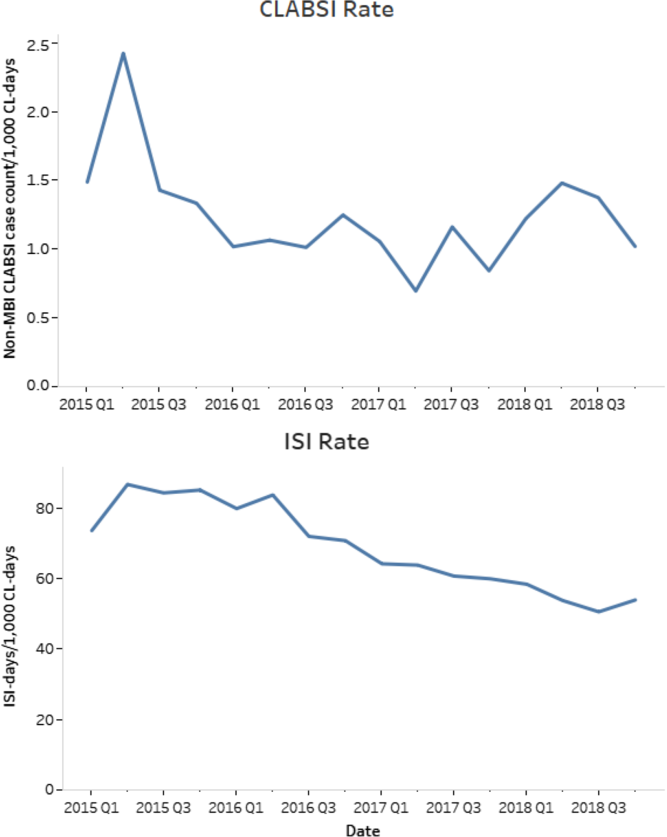
During January 2015–October 2018, there were 714,709 patient days and 265,268 central-line days. In total, 2,324,446 central-line assessments were performed by nursing staff and 286 CLABSIs were detected. Of those, only 194 cases had 2 matching controls, yielding 194 cases and 388 controls. ISI (at or before CLABSI onset among cases) was more frequently documented in CLABSI patients compared with controls (30.4% vs 22.4%; OR, 1.51; 95% CI, 1.03–2.23; P = .036). Over the study period, ISI incidence decreased from ~80 to ~50 ISI days per 1,000 central-line days (Fig. 1), and non-MBI CLABSI rates decreased from ~1.5 to ~1.0 per 1,000 central-line days. The NHSN SIR decreased from 1.39 in 2015 to 1.17 in 2018.
Central-line–associated bloodstream infection (CLABSI) and insertion site inflammation (ISI) incidence at a tertiary-care center, 2015–2018. Note. MBI, mucosal barrier injury.

Within 286 CLABSIs, the most common organism was Staphylococcus aureus (n = 49, 17%), followed by Staphylococcus epidermidis (n = 42, 15%), Escherichia coli (n = 22, 8%) and Pseudomonas spp (n = 22, 8%).
Discussion
We were able to show an association between ISI incidence and CLABSI. We also created an automated surveillance system for ISI using data routinely captured in the EHR. Because CLABSI incidence is relatively low in the United States, surveillance for ISI could be a more sensitive indicator for monitoring the impact of central-line care and maintenance efforts.
Our study revealed that ISI was more common in patients with CLABSIs. This finding result differed from a previous study by Safdar et al Reference Safdar and Maki5 that demonstrated no predictive value of ISI for CLABSI. However, most of their CLABSIs (27 of 35, 77%) were caused by coagulase-negative Staphylococcus, which elicits less inflammation than Staphylococcus aureus. Reference Safdar and Maki5 In our study, the most common organism was Staphylococcus aureus, and this difference might have contributed to the association between ISI and CLABSI. Monitoring ISI incidence as a parameter of CLABSI prevention strategies might be helpful depending on CLABSI microbiology data in each institution. Gohil et al Reference Gohil, Yim and Quan6 designed a central-line insertion site assessment scoring system to standardize the evaluation of local signs of inflammation and identify central-lines at risk for CLABSI. Reference Gohil, Yim and Quan6 However, they were unable to show an association with CLABSI perhaps due to the power of the study or their low CLABSI rates at baseline.
The Society of Healthcare Epidemiology of America Compendium does not recommend central-line insertion site assessment surveillance. Reference Marschall, Mermel and Fakih7 Gohil et al Reference Gohil, Yim and Quan6 showed that ISI surveillance was associated with ISI incidence reduction and increased compliance with timely central-line removal. They implemented an ISI scoring system with automated EHR notification to providers. We did not have an automated EHR process to communicate ISI findings to providers. Other infection prevention activities, such as physician training on optimal insertion practices and nurse education for standardized dressing changes, likely contributed to our reduction in ISI and CLABSI. The impact of ISI detection on CLABSI incidence reduction may be due to early removal of central lines before CLABSI development. Nursing–provider communication may occur verbally in our institution but automating it using the EHR may accelerate the decrease in ISI.
Gohil et al Reference Gohil, Yim and Quan6 prospectively used ISI standardized definitions applied by frontline staff to daily central-line assessments. Standardizing ISI definitions is helpful for comparing ISI trends over time and between institutions. However, it may be time intensive because it requires training of frontline staff and modification to the EHR. We support standardization of ISI definitions. But if standardization is not possible due to a lack of resources or information technology support, mining data already collected for other purposes can still be helpful in monitoring infection prevention practices.
Continued efforts to reduce CLABSI incidence have been successful in the United States. Between 2008 and 2013, the implementation of prevention bundles was associated with a 46% reduction in CLABSI incidence in the United States. 8 Because of small CLABSI case counts at individual hospitals, CLABSI incidence may frequently vary over time, making it difficult for infection prevention professional to discern meaningful increases versus random variation. ISI incidence (~50–80 per 1,000 central-line days) is several fold higher than CLABSI incidence (~1 per 1,000 central-line days). Because ISI incidence is higher, it has less variability over time, representing a more robust indicator of prevention practices. Also, currently, even if not intended, a large proportion of CLABSIs reported to the NHSN may arise from sites other than the central-line (eg, pneumonia, gastrointestinal) Reference Hammadi, Ostrosky-Zeichner, Boston, McInnis-Cole and Butler9 and CLABSI incidence may not be a perfect marker of appropriate central-line insertion and maintenance.
This study has several limitations. It was conducted at a single center, and the results may not be generalizable. Insertion site assessments are subjective and site assessment recording was independent from this retrospective study. Our ISI definition was created using insertion site descriptors already populated in the EHR: other centers may need to adjust these definitions. Because ISI documentation was unsupervised, our ISI definition may not be implementable across multiple settings. A prospective standardized ISI definition is needed, such as the one proposed by Gohil et al. Reference Gohil, Yim and Quan6 Sensitivity analyses were performed with and without erythema and/or discharge in the ISI definition and results remained similar. However, this unsupervised approach was able to prove an association between ISI and CLABSI and allowed automated monitoring of ISI in parallel to CLABSI prevention efforts and CLABSI incidence.
In conclusion, there was an association between ISI and the development of CLABSI. Automated surveillance for ISI is feasible and could help prevent CLABSI.