





1. Introduction
Interjections occupy a difficult position in the history of linguistic thought. Despite their ubiquity in spoken interaction and their recognisable presence in written representations of speech, they have repeatedly been described as marginal, irregular, or even extraneous to the grammatical system – a belief that still holds true for many grammars (Lahaussois Reference Lahaussois, Assunção, Fernandes and Kemmler2016). From classical grammar to modern linguistic theory, interjections have often been characterised as items that resist systematic analysis: they lack inflection, they are weakly integrated into syntactic structure, and their meaning appears to depend heavily on context, prosody and speaker stance. As a result, they have frequently been relegated to the periphery of grammatical description, treated as linguistic curiosities rather than as objects worthy of sustained theoretical attention.
In recent decades, this situation has changed substantially. Research in pragmatics, at both a synchronic and a diachronic level (Taavitsainen Reference Taavitsainen and Jucker1995; Jucker & Taavitsainen Reference Jucker and Taavitsainen2013; Taavitsainen & Jucker Reference Taavitsainen and Jucker2015), has shown that interjections are neither random nor purely expressive vocalisations. Instead, they constitute a conventionalised class of linguistic items that play a crucial role in managing interaction, signalling stance and regulating discourse. Functional and pragmatic approaches have demonstrated that interjections signal turn-taking, contribute to the organisation of talk, and encode both affective and interpersonal meanings. Within this renewed framework, interjections are increasingly understood as central components of what has been termed the ‘conversational architecture’ of language, rather than as marginal deviations from sentence grammar (Dingemanse Reference Dingemanse and van Lier2023, Reference Dingemanse2024).
Although interjections were first identified and discussed in the Latin grammatical tradition, their relevance in conversation has not always been fully appreciated.
This raises the question of how grammarians working before the emergence of pragmatics conceptualised a class of items that so clearly resist the structural assumptions of sentence-based grammar. Early Modern English grammar writing offers a particularly fruitful testing ground for this question. On the one hand, early modern grammarians inherited a powerful descriptive apparatus from Latin and Greek grammars, with well-established categories and metalanguage. On the other hand, they were confronted with the task of describing a vernacular language whose structure, usage patterns and communicative practices differed markedly from those of the classical languages on which their models were based.
This article investigates how interjections were treated in a set of Early Modern English grammars, with particular attention to the metalinguistic label interjection and to the functions and properties attributed to this category. Rather than approaching early grammars as flawed precursors of modern linguistic theory, the study adopts a historiographical perspective that emphasises descriptive adequacy – that is, the extent to which grammarians succeeded in capturing speakers’ linguistic intuitions within the constraints of their theoretical frameworks (Chomsky Reference Chomsky1965: 24–7; Dons Reference Dons2004: 1). Interjections are especially revealing in this respect, precisely because they expose the limits of inherited grammatical models and force grammarians to confront phenomena that cannot easily be reduced to morphology or syntax.
Among the grammarians that were active in early modern England, William Bullokar’s characterisation stands out as particularly remarkable. His Bref Grammar for English (1586) is one of the earliest and most influential grammars of English. Bullokar’s work is well known for its ambitious proposals for orthographic reform and for its attempt to systematise English using categories derived from Latin grammar. Less attention, however, has been paid to his treatment of interjections. As this article argues, Bullokar’s account of interjections is exceptional within the Early Modern English grammatical tradition, both in its explicitness and in its sensitivity to contextual and interactional factors. By defining interjections in terms of ‘sudden passion of the mind’ while simultaneously insisting that their meaning must be recovered through gesture, countenance, speaker attitude and communicative situation, Bullokar offers a description that goes beyond inherited definitions and gestures toward aspects of language use that would only later be theorised within pragmatics.
To situate Bullokar’s contribution, the article undertakes a systematic survey of the Early Modern English grammars available in the Early Modern English Grammar Archive (EMEGA), a digitised corpus of all English and Latin grammars published in England between 1542 and 1625.Footnote 1 The project was financed by the Italian Ministry of University and Research, and was headed by the University of Verona. By tracing the distribution and contextualisation of the label interjection across these texts, the study reveals a strikingly uneven pattern. Some grammarians retain the category but offer little elaboration; others subsume interjections under broader classes such as adverbs or ‘consignificant’ words; still others omit the label altogether. These differences are shown to correlate closely with the descriptive models adopted by individual grammarians, particularly the contrast between Latin-derived frameworks and Ramist reductions.
The analysis is integrated with modern insights on interjections coming from pragmatics and historical linguistics. Building on foundational accounts by Ameka (Reference Ameka1992) and Wilkins (Reference Wilkins1992), and on more recent syntheses by Dingemanse (Reference Dingemanse and van Lier2023, Reference Dingemanse2024), and corpus-based studies of Early Modern English interaction, the article explores points of convergence between early grammatical observation and later empirical findings. In doing so, it argues that Bullokar’s treatment of interjections reflects a keen awareness of their contextual, embodied and interactional nature, grounded in close observation of language use, coupled with a strong theoretical foundation inherited from past and authoritative models.
The structure of the article is as follows. Section 2 provides a theoretical overview of interjections, drawing on pragmatic and functional accounts to establish their key properties and to clarify why they pose persistent challenges to grammatical description. Section 3 situates Early Modern English grammar writing within its intellectual and pedagogical context, highlighting the tensions created by the application of classical models to English. Section 4 outlines the methodology and dataset used in the study. Section 5 presents the results of the analysis, comparing the treatment of interjections across grammars and examining Bullokar’s account in detail. Section 6 discusses the implications of these findings for our understanding of descriptive adequacy, grammatical theory and the history of linguistic thought. The conclusion summarises the main contributions of the article and reflects on the broader significance of interjections as a diagnostic category in the historiography of grammar.
2. What are interjections?
Interjections are traditionally considered an invariable part of speech, together with adverbs, conjunctions and prepositions. Despite their apparent grammatical stability, however, their status has long been debated, primarily because they resist standard criteria of morphological inflection, syntactic integration, propositional meaning and, in some cases, even their phonetic structure may be aberrant (Ameka Reference Ameka1992; Dingemanse Reference Dingemanse and van Lier2023, Reference Dingemanse2024). As a result, interjections have often occupied a marginal position in linguistic description, both in grammatical traditions inherited from classical models and in modern sentence-centred approaches to language.
In contemporary linguistics, the class of interjections has undergone a significant reappraisal. Once treated as peripheral or even extraneous to the study of language, interjections have increasingly become a central object of inquiry within pragmatics, conversation analysis and historical linguistics (Ameka Reference Ameka1992; Taavitsainen Reference Taavitsainen and Jucker1995; Jucker Reference Jucker1995, Reference Jucker, Watts and Trudgill2002; Culpeper & Kytö Reference Culpeper and Kytö2010; Dingemanse Reference Dingemanse and van Lier2023, Reference Dingemanse2024; Bagli Reference Bagli2023a, Reference Baglib). This shift reflects a broader reorientation of linguistic theory away from abstract, decontextualised sentences and towards language as situated interaction.
The traditional marginalisation of interjections can be traced back to classical grammatical models. As Ameka (Reference Ameka1992) observes, Ancient Greek grammarians generally treated interjections as a subclass of adverbs, while Latin grammarians – most notably Priscian – introduced interiectio as an independent part of speech, to preserve the Greek division of words into eight classes. Priscian grammar was an adaptation of an earlier Greek model developed by Dionysius Thrax, who divided words into eight classes: noun, verb, participle, article, pronoun, preposition, adverb and conjunction. When Latin grammarians adapted this model to their language, they developed the class of interjections to replace the Greek category of articles, which are not present in Latin (Robins Reference Robins1997: 12–78). Within this tradition, interjections were commonly defined as items expressing a passion of the mind through an irregular or inarticulate voice (voce incondita), a formulation that foregrounded emotional expression while offering little insight into their broader communicative functions.
This legacy contributed to the perception of interjections as ephemeral and subjective. In modern scholarship, this view is exemplified by Goffman’s (Reference Goffman1978) notion of response cries, described as vocal reactions grounded in physiological or evolutionary mechanisms rather than in symbolic communication. While such accounts capture an important aspect of interjections – namely their frequent association with affect and emotion – they fail to explain their systematic distribution, conventional form and recurrent interactional functions.
A decisive turn in the study of interjections came with the adoption of pragmatic and functional frameworks, most notably in Ameka’s (Reference Ameka1992) foundational study. Ameka argues that interjections constitute a distinct word class whose defining property is best defined according to use, and not formal structure. In his view, interjections are words that can function as complete utterances and whose primary role is to index the speaker’s mental state, attitude, or communicative intention in relation to the ongoing interaction.
Crucially, Ameka proposes a tripartite functional classification that has since become standard in the literature:
-
• Expressive interjections, which reveal the speaker’s internal state. These may be emotional (e.g. alas, expressing grief) or cognitive (e.g. aha, marking sudden realisation).
-
• Conative interjections, which are directed towards the addressee and aim to influence behaviour or attention (e.g. hey, shh).
-
• Phatic interjections, which serve to maintain or regulate the communicative channel, signal involvement, or display empathy (e.g. ah, mhm).
This classification moves beyond purely emotive accounts and shows that interjections fulfil a wide range of interactional functions, many of which involve deliberate communicative intent rather than spontaneous emotional discharge.
While Ameka establishes what interjections do, Wilkins (Reference Wilkins1992) provides a crucial explanation of how they derive their meaning. Wilkins argues that interjections are best analysed as deictic and indexical utterances. In other words, rather than encoding propositional content through syntactic structure, Wilkins suggests that interjections derive their meaning from the situation of utterance, which supplies the referential and relational parameters left unspecified by the lexical form itself. As Wilkins notes, interjections ‘must be tied to the actual speech moment … before their complete interpretation can be made’ (1992: 132).
From this perspective, interjections are neither incomplete nor defective. They are semantically complete utterances whose interpretation depends on context rather than grammatical parsing. This explains both their syntactic independence and their interface with gesture, prosody and bodily cues, which participate in the resolution of their indexical meaning.
Recent work has further embedded interjections within a broader theory of conversational architecture. Dingemanse (Reference Dingemanse and van Lier2023, Reference Dingemanse2024) emphasises that interjections are not marginal disruptions of discourse, but integral components of interactional organisation. Corpus-based studies show that interjections follow recurrent patterns of placement, contribute to turn-taking, and play a crucial role in managing alignment, empathy and interpersonal stance. Despite their phonological markedness – often involving sounds or sequences absent from the standard lexicon – interjections are highly conventionalised, culturally specific and learnable.
This interactional perspective also helps explain the difficulty of accommodating interjections within traditional grammatical frameworks. Sentence-based models, whether classical or early modern, are ill-equipped to capture items whose meaning emerges from contextual, embodied and sequential factors rather than from syntactic relations. Although these insights are typically presented as the outcome of late twentieth-century pragmatics and corpus linguistics, they also provide a valuable lens through which to reassess earlier grammatical traditions. In particular, they invite renewed attention to the ways in which Early Modern English grammarians attempted to conceptualise interjections using inherited metalanguage.
3. Writing grammars in early modern England
The emergence of grammars of English in the sixteenth century must be understood against a long-standing educational tradition in which grammar was synonymous with the study of Latin. Until the Renaissance, grammar did not denote the systematic description of vernacular languages, but rather the codified knowledge required to read, write and translate Latin. As Algeo (Reference Algeo, Mary-Jo Arn and Wirtjes1985) argues, the earliest grammars of English were not conceived as autonomous descriptions of the language sui generis, but as pedagogical tools designed to mediate between English and Latin. Their primary function was comparative and didactic: to provide English students with an analytical framework that would facilitate the learning of Latin, and to make English accessible to educated foreigners already trained in Latin grammatical categories.
The idea of a grammar for the description of English emerged in the sixteenth century. Until then, English was used primarily in everyday and practical contexts, whereas more formal, scholarly and literary functions were largely fulfilled by other languages. Complex and abstract concepts were mainly discussed in Latin, the language of the church and of universities, while French was spoken at court (Nevalainen Reference Nevalainen2006; Vezzosi Reference Vezzosi, Bergs and Brinton2012). English was widely regarded as a language of lower prestige than French, Italian, or Latin, which sported a more refined literature and were thus considered of higher prestige. Dons (Reference Dons2004: 4–6) identifies three major cultural factors that contributed to the rise and diffusion of grammar writing in English. A key role was played by the Renaissance and its re-evaluation of classical cultures and literatures. The circulation of Latin and Italian literature ignited interest in the refinement of the English language and of its means of expression, with the objective of reaching literary achievements in English similar to those of the other more prestigious languages. The interest in classical cultures coupled with a sense of patriotism and nationalistic pride, which was growing in England in the early modern era (Watts Reference Watts and Jucker1995; Ragni Reference Ragni2020, Reference Ragni2023).
The Reformation was another critical factor in the development of the tradition of English grammar writing. This religious movement established a direct link to the sacred texts, thus prompting translations into different European vernaculars. The translation of the Bible in English was instrumental in enriching the prestige and the expressivity of the language, while also contributing to the development and exposure to more standardised spelling norms.
Humanistic pedagogical practices and principles also played a relevant role in the redefinition of English and of its prestige. The motto ‘Teach the unknown by the known’ contributed significantly to the study of English: pupils in grammar schools would familiarise themselves with the grammatical structures and linguistic system of English, before turning to the study of Latin. Thus, students would learn grammatical categories and parts of speech in their own language, making it easier to compare the concepts acquired in their own language with those in a second language.
Finally, the invention of the printing press exposed more speakers to written forms of language, thus enabling more speakers to read. This, in turn, fostered the development of more binding spelling rules, thus leading to a standardisation of lexical forms and grammatical constructions (Bagli Reference Bagli2023b; Ciambella Reference Ciambella2023). In the second half of the seventeenth century, English was inserted into the school curricula and became a school subject.
In this cultural climate, early English grammarians inevitably relied on the descriptive apparatus of Latin grammar. This reliance has often been criticised as ‘slavish and unthinking imitation of Latin’ (Algeo Reference Algeo, Mary-Jo Arn and Wirtjes1985: 191), but such a judgement is historically misguided. As Algeo demonstrates, early grammarians were acutely aware of the structural differences between Latin and English – most notably the contrast between a highly inflected language and an increasingly analytic one – and repeatedly attempted to reconcile inherited categories with observable usage. The adoption of Latin metalinguistic terminology and classifications was therefore not merely conservative, but pragmatically motivated: it provided a shared metalanguage that could be exploited for pedagogical purposes.
A central difficulty faced by early modern grammarians concerned the categorisation of parts of speech. The traditional Latin model, inherited from Greek grammar and transmitted through authors such as Donatus and Priscian, distinguished eight parts of speech. For instance, in keeping with the Latin tradition, William Lily includes the following lexical categories in his description of Latin: four declined, i.e. noun, pronoun, verb, participle; and four undeclined, i.e. adverb, conjunction, preposition, interjection.
While this model was internally coherent for Latin, its application to English generated systematic tensions. As Dons (Reference Dons2004) shows, English did not map neatly onto the declined/undeclined distinction that underpinned Latin grammars, and several categories – most notably adjectives, articles and interjections – posed persistent classificatory problems. Adjectives, for instance, were declinable in Latin but not in English; articles existed in Greek but not in Latin; interjections, marginal in Greek and variably treated as adverbs, acquired a distinct status in Latin largely to preserve the canonical number of parts of speech.
Early modern grammarians responded to these mismatches in different ways, depending on the theoretical model they adopted. Two broad traditions can be identified. On the one hand, Lily & Colet’s A Short Introduction of Grammar provided a sound and authoritative model for the description of Latin. This text became the standard reference grammar book used in grammar schools (Dons Reference Dons2004: 19). It adhered closely to Priscian’s framework and retained the eight-part system, including interjections as a distinct, indeclinable part of speech. Grammarians working in this tradition retained the same distinctions and descriptions found in Lily & Colet and applied them to the description of English. On the other hand, grammars influenced by Petrus Ramus and his attempt at the reformation of logic and pedagogy reduced the number of word classes and subordinated semantic considerations to formal and structural criteria. In Ramist grammars, interjections were typically absorbed into broader residual categories (such as syncategoremata, or ‘consignificant’ words), or relegated to adverbs, if mentioned at all.
Crucially, neither tradition offered a fully adequate account of English usage. As Dons (Reference Dons2004) observes, early grammars oscillate between descriptive insights and theoretical constraints: while grammarians often recognised that English relied heavily on word order, function words and discourse-pragmatic elements, they lacked an analytical framework capable of integrating these observations systematically.
The coexistence of these divergent approaches helps explain the uneven distribution of the metalinguistic label interjection in Early Modern English grammars. As the analysis in sections 4 and 5 shows, grammarians working within a Ramist framework often dispense with the label altogether, while those adhering to the Latin grammatical tradition retain it, albeit with varying degrees of elaboration. Far from being accidental, this variation reflects deeper assumptions about what grammar is meant to describe: formal structure alone, or language as it is used in communicative interaction.
4. Methodology
This study investigates how the metalinguistic label interjection is distributed, defined and conceptualised in Early Modern English grammars. Following Dons (Reference Dons2004), the analysis adopts descriptive adequacy as its evaluative lens, focusing on how effectively grammarians capture speakers’ linguistic intuitions rather than on the formal consistency of their models.
4.1. Corpus and data selection
The data for this study are drawn from the Early Modern English Grammar Archive (EMEGA), a digital repository containing the full texts of all nine English and Latin grammars published in England between 1542 and 1625. EMEGA provides each grammar in both original and modernised spellings and offers a fully searchable interface, enabling systematic, replicable analyses of metalinguistic terminology. Searches were conducted on the modernised versions of the grammars available in the EMEGA corpus, thus minimising the risks of misidentification of labels due to spelling fluctuation.
Since the focus of this article is on the grammatical description of English, only English grammars in the archive were selected for analysis. The three Latin grammars included in EMEGA (Lily & Colet 1542; Granger 1616; Wise 1625) were excluded. The resulting dataset consists of six grammars:
-
• Hart, An Orthography (1569)
-
• Bullokar, Bref Grammar of English (1586)
-
• Greaves, Grammatica Anglicana (1594)
-
• Tonkis, De analogia anglicani sermonis (1612)
-
• Hume, Orthographie and Congruitie of the Briton Tongue (c. 1617)
-
• Gil, Logonomia Anglicana (1621)
These texts represent the full range of theoretical orientations, including Latin-derived and Ramist models, and thus provide a suitable basis for comparative analysis.
4.2. Retrieval procedure
To identify all relevant references to the metalinguistic label of interjections, a wildcard search for the string interj* was conducted across the selected grammars. This procedure retrieves all orthographic variants of the label while minimising false positives. Each occurrence was manually inspected to ensure that it referred to the grammatical category rather than to incidental or non-metalinguistic uses.
In addition to the wildcard search interj*, targeted searches were conducted for semantically related terminology (e.g. exclamation, passion) and for prototypical interjectional forms (e.g. alas, oh, fie, woe, yes, nay), in order to determine whether grammars lacking the label interjection discussed the category under alternative terminology.
The analysis treats both the presence and absence of the label as analytically meaningful. Given the theoretical background outlined in section 3, the omission of interjection from a grammar is interpreted not as an oversight, but as a consequence of the descriptive model adopted by the grammarian.
4.3. Analytical procedure
All retrieved occurrences of interjection were subjected to qualitative contextual analysis. For each occurrence, the surrounding co-text was examined to determine:
-
1. whether interjection is recognised as an independent part of speech or subsumed under a broader category;
-
2. whether a definition is provided, and if so, which criteria are invoked (formal, semantic, functional, contextual);
-
3. which examples are listed, and whether these are treated as stand-alone forms or as syntactically integrated elements;
-
4. whether interjections are associated with affective, interactional, or discourse-regulating functions.
This qualitative approach allows for a fine-grained comparison between grammarians and avoids reducing the analysis to frequency counts alone. While quantitative information is reported where relevant, the primary goal is to uncover patterns of conceptualisation rather than to measure statistical prominence.
4.4. Analytical focus and expectations
Based on the theoretical and historical considerations outlined in sections 2 and 3, the analysis proceeds from two working assumptions. First, grammars that adhere closely to Latin-derived models are expected to preserve interjection as a distinct category, though often with limited elaboration. Second, grammars influenced by Ramist principles are expected to marginalise or omit the category, either by subsuming interjections under broader classes or by excluding them from discussion altogether.
5. Results
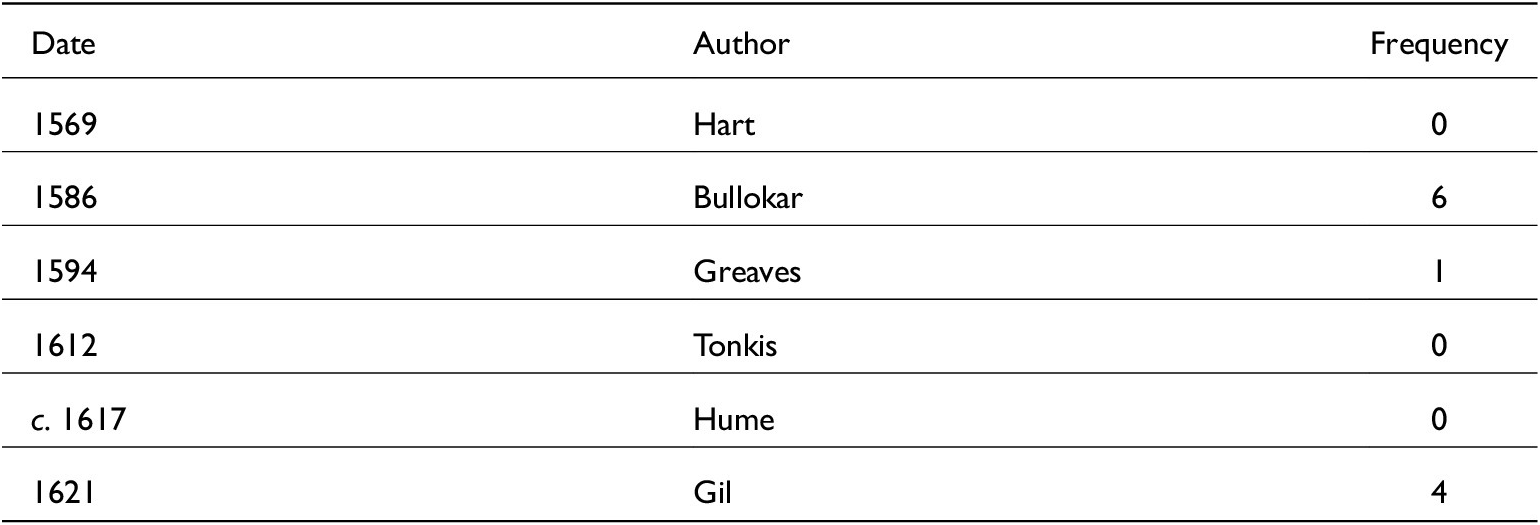
This section presents the results of the qualitative analysis of the metalinguistic label interjection across the English grammars included in the EMEGA corpus. Table 1 summarises the frequency of occurrence of the label interjection in each grammar. Raw frequencies should not be interpreted as directly comparable indicators of quantitative salience, since the grammars differ considerably in length, structure and descriptive scope. In the present study, occurrence counts primarily serve as heuristic indicators of metalinguistic attention to the category rather than as statistically normalised measures.
Frequency of interjection in English grammars (EMEGA)

Table 1. Long description
The table consists of three columns titled Date, Author, and Frequency. The data is organized as follows:
* 1569, Hart, 0.
* 1586, Bullokar, 6.
* 1594, Greaves, 1.
* 1612, Tonkis, 0.
* circa 1617, Hume, 0.
* 1621, Gil, 4.
As table 1 shows, the label interjection appears in only three of the six grammars examined: Bullokar (1586), Greaves (1594) and Gil (1621). Bullokar’s Bref Grammar contains the highest number of occurrences (n = 6), followed by Gil (n = 4), while Greaves includes a single occurrence. The remaining grammars – Hart, Tonkis and Hume – do not contain the label at all. The absence of the label interjection in these three grammars does not appear to result merely from terminological variation. Additional searches for semantically related labels and prototypical interjectional forms revealed no sustained alternative treatment of the category. Hume’s grammar contains no systematic discussion of interjectional or exclamatory forms, while Tonkis discusses forms such as yes, nay and ay within inventories of adverbs. Although Biber et al. (Reference Biber, Johansson, Leech, Conrad and Finegan1999) include these forms in the broader class of Inserts, together with interjections and polite formulae (such as please, thank you), a full reconsideration of these broader discourse-functional categories falls outside the scope of this article.
5.1. Greaves
Paul Greaves’ Grammatica Anglicana (1594) consists of two macro-sections: the first addresses phonological and morphological issues, while the second focuses on syntax. The grammar is written in Latin and adopts a predominantly Ramist framework, a choice that reflects both pedagogical considerations and an attempt to present English as a language worthy of systematic description to a learned audience. As noted by previous scholarship, the use of Latin allowed Greaves to situate English within a familiar grammatical metalanguage, making the work accessible to both domestic and foreign learners (Ragni Reference Ragni2023).
In line with the Ramist tradition, Greaves does not recognise interjections as an independent part of speech. Instead, the grammar lists six principal categories: substantives, adjectives, pronouns, verbs, adverbs and conjunctions. The label interjection appears only once in the entire work, under the heading of adverbs, alongside prepositions, as shown in example (1):
-
(1) And interjections too, such as alas, alack, oh, woe.
This brief mention confirms Greaves’ adherence to a model in which interjections are treated as a subclass of adverbs, rather than as a category deserving separate discussion. No definition is provided, nor are their formal or functional properties addressed. The four examples listed (alas, alack, oh, woe) are prototypical expressive interjections, but they are presented without commentary, as if their status was self-evident.
The absence of further elaboration is consistent with the Ramist emphasis on structural economy and formal categorisation. Given that Ramist grammars privilege logical structure over semantic and pragmatic considerations, it is unsurprising that a category as context-dependent and interactional as interjection receives minimal attention. Greaves’ treatment thus exemplifies a broader tendency within Ramist-influenced grammars to acknowledge interjections only insofar as inherited models require their placement, without engaging with their communicative functions.
5.2. Gil
John Gil’s Logonomia Anglicana (1621) occupies an intermediate position between strict Ramist reduction and Latin-derived grammatical tradition. Although Gil is best known for his extensive work on pronunciation and orthographic reform, Logonomia also offers a distinctive approach to grammatical categorisation. He was a fervent supporter of the prestige of English, and his appreciation of the native Anglo-Saxon elements led him to bitter criticism of foreign elements in the language (Compagnoni Reference Compagnoni2024).Footnote 2 According to him, the main reason for the disparagement of English was to be found in the chaotic spelling with which earlier books were written. As Compagnoni notes, ‘for this reason, Logonomia is no mere grammar-book but devotes extensive space to a discussion for a reformed orthography’ (Compagnoni Reference Compagnoni2024).
Gil recognises only three principal word classes: nouns, verbs and consignificativa dictio (‘consignificant words’), a heterogeneous category that echoes Priscian’s adaptation of Aristotle’s syncategoremata, i.e. ‘all words which, if taken by themselves, yield no meaningful utterance’ (Dons Reference Dons2004: 24). Within this framework, interjections are not recognised as an autonomous part of speech. Instead, they are explicitly included among consignificant words, as illustrated in example (2):
-
(2) Consignificant words include articles, also adverbs, conjunctions, prepositions and interjections.
This classification reflects a view of interjections as structurally dependent elements, incapable of forming complete utterances on their own. However, Gil’s subsequent discussion complicates this picture. The remaining occurrences of the label interjection are found in passages where Gil examines the syntactic behaviour of specific forms, particularly their association with case relations (3):
-
(3) The interjection ô governs the vocative, more rarely expressed, and that for the sake of emphasis, but with this word understood we preface our address to the individual classes of men, each one according to the degree of his own position and dignity. […] If ô governs the accusative, it is always expressed, as ô mï, or even ai mï, “o me!” Of the remaining interjections there are three which govern cases. Alak or alas is attached to the vocative or to the dative, as alak bruðer, hou kan J help it? “Alack brother, how can I help it?”; Alas for him, “alas for him”, or rather, “alas to me for him”.
Fj, with on or upon, is construed with the accusative, as fj upon ðï, “fie upon thee”.
Wö, “woe”, is used with the dative without a sign, as wö iz mï, “woe is me”, although in reality it seems to perform the function of a substantive rather than of an interjection. Note, wö iz mï for him, meaning “I feel woe for him”, and the adjective use, J am wö for him, or wö bïgön, meaning “I am overcome with grief”.
The excerpt in (3) illustrates Gil’s discussion of interjections. The inclusion of this category in the class of consignificatives is motivated by the observation that interjections govern different cases, either the vocative (o me!), the dative (Alas for him!), or even the accusative (fie upon thee!). Notably, the author recognises that this specific interjection has the same form as the noun woe, and goes as far as reconstructing a possible ‘matrix sentence’ (to put it in Brinton’s Reference Brinton1996 terms) from which this specific use derives: [I feel] woe for him!
These observations reveal a tension in Gil’s account. On the one hand, interjections are categorised as consignificant and structurally incomplete; on the other, Gil recognises their semantic weight and attempts to integrate them into clause-based syntax by reconstructing implicit argument structures. What remains largely unaddressed, however, is the possibility – well attested in Early Modern English usage – that interjections function as stand-alone utterances, independent of syntactic embedding (Culpeper & Kytö Reference Culpeper and Kytö2010; Bagli Reference Bagli2023a).
5.3. Bullokar
William Bullokar’s Bref Grammar for English (1586) offers the most extensive and systematic treatment of interjections in the EMEGA corpus. Unlike Greaves and Gil, Bullokar adopts the Latin-derived grammatical framework exemplified by Lily & Colet, retaining the traditional inventory of parts of speech and explicitly recognising interjection as an independent, undeclined category.
Bullokar provides two definitions of interjections, a brief one and an expanded one, reproduced in examples (4) and (5):
-
(4) An Interjection is easily known, for every word or clause of sentence being suddenly spoken with a sudden passion of the mind under an unperfect voice (which is in effect unparsable) is called an interjection.
-
(5) An interjection is a part of speech that betokeneth a sudden passion of the mind: the signification or meaning of which speech must be understanded by the gesture, countenance, or passion of the speaker, and some time with regard of the person spoken to, or of the thing spoken of.
These definitions go well beyond the minimal characterisations found in contemporary grammars. While Bullokar inherits the traditional emphasis on passion of the mind, he expands it by explicitly foregrounding contextual and embodied parameters. Meaning, in his account, is not contained in the lexical form alone, but must be recovered through gesture, facial expression, speaker attitude and the communicative situation. The reference to ‘unperfect voice’ further suggests an awareness that interjections resist analysis within standard syntactic frameworks, without thereby being semantically deficient.
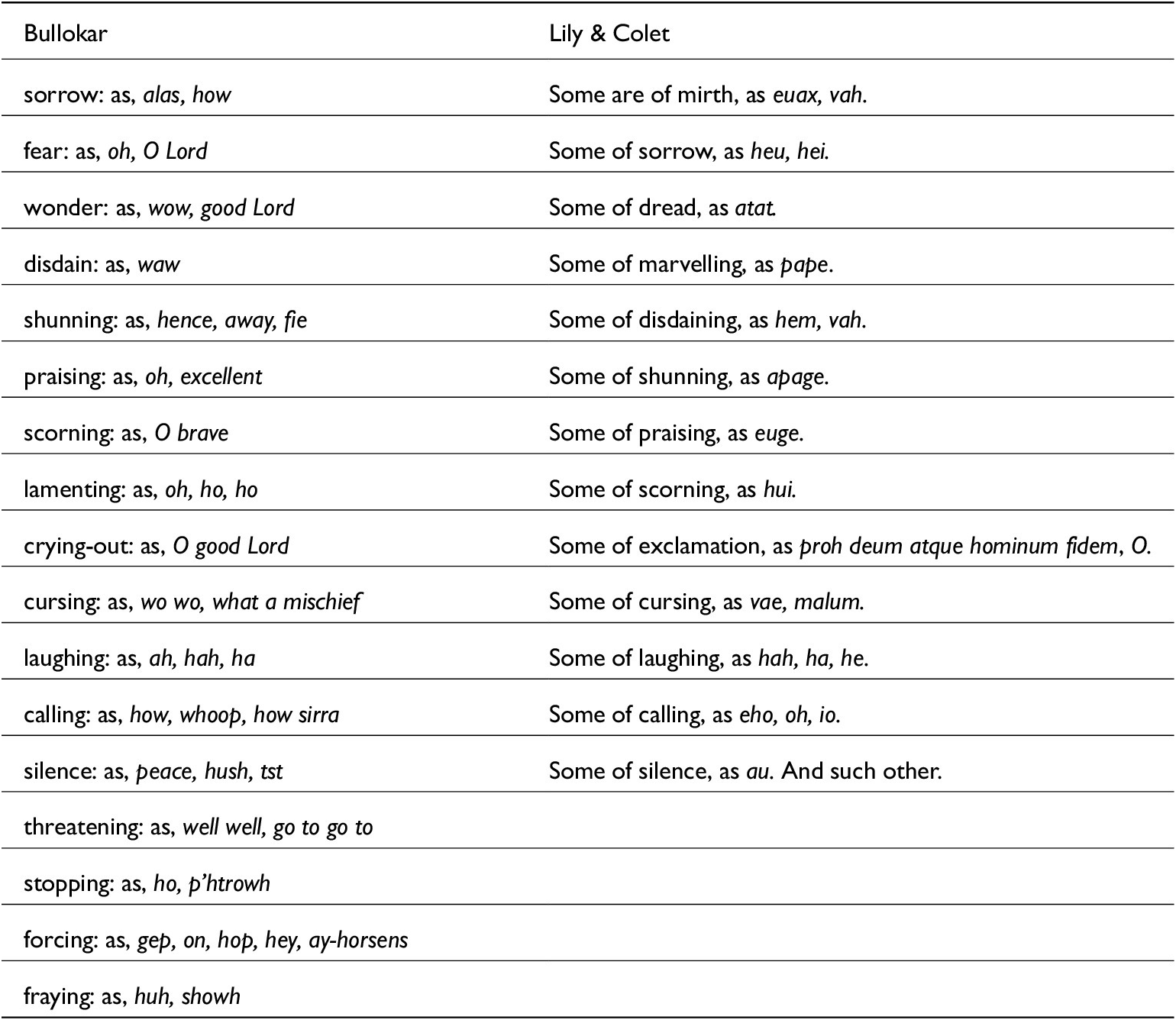
Table 2 compares the inventory of interjections listed by Bullokar and Lily & Colet, respectively, thus revealing continuity and innovation.
Comparison between the inventory of interjections in Bullokar and in Lily & Colet

Table 2. Long description
The table consists of two columns.
Left Column: Bullokar. Categories and examples include:
* sorrow: as, alas, how
* fear: as, oh, O Lord
* wonder: as, wow, good Lord
* disdain: as, waw
* shunning: as, hence, away, fie
* praising: as, oh, excellent
* scorning: as, O brave
* lamenting: as, oh, ho, ho
* crying-out: as, O good Lord
* cursing: as, wo wo, what a mischief
* laughing: as, ah, hah, ha
* calling: as, how, whoop, how sirra
* silence: as, peace, hush, tst
* threatening: as, well well, go to go to
* stopping: as, ho, p’htrowh
* forcing: as, gep, on, hop, hey, ay-horsens
* fraying: as, huh, showh
Right Column: Lily and Colet. Categories and examples include:
* Some are of mirth, as euax, vah.
* Some of sorrow, as heu, hei.
* Some of dread, as atat.
* Some of marvelling, as pape.
* Some of disdaining, as hem, vah.
* Some of shunning, as apage.
* Some of praising, as euge.
* Some of scorning, as hui.
* Some of exclamation, as proh deum atque hominum fidem. O.
* Some of cursing, as vae, malum.
* Some of laughing, as hah, ha, he.
* Some of calling, as eho, oh, io.
* Some of silence, as au. And such other.
The comparison between the two lists of functions reveals that Bullokar retains several affective categories (e.g. sorrow, disdain, praising), but he also introduces functions that extend beyond emotional expression to encompass interactional control and action regulation, such as calling, stopping, forcing and silence. This expansion is significant. While Bullokar continues to frame interjections as sudden expressions of mental states, his functional taxonomy implicitly recognises their conative and phatic roles, aligning them with what modern pragmatics identifies as central to interjectional use. Among the grammars examined, Bullokar is the only author to combine definitional clarity, functional classification and explicit reference to contextual interpretation.
6. Discussion
The analysis presented in section 5 highlights a striking asymmetry in the treatment of interjections in Early Modern English grammars. While several grammarians either marginalise the category or omit it altogether, William Bullokar devotes sustained attention to defining and classifying interjections as a distinct part of speech. This divergence cannot be explained by chronology alone, but must instead be understood in relation to the descriptive models and theoretical assumptions that shaped early grammar writing.
Following Dons (Reference Dons2004), the notion of descriptive adequacy provides a useful framework for interpreting these differences. Rather than evaluating early grammars by modern standards of formal consistency, descriptive adequacy asks whether a grammatical description captures the linguistic intuitions of native speakers. From this perspective, the treatment of interjections is particularly revealing, as these items resist classification according to inflectional or syntactic criteria and derive much of their meaning from context, speaker stance and interactional dynamics.
Grammars in the Ramist tradition, such as those by Greaves and Gil, prioritise formal structure and logical organisation. As a result, interjections are either subsumed under broad categories or treated primarily in terms of their syntactic attachments. While these approaches are internally coherent within their respective models, they fail to account for the stand-alone use and interactional salience of interjections in Early Modern English. The absence of the label interjection in several grammars, therefore, reflects not an empirical oversight, but a theoretical choice grounded in a conception of grammar that privileges clause structure over communicative function. Significantly, targeted searches for alternative terminology reveal that these grammars do not systematically relocate interjections elsewhere; rather, they tend to exclude interactionally oriented forms from grammatical discussion altogether.
Bullokar’s grammar, by contrast, demonstrates a higher degree of descriptive adequacy with respect to interjections. Although firmly rooted in the Latin grammatical tradition, Bullokar does not restrict his account to formal properties alone. Instead, he explicitly acknowledges the difficulty of parsing interjections within sentence grammar and relocates their interpretation to the speech situation, thereby offering a description that aligns more closely with speakers’ intuitive understanding of how these items function in use.
One of the most distinctive aspects of Bullokar’s definition is his insistence that the ‘signification or meaning’ of interjections must be recovered through gesture, countenance, speaker passion and regard for the addressee or situation. This move is remarkable within the context of early modern grammar writing, where such parameters are typically excluded from grammatical analysis. While Bullokar obviously does not theorise these factors in modern pragmatic terms, his observations converge with later accounts that treat interjections as indexical and deictic utterances (e.g. Wilkins Reference Wilkins1992).
The emphasis on embodiment further reinforces this convergence. Both modern pragmatic studies and analyses of Early Modern English usage show that interjections are closely tied to prosody, gesture, and bodily expression (Culpeper & Kytö Reference Culpeper and Kytö2010). Bullokar’s inclusion of gesture and countenance as interpretive cues suggests an awareness that interjections are often accompanied by suprasegmental and paraverbal features in conversation.
Nonetheless, Bullokar inherits from the Latin tradition the characterisation of interjections as expressions of ‘passion of the mind’, a notion that foregrounds emotional response. However, his functional inventory complicates this picture. While many of the categories he lists are affective (e.g. sorrow, fear, lamenting), several others are clearly interactional and action-oriented, such as calling, silence, threatening, stopping and forcing. These functions presuppose intentionality and audience design, and cannot be reduced to involuntary emotional reactions. This observation aligns closely with modern functional accounts of interjections, particularly Ameka’s distinction between expressive, conative and phatic uses. Bullokar’s taxonomy implicitly recognises all three functions, even though he does not articulate them as such. His grammar therefore challenges the view, albeit not explicitly, that interjections are purely emotive or instinctive vocalisations. Instead, interjections emerge as resources for managing interaction, capable of shaping the behaviour of others and regulating the flow of discourse.
Importantly, this convergence should not be interpreted as evidence that Bullokar anticipated modern pragmatics in any strong theoretical sense. Rather, it suggests that Bullokar was a careful observer of linguistic practice, working within the constraints of an inherited grammatical framework. Where many of his contemporaries suppressed or marginalised problematic categories, Bullokar elaborated them, thereby achieving a higher degree of descriptive adequacy for a class of items that sits at the intersection of grammar, discourse and embodied communication.
The findings of this study have broader implications for the historiography of grammar writing. They show that Early Modern English grammars cannot be understood solely as mechanical adaptations of Latin models, nor can they be dismissed as descriptively naïve. Instead, they represent a heterogeneous field of descriptive strategies, shaped by competing theoretical commitments and pedagogical goals. Interjections, precisely because they resist formalisation, serve as a diagnostic category for evaluating these strategies.
7. Conclusion
This study set out to examine how interjections were conceptualised in Early Modern English grammars, with particular attention to the distribution and interpretation of the metalinguistic label interjection and to the descriptive strategies adopted by individual grammarians. By focusing on a category that resists formalisation and challenges sentence-based grammatical descriptions, the article has sought to illuminate broader issues concerning the relationship between grammatical theory, language use and descriptive adequacy in the early modern period.
The analysis of the EMEGA corpus has shown that the treatment of interjections in Early Modern English grammars is far from uniform. Some grammarians omit the category entirely, others mention it only in passing, and only a small number offer any sustained discussion. This unevenness is not accidental. Rather, it reflects the underlying theoretical commitments of early grammarians and the models they adopted. Grammars influenced by Ramist principles tend to marginalise interjections by subsuming them under broad residual categories or by focusing on their syntactic attachments. Grammars grounded in the Latin-derived tradition preserve interjection as a distinct part of speech but often reproduce inherited definitions with little elaboration.
Against this background, William Bullokar’s Bref Grammar for English emerges as a notable exception. Bullokar not only recognises interjections as an independent category, but also provides explicit definitions and an extensive functional taxonomy. While his account remains anchored in the traditional notion of interjections as expressions of ‘passion of the mind’, it simultaneously expands this notion by foregrounding contextual interpretation, embodiment and interaction. By insisting that the meaning of interjections must be understood through gesture, countenance, speaker attitude and communicative situation, Bullokar relocates signification from the lexical form to the speech event itself. This is particularly striking when considered in light of modern pragmatic and semantic accounts of interjections. Contemporary theories emphasise their context-boundedness and indexicality. Although Bullokar does not possess the theoretical contemporary vocabulary of pragmatics, his observations converge with these insights in meaningful and relevant ways. Crucially, this convergence should be interpreted as the result of attentive observation, and not as evidence that Bullokar was a proto-pragmatic theorist.
The analysis suggests that the history of linguistic thought benefits from closer engagement with categories traditionally regarded as marginal. Interjections, precisely because they sit at the intersection of grammar, discourse and embodied communication, force us to reconsider the boundaries of grammatical description and to recognise the role of usage and interaction in shaping linguistic theory. Bullokar’s treatment of interjections stands as an early and revealing attempt to grapple with these issues – one that resonates strongly with insights that would only later be articulated explicitly within modern linguistics.
Acknowledgements
The author used generative AI to improve clarity and cohesion of academic English, streamline the organisation of arguments and assist with summarising secondary literature already known to the author; all research design, theoretical framing, data selection, analysis, interpretation and conclusions are solely the author’s responsibility.

 Open access

