Introduction
Political scientists have long discussed what factors increase legislative production, i.e. the number of important lawsFootnote 1 passed by a legislative body during a given time period. Another statement of the question is what factors reduce legislative gridlock (Binder Reference Binder2003). The factor most often considered in the existing literature is that of divided government. Since Mayhew's seminal work (1991), there has been an ongoing debate over whether or not divided government dampens lawmaking (Binder Reference Binder2003; Clinton and Lapinski Reference Clinton and Lapinski2006; Coleman Reference Coleman1999; Edward, Barrett, and Peake Reference Edward, Barrett and Peake1997; Howell et al. Reference Howell, Adler, Cameron and Riemann2000; Kelly Reference Kelly1993; Krehbiel Reference Krehbiel1998: ch. 3; Krutz Reference Krutz2000). Other political factors have also been studied, including: agenda control, the number of veto players, the duration of the government, ideological shift of the government, budgetary deficits, the desire by legislators to claim credit, and the question of whether or not it is an electoral year (in addition to the references cited above, see Döering Reference Döering1995; Golden Reference Golden2003; Taylor Reference Taylor1998; Tsebelis Reference Tsebelis2002: ch. 7). Other scholars have pointed to socio-economic indexes, such as population, urbanization, industrialization, unemployment, social inequality, and economic growth to explain legislative production (Mulligan and Shleifer Reference Mulligan and Shleifer2005; Rosenthal and Forth Reference Rosenthal and Forth1978; Tanabe Reference Tanabe1995). To date, however, these factors have not received the attention they deserve.
The works cited above have left three important issues unaddressed, which together represent the gap in the literature this study attempts to fill. First, existing studies do not make clear why the factors identified increase or decrease the number of laws produced by legislatures. It is true that each author's argument sheds light on some aspect of the mechanism behind law production, but individual arguments have not been adequately related to those of other researchers nor have they been integrated under a coherent framework. As a result, one strain in the literature (for example, the debate over divided government) fails to consider the factors addressed in many of the others (e.g., agenda control, etc.). Utilizing Döering's (1995: ch. 1) model, which regards a legislature as a monopoly of the lawmaking market and as an utility maximizer, this paper incorporates explanatory variables from the existing literature as well as previously unaddressed factors. This model predicts the ways in which socio-economic changes (such as inflation) and political ones (such as government alteration) increase the marginal benefit of laws and lead to policy changes and additional laws; it also predicts that low negotiation costs and ample legislative resources can decrease the marginal cost of laws and contribute to legislative production. These predictions form my hypotheses about legislative production.
The second issue addressed by the current study but not by previous work is what can be described as an empirical problem. Most of the existing literature on legislative production has concerned itself exclusively with the United States, and, in a few cases, a dozen or so European countries (Döering Reference Döering1995; Döering and Hallerberg Reference Döering and Hallerberg2004). Hence, the findings of these studies have not been adequately tested for their generalizability. In addition, since ‘divided government’ in a presidential system and ‘minority government’ in a parliamentary system are functionally equivalent to ‘separation of purpose’ (Haggard and McCubbins Reference Haggard and McCubbins2001), we need to analyze them both in the common framework. This paper offers a universal model applicable to any country, widening the scope of legislative output study to a more extensive and cross-sectional comparison. Forty-two developed and developing countries are examined below, as is the body of Japanese legislation from 1949 to 1990.
The final gap in the literature addressed here is a methodological concern. Annual legislative production should not only consider time-series but also non-negative integer data to which ordinary regression analysis cannot be applied. To date, however, researchers of this field have not taken these combined features seriously (Coleman Reference Coleman1999). Many have used a normal linear model inappropriately, and even cautious researchers have not considered serial correlations. To deal with this problem, I employ the Poisson Exponentially Weighted Moving Average (PEWMA) model (Brandt et al. Reference Brandt, Williams, Fordham and Pollins2000) and the Poisson Autoregressive (PAR) model (Brandt and Williams Reference Brandt and Williams2001).
The paper proceeds in the following manner. The first section constructs a monopoly model and considers explanatory variables in detail. This same model is then tested using two kinds of data to increase the robustness of the model's explanations for legislative production. In the second section, hypotheses are tested using data from a variety of countries worldwide. In the third section, Japanese time-series data are analyzed. The empirical tests are found to support the model. In the conclusion, I outline implications for our understanding of the factors and mechanisms behind legislative production.
A monopoly model of legislative production
Following the methods used in previous works (Clinton and Lapinski Reference Clinton and Lapinski2006; Döering Reference Döering1995; Howell et al. Reference Howell, Adler, Cameron and Riemann2000; Mayhew Reference Mayhew1991), I measure legislative production by counting the number of important (e.g. often mentioned or referred to by journalists or policy experts) enacted (not just proposed) laws. I will also supplement this measure by considering the number of unimportant laws, which might not be determined in the same way as important laws. An operational definition of importance and relevance of unimportant law analysis will be explained in the following data subsections. Moreover, some argue that we should include in our count important bills that failed to pass (Edward, Barrett, and Peake Reference Edward, Barrett and Peake1997); others examine the rate of the number of agendas (such as policy issues in New York Times editorials) which are achieved to that of all proposed agendas (Binder Reference Binder2003; Coleman Reference Coleman1999). According to Mayhew (Reference Mayhew, Adler and Lapinski2006: 241–242), however, proposed but unachieved agendas ‘are often vague, shifting, untested, infeasible, or otherwise insubstantial’ and ‘[i]f . . . legislative agenda sizes are appreciably endogenous they are . . . artifactual’. These problems ‘argue[s] for keying on actual changes from status quo policy to index governmental production’. These measurement problems grow more severe when more than one country is being studied. Therefore, I choose the number of laws as the dependent variable. In addition, as I will argue below, my model considers the relative size of possible agendas as an independent variable.
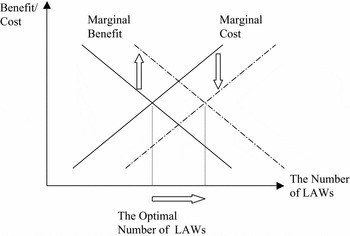
In order to explain the number of laws, I use Döering's (1995: ch. 1) monopoly model. A legislature is a kind of monopoly, because no body other than it can supply laws. In such a situation, in order to maximize its own utility (or that of its median voter), a legislature makes enough laws so that the marginal benefit of each additional law is equal to its marginal cost (Figure 1). Hence, when the marginal benefit increases, or the marginal cost decreases, a legislature produces more laws. This paper considers the benefit-increasing factors or the cost-decreasing factors as causes of law production, while Döering himself focuses on agenda power only.
A monopoly model of legislative production

Benefit-increasing factors
Let us begin by supposing that there is a uni-dimensional policy space. Since the legislature can set whatever government policy it chooses by legislating, I have assumed that a status quo policy, SQ, is the same as the ideal point of the legislature for the previous year, Pt −1. If the legislature changes its ideal point from Pt −1 to Pt, it will enact a law on that dimension so that the current policy moves from SQ to Pt.
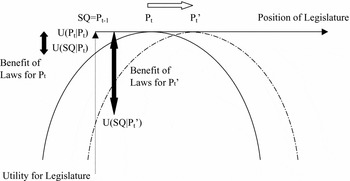
I denote the utility of policy X for the legislature with its ideal point P by U(X|P). U(X|P) is a decreasing function of distance between policy X and the legislature P. Let it be the negative Euclidean squared distance −|X − P|2. The benefit of a law the legislature Pt makes on this dimension will be the difference between the utility of its old policy SQ(=Pt −1), U(SQ|Pt), and the utility of its new policy Pt, U(Pt|Pt); i.e., U(Pt|Pt) – U(SQ|Pt) = −(Pt − Pt)2 + (SQ–Pt)2 = (Pt − Pt –1)2. Therefore, the farther the legislature's ideal point is from its previous position, the farther a law moves policy and the more benefit the law will provide with the legislature. For example, compare Pt and Pt′ in Figure 2, where |Pt − Pt –1|< |Pt′ − Pt −1| and, as a result, (Pt − Pt −1)2 < (Pt′ − Pt −1)2 and −U(Pt−1|Pt) <−U(Pt−1|Pt′). There are two types of variables that promote change in the legislature's ideal point; they are socio-economic and political, as explained in the following sections. Operational definitions of all variables will be provided below with the descriptions of data, because variables are operationalized differently in each dataset.
Utility of legislature and change of the legislature's ideal point

Socio-Economic Changes When the socio-economic situation changes, the legislature's old ideal point P t−1 is ill suited to the new circumstances and moves to its new position P t (c.f. Rosenthal and Forth Reference Rosenthal and Forth1978). For example, if there is a change in price levels, i.e., inflation, the old progressive tax rate would bring about a substantial tax increase (tax creep) and current pension payments would be discounted. Therefore, the legislature updates its own ideal point by reducing taxes or increasing nominal pension payments. Similarly, deflation also changes the legislature's ideal point, but in the opposite direction. According to this model, it is the magnitude, and not the direction, of socio-economic change that determines the benefit of a law. Hence, I use the absolute value of the inflation rate as an independent variable. Please note that inflation is not just a matter of price level but also representative of other aspects of socio-economic change.
This paper also considers absolute changes in the GDP/GNP and in population (see also Mulligan and Shleifer Reference Mulligan and Shleifer2005; Rosenthal and Forth Reference Rosenthal and Forth1978). GDP/GNP growth is more than an indicator of economic growth. Either depressions or boom brings about industrial restructuring, modernization, and urbanization in societies, and they also intensify social inequalities and industrial pollution. In order to address these issues, the legislature updates its policies on social infrastructure and utilities, on labor, and on the environment. In order to respond to population increases, which are often accompanied by shifts in the generational structure and in geographical distribution, the legislature alters its welfare measures. These concern both the young and the old and cover such policies as social insurance, education, and public health (Mulligan and Shleifer Reference Mulligan and Shleifer2005).
Thus, according to the model, significant INFLATION, rapid GDP/GNP change, and rapid POPULATION change can all increase the number of LAWs in a given year. In addition, we can see that, in making these changes, the previous year's absolute values are referred to, as this is the most current data available to legislators. For example, in 2006, lawmakers do not know the GDP growth rate of 2006 (which is not yet confirmed), but that of 2005.
Political changes Every year, as the political situation changes, the legislature updates its ideal point to fit its new political circumstances. In this respect, elections and changes in the party of the chief executive are key (Krehbiel Reference Krehbiel1998: ch. 3). The most significant changes occur in a legislature's ideal point just after a general election. At that time, every party renews its platform, and the components of the legislature are altered as well. In the years that follow an election, more and more policies that support the majority party's platform are expected to be fulfilled. In this way, it becomes less necessary for the legislature to shift its current policy. The same mechanism works when the party of the chief executive changes. A new government will set fresh political agendas, and the legislature will have to shift its ideal point to adjust to them. The longer the party holds the chief executive, however, the less room remains for legislative adjustment. Thus, LEG-AGE is the number of years that have passed since the last general election, while GOV-AGE is the number of years for which the party of the current chief executive (Prime Minister or President) has been in office. The smaller LEG-AGE or GOV-AGE is, the more LAWs will be produced.Footnote 2
Readers may wonder if the ideological position of a legislature or that of a government affects legislative output (Krehbiel Reference Krehbiel1998: ch. 3; Tsebelis Reference Tsebelis2002: ch. 7). According to my model, wherever the legislature stands, it will not have to alter government's current policy as long as it remains in the same place, because it has already set the policy at its ideal point. What matters is not position but change, as we have already seen in the formulations of LEG-AGE and GOV-AGE.
Two observations must be made at this point. First of all, larger socio-economic and/or political changes enhance the value of policy changes (namely, laws), which, in turn, lead to increment in the number of laws. If nothing changes, why do we need new laws? The legislature updates the policies so as to catch up with its environment. Secondly, by adding socio-economic or political demands to the independent variables, we can take into consideration policy demand and avoid dividing the number of laws by all possible agendas (as suggested at the beginning of this section).
Cost-decreasing factors
Low negotiation costs Initially, legislative costs arise from political negotiations. If the governing parties control more seats, they probably also have control of the house speakership, more committee chairs, and a decreased vulnerability to defection. Thus, having more seats reduces the cost of negotiating with opposition parties. Since most of important bills are proposed by the government, stronger control by governing parties produces more enacted laws. The seat share of governing parties is a visible measurement of this fact. This continuous variable offers finer measurement than the often used dichotomy between unified and divided government (Binder Reference Binder2003; Calvo Reference Calvo2007; Coleman Reference Coleman1999; Edward, Barrett, and Peake Reference Edward, Barrett and Peake1997; Howell et al. Reference Howell, Adler, Cameron and Riemann2000; Krehbiel Reference Krehbiel1998: ch. 3; Mayhew Reference Mayhew1991).
On the other hand, veto players, whose consent is necessary for passing bills, raise negotiation costs. Indeed, Tsebelis (2002: ch. 7) shows that a greater number of veto players decreases the number of laws. Therefore, a greater SEAT share among the governing parties increases the number of important LAWs, while a greater number of VETO players decreases the number of LAWs.
Legislative resources. A second source of marginal costs is a shortage of such legislative resources as facilities and session time (Blondel Reference Blondel1969). This paper focuses on committees. A legislature with a greater number of committees facilitates a quantitative division of labor, log rolling, and informational specialization (Krehbiel Reference Krehbiel1991). Hence, a greater number of committees can be said to reduce legislative costs and result in the making of more laws: when the legislature establishes more COMMITTEES, more LAWs are passed. Some may argue that committees are hurdles to lawmaking and their number should decrease the legislative production. This is an empirical question. In the following sections, I test the above hypotheses using two approaches.
Finally, many will suspect that democratic governments and non-democratic ones have different law production levels. Thus, I include the variable DEMOCRACY. Since this is just a control variable, not a cost-decreasing factor, no prediction about its coefficient's sign is made.
Comparison of 42 countries
Data
I use two datasets for a cross-country comparison. Dataset A features important laws: it includes data from eleven European countries for the years 1981 to 1991. Dataset B is extensive: it is made up of data from 42 developed and developing countries for the years 1978 to 1982.Footnote 3 For both datasets, since not every year's number of laws, and only the total number of laws is known, the unit of analysis is country, not country-year, and a panel analysis cannot be done. Time-varying independent variables are, therefore, averaged for each period.
The dependent variable to be explained is the total number of enacted laws, LAW. In Dataset A, following Döering (1995: 45) and Tsebelis (2002: ch. 7), I use the total number of important laws that concern work hours and work conditions, as listed by each country's legal experts in Roger Blanpain's The Encyclopedia of Labour Law and International Relations (Scholz and Trantas Reference Scholz, Trantas and Döering1995: 639, Table 21.1). These laws are all judged to represent important changes in the status quo and are documented in the International Labour Organization's legal database, NATLEX. Though this collection of data is limited to laws that affect labor policy, it is, nonetheless, the best indicator of its kind that I know, since labor policy is one of the most important policy areas in which capital and labor conflict with one another.
In Dataset B, LAW is the annual average number of all laws (Inter Parliamentary Union 1986: Table 31.1). I distinguish between government laws (proposed by government and enacted by a legislature) and members laws (proposed by legislators and enacted by a legislature). But I cannot differentiate between important laws and unimportant ones. The merit is that this dataset includes more countries than the other (and it is, to my knowledge, the most comprehensive). Moreover, analyzing unimportant laws can actually be useful. Even (seemingly) unimportant enacted laws change the status quo policy and have greater utility than dead important bills. This is why the legislature passes the former and not the latter in the first place. If one ignores them, one fails to consider a large part of the legislative process. Thus, Dataset B is a useful complement to study.
As for measurement of independent variables, I include three socio-economic changes: i.e., INFLATION (percentage of the consumer price index); GDP growth rate (percentage); and POPULATION growth rate (permillage) (World Bank 2000). The annual average of absolute values of one-year lagged indexes is calculated using available years’ values. For political change variables, since LEG-AGE itself is unavailable, the normal term of the Lower House is used as a proxy (Inter Parliamentary Union 1986: Table 1.3). GOV-AGE denotes the annual average number of years the party of the current chief executive (the Prime Minister or the President) has been in office.Footnote 4DEMOCRACY in Dataset B is 14 minus the sum of political rights and civil liberties ratings by Freedom House, ranging from 1 to 13.Footnote 5 As for cost-decreasing variables, I consider SEAT to be the annual average percentage of seats held by the government in the Lower House,Footnote 6VETO to be the average number of veto players (Tsebelis Reference Tsebelis2002: Table 7.3), and COMMITTEE to be the number of permanent committees in the Lower House.Footnote 7 The model predicts that all coefficients will be positive except for those of LEG-AGE, GOV-AGE, and VETO, which should be negative (no prediction about DEMOCRACY).
Analysis
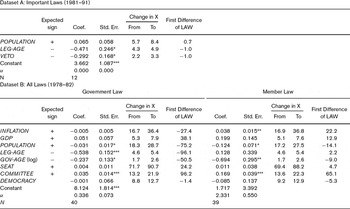
Since the dependent variable, LAW, is a cross-sectional count of events and, according to the model, enactment of any one law is not independent of the production of another, the appropriate statistical method is the negative binominal regression. Table 1 shows the results. Since one cannot proceed directly to an interpretation of these coefficients, I have also reported the first difference in the quantity of interest, namely the difference in the number of LAWs when each independent variable increases from its mean by one standard deviation, holding other variables at their means. Below, I mention only independent variables whose coefficients differ significantly from zero at 10% confidence level.Footnote 8
Negative Binomial Regressions of LAW (Cross-Country Comparison)

Note: ***p < 0.01, **p < 0.05, *p < 0.1
To begin with, I discuss analysis of Dataset A. Since the number of observations is small, I choose the most effective independent variable from each variable group factor. Half year short LEG-AGE or one more VETO player reduces one LAW. Next, to examine more countries, I analyze Dataset B. If the number of COMMITTEEs increases by nine, 96 more government LAWs will be produced. On the other hand, a legislative term that is one year longer (LEG-AGE) results in 96 fewer government LAWs. Also, a 20-point higher INFLATION rate adds 22 new member LAWs and nine more COMMITTEEs create 65 more member LAWs. A government that has been in office for eight years (GOV-AGE) dampens the number of government LAWs by 50 as well as that of member LAWs by nine. The sign of the coefficients supports the hypotheses generated by the model save for one exception. Increasing POPULATION by increments of 10 reduces government LAWs by 75 and member LAWs by 14, which goes against my predictions.Footnote 9
The Japanese time-series: 1949–1990
Data
For robust conclusions, I test the model presented above using another approach with different data, a time-series analysis of Japanese lawmaking from 1949 to 1990.Footnote 10 Time unit of analysis is legislative year.Footnote 11 Longitudinal data analysis offers some merits because it controls for such unobserved country-specific variables as legal culture, etc. Wherever possible, all variables are defined in the same way as those in the cross-country Dataset A.
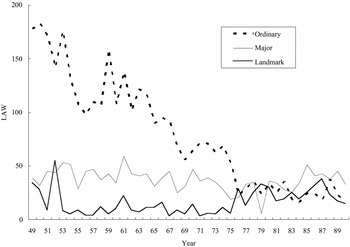
The dependent variable, LAW, is the number of enacted government laws in each legislative year. I divide all laws into three categories according to their importance and count them separately. Following Mayhew (Reference Mayhew1991), I define ‘landmark laws’ as those which the Japanese Diet official record, Shugiin and Sangiin (1990), mentions in the section ‘Activities of the Diet’ in chapter 1 ‘Overview’ of each session. Similarly, I regard as ‘major laws’ those described as ‘Main Bills’ in the chapter ‘Bills’ (with the exception of landmark laws). The landmark laws and major laws are mentioned in the book because they are significant not only in terms of their policy contents but also in the context of the political climate of each session. When I compare them with the laws that almanacs and other historical works refer to as landmarks, I find that their coverage overlaps. The record of Shugiin and Sangiin (1990) is, however, superior to other materials because: (1) it accurately lists every law by its correct name, (2) it covers all sessions using the same criteria, and (3) it is an official publication. Landmark laws and major laws account for 12.2% and 27.5% of all government laws, respectively. Other laws are referred to as ‘ordinary laws’. Their analysis is also presented because it turns out that their numbers are determined in almost the same way as those of landmark laws and major laws (Figure 3 plots these three series.)
The number of LAWs in Japan (1949–1990).

For socio-economic changes, one-year lagged absolute values of the INFLATION,Footnote 12GNP growth rate,Footnote 13 and POPULATION growth rateFootnote 14 are employed. As for political changes, LEG-AGE is used to indicate the number of years that have passed since the most recent general election in the House of Representatives, and GOV-AGE indicates the number of years the prime minister's party has been in power (natural logarithm). SEAT, the share of seats of the governing parties in the House of Representatives (Shugiin Jimukyoku Reference Jimukyoku2003: Table 3), and COMMITTEE, the number of standing committees in the House of Representatives (Shugiin Jimukyoku Reference Jimukyoku2003: Table 24),Footnote 15 are included as cost-decreasing variables. DEMOCRACY and VETO are not included because they are considered to be (almost) constant over this period and do not explain variation of LAW. Furthermore, there are no data available for them. LEG-AGE and GOV-AGE should decrease LAW, while the other variables are expected to increase it.
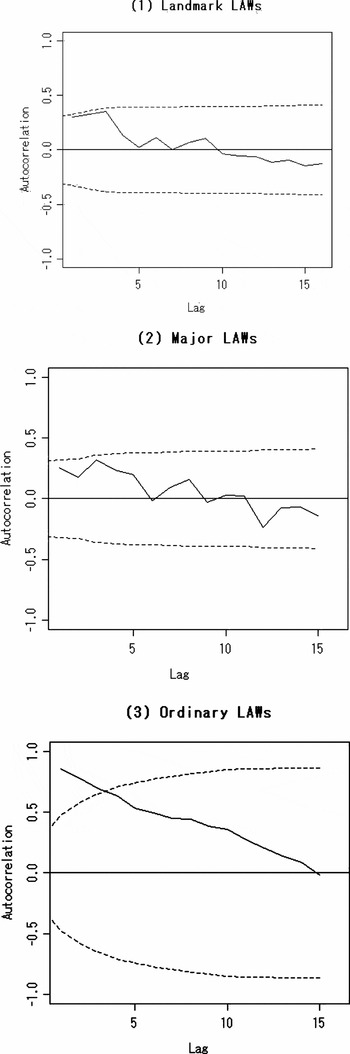
Autocorrelation of the Number of LAWs.

Analysis
The dependent variable, LAW, is not simply an event count, it is also time-series data. Therefore, both of these features must be taken into consideration in the statistical method to be employed here. To address its dual nature, scholars have employed logged-lagged OLS, lagged Poisson, lagged negative binomial, and ARIMA, to name only a few of the methods used. Recently, however, Brandt et al. (2000) and Brandt and Williams (Reference Brandt and Williams2001) have proposed two new models for event count time-series data, viz. the Poisson Exponentially Weighted Moving Average (PEWMA) model for non-stationary persistent data and the Poisson Autoregressive (PAR) model for stationary mean-reverting data. They model the process in state space form and use a Kalman filter for estimation. They have demonstrated that their models are superior to the previous ones mentioned, both in terms of efficiency and of unbiasedness. I have, therefore, followed their approach. Correlogram shows that, only for the number of ordinary LAWs, the autoregressive coefficients are significantly different from zero over many lags (Figure 4. Dotted lines indicate the moving average of 95% confidence limits). Therefore, for landmark laws and major laws, the numbers of LAWs are mean-reverting series and I have chosen the PAR model; for ordinary laws, however, the numbers of LAWs are persistent series and I have applied the PEWMA model.
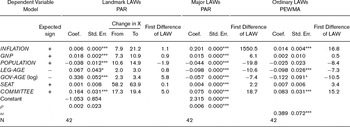
The results are reported in Table 2 as in Table 1.Footnote 16 A 13-point higher rate of INFLATION brings about one landmark LAW, 1550 major LAWs, and 17 ordinary LAWs. A four-point increase in the GNP results in one landmark LAW and six major LAWs. The third year following a general election (larger LEG-AGE) sees 11 fewer major LAWs and seven fewer ordinary LAWs than in the preceding year. A government that stays in place for 20 additional years (larger GOV-AGE) sees the number of major LAWs decline by seven and that of ordinary LAWs by ten. A six-point rise in SEAT share leads to the creation of two additional major LAWs. The creation of two more COMMITTEEs brings about five landmark LAWs, 19 major LAWs, and 15 ordinary LAWs. ρ is the coefficient of the autoregressive term and it is significantly different from zero for major LAWs. ω is the discounting rate used for the past values of dependent variables when computing the mean and it is significantly different from both zero and one, which would suggest that the standard Poisson model cannot be applied. All of these results concur with my expectations.
The state-space time series poisson models of the number of LAWs (Japanese time series, 1949–1990)

Note:***p < 0.01, **p<0.05, *p<0.1.
In contrast to what I had expected, however, a four-point increase in the POPULATION growth rate reduces the number of landmark LAWs by two and the number of major LAWs by 20. A legislature in its third year after a general election (larger LEG-AGE) produces one more landmark law than in its second year. A government that stays in place for 20 additional years (larger GOV-AGE) creates six more landmark LAWs. I suspect that increased experience in the government may reduce legislative costs, though this is future research agenda.
Conclusion
Howell et al. (2000: 302) lament that ‘studies of legislative productivity have yet to link well-developed theory, appropriate independent variables, and the new data of legislative outputs’. The purpose of this paper is to advance these goals.
Using a monopoly model, I argue that legislative production, viz. the number of laws, is explained by benefit-increasing factors and cost-decreasing ones. The former is composed of socio-economic changes (inflation, GDP/GNP growth rates and population change) and political changes (the number of years that have passed since the last general election or since the party of the current Prime Minister or President took power). The legislature updates government's policies to adjust to socio-economic and political changes, and new laws represent changes in current policies. Cost-decreasing factors are low negotiation costs (the seat share of the governing parties in the legislature) and ample legislative resources (the number of committees). These independent variables have been considered in previous works, but their relationships to one another have not been studied, nor have they been incorporated into a coherent framework. In addition, prior to this paper, no researchers have examined the effect of number of committees on legislative production.
In order to show how my model works in a comparative perspective, I compiled and examined two new kinds of data for legislative output. No previous research has covered as many countries (42 in all). Furthermore, the time-series of the annual number of laws has never before been analyzed for countries other than the US, while I also study the time-series of the annual number of laws for Japan. Even studies on American longitudinal lawmaking have not used an appropriate method to take into consideration the dual nature of non-negative integers and time-series. In order to address this issue, I utilize the PEWMA model and the PAR model. This wide application enhances the robustness and universality of the results.
The predictions of the model are largely supported by the data. If coefficients are significantly different from zero, their signs are in the expected direction in most cases. Seat share in particular is, at present, the object of vehement debate. Indeed, in the context of congressional literature, it is thought to be as controversial a subject as that of divided government. As for the postwar Japanese legislative production, Sato and Matsuzaki (Reference Sato and Matsuzaki1986: 128) have said that the ‘seat share of the governing Liberal Democratic Party does not correlate with the number of laws’ and ‘legislative output responds to nothing more than to social request’ (emphasis is mine). I have considered this dispute from a new perspective and concluded that, in general, a majority government, or a unified government, is more productive. Though this finding may be taken as a matter of course, Mayhew (Reference Mayhew1991) and many other scholars argue for the opposite on this contentious issue. The present paper offers new evidence, which challenges their view.
Recently, there has been an increasing interest in the macro-level performance of legislatures (Adler and Lapinski, Reference Adler and Lapinski2006), because legislative output contributes directly to the stability and/or tenure of a political system, a political regime, or a government. Since my theory of legislative production is based on utility maximization, I expect these results will hold in the other cases. Whether or not they withstand the test of time will depend on future research done with other data from different periods and/or different countries.