Introduction
The Mexican fruit fly Anastrepha ludens (Loew) (Diptera: Tephritidae) is a pest that causes substantial economic losses to citrus and mango growers in Mexico (Salcedo-Baca et al., Reference Salcedo-Baca, Terrazas-González, Lomelí-Flores, R odríguez-Leyva, Montoya, Toledo and Hernández2010). Populations of this species are mainly suppressed through the removal of alternate hosts, the application of toxic baits, the release of parasitoids and the implementation of the sterile insect technique (Gutiérrez, Reference Gutiérrez, Montoya, Toledo and Hernández2010). An ecologically sound alternative could be the use of entomopathogenic fungi (EPF). It is known that some EPF such as Beauveria bassiana (Bals.) Vuill. (De la Rosa et al., Reference De la Rosa, López and Liedo2002) and Metarhizium anisopliae (Metsch.) Sorokin (Lezama-Gutiérrez et al., Reference Lezama-Gutiérrez, Trujillo-de la Luz, Molina-Ochoa, Rebolledo-Dominguez, Pescador, López-Edwards and Aluja2000) can infect adults and third instar A. ludens, respectively. Actually, some researchers have suggested that EPF can be incorporated into the soil to control early stages of fruit flies (Ekesi et al., Reference Ekesi, Maniania, Mohamed and Lux2005), introduced into wild populations by using sterile flies as vectors (Toledo et al., Reference Toledo, Campos, Flores, Liedo, Barrera, Villaseñor and Montoya2007), or disseminated by deploying traps that dispense conidia to visiting flies (Navarro-Llopis et al., Reference Navarro-Llopis, Ayala, Sanchis, Primo and Moya2015). Despite the enormous potential of M. anisopliae to control A. ludens, only one study has evaluated the effect of this fungus (strains Ma-lu01 and META-TNK) on adults of this tephritid (Toledo-Hernández et al., Reference Toledo-Hernández, Ruíz-Toledo, Toledo and Sánchez2016).
Doses of EPF that flies receive may be sublethal, i.e. can cause mortality <100% at the population level. Several factors may contribute to sublethal contact between EPF and the target, such as wind velocity, canopy cover and drop size (Chapple et al., Reference Chapple, Downer, Bateman, Lacey and Kaya2007). Sublethal levels of EPF might cause changes in the behaviour or the physiology of the target insects and have a significant effect on their survival. For example, sublethal exposure of M. anisopliae is known to cause changes in mating behaviour in the Mediterranean fruit fly Ceratitis capitata (Wiedemann) (Dimbi et al., Reference Dimbi, Maniania and Ekesi2009) and a reduction in food consumption in the African malaria mosquito Anopheles gambiae Gilles (Diptera: Culicidae) (Scholte et al., Reference Scholte, Knols and Takken2006), the spotted stalk borer Chilo partellus (Swinhoe) (Lepidoptera: Pyralidae) (Tefera and Pringle, Reference Tefera and Pringle2003) and the desert locust Schistocerca gregaria (Forskal) (Orthoptera: Acrididae) (Moore et al., Reference Moore, Reed, Le Patourel, Abraham and Prior1992). Concerning pest control, a reduction in food consumption in A. ludens caused by sublethal exposure to M. anisopliae would be an additional desirable effect, since egg production and mating competitiveness depend directly on the calories consumed (Aluja et al., Reference Aluja, Díaz-Fleischer, Papaj, Lagunes and Sivinski2001; Reference Aluja, Rull, Sivinski, Trujillo and Pérez-Staples2009). Thus, in this work, we aimed to determine the effect of M. anisopliae strain MAAP1 on the food consumption and mortality in adults of A. ludens at sublethal and lethal concentrations, respectively.
Materials and Methods
Biological material
All experiments were carried out from March to May 2015 in El Colegio de la Frontera Sur, in Tapachula, Chiapas, Mexico (14°42′06″N, 92°18′57″W). A. ludens pupae were provided by the MOSCAFRUT Program (SAGARPA-SENASICA-IICA) located in Metapa, Chiapas, Mexico, and kept at 26 ± 2 °C and 60 ± 5% RH until emergence. Adults were separated by sex and placed in 30 × 30 × 30 cm glass cages, maintained in identical conditions of temperature and humidity as pupae and a photoperiod of 12:12 (L:D). Flies were fed with a mixture of hydrolysed yeast (MP Biomedicals, Irvine, CA) and sucrose at a ratio of 1:3; distilled water was provided ad libitum in vials with cotton swabs.
M. anisopliae strain MAAP1 was isolated from a specimen of the spotted spittlebug Aeneolamia postica (Walker) (Hemiptera: Cercopidae) collected in Huixtla, Chiapas, Mexico (15°06′10″N, 92°29′57″W). MAAP1 formulation was provided as dry conidia (1.2 × 10¹⁰ conidia/g, > 95% viability) by the Asociación de Productores de Caña de Azúcar, Huixtla, Chiapas. A stock suspension was prepared by mixing 1 g of formulation with 20 ml of 0.01% v/v Tween 80. To calculate the actual concentration of the stock suspension, we diluted 0.1 ml of it with 99.9 ml of 0.01% v/v of Tween 80 and counted the conidia of this solution with a Neubauer chamber (Goettel and Inglis, Reference Goettel, Inglis and Lacey1997). Once the concentration of the stock suspension was calculated, we prepared a dilute, working suspension of 1 × 10⁹ conidia/ml (field recommended concentration as suggested by the manufacturer) for the pathogenicity test.
Pathogenicity test
To evaluate pathogenicity, five replicates of the fungus-exposed treatment (FET) were carried out, which consisted in exposing 42 8-day-old flies (21 females and 21 males) previously anaesthetized in a freezer at 3 °C for 4 min to facilitate handling. The fungus was applied to adults as 20 ml of conidial suspension by using a hand-held spray. To estimate the concentration of inoculum received by flies, two insects (one male and one female) per replicate were rinsed with 1 ml of 0.01% v/v Tween-80® inside a 1 cm diameter × 10 cm high glass tube to dislodge the spores from the body. Next, the number of conidia per millilitre of this suspension was estimated using a Neubauer chamber. Each fly received on average 2.5 × 10⁸ ± 0.7 × 10⁸ conidia. The 20 remaining flies of each replicate were transferred to five cylindrical plastic containers (12.5 cm diameter × 23.5 cm) with a screen lid for ventilation. Exposed flies were fed with a 1:3 (ratio based on v/v) mixture of enzymatically hydrolysed yeast (MP Biomedicals, Irvine, CA) and sucrose and kept in the laboratory at 26 ± 2 °C and 60 ± 5% RH. Control treatment (CT) consisted in exposing one group of 20 flies of the same age and sex to a 0.01 % v/v Tween-80® solution and maintained under the same environmental conditions as with the FET. Mortality was followed in both treatments until 100% of flies in the FET were dead. To determine if an insect was dead, we gently touched immobile individuals with a brush, and flies that failed to respond to this stimulus were considered dead. Dead flies were removed as soon as they were noticed and placed into a Petri dish with moist filter paper to allow the development of the fungus (Butt and Goettel, Reference Butt, Goettel, Navon and Ascher2000).
Effect of sublethal concentration on food consumption
In this experiment, 20 flies (10 females and 10 males) were treated following the procedure described previously, but with a lower concentration of the entomopathogen (106 conidia/ml) by diluting the stock solution; actual concentration was determined using a Neubauer chamber according to the method described by Goettel and Inglis (Reference Goettel, Inglis and Lacey1997). After exposure, flies were individually placed in 5 cm diameter × 12 cm plastic containers with lids to allow airflow. No food was given for 12 h to synchronize feeding activity. Next, food was given in graduated glass capillaries. Flies were fed the same food as in the above experiment, but in this case the food was diluted in water in a 1:1 (w/v) ratio, so the food could move through the capillaries. Food consumption was estimated by removing the length of the column of food at 24 h from the initial length at 0 h. Capillaries were replaced every 24 h for 8 days. We corrected any losses caused by evaporation by placing individual capillaries with food in five cages without flies. Exposed flies were maintained at 27 ± 2 °C, 70 ± 10% RH and 12:12 h L:D. The CT consisted of a group of 20 flies exposed to 0.01% v/v Tween-80® solution and subjected to the same procedure as the ones exposed to the fungus.
Statistical analysis
Data collected from the pathogenicity test were subjected to survival analysis (Carey, Reference Carey1993). Data of the food consumption experiment were corrected by subtracting the average losses caused by evaporation and then analysed with repeated measures ANOVA. Statistical analyses were conducted using the package Survival v 2.38-1 (Therneau, Reference Therneau2015) and the core package in R (R Development Core Team, 2016).
Results
Pathogenicity test
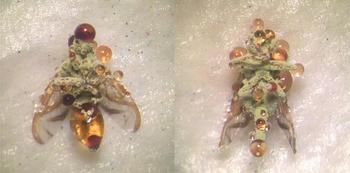
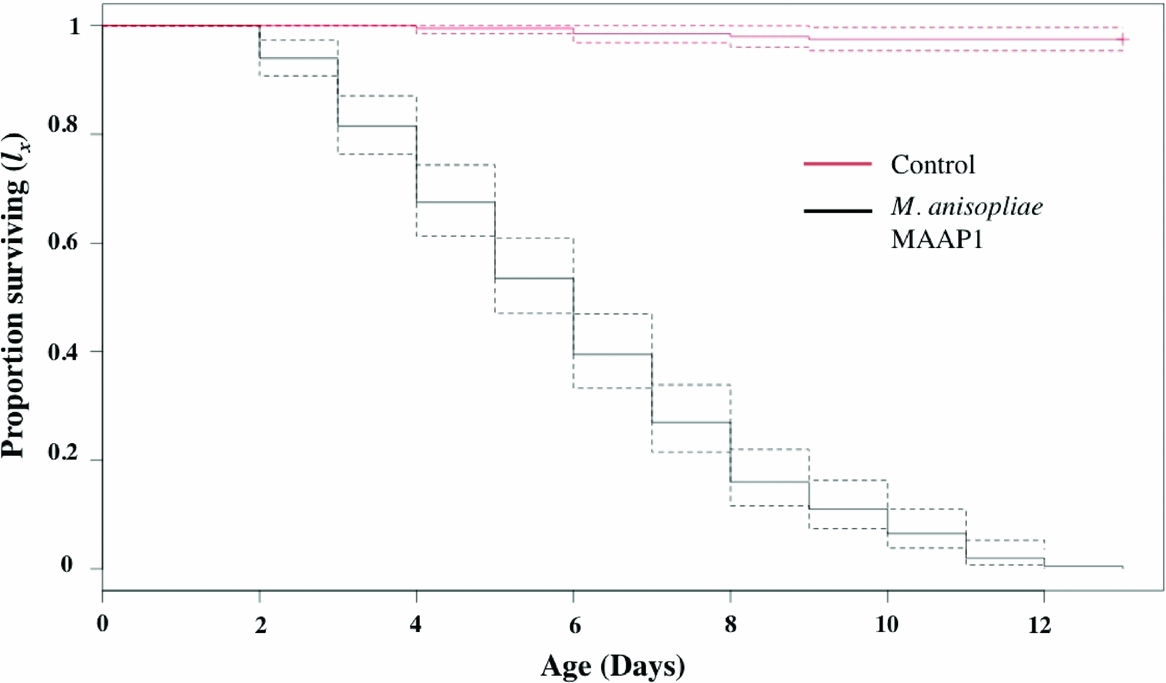
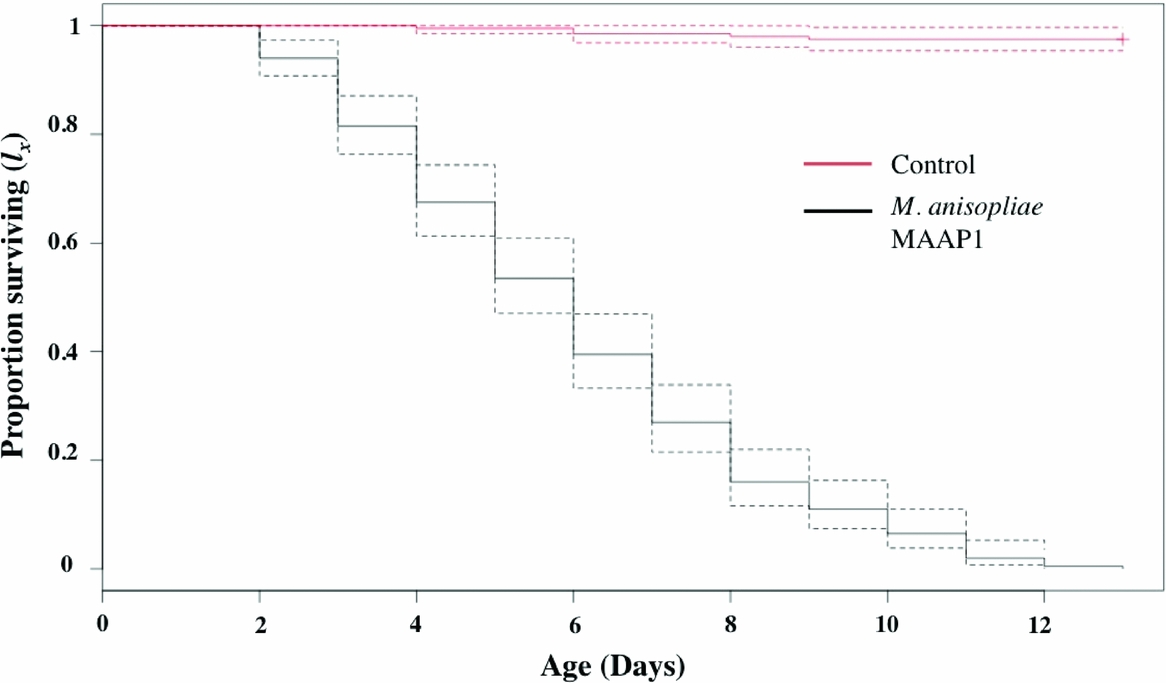
We failed to find any difference in the mortality between sexes (P > 0.05), so we pooled our data. M. anisopliae strain MAAP1 was pathogenic to A. ludens adults; the death of 92.3 ± 0.62% flies in the FET could be attributed to the fungus, since hyphal growth, sporulation and fungus-borne drops could be observed (Fig. 1). Overall, 50% of flies in the FET died within the first 6 days, and 100% mortality was reached at day 13. Mortality in the CT at day 13 was low (2.5 ± 0.27%). Moreover, no dead fly in this treatment showed any fungal disease symptoms. The survival of A. ludens was significantly reduced following the exposure to M. anisopliae (χ 2 = 366, DF = 1, P < 0.001; Fig. 2).
Anastrepha ludens male (left) and female (right) mycosed and colonized by Metarhizium anisopliae.

Proportion of the treated flies with Metarhizium anisopliae surviving over time (days). Dashed lines represent CI95.
Effect of sublethal concentration on food consumption
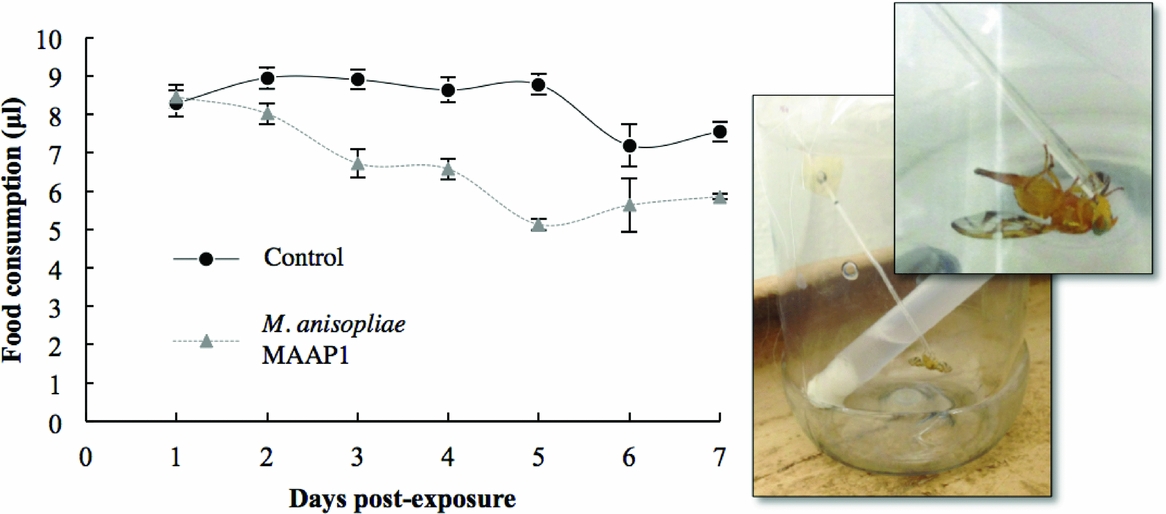
The effect of M. anisopliae on food consumption is shown in Fig. 3. Evaporation caused minimal losses on food volume: 0.57 ± 0.02 μl/day. On average (± SE), flies in the FET consumed 17% less food (6.9 ± 0.2 μl) than CT (8.33 ± 0.14 μl). Except for day 1, average daily food consumption observed in the FET was significantly lower than in the CT (F = 51.78, DF = 1.19, P < 0.001; Fig. 3).
Daily food consumption (average ± SE) of exposed and control flies.

Discussion
In a previous work, we showed that M. anisopliae strains Ma-lu01 and Meta-TNK could be a good choice for the control of A. ludens (Toledo-Hernández et al., Reference Toledo-Hernández, Ruíz-Toledo, Toledo and Sánchez2016). In the current paper, we used a different strain, with exciting results, inducing a higher mortality than in the previous work. Differences in the effectiveness among M. anisopliae strains have been reported for other fruit flies. For instance, Beris et al. (Reference Beris, Papachristos, Fytrou, Antonatos and Kontodimas2013) found 52% mortality in C. capitata, while Castillo et al. (Reference Castillo, Moya, Hernández and Primo-Yúfera2000) found a high mortality (> 90%), similar to our study. Also, a diversity of strains of M. anisopliae (ICIPE 18, ICIPE 20, ICIPE 32, ICIPE 40, ICIPE 41, ICIPE 62, ICIPE 63 and ICIPE 68) caused mortalities from 7% to 100% in C. capitata (Dimbi et al., Reference Dimbi, Maniania, Lux, Ekesi and Mueke2003). Also, a strain of M. anisopliae that was effective against A. obliqua adults (MacQuart) caused 87% of mortality (Hernández-Diaz-Ordaz et al., Reference Hernández Díaz-Ordaz, Pérez and Toledo2010). However, comparison of the results between these works and ours should be done cautiously because the strains and the methods of exposure were different. Only two other fungi have been studied as potential agents for the control of A. ludens: De la Rosa et al. (Reference De la Rosa, López and Liedo2002) showed that B. bassiana was able to cause mortality from 82% to 100 % at 10 days post-exposure, whereas Toledo-Hernández et al. (Reference Toledo-Hernández, Ruíz-Toledo, Toledo and Sánchez2016) found that Isaria fumosorosea (Wize) A.H. Br & G. Sm. caused a mortality rate lower than 20% in A. ludens at 20 days post-exposure.
Infected flies died at a faster rate than those in the control group. Survival declined steadily from day 2 onwards (Fig. 2). It is reasonable to assume that the reduction in survival may contribute to the efficacy of M. anisopliae because adult flies in favourable conditions have a long lifespan (up to 110 days) and greater fecundity rates (up to 1597 eggs per female) (Liedo et al., Reference Liedo, Carey, Celedonio and Guillen1992). So, even though treated flies in our study lived up to 13 days post-exposure, the number of eggs they could lay would be lower than that of the untreated flies. Moreover, though we did not investigate, they might have had abnormal behaviour and changes in their physiology that further reduced their capacity to infest their hosts, like impaired host recognition and orientation. Females of the carrot fly Chamaepsila rosae (Fabricius) (Diptera: Psilidae), for example, laid eggs in sites other than near the roots of its host when infected by the fungus Entomophthora muscae (Cohn) Fresen (Eilenberg, Reference Eilenberg1987). In fact, we found that at 48 h post-exposure, flies consumed significantly less protein and sucrose than in the control. This effect has been observed in other insects, but varies depending on the host species and the fungus. For example, Scholte et al. (Reference Scholte, Knols and Takken2006) found that females of An. gambiae consumed less food 72 h after being exposed to M. anisopliae (ICIPE 30), whereas M. flavoviridae caused a similar phenomenon in S. gregaria 24 h post-exposure (Moore et al., Reference Moore, Reed, Le Patourel, Abraham and Prior1992). Reduced feeding activity in infected insects could be due to the colonization of fungi inside the insect's body and the production of secondary metabolites (Vilcinskas et al., Reference Vilcinskas, Matha and Götz1997; Amnuaykanjanasin et al., Reference Amnuaykanjanasin, Jirakkakul, Panyasiri, Panyarakkit, Nounurai, Chantasingh, Eurwilaichitr, Cheevandhanarak and Tanticharoen2013). Such results, in which the health of the insect is observed to have been reduced, have led some authors to propose that in such situations the ‘pest status’ of the target insect should be reconsidered, given that the host would be less affected (Arthurs and Thomas, Reference Arthurs and Thomas2000; Blanford and Thomas, Reference Blanford and Thomas2001).
A reduction in food consumption may have important consequences in population dynamics of A. ludens. For example, protein is necessary for ovarian development and egg production (Hendrichs et al., Reference Hendrichs, Cooley and Prokopy1992; Wheeler, Reference Wheeler1996). In our work, we did not measure egg production in the infected flies, but reduction in fecundity was reported for A. ludens treated with B. bassiana (Toledo et al., Reference Toledo, Campos, Flores, Liedo, Barrera, Villaseñor and Montoya2007; Sánchez-Roblero et al., Reference Sánchez-Roblero, Huerta-Palacios, Valle, Gómez and Toledo2012). Moreover, wild and sterile males of A. ludens produce the greatest amount of the three main sex pheromone components and are more successful at mating when fed on a fruits (mango and orange) and a sugar:yeast diet (3:1) (Aluja et al., Reference Aluja, Rull, Sivinski, Trujillo and Pérez-Staples2009; Liedo et al., Reference Liedo, Orozco, Cruz-López, Quintero, Becerra-Pérez, del Refugio Hernández, Oropeza and Toledo2013). This observation is in agreement with Dimbi et al. (Reference Dimbi, Maniania and Ekesi2009), who reported that the infection by M. anisopliae (strain ICIPE 62) delays the sexual call and reduces mating frequency in males of C. capitata, C. cosyra and C. fasciventris 3 days post-exposure. These results indicate the potential of M. anisopliae MAAP1 for the biological control of A. ludens.
Conclusion
M. anisopliae strain MAAP1 seems to be a promisory agent for the control of A. ludens, even better than previously tested strains (Toledo-Hernández et al., Reference Toledo-Hernández, Ruíz-Toledo, Toledo and Sánchez2016). Producers commonly complain about the slow effect of EPF, compared to insecticides like malathion. However, the reduction of food consumption in exposed flies could induce physiological and behavioural impairments that further reduce the impact of A. ludens on mango crops, which would be advantageous to producers and to ecosystems (Crawley, Reference Crawley1989).
Acknowledgements
We thank to the Programa Moscafrut (SAGARPA-SENASICA-IICA) for providing A. ludens fruit flies. Also, Dr Ernesto Toledo-Toledo for providing the Metarhizium anisopliae MAAP1 strain. We acknowledge COCYTECH through the program Sistema Estatal de Investigadores 2014–2015 and SAGARPA-CONACYT Project No. 163431 ‘Validación y desarrollo de tecnología para el manejo integrado de moscas de la fruta en mango con enfoque en áreas grandes’ for providing financial support.