INTRODUCTION
Alzheimer’s disease (AD) is an age-related degenerative condition of the brain that gradually affects memory, other aspects of cognition (e.g., decision making), emotional processing, social relationships, and ultimately one’s sense of self. The pathogenic cascade of AD is believed to begin years before clinical signs of cognitive and functional decline emerge, a period known as preclinical AD (Sperling et al., Reference Sperling, Aisen, Beckett, Bennett, Craft, Fagan and Phelps2011). The accumulation of beta amyloid (Aβ) and tau-related neurodegeneration are hallmark neuropathological mechanisms of preclinical AD and both increase risk for conversion to mild cognitive impairment (MCI) and dementia (Jack et al., Reference Jack, Knopman, Jagust, Shaw, Aisen, Weiner and Trojanowski2010, Reference Jack, Knopman, Jagust, Petersen, Weiner, Aisen and Trojanowski2013). According to some conceptual models, these preclinical AD neuropathological processes initially cause subtle cognitive decline, which is mild cognitive deficiency that has not reached the severity to warrant a diagnosis of MCI (Caselli & Reiman, Reference Caselli and Reiman2013; Han, Nguyen, Stricker, & Nation, Reference Han, Nguyen, Stricker and Nation2017; Edmonds, Delano-Wood, Galasko, Salmon, & Bondi, Reference Edmonds, Delano-Wood, Galasko, Salmon and Bondi2015). Currently, there is not a definitive neuropsychological profile of subtle cognitive decline associated with AD, nor do we know how early in the preclinical phase subtle cognitive decline emerges and is detectable. The development of cognitive assays that are sensitive to such subtle decline has the potential to address these issues, facilitating earlier diagnosis and clinical treatment.
Long before diagnosable cognitive impairment is present, Aβ and tau-related neurodegenerative mechanisms can collectively affect much of the neural network that supports episodic memory (Chen, Gilmore, Nelson, & McDermott, Reference Chen, Gilmore, Nelson and McDermott2017; Gilboa, Reference Gilboa2004; Monge, Wing, Stokes, & Cabeza, Reference Monge, Wing, Stokes and Cabeza2018; Rugg & Vilberg, Reference Rugg and Vilberg2013). For instance, the earliest stages of AD have been associated with increased accumulation of Aβ in parietal lobe regions that are anatomically and functionally connected to the medial temporal lobes (MTL) (Buckner et al., Reference Buckner, Snyder, Shannon, LaRossa, Sachs, Fotenos and Mintun2005; Chételat et al., Reference Chételat, Villemagne, Bourgeat, Pike, Jones and Ames2010), with frontal and lateral temporal lobe regions also sites of Aβ accumulation (Masters et al., Reference Masters, Bateman, Blennow, Rowe, Sperling and Cummings2015; Price & Morris, Reference Price and Morris1999; Schmitt et al., Reference Schmitt, Davis, Wekstein, Smith, Ashford and Markesbery2000; Sperling et al., Reference Sperling, Aisen, Beckett, Bennett, Craft, Fagan and Phelps2011). Tau-related neurodegenerative mechanisms, on the other hand, begin in the MTL (entorhinal cortex and hippocampal formation) before spreading cortically (Masters et al., Reference Masters, Bateman, Blennow, Rowe, Sperling and Cummings2015; Price & Morris, Reference Price and Morris1999; Schmitt et al., Reference Schmitt, Davis, Wekstein, Smith, Ashford and Markesbery2000; Sperling et al., Reference Sperling, Aisen, Beckett, Bennett, Craft, Fagan and Phelps2011). Other disease processes not specific to Aβ or tau affect these brain regions as well (Jack et al., Reference Jack, Wiste, Weigand, Therneau, Knopman, Lowe and Petersen2017). Therefore, given the neural targets and distributed nature of early neuropathological risk factors for AD, one potentially fruitful approach to improving sensitivity to subtle cognitive decline is to focus on episodic memory components that tax the involvement of MTL-cortical interaction.
Episodic autobiographical memory (EAM), which is memory for personal, real-world events, involves multiple cognitive processes that rely on dynamic MTL-cortical interaction (McCormick, St-Laurent, Ty, Valiante, & McAndrews, Reference McCormick, St-Laurent, Ty, Valiante and McAndrews2015), including scene construction (Hassabis, Kumaran, Vann, & Maguire, Reference Hassabis, Kumaran, Vann and Maguire2007) and flexible retrieval and binding of multimodal episodic details (Addis, Wong, & Schacter, Reference Addis, Wong and Schacter2008; Cohen & Eichenbaum, Reference Cohen and Eichenbaum1993). In line with this idea, functional neuroimaging studies have implicated the MTL, as well as frontal, parietal, and lateral temporal lobe regions in the retrieval of EAMs (Addis, Moloney, Tippett, Roberts, & Hach, Reference Addis, Moloney, Tippett, P. Roberts and Hach2016; Martinelli, Sperduti, & Piolino, Reference Martinelli, Sperduti and Piolino2013; Svoboda, McKinnon, & Levine, Reference Svoboda, McKinnon and Levine2006). Lesion studies have corroborated these neuroimaging findings and shown that EAM retrieval not only depends on the MTL (Cermak & O’Connor, Reference Cermak and O’Connor1983; Grilli & Verfaellie, Reference Grilli and Verfaellie2014; Tulving, Reference Tulving1985) but also cortical regions of the episodic memory neural network (Berryhill, Phuong, Picasso, Cabeza, & Olson, Reference Berryhill, Phuong, Picasso, Cabeza and Olson2007; Bertossi, Tesini, Cappelli, & Ciaramelli, Reference Bertossi, Tesini, Cappelli and Ciaramelli2016). Critically, recent task-based functional magnetic resonance imaging (fMRI) findings (Chen et al., Reference Chen, Gilmore, Nelson and McDermott2017; Monge et al., Reference Monge, Wing, Stokes and Cabeza2018) have shown that when directly compared to lab-based episodic memory tasks (i.e., comparing the retrieval of episodic autobiographical memories cued by visual images or words to the recollection of prior exposure to visual images and word “chains”), EAM retrieval results in greater activation in the MTL (hippocampus and parahippocampal cortex), as well as connected posterior and anterior cortical regions (i.e., posterior cingulate cortex, retrosplenial cortex, angular gyrus, medial prefrontal cortex, and anterior lateral temporal lobe). Thus, compared to other components of episodic memory, EAM may be more sensitive to subtle changes in an MTL-cortical network that if compromised, increases risk for conversion to AD-related MCI and dementia.
Identifying cognitive factors that increase risk for AD-related clinical decline faces several challenges, including low incidence of dementia until the seventh and eighth decade of life and the need for longitudinal data. However, the study of cognitively normal middle-aged and older individuals who are carriers of the ε4 allele of the apolipoprotein E (APOE) gene has proven to be a successful way to begin to address the sensitivity of different cognitive and neural risk factors for AD dementia (Caselli & Reiman, Reference Caselli and Reiman2013). Although the ε4 allele is present in only 20 to 25% of the general population in most global regions, it contributes to nearly half of all cases of late-onset AD (i.e., typical onset after age 65) (Caselli & Reiman, Reference Caselli and Reiman2013). The ε4 allele has been shown to be a promising model for tracking episodic memory decline associated with AD. Specifically, in longitudinal studies, cognitively normal ε4 carriers exhibit accelerated decline of episodic memory relative to non-carriers beginning in their mid- to late-50s, years before obvious signs of memory impairment typically emerge (Caselli et al., Reference Caselli, Dueck, Osborne, Sabbagh, Connor, Ahern and Reiman2009). This appears to be related to their increased probability of having neural risk factors for AD dementia. Indeed, according to recent estimates, ε4 carriers can account for approximately half of all cognitively normal middle-aged and older adults who are positive for Aβ (Jack et al., Reference Jack, Wiste, Weigand, Therneau, Knopman, Lowe and Petersen2017). This population commonly exhibits additional brain imaging markers suggesting that the MTL-cortical network that supports episodic memory is compromised, including smaller cortical volume (den Heijer et al., Reference den Heijer, Oudkerk, Launer, van Duijn, Hofman and Breteler2002), reduced regional cerebral glucose metabolism (Reiman et al., Reference Reiman, Chen, Alexander, Caselli, Bandy, Osborne and Hardy2005), white matter integrity differences (Ryan et al., Reference Ryan, Walther, Bendlin, Lue, Walker and Glisky2011), and abnormal fMRI task-based and resting state patterns of activation (Sheline et al., Reference Sheline, Raichle, Snyder, Morris, Head, Wang and Mintun2010; Trachtenberg, Filippini, & Mackay, Reference Trachtenberg, Filippini and Mackay2012) in regions of this distributed neural network. Therefore, the power to detect subtle memory disruptions that have potential as cognitive indicators of risk for clinical decline secondary to AD is increased by comparing cognitively normal middle-aged and older ε4 carriers to non-carriers.
To begin to address the possibility that EAM may be sensitive to the presence of subtle cognitive decline associated with AD, we investigated whether the episodic specificity of EAM is compromised in cognitively normal middle-aged and older ε4 carriers relative to non-carriers. To measure EAM episodic specificity, we used the Autobiographical Interview (AI) approach developed by Levine and colleagues (Levine, Svoboda, Hay, Winocur, & Moscovitch, Reference Levine, Svoboda, Hay, Winocur and Moscovitch2002), which involves assessing the ability to generate “internal” (i.e., episodic) details of autobiographical events from across the lifespan as opposed to details that are “external” to these events (e.g., semantic details). Prior studies using this approach have established that EAM episodic specificity, meaning the ability to populate EAMs with internal details, is disrupted in individuals with MCI and Alzheimer’s dementia relative to healthy peers (Bastin et al., Reference Bastin, Feyers, Jedidi, Bahri, Degueldre, Lemaire and Salmon2013; Gamboz et al., Reference Gamboz, De Vito, Brandimonte, Pappalardo, Galeone, Iavarone and Della Sala2010; Irish et al., Reference Irish, Hornberger, Lah, Miller, Pengas, Nestor and Piguet2011; Irish, Addis, Hodges, & Piguet, Reference Irish, Addis, Hodges and Piguet2012; Murphy, Troyer, Levine, & Moscovitch, Reference Murphy, Troyer, Levine and Moscovitch2008; Tramoni et al., Reference Tramoni, Felician, Koric, Balzamo, Joubert and Ceccaldi2012). Prior studies also have found that in older adult populations that include individuals with varying degrees of clinical impairment, ε4 status is sensitive to episodic memory retrieval mechanisms (El Haj et al., Reference El Haj, Antoine, Amouyel, Lambert, Pasquier and Kapogiannis2016; van der Flier, Schoonenboom, Pijnenburg, Fox, & Scheltens, 2006; van der Vlies et al., Reference van der Vlies, Pijneburg, Koene, Klein, Kok, Sheltens and van der Flier2007), including EAM retrieval (Buckley, Saling, Irish, Ames, Rowe, Villemagne, et al., Reference Buckley, Saling, Irish, Ames, Rowe and Villemagne2014). However, whether EAM episodic specificity is reduced among ε4 carriers relative to non-carriers before clinical impairment is not known. We hypothesized that if EAM is sensitive to subtle cognitive decline associated with AD, cognitively normal middle-aged and older ε4 carriers would retrieve EAMs with fewer internal details relative to non-carriers.
METHODS
Participants
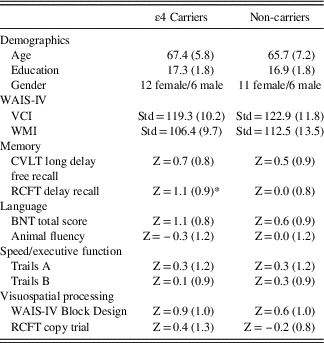
Seemingly cognitively intact middle-aged and older adult individuals (n=40; age range: 52–80 years) were recruited from an existing pool of participants with previously collected genetic information. Our goal was to enroll approximately an equal number of ε4 carriers and non-carriers in the study sample, with the two groups comparable overall on age, education, and gender. Before enrollment in the present study, participants were interviewed about their cognition and daily activity independence, and all reported no concerns. To screen participants for MCI, we used a recently developed conceptual framework for actuarial decision making on the basis of performance across multiple neuropsychological tests (Bondi et al., Reference Bondi, Edmonds, Jak, Clark, Delano-Wood, McDonald and Salmon2014, Reference Bondi, Jak, Delano-Wood, Jacobson, Delis and Salmon2008). In this approach, two test scores are selected from multiple cognitive domains and individuals are considered to have MCI if one of two conditions are met: (1) they perform more than 1 SD below the age-corrected normative mean on both scores in one domain, or (2) they perform more than 1 SD below the age-corrected normative mean on one test in three domains. Consistent with Bondi and colleagues (Bondi et al., Reference Bondi, Edmonds, Jak, Clark, Delano-Wood, McDonald and Salmon2014), in our application of this actuarial approach, we used Trail Making Test A and B (Reitan & Wolfson, Reference Reitan and Wolfson1993) as our two measures of speed/executive function, and we used the Boston Naming Test (BNT; Goodglass, Kaplan, & Barresi, Reference Goodglass, Kaplan and Barresi2001) and animal fluency from the Controlled Oral Word Association Test (Benton, Reference Benton1969) as our measures of language function. Whereas Bondi and colleagues (Bondi et al., Reference Bondi, Edmonds, Jak, Clark, Delano-Wood, McDonald and Salmon2014) used two scores from the Rey Auditory Verbal Learning Test for learning and memory, we used the California Verbal Learning Test (CVLT-II; Delis, Kramer, Kaplan, & Ober, Reference Delis, Kramer, Kaplan and Ober2000) long delay free recall and Rey-Osterrieth Complex Figure Test (RCFT; Rey, Reference Rey1941) delay recall scores. Finally, we also added a fourth cognitive domain, namely visuospatial functioning, to increase our power to detect non-amnestic MCI. For this cognitive domain, we used Block Design from the Wechsler Adult Intelligence Scale (WAIS-IV; Wechsler, Reference Wechsler2008) and RCFT Copy scores. We used age (and education if available) corrected norms. With this actuarial decision-making approach, four individuals were excluded because of MCI. One additional individual was excluded based on endorsing a high number of depressive symptoms on the Center for Epidemiological Studies Depression Scale (Radloff, Reference Radloff1977). Therefore, 35 participants were included in the final study sample. This included 18 carriers of the ε4 allele (ε3/ε4 n=15, ε2/ε4 n=1, ε4/ε4 n=2) and 17 non-carriers (ε3/ε3 n=16, ε2/ε3 n=1). Participants were blind to their ε4 status. As shown in Table 1, the groups were comparable on age, education, and gender, p’s>.42. All participants provided informed consent, and this study was approved by the Institutional Review Board of the University of Arizona.
Demographics and mean normative scores on the standard neuropsychological tests for the ε4 carriers and non-carriers

Note. Standard deviations are presented in parentheses. *=difference between groups, p<.05; VCI=Verbal Comprehension Index (WAIS-IV), WMI=Working Memory Index (WAIS-IV), CVLT-II= California Verbal Learning Test-II, RCFT=Rey-Osterrieth Complex Figure Test, BNT=Boston Naming Test. Norms for the WAIS are from the manual (Wechsler, Reference Wechsler2008). Norms the CVLT-II are from the manual (Delis et al., Reference Delis, Kramer, Kaplan and Ober2000). Norms for the RCFT are from Fastenau, Denburg, and Hufford (Reference Fastenau, Denburg and Hufford1999). Norms for animal fluency, BNT, and Trail Making Test are from Heaton and colleagues (Heaton, Miller, Taylor, & Grant, Reference Heaton, Miller, Taylor and Grant2004).
Power Analysis
We powered our study to detect a group difference in EAM internal detail generation. Given that no study has investigated the effect of ε4 status on EAM episodic specificity in cognitively normal older adults, we used studies comparing individuals with MCI to cognitively normal older adults. For 14 such studies, Cohen’s d for the reduction in internal detail generation or overall EAM success ranged from .61 to 2.90, with a mean of 1.25. We assumed an effect in the range of the mean to slightly weaker (d=1.25 to 1.04), with the lower bound being the effect size from a study that found a relation of ε4 to EAM retrieval in a sample including individuals with MCI (Buckley, Saling, Irish, Ames, Rowe, Villemagne, et al., Reference Buckley, Saling, Irish, Ames, Rowe and Villemagne2014). On the basis of effect sizes of d=1.25 and 1.04 and the parameters of α=.05 and power (1 – β)=.80, 12 to 16 participants per group was the estimated required sample size for a two-tailed between group comparison.
Procedures
Standard neuropsychological tests
Participants were administered a battery of standard measures of neuropsychological function, including the tests mentioned above as part of the actuarial decision-making approach for MCI. Also, given that our EAM assessment can be assumed to place relatively high demands on narrative ability and working memory, consistent with prior work (Grilli & Verfaellie, Reference Grilli and Verfaellie2015; Grilli, Wank, Verfaellie, Reference Grilli, Wank and Verfaellie2018), we administered the subtests that contribute to the Wechsler Adult Intelligence Scale (WAIS-IV; Wechsler, Reference Wechsler2008) Verbal Comprehension Index and the Working Memory Index.
Episodic autobiographical memory test
EAM details were assessed using an adapted version of the AI (Levine et al., Reference Levine, Svoboda, Hay, Winocur and Moscovitch2002). This adaptation used the general methods of the AI, but included six, rather than five, time periods spanning the lifespan, including childhood to adolescence (up to 17 years old), early adulthood (age 18 up to 30 years old), middle adulthood (age 30 up to 5 years ago), later adulthood (5 years ago to 1 year ago), recent (1 year ago to 1 week ago), and very recent (last week, not including the day of experiment).
In the general probe section, for each time period, participants were instructed to describe a specific event. They were told that they could choose any specific event in which they remembered being personally involved. Participants were also instructed that a specific event is an event that occurred at a particular time and place. If the participant could not think of a specific event, they were asked to use a list of events included in the AI materials to help cue a memory. They were given 5 min to freely describe each event, and if the participant finished elaboration within 5 min, the experimenter provided one general probe (i.e., “Can you tell me more? I want to know all of the details.”). If the participant did not provide a specific event, the experimenter probed for one until one was generated.
Following the general probe section, there was a specific probe section during which each memory was revisited to ask four specific probes: (1) “Can you think of any more visual details, such as colors and other features of objects or people?”, (2) “Can you remember any sounds/smells/tastes/temperatures?”, (3) “Can you think of any more details about the scenery, such as where objects and people were located in relation to each other?”, and (4) “Can you remember what you were thinking, or how you felt at the time, in terms of emotion?”. Each probe was only asked once per memory. These specific probes are modifications of the probes from the AI. All responses were audio recorded and transcribed by research assistants blind to group membership.
Events were scored using the internal and external detail categories of the AI protocol (Levine et al., Reference Levine, Svoboda, Hay, Winocur and Moscovitch2002). Briefly, details were scored as internal if they described an event (event details), the place of the event (event-place details), the time of the event (event-time details), thoughts or feelings that one had during the event (thought/emotion details), and sensory-perceptual and spatial features of the event (perceptual details). Details were scored as external if they were a semantic detail, such as a personal fact or general knowledge of things, places, or time, meta-comments about the experimental task or one’s current state of mind (e.g., “I’m trying to remember…”), repetitions of previous statements, and reference to other events not related to the unique event being described.
Following established scoring procedures (Verfaellie, Bousquet, & Keane, Reference Verfaellie, Bousquet and Keane2014), a primary scorer, who was blind to participant status, scored all of the memories. Inter-rater reliability for detail scoring both in the general probe and specific probe sections was calculated based on a random selection of four ε4 carriers and four non-carriers (approximately 25% of the memories in total), which were scored by a secondary rater who was also blind to participant status. For the general and specific probe sections, inter-rater reliability was excellent for total details, total internal details, and total external details (Cronbach’s α’s range=.98 to .91). Inter-rater reliability was excellent to good for each of the detail subtypes (Cronbach’s α’s range=.94 to .80) with the exception of other event details (Cronbach’s α’s=.31 for general probe and .31 for specific probe), which reflects the infrequency of generation of this detail type (<1 per participant).
Analyses
Parametric tests were used for analyzing performance on the standard neuropsychological tests and EAM task, as initial review revealed that the data met assumptions for such analysis. For the standard neuropsychological tests, the ε4 carrier and non-carrier groups were compared with independent samples t tests (Table 1). The EAM details generated by carriers and non-carriers were submitted to mixed analysis of variance (ANOVA). First, we investigated whether ε4 status influenced the generation of internal or external details in the general probe section across the six time periods with a 2 (Group: ε4 carriers vs. non-carriers)×2 (Detail type: internal vs. external)×6 (Time period: time 1–time 6) ANOVA (Figure 1) and whether group differences varied by internal detail subtype with a 2 (Group: ε4 carriers vs. non-carriers)×5 (Internal detail type: event, event-place, event-time, thought/emotion, and perceptual) ANOVA (Table 2). Next, we repeated these analyses including the additional details provided during the specific probe section (i.e., cumulative performance after all probing; Figure 2 and Table 2).
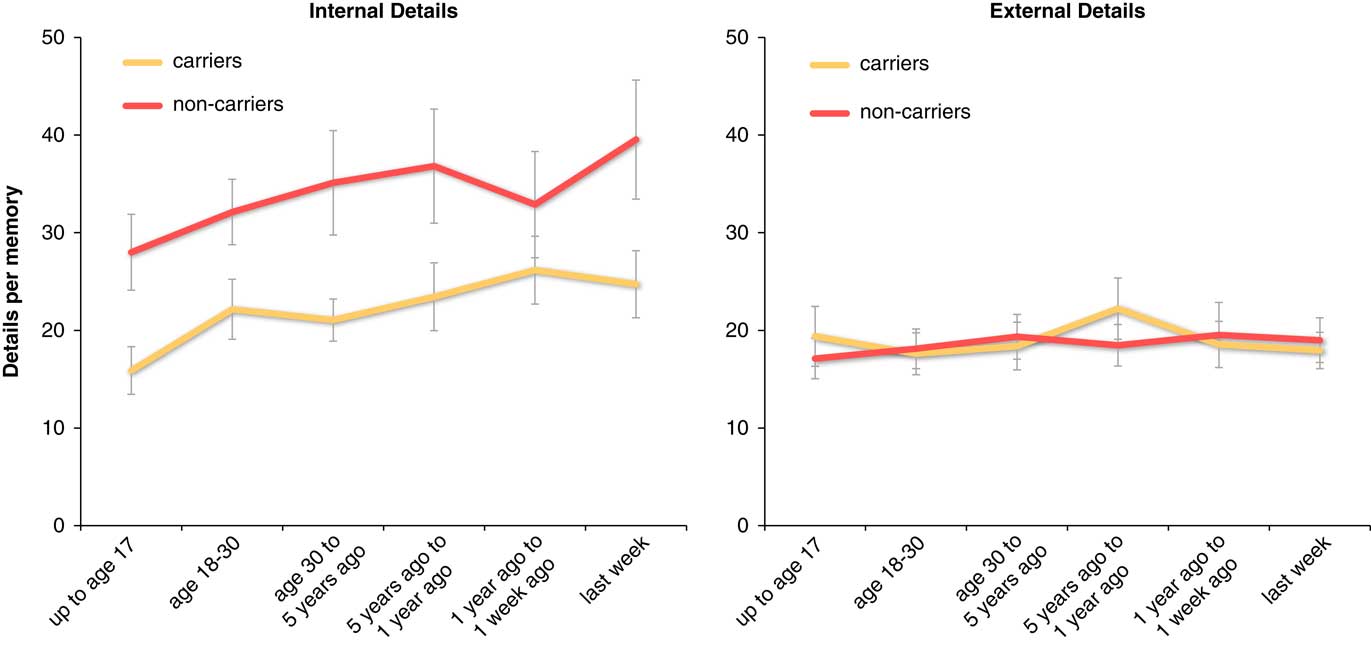
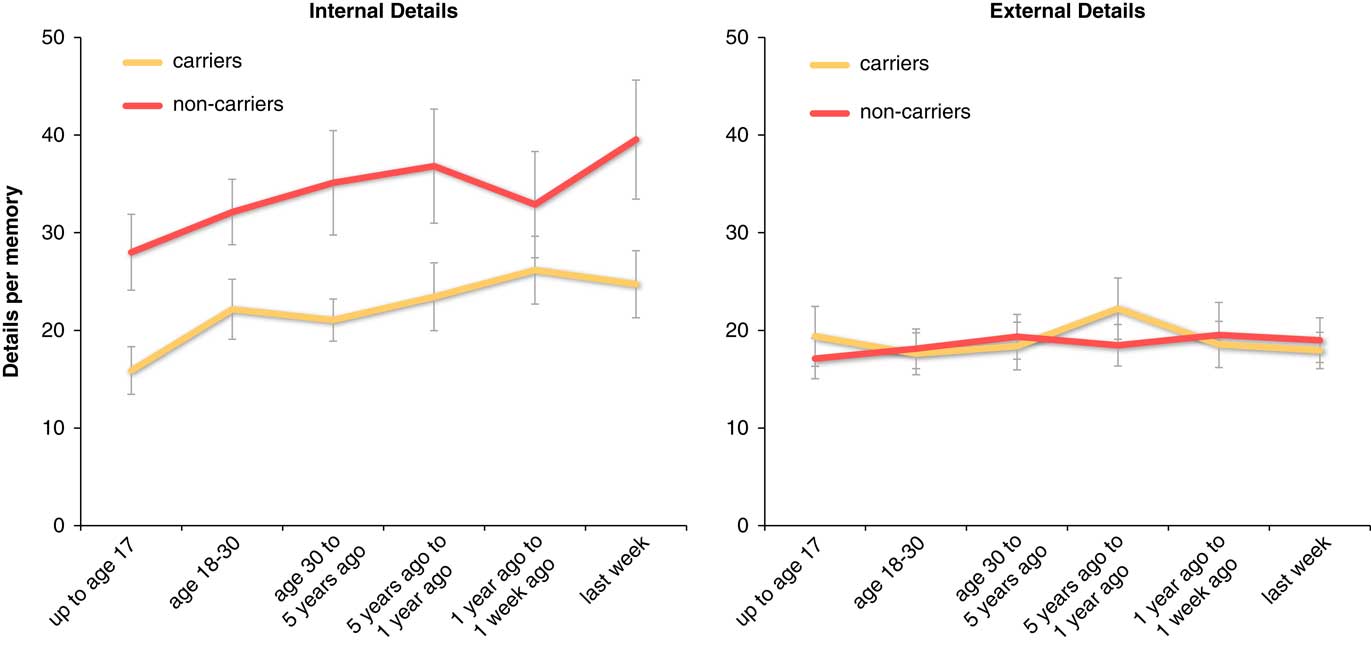
Mean number of details retrieved per memory by each group before providing the specific probes. Error bars depict standard error of the mean.
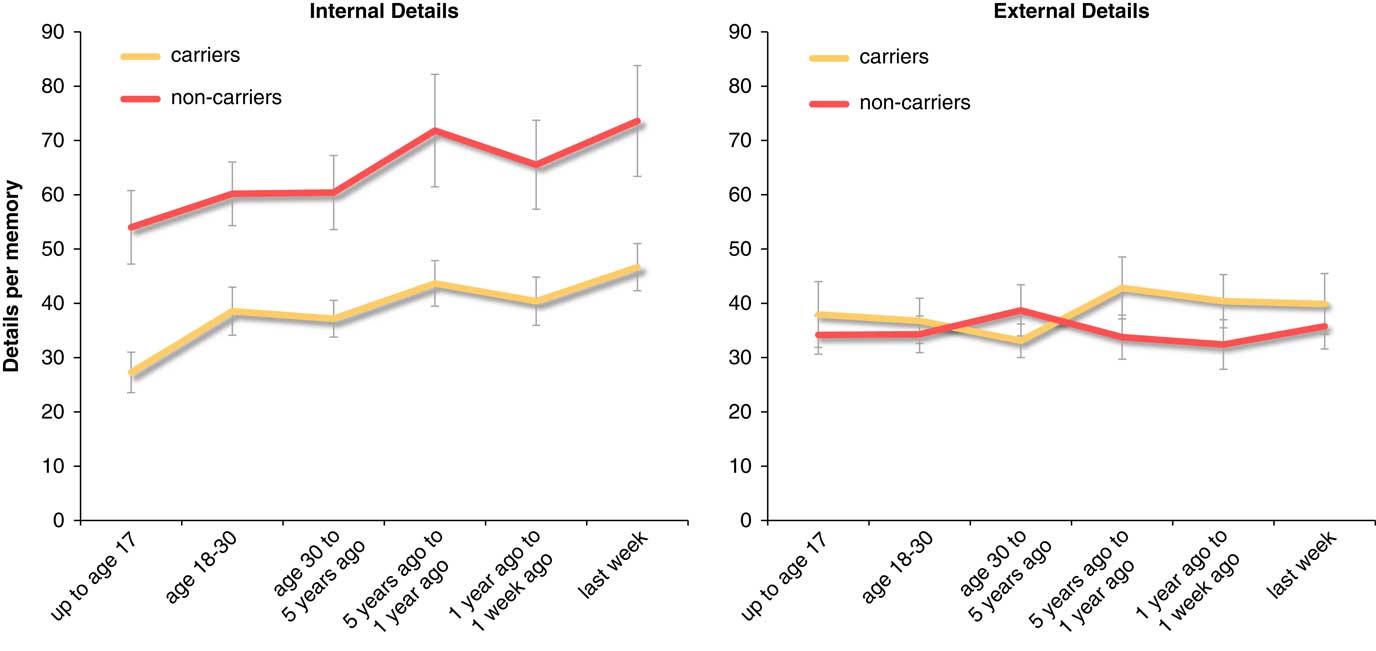
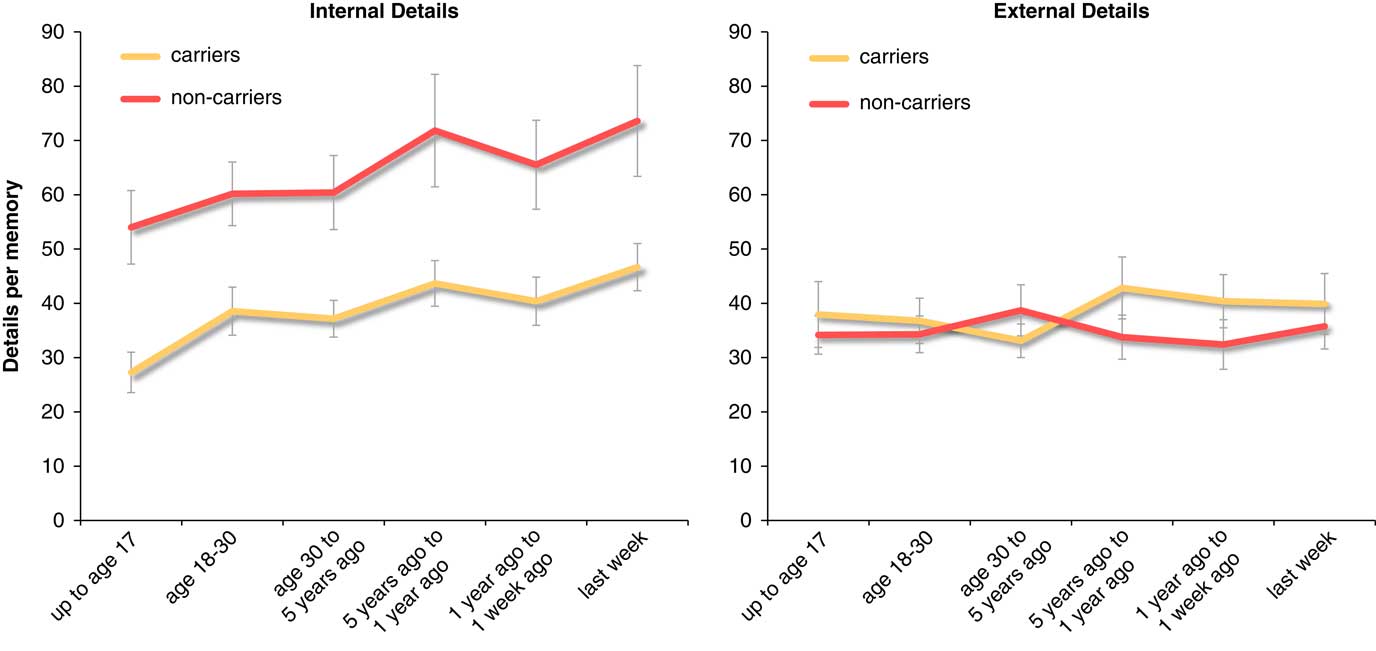
Mean number of details retrieved per memory by each group after providing the specific probes (cumulative). Error bars depict standard error of the mean.
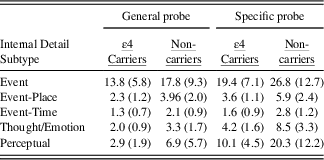
Mean frequencies of internal detail subtype retrieval per episodic autobiographical memory.

Note. The specific probe is cumulative. Standard deviations are presented in parentheses.
Edmonds and colleagues (Edmonds et al., Reference Edmonds, Delano-Wood, Galasko, Salmon and Bondi2015) recently extended the conceptual framework developed by Bondi and colleagues (Bondi et al., Reference Bondi, Edmonds, Jak, Clark, Delano-Wood, McDonald and Salmon2014) to operationalize subtle cognitive decline on the basis of actuarial judgment using neuropsychological data (as well as reported functional independence). Given our focus on the presence of subtle cognitive decline among cognitively normal middle-aged and older adults, we applied this actuarial approach and operational definition of Edmonds and colleagues (Edmonds et al., Reference Edmonds, Delano-Wood, Galasko, Salmon and Bondi2015) to our neuropsychological test scores. This approach considers two scores more than 1 SD below the normative mean on tests from different cognitive domains as evidence of subtle cognitive decline. For our sample, we compared the proportion of carriers and non-carriers with subtle cognitive decline as defined in this way using chi square.
RESULTS
Standard Neuropsychological Tests
Normative scores across the neuropsychological tests for the ε4 carrier and non-carrier groups are presented in Table 1. Because of an administrative error, two of the non-carriers did not complete the RCFT. With the exception of the RCFT delay recall score, there were not significant group differences for any of the tests (or indices), t’s≤1.81, p’s≥.08. The ε4 carriers actually performed better than the non-carriers on the RCFT delay recall score, t(31)=3.56, p=.001, d=1.2. This difference appears to be driven by the ε4 carriers being slightly above the normative mean as a group, whereas the non-carriers were comparable to the normative mean on this test.
Autobiographical Memory Task
All participants were able to generate an EAM for each time period. For the general probe section, groups did not differ in the average number of probes given, t<1, p=.45, the proportion of each group who received a probe did not differ for any time period, and how often participants were given probes did not vary by time period, χ2’s ≤2.42, p’s≥.12.
Autobiographical Memory Episodic Specificity: General Probe
Figure 1 shows the mean number of internal details (collapsed across subtype) and external details generated per time period in the general probe section for ε4 carriers and non-carriers. The 2 (Group: ε4 carriers vs. non-carriers)×2 (Detail type: internal vs. external)×6 (Time period: time 1–time 6) ANOVA revealed that the non-carriers generated marginally more detailed memories relative to the ε4 carriers (main effect of group), F(1,33)=3.77, p=.06, d=.67, and not surprisingly internal details were generated more than external details (main effect of detail type), F(1,33)=17.64, p<.001, d=.73. However, there was also a significant interaction between group and detail type, F(1,33)=7.58, p=.01, partial η2=.19, such that, relative to non-carriers, ε4 carriers generated fewer internal details, t(22.7)=2.54, p=.02, d=.87, but not fewer external details, t(33)=.43, p=.67.
Total detail generation was affected by memory remoteness (main effect of time period), F(5,165)=3.37, p=.006, partial η2=.09, such that memories from the earliest time period were less detailed relative to memories from two of the three most recent time periods (5 to 1 year ago and last week not including today), t’s≥3.39, p’s ≤.002, d’s≥.62 (corrected α level=.003). However, memory remoteness did not interact with group or detail type, nor was there a three-way interaction, F’s ≤1.48, p’s≥.20.
Given that there was a marginally significant reduction in total detail in the ε4 carriers, we also calculated internal to total detail ratios for each time period and conducted a 2 (Group: ε4 carriers vs. non-carriers)×6 (Time period: time 1– time 6) ANOVA. Consistent with the ANOVA on frequency of internal and external detail degeneration, non-carriers generated a higher internal to total detail ratio in comparison to ε4 carriers (main effect of group), F(1,33)=5.08, p=.03, d=.77. Also, there was not an effect of time period on ratio of internal details, nor was there a significant interaction between group and time period, F’s ≤1, p’s≥.65.
The 2 (Group: ε4 carriers vs. non-carriers)×5 (Internal detail type: event, event-place, event-time, thought/emotion, and perceptual) ANOVA investigated whether the internal detail group difference varied by subtype of internal content, but the interaction was not significant, F(1.46, 48.2)=1.88, p=.17 (see Table 2 for subtype retrieval frequencies).
Autobiographical Memory Episodic Specificity: Specific Probe
As seen in Figure 2, not surprisingly there was a numerical increase in details per memory after taking into account the additional details generated in the specific probe section, but the overall pattern of results appeared to be largely the same as the general probe section. This impression was supported by the 2 (Group: ε4 carriers vs. non-carriers)×2 (Detail type: internal vs. external)×6 (Time period: time 1–time 6) ANOVA, as the non-carriers generated marginally more detailed memories relative to the ε4 carriers (main effect of group), F(1,33)=3.89, p=.06, d=.70, internal details were generated more than external details (main effect of detail type), F(1,23)=18.69, p<.001, d=.61, and group interacted with detail type, F(1,33)=17.55, p<.001, partial η2=.35, such that relative to non-carriers, ε4 carriers generated fewer internal details, t(20.9)=3.35, p=.003, d=1.24, but not fewer external details during EAM retrieval, t(33)=.67, p=.51.
Similar to the general probe section, memory remoteness affected total detail generation (main effect of time period), F(5,165)=5.65, p<.001, partial η2=.15. However, there also was a significant interaction between time period and detail type, F(5,165)=2.93, p=.02, partial η2=.08, such that memories from the earliest time period contained fewer internal details relative to memories from the three most recent time periods, t’s≥3.48, p’s ≤.001, d’s≥.60, but not fewer external details, p’s≥.23 (corrected α level=.0017). Importantly, memory remoteness did not interact with group, and there was not a three-way interaction, F’s<1, p’s>.46.
Consistent with the general probe section, we conducted a 2 (Group: ε4 carriers vs. non-carriers)×6 (Time period: time 1–time 6) ANOVA on the ratio of internal to total details. In line with the ANOVA on frequency of internal and external detail degeneration, non-carriers generated a higher internal to total detail ratio in comparison to ε4 carriers (main effect of group), F(1,33)=14.32, p=.001, d=1.31. Also, there was not an effect of time period on ratio of internal details, nor was there a significant interaction between group and time period, F’s ≤2.09, p’s≥.09.
In contrast to the general probe section, the 2 (Group: ε4 carriers vs. non-carriers)×5 (Internal detail type: event, event-place, event-time, thought/emotion, and perceptual) ANOVA revealed a significant interaction, F(1.63, 53.93)=4.73, p=.018, partial η2=.13. Critically, the ε4 carriers generated fewer internal details than the non-carriers across all subtypes, t’s≥2.12, p’s ≤.044, d’s≥.75. The interaction reflects that whereas non-carriers generated thought/emotion details more than place details, t(16)=3.17, p=.006, d=.86, ε4 carriers did not, t(17)=1.46, p=.16. However, the former does not survive correction for multiple comparisons (α=.003).
Subtle Cognitive Decline Using Standard Neuropsychological Test Scores
When we applied the actuarial decision-making approach developed by Edmonds and colleagues (Edmonds et al., Reference Edmonds, Delano-Wood, Galasko, Salmon and Bondi2015), two ε4 carriers and one non-carrier met criteria for subtle cognitive decline on the basis of standard neuropsychological test scores. The proportion of carriers was not significantly different from the proportion of non-carriers, χ2=.003, p=.96. The results of all EAM analyses described above persisted when these individuals were removed.
DISCUSSION
The present study found that cognitively normal ε4 carriers recalled autobiographical memories with fewer internal details, but not fewer external details, relative to matched non-carriers. These results, therefore, suggest that episodic specificity is not only reduced in individuals with MCI and AD dementia (Bastin et al., Reference Bastin, Feyers, Jedidi, Bahri, Degueldre, Lemaire and Salmon2013; Gamboz et al., Reference Gamboz, De Vito, Brandimonte, Pappalardo, Galeone, Iavarone and Della Sala2010; Irish et al., Reference Irish, Hornberger, Lah, Miller, Pengas, Nestor and Piguet2011, Reference Irish, Addis, Hodges and Piguet2012; Murphy et al., Reference Murphy, Troyer, Levine and Moscovitch2008; Tramoni et al., Reference Tramoni, Felician, Koric, Balzamo, Joubert and Ceccaldi2012), but also in individuals who, although cognitively normal, are at increased risk of developing AD dementia. Given that the groups did not differ on a standard neuropsychological test score of verbal memory (i.e., CVLT-II) and the ε4 carriers actually outperformed the non-carriers on a standard neuropsychological test score of nonverbal memory (i.e., RCFT), the EAM disruption appears to be capturing a subtle episodic memory reduction not also reflected in the scores of these two commonly used neuropsychological tests. Overall, the ε4 carriers were not more likely than non-carriers to be identified as exhibiting subtle cognitive decline using an actuarial decision-making approach with standard neuropsychological data (Edmonds et al., Reference Edmonds, Delano-Wood, Galasko, Salmon and Bondi2015). This supports the idea that EAM assessment, if adapted for and incorporated into neuropsychological evaluation, has potential to further facilitate the detection of subtle cognitive decline associated with AD.
Although we considered several possible retrieval mechanisms and qualitative features of EAM that might influence episodic specificity, none of them appeared to drive the difference between ε4 carriers and non-carriers. For instance, the episodic specificity discrepancy between ε4 carriers and non-carriers was not attenuated by drawing attention to specific internal content with additional specific probes. The findings also indicate that the reduction in episodic specificity among ε4 carriers was not affected by the remoteness of the memories. Rather, this disruption of personal memory reaches far back along the autobiographical timeline. When examined at a fine-grained level, the reduced specificity seems not to be exclusively driven by certain internal content, because ε4 carriers produced fewer internal details of all types relative to non-carriers—the spatial-temporal context, perceptual detail, and emotional content. Therefore, although these internal detail subtypes may vary in their episodic qualities, the fact that all were reduced among ε4 carriers highlights the extent to which EAM episodic specificity is compromised. Also, the fact that external detail generation did not differ between groups suggests that the internal detail deficit is unlikely a consequence of a tendency for ε4 carriers to focus on semantic content, or because of group differences in executive control (Levine, Reference Levine2004; Spreng et al., Reference Spreng, Lockrow, DuPre, Setton, Spreng and Turner2018).
At this point, we can only speculate as to the cognitive processes that may be contributing to this ε4-related memory discrepancy. On the basis of cognitive neuroscience theory of autobiographical memory, three cognitive processes are important to consider. First, the mental construction of a scene is thought to create the “stage” on which an event plays out. The ability to form a vivid scene is dependent on the MTL (Hassabis et al., Reference Hassabis, Kumaran, Vann and Maguire2007; Maguire & Mullally, Reference Maguire and Mullally2013; Palombo, Hayes, et al., Reference Palombo, Hayes, Peterson, Keane and Verfaellie2018) and frontal and parietal lobe regions (Irish et al., Reference Irish, Halena, Kamminga, Tu, Hornberger and Hodges2015; Summerfield, Hassabis, & Maguire, Reference Summerfield, Hassabis and Maguire2010), likely because of shared contributions to spatial-perceptual detail retrieval and binding. Therefore, reduced EAM episodic specificity may be related to an inability to construct a vivid scene. Second, the ability to populate EAMs with internal details about the scene, people, and objects involves flexible retrieval and binding of content—a relational process that goes beyond scene construction (Roberts et al., Reference Roberts, Schacter and Addis2018; Schacter & Addis, Reference Schacter and Addis2007). This (re)constructive retrieval also depends on the MTL for binding (Cohen & Eichenbaum, Reference Cohen and Eichenbaum1993) and interaction with frontal and parietal regions for flexible retrieval of multimodal contents (McCormick et al., Reference McCormick, St-Laurent, Ty, Valiante and McAndrews2015). There is some evidence that relational processing is sensitive to a genetic variant of early onset AD (Parra et al., Reference Parra, Abrahams, Logie, Méndez, Lopera and Della Sala2010), as well as brain amyloid deposition in older adults (Rentz et al., Reference Rentz, Amariglio, Becker, Frey, Olson, Frishe and Sperling2011). Therefore, a general disruption to flexible retrieval and binding may lead to a reduction in episodic specificity that is not limited to scenes. Third, narrative ability may be contributing to our results as well. Although ε4 carriers and non-carriers did not differ on standard neuropsychological indices of verbal intelligence or working memory, these aspects of cognition could be expected to account for only some variance in the ability to construct a complex narrative. Perhaps there are subtle differences in narrative ability that reduce episodic specificity. Or, multiple mechanisms may contribute to our finding. We are inclined to adopt this latter viewpoint and propose that EAM episodic specificity is more sensitive to ε4 status in cognitively normal middle-aged and older adults in comparison to other more traditional neuropsychological tests of memory, because EAM retrieval engages multiple MTL-cortically mediated cognitive mechanisms, all of which may be subtly compromised by preclinical AD. To refine this cognitive index into the most sensitive predictor it can be, it will be important to elucidate the contributions of EAM sub-components to the EAM disruption.
It is interesting to consider our results in light of emerging neuroimaging findings related to the neural bases of internal details and external details of autobiographical memory. For instance, recent research has shown that variation in volume of certain hippocampal subregions (i.e., dentate gyrus, CA2/3, and subiculum) is associated with internal detail generation (Miller et al., Reference Miller, Chong, Aimola Davies, Ng, Johnson, Irani and Rosenthal2017; Palombo, Bacouulos, et al., Reference Palombo, Bacopulos, Amaral, Olsen, Todd, Anderson and Levine2018), but not external detail generation (Miller et al., Reference Miller, Chong, Aimola Davies, Ng, Johnson, Irani and Rosenthal2017). Also, Hodgetts and colleagues (Hodgetts et al., Reference Hodgetts, Postans, Warne, Varnava, Lawrence and Graham2017) showed that in young adults, internal detail generation was associated with diffusion measures of white matter integrity of the fornix, whereas semantic detail generation was related to white matter integrity of the inferior longitudinal fasciculus. There also is evidence that in young and middle-aged individuals, subjective report of one’s general tendency to use episodic-driven autobiographical remembering is related to MTL-posterior cortical intrinsic functional connectivity (Sheldon, Farb, Palombo, & Levine, Reference Sheldon, Farb, Palombo and Levine2016). In addition, resting state functional coupling between default mode and executive control regions in older adults has been shown to be associated with the tendency to generate external details during EAM retrieval (Spreng et al., Reference Spreng, Lockrow, DuPre, Setton, Spreng and Turner2018). Although we caution against strong claims about the neural bases of our ε4 deficit, these findings support the notion that reduced internal detail generation may relate to MTL integrity. Future research will need to determine the neural markers of internal detail reductions in older adults, and in particular whether this cognitive marker tracks with amyloid or tau biomarkers.
Our findings raise several additional questions that will need to be addressed in future work. For instance, prior research has shown that reduced EAM retrieval in individuals with MCI and AD is not only apparent in objective analysis of their narratives but also in their subjective report of retrieval experience (Buckley, Saling, Irish, Ames, Rowe, Lautenschlager, et al., Reference Buckley, Saling, Irish, Ames, Rowe, Lautenschlager and Ellis2014; Irish, Lawlor, O’Mara, & Coen, Reference Irish, Lawlor, O’Mara and Coen2010). It will be important to determine if subjective report of EAM is a sensitive marker of subtle cognitive decline. Related to this point, although participants did not report cognitive concerns in an initial interview, it is possible that a more comprehensive screening would reveal mild concerns among the ε4 carriers. Also, it is interesting to consider whether cognitively normal ε4 carriers might demonstrate subtle deficits in cognitive functions that are believed to be supported by EAM, including the construction and maintenance of a self-concept (Addis & Tippett, Reference Addis and Tippett2004; El Haj, Antoine, Nandrino, & Kapogiannis, Reference El Haj, Antoine, Nandrino and Kapogiannis2015). The sensitivity of EAM to ε4 status in older adults with clinical impairment relative to other measures of learning and memory remains an open question as well (El Haj et al., Reference El Haj, Antoine, Amouyel, Lambert, Pasquier and Kapogiannis2016; van der Flier et al., Reference van der Flier, Schoonenboom, Pijnenburg, Fox and Sheltens2006; van der Vlies et al., Reference van der Vlies, Pijneburg, Koene, Klein, Kok, Sheltens and van der Flier2007). We note that the present study was cross-sectional, and longitudinal research will need to determine the extent to which reduced EAM quality can predict clinical conversion to dementia. Longitudinal research also could shed light on how external detail generation during EAM retrieval might vary at distinct stages of cognitive aging. It is noteworthy that whereas cognitively normal older adults commonly generate more external details relative to young adults (Levine et al., Reference Levine, Svoboda, Hay, Winocur and Moscovitch2002; St. Jacques & Levine, Reference St. Jacques and Levine2007), ε4 carriers did not exhibit increased retrieval of such content relative to non-carriers. Interestingly, there is mixed evidence as to whether individuals with amnestic MCI generate more external details relative to cognitively normal older adults (increased: Murphy et al., Reference Murphy, Troyer, Levine and Moscovitch2008; Sheldon et al., Reference Sheldon, Vandermorris, Al-Haj, Cohen, Winocur and Moscovitch2015; not increased: Barnabe, Whitehead, Pilon, Arsenault-Lapierre, & Chertkow, Reference Barnabe, Whitehead, Pilon, Arsenault-Lapierre and Chertkow2012; Bastin et al., Reference Bastin, Feyers, Jedidi, Bahri, Degueldre, Lemaire and Salmon2013), and individuals with AD dementia commonly do not show increased generation of external details (Barnabe et al., Reference Barnabe, Whitehead, Pilon, Arsenault-Lapierre and Chertkow2012; Benjamin, Cifelli, Garrard, Caine, & Jones, Reference Benjamin, Cifelli, Garrard, Caine and Jones2015; Irish et al., Reference Irish, Hornberger, Lah, Miller, Pengas, Nestor and Piguet2011, Reference Irish, Landin-Romero, Mothakunnel, Ramanan, Hseih, Hodges and Piguet2018). In comparison, focal dorsolateral prefrontal cortex lesions and frontotemporal dementia can result in elevated generation of external details (Levine, Reference Levine2004; cf., Irish et al., Reference Irish, Hornberger, Lah, Miller, Pengas, Nestor and Piguet2011, Reference Irish, Landin-Romero, Mothakunnel, Ramanan, Hseih, Hodges and Piguet2018). Finally, given that our participants were highly educated, it will be important to determine the sensitivity of EAM to ε4 status and subtle cognitive decline in individuals from more diverse demographic backgrounds.
Despite these unresolved issues, the present study highlights the potential that investigating the qualitative recollection of autobiographical memory has for capturing subtle cognitive decline associated with AD. This may be a promising direction for the neuropsychological detection of preclinical AD and the development of new assessment tools.
ACKNOWLEDGMENTS
We have no conflicts of interest to report. This work was supported by the Arizona Alzheimer’s Disease Core Center Pilot Grant Program, National Institute on Aging, P30 AG 019610 (MDG); the Arizona Alzheimer’s Consortium, Department of Health Services (MDG); The University of Arizona College of Science Dean’s Innovation and Education Fund (MDG); and the University of Arizona Research, Development, and Innovation Faculty Seed Grant Program (MDG).