Introduction
My interest in researching the collection and accessibility of sketchbooksFootnote 1 sprang in part from a paper given by Siobhan Britton on zinesFootnote 2 at a Radical Collections conference at the Institute of Historical Research, Senate House, London in 2017, during the course of my MSc in Library Science at City, University of London. Since graduating from art school in the 1980s, I have been a regular user of sketchbooks, and recognize them as vital research documents that can reveal interesting insights into an artist's ideas and processes.
Sketchbooks usually have the role of incubators of ideas for creatives rather than being works in themselves, and their non-commercial aspect means they can remain in the studio until after the artist's death before being bequeathed to a suitable archive. But even then, they can remain out of the public eye; they are difficult to exhibit in their full, tactile state and are usually shown under glass in a static one-page-only state. Images from sketchbooks, shown in isolation, are stripped of their context and narrative element. To see them in their entirety, users must be able to pick them up, hold them, and turn their pages, which inevitably presents issues of conservation and security. To hold them is to better understand them.
For instance, they can be used at random by artists, who may use the sketchbook that is closest to hand at a time of need rather than filling a series of books in strict chronological sequence. Sometimes they may be used in an inverted state so that they can be read from either cover, or sections may be left blank or torn out.
My experience of accessing sketchbooks held in archives prior to my research was limited. My move to study library science was a career change from years working as an arts journalist. This, along with a lack of previous research into the subject to build upon, meant I embarked upon my dissertation with what I acknowledge was a degree of naivety and inexperience. My objectives therefore were to get a better overall understanding of how sketchbooks are collected, organized and made accessible in libraries and other institutions in the UK.
Previous research
There has been relatively little research into how sketchbooks have been collected and how they are accessed. Elisa Alaluusua's researchFootnote 3 was a qualitative analysis of creative strategies used in sketchbooks that focused on videos made with 13 artists that were exhibited as part of her practice-based PhD at the University of the Arts, London, and which have been subsequently exhibited. She refers to the problems faced in exhibiting sketchbooks and making them accessible and the change of status of sketchbooks as they metamorphosize from everyday working objects to carefully preserved documents:
The status of the sketchbook has changed from an object to be handled, perhaps at times rather carelessly, to something that needs to be preserved. Also the access to the sketchbook has changed from the artist (and those he or she chose to share the sketchbook with) to an archivist and researchers visiting the archives.Footnote 4
The research of another artist, Paul Ryan,Footnote 5 was a semiotic study of sketchbooks and its position in the hierarchies of making, collecting and exhibiting. Additionally, Recto verso: redefining the sketchbook, Footnote 6 which includes expanded versions of papers presented at a conference at the Collection, Lincoln, in 2011, refers to the tactile nature of sketchbooks and the importance of being able to handle them and turn their pages. Touching the books is ‘an opportunity to share the experience, to get close to the act and moment of touch and, in this case, creativity… The encounter sees the viewer enter the relationship between “maker” and “made”, even if this result is only for a moment’.Footnote 7 The haptic nature of sketchbooks and the degree to which this is possible in archival situations were important elements within my own research.
Defining sketchbooks
While sketchbooks may be understood to be books of plain paper containing sketches or for making sketches in (Collins English Dictionary), the definition can be more confusing at times. Text often plays a large part in a book's content, and a book without a graphic content may be more accurately described as a notebook, and therefore outside the bounds of my research. But even a few drawings may allow it to be considered a sketchbook: for instance, an item in Tate Archive, a sketchbook by Terry Frost (TGA8517/3), is a Cornwall Education Committee exercise book mostly containing notes on the history of furniture and his income in 1952/3, but it contained a few abstract and figure drawings – enough for it to be considered a sketchbook. Artists books, as self-published works of art, and composers’ sketchbooks, which note rough compositional outlines, were not included in my research.
Research methodology
The lack of previous research into sketchbook collections prompted me to take a broader, qualitative approach than I had originally intended. My research fell into two parts: interviews with people who had experience of accessing sketchbooks in a variety of institutions, and a survey sent to sketchbook-holding institutions in the UK.
The four interviewed included artists who had undertaken previous research, either academic (Elisa Alaluusua) or while writing books about sketchbooks (Stephen Farthing), a lecturer (Leo Duff) and a book artist (Guylaine Couture). All four of them use sketchbooks as part of their practice. Finding users of sketchbook archives to interview for my research was difficult, and so this convenience sample was identified. The aim was to get a sense of the processes and problems faced when accessing sketchbooks and to enable me to put together survey questions to send to sketchbook-holding institutions.
The problems faced when attempting to access sketchbooks included simply finding the catalogue on a museum's website, and the stifling effect of being unable to browse graphic items serendipitously when depending upon a traditional text-only catalogue. Without a visual resource, and when archive visits need to be arranged weeks in advance, there is little chance for the fortuitous discovery that can take users’ research in unexpected directions.
While increased digitization of sketchbooks would enable the creation of a more accessible visual catalogue and broaden access, the interviews revealed the concern that digitization can also have the effect of restricting access to the actual physical item for conservation reasons, apart from in exceptional circumstances. AlaluusuaFootnote 8 refers to an occasion when she travelled to an American institution to view a sketchbook that she had already viewed online only to be told that because it had been digitized it was no longer made physically available to researchers.
The online questionnaire
Aspects raised in these interviews were used to create a survey to send to sketchbook-holding institutions in the UK. These were identified primarily through the Artists’ Papers Register,Footnote 9 Discovery: The National Archives website,Footnote 10 and Archives Hub.Footnote 11 The number of institutions holding what were understood to be sketchbooks totaled 197, covering national libraries, university archives, major collections of prints and drawings, and local records offices. The subjects of those holdings included art, design, crafts, architecture, science, engineering and the military. Entry to a prize draw for a £50 book voucher was offered as an incentive to respond to the survey, which was posted on SurveyMonkey, the cloud-based data collection software.
The questionnaire consisted of 11 questions. The first three – relating to the number of sketchbooks the institutions held, how they were acquired, and who could access them – were scene setting in order to get a context for subsequent answers. Subsequent questions covered management software and data standards, the level at which they are catalogued, whether the institution held sketchbooks that would not be revealed through searches on their online catalogue, the most common users of the sketchbooks, if known, how often they are accessed, and whether the sketchbooks can be held and photographed by users. The questionnaire closed with a question about the level at which the sketchbooks have been digitized, with a final box offering the opportunity for respondents to suggest ways of improving accessibility to sketchbooks.
These questions are broader in scope than I had intended when I first undertook the study, but the dearth of previous research into the subject suggested that a more encompassing assessment of the current state of how sketchbooks are held would be fruitful. The link to the questions on the SurveyMonkey site was sent to 165 institutions, from which 55 completed responses were returned – a response rate of 33%.
Findings
The sketchbooks in all 55 institutions were accessible to the public, sometimes subject to registration for a readers’ card and a prearranged appointment, and under supervision in certain circumstances. The institutions responding ranged from those with fewer than 10 sketchbooks, which tended to be non-art related, such as Flintshire Record Office and the Honorable Artillery Company Archive, to those with more than 250, such as the Tate Archive and Henry Moore Institute. Sixteen expressed uncertainty about how many they held, in part due to incomplete cataloguing and the problem of definition.
It had been anticipated that most sketchbooks would pass to institutions on their owners’ death and this was reflected in the responses through the number receiving them by donations (94%). But nearly half of responding institutions contained purchased sketchbooks. Although, exceptionally, Henry Moore's 24-sheet Textile design sketchbook I sold at Christie's New York in 2012 for $242,500, sketchbooks may generally be seen as a less commercial creative product and hence more affordable. This is one of several aspects of the responses to the survey that suggested further avenues of research.
Only 31% of the 55 institutions reported that all of the sketchbooks they hold have been catalogued; reasons, when given, included that more time was required to catalogue new acquisitions and planned changes to management systems. Again, further research would be needed to shed more light on this subject.
Most of the respondents to the survey were unable to give figures to the question of how often the sketchbooks in their collection are accessed, beyond the anecdotal. Generally, no data is collected on this, or there is uncertainty over the definition of sketchbooks in relation to the books they hold. Of the 55 respondents, 22 (40%) were unable to give any suggestion of how regularly they are accessed, and 23 (42%) are accessed ‘rarely’, ‘infrequently’ or a few times a year. Nine institutions (16%) are accessed weekly or monthly, and just one (2%), the Henry Moore Institute Archive, has sketchbooks that are reported as being accessed daily. Comparisons between institutions are difficult however, when some hold hundreds of sketchbooks and others just a handful. Some sketchbooks are reported as never having been accessed. The inclusion of sketchbooks in exhibitions can raise awareness and lead to an increase in access.Footnote 12
The accessibility of users to explore the haptic nature of the books, and the extent to which digitization may be affecting this was an important strand of my research. Fifty-eight percent (32) of the responding institutions reported that none of their sketchbooks had been digitized, although others were in the process of doing so or had plans to do so. The National Art Library and Balliol College, for instance, referred to the advantages of digitizing items that are in particular demand by researchers or in a fragile state.
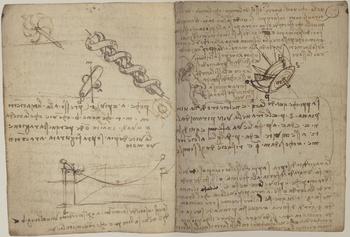
But digitizing does not necessarily mean worldwide access: 52 digitized sketchbooks in Oriel Yns Mon (Anglesey Archive) were accessible only through a PC within the archive, whereas Leonardo's Codex Forster, held at the National Art Library, is available in its entirety on the Victoria and Albert Museum website. Digitized versions of sketchbooks from the Tate Archives are accessible on touchscreen terminals at Tate Britain using Turning the Pages software, an application that creates a digital facsimile of a volume with pages that can be turned, magnified and rotated. It also features a search facility and information relevant to the pages shown, sometimes with a related audio or video file. Publication purposes, revenue-raising print sales and integration into an archive's catalogue were other drivers given for digitization.
Digitized image of Leonardo's Codex Forster, Book 1, Folios 43v and 44r.

The survey ended with an open-ended comments box inviting comments on improving accessibility to sketchbooks, with the most commonly reported factor among the 23 institutions completing this section being increased digitization. The Fitzwilliam Museum, for instance, sees digitization as ‘a good way of facilitating research and reducing handling’. But it is also seen by some as an alternative way of exhibiting the books, which are recognized as difficult to display effectively. The Usher Gallery states:
Displays of sketchbooks are difficult due to the very nature of the objects, so providing alternative access is very important, and we would certainly like to have 100% digitization of the sketchbooks in the collection in the future.
Cataloguing and funding issues are also citied: Sedgwick Museum of Earth Sciences would like to see the digitization of some of its sketchbooks but notes that ‘cataloguing still needs to be completed first before considering this. This means that digitizing is on an ad-hoc basis at the current time. Future projects would be dependent on securing funding and enlisting the support of volunteers.’ Two institutions, the National Art Library and Balliol College, Oxford, refer to the opportunities of publicizing holdings through social media.
While the Tate's library and archive receives around 20,000 visitors a year, the archive reports, when its holdings were placed online, the Tate's website attracted more than 1,000,000 hits. This initiative was used as an opportunity to address the issue of open access of the archive's digitized items through Creative Commons licences.
Conclusions
Although few of the institutions that responded to the survey hold digitized sketchbooks, the process is recognized as a priority by many of them. This allows not just greater access, but is a means of preserving fragile items by lessening the demand for handling of the physical sketchbooks, the opportunity to negotiate Creative Commons licences, the printing of facsimile sketchbooks, and as a cataloguing aid. The needs of cataloguing and the assessment of sketchbooks held, however, come before the costly digitization process.
The research shows that remarkable sketchbooks by leading artists, designers and others can be handled and studied closely in the archives by the public, or with an archivist in some circumstances, although in time increased digitization may reduce access to the physical objects. Their pages can still usually be touched and turned, and subject to the kind of close-up inspection that other works of art rarely can. Sketchbooks remain difficult to identify within catalogues, and there is no central online platform or point of access for them that could fully reveal the sketchbook treasures that are waiting to be explored.