1. Introduction
In Mathematische Grundlagen der Quantenmechanik von Neumann (Reference von Neumann1996) introduces −Trρlnρ as the quantum mechanical generalization of the phenomenological thermodynamic entropy, where ρ is the quantum mechanical density operator.Footnote 1 In his argument, he considers the cyclic transformation of a quantum gas confined to a box. By demanding that the overall entropy change of system and heat bath must be zero by the end of the cycle,Footnote 2 von Neumann concludes that the entropy of the quantum gas ought to be given by −Trρlnρ. Hemmo and Shenker (Reference Hemmo and Shenker2006) recently challenged this argument by pointing out an alleged discrepancy between the two entropies in the single-particle case, concluding that they must be distinct. In this article I demonstrate that their argument against the equivalence of thermodynamic and von Neumann entropy is problematic, as it (a) allows for a violation of the second law of thermodynamics and (b) is based on an incorrect calculation of the von Neumann entropy. The article is structured as follows: after a summary of von Neumann’s original argument, I quickly revisit the debate that has been lead to date by Shenker (Reference Shenker1999) and Henderson (Reference Henderson2003) before moving on to an analysis of Hemmo and Shenker’s (Reference Hemmo and Shenker2006) most recent contribution, which will be shown to be problematic.
2. The Argument
To fully appreciate Hemmo and Shenker’s criticism, it is helpful to begin by recapitulating von Neumann’s (Reference von Neumann1996) argument.
2.1. The Setup
Von Neumann begins by considering N noninteracting, quantum systems, denoted by S1, …, SN. For the purpose of this article, we take these systems to be two-state quantum systems and only consider, say, the spin states of a spin half particle.Footnote 3 Each of these systems is placed in a box Ki, with
 , … N, whose walls shield its contained system off from its environment and thus prevent any interaction between systems. The boxes K1, …, KN are now all placed into another much larger box
 of volume V. For simplification, von Neumann assumes that there are no force fields, in particular no gravitational fields, present in
 . This in turn means that there is no gravitational interaction between the boxes K1, …, KN, even though they may exchange kinetic energy via collisions. The boxes can thus be taken to behave just like molecules of a gas. Von Neumann calls this ‘quantum gas’ a [S1, …, SN] gas, where [S1, …, SN] is the statistical ensemble associated with the systems. A more detailed analysis of von Neumann’s understanding of such an ensemble, or Gesamtheit, will be presented in the appendix. The large box
 can be brought into thermal contact with a heat bath at temperature T, and in that case, after some equilibration time, the [S1, …, SN] gas itself will be at temperature T.Footnote 4 Finally, we add an empty box
 of equal volume V to the right of
 .
2.2. The Process
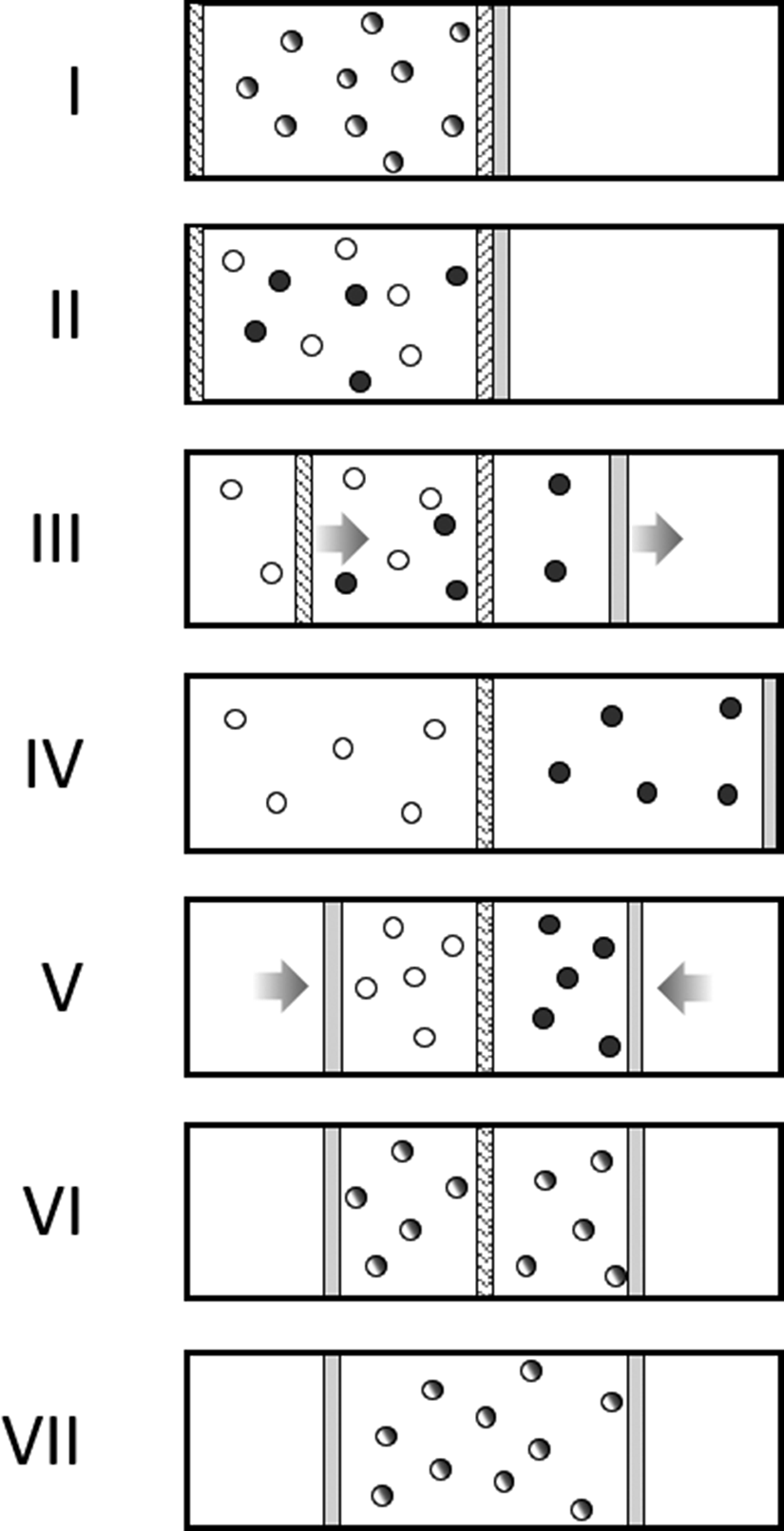
The [S1, …, SN] gas now undergoes a series of transitions. The following various stages are also illustrated in figure 1.Footnote 5
Stage I: Each of the two-level quantum systems Si initially is in the pure state
 , where the states |+〉 and |−〉 can be taken to be spin eigenstates of a spin half particle. Given the lack of interaction between the quantum systems, the density matrix of the overall system factorizes as
 with
 .
Stage II: Each system is now measured in the {|+〉, |−〉} basis, resulting in a mixture with
 particles in state |+〉 and
 particles in state |−〉.
Stages III and IV: The |+〉 and |−〉 systems are now separated in the following manner. The wall between
 and
 is replaced with a movable partition and a fixed semipermeable membrane.Footnote 6 This first semipermeable membrane is transparent to |−〉 systems but impermeable to |+〉 systems. From the very left of
 , another semipermeable membrane is inserted. It is movable and furthermore transparent to |+〉 systems, while being impermeable to |−〉 systems. The |−〉 systems are now ‘pushed’ into the right box
 by moving this second semipermeable membrane and the movable partition in the center simultaneously and quasi-statically to the right, keeping the enclosed volume constant at all times (see fig. 1, stage III, for an illustration of this step). During this process, no work is done on the gas, and no heat is exchanged with the heat bath. Eventually, all the |−〉 systems will be in
 , while the |+〉 systems remain in the left box (fig. 1, stage IV).
Stage V: The two boxes are now isothermally compressed to volumes
 and
 . Figure 1 illustrates this step for
 . The particle densities in
 and
 change from
 and
 to N/V, where, as before, N is the total number of systems. The entropy of the heat reservoir increases by
 and
 , respectively, where kB is the Boltzmann constant.
Stage VI: The |+〉 and |−〉 gases are then reversibly transformed back into a |0〉 gas via unitary operations.
Stage VII: Finally, the partition between the two chambers is removed, restoring the original state of the gas.
Illustration of von Neumann’s argument. (I) Individual two-state quantum systems are each in state
 , indicated by bicolored circles. For illustrative purposes, we assume
 . (II) After the measurement in the |+〉/|−〉 basis, the system is now described by a statistical mixture of |+〉 (white) and |−〉 systems (black). (III) The |+〉 and |−〉 systems are now separated by using semipermeable membranes to ‘push’ the |−〉 systems into the right box
 . (IV) The |+〉 and |−〉 systems are now completely separated. (V) The two boxes are compressed to half of their respective volumes. (VI) The |+〉 and |−〉 gases are now transformed back into their original state of superposition. (VII) The partition is removed. No heat bath is present, but we assume that it exists in the background and takes up the dissipated entropy at 4 → 5.

Von Neumann now argues as follows: all transitions between stages II and VII take place in a reversible fashion, which means that the total entropy change of gas and heat bath between II and VII must be zero. Since a total amount of
 has been dumped into the heat bath during the compression stage, and since the (normed) entropy of the final |0〉 gas is zero by definition, the entropy of the gas must have been
 before. Later in his book, von Neumann explains that the measurement process (‘Prozess 1’) is responsible for the entropy increase between stages I and II (Reference von Neumann1996, 202–6).
The above considerations are easily generalized to more dimensions. For a system described by a density matrix ρ with eigenvectors |ϕ 1〉, …, |ϕ n〉 and eigenvalues w 1, …, wn, the entropy is then given by
 .
3. Shenker’s Criticism and Henderson’s Reply
I will now briefly consider Shenker’s (Reference Shenker1999) first criticism against von Neumann’s argument and Henderson’s (Reference Henderson2003) reply. According to Shenker, two assumptions were made by von Neumann: (a) the thermodynamic entropy only changes during the compression, stages IV–V, and (b) the entropies of stages I and VII are the same. As Shenker presents the argument, von Neumann’s conclusion was that the entropy must thus have increased during the measurement process (I–II), to balance out the decrease during the compression (IV–V).
In order to show that von Neumann entropy and “classical entropy” are distinct, Shenker points out an alleged discrepancy in behavior, which supposedly takes place between stages II and IV.Footnote 7 Following her argument, let us first consider the change in von Neumann entropy: at stage II, the system is in a mixed state and has positive von Neumann entropy. At stage IV, the system is in a pure state and, so Shenker claims, has zero von Neumann entropy by definition. The von Neumann entropy therefore must have decreased between II and IV; that is, it must have decreased during the separation of the |+〉 and |−〉 systems.
“From a thermodynamic point of view” (Shenker Reference Shenker1999, 42), however, the entropy has not changed between II and IV. This is because “the entropy reduction of the separation is exactly compensated by an entropy increase due to expansion” (45). The thermodynamic entropy instead changes between during the compression, IV–V. According to Shenker, Thermodynamic entropy and von Neumann entropy therefore differ in their behavior since the reduction in thermodynamic entropy takes place at a later stage (IV–V) than the reduction of von Neumann entropy (II–IV).
Henderson (Reference Henderson2003) points out some deficiencies in Shenker’s argument that explain the alleged discrepancy. She shows that the system at stage IV cannot be considered to be in a pure state, as the gas’s spatial degrees of freedom ought also be taken into account in addition to its spin degrees of freedom. The initial state of the system at stage I is then given by
 , where ρ β is the thermal state of the system in contact with a heat bath at inverse temperature β. The entropy change at stage II is then only due to the entropy change of the spin degrees of freedom. Furthermore, even if we assume collapse, as Shenker implicitly does, the entropy is still high, since “we lack knowledge of which pure state the system is in” (Henderson Reference Henderson2003, 294). The separation step between II and IV then only ‘labels’ the states insofar as they are associated with a particular spatial area of the box, but this step does not change the entropy. The change in entropy at the compression stage V is then due to a change of the entropy of the spatial degrees of freedom.
4. Modern Criticism by Hemmo and Shenker
In a subsequently published, revised, and amended version, Hemmo and Shenker (Reference Hemmo and Shenker2006) offer an amended proposal with a similar but slightly weakened claim. They assert that “von Neumann’s argument does not establish a conceptual link between −Tr[ρlnρ] and the thermodynamic quantity
 (or
 ) in the single particle gas” (Hemmo and Shenker Reference Hemmo and Shenker2006, 158, emphasis added). They therefore retain their position that the von Neumann entropy cannot be empirically equivalent to the phenomenological entropy but restrict this inequivalence to the domain of single or sufficiently few particles. Von Neumann and thermodynamic entropy, they argue, are effectively equivalent only in the thermodynamic limit.
This section will discuss Shenker’s and Hemmo and Shenker’s efforts to show dissimilar behavior between the two entropies and reveal that their argument is problematic to the extent that it allows for a perpetuum mobile of the second kind. The shortcoming will be identified as the failure to take into account the entropy contribution of the measurement apparatus. I will make use of the famous one-particle engine developed by Szilard (Reference Szilard1929), in order to show that measurement based correlations with an external agent cannot be ignored in the single-particle limit, as they straightforwardly lead to a violation of the second law. Once the entropy contribution of the measurement apparatus is taken into account, however, the analogous behavior of thermodynamic entropy and von Neumann entropy for the joint system is restored.
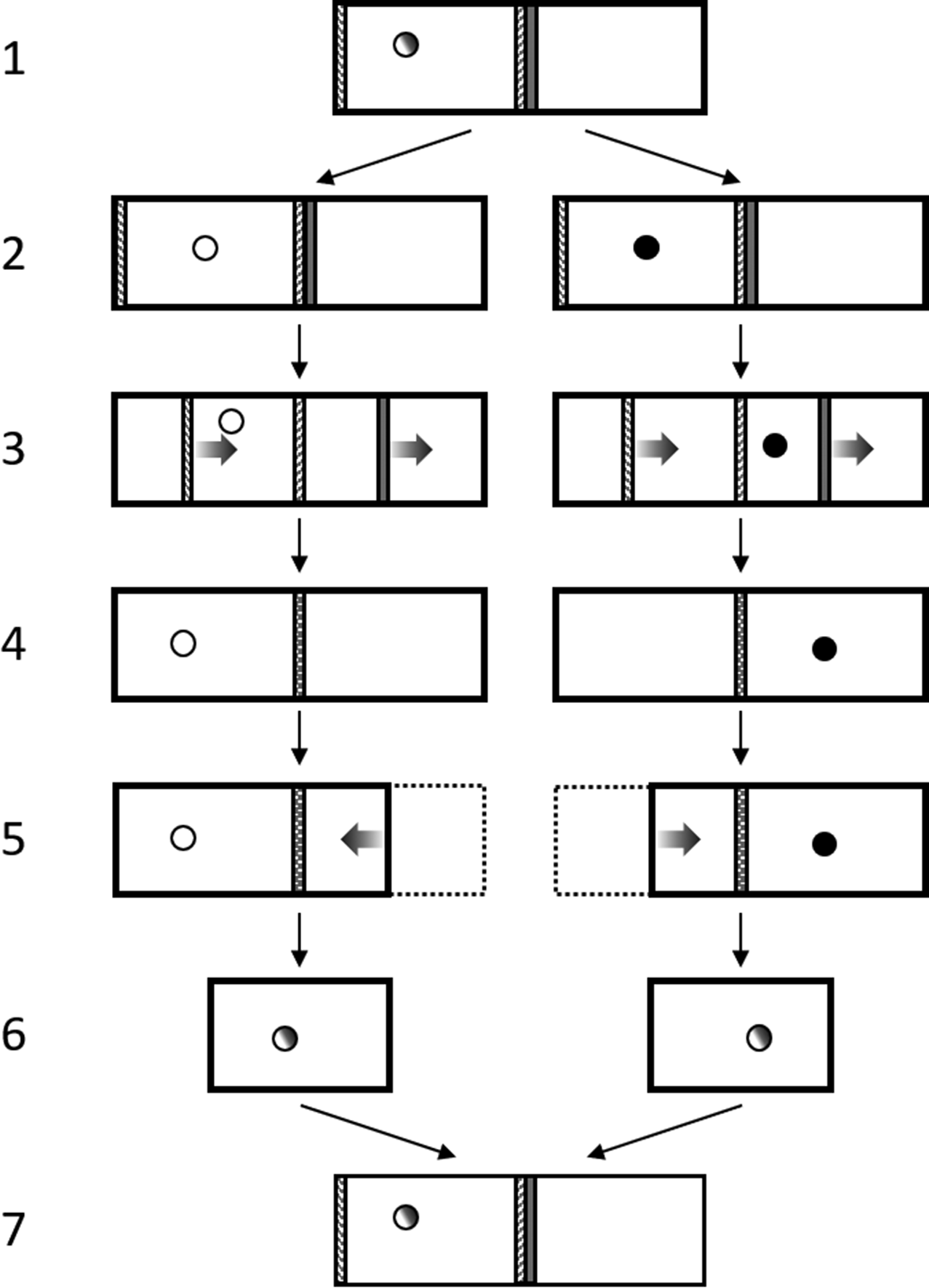
The following argument, including any conceptual ambiguities, has been taken unamended from Hemmo and Shenker (Reference Hemmo and Shenker2006), with the exception that we represent the position of the particle by the two orthogonal states |L〉 and |R〉, where L and R stand for ‘left’ and ‘right’, as opposed to Hemmo and Shenker’s mixed state ρ(L) representation. For the remainder of the article, I furthermore assume, just like Hemmo and Shenker, that it is in fact possible to treat a single quantum particle as a genuine thermodynamic system. An illustration of the following steps can be found in figure 2.
Step 1 (Preparation I): A quantum particle P is prepared in a spin-up eigenstate in the x direction,
 . Its initial location is given by |L〉p, where L and R refer to its position in either the left or the right part of the box. The measuring apparatus M starts out in the state |Ready〉M. The initial state of the particle is then given by the product state:

Step 2 (Preparation II): A measurement in the spin z direction is performed, leading to an entanglement of the measurement apparatus’s pointer states and the z spin eigenstates. It is important to note that Hemmo and Shenker do not specify the nature of the measurement at this stage, that is, whether they are working in a collapse or no-collapse model. The state of the entire system is given by

while the reduced density matrix of the particle becomes

which, as Hemmo and Shenker state, “in some interpretations may be taken to describe our ignorance of the z spin of P” (Reference Hemmo and Shenker2006, 160).
Whereas the von Neumann entropy of the spin component
 was zero before, it now becomes positive. The authors assert, however, that the thermodynamic entropy remains the same.
Step 3 (Separation): Two semipermeable membranes are inserted and moved through the box in such a way that the particle remains on the left if it is in state |+z〉 but is moved to the right if it is in state |−z〉. There is no work cost involved in this process, and neither von Neumann entropy nor thermodynamic entropy change during this step, during which the spatial degrees of freedom are coupled to the spin degrees of freedom.
Step 4 (Measurement): As we are only considering a single molecule in this setup as opposed to von Neumann’s original many-particle gas, the compression stage needs to be preceded by a location measurement in order to determine which part of the box is empty. Hemmo and Shenker, therefore, introduce a further measurement before compression (not present in von Neumann’s original argument), in order to determine in which part of the box the particle is located.
Hemmo and Shenker add that for the calculation of the von Neumann entropy, collapse and no-collapse interpretations will now have to use different expressions for the quantum state. In collapse theories, the state as a result of the location measurement collapses into either

For no-collapse interpretations, however, the system’s state is given by the reduced density matrix:

The thermodynamic entropy, S TD, as the authors stress, is not influenced by the position measurement and does not change during this step, in the sense—presumably—that no heat flows into, or out of, the system in consequence of this measurement. By contrast they urge, whether the von Neumann entropy changes depends on whether we consider collapse or no-collapse interpretations. In the case of collapse interpretations, the von Neumann entropy of the system allegedly decreases, whereas in the case of no-collapse interpretations, it remains the same.
Step 5 (Compression): The box is isothermally compressed back to its original volume V. The change in thermodynamic entropy during this step is normally given by
 . However, since there is no work involved in the compression against the vacuum, Hemmo and Shenker argue, the thermodynamic entropy does not change at step 5. In fact, the thermodynamic entropy does not change throughout the whole experiment, the authors claim.
Step 6 (Return to Initial State): The system is brought back to its initial state by unitary transformations with no entropy cost. “The measuring device need also be returned to its initial ready state. One can do that unitarily” (Hemmo and Shenker Reference Hemmo and Shenker2006, 161). Hemmo and Shenker’s main criticism thereby focuses on the fact that the thermodynamic entropy remains constant throughout the experiment, whereas the von Neumann entropy does not: “Therefore, whatever changes occur in Trρlnρ during the experiment, they cannot be taken to compensate for
 since the latter is null throughout the experiment” (162).
Illustration of the Gedankenexperiment following Hemmo and Shenker (Reference Hemmo and Shenker2006). (1) The particle is prepared in a spin x up eigenstate. (2) A spin z measurement is performed on the particle. (3) Depending on the outcome, the particle is moved to the right side of the box or remains in the left side via semipermeable membranes. (4) A location measurement is performed. (5) The empty side of the box is compressed. (6) and (7) The system is brought back to its original state.

5. Discussion of Hemmo and Shenker’s Argument
This section will discuss the argument presented above and identify two problems. The first concerns a wrong calculation of the von Neumann entropy during the step 4 location measurement. The second problem regards the suggested unitary reset of the measurement apparatus.
5.1. Redundancy of the Step 4 Location Measurement
I begin the discussion with some general observations, in order to provide more clarity. For this, we recall that according to Hemmo and Shenker, the only difference between their and von Neumann’s original thought experiment is that a further measurement, a location measurement (step 4), is needed to determine the molecule’s location before the compression stage. For gases at the thermodynamic limit, this measurement becomes redundant, since the amount of molecules on each side of the box becomes proportional to their respective occupying volume. Not so for single molecules, for which, before the empty side of the box can be compressed (with probability 1), a location measurement is required in order to determine which side the particle is on.
Contrary to Hemmo and Shenker’s assertions, however, the location measurement during step 4 is not needed. A spin z measurement already took place at step 2, and the outcome of this measurement will be fully correlated with the position of the particle after the separation in step 3. And so instead of introducing yet another auxiliary system that performs a location measurement on the particle, it would have been sufficient to read out the measurement result of the spin z measurement.
In the case of collapse, for example, the particle will have already collapsed into a spin eigenstate during the step 2 measurement. The correlations established during the location measurement will thereby all be classical, and reading out the spin measurement result is sufficient to predict the particle’s location after the separation. In the case of no-collapse interpretations, the system and (spin) measurement apparatus become entangled during step 2:

During the separation in step 3, the particle’s spatial degree of freedom becomes entangled with its spin degree of freedom. This means that the state of the overall system is

Therefore, for both collapse and no-collapse cases, it is in fact sufficient to read out the measurement result of the step 2 spin measurement in order to determine the location of the particle after the separation process.
Having two instead of one measurement would not be much of a problem, if it were not the case that in Hemmo and Shenker the two measurements have different consequences for the von Neumann entropy. This is the first inconsistency in their argument: whereas Hemmo and Shenker agree that after the spin z measurement at step 2 the postspin measurement density matrix of the particle is given by

they do not apply the same reasoning to the postlocation measurement state of the system at step 4. Instead, they use a ‘collapsed’ density matrix to calculate the von Neumann entropy:

In the first case, the (spin) measurement has therefore increased the entropy, whereas in the second case the (location) measurement has effectively reduced it. What is going on?
Let me first try to assemble what the authors themselves could have had in mind. In von Neumann’s original argument, the step 2 spin measurement is nonselective,Footnote 8 which means that even if the system has de facto collapsed into one of its eigenstates, an external agent would not be able to determine into which state the system has collapsed and would therefore describe the system by a density matrix ρ (2,red).Footnote 9 The system would be in a so-called proper mixture, meaning that it is possible to understand ρ as representing a probability distribution over pure states.Footnote 10 The von Neumann entropy of the system at step 2 has thereby increased compared to its previous state, in agreement with what von Neumann considers as being the irreversibility of a ‘Prozess 1’.
The step 4 location measurement, however, is selective—it establishes correlations between the agent who performs the measurement and the system.Footnote 11 These correlations then allow the agent to perform further operations on the system, such as the step 5 compression of the box. For Hemmo and Shenker, the von Neumann entropy of the system at step 4 has therefore decreased from step 3.
Since Hemmo and Shenker want to include the nonselective spin measurement at step 2, the step 4 location measurement is indeed a necessary requirement for the single-particle case, given that the compression is not being allowed to be conditional on the outcome of the step 2 measurement. Without the selective measurement, the work-free compression against vacuum could not take place. The limiting case of infinite particles (and in fact von Neumann’s original account) does not require this selective measurement since the amount of particles within each chamber of the box becomes equal.
The problem with including a second measurement on the system is that this second measurement also introduces a second measurement apparatus. It will be shown shortly that Hemmo and Shenker’s conclusion is based on an erroneous calculation of the von Neumann entropy when the system is correlated to this second measurement apparatus. Before elaborating on this point, however, I would like to discuss another shortcoming of their argument.
5.2. Violation of the Second Law
Hemmo and Shenker notably claim that the thermodynamic entropy change is zero throughout the whole cycle and, in particular, that at the end of the cycle “the measuring device [can be returned to its initial ready state] unitarily” (Reference Hemmo and Shenker2006, 161) and, hence, without any heat cost. To appreciate the consequences of this claim, let us assume that it is indeed possible to unitarily bring the measurement apparatus back to its original position without a compensating heat transfer into the environment, as Hemmo and Shenker claim. We may then construct a slightly amended version of their proposed cycle. For this amended version, the only thing we change is step 5, which instead of being a compression we turn into an isothermal expansion. This means that instead of compressing the empty side against the vacuum, we let the particle push against the partition in a quasi-static, isothermal fashion. Given that the position of the particle is ‘known’ as a result of the location measurement, it is possible to attach a weight to the partition, thereby extracting kTln2 units of work from the system during the expansion, while the according amount of heat is delivered from the heat reservoir. After the work extraction, the measurement apparatus is brought back to its initial state (which according to Hemmo and Shenker can be done for free). The partition is then reinserted into the original system (for free), the position of the particle is measured again (for free), and the above process is repeated, thereby extracting arbitrarily large amounts of work from this one-particle engine with the sole effect being that heat is extracted from a single reservoir. This constitutes a direct violation of the Kelvin-Planck statement of the second law (Planck Reference Planck1991).
Von Neumann himself, as the authors acknowledge, states that “in the sense of phenomenological thermodynamics, each conceivable process constitutes valid evidence, provided that it does not conflict with the two fundamental laws of thermodynamics” (Reference von Neumann1996, 192; trans. Reference von Neumann and Beyer1955, 359).Footnote 12 And so at this point, one might already conclude that Hemmo and Shenker’s argument fails, as their suggested unitary reset does conflict with one of the fundamental laws of thermodynamics.
It should be noted, however, that there exists some controversy in the literature about whether we ought to expect the second law to hold in the single-particle case and whether thermodynamic considerations in these cases are indeed acceptable (Maxwell Reference Maxwell1878; Earman and Norton Reference Earman and Norton1999; Hemmo and Shenker Reference Hemmo and Shenker2012; Norton Reference Norton2013).Footnote 13 In fact Hemmo and Shenker elsewhere have expressed skepticism on whether the second law holds in such cases (Hemmo and Shenker Reference Hemmo and Shenker2012). While it seems reasonable to assume that in the article under consideration the second law is required to hold (after all, the article is about comparing the thermodynamic entropy with the von Neumann entropy, and the authors explicitly state that they “do not address this issue” of skepticism here; Hemmo and Shenker Reference Hemmo and Shenker2006, 158), it is worth emphasizing that the above violation is a reliable violation of the second law. This means that even if one is willing to sacrifice the strict second law that states that entropy should never decrease, and instead adapts either a statistical or a probabilistic version of the second law,Footnote 14 the problem with the above case is that we are confronted with a violation that allows us to extract work from the heat reservoir 100% of the time. It allows us to extract work reliably and continuously and, so, is a particularly serious version of a Maxwell’s demon.
A common strategy to recover the second law from situations like the one presented above is to invoke Landauer’s principle (Landauer Reference Landauer1961; Bennett Reference Bennett1973). It states that there is a heat cost involved with the resetting of the measurement apparatus to its initial state, and it is widely accepted in the physics community.Footnote 15 For the case presented above, the resetting of the memory cell would then lead to an increase of heat in the environment, thereby offsetting the previous entropy decrease.Footnote 16
And indeed, this is what is required in the current case, for contrary to Hemmo and Shenker’s assertion, a unitary reset of the measurement device is not possible. To see this, we consider the end of the cycle. The measurement device then is in one of the two mutually exclusive states |−〉M or |+〉M. As can be easily seen, there then exists no unitary operator that reliably maps the memory cell back to its initial, ready state
 . The only way to reset the measurement device unitarily is if one recorded beforehand which one of the two mutually exclusive states the device is in. To do so, however, one requires a measurement on the measurement device itself, performed by a second measurement device. But then one would want to reset this second measurement device unitarily, too, for which a third device would be needed, and so on. Eventually, one would run out of resources, and a Landauer type reset, at a cost, becomes unavoidable.
Which Entropy?—Notwithstanding the above criticism, Hemmo and Shenker’s main point is that the von Neumann entropy (as opposed to the thermodynamic entropy) during the step 4 location measurement decreases and that this gives us reason to reject that their conceptual equivalence still stands, or seems to. “As a result of the location measurement, the von Neumann entropy decreases back to its original value” (Hemmo and Shenker Reference Hemmo and Shenker2006, 163).
In this section I discuss this claim, and in particular I show that
i) The physically relevant entity is the joint entropy of system and measurement apparatus. It remains the same.
ii) It is the system’s so-called conditional entropy that decreases during the measurement, not the system’s marginal von Neumann entropy.
I begin with a justification of the two claims. In phenomenological thermodynamics, the joint entropy of two systems is always the sum of their respective entropies. The von Neumann (in the classical case, the Gibbs) entropy, however, is generally subadditive and additive only in the absence of correlations between two systems:

where S stands for ‘system’ and M stands for ‘measurement apparatus’ or ‘memory cell’. In the concrete case of the step 4 location measurement, we can model the measurement apparatus M as a box containing a single molecule divided by a partition. It can then be in one of two mutually exclusive states, corresponding to the position of the molecule, left (l) or right (r). We assume it needs to be in a ‘ready’ state before the measurement, which we chose to be l. The entropy is zero, in this case. If we consider the case of collapse, then at the time of the measurement the system will have already collapsed into a spin eigenstate. The correlations between the location of the system and the measurement apparatus are then all essentially classical, and the von Neumann entropy before the measurement can be rewritten as

where p(s) is the probability of the system being in the left or right chamber of the box.
Before the step 4 location measurement, system and measurement apparatus are not correlated, and their joint entropy is given by
 , where 3 is taken to denote ‘stage 3’, or, in other words, ‘before the step 4 measurement’. During the measurement, the memory cell will align itself with the position of the particle, and the two systems become correlated. The joint entropy now cannot be expressed anymore as the sum of the individual entropies and instead becomes

with H(S|M) being the so-called conditional entropy, which quantifies how much S is correlated with M and which is given by

Here p(s) and p(m) are the probabilities that system and memory cell are found in macrostate
 , rs or
 , rm respectively, p(m, s) is their joint probability, and p(s|m) the conditional probability, with
 . The conditional entropy is nonnegative and is maximal when the system and measurement apparatus are uncorrelated,
 , in which case equation (12) reduces to equation (10). It is often considered to be the entropy relative to an agent (in this case the measurement apparatus).
Let us now go back to Hemmo and Shenker’s claim that the von Neumann entropy of the system decreases during the location measurement. Does it? The answer is no. What decreases, however, is the conditional entropy relative to the measurement apparatus:

It reduces to zero because system and measurement apparatus become perfectly correlated during the measurement. And so when Hemmo and Shenker claim that the system’s entropy has decreased, what they mean is that the system’s conditional entropy has decreased. But the conditional entropy is distinct from the marginal entropy. Rewriting the joint entropy of system and measurement apparatus demonstrates this:

As opposed to phenomenological thermodynamics, which treats systems as black boxes, (classical and quantum) statistical mechanics is able to detect correlations between subsystems, allowing us to mathematically handle the concept of ‘measurement’ in the first place. If we associate entropy with the potential to (reliably) extract work from a system, then the conditional entropy quantifies this ability to a certain extent: a memory cell endowed with an automaton would now be able to (reliably) extract work from the system by allowing it to isothermally expand into the other half of the box, thereby raising a weight, contrary to an external agent who is not correlated to the particle location. But this is just the ordinary Maxwell’s demon scenario applied to a one-particle setting.Footnote 17
What becomes important for thermodynamic treatments in such a setting is the joint entropy of system and measurement apparatus, as the joint system (ideally) has no correlations with the outside and can thus be treated as a thermodynamic black box. And it turns out that the behavior of the thermodynamic entropy of the joint system is exactly mirrored by the behavior of the von Neumann entropy. The joint entropy of system and measurement apparatus does not change during the location measurement but remains the same:

And so, to summarize the above: all that changes during the location measurement is the conditional entropy, not the joint entropy of the system or the marginal entropy H(S). Furthermore, the joint entropy, just like the thermodynamic entropy of the joint system, remains the same during the location measurement.
5.3. No-Collapse Scenarios
Let us now consider the case of no-collapse scenarios. In no-collapse scenarios, following the measurement in step 4, the measurement apparatus and the location degree of freedom become entangled. The reduced density matrix after tracing out the decohering environment therefore is given by an improper mixture due to the neglect of the correlations with the environment. After the step 4 measurement, the density matrix of the combined system and measurement apparatus is given by

where now |L〉M and |R〉M represent the states of the measurement apparatus. The correlations between the measurement apparatus and the system are of a classical nature, and so also in the absence of collapse, the von Neumann entropy of system and apparatus has not changed during the step 4 measurement.
6. Conclusion
This article considers von Neumann’s introduction of −Trρlnρ as the quantum mechanical generalization of thermodynamic entropy. In particular, it shows that an argument raised by Shenker (Reference Shenker1999) and Hemmo and Shenker (Reference Hemmo and Shenker2006) against the equivalence of von Neumann and thermodynamic entropy is problematic because (a) their reasoning allows for a violation of the second law of thermodynamics and (b) the alleged disparate behavior in von Neumann and thermodynamic entropy during the step 4 location measurement is due to a wrong calculation of the von Neumann entropy. It is in fact the system’s conditional entropy that decreases during the step, leading to the seemingly disparate behavior of the two entropies. Finally, the article shows that the relevant quantum entropy, the joint entropy of system and measurement apparatus, remains unchanged during the location measurement and thus exactly mirrors the thermodynamic entropy.
Appendix. Von Neumann, Entropy, and Single Particles
In his original setup, von Neumann introduced a ‘gas’ consisting of individual quantum systems, locked up in boxes and placed in a further, giant box.Footnote 18 The ‘gas’ represents a imaginary statistical but finite ensemble. The density operator, which he calls the ‘statistical operator’, can only relate to such a Gesamtheit. This means that even in the case of an individual quantum system, von Neumann’s argument would remain unchanged: the density operator of this individual quantum system would still relate to an ensemble of systems, and a system containing a single particle would therefore still be modeled as an N-particle ensemble. The statistical representations of (a) a system containing a single particle and (b) a system containing many particles are therefore identical. This, however, does not imply that von Neumann denies the meaningful application of thermodynamics to individual particles. Quite the contrary: von Neumann explicitly considers the case of a single particle in a box (Reference von Neumann1996, 212). He uses the example to demonstrate that the capacity of an agent to extract work from such a single-particle thermodynamic system depends on the agent’s state of knowledge about the position of the particle and therefore adopts what one might call an epistemic interpretation of entropy: “The time variations of the entropy are then based on the fact that the observer does not know everything, that he cannot find out (measure) everything which is measurable in principle” (213; trans. Reference von Neumann and Beyer1955, 401).Footnote 19 While one may raise several severe objections to this reading of entropy and the density operator, the above nevertheless shows that von Neumann’s argument in its original intention applies not only to large (macroscopic) systems but also small (microscopic) systems.