INTRODUCTION
APOE, the gene encoding apolipoprotein E (apoE), is the strongest genetic susceptibility marker for late-onset Alzheimer’s disease (LOAD). Carriers of the risk allele ε4 are at increased risk for developing AD in a gene dose dependent manner (Corder et al., Reference Corder, Saunders, Strittmatter, Schmechel, Gaskell and Small1993) and also have a dose dependent increased risk of an earlier disease debut (Raber, Huang, & Ashford, Reference Raber, Huang and Ashford2004). In addition to the impact on AD pathology, apoE can influence brain structure and function as well as cognitive function in normal aging (Chen et al., Reference Chen, Reiman, Alexander, Caselli, Gerkin and Bandy2007; Christensen et al., Reference Christensen, Batterham, Mackinnon, Jorm, Mack and Mather2008; Espeseth et al., Reference Espeseth, Westlye, Fjell, Walhovd, Rootwelt and Reinvang2008; Flory, Manuck, Ferrell, Ryan, & Muldoon, Reference Flory, Manuck, Ferrell, Ryan and Muldoon2000; Jack et al., Reference Jack, Lowe, Weigand, Wiste, Senjem and Knopman2009; Lind, Larsson et al., Reference Lind, Larsson, Persson, Ingvar, Nilsson and Bäckman2006; Nilsson et al., Reference Nilsson, Adolfsson, Backman, Cruts, Nyberg and Small2006; Reiman et al., Reference Reiman, Caselli, Yun, Chen, Bandy and Minoshima1996, Small, Rosnick, Fraatiglioni, & Backman, Reference Small, Rosnick, Fratiglioni and Backman2004). Recent findings (Reiman et al., Reference Reiman, Chen, Liu, Bandy, Yu and Lee2009; Small et al., Reference Small, Siddarth, Burggren, Kepe, Ercoli and Miller2009) indicate that increased accumulation of AD pathology (fibrillar amyloid β and tau proteins) is found in cognitively normal APOE ε4 carriers of age 60–70, indicating that a clear distinction between normal and pathological effects of APOE ε4 on typical cognitive aging may not be possible. Reliable effects of APOE ε4 are not found in all studies of cognitively normal individuals (Jorm, Mather, Butterworth, Anstey, Christensen, & Easteal, Reference Jorm, Mather, Butterworth, Anstey, Christensen and Easteal2007; Luciano et al., Reference Luciano, Gow, Taylor, Hayward, Harris and Campbell2009; Reynolds, Prince, Feuk, Brookes, Gatz, & Pedersen, Reference Reynolds, Prince, Feuk, Brookes, Gatz and Pedersen2006), but a recent meta-analysis (Wisdom, Callahan, & Hawkins, Reference Wisdom, Callahan and Hawkins2009) concludes that ε4 carriers perform significantly worse than noncarriers on episodic memory, executive function, and global cognitive ability, whereas results for measures of perceptual speed reveal small effects. Wisdom et al. (Reference Wisdom, Callahan and Hawkins2009) also showed that increased age is associated with increased genetic effect on episodic memory and global cognition.
Further progress in identifying reliable effects of APOE on a broad range of cognitive functions may depend on taking into consideration epistasis with other genes (Phillips, Reference Phillips2008). Cholinergic genes are of special interest in the context of APOE related mechanisms of reduced cognitive function for several reasons. Normal cognition is highly dependent on the integrity of the cortical cholinergic system (Dani & Bertrand, Reference Dani and Bertrand2007), which plays a key role in age related decline in attention and working memory (Sarter & Bruno, Reference Sarter and Bruno2004). Reduced number and altered function of nicotinic acetylcholine receptors (nAChRs) and the loss of cholinergic neurons in disease-relevant brain regions are among the major neurochemical hallmarks of AD (Court, Martin-Ruiz, Graham, & Perry, Reference Court, Martin-Ruiz, Graham and Perry2000; Nordberg, Reference Nordberg2004; Oddo & LaFerla, Reference Oddo and LaFerla2006; Pimlott et al., Reference Pimlott, Piggott, Owens, Greally, Court and Jaros2004). Data from AD patients have shown that apoE affects the ACh system in an isoform-specific manner, such that apoE4 is associated with decreased nucleus basalis neuronal activity (Salehi, Dubelaar, Mulder, & Swaab, Reference Salehi, Dubelaar, Mulder and Swaab1998) and reduced choline acetyltransferase activity in the cortex and hippocampus compared with apoE2 and apoE3 (Allen et al., Reference Allen, MacGowan, Tyler, Wilcock, Robertson and Holden1997; Lai et al., Reference Lai, Tsang, Garcia-Alloza, Minger, Nicoll and Esiri2006; Poirier et al., Reference Poirier, Delisle, Quirion, Aubert, Farlow and Lahiri1995). In human AD the activity of the nicotinic α4β2 receptor is altered both in terms of reduced binding and subunit expression (Burghaus et al., Reference Burghaus, Schütz, Krempel, de Vos, Jansen Steur and Wevers2000; Martin-Ruiz et al., Reference Martin-Ruiz, Court, Molnar, Lee, Gotti and Mamalaki1999, Reference Martin-Ruiz, Court, Lee, Piggott, Johnson and Ballard2000), and similar effects have been reported for patients with mild cognitive impairment (MCI) and for normal aging (Mitsis et al., Reference Mitsis, Cosgrove, Staley, Bois, Frohlich and Tamagnan2009; Terrière et al., Reference Terrière, Dempsey, Herrmann, Tierney, Lonie and O’Carroll2008; Tohgi et al., Reference Tohgi, Utsugisawa, Yoshimura, Nagane and Mihara1998). Single nucleotide polymorphisms (SNPs) of the cholinergic system have been associated with increased risk for AD. The CHRNB2 gene on chromosome 1q21 coding for the β2 component of the α4β2 receptor shows association with AD risk in several studies (Cook et al., Reference Cook, Ho, Taylor, Brayne, Evans and Xuereb2004; Kawamata & Shimohama, Reference Kawamata and Shimohama2002; Schjeide et al., Reference Schjeide, McQueen, Mullin, DiVito, Hogan and Parkinson2009), and is among the top hits in the AlzGene database (Bertram, Reference Bertram2009).
CHRNA4 codes for the α4 component of the α4β2 receptor and several studies have found functional consequences of normal variation in common SNPs in this gene (Espeseth et al., Reference Espeseth, Greenwood, Reinvang, Fjell, Walhovd and Westlye2006, Reference Espeseth, Endestad, Rootwelt and Reinvang2007; Greenwood, Fossella, & Parasuraman, Reference Greenwood, Fossella and Parasuraman2005; Greenwood, Lin, Sundararajan, Fryxell, & Parasuraman, Reference Greenwood, Lin, Sundararajan, Fryxell and Parasuraman2009; Parasuraman, Greenwood, Kumar, & Fossella, Reference Parasuraman, Greenwood, Kumar and Fossella2005; Reinvang, Lundervold, Rootwelt, Wehling, & Espeseth, Reference Reinvang, Lundervold, Rootwelt, Wehling and Espeseth2009; Winterer et al., Reference Winterer, Musso, Konrad, Vucurevic, Stoeter and Sander2007). TT-carriers of CHRNA4 accounted for adverse effects on tests of cognitive speed and attention, and in several studies (Greenwood et al., Reference Greenwood, Fossella and Parasuraman2005; Parasuraman et al., Reference Parasuraman, Greenwood, Kumar and Fossella2005; Winterer et al., Reference Winterer, Musso, Konrad, Vucurevic, Stoeter and Sander2007) the participants were 20–40 years of age. The CHRNA4 × APOE interaction has been shown to modulate reaction time in a selective attention task and to influence brain total white matter volume in middle-aged healthy participants (Espeseth et al., Reference Espeseth, Greenwood, Reinvang, Fjell, Walhovd and Westlye2006).
Studies using a longitudinal follow-up design of well characterized normal samples, and excluding participants with incipient dementia, may be more sensitive and give a stronger basis for evaluating genetic effects on cognition than cross-sectional studies. Mayeux, Small, Tang, Tycko, & Stern (Reference Mayeux, Small, Tang, Tycko and Stern2001) noted that, although rate of decline was greater in ε4 carriers followed for 7 years, differences at any one time point were not significant. Other longitudinal studies linking ε4 to cognition in nonclinical groups have confirmed that there is evidence for greater decline in ε4 carriers than noncarriers, and that ε4 homozygotes show this pattern at an earlier age than heterozygotes and noncarriers (Baxter, Caselli, Johnson, Reiman, & Osborne, Reference Baxter, Caselli, Johnson, Reiman and Osborne2003, Caselli et al., Reference Caselli, Reiman, Osborne, Hentz, Baxter and Hernandez2004, Reference Caselli, Reiman, Locke, Hutton, Hentz and Hoffman-Snyder2007). Longitudinal studies have further indicated that cognitive effects of APOE are found in ages 60 and older (Caselli et al., Reference Caselli, Reiman, Osborne, Hentz, Baxter and Hernandez2004, Reference Caselli, Reiman, Locke, Hutton, Hentz and Hoffman-Snyder2007), alternatively 65 and older (Christensen et al., Reference Christensen, Batterham, Mackinnon, Jorm, Mack and Mather2008; Mayeux et al., Reference Mayeux, Small, Tang, Tycko and Stern2001). Nilsson et al. (Reference Nilsson, Adolfsson, Backman, Cruts, Nyberg and Small2006) found evidence for greater decline only in the group of 70–85 years old participants.
In the present study, we followed a healthy, intellectually well functioning group in the age range 45–79 years at time of recruitment for 3–5 years, and evaluated performance on neuropsychological tests in light of the hypothesis that APOE affects cognition, but is modulated by age and association with CHRNA4. Based on previous studies we hypothesize that the strongest effects involving APOE ε4 will be found on memory performance, whereas the strongest effects involving CHRNA4 allele combinations will be found on speeded tasks. The hypotheses are tested both in relation to level of performance at initial testing and to decline.
METHODS
Participants
Norwegian participants in the age range 45–79 years were recruited through advertisements in local newspapers in the Oslo and Bergen urban areas. Exclusion criteria were previously diagnosed neurological or psychiatric illness, any other chronic illness with symptoms that might influence test performance, sensory or motor impairments. For further details, see Espeseth et al. (Reference Espeseth, Greenwood, Reinvang, Fjell, Walhovd and Westlye2006). All consenting participants underwent structural magnetic resonance imaging scans, and persons with gross pathology (tumors, strokes, traumatic lesions, or other) were excluded. All participants read an information sheet and signed a statement of informed consent approved by the regional committee for medical and health research ethics. All participants completed Beck’s Depression Inventory (BDI, Beck & Steer, Reference Beck and Steer1987), and none were clinically depressed at initial assessment or at follow-up. The 304 participants completed the first investigation, and they were invited for a follow-up after 3–5 years (mean, 3.44 years; range, 2.89–5.09 years). Seventy-eight percent agreed to take part and completed the follow-up study. Magnetic resonance scanning was repeated, and no cases of major pathology (cortical strokes, tumors) or findings leading to a neurological diagnosis were detected. Two participants were excluded on the basis of cognitive decline indicating incipient dementia (see below).
Tests
We used a battery of tests including the Vocabulary and Matrix Reasoning subtests from Wechsler Abbreviated Scale of Intelligence (WASI; Wechsler, Reference Wechsler1999) to estimate intellectual function (IQ). Furthermore, we included tests of psychomotor speed, attention, and cognitive control functions [WAIS-R Digit Symbol (DSS); Color Word Interference Test (CWIT) from the Delis-Kaplan Executive Function System, D-KEFS (Delis, Kaplan, & Kramer, Reference Delis, Kaplan and Kramer2001)] and tests of memory function [California Verbal Learning Test II - CVLT II, (Delis, Kramer, Kaplan, & Ober, Reference Delis, Kramer, Kaplan and Ober2000)]. The CVLT II allows for scoring of several parameters of learning and memory performance, including total learning score (learning), free recall after 5 and 30 min (recall 1, and recall 2), and recognition of previously learned words measured with recognition hits (RH) and false positive responses (FP). The CWIT is an adaptation of the Stroop task (Stroop, Reference Stroop1935), and includes naming of color patches (CW-N), reading of color words (CW-R), color-word inhibition (CW-I), and color-word inhibition/switching (CW-I/S).
The follow-up protocol included the Mini Mental State Examination (MMSE) (Folstein, Folstein, & McHugh, Reference Folstein, Folstein and McHugh1975) to exclude dementia. All participants were interviewed about family history of dementia or stroke, and about health condition according to a standard protocol.
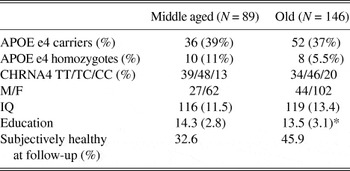
The proportions of ε4 carriers in the initial sample was 6.6% ε4 homozygotes, and 30.9% ε4 heterozygotes, and in the follow-up sample the proportions were 7.6% ε4 homozygotes (n = 18) and 29.8% ε4 heterozygotes (n = 70). The proportions do not indicate selective attrition of ε4 carriers. The present group has an ε4 allele frequency of 22.5%, and the sample deviates from Hardy-Weinberg equilibrium (χ2 = 6.03; p < .05), the main reason being an overrepresentation of ε4 homozygotes. The sample has a CHRNA4 T-allele frequency of 30.6 and does not deviate significantly from Hardy-Weinberg equilibrium (χ2 < 1). For comparison with previous studies we divided participants into two age groups of 45–59 and 60–79 years, respectively. Demographic data are given in Table 1.
Demographic characteristics

* p < .05.
The proportion of ε4 carriers in the different age groups did not vary significantly (χ2 = .348; not significant), but there was a smaller proportion of ε4 homozygotes in the oldest age group. There were only 2 ε4 homozygotes older than 70 years of age. The proportion of CHRNA4 TT-carriers did not vary between age groups (χ2 = .432), and there were no significant association between distribution of APOE ε4 carrier status and CHRNA4 TT-carrier status in any of the age groups. Breaking down the material into subgroups defined by Age (± 60), CHRNA4 (± TT), and APOE (± ε4) defined 8 cells with a balanced distribution of participants and n > 15 in every cell. Gender distribution and IQ were not significantly associated with APOE or CHRNA4 genotype. Two participants had developed a significant cognitive deficit (MMSE 23 and 24) at follow-up and were not included in further analyses. None of them were ε4 homozygotes.
Genotyping
Genotyping for APOE was performed by real-time PCR with allele-specific fluorescence energy transfer probes and melting curve analyses on the LightCycler™ system (Roche Diagnostics, Mannheim, Germany) and typing of the APOE ε2, ε3, and ε4 genotypes was performed using the LightCycler APOE Mutation Detection Kit (Roche). Further details are given in Espeseth et al. (Reference Espeseth, Greenwood, Reinvang, Fjell, Walhovd and Westlye2006).
Genotyping of the same sense thymine-to-cytosine single nucleotide polymorphism (rs1044396) in the gene CHRNA4 coding for the α4 subunit in nicotinic α4β2 receptors, was performed by real-time PCR with allele-specific fluorescence energy transfer probes and melting curve analyses on the LightCycler™ system (Roche Diagnostics, Mannheim, Germany) as previously described in Espeseth et al. (Reference Espeseth, Greenwood, Reinvang, Fjell, Walhovd and Westlye2006). DNA sequencing was initially performed to verify the genotypes identified.
Statistics
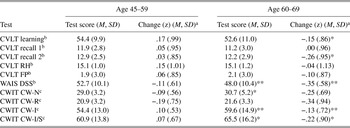
Standardized scores were used for statistical analyses. Distributional properties of the variables were examined, and we found that recognition measures of memory (CVLT RH and CVLT FP) were strongly skewed, indicating ceiling effects (see Table 2). They were, therefore, not included in further analyses. Test scores were analyzed as individual parameters, but on conceptual as well as empirical grounds they are taken to represent intercorrelated measures within broader domains of cognitive functions of memory, highly automatized speeded tasks and tasks demanding cognitive control.
Performance on test 1(raw scores) and mean change test 1- test 2 (z-scores)

a Negative sign indicates decline.
b Number of items.
c Time in seconds.
*p < .05; **p < .01 of age 45–9 ≠ age 60–79.
Performance at test 1 was analyzed by analysis of covariance (ANCOVA) using age group (± 60), APOE genotype (± ε4), CHRNA4 genotype (± TT) and interactions of these variables as predictors. Sex and IQ were included as covariates. Significant interactions were followed up with individual t tests between relevant subgroups. Insignificant covariates and higher order interaction terms were eliminated in the final model (Tabachnick & Fidell, Reference Tabachnick and Fidell2007).
For analyzing change, the standard deviations of scores from test 1 were used as a metric for measuring change from test 1 to test 2. Change scores were analyzed by ANCOVA with age group (± 60), APOE genotype, CHRNA4 genotype, and interactions of these variables as predictors. Test–retest interval, sex, and IQ were included as covariates.
RESULTS
The middle-aged group had approximately 1 year higher general education than the old group (p < .05), but the older age group had a 3 point higher IQ score (p = .06).
A higher proportion of ε4 homozygotes (61%) than ε4 heterozygotes (45%) and noncarriers (34%) reported their general health as having declined between the two sessions. In most cases, the decline involved increasing symptoms of a chronic condition. The decline did not lead to a neurological or psychiatric diagnosis. Health problems varied widely from mild concerns (sleep problems, overweight, muscular pain, arthritis) to successfully treated major illness (heart conditions, cancer) with residual symptoms.
The self-reported incidence of having a first degree relative with dementia in the two age groups was 39% for the middle-aged, and 31% for the old-age group. We note that only 19% of the 70- to 79-year-olds reported a positive family history. There was a clear association between APOE ε4 dose and risk of dementia in first degree relatives with an incidence of 23% in noncarriers of APOE ε4 and 40% and 67% in ε4 heterozygotes and in homozygotes, respectively. The debut of dementia tended to be earlier in close relatives of ε4 homozygotes (mean age, 73 years vs. 77 years in heterozygotes and 78 years in noncarriers). There was no significant association between CHRNA4 genotype and family history (χ2 = .615, not significant). There was no significant association of allele distribution with family history of stroke for either APOE or CHRNA4.
Test performance on initial evaluation together with average decline on each test (Z-scores) for the middle-aged and old groups are shown in Table 2.
The age groups did not differ significantly in level of initial performance on memory tests, but the old group was slower, most significantly so on demanding timed tasks (CW-I and WAIS DSS). For the middle-aged group there was on the average a small learning effect, whereas for the older group there was some decline on most measures. The magnitude of changes corresponded to at most approximately 1/3 of the standard deviation of between subject performance. The older group declined most relative to the middle-aged group on complex attention and cognitive control tasks, and on measures of learning and delayed recall.
Genetic Predictors of Performance at Test 1
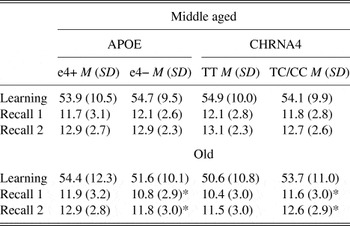
The ANCOVA analyses of APOE, CHRNA4 and Age, including interactions, showed that for tests of memory the genetic effects of APOE or CHRNA4 were dependent on age, whereas for test of speed and cognitive control the genetic effects were independent of age. CVLT learning showed a significant interaction of APOE × Age (F(1,224) = 4.21; p < .05; η2 = .019). This interaction was also significant for short delay free recall (F(1,224) = 7.69; p < .01; η2 = .033), and for long delay free recall (F(1,224) = 5.76; p < .05; η2 = .025). Further analyses show that old APOE ε4 carriers perform better than noncarriers on delayed recall measures (see Table 3).
APOE and CHRNA4 as predictors of age dependent memory performance

* p < .05 of groups within APOE and CHRNA4 respectively not differing.
Memory was also significantly affected by an interaction of CHRNA4 and age, which was found for short-term delayed recall (F(1,224) = 4.38; p < .05; η2 = .019), and for long delay free recall (F(1,224) = 3.79; p = .05; η2 = .017). Further analyses indicate that old CHRNA4 TT-carriers perform worse than noncarriers, and there were no significant differences in the middle-aged group (Table 3).
Performances requiring speed and cognitive control were sensitive to genetic influences independently of age. There were no significant main effects of APOE, but significant main effects of CHRNA4 were found for CW-R (F(1,218) = 6.11; p < .05, η2 = .026). Furthermore, CHRNA4 had a significant main effect on CW-I (F(1,218) = 6.28; p < .05, η2 = .027), but not on other cognitive control tasks. In both cases, the effect was that CHRNA4 TT-carriers were slower than TC/CC carriers (for CW-R, t(230) = 2.20; p < .05; for CW-I, t(230) = 2.15; p < .05).
We found a significant interaction of CHRNA4 and APOE on CW-N, CW-I/S, and on DSS. The values were for CW-N (F(1,222)= 5.07; p < .05, η2 = .022), for CW-I/S (F(1,222) = 4.11; p < .05; η2 = .018), and DSS (F(1,218) = 7.48; p < .01; η2 = .032). For CW-I the interaction showed a nonsignificant trend (F(1,222) = 2.62; p < .10. Figures 1, 2, and 3 show the age independent interaction of APOE and CHRNA4, and indicate that the combination of being an APOE e4 carrier and a CHRNA4 TT carrier leads to significantly lower naming speed performance (Figure 1), and lower performance on cognitive control tasks, that is, CW I/S (Figure 2), and DSS (Figure 3).
Interactive effects of APOE and CHRNA4 on the CW-N score. Negative sign indicates slower performance. Error bars indicate standard error of the mean.

Interactive effects of APOE and CHRNA4 on the CW I/S score. Negative sign indicates slower performance.

Interactive effects of APOE and CHRNA4 on DSS performance.

Examining the separate test parameters, we note that within the cognitive control tasks the relatively simpler task (CW-I) showed a significant main effect of CHRNA4, and a trend for interaction of CHRNA4 with APOE. In contrast, the more complex tasks (CW-I/S, DSS) were sensitive to the APOE × CHRNA4 gene interaction, but not to a main effect of CHRNA4. Analogously, within the speed component, we found reading speed (CW-R) to be most sensitive to the main effect of CHRNA4, whereas color naming (CW-N), which may be a less highly automatized function in this well educated group, is more sensitive to the genetic interaction of APOE and CHRNA4.
Genetic Predictors of Decline
For memory we found genetic associations with decline in specific variables. We found a significant APOE × age group interaction (F(1,225) = 4.41; p < .05; η2 = .019) for the short delay free recall variable and a nonsignificant trend also for long delay free recall. Follow-up analyses indicated that ε4 carriers in the old group showed a decline in short delay free recall of .19 SDs , in contrast to noncarriers who improved by 0.10 SDs (p = .09). We also analyzed the results for participants above 70 years, but the results did not indicate a significant relationship of APOE to memory decline in this group. In the middle-aged group, there were no significant genetic group differences or trends.
We found a significant genetic interaction effect of APOE and CHRNA4 on memory decline independently of age for short-term delayed recall (F(1,224) = 5.06; p < .05, η2 = .022). The interaction is shown in Figure 4 for short-term delayed recall scores, which shows that age independent memory decline tends to only be found in carriers of APOE ε4 when they are also carriers of CHRNA4 TT. Pairwise comparisons are, however, not significant. Retest interval had no significant effect on memory decline.
Epistatic effects on memory decline. Decline in short delay recall score is affected by interaction of APOE and CHRNA4. Negative values indicate decline.

The analysis of change scores showed that for the speed tasks there was a significant three-way interaction of APOE × CHRNA4 × Age with regard to decline in CW-N performance (F(1,224) = 10.14; p < .01; η2 = .044) with relatively more decline in old carriers with the combination of APOE ε4 and CHRNA4 TT, and more decline in middle-aged carriers with the combination APOE ε4 and CHRNA4 TC/CC (Figure 5). None of the pairwise comparisons were significant. The same pattern was not found on reading speed (CW-R) or on cognitive control tasks.
Epistatic effects on speed decline in two age groups. Decline in speed of color naming (CW-N) is modified by interaction of APOE, CHRNA4, and age. Panel A shows middle-aged participants and panel B shows old participants.

DISCUSSION
The results confirm that cognitive effects of APOE genotype are seen on memory test results, and that cognitive effects of CHRNA4 genotype are seen on speeded tasks. However, we also find evidence of more complex genetic interactions in regard to both these cognitive domains as well as in regard to cognitive control, and in both middle-aged and old participants. Interaction of APOE and CHRNA4 affects speeded performance, which in previous studies has shown small or unreliable effects of APOE ε4 (Wisdom et al., Reference Wisdom, Callahan and Hawkins2009). The results are consistent with previous findings (Espeseth et al., Reference Espeseth, Greenwood, Reinvang, Fjell, Walhovd and Westlye2006) in that we find a specific negative effect on speed in TT-allele carriers who also carry APOE ε4. While Espeseth et al. (Reference Espeseth, Greenwood, Reinvang, Fjell, Walhovd and Westlye2006) showed this pattern in experimental reaction time tasks, the present results confirm the findings in neuropsychological tests that are commonly used in clinical research. CHRNA4 TT carriers constitute 34–39% of the present sample, and a similar proportion would, therefore, have a considerable impact on the result of any genetic association study focusing on APOE.
Separate effects of APOE on memory are only found in the old group where APOE ε4 carriers show indications of accelerated decline, whereas age independent effects of APOE depend on the CHRNA4 context. APOE ε4 carriers with CHRNA4 TT show greater memory decline independently of age, whereas the TT noncarriers are stable. Unexpectedly, old CHRNA4 TT carriers have reduced memory function at initial testing. We did not predict an effect of CHRNA4 on memory function, but effects of genes primarily involved in attention control is not unlikely in view of the complex nature of memory tasks. We note that although APOE effects on memory are significant in meta-analytic studies (Small et al., Reference Small, Rosnick, Fratiglioni and Backman2004; Wisdom et al., Reference Wisdom, Callahan and Hawkins2009) the effect sizes are small. This indicates that contributions from interacting genes will have to be considered to achieve higher explanatory power. While our results indicate a possible role for CHRNA4 in memory, there are a range of likely candidate genes including BDNF (Hariri et al., Reference Hariri, Goldberg, Mattay, Kolachana, Callicott and Egan2003, Le Hellard et al., Reference Le Hellard, Håvik, Espeseth, Breilid, Løvlie and Luciano2009), KIBRA (Papassotiropoulos et al., Reference Papassotiropoulos, Stephan, Huentelman, Hoerndli, Craig and Pearson2006), and others.
The age groups included in the present study are closely similar to previous studies that have reported APOE ε4 related decline in participants age 60 and older (Baxter et al., Reference Baxter, Caselli, Johnson, Reiman and Osborne2003; Caselli et al., Reference Caselli, Reiman, Osborne, Hentz, Baxter and Hernandez2004), alternatively 65 and older (Mayeux et al., Reference Mayeux, Small, Tang, Tycko and Stern2001) or 70 and older (Nilsson et al., Reference Nilsson, Adolfsson, Backman, Cruts, Nyberg and Small2006). The studies by Caselli et al. (Reference Caselli, Reiman, Osborne, Hentz, Baxter and Hernandez2004) indicated that a follow-up interval of approximately 3 years could reveal differences in decline rate, whereas other studies demonstrating decline had follow-up intervals of 5 years or more (Bretsky, Guralnik, Launer, Albert, & Seeman, Reference Bretsky, Guralnik, Launer, Albert and Seeman2003; Nilsson et al., Reference Nilsson, Adolfsson, Backman, Cruts, Nyberg and Small2006; Mayeux et al., Reference Mayeux, Small, Tang, Tycko and Stern2001; Wilson et al., Reference Wilson, Schneider, Barnes, Beckett, Aggarwal and Cochran2002; Schultz et al., Reference Schultz, Lyons, Franz, Grant, Boake and Jacobson2008). We confirm that longitudinal data, even in a 3- to 5-year time perspective, can give evidence for genetic effects on cognition, but in initially high performing participants a longer follow-up interval is more optimal. We also confirm that tests of episodic memory in verbal list learning with measures of delayed recall, and especially of decline in these measures, may be sensitive to ε4 carrier status, as has been the most consistent finding in the literature (Small et al., Reference Small, Rosnick, Fratiglioni and Backman2004; Wisdom et al., Reference Wisdom, Callahan and Hawkins2009). Explanations for this finding invoke reports that indicate reduced hippocampal volume (Cherbuin, Leach, Christensen, & Anstey, Reference Cherbuin, Leach, Christensen and Anstey2007; Lind, Larsson, et al., Reference Lind, Larsson, Persson, Ingvar, Nilsson and Bäckman2006) or change in activation in other brain areas known to contribute to memory function (Bookheimer et al., Reference Bookheimer, Strojwas, Cohen, Saunders, Pericak-Vance and Mazziotta2000; Lind, Persson, et al., Reference Lind, Persson, Ingvar, Larsson, Cruts and Van Broeckhoven2006).
The finding of an age independent effect of CHRNA4 on some speeded tasks is consistent with previous studies reporting effects on attention in participants as young as in their 20s (e.g., Parasuraman et al., Reference Parasuraman, Greenwood, Kumar and Fossella2005). Interactions of CHRNA4 and APOE show both age dependent and age independent effects. CHRNA4 is not directly associated with any known pathological mechanisms, but may lead to increase in vulnerability to pathological and nonpathological factors affecting cognition through APOE-related mechanisms. In young or middle-aged participants, these factors may include reductions in regional brain energy metabolism (Reiman et al., Reference Reiman, Caselli, Yun, Chen, Bandy and Minoshima1996) or synaptic repair mechanisms (Mahley, Weisgraber, & Huang, Reference Mahley, Weisgraber and Huang2006). APOE is also associated with age associated pathological mechanisms, and the present results may indicate that a pathogenic effect of APOE ε4 in old-age groups is a source of increased vulnerability to interactive genetic effects on decline in speed and memory. Recent studies show that this pathogenic factor may be increased β amyloid load in APOE ε4 carriers (Reiman et al., Reference Reiman, Chen, Liu, Bandy, Yu and Lee2009; Small et al., Reference Small, Siddarth, Burggren, Kepe, Ercoli and Miller2009). The hypothesis of increased impact of a pathological mechanism in the old group is also indirectly supported by the high incidence of family history of dementia among APOE ε4 carriers in the present study group. The ε4 carriers reported a dose dependent higher frequency of dementia in first degree relatives, and the age of debut of dementia in these relatives was younger when the participant was an ε4 homozygote. The hypothesis that decline may be stronger in, or limited to, ε4 homozygotes could not be confirmed, but we note the lower participation rates for ε4 homozygotes over 60 years of age. Also, we could not show a stronger effect in participants over age 70, which we attribute to selection factors discussed below.
The present study group is a community volunteer sample with high level of intellectual functioning as shown by mean IQ at 1 SD or more above population mean. Wisdom et al. (Reference Wisdom, Callahan and Hawkins2009) note that effects of APOE ε4 on global cognition tend to increase with age, so the high level of intellectual function in our old group argues for the presence of age sensitive positive selection factors. The sample differs from that reported in another large study of a Scandinavian population (Nilsson et al., Reference Nilsson, Adolfsson, Backman, Cruts, Nyberg and Small2006) by not aiming for a representative population sample, but rather for a more homogeneous and healthy sample. The group of age 70 and above in our sample includes fewer ε4 homozygotes than the younger groups, but the same proportion of ε4 heterozygotes. Furthermore, this group tends to have the highest IQ level of the study groups, and report themselves as in more stable health than the other groups. Thus selection factors are the most likely explanation why we find no increased adverse affect of ε4 in the group above age 70, whereas Nilsson et al. (Reference Nilsson, Adolfsson, Backman, Cruts, Nyberg and Small2006) find their strongest effects in this age group. Life expectancy in Scandinavian countries is among the longest in the world, and population differences in life expectancy may be a factor that contributes to diverging findings in studies of age dependent genetically related cognitive decline (Thorvaldsson, Hofer, Berg, Skoog, Sacuiu, & Johansson, Reference Thorvaldsson, Hofer, Berg, Skoog, Sacuiu and Johansson2008).
Studies of APOE genetic effects in normal aging have yielded positive findings, but with variable and generally small effect sizes for different cognitive domains. Our results indicate that epistasis may be an important source of variation and may specially affect the relation of APOE ε4 to speeded tasks, both in simple overlearned functions and in tasks requiring cognitive control. The finding that variation in a cholinergic receptor gene (CHRNA4) is a significant modulator of cognitive APOE effects is neurobiologically plausible in view of the evidence for interaction between mechanisms partly controlled by these genes in both healthy individuals and individuals with AD.
ACKNOWLEDGMENTS
The study was supported by Norwegian Research council grants 154313/V50 to Ivar Reinvang and 177458/V50 to Thomas Espeseth, and by a grant from the Western Norway Regional Health Authority to Astri J. Lundervold.