INTRODUCTION
Long-term studies have become an important tool for the estimation of survival, recruitment and growth rates needed for the parameterization of demographic models (Pollock et al., Reference Pollock, Nichols, Brownie and Hines1990; Pradel, Reference Pradel1996; Mowat & Strobeck, Reference Mowat and Strobeck2000; Caswell, Reference Caswell2001; Lauzon-Guay & Scheibling, Reference Lauzon-Guay and Scheibling2008) to better understand the population dynamics of marine species. The use of external and internal devices have been very useful in identifying invertebrates, fish, birds, reptiles and mammals in the field and in controlled environments (Prentice et al., Reference Prentice, Flagg and Mccutcheon1990; Schooley et al., Reference Schooley, Van Horne and Burnham1993; Steyermark et al., Reference Steyermark, Williams, Spotila, Paladino, Rostal, Morreale, Koberg and Arauz-Vargas1996; Duggan & Miller, Reference Duggan and Miller2001; Nicolaus et al., Reference Nicolaus, Bouwman and Dingemanse2008; Rodríguez-Barreras et al., Reference Rodríguez-Barreras, Serrano-Torres and Macías-Reyes2014b). These types of studies need high tag retention rates and neutral effects on survival, growth, movement, etc. (Williams et al., Reference Williams, Nichols and Conroy2002; Amstrup et al., Reference Amstrup, Macdonald and Manly2006).
Multiple tagging techniques have been developed for sea urchins, such as the insertion of metallic labelled bars into the coelomic cavity, tetracycline marks, plastic tags attached to the spines, painted madreporite, or anchored labels attached to the animal's test (Walker, Reference Walker1981; Ebert & Russel, Reference Ebert and Russel1992; James, Reference James2000; Agatsuma et al., Reference Agatsuma, Nakata and Matsuyama2000; Duggan & Miller, Reference Duggan and Miller2001; Cipriano et al., Reference Cipriano, Burnell, Culloty and Long2014). Recently, the Passive Integrated Transponder (PIT) tag has become one of the most common internal devices used for accurate and individual identification of sea urchins (Hagen, Reference Hagen1996; Hazan et al., Reference Hazan, Wangensteen and Fine2014). Laboratory and field studies with sea urchins have recorded more than 90% retention with PIT tags and low mortality rates (Sonnernholzner et al., Reference Sonnernholzner, Montaño-Moctezuma and Searcy-Bernal2010; Rodríguez-Barreras & Sonnenholzner, Reference Rodríguez-Barreras and Sonnenholzner2015).
The sea urchin Diadema antillarum (Philippi, 1845) is one of the most common species in the Western Atlantic. The species suffered a population collapse in the early 1980s caused by an unknown pathogen (Lessios, Reference Lessios, Fernández-Palacios, De Nascimento, Hernández, Clemente, González and Díaz-González2013). Three decades later, D. antillarum has partially recovered but the process has not been homogeneous and densities remain far from pre-mortality levels throughout the Gulf of Mexico and the Caribbean (Lessios, Reference Lessios, Fernández-Palacios, De Nascimento, Hernández, Clemente, González and Díaz-González2013; Rodríguez-Barreras et al., Reference Rodríguez-Barreras, Pérez, Williams, Mercado-Molina and Sabat2014a). The development of demographic models for a better understanding of Diadema population dynamics is critical to informing proper management and conservation decisions that promote re-establishment of current populations. Surgical tubing attached to the spines, hooks fastened to a fishing line inserted in the aboral membrane, and nylon T-bars crossing the test have all been used in movement and predation studies on the genus Diadema (Carpenter, Reference Carpenter1984; Tuya et al., Reference Tuya, Martin and Luque2003; Clemente et al., Reference Clemente, Hernández and Brito2007), but there is no information relating to the use of PIT-tags in the genus.
The development of suitable and effective tagging methods for D. antillarum constitutes a serious challenge for the development of long-term studies that include capture-mark-recapture techniques. The main goal of this study was to determine the most effective tagging method for D. antillarum using three different types of tags. We hypothesized that tagging D. antillarum with PIT-tags will result in higher retention and lower mortality rates than with external nylon tags (T-bar/snap lock tags).
METHODS
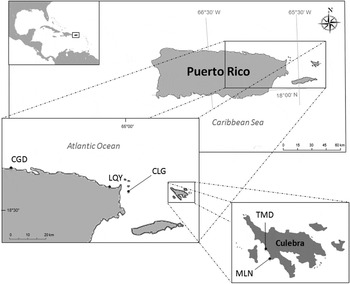
The study was conducted in four fringing reefs, located in north-eastern Puerto Rico and Culebra Island: Cerro Gordo (CGD: 18°16′51.40″N 65°17′12.21″W), Luquillo (LQY: 18°23′18.46″N 65°43′5.52″W), Tamarindo Bay (TMD: 18°18′55.29″N 65°19′5.82″W), Melones (MLN: 18°18′15.70″N 65°18′42.27″W), and Key Largo (CLG: 18°18′31.29″N 65°34′48.48″W), see Figure 1. Study area descriptions appear in Rodríguez-Barreras et al. (Reference Rodríguez-Barreras, Pérez, Williams, Mercado-Molina and Sabat2014a). The experiment was carried out between October and December 2012; during which field and enclosed experiments lasted 1 month each.
Map showing the five study sites: Cerro Gordo (CGD), Luquillo (LQY), Key Largo (CLG), Tamarindo Bay (TMD) and Melones (MLN).

Experimental setup
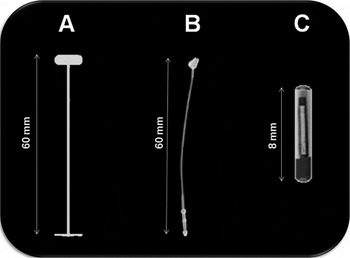
We established three circular plots of 5 m diameter, each separated by 20 m, with the centre of each circle marked with iron bars to avoid using the same sea urchin in more than one treatment. The sea urchin D. antillarum has a well-established ‘homing behaviour’, where individuals usually do not displace more than 4 m from the site used as refuge (Carpenter, Reference Carpenter1984). A buffer zone of an additional 5 m radius from the border of the plots was established to check for any potential displacement of individuals outside of the study plots. We tagged only individuals of D. antillarum greater than 40.0 mm of horizontal test diameter. We used PIT-tags, and two external tags: tag fasteners inserted through a hole in the test (T-bar), and snap lock pins attached to one of the urchin's spines (S-tag) (Figure 2). For field experiments, each type of tag was tested in different months. We did not tag the same sea urchin with more than one type of tag.
Three types of tags used in the sea urchin Diadema antillarum: (A) T-bar, (B) S-tag and (C) PIT-tag.

Tags were tested in the field under two conditions: enclosed and free ranging. We selected 20 sea urchins for each trial at each location. PIT-tags were tested at CGD, LQY, TMD and MLN; while T-bars and S-tags were tested in all locations except at CGD. The site LQY was the only one checked weekly during the experiments. With the resulting data, we calculated the per cent of recapture for each treatment, which is the number of tagged sea urchins recaptured after a month, and would be equivalent to retention under field conditions. All individuals were tagged in situ and immediately liberated after tagging.
Another experiment was conducted to measure the effect of tags on mortality and retention under semi-captivity conditions. A group of 10 sea urchins per treatment (one control and three tag treatments) were placed inside bottomless metallic cages (2 m length × 1 m height × 1 m wide) during 1 month in CLG with no replicates. Sea urchins were assigned randomly to treatments and each cage represented a treatment to allow correct individual/treatment identification.
T-shape fasteners tag (T-bar)
Individuals were tagged using a Fine Tagging Gun. Light pressure was applied in the inter-ambulacral region until the test was perforated and a hole of 1.5 mm was made. Once the needle was inside the coelomic cavity, the tagging gun was engaged and the tag attached against the inside wall of the test. The distal part of the tag outside the urchin was labelled with a number code (Figure 2A).
Snap lock pin (S-tag)
The S-tag has a structure composed of three proximal teeth with a cavity in the middle of one side and a distal 60 mm tail (Figure 2B). We added a label in the distal side for identification purposes. We attached the tag to a spine close to the peristome membrane for maximum visibility, using a pipette to push the proximal side of the tag through the spine close to its base. Once the tag was in place, the pipette was withdrawn, and the tag fixed to the spine by adding a droplet of a non-toxic Ecotech Marine Coral Glue (www.ecotechmarine.com).
Passive integrated transponders (PIT-tag)
Sea urchins were tagged in situ with a 8 mm PIT-tag (HDX-134.2 kHz, Figure 2C) and their test diameters were measured with a caliper (error ± 0.5 mm). The PIT-tag was inserted through the peristome membrane and into the coelom cavity with a plastic injector and a 2.15 mm diameter needle. Sites were visited 1 month later and sea urchins identified with a handheld portable PIT-tag reader.
Statistical analysis
We ran a non-parametric analysis of variance (Kruskal–Wallis) to test differences in per cent of recapture among treatments (Zar, Reference Zar2010). We performed a pairwise comparison (Mann–Whitney U-test) to check which pairs of tags were significantly different from each other. This analysis was also performed to test for differences in mortality and retention among treatments. Statistical analyses were performed in the statistical program R version 3.0.1 with an alpha value of 0.05 (R Core Team, 2013).
RESULTS
Open-field experiment
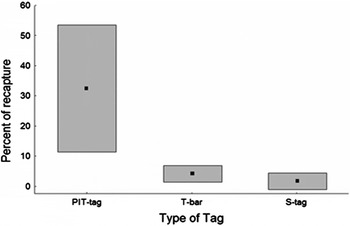
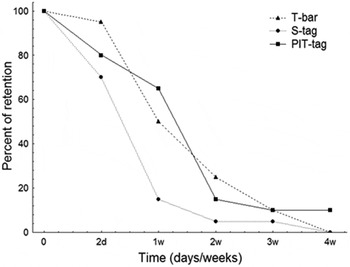
Recapture rates among all three tagging methods were low, with significant differences in recapture were detected among tagging methods (Kruskal–Wallis test, df = 2, H = 6.99, P = 0.030). The PIT-tag exhibited the highest retention rate, followed by T-bars, and lastly the S-tags (Figure 3). A posteriori pairwise comparison test found significant differences between PIT-tags and each of the other two types (P < 0.05), whereas T-bar and S-tag did not exhibit remarkable differences between them (P > 0.05). The PIT-tag recaptures averaged 32.5 ± 22.18%, and exhibited high variability among sites. Recaptures ranged from 10% in LQY to 60% in MLN. In LQY, where individuals were followed weekly, the greatest loss of PIT-tags occurred during the first week, with 35% of the tags lost (Figure 4). With the T-bar, we obtained an average recapture of 1.67 ± 2.89%, with no recaptures in TMD or MLN, and a maximum of 5% in LQY (Figure 3). Weekly sampling showed a constant decline in retention. Recaptures decreased 50% after the first week, and maintained this declining trend until the last week, in which no recaptures were identified (Figure 4). Some carcasses were found in LQY, recognized by the presence of the drilled holes (Figure 5B).
Overall recaptures (Mean ± SD) of three different tagging methods for the sea urchin Diadema antillarum after 1 month at four sites for PIT-tag, and three sites for S-tag and T-bar, all in the north-eastern coast of the Puerto Rico Archipelago.

Recapture rate (without replicates) of three different tags for the sea urchin Diadema antillarum at Luquillo Beach (LQY).

Detail of a live sea urchin Diadema antillarum with a damaged area covered with fine sediment after the loss of the T-bar (A). The same species with the T-tag still inserted (B). Notice the internal view of the same test with the base of the T-bar and the drilled area with necrotic signals (black colour). Sea urchin carcass with the S-tag attached to the aboral region (C) and evidence of autotomy response to the presence of T-bar (D).
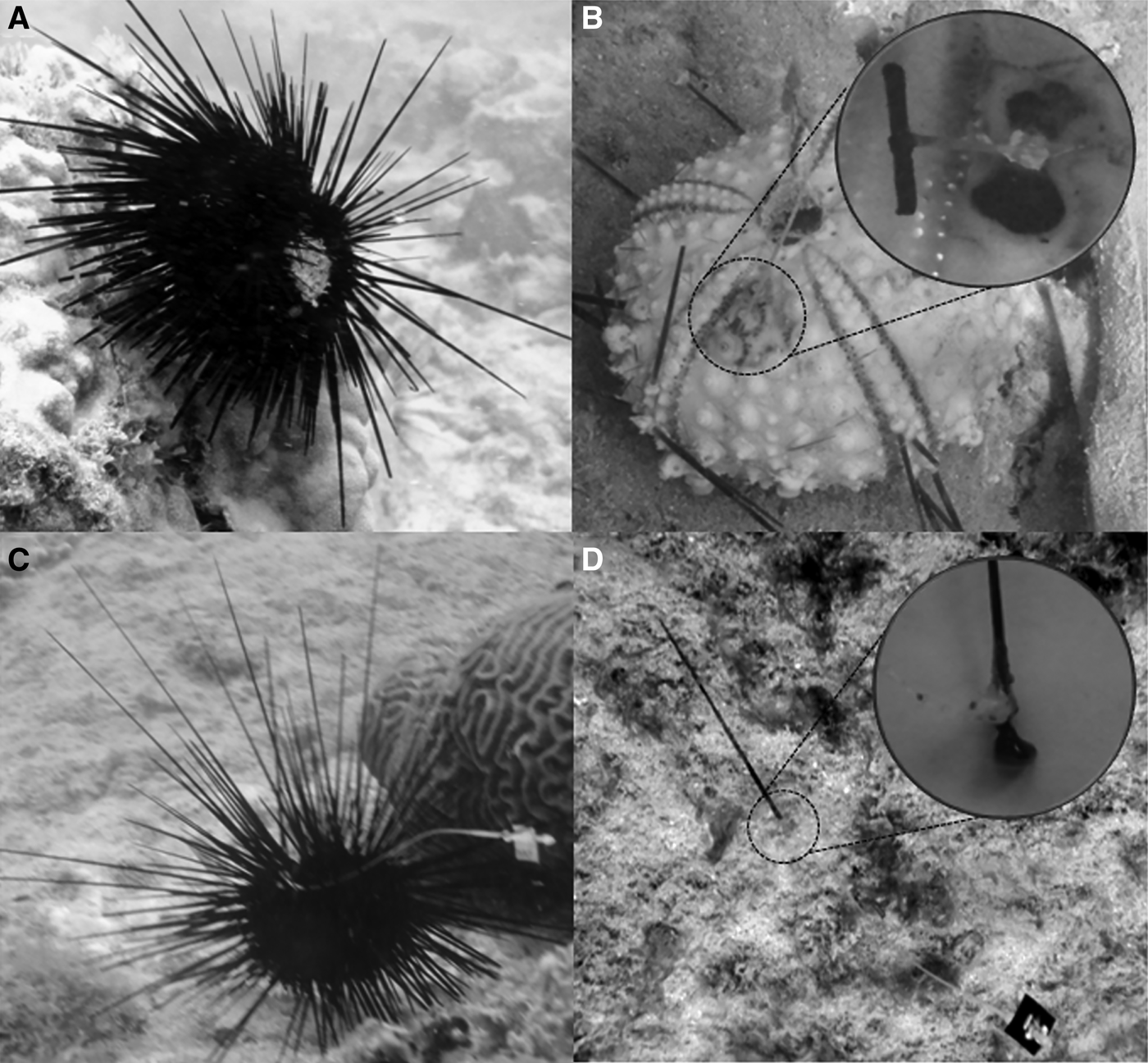
S-tag recaptures were 3.33 ± 2.89%, and ranged from no recaptures in TMD, to a maximum of 5% in LQY and TMD (Figure 3). Particularly in LQY, recaptures dropped 85% at the end of the first week, and only 5% retained the S-tag after a month (Figure 4). Spine autotomy was detected in S-tagged individuals. Some entire spines with the S-tag still attached were found in the field, showing evidence of high rates of autotomy. Some echinoids were easily recognized for the absence of one large dorsal spine and the presence of a naked tubercle (not covered with epidermis), which indicates a recent autotomy event. Indeed, we recorded 10% of autotomy with S-tags during the first hour after the procedure (Figure 5C, D). This tagging procedure was time consuming due to the excessive spine and pedicellariae movement, a natural response when a sea urchin is manipulated.
Semi-captivity experiment
In the experiment where sea urchins were tagged and placed in metallic cages for 1 month, CLG individuals exhibited low tag retention for all three tags. Echinoids exhibited 30% of retention and 20% of mortality with PIT-tags. Individuals with no signal were dissected to eliminate a potential reading error, and no PIT-tag was found in the coelomic cavity. T-bar tagged sea urchins exhibited 40% mortality after a month, and surviving individuals had no tag (i.e. 0% retention). Two live individuals showed the presence of a circular layer of fine sediment covering the affected area (Figure 5A); whereas the other three individuals showed evidence of the drilled area covered by new epidermis. The tests belonging to dead individuals exhibited evidence of necrosis in the drilled area (Figure 5B). No mortality, but 0 retention rates were recorded for S-tags after a month. Control sea urchins exhibited no mortality either.
DISCUSSION
The major goal of this study was to provide information about the effectiveness of three different tags in the sea urchin D. antillarum, both under semi-captivity and field conditions. Several studies have previously reported high retention rate and low mortality in laboratory trials with PIT-tags in echinoids (Hagen, Reference Hagen1996; Cipriano et al., Reference Cipriano, Burnell, Culloty and Long2014; Hazan et al., Reference Hazan, Wangensteen and Fine2014). High retention and survivorship are required for a successful and accurate long-term capture-mark-recapture study aimed at estimating vital rates (Williams et al., Reference Williams, Nichols and Conroy2002; Amstrup et al., Reference Amstrup, Macdonald and Manly2006). For instance, a study conducted with the echinoid Strongylocentrotus purpuratus recorded 100% retention rate (Sonnernholzner et al., Reference Sonnernholzner, Montaño-Moctezuma and Searcy-Bernal2010), while the same technique tested in another sea urchin reported more than 90% of retention and no mortality after 2 months (Hagen, Reference Hagen1996). However, another study conducted in Strongylocentrotus droebachiensis found low retention and survival under field conditions (Lauzon-Guay & Scheibling, Reference Lauzon-Guay and Scheibling2008). Our results differed from these studies because retention/recaptures with PIT-tags were lower than expected. The highest recapture rate of 60% recorded in one of the three localities cannot be considered suitable for long-term studies.
The majority of studies with PIT-tags in echinoids have been conducted under controlled conditions in laboratory and other marine facilities, but not in the field (Kalvas et al., Reference Kalvas, Henrix and Law1998; Palleiro-Nayar et al., Reference Palleiro-Nayar, Sosa-Nishizaki and Montaño-Moctezuma2009; Sonnernholzner et al., Reference Sonnernholzner, Montaño-Moctezuma and Searcy-Bernal2010). Differences in retention and mortality rates between field and laboratory experiments suggest that environmental conditions decreases the efficacy of PIT-tags in field studies. However, Cipriano et al. (Reference Cipriano, Burnell, Culloty and Long2014) found high recapture with Paracentrotus lividus in the field, which disagrees with our results. Low retention obtained here for PIT-tags demonstrate that field conditions may diminish the effectiveness of tags, lowering retention/recapture rates.
Previous evaluations of T-bars in other echinoids have recorded low mortality rates (Dix, Reference Dix1970; Duggan & Miller, Reference Duggan and Miller2001). Low survival and low retention obtained here demonstrates the unsuitability of this technique for long-term field studies. This invasive device in which the test is drilled may cause internal infection, and induces necrosis around the affected area (Figure 5B). Indeed, Olson & Newton (Reference Olson and Newton1979) reported epithelium growth around the drilled area, but the test did not recalcify properly. Furthermore, substrate complexity may play an important role for external tags. The external T-bar is exposed directly to substrate irregularities, being lost easily in the field, but not in fish tanks where rugosity is not significant. T-bars may have become lodged in the wall of the metallic cages or between rocks, and subsequently lost. The other tested external tag, however, could reduce loss probabilities due to its pointed distal shape (Figure 2).
This was the first time that S-tags were used in D. antillarum. This type of tag is considered the least invasive because it does not require the entrance of any device into the coelomic cavity. Nevertheless, attaching a device to Diadema spines is not new. A similar method was used on D. antillarum in which numbered surgical tubes were inserted in the spine (Carpenter, Reference Carpenter1984); whereas we used a toothed structure (Figure 2) fixed with a non-toxic glue to minimize the pedicellariae removing effect. The sea urchin detected the presence of a non self-object and induced an autotomy response. Carpenter (Reference Carpenter1984) was able to identify individuals during 6 months and reported an autotomy rate of 10%. However, we recorded 100% autotomy and no recaptures after 1 month. We speculate that some chemical component of the non-toxic glue may have led to an increase in autotomy or that the length of the tag made its detection easier for Diadema, which released the entire spine from the base including the attached tag (Figure 5D).
Another factor which may have negatively influenced our results is predation, particularly with T-bars. Mixed groups of the small wrasses Thalassoma bifasciatum and Halichoeres bivittatus were observed surrounding and aggressively biting urchins recently tagged with a T-bar. Both of these carnivorous fishes have been previously reported as potential predators of D. antillarum by Lessios (1988). Moreover, the existence of an injured area (where the T-bars attached to the test) occasionally attracted the polychaete Hermodice carunculata. On more than 15 occasions we recorded the presence of this fire worm on recently T-bar tagged D. antillarum. This polychaete moved through the spine canopy until it found the hole, and removed living tissue around the drilled zone.
We confirmed the homing behaviour of D. antillarum proposed by Carpenter (Reference Carpenter1984); 95% of the tagged sea urchins moved no more than 5 m from the designated circular plots. This result supports the conclusion that low recaptures were not related to movements of Diadema, outside the study plots.
Since the PIT-tags have been successfully used in other sea urchin species (e.g. Cipriano et al., Reference Cipriano, Burnell, Culloty and Long2014 in Paracentrotus lividus, and Rodríguez-Barreras & Sonnenholzner, Reference Rodríguez-Barreras and Sonnenholzner2015 in T. ventricosus), possible differences in the response of different species of echinoids against intra-coelomic tagging devices should be a reasonable explanation. It is possible that Diadema antillarum is more sensitive to invasive devices, which could still be used in other more tolerant species, such as T. ventricosus (Rodríguez-Barreras & Sonnenholzner, Reference Rodríguez-Barreras and Sonnenholzner2015). Further experiments are needed, involving other tropical and temperate sea urchin species, to reassess these results.
The development of a suitable tagging method is a real need for long-term studies in D. antillarum. Differences between previous studies conducted under controlled conditions and field experiments reflect the high variability and the necessity of testing tagging procedures under both conditions. The present study does not support the use of any of these tags for long-term studies in D. antillarum due to low retention. The S-tag and T-bar were the least adequate tags to use in D. antillarum. The S-tag induced high autotomy; whereas the T-bar tags had low retention and low survival. Nevertheless, T-bars can be useful and cheap for short-term studies on Diadema (see Clemente et al., Reference Clemente, Hernández and Brito2007). We do not recommend PIT-tags for short-term studies because of their relatively low effectiveness with D. antillarum. Although retention rates of PIT-tags were significantly higher than the other two tags, they are, nevertheless, too low to make them useful for long-term field experiments.
ACKNOWLEDGEMENTS
We would like to express our gratitude to Benjamin Branoff, and the anonymous reviewers for their valuable contribution to this manuscript.
FINANCIAL SUPPORT
We thank the Sea Grant Program (projects PD-295 and R92-110), as well as the Center of Applied Tropical Ecology and Conservation (CATEC) of the University of Puerto Rico for their economic and logistic support.