Introduction
The present study employed experience sampling methodology (ESM) to examine the expression of positive and negative schizotypy in daily life in a non-clinical sample of young adults. Schizotypy is conceptualized as a broad, multidimensional phenotype that encompasses schizophrenia, schizophrenia-spectrum disorders and the prodrome, as well as non-clinical manifestations (e.g. Meehl, Reference Meehl1990; Claridge, Reference Claridge1997; Lenzenweger, Reference Lenzenweger2010; Kwapil & Barrantes-Vidal, in press). It is assumed that the majority of schizotypes will never decompensate, although they may demonstrate mild or transient signs of schizophrenia including neurocognitive and biobehavioral deficits, clinical and subclinical symptoms, and social impairment. Thus, schizophrenia represents the most severe manifestation of the schizotypic continuum. Consistent with multidimensional models of schizophrenia, schizotypy is a multidimensional construct in which positive schizotypy and negative schizotypy are the most consistently replicated factors (e.g. Raine et al. Reference Raine, Reynolds, Lencz, Scerbo, Triphon and Kim1994; Vollema & van den Bosch, Reference Vollema and van den Bosch1995; Stefanis et al. Reference Stefanis, Hanssen, Smirnis, Avramopoulos, Evdokimidis, Stefanis, Verdoux and Van Os2002). Parallel facture structure in schizophrenia and non-clinical schizotypy adds empirical support to the hypothesis that the vulnerability for schizophrenia is expressed across the continuum of schizotypy.
The Wisconsin Schizotypy Scales, including the Magical Ideation (Eckblad & Chapman, Reference Eckblad and Chapman1983), Perceptual Aberration (Chapman et al. Reference Chapman, Chapman and Raulin1978), Physical Anhedonia (Chapman et al. Reference Chapman, Chapman and Raulin1976), and Revised Social Anhedonia (M. Eckblad et al. unpublished observations) Scales, have been widely used to assess schizotypy in clinical and non-clinical samples. Numerous studies (e.g. Lewandowski et al. Reference Lewandowski, Barrantes-Vidal, Nelson-Gray, Clancy, Kepley and Kwapil2006; Brown et al. Reference Brown, Silvia, Myin-Germeys, Lewandowski and Kwapil2008; Kwapil et al. Reference Kwapil, Barrantes-Vidal and Silvia2008) indicate that two factors (positive and negative schizotypy) underlie the scales. Kwapil et al. (Reference Kwapil, Barrantes-Vidal and Silvia2008) indicated that the positive and negative schizotypy dimensions were differentially related to psychopathology, personality and social functioning. Both schizotypy dimensions were related to schizotypal and paranoid personality disorder symptoms. Positive schizotypy was uniquely related to psychotic-like experiences, substance abuse, mood disorders and history of mental health treatment, whereas negative schizotypy was specifically associated with negative and schizoid symptoms. Both dimensions were associated with poorer overall and social functioning, but negative schizotypy was associated with decreased likelihood of intimate relationships. However, little is known about the experience and expression of these dimensions of schizotypy in daily life.
Researchers recently began using ESM to explore the daily life experiences of schizophrenic patients and the context in which these experiences occur (e.g. Myin-Germeys et al. Reference Myin-Germeys, Delespaul and van Os2003a; Kimhy et al. Reference Kimhy, Delespaul, Corcoran, Ahn, Yale and Malaspina2006; Granholm et al. Reference Granholm, Loh and Swendsen2008). ESM is a within-day self-assessment technique in which participants are prompted at random intervals to complete brief questionnaires. ESM offers several powerful advantages to traditional assessment procedures (e.g. deVries, Reference deVries1992; Hektner et al. Reference Hektner, Schmidt and Csikszentmilhalyi2007). Specifically, ESM (1) repeatedly assesses participants in their normal daily environment, thereby enhancing ecological validity; (2) assesses the participants' experiences at the time of the signal, thereby minimizing retrospective bias; and (3) allows for an examination of the context of participants' experiences.
ESM studies indicate that patients with schizophrenia are more emotionally active than behavioral observations suggest (Myin-Germeys et al. Reference Myin-Germeys, Delespaul and deVries2000), that daily life context makes an impact on the experience of delusions (Myin-Germeys et al. Reference Myin-Germeys, van Os, Schwartz, Stone and Delespaul2001), and that different patterns of emotional reactivity occur for patients with schizophrenia and affective disorders (Myin-Germeys et al. Reference Myin-Germeys, Peeters, Havermans, Nicolson, Delespaul, deVries and van Os2003b). In addition, several recently published studies used ESM with putatively schizotypic college students. Verdoux et al. (Reference Verdoux, Husky, Tournier, Sorbara and Swendson2003) reported that change in social contact was associated with the experience of psychotic symptoms in positive schizotypy participants. Husky et al. (Reference Husky, Grondin and Swendsen2004) reported that schizotypy was associated with increased negative affect (NA) when with friends, but decreased NA in secure environments. Kwapil et al. (Reference Kwapil, Silvia, Myin-Germeys, Anderson, Coates and Brown2009) reported that high scorers on the Revised Social Anhedonia Scale exhibited schizoid-like social functioning.
The present study seeks to extend these ESM studies examining the experience and expression of schizotypy. It is hypothesized that positive and negative schizotypy will be associated with differential patterns of cognition, affect, social functioning and activities in daily life. Specifically, it is hypothesized that positive schizotypy will be related to increased NA, thought impairment and problems in daily activities, whereas negative schizotypy will be related to anhedonia and disinterest in social contact. The study also examines the effect of social contact on mood, cognition and activities in daily life, as well as the extent to which positive schizotypy and negative schizotypy moderate these relationships.
Method
Participants
Usable ESM data were collected from 412 undergraduates (310 female, 102 male) enrolled in psychology courses (mean age = 19.9, s.d. = 2.9 years). An additional 18 participants enrolled in the study, but were omitted from the analyses (ESM data were irretrievable for 13 participants due to equipment malfunctions and five participants failed to complete at least 15 ESM questionnaires). Participants received course credit for taking part in the study. Participants who completed at least 70% of the ESM questionnaires were entered into a gift card drawing.
Materials and procedures
Participants completed the four Wisconsin Schizotypy Scales during mass-screening sessions. The four schizotypy scales reliably produce two factors, positive and negative schizotypy, that account for 80% of their variance (Kwapil et al. Reference Kwapil, Barrantes-Vidal and Silvia2008). Participants were assigned positive and negative schizotypy dimensional scores, based upon factor loadings from a sample of 6137 undergraduates. Standardized scores ranged from −1.73 to 4.17 on the positive schizotypy factor and from −2.08 to 5.25 on the negative schizotypy factor. Participants who completed the mass-screening sessions were able to enroll voluntarily in the ESM study using an on-line sign-up system. In order to ensure that there was an adequate number of participants in the ESM study who had elevated positive and negative schizotypy scores, we emailed participants who scored 1.5 s.d. or higher above the mean on the positive or negative schizotypy scales in the mass-screening sessions to invite them to sign up for the study. Note that 46% of the participants who scored 1.5 s.d. or higher above the mean on the schizotypy dimensions participated in the ESM study. High-scoring subjects who did participate did not differ from those who did not participate on schizotypy scores, age or sex.
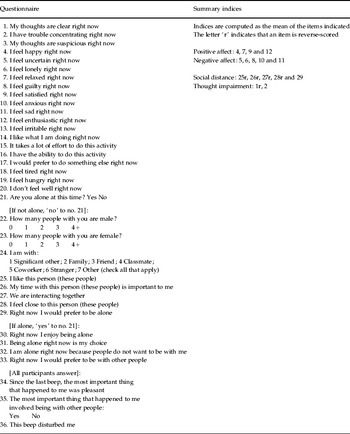
ESM data were collected on palm pilot personal digital assistants (PDAs). The ESM questionnaire inquired about a variety of daily life events including cognitions, emotions, activities and social contact. Following Myin-Germeys et al. (Reference Myin-Germeys, van Os, Schwartz, Stone and Delespaul2001), summary indices were computed for positive affect (PA) (coefficient α = 0.89), NA (α = 0.90), social distance (α = 0.91) and thought impairment (α = 0.79). Table 1 contains the ESM items and indices. The PDA signaled the participants to complete the ESM questionnaire eight times daily between 12.00 hours (noon) and 00.00 hours (midnight) for 7 days. Each questionnaire required 2 min to complete.
ESM questionnaire and summary indices

Statistical analyses
ESM data have a hierarchical structure in which ESM ratings (level 1 data) are nested within participants (level 2 data). Multilevel or hierarchical linear modeling provides a more appropriate method than conventional unilevel analyses for analysing nested data. Multilevel modeling techniques are a variant of the more commonly used unilevel regression analyses (Luke, Reference Luke2004), and are standard for the analysis of ESM data (Nezlek, Reference Nezlek2001).
The multilevel analyses in the present study examined two types of relationships between the schizotypy factor scores and experiences rated in daily life. The first was the intercept of the level 1 criterion, which assessed the independent effects of the level 2 predictors (positive and negative schizotypy) on level 1 dependent measures (ESM ratings in daily life). The second analyses examined the cross-level interactions of the associations of the level 1 ESM variables (e.g. PA and social contact) with the level 2 ratings of schizotypy. Cross-level interactions (or slopes-as-outcomes) test whether level 1 relationships (e.g. the association of social contact and PA in daily life) vary as a function of level 2 variables. The associations of the level 1 variables in cross-level interactions provide an effective test of the validity of the assessment of daily experiences, although they are not necessarily directly related to hypotheses regarding positive and negative schizotypy. Note that the level 2 predictors positive schizotypy and negative schizotypy were entered simultaneously in all analyses, so the effects of each were assessed with the other partialed out of the equation. The positive × negative schizotypy interaction term was entered at a second step to examine its effect over and above the partialed main effects.
The analyses were computed with MPlus 6.1 (Muthén & Muthén, Reference Muthén and Muthén2010). Level 1 predictors were group mean centered and level 2 predictors were grand mean centered. The data departed from normality in some cases, so parameter estimates were calculated using robust standard errors. Furthermore, level 1 criteria exhibiting significant skew were treated as categorical.
Results
Participants averaged completing 41.8 usable questionnaires (s.d. = 10.8). Neither the positive nor negative schizotypy factor was significantly correlated with the number of usable records (r = − 0.10 and −0.04, respectively). The positive and negative schizotypy dimension scores were modestly correlated in the present sample (r = 0.20, p < 0.001).
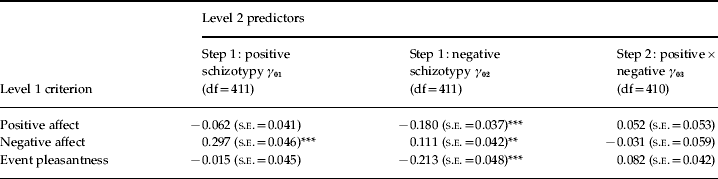
Positive schizotypy and negative schizotypy were differentiated by their experience of affect in daily life (Table 2). Positive schizotypy was associated with increased reports of NA, as well as with greater variability in the experience of NA in daily life (r = 0.24, p < 0.001; i.e. zero-order correlation of each participant's schizotypy score with the variance of their affect in daily life). However, positive schizotypy was unassociated with PA or variability in PA in daily life (r = 0.08). Negative schizotypy was associated with decreased PA, as well as with decreased ratings of the pleasantness of the most important event since the last signal. Negative schizotypy was unrelated to the variability in ratings of PA (r = 0.02). Negative schizotypy was also associated with overall NA, specifically with feeling uncertain and sad in daily life, but not with feeling anxious, guilty or lonely. Negative schizotypy was unrelated to variability of NA (r = 0.05). Note that the schizotypy interaction term did not account for additional variance in any of the analyses.
Relationship of positive and negative schizotypy with experiences in daily life: affect
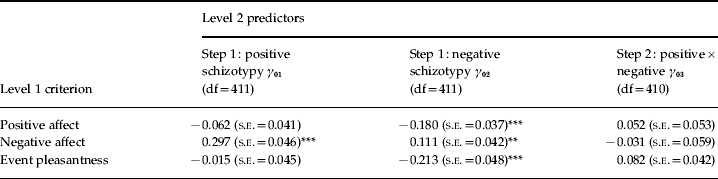
Data are given as raw multilevel regression coefficients indicating the relationship of the level 2 predictors with the level 1 (daily life experience) criteria.
df, Degrees of freedom; s.e, standard error.
** p < 0.01, *** p < 0.001.
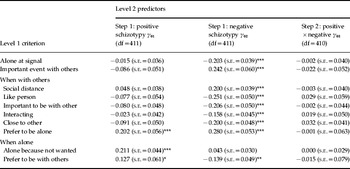
Positive schizotypy and negative schizotypy were also differentiated by social contact and functioning in daily life (Table 3). Consistent with hypotheses, negative schizotypy was characterized by social disinterest. Specifically, it was associated with decreased social contact, decreased likelihood that the most important event since the last signal involved other people, greater social distance when with others, feeling less closeness, increased desire to be alone when with others, and decreased desire to be with others when alone. Positive schizotypy was unassociated with the proportion of time spent with others or social disinterest. Strikingly, positive schizotypy was associated with an increased desire to be with people when alone, but an increased desire to be alone when with others. It was also associated with the attribution that being alone was due to being unwanted by others (i.e. feeling rejected).
Relationship of positive and negative schizotypy with experiences in daily life: social contact and functioning

Data are given as raw multilevel regression coefficients indicating the relationship of the level 2 predictors with the level 1 (daily life experience) criteria.
df, Degrees of freedom; s.e, standard error.
* p < 0.05, ** p < 0.01, *** p < 0.001.
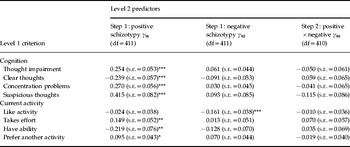
Table 4 presents the relationship of positive and negative schizotypy with impairment in cognition and activities in daily life. Positive, but not negative, schizotypy was associated with difficulty concentrating, less clear thoughts and suspiciousness. Positive schizotypy was also associated with negative beliefs and expectations about current activities – specifically that activities required effort, the participant lacked ability to complete the activity, and preference for another activity. Negative schizotypy was unassociated with impairment in thought. It was associated with a decreased enjoyment from activities, but unassociated with negative beliefs about current activities.
Relationship of positive and negative schizotypy with experiences in daily life: cognition and daily activities

Data are given as raw multilevel regression coefficients indicating the relationship of the level 2 predictors with the level 1 (daily life experience) criteria.
df, Degrees of freedom; s.e, standard error.
* p < 0.05, ** p < 0.01, *** p < 0.001.
Cross-level interactions examined the associations of level 1 variables in daily life across levels of positive and negative schizotypy in three broad areas: (1) relationship of social contact with affect and functioning, (2) relationship of closeness of contacts with affect and functioning, and (3) factors affecting suspiciousness in daily life. The first set of multilevel analyses examined whether positive and negative schizotypy moderated the relationships of social contact (alone = 1; with others = 2) with PA and NA. There was a positive association between social contact and PA (γ = 0.261, s.e. = 0.025, p < 0.001), indicating that in general people experience more PA when with others than when alone. This association was not moderated by positive or negative schizotypy. Conversely, NA had an inverse association with social contact (γ = − 0.256, s.e. = 0.022, p < 0.001), indicating that people generally experience more NA when alone than when with others. This association was exacerbated by positive schizotypy (γ = − 0.062, s.e. = 0.023, p < 0.01), such that being alone was more strongly associated with NA in people high in positive schizotypy than people low in positive schizotypy.
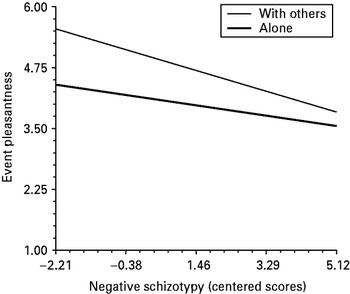
Participants were asked to rate the pleasantness of the most important event since the last ESM signal and to indicate whether it involved other people. There was a significant association between event pleasantness and social contact (γ = − 0.890, s.e. = 0.048, p < 0.001), indicating that, in general, events were experienced as more pleasant when with others. However, this association was moderated by negative schizotypy (γ = 0.137, s.e. = 0.054, p < 0.05), as seen in Fig. 1. High levels of negative schizotypy were associated with considerably less pleasure when with others than low negative schizotypy.
Relationship of the pleasantness of the most important event since the last signal with whether that event involved being with other people or not across levels of negative schizotypy.

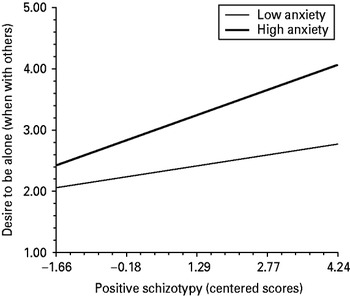
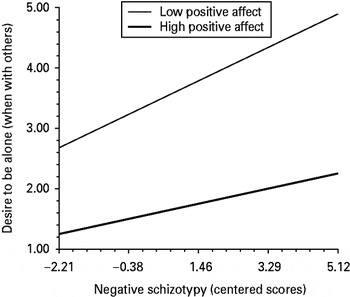
Positive schizotypy and negative schizotypy were associated with a preference to be alone when with others. However, the desire to be alone in the two dimensions was differentiated by the experience of anxiety and PA in the moment (Figs 2 and 3, respectively). The desire to be alone in positive schizotypy occurred at high levels of anxiety in the moment (γ = 0.030, s.e. = 0.015, p < 0.05), although this moderating relationship did not occur with negative schizotypy. In contrast, the desire to be alone in negative schizotypy was associated with decreased PA (γ = − 0.049, s.e. = 0.020, p < 0.05). Participants also reported experiencing more cognitive disturbance in daily life when they were alone (γ = − 0.122, s.e. = 0.028, p < 0.001), which was exacerbated by positive (γ = − 0.055, s.e. = 0.026, p < 0.05), but not negative, schizotypy.
Relationship of desire to be alone (when with others) with anxiety (——, low anxiety;
 , high anxiety) across levels of positive schizotypy.

Relationship of desire to be alone (when with others) with positive affect (——, low positive affect;
 , high positive affect) across levels of negative schizotypy.

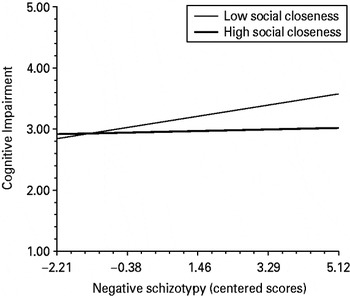
In addition to examining the effect of social contact, we examined the effect of the closeness of social interactions on daily experiences. PA and social closeness were positively correlated (γ = 0.152, s.e. = 0.007, p < 0.001), although this association was not moderated by schizotypy. Closeness was associated with decreased NA (γ = − 0.052, s.e. = 0.006, p < 0.001) and this was more pronounced in high positive schizotypy than low positive schizotypy (γ = − 0.019, s.e. = 0.007, p < 0.01). Cognitive disturbances in daily life were associated with greater distance in social contact (γ = − 0.079, s.e. = 0.011, p < 0.01). This association was moderated by negative schizotypy (γ = − 0.016, s.e. = 0.007, p < 0.05), such that the relationship only held for participants who were high in negative schizotypy (despite the fact that overall negative schizotypy was unrelated to cognitive disturbance). Low negative schizotypy participants tended not to experience cognitive disturbance and it was unrelated to closeness (Fig. 4). Reports of suspiciousness in daily life were unrelated to social closeness and were not moderated by the schizotypy ratings. Social closeness was inversely related to anxiousness (γ = − 0.088, s.e. = 0.010, p < 0.001) and this association was exacerbated by positive schizotypy (γ = − 0.019, s.e. = 0.008, p < 0.05). Furthermore, there was a positive association of cognitive disturbance and suspiciousness (γ = 0.197, s.e. = 0.012, p < 0.001) that was moderated by positive schizotypy (γ = 0.031, s.e. = 0.013, p < 0.05). Participants high in positive schizotypy experienced more suspiciousness overall and had a significantly stronger association of thought impairment and suspiciousness.
Relationship of cognitive impairment with closeness of current interaction (——, low social closeness;
 , high social closeness) across levels of negative schizotypy.

Discussion
The present study examined the expression of positive and negative schizotypy in daily life using ESM in a large sample of non-clinical participants. Consistent with our hypotheses, the schizotypy dimensions were associated with meaningful and distinct patterns of psychological experiences, providing further support for: (1) the continuum model of schizotypy (given the consistency of the findings with the schizophrenia literature); (2) the multidimensional structure of schizotypy; and (3) the use of psychometric screening inventories for assessing these dimensions.
Despite the fact that neither positive nor negative schizotypy is primarily defined or measured by emotional disturbances, it was expected that these dimensions would be related to distinct patterns of affect in daily life given the significant influence that emotions have on cognitive processes and behaviors (e.g. Clore et al. Reference Clore, Gasper, Garvin and Forgas2001; Matthews & Wells, Reference Matthews, Wells, Dalgleish and Power2002). Positive schizotypy was related to increased NA, consistent with previous research in non-clinical samples describing associations of positive schizotypy with neuroticism (Krabbendam et al. Reference Krabbendam, Janssen and Bak2002; Kwapil et al. Reference Kwapil, Barrantes-Vidal and Silvia2008; Barrantes-Vidal et al. Reference Barrantes-Vidal, Morente and Kwapil2009), anxiety and depression (Spitznagel & Suhr, Reference Spitznagel and Suhr2004; Lewandowski et al. Reference Lewandowski, Barrantes-Vidal, Nelson-Gray, Clancy, Kepley and Kwapil2006; Brown et al. Reference Brown, Silvia, Myin-Germeys, Lewandowski and Kwapil2008), and history and development of mood symptoms and episodes (Chapman et al. Reference Chapman, Chapman, Kwapil, Eckblad and Zinser1994; Gooding et al. Reference Gooding, Tallent and Matts2005), as well as with studies relating neuroticism or NA with the positive symptom dimension in SPD (Gurrera et al. Reference Gurrera, Dickey, Niznikiewicz, Voglmaier, Shenton and McCarley2005; Berenbaum et al. Reference Berenbaum, Boden, Baker, Dizen, Thompson and Abramowitz2006) and schizophrenia (Berenbaum & Fujita, Reference Berenbaum and Fujita1994; Norman et al. Reference Norman, Malla, Cortese and Diaz1998; Myin-Germeys & van Os, Reference Myin-Germeys and van Os2007). Positive schizotypy was also associated with higher variability in ratings of NA during the week, suggesting instability in the experience of NA. This is consistent with findings that the levels of NA are especially context-dependent in positive schizotypy (especially when alone or with unfamiliar people). As hypothesized, positive schizotypy was unrelated to decrements in PA or a lower experience of pleasure in life events. It is important to note that PA and NA are separate, albeit distinct, dimensions, not the opposite poles of a bipolar dimension, which makes it possible to experience elevated NA without corresponding declines in PA.
The mechanisms underlying emotional dysregulation in positive schizotypy and schizophrenia are not entirely clear. However, Berenbaum et al. (Reference Berenbaum, Boden, Baker, Dizen, Thompson and Abramowitz2006) suggested that high levels of NA associated with positive schizotypy may result in a wide variety of errors in thinking. Consistent with this, Barrantes-Vidal et al. (Reference Barrantes-Vidal, Morente and Kwapil2009) reported that neuroticism moderated the association of positive schizotypy with ratings of psychotic-like symptoms and impairment.
Negative schizotypy was associated with increased NA (although to a lesser degree than the relationship of positive schizotypy with NA), consistent with the report by Berenbaum et al. (Reference Berenbaum, Boden, Baker, Dizen, Thompson and Abramowitz2006) that both positive and negative symptoms of schizotypal personality disorder were associated with increased levels of NA. As they noted, this is consistent with the extensively reported link between NA and all forms of psychopathology (e.g. Clark & Watson, Reference Clark and Watson1991). At the same time, the stronger association of NA with the positive rather than negative dimension is consistent with previous research in schizotypy (Lewandowski et al. Reference Lewandowski, Barrantes-Vidal, Nelson-Gray, Clancy, Kepley and Kwapil2006; Kwapil et al. Reference Kwapil, Barrantes-Vidal and Silvia2008) and schizophrenia (e.g. Emsley et al. Reference Emsley, Oosthuizen, Joubert, Roberts and Stein1999), despite the apparent higher phenotypic resemblance of depression to negative (e.g. apathy, social withdrawal, anhedonia) than positive schizotypy. Unlike positive schizotypy, negative schizotypy was not associated with increased variability of NA during the week. These findings, as well as clinical observations, indicate that negative schizotypy is associated with a reduced experience of affective tone and response, although not with a total lack of emotional discomfort (e.g. Myin-Germeys et al. Reference Myin-Germeys, Delespaul and deVries2000). Unlike positive schizotypy, negative schizotypy was associated with decreased PA and less pleasure from activities occurring at the time of the signal.
Overall, these findings are consistent with Bleuler's (Reference Bleuler1950; originally published in 1911) emphasis on the relevance of emotional disturbances in the development of positive symptoms (especially delusional ideation). This view is supported by empirical literature associating negative emotions with the positive dimension in both schizophrenia and schizotypy, whereas the negative dimension does not seem to be so affected by emotional disturbances. For example, research in schizophrenia suggests two distinct endophenotypes underlying these symptom dimensions; the negative dimension has been primarily related to neurocognitive impairment whereas the positive dimension has been related to sensitivity to stress (e.g. Myin-Germeys & van Os, Reference Myin-Germeys and van Os2007), consistent with the association between positive and affective symptoms. The negative and odd dimensions seem to be genetically more closely related to schizophrenia, whereas positive symptoms may also overlap with mood disorders (e.g. Vollema & van den Bosch, Reference Vollema and van den Bosch1995; Battaglia & Torgersen, Reference Battaglia and Torgersen1996).
Human beings are social creatures and human functioning takes place within a social milieu. Baumeister & Leary (Reference Baumeister and Leary1995) proposed that people possess an innate ‘need to belong’ that compels them to pursue meaningful social encounters. According to this theory, people experience well-being and enhanced functioning when the need to belong is fulfilled. The present data supported this theory in that being with others in daily life was associated with increased PA, decreased NA, and more pleasure from activities. However, both positive schizotypy and negative schizotypy were characterized by impairments in social functioning in daily life and the schizotypy dimensions were differentiated by the nature of the impairment and presumably by the role that it played in daily life.
As hypothesized, negative schizotypy involved a schizoidal style of relating to the world characterized by decreased social contact, diminished pleasure from and interest in interactions, and increased desire to be alone when with others. Persons with negative schizotypy were more likely to indicate that their most important experiences occurred when they were alone and that these experiences were more pleasant when alone. Consistent with Cornblatt & Keilp (Reference Cornblatt and Keilp1994), this social withdrawal might actually be a protective strategy for people cognitively vulnerable to psychosis. Positive schizotypy was not associated with decreased social contact or impairment in social interactions, although it was associated with increased NA and thought impairment when alone and increased (social) anxiety when with others with whom they were not close.
Positive schizotypy was associated with increased desire to be alone when with others and increased desire to be with others when alone – consistent with ambivalence described by Bleuler (Reference Bleuler1950) in schizophrenia and Meehl (Reference Meehl1962) in schizotypy. Bleuler considered ambivalence to be a fundamental symptom of schizophrenia that represented significant disruption in cognitive and emotional processing (central to his idea of splitting of associative threads). Consistent with the increased social anxiety and ambivalence, positive schizotypy was associated with increased suspiciousness, suggesting that persons high in positive schizotypy experience distress and thought impairment when alone, but also experience the pursuit of social contact as a risky endeavor.
The social impairment that characterizes schizotypy and schizophrenia appears to be differentiated in large part by the experience of PA and NA in social situations. As noted above, negative schizotypy is characterized by a generalized decrease in PA. Similarly, negative schizotypes' social behavior is characterized by disinterest and lack of approach or appetitive behaviors. Thus, social impairment and withdrawal associated with negative schizotypy seem to occur because social encounters are less rewarding. In contrast, social impairment associated with positive schizotypy arises not from a lack of PA, but from negative emotions associated with fear of evaluation and paranoid ideation. In the present study, the desire to be alone in positive schizotypy was driven by increased anxiety, whereas the desire to be alone in negative schizotypy was driven by decreased PA.
Thus, a picture emerges in which positive schizotypy is associated with increased distress and trouble thinking clearly when alone. Social contact with trusted others appears to be protective for persons high in positive schizotypy; however, social contact with less familiar individuals produces marked anxiety and desire to be alone. Thus the road to beneficial social contact is a difficult one for positive schizotypes (consistent with the social anxiety and suspiciousness characteristic of schizotypal personality disorder). Consistent with schizoid personality disorder and negative symptom schizophrenia, negative schizotypy is characterized by decreased interest in, pleasure from, and connections within the social world.
The social impairment associated with schizotypy appears consistent with the social dysfunction reported in schizophrenia-spectrum disorders. Furthermore, it is especially concerning because numerous studies indicate that impairments in social functioning in at-risk samples predict development of schizophrenia (Davidson et al. Reference Davidson, Reichenberg, Rabinowitz, Weiser, Kaplan and Mark1999; Cannon et al. Reference Cannon, Walsh, Hollis, Kargin, Taylor, Murray and Jones2001). Johnstone et al. (Reference Johnstone, Ebmeier, Miller, Owens and Lawrie2005) reported that high-risk participants who developed schizophrenia were characterized by more social impairment than their counterparts who remained compensated. Likewise, Kwapil (Reference Kwapil1998) reported that 24% of non-psychotic young adults identified as schizotypic by the Revised Social Anhedonia Scale developed schizophrenia-spectrum disorders at a 10-year reassessment compared with only 1% of control participants.
The finding that social functioning is impaired in non-psychotic adults identified as schizotypic is consistent with the continuum model of schizotypy in which milder forms of schizophrenic impairment are exhibited by non-clinical schizotypes. This raises clinical concerns because social impairment in non-psychotic people with schizotypy may serve both as a marker of pre-morbid impairment and as a trigger that contributes to the transition into schizophrenia-spectrum disorders. Poor pre-morbid functioning is often characterized by social withdrawal and disinterest. Although the expressed emotion literature suggests that not all social contact is beneficial, social contact generally offers numerous protective features, which schizotypes may lack. This is especially problematic for schizotypes who experience prodromal symptoms, such as unusual beliefs and perceptual experiences, because they may fail to seek social support and clinical intervention.
Positive schizotypy was associated with impairments in concentration and clarity of thought, as well as increased suspiciousness. The experience of difficulty thinking left positive schizotypes prone to suspicious ideation. Furthermore, being with others partially diminished impairment in thinking, but not suspiciousness for positive schizotypes. These results are consistent with impairments reported in paranoid and schizotypal personality disorders. The findings of impairment in cognition are especially striking given that the sample consisted of college students, who might be expected to experience less cognitive impairment than community-based schizotypes. However, the findings are consistent with Meehl's (Reference Meehl1962) view that cognitive slippage represents the ‘diagnostic bell ringer’ of schizotypic and schizophrenic indicators (p. 828). The finding that difficulty thinking was more common in positive schizotypy and was associated with suspicious or paranoid ideation also raises concerns about participants' ability to function adaptively in a complex social milieu.
As hypothesized, negative schizotypy was associated with a decreased experience of pleasure in daily life (i.e. anhedonia), supporting the construct validity of the psychometric measurement of negative schizotypy. Note that these anhedonia ratings reflect experiences reported across an entire week and across a range of activities and contexts, indicating that negative schizotypy represents a generalized anhedonic temperament. Furthermore, the decreased experience of pleasure was greater when activities involved other people. This is consistent with the reported lack of pleasure derived from social contact by high negative schizotypes. Positive schizotypy was not associated with decreased enjoyment of events. However, positive schizotypy was associated with the perception that activities were burdensome and with feeling less competent to perform them – possibly due to the elevated levels of NA and NA reactivity associated with positive schizotypy.
General overview and conclusions
The present findings support the construct validity of a multidimensional model of schizotypy. However, simply identifying promising constructs or putatively vulnerable individuals does not explain the etiology of schizotypy or the development of schizophrenia-spectrum disorders. An improved understanding of the experiences of such individuals and the context in which they occur is needed to further our knowledge of these developmental processes. Furthermore, future studies should not be limited to only examining positive and negative schizotypy dimensions, but should also evaluate the validity and expression of other putative dimensions of schizotypy such as disorganization and paranoia. ESM provides a powerful and ecologically valid approach for assessing the nature of schizotypic (and by extension schizophrenic) behavior, affect, cognition and symptoms.
Studies of non-clinical schizotypes are frequently criticized for employing participants who have not developed schizophrenia or spectrum disorders, are not expected to develop such disorders during the course of the study, and in fact may never develop spectrum disorders in their lifetime. However, we strongly suggest that this criticism confounds construct validity with criterion validity. Transition into clinical disorders provides only one standard for assessing the (criterion) validity of measures of schizotypy. Furthermore, many studies of transition rates of prodromal patients focus on individuals who are already exhibiting marked spectrum symptoms. However, conceptual models of schizotypy and schizophrenia clearly suggest that most schizotypes are not exhibiting clinical levels of symptoms and that many if not most schizotypes will not deteriorate into clinical disorders (although, strikingly, psychometric inventories have demonstrated validity for predicting the development of spectrum disorders in high-functioning samples). Consistent with the construct validation approach, the present study developed specific hypotheses regarding schizotypic characteristics and impairment in a non-clinical sample, employed validated multidimensional measures of schizotypy, and identified meaningful schizotypic variation in a high-functioning sample of late adolescents and young adults.
Acknowledgements
The authors thank A. J. Anderson, Gena Barbee, Ben Cline and Sarah Coates for their assistance with data collection. No financial support was received for this work.
Declaration of Interest
None.