Introduction
The degradation of organic materials on pastures is a complex process in which microorganisms and edaphic fauna at and just below the soil surface play a key role. Dung beetles (Coleoptera: Geotrupidae and Scarabaeidae) are common participants in this process and promote pasture quality by accelerating the decomposition of cattle dung and its incorporation back into the soil. In California, United States of America (Anderson et al. Reference Anderson, Merritt and Loomis1984) and southern France (Lumaret and Kadiri Reference Lumaret and Kadiri1995), dung deposited on pastures in May and July, respectively, fully degraded in 18 months in the presence of insects, but required up to four years when insects were excluded. In Great Britain, dung deposited on pastures in mid-June was largely degraded in 100 days, but showed few signs of degradation when insects were excluded (Wall and Strong Reference Wall and Strong1987). In Alberta, Canada, dung deposited on native pastures in May was mostly degraded after 340 days, but showed no signs of degradation if first treated with an insecticide (Floate Reference Floate1998).
Dung beetle activity may also reduce populations of pestiferous flies and gastrointestinal parasites associated with dung (Fincher Reference Fincher1981). Following the introduction of cattle into Australia in the 18th century by British settlers and the subsequent intensification of livestock production, there were no endemic species of dung beetles suited to degrade cattle dung (Doube et al. Reference Doube, Macqueen, Ridsdill-Smith and Weir1991). The lack of this activity helped to maintain dung pats as breeding sites for flies that are pests of livestock (Bornemissza Reference Bornemissza1976) and which vector diseases such as trachoma, a major public and veterinary health problem (Ridsdill-Smith and Matthiessen Reference Ridsdill-Smith and Matthiessen1984, Reference Ridsdill-Smith and Matthiessen1988).
Dung beetles belong to three main functional guilds: Scarabaeinae (Scarabaeidae) as rollers and tunnellers, Aphodiinae (Scarabaeidae) as dwellers, and Geotrupidae as tunnellers (Cambefort and Hanski Reference Cambefort and Hanski1991). Degradation of dung is accelerated by the feeding activities of adults and larvae within the pats. These latter may consume daily 175–530% of their body mass (dry mass) in dung (Holter Reference Holter1974). The effectiveness of dung beetles in the use of animal dung depends on both their number and their size (Horgan Reference Horgan2001), the latter being correlated to their biomass (Lobo Reference Lobo1993). Core species total at least 10% of the assemblage at a given time, both in number and biomass of beetles (Lumaret et al. Reference Lumaret, Kadiri and Bertrand1992). Satellite species total at least 10% of total individuals or total biomass, whereas accessory species are those that total <10% of total individuals and <10% of total biomass (Stiernet and Lumaret Reference Stiernet and Lumaret1993). Core and satellite species define the functional group at a given time within an assemblage (Hanski Reference Hanski1982). Competition for trophic resources and reproduction sites in a dung beetle assemblage can be mitigated by the coexistence of species of the same size if they belong to different guilds or by the coexistence of species of the same guild that differ in size (Hanski and Cambefort Reference Hanski and Cambefort1991; Lumaret et al. Reference Lumaret, Kadiri and Bertrand1992).
The current study is the second of two papers reporting on dung beetle assemblages of native grasslands in southern Alberta, Canada. The first paper (Floate and Kadiri Reference Floate and Kadiri2013) summarised the relative abundance of species at each of three native grasslands with little reference to seasonal activity. It also reported recent changes to regional assemblages. This second paper examines in more detail, the assemblage at one of these grasslands localities for which most data were available. Specifically, changes in seasonal activity of species, abundance, biomass, and community structure. A previous study reported the seasonal activity for a number of these same species on disturbed grasslands in southern Alberta (Floate and Gill Reference Floate and Gill1998). Our work validates that earlier findings and provides data for additional species.
Materials and methods
Sites
Coprophagous beetles were collected on native grassland at the Purple Springs Grazing Reserve near the hamlet of Purple Springs, in southern Alberta, Canada. Located at an elevation of ∼800 m, the grazing reserve comprises 1530 ha of short grass prairie characterised by unshaded pastures with gently rolling hills and sandy soils. Cattle are present on these pastures from May through October.
The grazing reserve is in the province's dry mixed-grass natural subregion (Natural Regions Committee 2006). Weather records (1971–2000) for the city of Taber, ∼18 km from Purple Springs, identify annual precipitation of 368 mm, an average of 125+ frost-free days per year, and mean daily temperatures for January and July of −8.6 °C and 18.8 °C, respectively (Chetner and Agroclimatic Atlas Working Group Reference Chetner2003; Environment Canada 2013).
Within this general landscape, five dung-baited pitfall traps were operated at each of three sites (A, B, C). Site A (49°52′24.69′′N, 111°54′11.67′′W) was located near (<50 m) a small shallow pond maintained by an irrigation canal and surrounding by shrubby vegetation. Dominant shrubs included prickly rose, Rosa acicularis Lindley (Rosaceae), silverberry, Elaeagnus commutata Bernhardi ex Rydberg (Elaeagnaceae), and buckbrush, Symphoricarpos occidentalis Hooker (Caprifoliaceae). Site B (49°50′38.06′′N, 111°53′48.35′′W) was located along a fence line and was characterised by short grasses and forbs. Site C (49°50′55.72′′N, 111°53′21.46′′W) was similar to site B, but contained several large areas of open sand. Maximum and minimum distances between sites were 2.5 (sites A and B) and 0.8 km (sites B and C), respectively. Traps within sites were separated by a minimum distance of 10 m.
Trapping methods
Each pitfall trap comprised two plastic pails (1 L capacity), one nested inside the other, buried with the lip of the trap level with the soil surface. The outer pail prevented the hole from collapsing. The inner pail held a preservative (propylene glycol formulated in a commercial product sold as a non-toxic antifreeze) and was easily removed to recover insects collected during the trap period. A wire screen (∼25 mm grid) over the mouth of each trap supported a dung bait and excluded rodents and birds. Baits comprised cattle dung (∼75 g) wrapped in two layers of cheesecloth, previously prepared and frozen 1–16 weeks before use.
Such standard pitfall traps are used in routine for sampling dung beetles (Lobo et al. Reference Lobo, Martin-Piera and Veiga1988; Lumaret et al. Reference Lumaret, Kadiri and Bertrand1992; Kadiri Reference Kadiri1993; Kadiri et al. Reference Kadiri, Lobo and Lumaret1997).
Traps were operated from 19 May to 17 October 2008, 20 April to 9 October 2009, and 20 April to 15 October 2010. During these periods, traps normally were operated for three to four days, then emptied and re-baited each week (i.e., n = 15 trap catches/week). However, trap catches occasionally were lost either because of inclement weather, muddy road conditions that prevented access to traps, and (or) traps were flooded during heavy rain events. Recovered beetles were stored in 70% ethanol until sorted, counted, and identified.
Climatic conditions
Monthly records of mean air temperature (°C) and precipitation (mm) during the study were obtained from an Agriculture and Agri-Food Canada weather station at Vauxhall, Alberta, Canada. Located ∼30 km from Purple Springs, Vauxhall was the closest location with annual reports by month and a more recent 30-year period of climate data; i.e., 1980–2010 (Vauxhall).
Statistical methods
The pairwise comparison of dung beetle composition and abundance of assemblages between sites A, B, C, and years 2008–2010, was calculated using the χ 2 test with 95% confidence limits performed by the program Minitab™ Statistical Software Paris (version 13) (Minitab SARL, Paris, France).
Results did not detect an effect of year on the relative abundance of species at each site (χ 2 test; P < 0.05), nor an effect of site on the relative abundance of species for each year (χ 2 test; P < 0.05). Data were therefore combined across years and sites (Tables 1 and 2).
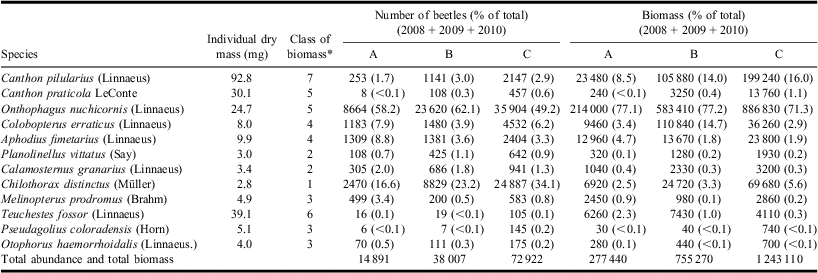
Recovery and biomass (mg) of dung beetles (Coleoptera: Scarabaeidae) in pitfall traps at the three sites (A, B, and C) during the 2008–2010 periods (native grassland, Purple Springs, southern Alberta, Canada).

Note: *Classes according to Lumaret et al. Reference Lumaret, Kadiri and Bertrand1992.
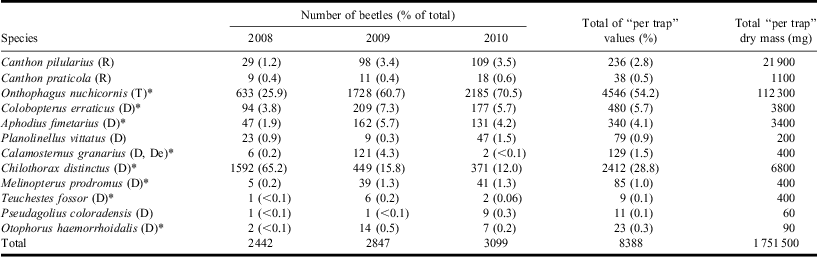
Recovery of dung beetles (Coleoptera: Scarabaeidae) for 2008, 2009, and 2010 at three combined sites (A + B + C) on native grassland Purple Springs in southern Alberta, Canada.
Notes: Numbers were adjusted to a “per trap” basis (five traps/site). Functional groups are R, T, D, and De.
*European or exotic species.
R, rollers; T, tunnellers; D, dwellers; De, detritivores.
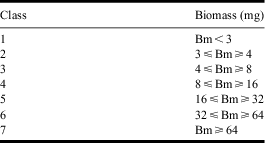
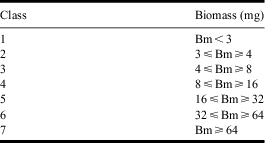
The numbers were converted to biomass (dry mass) for species comparisons of abundance and biomass (Table 1) to identify core and satellite species in each collection period. A pooled estimate of the dry mass per individual (mg/ind) was calculated for each species and expressed in mg of beetles. For each species, 10–200 individuals depending on their size were oven-dried for five days at 70 °C and weighed (according to Lumaret et al. Reference Lumaret, Kadiri and Bertrand1992). Species have been sorted into seven classes with a geometric progression (Table 3).
Biomass of individuals (dry mass) distributed in seven classes (geometric progression) (according to Lumaret et al. Reference Lumaret, Kadiri and Bertrand1992).
Results
Climatic conditions
Mean monthly temperatures for June through August were similar across years during the study, but more variable for April, May, August, and September. April was cold (3–6 °C) (Fig. 1). Mean monthly temperature increased in May to reach a maximum in July and August of ∼18 °C. In October, mean monthly temperature decreased to 4–8 °C and was particularly cool in 2009. With few exceptions, mean monthly temperatures during the 2008–2010 period were below the 30-year averages at Vauxhall. However, in September 2009, the mean monthly temperature was 3.3 °C above the 30-year average. In October of 2008 and 2010, the mean monthly temperature was ∼1–2 °C warmer than the 30-year average.
Mean monthly air temperature (°C) at Vauxhall, close to Purple Springs, Alberta, Canada, from 2008 to 2010 (May–October period). Arrows correspond to average of 30-year period at Taber Alberta, Canada.
Monthly precipitation was highly variable within months across years, and across months within years (Fig. 2). In 2008, total precipitation in April and October was 4.4 and 11.0 mm, respectively, but in intervening months ranged from 44.6 (September) to 95.1 mm (June). In 2010, precipitation in April was 15-fold higher than that for April of 2008 and exceeded 100 mm in May.
Monthly total precipitation (mm) at Vauxhall Alberta, Canada from 2008 to 2010 (May–October period).
Species composition
Twelve species of scarabs (n = 125 820 beetles) were recovered during the three-year study, comprising 14 891, 38 007, and 72 922 beetles for sites A, B, and C, respectively (Table 1). There were four native species represented by two rollers (Canthon pilularius (Linnaeus), Canthon praticola LeConte) and two dwellers (Pseudagolius coloradensis (Horn), Planolinellus vittatus (Say)). There were eight exotic species, all of European origin. These included two tunnellers (Onthophagus nuchicornis (Linnaeus), Colobopterus erraticus (Linnaeus)) and five dwellers (Aphodius fimetarius (Linnaeus), Chilothorax distinctus (Müller), Melinopterus prodromus (Brahm), Teuchestes fossor (Linnaeus), Otophorus haemorrhoidalis (Linnaeus)). The eighth species, Calamosternus granarius (Linnaeus), is a detritivore that breeds in organic rich soils and manure, but whose adults feed in fresh cattle dung. At Purple Springs, the same number of traps was used each year, but the length of the trap season differed, so that the numbers were adjusted to reflect differences in trap periods across years. Thus, for C. pilularius 435, 1452, and 1638 individuals were collected in 2008 (22 weeks), 2009 (25 weeks), and 2010 (26 weeks). To accommodate differences in trap periods across years, these values were converted into numbers of beetles collected per trap week and reported in Table 2 as 29, 98, and 109.
Rarer species were not recovered in some combinations of site × year as observed for two native taxa. At site A, C. praticola was not collected in 2010, but was recovered in 2008 and 2009. Specimens of P. coloradensis were recovered at sites A and B in 2008 and 2010, but not in 2009. These differences were minor and did not affect the structure of the assemblages.
In terms of numbers, European species comprised 96% of the total three-year collection, chiefly O. nuchicornis and C. distinctus (Tables 1 and 2). Of the native species, only C. pilularius provided a significant role in the organisation of assemblages. This large beetle comprised only 2.8% of the total three-year collection, but represented 14% and 16% of the total biomass of beetles collected at sites A and B, respectively (Table 1).
Temporal distribution of species
Patterns of adult seasonal activity were obtained for 12 species (Figs. 3 and 4), including three species for which data were not reported in Floate and Gill (Reference Floate and Gill1998); i.e., C. erraticus, C. pilularius, C. praticola. Results are summarised by two-week intervals (April through October) as the number of beetles recovered per trap day for sites A, B, and C combined. For example, 16 485 O. nuchicornis were collected across sites A, B, and C during the last two weeks in May. During this time, 15 traps were operated for a total of 10 days (=150 traps days). Thus, the number of O. nuchicornis is reported in Figure 4 for this period is 109.9 (16 485/150).
Seasonal activity of dung beetles from 2008 to 2010 at Purple Springs Alberta, Canada: Pseudagolius coloradensis, Chilothorax distinctus, Colobopterus erraticus, Aphodius fimetarius, Teuchestes fossor, and Calamosternus granarius. Collection periods summarised in two-week intervals. Years: black bars (2008); hatched bars (2009); white bars (2010).
Seasonal activity of dung beetles from 2008 to 2010 at Purple Springs Alberta, Canada: Otophorus haemorrhoidalis, Melinopterus prodromus, Planolinellus vittatus, Canthon pilularius, Canthon praticola, and Onthophagus nuchicornis. Collection periods summarised in two-week intervals. Years: black bars (2008); hatched bars (2009); white bars (2010).
The main colonisation of fresh dung by beetles occurred from May to July, with a secondary peak of activity in autumn. Individual species, however, exhibited one of two general patterns of seasonal activity. Unimodal species have peak adult activity in spring and early summer; i.e., T. fossor, C. granarius, P. coloradensis, and P. vittatus. Bimodal species exhibit a peak of activity in spring-summer followed by a second peak in autumn; i.e., C. pilularius, C. praticola, O. nuchicornis, C. erraticus, A. fimetarius, O. haemorrhoidalis, and M. prodromus. Chilothorax distinctus is also a bimodal species, although its recovery in pitfall traps suggests otherwise (Fig. 3). This discrepancy arises because the large numbers of overwintered adults that emerge in early spring show little attraction to dung (Seamans Reference Seamans1934; Floate and Gill Reference Floate and Gill1998).
Core species and satellite species
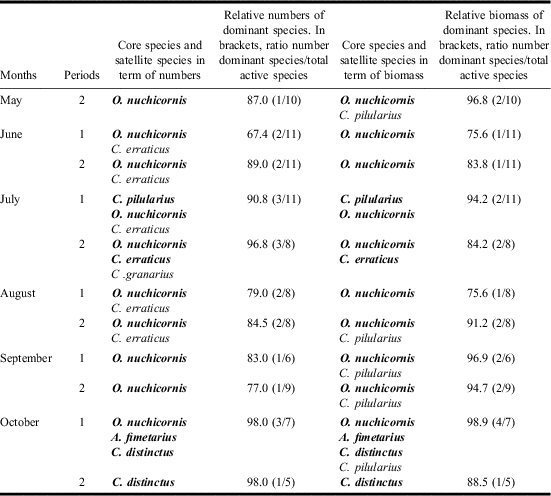
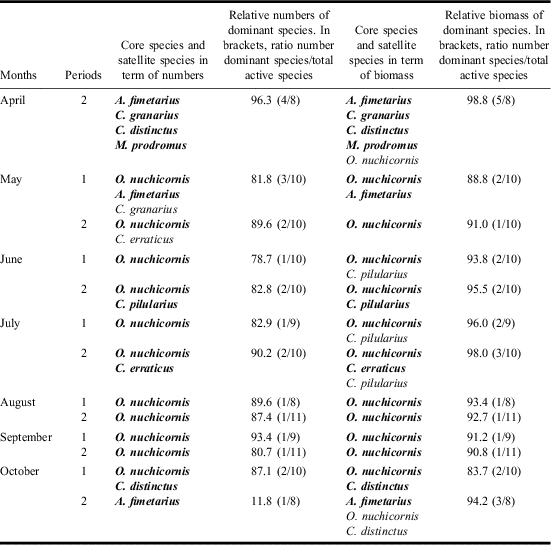
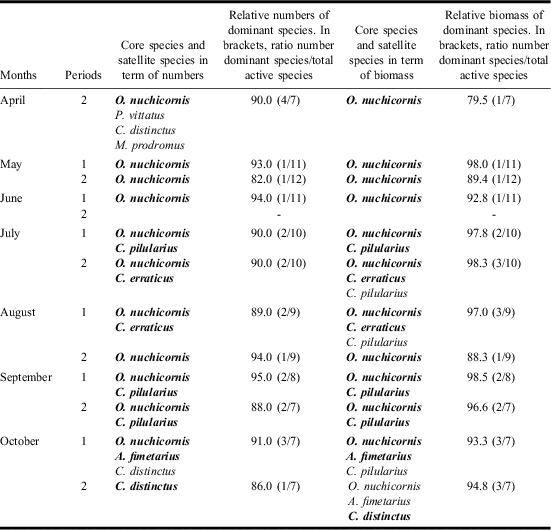
Core and satellite species define the functional groups within an assemblage. These species are identified for each two-week period from May through October for 2008, 2009, and 2010 (Tables 4–6). For these periods, functional groups comprised one to five species (of the 5–12 total species present) and represented up to 98% of total individuals and 98.8% of total biomass.
Dominant species (core and satellite species) recovered from May to October 2008 at Purple Springs, Alberta, Canada. Periods 1 and 2 are the first and second two weeks of the month.
Note: Bold fonts correspond to core species at a given period. Collections are weekly trap catches from 15 pitfall traps combined as two-week intervals.
For data combined across years and sites, O. nuchicornis was dominant both in numbers and biomass (Tables 1 and 2). It maintained its core status throughout the season until late October. Then it became a satellite species with C. distinctus or A. fimetarius becoming core species, according to year (Tables 4–6). Throughout the season, several species also reached the status of core species but not for extended periods; i.e., C. pilularius (June), C. erraticus (late July), A. fimetarius, and C. distinctus (October).
In 2008, the assemblages were dominated in descending order by the core species O. nuchicornis (May to early October: n = 10.8–87.0%, biomass = 26.6–85.6%); C. distinctus (September: n = 65.7%, biomass = 19.9%; October: n = 98%, biomass = 88.5%); C. erraticus (July: n = 72%, biomass = 57.6%); and A. fimetarius (October: n = 13.6%, biomass = 14.7%). The only native species to reach core status was C. pilularius (July: n = 10%, biomass = 34%). Excluding O. nuchicornis, the above core species at other times were reduced to satellite status by virtue of either number or biomass (but not both) exceeding 10% (Table 4). During such times, biomass for C. pilularius ranged from 11.2% to 26.8%. Numbers of C. erraticus ranged from 14.6 (June) to 11% (August) and those for C. granarius attained 14% (July).
In 2009, seven species reached core status (Table 5). As in 2008, O. nuchicornis remained dominant without interruption between May and October. Other core species included A. fimetarius (late April–May and October), C. granarius and M. prodromus (late April), C. distinctus (late April and early October), C. erraticus (late July), and C. pilularius (late June). Although C. distinctus was almost absent in trap catches in April (Fig. 3), it reached core status together with three other species because so few total beetles were collected at that time (Table 5). Its status as a core species was undeniable in October, when thousands of individuals were collected in traps. At other times, these core species were reduced to satellite status, reflecting values of numbers or biomasses below the 10% threshold. Such cases included O. nuchicornis in late April and late October, C. granarius in early May, C. erraticus in late May, C. distinctus in October, and C. pilularius in early June and in July (Table 5).
Dominant species (core and satellite species) recovered from April to October 2009 at Purple Springs, Alberta, Canada. Periods 1 and 2 are the first and second two weeks of the month.
Note: Bold fonts correspond to core species at a given period. Collections are weekly trap catches from 15 pitfall traps combined as two-week intervals.
In 2010, five species obtained core status, varying with trap periods (Figs. 3 and 4). These included O. nuchicornis (April to early October), C. erraticus (early August), A. fimetarius (early October), C. distinctus (early October), and C. pilularius (July and September) (Table 6). As per 2008 and 2009, these species at other times were reduced to satellite status; i.e., O. nuchicornis and A. fimetarius in October, P. vittatus and M. prodromus in late April, C. distinctus in late April and in October, and C. pilularius in July–August and in October (Table 6).
Species (core and satellite species) recovered from April to October 2010 at Purple Springs, Alberta, Canada. Periods 1 and 2 are the first and second two weeks of the month.
Note: Bold fonts correspond to core species at a given period. Collections are weekly trap catches from 15 pitfall traps combined as two-week intervals.
Discussion and conclusion
Interannual climatic differences did not affect seasonal activity. However, the abundance of individual species did vary across years as previously reported by Floate and Gill (Reference Floate and Gill1998). For example, P. coloradensis could have been favoured in 2010 by cold and rainy periods between May and July.
The current and related studies (Floate and Kadiri Reference Floate and Kadiri2013) show that the dung beetle assemblages on native grasslands of southern Alberta are dominated by exotic species of European origin that were introduced accidently to North America during European settlement (Blume and Aga Reference Blume and Aga1978; Gordon Reference Gordon1983; Fincher Reference Fincher1986; Legner Reference Legner1986). One route of introduction may have been as ballast traffic. Ships arriving from Europe in the 17th and 18th centuries carried sand or soil that was emptied on shores in North America. Any insects associated with this ballast would thus be carried across the Atlantic (Brown Reference Brown1940, Reference Brown1950). The expansion of exotic species in North America is a long-term phenomenon, as already reported by Brown (Reference Brown1927, Reference Brown1967), Wilson (Reference Wilson1932), and Kessler et al. (Reference Kessler, Balsbaugh and McDaniel1974). Subsequent works have shown that the distribution of these introduced species continues to expand (Blume Reference Blume1985; Lobo Reference Lobo1994, Reference Lobo2000; Floate and Gill Reference Floate and Gill1998; Fiene et al. Reference Fiene, Connior, Androw, Baldwin and McKay2011; Rounds and Floate Reference Rounds and Floate2012; Floate and Kadiri 2013), and colonisation of new areas can be rapid. Local assemblages at Purple Springs were dominated by the European tunneller O. nuchicornis, which is the most efficient endemic species in degrading cattle dung. Although less abundant, the European species C. erraticus, also a tunneller (Rojewski Reference Rojewski1983), was common at Purple Springs and at sites elsewhere in southern Alberta (Floate and Kadiri Reference Floate and Kadiri2013) and thus also can be locally important in dung degradation. The range of this latter species appears to only recently have expanded into southern Alberta. In a previous survey in southern Alberta, only one individual of C. erraticus was recovered in a sample of 93 957 beetles recovered from two sites through 1993–1995 (Floate and Gill Reference Floate and Gill1998). Other aphodiine species of European origin also were members of the functional group, particularly in May and October. The only native species to occasionally attain functional group membership was C. pilularius. The success of exotic species in the region reflects invasion of an ecological niche largely unoccupied by native species. The competition of C. pilularius (roller) with exotics is limited by an abundance of fresh cattle dung that is renewed daily, by its difference in the use of the resource (roller versus dwellers and tunnellers) and its large size (Floate and Kadiri Reference Floate and Kadiri2013). This species, widely distributed from southern Canada to Mexico, does not seem therefore in danger of extinction or replacement.
The organisation in dung beetle assemblages depends mainly on the nature of the soil, the physiognomic differences between habitats and altitude constraints (Nealis Reference Nealis1977; Lumaret Reference Lumaret1983; Lumaret and Kirk Reference Lumaret and Kirk1987; Lumaret and Stiernet Reference Lumaret and Stiernet1991; Floate and Kadiri Reference Floate and Kadiri2013). In contrast, the abundance of a species depends on the quantity of trophic resources (Lumaret et al. Reference Lumaret, Kadiri and Bertrand1992). Relevant biological traits such as size of species, spatio-temporal reproductive patterns, and different life histories play also a significant role in this organisation to allow for the co-existence of different species in the assemblages. From an ecological point of view, results expressed in biomass provide better information on the role of the species than do results expressed in numbers. The quantity of dung used by dung beetles during egg-to-adult development is directly related to the mass and size of species (Halffter and Matthews Reference Halffter and Matthews1966; Nealis Reference Nealis1977; Kirk Reference Kirk1992). This relationship identifies those species of greatest functional significance in degrading organic matter. Smaller species must compensate for their size by a large number of individuals to achieve the same level of efficiency than larger species.
Competition among species within assemblages can be reduced by a number of factors to allow co-existence. Wilson (Reference Wilson1975) was unable to verify the role of body size in competition among arthropod species but noted that competition models mainly were developed for predators. For Holter (Reference Holter2000), food competition among adult of Aphodiinae seems unlikely despite of their selective feeding. However the mouthpart filter in species may be adapted to dung characteristics that are, at least to some extent, related to age. C. erraticus, eating the smallest particles, is early successional in a dung pat, i.e., confined to fresh dung, whereas T. fossor and A. fimetarius are both late-successional species (Gittings and Giller Reference Gittings and Giller1998). When several species compete for the same resource, their coexistence is possible when they differ enough in size and (or) if they belong to different guilds (Hanski and Cambefort Reference Hanski and Cambefort1991). This may explain the coexistence of C. pilularius (roller; class size 7) with O. nuchicornis (tunneller; class size 5) (Table 1) when both dominate in a temporal assemblage (e.g., in July 2008, and in June 2009 and 2010) (Tables 4–6). Similarly, the two dwellers A. fimetarius (class size 4) and C. distinctus (class size 1) could co-occur as core species in October 2008 (Table 4).
Core species can be described as keystone species; i.e., “species that are of demonstrable importance for ecosystem function”, even if the term “keystone” is considered as a metaphor (Bond Reference Bond1993; Cottee-Jones and Whittaker Reference Cottee-Jones and Whittaker2012). The organisation of dung beetle assemblages at Purple Springs (few dominant species) is very similar to that of assemblages in European regions (Stiernet and Lumaret Reference Stiernet and Lumaret1993), in many Mediterranean sites (Kadiri Reference Kadiri1993; Janati-Idrissi et al. Reference Janati-Idrissi, Kadiri and Lumaret1999), and elsewhere throughout North America (Lobo Reference Lobo2000). The assemblages in all these biogeographic regions are constituted by species of different origin in an uninterrupted dynamic balance, with the opportunity to receive new species when trophic resources are sufficient. The European species have seemingly left little room for native species in the use of animal droppings. Their expansion could not be the cause of the small number of native taxa (Lobo Reference Lobo2000; Floate and Kadiri Reference Floate and Kadiri2013), insofar as trophic competition was reduced, due to the abundance and availability of fresh dung daily renewed, and also by the difference in phenology of species (Floate and Gill Reference Floate and Gill1998; Floate Reference Floate2011; Tiberg and Floate Reference Tiberg and Floate2011).
Additional European species of dung beetles are expected to expand their distributions into Canada. Onthophagus taurus (Shreber) is one such species that is established in the United States of America and moving northward. It recently was reported at Lake City, Michigan, about 250 km from the Canadian border, where it co-exists with O. nuchicornis (Rounds and Floate Reference Rounds and Floate2012). These species are closely related, of similar size (O. nuchicornis: class 5 versus O. taurus: class 6), are both tunnellers and have co-occurring periods of seasonal activity. Studies on the competitive interactions between these two species may provide insights into mechanisms of their co-occurrence.
Acknowledgements
The authors thank V. Casey, C. Conrad, H. Dorchak, C. Durand, A. Middleton, K. Tiberg, L. Wilde, and particularly P. Coghlin for assistance in field collections and identifications. A. Middleton and I. Walker (Agriculture and Agri-Food Canada) facilitated research at Stavely and Onefour, respectively. J. Willms (Alberta Environment and Sustainable Resource Development) facilitated research at the Purple Springs Grazing Reserve. They also thank Dr. M. Bertrand from University Paul-Valéry Montpellier 3 for assistance in statistical analysis. Partial funding was provided by the Canada/Alberta Livestock Research Trust. This is Lethbridge Research Centre Contribution No. 387-13004.