

Having a satisfying marriage or romantic relationship is one of the most important goals for many people (Roberts & Robins, Reference Roberts and Robins2000). Unfortunately, couple distress or ‘partner relational problems’ involving communication or related interactional difficulties are common in couples (Snyder, Heyman, & Hayes, Reference Snyder, Heyman and Haynes2005) and are associated with mental and physical health problems (Whisman, Reference Whisman2013; Kiecolt-Glaser & Newton, Reference Kiecolt-Glaser and Newton2001). It has been argued that ‘insecure attachment’ is related to difficulties in adult romantic relationships (Mikulincer & Shaver, Reference Mikulincer and Shaver2007a). Due to Bowlby (Reference Bowlby1969/1982), adult attachment styles are formed by early experiences with our caregivers in the form of internal representations or ‘internal working models’ of the self and others. Based on this, Bartholomew (Reference Bartholomew1990; Griffin & Bartholomew, Reference Griffin and Bartholomew1994) proposed a theory of adult attachment with two underlying dimension models: The positivity of the self and the positivity of the other model. The positivity of the self model refers to the degree to which an individual has a sense of his or her own self-worth and, therefore, expects that others respond positively to him or her. It is associated with the degree of anxiety in close relationships or attachment anxiety that is characterised by fear of rejection and abandonment, concern about intimate relationships, and negative feelings about the self (Mikulincer & Shaver, Reference Mikulincer and Shaver2007a). In contrast, the positivity of the other model describes the degree to which others are generally expected to be available and supportive (e.g., that they will be there for us when needed, that they can help to soothe our distress and pain) and thus is associated with the tendency to seek out or avoid closeness in relationships. Attachment avoidance reflects the tendency to feel uncomfortable with and to avoid intimacy and closeness (Mikulincer & Shaver, Reference Mikulincer and Shaver2007a). Insecure attachment is characterised by either high attachment anxiety or high attachment avoidance, or both. In a meta-analysis with 73 studies, Li and Chan (Reference Li and Chan2012) found that both attachment anxiety and attachment avoidance were associated with poor relationship quality in couples, with an average correlation of r = −.23 for the association between attachment anxiety and relationship quality and r = −.24 for the association between attachment avoidance and relationship quality. The current study sheds light into the mechanism by which attachment style affects the quality of intimate relationships.
Attachment and Compassion
Attachment theory (Bowlby, Reference Bowlby1969/1982) proposes that humans have innate behavioural systems of attachment and caregiving. The function of these systems is to protect individuals from danger by ensuring that they maintain proximity to others by receiving and /or providing care. Further, the systems involve competencies for expressing distress, as well as assessing the needs of others and empathic understanding. There are different definitions of compassion (Strauss et al., Reference Strauss, Lever Taylor, Gu, Kuyken, Baer, Jones and Cavanagh2016), many of which share similarities. A common definition is that compassion is ‘a sensitivity to the suffering of self and others, with a commitment to alleviate and prevent it’ (Gilbert & Choden, Reference Gilbert and Choden.2013, p. 94).
Self-Compassion
Social mentality theory (Gilbert, Reference Gilbert1989, Reference Gilbert, Gilbert and Bailey2000) suggests that we relate to ourselves through systems that were originally evolved for relating to others (patterns that allow to enact social roles). Individuals high in attachment anxiety may have received inconsistent parenting and, as a result, are more likely to develop a negative view of the self (Pietromonaco & Feldman Barrett, Reference Pietromonaco and Feldman Barrett2000), to be self-critical (Cantazo & Wei, Reference Cantazo and Wei2010), to have a strong need for validation from others (Wei, Mallinckrodt, Larson, & Zakalik, Reference Wei, Mallinckrodt, Larson and Zakalik2005), and to exaggerate their own distress (Mikulincer, Shaver, & Pereg, Reference Mikulincer, Shaver and Pereg2003). These factors might make it less likely for them to be compassionate to themselves. For attachment avoidance, the theoretical relationship with self-compassion is more complex as high attachment avoidance can be associated with a negative or a positive view of the self (Pietromonaco & Feldman Barrett, Reference Pietromonaco and Feldman Barrett2000). A positive view of the self might be associated with higher self-compassion. However, as highly avoidant individuals tend to use so-called deactivation strategies (such as being emotionally distant and minimising the importance of others) when distressed (Kobak, Cole, Ferenz-Gillies, Fleming, & Gamble, Reference Kobak, Cole, Ferenz-Gillies, Fleming and Gamble1993; Mikulincer & Shaver, Reference Mikulincer, Shaver, Mikulincer and Shaver2007b/Reference Mikulincer, Shaver, Cassidy and Shaver2008) and are blocked to notice their own distress, it might be argued that attachment avoidance is negatively associated with self-compassion. Studies have shown that both attachment anxiety and attachment avoidance are negatively associated with self-compassion, although the former association is supported by stronger evidence (Neff & McGehee, Reference Neff and McGehee2010; Wei, Liao, Ku, & Shaffer, Reference Wei, Liao, Ku and Shaffer2011). Related, there is evidence that people tend to relate to themselves with compassion to the degree that others have related to them in that manner (Irons, Gilbert, Baldwin, Baccus, & Palmer, Reference Irons, Gilbert, Baldwin, Baccus and Palmer2006; Neff & McGehee, Reference Neff and McGehee2010; Pepping, Davis, O'Donovan, & Pal, Reference Pepping, Davis, O'Donovan and Pal2015).
Compassion for Others
It is assumed that individuals with high attachment anxiety are compassionate towards others, perhaps in an attempt to be liked by the other (Catarino, Gilbert, Mcewan, & Baiao, Reference Catarino, Gilbert, McEwan and Baiao2014), until their perceived attachment needs are no longer met. In contrast, attachment avoidance is associated with a negative view of others (Mikulincer & Shaver, Reference Mikulincer, Shaver, Mikulincer and Shaver2007b) and is therefore assumed to lead to low compassion towards others. A study by Pardess, Mikulincer, Dekel, and Shaver (Reference Pardess, Mikulincer, Dekel and Shaver2013) found evidence for a positive association between insecure attachment and compassion fatigue in volunteers working with traumatised individuals. It also showed that when attachment security was experimentally enhanced, compassion fatigue reduced. This finding is in line with another study that demonstrated that dispositional and experimentally induced attachment security promotes compassionate feelings towards others (Mikulincer & Shaver, Reference Mikulincer and Shaver2005).
Compassion and Relationship Functioning
Several arguments can be used to explain why self-compassion and compassion for others facilitate relationship functioning. First, self-compassion has been found to be associated with more positive psychological functioning (Neely, Schallert, Mohammed, Roberts, & Chen, Reference Neely, Schallert, Mohammed, Roberts and Chen2009) and lower psychopathology, including anxiety and depressive symptoms (Castilho, Pinto-Gouveia, Amaral, & Duarte, Reference Castilho, Pinto-Gouveia, Amaral and Duarte2014; Gilbert et al., Reference Gilbert, McEwan, Mitra, Franks, Richter and Rockliff2008; Irons et al., Reference Irons, Gilbert, Baldwin, Baccus and Palmer2006; Neff, Reference Neff.2003; Neff, Kirkpatrick, & Rude, Reference Neff, Kirkpatrick and Rude2007; Raes, Reference Raes2010), and individuals high in self-compassion may therefore respond more constructively to conflict in relationships. Second, the acceptance of the imperfect human experience may enhance mutual acceptance of imperfection of the two partners in a romantic relationship. Related, compassion for others (specifically the partner) might facilitate relationship functioning through a greater acceptance of the other, leading to reduced conflict behaviour, as well as more supportive behaviour during difficult times. Compassionate individuals might also be more sensitive to distress and suffering and more motivated to alleviate the distress. Managing one's own distress in that way might make it less likely for it to negatively impact the close relationship. Finally, a person treated compassionately by his or her intimate partner might experience less distress (e.g., negative affect). Neff and Beretvas (Reference Neff and Beretvas2013) have shown that self-compassionate individuals display more positive relationship behaviours, such as being caring and supportive with romantic partners, than those who are less self-compassionate. Similarly, Crocker and Canevello (Reference Crocker and Canevello2008) found that self-compassionate individuals tended to have more compassionate goals (i.e., provide social support and encourage interpersonal trust) in close relationships. Yarnell and Neff (Reference Yarnell and Neff2013) reported that self-compassionate individuals were more likely to use compromise solutions to resolve couple conflicts, and reported higher levels of relational wellbeing. In contrast, self-critical women have been found to be less satisfied in their romantic relationships (Zuroff & Fitzpatrick, Reference Zuroff and Fitzpatrick1995).
The Present Study
Given the evidence that attachment insecurity is associated with a lower ability to be compassionate to oneself and to others, and given that compassion for the self and for others is likely to influence relationship quality, the present study set out to examine for the first time whether compassion for the self and compassion for one's partner mediate the association between attachment insecurity and relationship outcomes. The present study used two relationship measures: relationship quality and relationship satisfaction. Relationship quality is defined as the extent to which a relationship provides or withholds beneficial experiences and interactions (Collins, Reference Collins2003), while relationship satisfaction is defined as an interpersonal evaluation of the positivity of feelings for one's partner and attraction to the relationship (Rusbult & Buunk, Reference Rusbult and Buunk1993). Because of the proposed negative self-view of individuals high in attachment anxiety (Mikulincer & Shaver, Reference Mikulincer, Shaver, Mikulincer and Shaver2007b), it was hypothesised that low self-compassion (i.e., low compassionate and high uncompassionate attitude towards self) would mediate the association between attachment anxiety and negative relationship outcomes. Further, because of the proposed negative view of their partner by individuals high in attachment avoidance (Mikulincer & Shaver, Reference Mikulincer, Shaver, Mikulincer and Shaver2007b), it was hypothesised that low compassion for one's partner (i.e., low compassionate and high uncompassionate attitude towards one's partner) would mediate the association between attachment avoidance and negative relationship outcomes. No hypotheses were formulated for the associations between self-compassion and attachment avoidance, and compassion for one's partner and attachment anxiety respectively.
Method
Participants and Recruitment
The study reported here was part of a wider study (Bolt, Reference Bolt2015). Individuals in a romantic relationship were invited to take part in an online survey. Minimum relationship duration was three months and minimum age for both partners was 18 years. The study was advertised on various online research boards in the United Kingdom and United States, and promotion emails were sent to various universities in the UK. Also, posters advertising the study were placed in shops, libraries, and train stations in the UK. In addition, snowball sampling was used, whereby participants were asked to forward the study information to other potential participants.
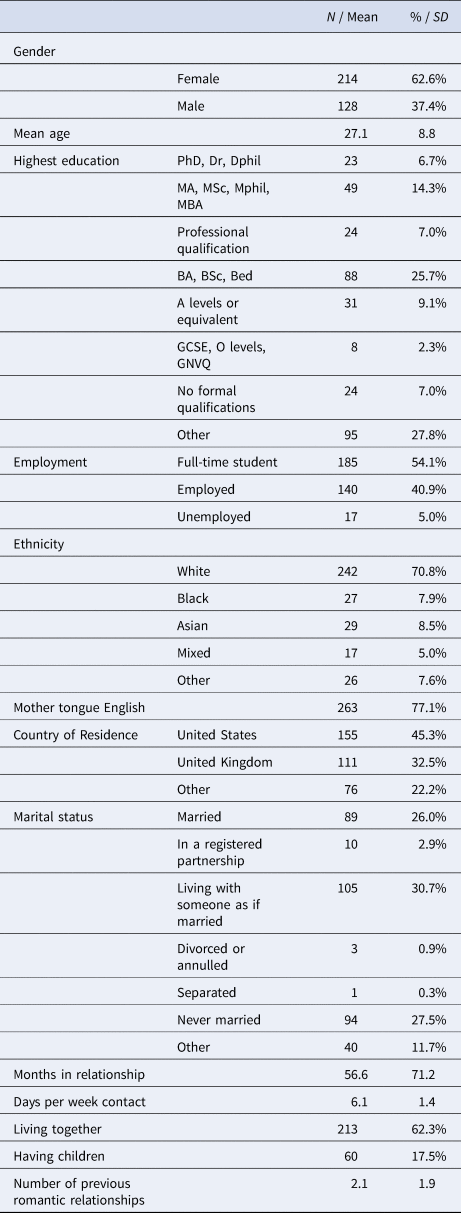
For the present study, 949 people started completing the questionnaire. Three hundred and fifty-six people (37.5%) completed it. Data from 14 participants were excluded because they were either younger than 18 or had been in their relationship for less than three months, resulting in a sample size of 342, with 89% being in a heterosexual relationship. The characteristics of the sample are presented in Table 1.
Sample Characteristics (N = 342)

Design
The study employed a cross-sectional questionnaire design. The survey consisted of questionnaires assessing adult attachment, compassionate and uncompassionate attitude towards self and towards one's partner, and relationship quality and satisfaction.
Measures
Adult attachment
Adult attachment anxiety and avoidance were assessed with the short version of the Experiences of Close Relationships scale (ECR-S; Wei, Russell, Mallinckrodt, & Vogel, Reference Wei, Russell, Mallinckrodt and Vogel2007). This scale consists of 12 items, six items assessing attachment anxiety (e.g., ‘I need a lot of reassurance that I am loved by my partner’) and six items assessing attachment avoidance (e.g., ‘I try to avoid getting too close to my partner’) that are rated on a scale from 1 (strongly disagree) to 7 (strongly agree). The items of each scale are summed to obtain total anxiety and total avoidance scores (higher scores indicate higher anxiety and higher avoidance). In the current study, internal consistencies, as measured by Cronbach's alpha, were .71 for anxiety and .74 for avoidance.
Self-compassion
Self-compassion was assessed using the Short Form Self-Compassion Scale (SCS-SF; Raes, Pommier, Neff, & Van Gucht, Reference Raes, Pommier, Neff and Van Gucht2011). This scale consists of 12 items (e.g., ‘I try to be understanding and patient towards those aspects of my personality I don't like’) that are rated on a scale from 1 (almost never) to 5 (almost always). It produces six subscales: self-kindness, self-judgment, common humanity, isolation, mindfulness, and over-identification. Given concerns about the validity of the total self-compassion score (e.g., Muris, Otgaar, & Pfattheicher, Reference Muris, Otgaar and Pfattheicher2019), the means of self-kindness, common humanity, and mindfulness subscales can be used to generate a ‘compassionate attitude towards self’ score, while the means of the self-judgment, isolation, and over-identification subscales generate a ‘uncompassionate attitude towards self’ score (Costa, Maroco, Pinto-Gouveia, Ferreira, & Casthilo, Reference Costa, Maroco, Pinto-Gouveia, Ferreira and Casthilo2016; Lopez et al., Reference Lopez, Sanderman, Smink, Zhang, van Sonderen, Ranchor and Schroevers2015). Internal consistencies in the current study were .71 for compassionate attitude towards self and .82 for uncompassionate attitude towards self.
Compassion for one's partner
To assess participants’ compassion for their partner, the Compassion for Others Scale (COS; Pommier, Reference Pommier2011) was used and adapted to apply to partners specifically. For example, instead of ‘I often tune out when people tell me about their troubles’, it was amended to read ‘I often tune out when my partner tells me about his/her troubles’. Kristin Neff, author of the SCS and co-author of the COS, confirmed that such an adaptation of the scale appears valid (personal communication, April 8, 2015). The COS consists of 24 items that are rated on a scale from 1 (almost never) to 5 (almost always). It produces six subscales: kindness, indifference, common humanity, separation, mindfulness, and disengagement. Similar to the Self-Compassion Scale, the subscales kindness, common humanity, and mindfulness form a ‘compassionate attitude towards partner’ score. The means of the subscales indifference, separation and disengagement produce an ‘uncompassionate attitude towards partner’ score. In the current study, internal consistency was .79 for the compassionate attitude towards partner score and .87 for the uncompassionate attitude towards partner score.
Relationship quality
Relationship quality was assessed with the Partner Behaviours as Social Context (PBSC) scale (Ducat & Zimmer-Gembeck, Reference Ducat and Zimmer-Gembeck2010). This scale assesses relationship quality by asking about positive and negative partner behaviour (‘My partner seeks my opinion and values it’ or ‘My partner tries to control me’). The PBSC consists of 30 items that are rated on a scale from 1 (not at all true) to 6 (very true). The scale produces six subscales: warmth, autonomy support, structure, rejection, coercion, and chaos. To calculate a total score, the negative subscales (rejection, coercion, and chaos) were reversed and then a total mean score is calculated (higher scores indicate higher relationship quality). Internal consistency in the current study was .95.
Relationship satisfaction
Relationship satisfaction was assessed using the Couples Satisfaction Index-16 (CSI-16; Funk & Rogge, Reference Funk and Rogge2007). This measure assesses relationship quality with 16 items asking participants about their happiness with their current relationship (e.g., ‘My relationship with my partner makes me happy’ or ‘How rewarding is your relationship with your partner?’). One global item uses a 7-point scale, whereas the other 15 items use a 6-point scale. For a total satisfaction score, items were summed (higher scores = higher relationship satisfaction). In the current study, internal consistency for relationship satisfaction was .97.
Ethics
Ethical approval was obtained from a university research ethics committee (Reference number: MMC/V75). All participants read a participant information sheet before giving consent to take part in the study. Consent was given online. Participants were encouraged to discontinue the completion of the survey should they become distressed and to contact a phone helpline should they stay distressed.
Power Analysis
The association between attachment anxiety and self-compassion has been reported on average as r = −.29 (Wei et al., Reference Wei, Liao, Ku and Shaffer2011), and the association between self-compassion and positive relationship behaviour has been reported on average as r = .25 (Neff & Beretvas, Reference Neff and Beretvas2013). Assuming an effect sizes of .26 for each path, the sample size to reach a power of .80 is N = 148 for a model with one mediator (Fritz & MacKinnon, Reference Fritz and MacKinnon2007). Thus, the sample size of the current study seems to be reasonable for a model with four parallel mediators.
Results
Preliminary Analyses
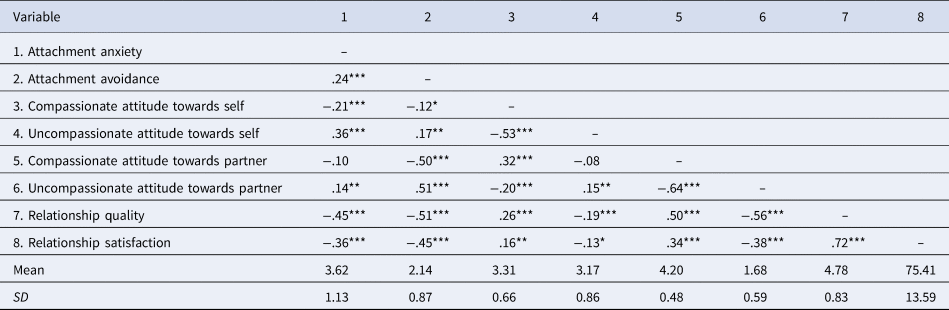
Table 2 shows means, standard deviations, and correlations of the measures. As expected, there were significant negative associations between the attachment variables and the relationship variables. There were also significant negative associations between attachment avoidance and compassionate attitude towards self and compassionate attitude towards partner, and a negative association between attachment anxiety and compassionate attitude towards self. However, attachment anxiety and compassionate attitude towards partner were not significantly associated. Attachment anxiety and attachment avoidance were both significantly positively associated with uncompassionate attitude towards self and uncompassionate attitude towards partner. The two compassionate attitude measures were significantly positively associated with the two relationship measures. The two uncompassionate attitude measures were significantly negatively associated with the two relationship measures.
Correlations, Means, and Standard Deviations of the Study Variables

Note: N = 342. SD = Standard deviation. Scores range from 6 to 42 for attachment anxiety and attachment avoidance, from 1 to 5 for compassionate and uncompassionate attitude towards self and partner, from 1 to 6 for relationship quality, and from 0 to 81 for relationship satisfaction.
*p < .05. **p < .01. ***p < .001 (two-tailed).
Mediation Analyses
Mediation was assessed using the PROCESS macro for SPSS (Hayes, Reference Hayes2013) and 5,000 bootstrap samples. Two mediation models were tested, one with relationship quality as outcome variable (Model A) and one with relationship satisfaction as outcome variable (Model B). Both models used attachment anxiety and attachment avoidance as predictors and compassionate and uncompassionate attitude towards self, and compassionate and uncompassionate attitude towards one's partner as simultaneous (parallel) mediators.
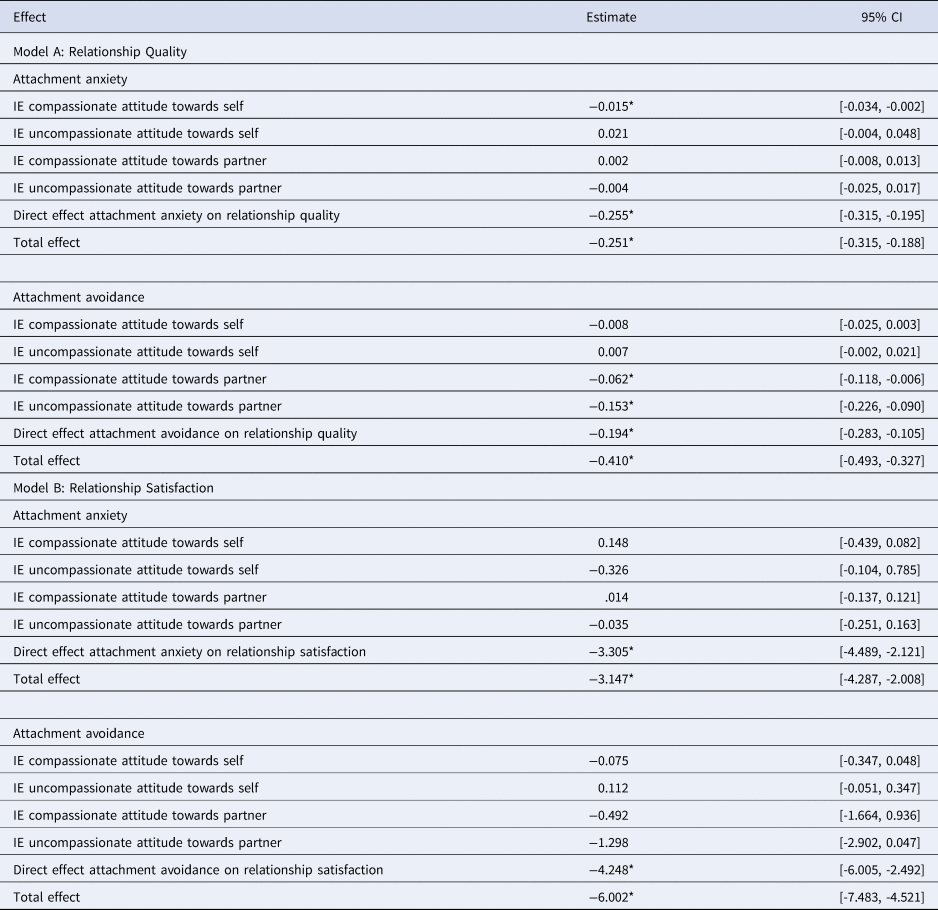
As shown in Table 3 and Figure 1, attachment anxiety had a significant indirect effect on relationship quality through compassionate attitude towards self, meaning that high attachment anxiety predicted low compassionate attitude towards self, which in turn predicted low relationship quality. There were no significant indirect effects for attachment anxiety on relationship quality through uncompassionate attitude towards self, and compassionate or uncompassionate attitude towards partner. Further, no significant indirect effects for attachment anxiety on relationship satisfaction emerged.
Unstandardised Indirect, Direct, and Total Effects of Mediation Models

Note: CI = confidence interval. IE = indirect effect. *p < .05.
Model with standardised estimates testing the association between attachment and relationship quality with compassionate and uncompassionate attitudes toward self and toward one's partner, as parallel mediators.

Attachment avoidance had a significant indirect effect on relationship quality through compassionate and uncompassionate attitude towards partner. This suggested that high attachment avoidance was predictive of low compassionate attitude towards partner and high uncompassionate attitude towards partner, which in turn predicted low relationship quality. There were no indirect effects for attachment avoidance through compassionate and uncompassionate attitude towards self. Also, there were no indirect effects for attachment avoidance on relationship satisfaction.
In addition to these indirect effects, direct negative effects of attachment anxiety and avoidance on relationship quality and satisfaction were found. This indicated that high anxiety and avoidance predicted low relationship quality and satisfaction. This speaks to there being a relationship between the attachment and relationship measures beyond that which is accounted for by the mediators. In sum, low compassionate attitude towards self statistically mediated the negative relationship between attachment anxiety and relationship quality. In addition, both low compassionate and high uncompassionate attitude towards the partner statistically mediated the negative relationship between attachment avoidance and relationship quality.
Moderated Mediation Analyses
Subsequent analyses included gender as a moderating variable on all direct and indirect effects. The two predictors and the mediators were centred prior to the analyses, and effect coding was used for gender. In both models, the results revealed that gender moderated the effect of attachment anxiety and avoidance on compassionate attitude towards partner. The effect of attachment anxiety on compassionate attitude towards partner was negative and significant in males (−.087) but revealed as not significant in females (.040). The effect of attachment avoidance on compassionate attitude towards partner was negative and significant in both males and females, but significantly stronger in males (−.355 vs. −.221). The differences in the size of the indirect effects were not significant.
Discussion
This is the first study to examine whether self- and partner-focused compassion statistically mediate the negative relationship between adult attachment and relationship quality and satisfaction. In line with previous research (e.g., Li & Chan, Reference Li and Chan2012), the results indicate that both high attachment anxiety and high attachment avoidance were associated with low relationship quality and satisfaction. Further, evidence was found for a negative association between both attachment variables and a compassionate attitude towards self, and a positive association between both attachment variables and an uncompassionate attitude towards self and towards one's partner. Mean scores and standard deviations were comparable to scores in other non-clinical samples (Ducat & Zimmer-Gembeck, Reference Ducat and Zimmer-Gembeck2010; Funk & Rogge, Reference Funk and Rogge2007; Neff & Beretvas, Reference Neff and Beretvas2013; Pommier, Reference Pommier2011; Wei et al., Reference Wei, Russell, Mallinckrodt and Vogel2007). These findings are in line with previous research showing that more insecurely attached individuals are less compassionate to themselves (Neff & Beretvas, Reference Neff and Beretvas2013; Wei et al., Reference Wei, Liao, Ku and Shaffer2011). Attachment avoidance was also negatively associated with compassionate attitude towards one's partner, but attachment anxiety was not. There was also clear support for a positive association between compassionate attitude towards self and relationship quality and satisfaction, as well as for compassionate attitude towards one's partner and relationship quality and satisfaction. This is in line with research showing that self-compassion is associated with more positive relationship outcome measures (Neff & Beretvas, Reference Neff and Beretvas2013) and extends this finding to compassion towards one's partner as well.
Self-Compassion and Relationship Quality
Low compassionate attitude towards self was a statistical mediator between attachment anxiety and relationship quality. This indicates that high attachment anxiety predicted low compassionate attitude towards self, which in turn predicted low relationship quality. This fits in with the idea that individuals high in attachment anxiety have a negative model of the self and therefore find it harder to be compassionate to themselves (Mikulincer & Shaver, Reference Mikulincer, Shaver, Mikulincer and Shaver2007b). It is also in line with results from Neff and Beretvas (Reference Neff and Beretvas2013), who found that self-compassion was associated with positive relationship behaviour when controlling for attachment. The finding that compassionate attitude towards self was not a statistical mediator between attachment avoidance and relationship quality fits in with previous results showing that the relationship between attachment avoidance and self-compassion is less strong than the relationship between attachment anxiety and self-compassion (Neff & McGehee, 2009; Wei et al., Reference Wei, Liao, Ku and Shaffer2011). Individuals with high attachment avoidance might be more self-compassionate, because they have a more positive model of the self than individuals high in attachment anxiety (Mikulincer & Shaver, Reference Mikulincer, Shaver, Mikulincer and Shaver2007b). However, it is worth pointing out here that as compassion is defined as sensitivity to the suffering of self and others, with a commitment to alleviate that suffering (Gilbert & Choden, Reference Gilbert and Choden.2013), people high in avoidance might be less self-compassionate than securely attached individuals as they are often less connected to their own distress (Kobak et al., Reference Kobak, Cole, Ferenz-Gillies, Fleming and Gamble1993; Mikulincer & Shaver, Reference Mikulincer, Shaver, Mikulincer and Shaver2007b, Reference Mikulincer, Shaver, Cassidy and Shaver2008) and therefore might see less reason to be compassionate to themselves. Also, people high in attachment avoidance may be less compassionate to themselves because being kind to themselves can make them feel vulnerable (Mikulincer, Dolev, & Shaver, Reference Mikulincer, Dolev and Shaver2004).
Interestingly, an uncompassionate attitude towards self was not a statistical mediator between attachment anxiety and relationship quality. It has been argued that an uncompassionate attitude towards self (self-judgment, isolation, overidentification) reflects psychopathology much stronger than a compassionate attitude towards self (self-kindness, common humanity, mindfulness; Muris et al., Reference Muris, Otgaar and Pfattheicher2019). A positive way of self-responding (i.e., a compassionate attitude towards self) might be a more specific predictor of positive personal relationships (i.e., relationship quality) than higher psychopathology (i.e., a uncompassionate attitude towards self).
Compassion for One's Partner and Relationship Quality
Low compassionate attitude towards one's partner and high uncompassionate attitude towards one's partner were found to mediate the negative relationship between attachment avoidance (but not anxiety) and relationship quality. High attachment avoidance predicted low compassionate attitude towards one's partner and high uncompassionate attitude towards one's partner, and these predicted low perceived relationship quality. The finding that reduced compassionate attitude towards one's partner is a mediator for attachment avoidance fits with the idea that avoidant individuals have a more negative view of other people (Mikulincer & Shaver, Reference Mikulincer, Shaver, Mikulincer and Shaver2007b) and that this is associated with being less able to be compassionate towards the partner. It has been hypothesised that avoidant individuals tend to deny their attachment needs and use deactivation strategies (such as being emotionally distant and minimising the importance of others) in relationships, which might lead to negative relationship functioning (Mikulincer & Shaver, Reference Mikulincer, Shaver, Mikulincer and Shaver2007b). Arguably, our findings are consistent with this hypothesis, since being less compassionate to a partner could be interpreted as a type of deactivation strategy. Not connecting with and wanting to alleviate the suffering of the partner might allow avoidant people to stay more disconnected from their relationship and to be less emotionally involved with their partner.
Compassion and Relationship Satisfaction
None of the compassion measures were found to mediate the association between attachment and relationship satisfaction. It could be argued that relationship satisfaction, that is, the interpersonal evaluation of the positivity of feelings for one's partner and attraction to the relationship (Rusbult & Buunk, Reference Rusbult and Buunk1993), is a less varied and less thorough measure of relationship functioning than relationship quality, that is, the extent to which a relationship is perceived to provide or withhold beneficial experiences and interactions (Collins, Reference Collins2003). It might therefore be that relationship quality is more strongly associated with compassion than relationship satisfaction. Further analyses partially supported this hypothesis, showing that the correlation between compassionate attitude towards one's partner and relationship quality was significantly stronger than between compassionate attitude towards one's partner and relationship satisfaction (Fisher's z = 2.16, p = .02). The same was true for uncompassionate attitude towards one's partner (Fisher's z = – 3.48, p <. 01). However, the association between compassionate attitude towards self and relationship quality was not statistically significantly stronger than the association between compassionate attitude towards self and relationship satisfaction (Fisher's z = 1.21, p = .11). The same was true for uncompassionate attitude towards self (Fisher's z = – 0.80, p = .21).
Limitations
This study has several limitations. First, the study involved a cross-sectional design, which makes it impossible to draw conclusions about how the measures assessed in the study relate to each other over time, as well as about the causal relations between the variables. Nevertheless, the study was able to examine some theoretically derived hypotheses, and the extent to which the findings are consistent with these is encouraging. Experimentally enhancing self-compassion or compassion for others (the partner) might be helpful in shedding some light into causal relationships between these variables. Future studies are needed to investigate the development and stability of compassion using a longitudinal design. Second, the response rate was relatively low (37.5%), though not atypical for this methodology (Nulty, Reference Nulty2008), which leaves open the possibility that there might be distinct differences between people who responded to the survey and those who did not. Third, the study sample was mainly White and heterosexual and therefore the findings need to be generalised with some caution, and further research is needed to assess the role of compassion in romantic relationships in more heterogeneous samples.
Clinical Implications
The results of this study suggest that interventions based on enhancing compassion for the self and compassion for one's partner, such as compassion-focused therapy (CFT; Gilbert & Choden, Reference Gilbert and Choden.2013; Gilbert & Irons, Reference Gilbert, Irons and Gilbert2005), may have the potential to be helpful for insecurely attached individuals who aim to improve their romantic relationships. More specifically, the findings suggest that anxiously attached individuals might especially benefit from strengthening the flow of compassion to the self, whereas avoidantly attached individuals might especially benefit from strengthening the flow of compassion to others.
CFT uses specific techniques to enhance compassion, such as imagery, letter writing, and breathing meditations (Gilbert & Choden, Reference Gilbert and Choden.2013). These techniques focus on three different flows of compassion: compassion to others, compassion from others, and compassion to the self. Given the apparent different needs of anxious and avoidantly attached individuals identified in this study, the relative balance of these techniques might helpfully be varied depending upon participants’ attachment style. This hypothesis would benefit from being tested empirically.
While this study measured two of the three flows of compassion that CFT is interested in (self-compassion and compassion for others), it did not measure the ability to be open to receiving compassion from others. Given the nature of both anxious and avoidant attachment styles, it may be interesting to see how this flow of compassion may impact upon relationship quality.
Conclusion
This is the first study to show that low compassionate attitude towards self and low compassionate and high uncompassionate attitude towards one's partner statistically mediate the relationship between insecure attachment and poor relationship quality. This suggests that interventions aiming to enhance compassion for the self and for the partner might be helpful in improving the quality of intimate relationships.