

Introduction
Social anxiety disorder (SAD) is characterised by being fearful of negative evaluations or judgements from others in social situations (Diagnostic and Statistical Manual of Mental Disorders (DSM)-5; American Psychiatric Association, 2013; Hirsch, Meeten, Krahé, & Reeder, Reference Hirsch, Meeten, Krahé and Reeder2016; Westenberg, Gullone, Bokhorst, Heyne, & King, Reference Westenberg, Gullone, Bokhorst, Heyne and King2007). It is one of the most epidemic psychological disorders in children and adolescents (Kessler et al., Reference Kessler, Mcgonagle, Zhao, Nelson, Hughes, Eshleman and Kendler1994) with a prevalence rate of about 10% (e.g., Beesdo et al., Reference Beesdo, Bittner, Pine, Stein, Hofler, Lieb and Wittchen2007; Wittchen, Stein, & Kessler, Reference Wittchen, Stein and Kessler1999). The existence of SAD in the period of adolescence would raise the risk of comorbid other mental disorders (e.g., Costello, Mustillo, Erkanli, Keeler, & Angold, Reference Costello, Mustillo, Erkanli, Keeler and Angold2003). Moreover, SAD during adolescence is relevant to impairments in academic and social functioning, such as, lower peer acceptance (e.g., Blöte & Westenberg, Reference Blöte and Westenberg2007; Greco & Morris, Reference Greco and Morris2005), negative interaction with peers (e.g., Blöte, Miers, Heyne, & Westenberg, Reference Blöte, Miers, Heyne, Westenberg, Ranta, La Greca, Garcia-Lopez and Marttunen2015), and victimisation by peers (e.g., Ranta, Kaltiala-Heino, Fröjd, & Marttunen, Reference Ranta, Kaltiala-Heino, Fröjd and Marttunen2013).
Clark and Wells (Reference Clark, Wells, Heimberg, Liebowitz, Hope and Schneier1995) proposed that the post-event rumination (PER) following an anxiety-provoking social situation is a key factor in the maintenance of SAD, including in youth sample (Hodson, McManus, Clark, & Doll, Reference Hodson, McManus, Clark and Doll2008). PER is a repetitive cognitive process involving intrusive images, negative thoughts and self-perception related to social situations, and similar past social failures (Abbott & Rapee, Reference Abbott and Rapee2004; Clark & Wells, Reference Clark, Wells, Heimberg, Liebowitz, Hope and Schneier1995; Hofmann, Reference Hofmann2007). Previous research has consistently indicated that socially anxious individuals registered high levels of PER after experiencing social occasions (e.g., Kiko et al., Reference Kiko, Stevens, Mall, Steil, Bohus and Hermann2012; Makkar & Grisham, Reference Makkar and Grisham2011); however, relatively few empirical studies have examined the role of PER in the maintenance of social anxiety (disorder) in youth samples (e.g., Blöte, Miers, Van den Bos, & Westenberg, Reference Blöte, Miers, Van den Bos and Westenberg2019; Hodson et al., Reference Hodson, McManus, Clark and Doll2008).
One cross-sectional study by Hodson et al. (Reference Hodson, McManus, Clark and Doll2008) demonstrated that socially anxious adolescents aged 11–14 years old showed greater PER than participants with low levels of social fear. The result of further regression analysis showed that after controlling for depression, PER could significantly predict social anxiety (SA) (Hodson et al., Reference Hodson, McManus, Clark and Doll2008). Although no longitudinal design was adopted in Hodson et al. (Reference Hodson, McManus, Clark and Doll2008)'s study, the authors still claimed that the cross-sectional research design was able to infer the applicability of Clark and Well's (Reference Clark, Wells, Heimberg, Liebowitz, Hope and Schneier1995) model to young people, which the conclusion that PER could be significantly predictive of adolescents’ SA was convincible as the model primarily concerns the maintenance, not the aetiology, of social anxiety (disorder) (Hodson et al., Reference Hodson, McManus, Clark and Doll2008). In another study, Blöte et al. (Reference Blöte, Miers, Van den Bos and Westenberg2019) used an experimental social event — a 5-min Leiden Public Speaking Task (Westenberg et al., Reference Westenberg, Bokhorst, Miers, Sumter, Kallen, van Pelt and Blöte2009) — with a community sample of 229 adolescents, aged 11–18 years, whose PER was measured with Thoughts Questionnaire (Edwards, Rapee, & Franklin, Reference Edwards, Rapee and Franklin2003) 1 week after the social task. Results demonstrated that after partially out of depression, adolescents’ SA measured at baseline significantly predicted PER after the speech task (Blöte et al., Reference Blöte, Miers, Van den Bos and Westenberg2019). Thus, for socially anxious adolescents, a vicious and an interactive circle exists; in other words, the original SA raises their PER level after experiencing social occasions; then the induced PER further increases their fears of social events.
Cognitive behavioral therapy (CBT) has been empirically proven efficacious in alleviating SA in the samples of youth (e.g., Albano, Reference Albano1995; Hayward et al., Reference Hayward, Varady, Albano, Thienemann, Henderson and Schatzberg2000) and also beneficial in reducing cognitive bias, such as PER (e.g., Kocovski & Rector, Reference Kocovski and Rector2008; Shikatani, Antony, Kuo, & Cassin, Reference Shikatani, Antony, Kuo and Cassin2014) but only in adult populations. McEvoy, Mahoney, Perini, and Kingsep (Reference McEvoy, Mahoney, Perini and Kingsep2009) recruited 61 participants diagnosed with SAD to conduct group CBT. Results showed that after the 7-week group intervention participants’ PER and SA levels were significantly improved with a moderate effect size (McEvoy et al., Reference McEvoy, Mahoney, Perini and Kingsep2009). Further analyses suggested a significant correlation between the reduction of both PER and SA (McEvoy et al., Reference McEvoy, Mahoney, Perini and Kingsep2009). Shikatani et al. (Reference Shikatani, Antony, Kuo and Cassin2014) recruited 56 participants with high levels of SA. In this study, after delivering a 3-min impromptu speech, participants were randomly distributed to one of two intervention groups: cognitive restructuring (CR) or mindfulness; a control group was also formed. Participants were provided with psychoeducation and were taught by the experimenter how to identify and challenge their negative and unrealistic thoughts about the speech performance. Findings showed that both the CR and the mindfulness groups scored lower on PER than the control group immediately after the intervention (Shikatani et al., Reference Shikatani, Antony, Kuo and Cassin2014).
Furthermore, in consideration of the potentially negative consequences of PER, Hofmann and Otto (Reference Hofmann and Otto2008) proposed PER-targeted techniques including aspects of CBT, for example, CR, in their treatment model. As far as we know, only two studies have examined the amelioration of PER with CR. One is from Shikatani et al. (Reference Shikatani, Antony, Kuo and Cassin2014), and the other is from Modini and Abbott (Reference Modini and Abbott2017). In the latter study, researchers recruited 47 adults diagnosed with SAD and randomly assigned them to an intervention or control group. Participants were asked to finish a speech presentation immediately followed by a brief 30-min intervention, including the rationale on CR and guidance on challenging negative thoughts about the speech task (Modini & Abbott, Reference Modini and Abbott2017). Results nevertheless demonstrated that the intervention effect did not differentiate between the intervention and the control group with regard to negative rumination following the speech task (Modini & Abbott, Reference Modini and Abbott2017). A possible explanation was that the cognitive intervention was not specific to PER but was instead applicable to broader cognitive bias, for example, threat appraisal and self-performance evaluation (Modini & Abbott, Reference Modini and Abbott2017), resembling the CR steps used by Shikatani et al. (Reference Shikatani, Antony, Kuo and Cassin2014). The unsupportive evidence left unclear whether the PER-targeted intervention was effective in improving the negative rumination of socially anxious individuals, including adolescents. Additionally, in the present study, one important manipulation which is unlike with Modini and Abbott (Reference Modini and Abbott2017)'s design was that, we would first trigger participants’ original anxiety with hypothetical social situation text, and then intervene their PER and SA by providing social situation-specified realistic thoughts. Our most concern was to target PER, not a range of cognitive processes as mentioned in Modini and Abbott (Reference Modini and Abbott2017), by CR.
CR is a technique designed to alleviate negative emotions by adjusting individuals’ biased cognitions (Ellis, Prather, Grenen, & Ferrer, Reference Ellis, Prather, Grenen and Ferrer2019; Goldin, Morrison, Jazaieri, Heimberg, & Gross, Reference Goldin, Morrison, Jazaieri, Heimberg and Gross2017). More specifically, CR can help individuals replace their distorted thoughts with more adaptive ones by using realistic thinking (McLellan, Alfano, & Hudson, Reference McLellan, Alfano, Hudson, Ranta, La Greca, Garcia-Lopez and Marttunen2015). Namely, adaptative thoughts might be for or against original thoughts (McLellan et al., Reference McLellan, Alfano, Hudson, Ranta, La Greca, Garcia-Lopez and Marttunen2015), e.g., a socially anxious adolescent scared to give a speech, as she/he feared to be observed as being nervous and hand-shaking; however, the adaptive fact might be that her/his hands were a little shaking but might not be found out by others. Another problem in conducting PER-targeted CR for socially anxious individuals, however, is how to develop the intervention procedure experimentally. Morgan and Banerjee (Reference Morgan and Banerjee2008) experimentally manipulated PER by providing a hypothetical social situation text and types of post-event thoughts, for example, ruminative as opposed to reflective; however, their study emphasised the influence of PER on autobiographical memories, not SA symptoms. Moreover, the operation of manipulating reflective post-event processing occurred by providing positive rather than realistic thoughts, for example, ‘I believe I can change and improve my feelings about my new job’ (Morgan & Banerjee, Reference Morgan and Banerjee2008). Despite a lack of CR in Morgan and Banerjee's (Reference Morgan and Banerjee2008) research, the manipulation procedure aiming at PER was a helpful reference. Hence, the main objective of the present study was to intervene PER by developing PER-orientated realistic thoughts suitable for (Chinese) socially anxious adolescents. Furthermore, whether the alleviation of PER could also reduce the distress resulting from SA was our concern. Another important reason to develop our own realistic thoughts was that some concerns about the social situation might be true, for instance, for an adolescent with SA who would blush during a speech task, she/he is possibly teased by others, as our eastern culture does not so encourage people to openly express themselves; but, the result would not be catastraphised as she/he concerns. Hence, unlike positive thoughts from Morgan and Banerjee (Reference Morgan and Banerjee2008), developing culturally appropriate realistic thoughts in the current was necessary.
Moreover, previous findings demonstrated a situational difference phenomenon in PER among participants after undergoing various social events, for example, a speech task as opposed to interaction with others. For instance, Fehm, Schneider, and Hoyer (Reference Fehm, Schneider and Hoyer2007) showed that participants reported higher levels of PER following social interaction as opposed to social performance (e.g., speech task). Conversely, Makkar and Grisham (Reference Makkar and Grisham2011) pointed out that socially anxious individuals are inclined to engage in PER during the speech task. A possible explanation was that, compared to interaction, the speech task was more likely to elicit negative performance appraisals, attracting attention from others and making the social situation ambiguous (Brozovich & Heimberg, Reference Brozovich and Heimberg2008; Makkar & Grisham, Reference Makkar and Grisham2011). By contrast, we preferred the idea proposed by Brozovich and Heimberg (Reference Brozovich and Heimberg2008): The deficiency of instant feedback from audiences in the process of a speech would indeed cause more negative appraisal, increasing the difficulty to verify the assumption about self-performance.
In general, PER may be changed after social situations, but for socially anxious individuals experiencing social occasions, such as a speech task as opposed to interaction with others, does the PER-targeted intervention effect show difference? When Price and Anderson (Reference Price and Anderson2011) conducted group CBT among participants diagnosed with SAD, their results showed a significant reduction in negative PER and SA symptoms. Nevertheless, further multilevel analyses results signified that participants with higher levels of PER at the baseline would relatively benefit less from the intervention. Taken together, we hypothesised that participants experiencing the speech task would benefit less from the PER-targeted intervention.
To summarise, by recruiting socially anxious (Chinese) adolescents, the present study focused on two research questions. First, does PER-targeted CR lead to the decrease in adolescents’ PER and SA level? Second, does the intervention effect show a situational effect?
Materials and Methods
Participants
Two stages were included for recruiting participants in the present study. During the first stage, 17 socially anxious Chinese adolescents who exceeded 50Footnote 1 on the Social Anxiety Scale for Adolescents (SAS-A) (La Greca & Lopez, Reference La Greca and Lopez1998) were recruited to evaluate the realism and emotional arousal of self-developed hypothetical social situation text. Their age range was from 13 to 17 years (M ± SD age = 15.24 ± 1.44). The average SAS-A score was 58.89 (SD = 10.05). During the second phase, another original sample of 907 Chinese adolescents from three urban public middle schools in the Beijing district completed an initial screening procedure using SAS-A. As there was no cut-off value for the Chinese version of SAS-A (Zhou et al., Reference Zhou, Xu, Inglés, Hidalgo and La Greca2008), among 907 participants, adolescents with SAS-A score in the top 10% (Miers, Blöte, Bögels, & Westenberg, Reference Miers, Blöte, Bögels and Westenberg2008; Yu, Westenberg, Li, Wang, & Miers, Reference Yu, Westenberg, Li, Wang and Miers2019) were invited to participate the intervention; finally, 73 high socially anxious Chinese adolescents (30 boys and 43 girls) (and their parents) in total voluntarily accepted our invitation and were then randomly allocated to the speech (n = 37) or interaction (n = 36) group, without control group. They ranged from 12 to 16 years old with the average of 13.93 (SD age = 1.51) and a score of 70.80 on the SAS-A (SD SAS-A = 6.88).
The majority of adolescents’ parents (n = 64; 87.7%) were married, 5.5% were divorced (n = 4), 1.4% (n = 1) were separated, 4.1% (n = 3) were widowed, and 1.4% (n = 1) were remarried. Among which, the most of the participants (95.9%) reported their place of residence as city, 2.7% as county/town, and the rest (1.40%) was from the countryside. Most participants (74.0%) were the only child of the family. In addition, adolescents in the speech or interaction group showed no significant difference in terms of demographic information, including gender, age, place of residence, or parental marriage status. In the two stages, exclusion criteria were as follows: (1) intellectual disability or history of substance abuse, (2) diagnosis with a psychotic disorder, (3) reported suicidal ideation or tendency, or (4) currently receiving psychological or medical therapy. After receiving the intervention, adolescents also were given a small gift for their participation.
Experimental MaterialsFootnote 2
Hypothetical social situation text
The preparation process was conducted in the following procedures. First, we reviewed several intervention handbooks targeting SA (e.g., Hope, Heimberg, Juster, & Turk, Reference Hope, Heimberg, Juster and Turk2000; Rapee et al., Reference Rapee, Lyneham, Schniering, Wuthrich, Abbott, Hudson and Wignall2006) and related literature and drew upon our clinical experiences. Hereby, anxiety-provoking texts for the speech (i.e., give a self-introduction talk in front of classmates at the beginning of a new semester) and interaction (i.e., chat with classmates in the 10-min break in the corridor) situations typically for high socially anxious adolescents were drafted. Second, three research experts in the adolescent SA field and one professor certified by the Academy of Cognitive Therapy were invited to discuss the social encounters.Footnote 3 Third, a psychological practitioner working with adolescents in middle school for more than 3 years was invited to adjust the drafted text. Fourth, to confirm the final version, 17 socially anxious Chinese adolescents were invited to score the text for its realism and emotional arousal.Footnote 4 Finally, the hypothetical social text contained four social encounters and 405 Chinese characters for speech and interaction situations, respectively. For example, ‘… You stand on the platform and introduce yourself. Your classmates are looking at you. You notice that your hands are sort of shaking. You have no idea where to put them and are also concerned that your shaking hands will be noticed by others … ’ (excerpt from speech situation text). An excerpt from interaction situation is given as follow, ‘… You wanted to join them, but you hesitated, wondering if they would like you to join. In the end, you walked over and participated in the discussion with everyone, but found that your voice was shaking when you spoke, and you were not sure whether people really wanted to listen to you …’.
Social situation-specified realistic thoughts
First, the original version of the social situation-specified realistic thoughts was mostly derived from several therapeutic handbooks for SADs (e.g., Hope et al., Reference Hope, Heimberg, Juster and Turk2000; Rapee et al., Reference Rapee, Lyneham, Schniering, Wuthrich, Abbott, Hudson and Wignall2006) but adapted to be specific to the social encounters in the hypothetical social situation. The rationale for developing realistic thoughts relied on the important approaches of cognitive therapy, for instance, de-catastrophisation, looking at the positive side, breaking the emotional reasoning (McLellan et al., Reference McLellan, Alfano, Hudson, Ranta, La Greca, Garcia-Lopez and Marttunen2015). Then, 14 realistic thoughts targeting SA symptoms were drafted for speech and interaction situation, separately.Footnote 5 Second, to modify the wording, we mainly adopted expert evaluation method as those thoughts are more likely to be clinical-experience-independent, i.e., we consulted two Ph.D. candidates in clinical and consulting psychology with more than 5 years’ experience with CBT and one clinical psychology professor certified as CBT therapist and fellow by the Academy of Cognitive Therapy. Finally, 12 realistic thoughts were confirmed for the speech and interaction situations (cf. Morgan & Banerjee, Reference Morgan and Banerjee2008), separately. Example is given from the speech situation: ‘I was undeniably nervous; however, I stood on the platform anyway.’, and from interaction situation: ‘Although chatting with classmates may seem a little nervous, it will not affect my completion of the entire chat process.’, separately.
Measurements
Social anxiety scale for adolescents (SAS-A)
La Greca and Lopez (Reference La Greca and Lopez1998) contained 18 items and three subscales: Fear of Negative Evaluation (SAS-A-FNE), Social Avoidance Specific to New Situations or Unfamiliar Peers (SAS-A-New), and Social Avoidance and Distress in General (SAS-A-G). According to the degree to which the item ‘is true for you’, SAS-A was rated on a 5-point Likert scale from 1 (not at all) to 5 (all the time). The Chinese version of the SAS-A was revised by Zhou et al. (Reference Zhou, Xu, Inglés, Hidalgo and La Greca2008), showing a satisfactory reliability and validity. Cronbach's coefficient for the SAS-A in the current study was 0.59, and the alpha coefficients for three subscales were 0.76, 0.66, and 0.60, separately (N = 907).Footnote 6
Short mood and feelings questionnaire (SMFQ)
Angold, Costello, Messer and Pickles (Reference Angold, Costello, Messer and Winder1995) were used to measure depressive emotion in children and adolescents aged 8–16 years. The SMFQ included 13 items and was rated on a 3-point Likert from 0 (not true) to 2 (true). The Chinese version of the SMFQ was culturally revised by Cheng, Cao, and Su (Reference Cheng, Cao and Su2009) and showed reliable psychometric properties. The internal consistency coefficient in the current study was 0.84 (N = 907).
Post-event processing inventory-trait (PEPI-T)
Blackie and Kocovski (Reference Blackie and Kocovski2017) were to measure PER following all types of social situations and showed an excellent psychometric property. PEPI-T contained 12 items asking participants to rate on a 5-point Likert scale (1 = ‘strongly disagree’, 5 = ‘strongly agree’). The Chinse version of the PEPI-T was revised for adolescents and showed an acceptable reliability and validity (Yu, Pan, Xu, Zhu, & Wang, Reference Yu, Pan, Xu, Zhu and Wang2020). PEPI-T was administered during the screening stage in the present study, and its internal consistency coefficient was 0.85 (N = 907).
Post-Event Processing Inventory-Trait-Revised (PEPI-T-R) was adapted by authors from the PEPI-T to measure rumination pre- and post-intervention. The main revisions focused on the instructions and the verb tense in items. The PEPI-T-R was administered twice in the current study. During the first measurement, participants were asked to rate the degree of agreement (agree or disagree) with statements after reading the hypothetical social situation text. The verb tense was changed from the present to future, for example, ‘I will think about how poorly the situation will go’. During the second measurement, after the reading realistic thoughts, that is, receiving cognitive appraisal intervention, the socially anxious adolescents were asked to rate again how they will think when encountering similar social situations in the future. The Cronbach's coefficient for the PEPI-T-R pre- and post-intervention in the current study was 0.87 and 0.91, respectively (n = 73).
Emotional thermometer
The emotional thermometer was adapted from Higa and Daleiden (Reference Higa and Daleiden2008) to measure SA pre- and post-intervention. As the protagonist in the hypothetical text, participants were asked to rate from 0 (not at all) to 10 (extremely) how worried they would be about looking foolish to others in a particular situation. SA was surveyed twice, immediately after reading the hypothetical social situation text and immediately after reading the realistic thoughts.
Experimental Procedure
This research was approved by the ethics committee of the corresponding author's university. The research was completed in two sessions. At the baseline measurement, adolescents were invited to fill out a packet of questionnaires, including the SAS-A, the SMFQ, the PEPI-T, and the demographic information questionnaire. Then, those participants whose SAS-A score ranked in the top 10% (Miers et al., Reference Miers, Blöte, Bögels and Westenberg2008; Yu et al., Reference Yu, Westenberg, Li, Wang and Miers2019) were invited to participate in the intervention experiment 1 week later. Once informed written consents were acquired from participants and at least one parent, the adolescents were randomly assigned to the speech or interaction group.
At the appointed time participants attended the second session. Sitting before a laptop, each participant was instructed to read the hypothetical social situation (speech or interaction) text displayed on the screen with no time limit. They were requested to try their best to visualise them locating in the hypothetical social situations. This manipulation was expected to induce participants’ SA (Morgan & Banerjee, Reference Morgan and Banerjee2008). Once participants had finished reading the text, they reported their PER and SA levels (T1) by filling in the PEPI-T-R and the emotional thermometer. Then, they were instructed to read the situation-specified realistic thoughts displayed on the laptop screen; thus, they received CR intervention. Each realistic thought statement was presented for 10 s. When all 12 realistic thought sentences had been presented in sequence, adolescents were asked to make a choice which two statements were the most believable. The choice of the statement was not included in the analyses but to ensure that the adolescents were indeed engaged in reading the sentences (Morgan & Banerjee, Reference Morgan and Banerjee2008).
Following the above-mentioned procedure, via completing the PEPI-T-R and using the emotional thermometer, participants were asked to report again their PER and SA level (T2). Finally, participants were asked to choose the most fearful social situation among the given choices. This task was designed to check whether the group — speech and interaction — to which the participants were randomly assigned matched the social situation they feared in reality. All participants took part in the current study individually and were thanked for their participation with a small gift.
Data Analyses
Participants who dropped out of the study (n = 1) at any stage were excluded from the data analyses. Hence, the final sample comprised 73 socially anxious adolescent participants. First, the Pearson chi-squared test was used to examine whether the group to which the participants were randomly assigned matched the social situation they actually were in fear of. The Pearson correlation analyses were adopted for investigating the correlation coefficients between variables at the baseline and pre- and post-intervention. Tests of heterogeneity of variance were conducted before ANOVAs for analysing the group differences between variables. ANCOVAs, with depression as a covariate to control the comorbidity effect, were used for analysing the intervention effect and the effect between groups. Hierarchical regression analysis was adopted to investigate whether the intervention targeting PER could also effectively alleviate SA symptoms. All the analyses were conducted with SPSS 22.0. In addition, Cohen's d was adopted to demonstrate the intervention effect and was interpreted as follows: 0.20, 0.05, and 0.80 for small, medium, and large effect, respectively (Cohen, Reference Cohen1988).
Results
Descriptive Statistics and Bivariate Relations
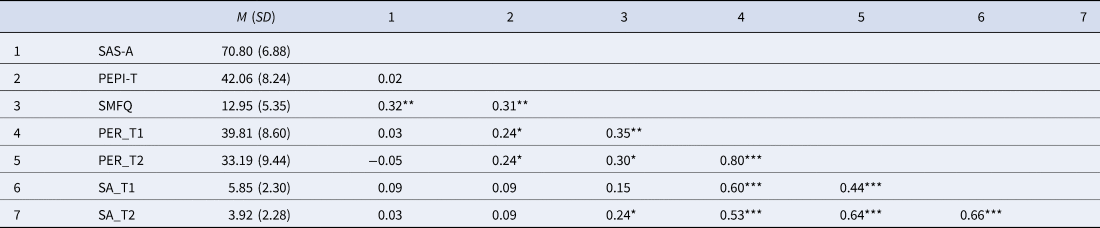
The Pearson chi-squared test showed no significant difference (x 2 (1) = 0.01, p = 0.922), suggesting a random grouping. Further Analysis of Variance (ANOVA) results demonstrated no significant difference between speech and interaction participants on the SAS-A, SMFQ, and PEPI-T (F(1,71) = 0.003–1.67, ps > 0.200), suggesting the homogeneity of the participants. As shown in Table 1, Pearson correlation analyses results demonstrated that PEPI-T significantly correlated with PER_T1 and PER_T2. Score on the SMFQ was significantly (rs = 0.24–0.35, ps < 0.039) associated with SA_T1 and PER pre- and post-intervention. The SMFQ also significantly associated with SA (r = 32, p = 0.007) and the PER level measured at the baseline (r = 31, p = 0.008). Associations between SA and PER scores measured at pre- and post-intervention displayed at significantly moderate to high level (rs = 0.44–0.80, ps < 0.001).
Bivariate Relations Among Variables

Note: *p < 0.05, **p < 0.01, ***p < 0.001. SAS-A = Social Anxiety Scale for Adolescents measured at the baseline; PEPI-T = Post-Event Processing Inventory-Trait measured at the baseline; SMFQ = Short Mood and Feelings Questionnaire measured at the baseline; PER_T1 = the PER score measured immediately after reading the hypothetical social situation text; PER_T2 = the PER score measured immediately after receiving the CR intervention; SA_T1 = the social anxiety score measured at Time 1; SA_T2 = the social anxiety score measured at Time 2, that is, immediately after receiving CR intervention.
The Intervention Effect of CR
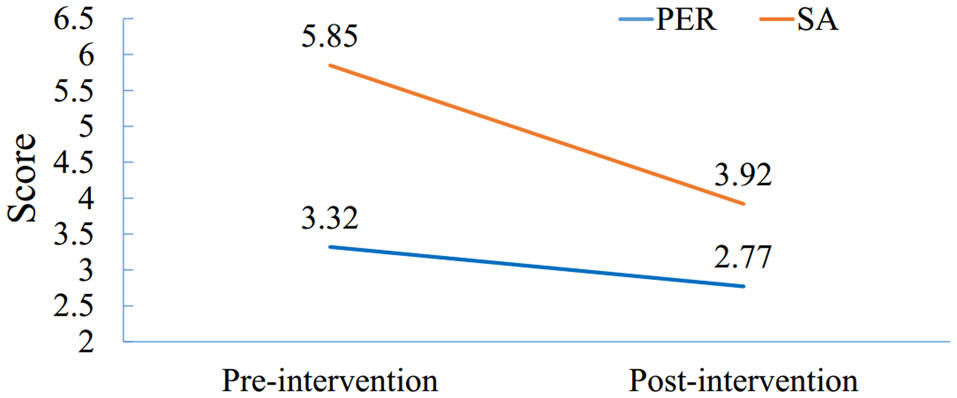
As shown in Table 2 and Figure 1, after controlling for depression, participants’ PER and SA levels significantly decreased after the intervention (ps < 0.001) with moderate to high effect size (d = 0.71–0.84). Hierarchical regression analysis further demonstrated that, after inputting depression in the first step as covariate ((β = 0.11, ΔR 2 = 0.01, p = 0.356), the decrease in PER could significantly predict the improvement of SA symptoms immediately after receiving CR intervention (β = 0.55, ΔR 2 = 0.30, p < 0.001).
ANCOVA Results of PER and SA Pre- and Post-Intervention

Note: ***p < 0.001. PER = post-event rumination; SA = social anxiety.
Score change of PER and SA pre- and post-intervention. Note: PER — the average item score; SA — the sum score.

The Situational Effect of CR Intervention
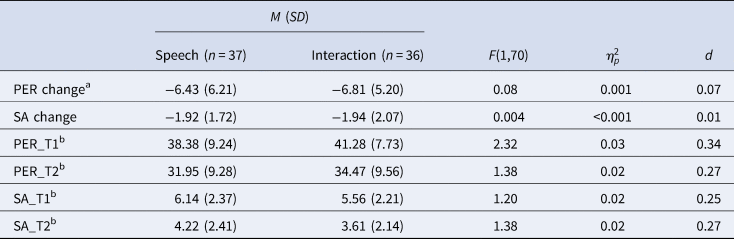
As shown in Table 3, unexpected in the hypothesis, the change in PER and SA, that is, the intervention effect, showed no difference among participants from speech and interaction groups. From the perspective of PER and SA levels pre- and post-intervention, no significant difference between groups was shown even after controlling for depression (F(1,70) = 1.20–1.38, ps > 0.132). Additional ANCOVA results showed no significant difference between PEPI-T and PER_T1 (F(1) = 2.91, p = 0.090, $\eta _p^2$ = 0.02) after controlling for depression; however, a significant difference was found between the PEPI-T and PER_T2 (F(1) = 39.98, p < 0.001, $\eta _p^2$
 = 0.22) after controlling for depressive emotion. Thus, this finding also demonstrated the effectiveness of the one-session intervention for targeting PER.
Analysis of Variance Results Among State PER and Social Anxiety

Note: aChange = the score of post-intervention minus pre-intervention; bSMFQ score was controlled as a covariate when analysing the state of PER and social anxiety. PER_T1 = the PER score measured immediately after reading the hypothetical social situation text; PER_T2 = the PER score measured immediately after receiving the CR intervention; SA_T1 = the social anxiety score measured at Time 1; SA_T2 = the social anxiety score measured at Time 2 (i.e., immediately after receiving CR intervention).
Discussion and conclusions
To our best knowledge, the present study was the first attempt to target PER with the rationale of CBT among socially anxious adolescents and yielded encouraging findings. On the basis of the cognitive model of SAD proposed by Clark and Wells (Reference Clark, Wells, Heimberg, Liebowitz, Hope and Schneier1995), we developed PER-targeted realistic thoughts to examine their intervention effect. Results showed that, albeit no control group was included, one-session CR still showed its potential to improve rumination and SA symptoms among adolescents with high levels of SA, with moderate to high effect size. This is parallel with previous results with CBT among adults (e.g., McEvoy et al., Reference McEvoy, Mahoney, Perini and Kingsep2009; Modini & Abbott, Reference Modini and Abbott2017). Furthermore, regression analysis result showed that the reduction of PER could be significantly predictive of SA, which also parallels the previous findings in an adult population (e.g., Price & Anderson, Reference Price and Anderson2011). Although a randomised control group was not adopted in the current study, the significant difference between the rumination score measured at the baseline and post-intervention still suggested the intervention effect of PER-targeted method. Unexpectedly, the intervention did not show situational effect.
The improvement in individuals’ PER often benefits from the change of negative self-perception and catastrophic estimation to social costs (Hofmann & Otto, Reference Hofmann and Otto2008). The current study provided realistic thoughts specific to social encounters to reduce negative self-perceptions in socially anxious adolescents (e.g., ‘My classmates might notice my embarrassment, but most of them also dislike giving speeches, so this is not a big deal.’) and to decatastrophise the social costs (e.g., ‘Although I was a little awkward during the conversation, they'll soon forget about it.’). Notably, participants were primed with realistic thoughts (e.g., ‘I was undeniably nervous; however, I stood on the platform anyway.’) to notice positive cues. This assisted them in expanding their scope of attention (Price & Anderson, Reference Price and Anderson2011) and in more objectively judging their social outcomes. Once less obsessed with focusing on negative details, they became less anxious. From the perspective of intervention, the hypothesis proposed in the cognitive model — that PER is key to the persistence of SAD (Clark & Wells, Reference Clark, Wells, Heimberg, Liebowitz, Hope and Schneier1995) — was tested again in the present study.
Previous research conducted with adults showed that CBT can moderately to highly improve PER and SA symptoms (e.g., 7-week intervention) (McEvoy et al., Reference McEvoy, Mahoney, Perini and Kingsep2009). Notably, in the current study, the PER-targeted invention also yielded a moderate to high effect size among highly anxious adolescents, illustrating that one-session CR demonstrated its potential value in improving the social-related distorted cognition. Adolescence is characterised by changes in social — effective and — cognitive abilities (Haller, Kadosh, Scerif, & Lau, Reference Haller, Kadosh, Scerif and Lau2015); therefore, adolescents’ emotion and ratiocination about outside social world and others’ mental states would easily fluctuate in response to social cues (Haller et al., Reference Haller, Kadosh, Scerif and Lau2015). Because of its nonfixed nature, targeted intervention can loosen their biased cognitions and make the alleviation of symptoms of anxiety and distress possible; moreover, compared to children, adolescents have the advantage of better understanding and ability to learn (Crone & Dahl, Reference Crone and Dahl2012). These age characteristics favour the application of one-session PER-targeted CR for adolescents.
Unexpectedly, the intervention effect did not show group differences in the current study. Combining results from sections The Intervention Effect of Cognitive Restructuring and The Situational Effect of Cognitive Restructuring Intervention, the level of PER was indeed significantly lower right after receiving CR than that both at the baseline and after reading hypothetical social situation; however, after reading the PER-targeted realistic thoughts, socially anxious adolescents from two groups did not differentiate on PER and SA scores. In addition, the amount of reduction from pre- to post-intervention also did not differ between the two groups. A possible explanation would be that the hypothetical text provoking SA, especially for interaction, was still imaginary, despite the high score on realism and emotional arousal. This might limit the participants’ engagement in real conversational situations and not receiving feedback from partners with no chance to affirm self-image in others’ eyes; therefore, participants visualising themselves in the hypothetical interaction situation still reported similar levels of rumination and anxiety by contrast to those in the speech task group. Nevertheless, in the consideration of convenience, the hypothetical social situation texts still effectively provoked SA.
Albeit the present study yielded notable findings on intervening PER and SA among Chinese socially anxious adolescents, several important limitations require consideration. First, highly socially anxious adolescents, instead of a group with a diagnosis of SAD, were recruited to conduct a preventive intervention in the current study; so the findings cannot be generalised to clinical patients. Second, because of the changing characteristics of adolescents and the special requirements of the school, no randomised control group was adopted; however, compared to the rumination score measured at baseline, the rumination level immediately after the intervention still showed a significant decrease. Future research should incorporate control group to re-examine the effect of this one-session CR intervention for socially anxious adolescents. Third, developing PER-targeted CR sentences specific to social situations (e.g., social encounters) requires researchers armed with CBT clinical practice, which to some extent would constrain the wide application of this method. Fourth, to examine the stability of the intervention effect over time, a follow-up measurement should have been required. Fifth, because the hypothetical texts were visualised, more vivid methods, such as Apps with interactive functions would be useful in future research. Finally, as the sample size in the current study was not-large, results should be cautiously explained and future research should re-examine the situation effect in a larger population of socially anxious adolescents.
Despite the limitations noted above, the current study still was the first effort to examine the intervention effect of targeting PER using aspects of CBT among socially anxious (Chinese) adolescents and yield clinical implications. Several cognitive models of SAD (Clark & Wells, Reference Clark, Wells, Heimberg, Liebowitz, Hope and Schneier1995; Hofmann, Reference Hofmann2007; Rapee & Heimberg, Reference Rapee and Heimberg1997) have shown that after engaging in social events, highly anxious individuals often repetitively ruminate on their mistakes and negative performance. With the sense of shame, and their levels of self-confidence were then gradually reduced. To relieve the distress, individuals might avoid social situations and become more isolated from others. Clinically, PER may further increase individuals’ suicide rate (Clark & Wells, Reference Clark, Wells, Heimberg, Liebowitz, Hope and Schneier1995); consequently, the intervention aiming at PER, especially in adolescents’ population, would effectively relieve rumination and anxious symptoms. More importantly, the standardised intervention procedure may have made the operation process easier to follow and the duration shorter. In addition, the one-session PER-targeted method presented on a computer screen is easy to conduct, suggesting the inclusion of this method in psychology classes for (Chinese) adolescents as a preventive measure is possible and perhaps essential in future research and practice. To sum up, the present study endeavoured its first effort to conduct the PER-oriented intervention with CR, and proved it in socially anxious Chinese adolescents’ sample. Future research should be concerned with the cultural examination of the intervention effect's diversity and uniformity.
Acknowledgements
None.
Funding
This work is funded by Social Science Fund of Ministry of Education of the People's Republic of China (grant No. 21YJC190020) for the first author.
Declaration of interest
None.