


I. Introduction
In the preface to the 40th book of his history, the Roman historian Cn. Pompeius Trogus narrates the end of the royal house of the Seleucid kings (Prol. 40):
Quadragensimo uolumine continentur haec. Ut mortuo Grypo rege Cyzicenus cum filiis eius bello congressus interiit, hi deinde a filio Cyziceni Eusebe <extincti sunt: et ut repetito domestico bello> extinctaque regum Antiochorum domo Tigranes Armenius Syriam occupauit, quo mox uicto Romani abstulere eam.
How, on the death of [Antiochus VIII] Grypus, [Antiochus IX] Cyzicenus lost his life in armed conflict with Grypus’ sons, and how the latter were then wiped out by [Antiochus X] Eusebes, the son of Cyzicenus. Then the recommencement of civil war, the demise of the royal house of the Antiochi, and the seizure of Syria by the Armenian Tigranes, who was soon afterward defeated and deprived of it by the Romans.Footnote 1
The importance of this abbreviated summary lies in the quick succession of kings and civil war, brought to a hard stop by the Romans in the person of the unmentioned Roman general, Cn. Pompeius. This end-point to the Seleucid royal family is further underlined by the author’s summary of his 39th book which, in contrast to his earlier books that dealt with a variety of topics in the western and eastern Mediterranean, is almost exclusively narrated through the fraternal wars of the Seleucid kings, focusing on the collapse of Seleucid Syria and the rise of marauding Judaeans, Arabs and pirates in Syria and the eastern Mediterranean. For Trogus, writing around the time when the Roman civil war had ended, the world of civil wars was one to be avoided at all costs.
The passage demonstrates how, in Trogus’ eyes, within a generation of the end of the Seleucid Empire, the Roman succession in Syria became an inevitable coda to Seleucid history. The beginning of the end had been prepared long before this: in Trogus’ work, the decline of the Seleucid house had its roots in the first fraternal wars of the third century (Just. Epit. 27.1–3). Ancient authors writing about the Seleucid Empire in the second century, for example Poseidonius of Apameia and Diodorus Siculus, but also later authors such as Appian and Porphyry of Tyre in addition to Trogus and Justin, were deeply interested in the moral failings of the Seleucid kings and their incompetence, creating a discourse of an almost inevitable moral and political decline that predicted the end of the empire. There is a parallel for this in Ottoman studies, where it is argued that a combination of literary genres that describe decline and their modern receptions has led all of Ottoman history to be slotted into a so-called decline paradigm.Footnote 2 We can argue that for the late Seleucid Empire, too, most modern analyses are still caught up in a similar paradigm, created by the Greek and Latin literary evidence that has informed scholarship for centuries.Footnote 3 While important work has been done in recent years,Footnote 4 the overall framework of decline, foreshadowing the end of empire, is seldom questioned.
Our corpus of evidence, however, has advanced tremendously: our understanding of amphora stamps and fine wares, for example, has grown significantly over the last few decades. Yet when it concerns the interpretation for the empire at large, archaeological evidence is rarely discussed.Footnote 5 Similarly, on the rare occasions that, for example, tableware is used to interpret broader Mediterranean phenomena, it is done without a demonstrated understanding of both the local conditions of the ware’s travels and of the economic and political environment of the late Seleucid Levant.Footnote 6
By focusing on local phenomena and their interpretation, this article will facilitate different ways of thinking about late Seleucid history. I argue that this focus will also enable a new perspective on some key events of the empire. Within the context of a general expectation of political failure, important political questions such as why the king of Armenia conquered the Seleucid Empire, or why Cn. Pompeius refused to accept the Seleucid princes as kings at Antioch, even as he retained many other local dynasts, kings and warlords in their positions, are currently seldom raised.
What we need, therefore, are methodological tools to interpret the Seleucid Empire from a local perspective, but where does one find them? Arguably, the world of political economy may just offer a solution. When analysing the globalizing world of the 1980s and 1990s, Susan Strange worried that the world’s financial markets had outgrown governments, eroding the political underpinnings of the global order.Footnote 7 She was certainly not alone in arguing that the emergence of global markets separated power from politics and took authority away from the state. Similar observations led the postmodern philosopher Zygmunt Bauman to formulate his model of a ‘liquid playground of uncertainties’ in which politics, market forces and other global agents increasingly fall out of communities’ ability to control.Footnote 8 Strange’s focus on power and the economy is narrower than Bauman’s, and it is of particular interest to me because she argues that the growth of markets has led to ‘the diffusion of authority away from national governments’, leaving ‘a yawning hole of non-authority, ungovernance it might be called’.Footnote 9 I am conscious that this is a decidedly modern theory published for the globalizing world of the late 20th century, but I shall argue that it offers two paths to help us interpret the political dynamics and the local archaeology of the late Seleucid Empire.
The first concerns the question of multiple agents and actors (these terms will be used interchangeably in this paper) who do not form part of what is traditionally described as the political world. For Strange and Bauman, power was channelled away from political actors and given to powerful non-state actors such as firms and sectors.Footnote 10 Constrained by the nature of our (often literary) evidence, scholarship on the Seleucid Empire of the later second and early first centuries, however, has been limited to an analysis of the Seleucid state, as defined by political structures, administrations and players. In this article, I shall seek out local histories of power on the ground and speak of the Seleucid Empire not primarily as a state, but as a geopolitical and economic environment that was controlled by rulers who claimed the Seleucid dynasty as their ancestors. It will be a useful way of not focusing on the political questions concerning multiple Seleucid kings (and thus states) of the late second century and the emergent possibility of multiple empires. Simply put, the separation of power from the realm of politics will enable me in the second section of this article to identify agents beyond the obvious key players of the state.
The second path concerns the question of power. For Strange, the diffusion of power led to a world of ungovernance, a vacuum. Yet, as Benjamin J. Cohen argued in his critical appraisal of Strange’s interpretation of power, her definition of the concept was one-dimensional, essentially limited to a Weberian type of authority, and this led her to see diffusion of power as a ‘gaping hole of non-authority’. Cohen, on the other hand, divides power into two distinct but interrelated dimensions: a) authority (which he describes as external, meaning ‘power over’, influence) and b) autonomy (which is for him internal, the ‘power to’ achieve certain aims). This enables him to create a more nuanced view of the global economy.Footnote 11 He argues, for example, that stockpiles of reserves in East Asian countries enable more autonomy in making local decisions, yet not necessarily greater authority.Footnote 12 His reconstruction of the political economy of the post-financial crisis era is not a world that is leaderless, but one that has very many leaders and is, to put it perhaps too simply, just very different from previous systems. I shall argue in the third section of this article that while ‘authority’ and ‘influence’ may be too blunt as tools to be fully applicable to the questions of power in the Seleucid Empire, the dimensions of ‘power to’ and ‘power over’ offer a more nuanced view. That perspective, along with the findings on local consumption from the second section, will facilitate a step away from a focus on political affairs to an inclusive history of lived experiences in the Seleucid Empire. In the final section of this article, this approach will also offer opportunities for revisiting some political questions concerning the end of the Seleucid state.
II. Local archaeology, new actors and their actions: the power of trade
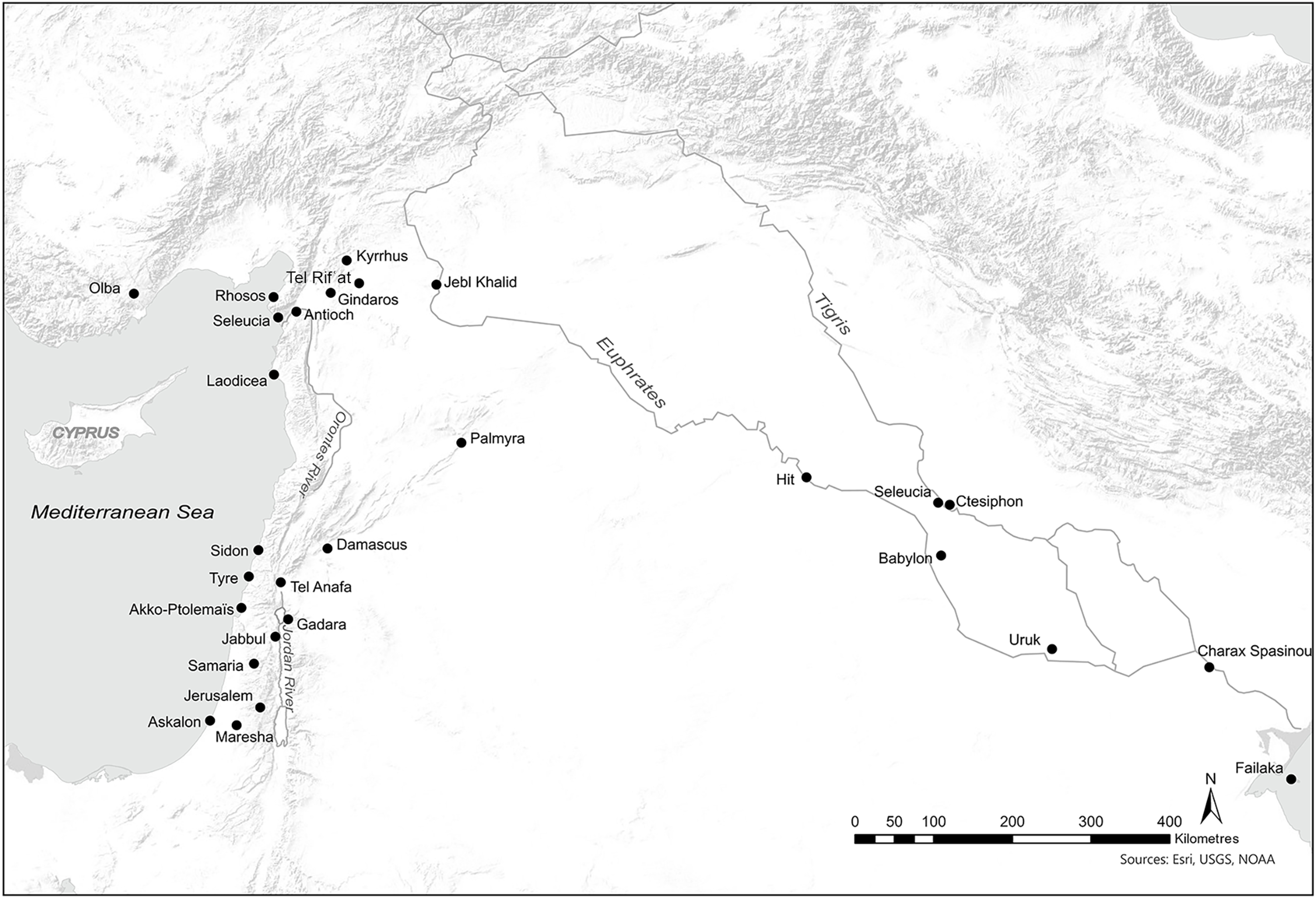
This section seeks out political actors beyond the traditional state players such as kings, dynasts and cities, and introduces unnamed traders and merchants as crucial agents in the eastern Mediterranean. How does one speak about traders in Syria in the late second and first century without direct evidence of their associations, villas and receipts, as one can about traders from other regions and time periods for which this information is available?Footnote 13 Local archaeology offers a rich body of evidence for both state and non-state actors, but it must be noted that there is a significant contrast in local archaeology between the southern and northern Levant for the late second and early first centuries (fig. 1). In the south, at administrative centres, in cities like Samaria and Maresha and at individual farmsteads traces of destruction, or at least of local disturbance, are visible all along the border between the Seleucid and Hasmonean zones of interest.Footnote 14 In the north, local archaeology looks very different. Gindaros in northern Syria is a striking example. The ancient settlement next to modern Jindires, likely named after a village in Macedonia, is located on a plateau in the fertile lowlands of the Oinoparas, the modern river Afrin.Footnote 15 Situated ca. 50km northeast of Antioch, it is a stopping point on the road to Kyrrhus. Fine ware deposits at the site suggest a foundation in the early Hellenistic period, and geomagnetic prospecting demonstrates that the community was laid out on the Hippodamian grid.Footnote 16 As a Hellenistic village, it must have relied on local agriculture, as well as the likely production of wine and oil also for consumption at Antioch.Footnote 17 While the finds at Gindaros suggest a continuous connection to Antioch and the western Mediterranean from the time of its foundation,Footnote 18 it is striking that the quantity of fine ware, such as mould-made (so-called ‘Megarian’) bowls, black gloss and West Slope Ware, Eastern Sigillata A and other small items such as clay lamps, coins and, later, glass increases from the mid-second century onwards, peaking in terms of quality and quantity in the first century BCE.Footnote 19 Norbert Kramer persuasively argues that these finds strongly suggest a peak in the wealth and prosperity of the community, and he sees similar parallels in the growth of local fine wares in other regions in northern Syria, especially the surveys at Tel Rifʿat, Jabbul and around Antioch.Footnote 20 While the growth in fine wares in Gindaros does not necessarily account for the fact that its inhabitants may also have been negatively impacted by the civil wars of the late second and early first centuries in the region, the local environment appears to be one of prosperity and growth.
Map of the Levantine coast and Babylonia, noting sites under discussion (© Lana Radloff).

Perhaps more importantly, at Gindaros and the other surveys of northern Syria, the overall increase in fine ware deposits may also suggest a level of local wealth that opens a window onto the activity of non-state actors in the region: that is, the world of traders. Fine wares, especially imported ones, inform us about local fashions and choices; hypotheses about how the wares got where they were discovered constitute important evidence. The sites of Gindaros in northern Syria, Jebel Khalid on the Euphrates, Gadara in the Decapolis, Tel Anafa in the Hula Valley north of the Sea of Galilee, and Samaria and Palmyra in the Syrian desert in particular provide crucial data for our argument, advocating for the the increased visibility in the archaeological record of a specific type of ceramic fine ware, conventionally referred to as Eastern Sigillata A (ESA).Footnote 21
This name, Eastern Sigillata, is a generic modern term for Roman red gloss ware. It continued to be very popular throughout the Roman period and was later even influenced by Italian shapes and forms.Footnote 22 At the same time, there is no question that ESA’s origins, in terms of its chronology, its geography and its semantics via its relationship with other eastern Mediterranean fine wares, are entirely Hellenistic. Even though the kilns have not yet been located, the discovery of some misfired vessels makes it almost certain that ESA was produced in northern Syria around Antioch near Daphne.Footnote 23 Emerging around 145 BCE, ESA consisted of plates, bowls and drinking-cups, to which different shapes of the same items, as well as jugs and a crater, were added within a generation. The forms were wheel- or mould-made, and their distinctive feature was that they were usually covered by a very fine red slip. Their appearance was innovative: dishes covered by an oxidized red gloss simply looked very different from previous types of fine ware.Footnote 24
This new ware, once it emerged, spread like wildfire throughout the Seleucid Empire and the eastern Aegean: by the first century, examples of ESA can be found in mainland Greece, on the coast of western Asia Minor, in Cyprus, most regions of the Levant and Ptolemaic Egypt and Libya.Footnote 25 It seems to have proven so popular that it almost completely replaced other fine wares very quickly after its arrival. At Tel Anafa, a small site north of the Sea of Galilee, for example, ESA made up 94 per cent of the fine wares found in the second season of excavations.Footnote 26 Gadara, situated on a hill east of the Sea of Galilee, was at the very southern edge of late Seleucid influence. After the Seleucid conquest of the region around 198 BCE, the highest place was heavily fortified using the latest wall and tower techniques.Footnote 27 In the middle of the second century BCE, construction began for an extramural sanctuary that was highly visible in the surrounding landscape.Footnote 28 Here, too, ESA arrived early and became the dominant ware.Footnote 29 At Gindaros in northern Syria, ESA makes up 40 per cent of the local fine ware.Footnote 30 Even at Palmyra, ESA emerges with the earliest wares in the second century and eclipses other fine wares, both imported and locally made, in the first century BCE.Footnote 31 At Maresha, early forms of ESA are present,Footnote 32 even if the end of the city around 112 BCE means that the proportion of ESA is lower than that of other imports. The ware’s rapid spread is clearly connected to ESA’s availability but also to local taste.
Even if the identification of ESA with the rhosica vasa from Laodicea in Syria described by Cicero in 50 BCE as fashionable tableware (Att. 6.1.13 [115] Shackleton Bailey) cannot be proven,Footnote 33 the latter clearly became very popular with the elite in Cicero’s time. Athenaeus tells us the story that Kleopatra VII used to spend significant amounts of money daily on vasa rhosica (Deipn. 6.229d). Vasa rhosica had its origins in Rhosos in northern Syria, and some form of relationship with ESA can surely be envisioned even if the two wares are not identical. But even if they were one and the same, it would be taking a step too far to interpret ESA as solely a high elite luxury product based on these literary accounts. Yes, it was clearly more expensive than locally made wares, especially if it had to be transported over land, but ESA was mass-produced in moulds, and a high degree of efficiency in terms of costs was likely achieved, as John Lund envisions.Footnote 34 The large quantity of ESA found at a broad range of archaeological sites, including not only elite farmsteads but also many urban places and more modest houses,Footnote 35 however, should underline that ESA was a product consumed more widely across society than normal luxury products such as expensive silverware would have been.Footnote 36 The quick and pervasive spread of ESA, then, should also offer us insight into the consumer behaviour of the sub-elite groups that are often invisible in regions of the Hellenistic world where papyri did not survive.
The spread of ESA, however, does not inform us only about local taste and consumer habits. For Kramer, it is ‘possibly the most important indicator of trade in Greater Syria in the Hellenistic and Roman periods’.Footnote 37 The fact that the ware’s centre of production is in northern Syria near Antioch has strong implications for the trade routes and traders’ networks of the Seleucid Empire.Footnote 38 The high volume of ESA at sites such as Antioch and Gindaros might be partially explained by proximity to the workshops. Ostensibly, being closer to the fine ware’s places of origin meant that more people at Gindaros could (and did) afford ESA as their dinner ware.
The people of Jebel Khalid seem to have had strong connections to the region of Antioch, but here also ESA is a clear indicator of the presence of trade routes.Footnote 39 Further south, at Tel Anafa, ESA was found in such large quantities that it initially led excavators to seek the kilns that produced it on the Phoenician coast.Footnote 40 The ware’s dominance at the site must tell us something about the trade networks that brought it to the local inhabitants and similarly to Gadara and Samaria further south.Footnote 41 The most important site in this regard, however, might be Palmyra, for which excavation reports of two Hellenistic layers have now been published. The finds at the Hellenistic/Roman street intersection demonstrate an ongoing link between Palmyra and the Levantine coast from at least the early Hellenistic period, and the excavators argue for significant trade at Palmyra by the third century BCE.Footnote 42 A discovery of significant numbers of ESA fragments located in the same trench further underlines that this heavy trade was not interrupted in the period under discussion in this paper, the later second and early first centuries BCE.Footnote 43 The prominent role of Palmyra in the Roman civil wars, which led Appian to muse later that it was attacked by Mark Antony for its riches (B Civ. 9), should further suggest that while Palmyra rose to greater prominence when the Levantine coast was part of the Roman Empire, its foundation lay in the Hellenistic period, and it was an important ‘caravan city’ in the early first century BCE.Footnote 44
Palmyra’s subsequent wealth was also based on its role in the Indian Ocean trade, and there is little reason to assume that this trade or its precursors began in a later period. A significant portion of Roman Indian Ocean trade was conducted via the Red Sea, as testified by the Periplus of the Erythraian Sea written around the middle of the first century CE,Footnote 45 the Muziris Papyrus and extensive excavations in Egypt.Footnote 46 That said, some of it also evidently came via Palmyra. In the Imperial period, Palmyrenes are attested at the island of Socotra in the Gulf of Aden; myrrh, indigo and imported textiles are already present in graves in Palmyra in the first century CE; and it seems likely that glass finds at Palmyra and Ed-Dur in the United Arab Emirates have the same origins on the Levantine coast, indicating Palmyra’s role in the glass trade.Footnote 47 Already in the third century BCE, spices, especially cinnamon and cassia, arrived in Egypt via Palestine rather than the Red Sea. Much later, the Roman imperial medical philosopher Galen of Pergamon describes how ‘Indian lyicum’ and ‘Indian aloe’ were brought by camels to the Phoenician coast (Nat. Fac. 12.215 Kühn). It is uncertain whether all these commodities were transported directly from India or rather came up the East African coast, but what is essential for my argument is that by the first century BCE these trade routes existed and seem hardly to have been affected by the political changes in the Seleucid Empire.Footnote 48 Nabataeans and nomadic groups from the Syrian and Arabian deserts had for centuries supplied valued commodities to the Levantine coast via the Red Sea and the Arabian desert (as also implied in Periplus 19), or via the Persian Gulf. One reason for Palmyra’s success might also be seen in Eivind Seland’s reassessment of the caravan trade, where he argued that the two routes via Palmyra and the Red Sea enabled trade throughout the year, rather than only in certain seasons.Footnote 49
The significant number of fragments of ESA at Palmyra further underline the city’s role as a trading hub in the Syrian desert. Critically, it might also provide additional evidence for the Hanson termini of the trade routes from the Persian Gulf. The results of the Hellenistic excavations were published too late to be considered in his study, but Seland argued that for geomorphological reasons it is the region around Antioch that should be seen as a key western terminus for the Palmyrene trade, rather than Damascus and the Phoenician cities, as is sometimes argued.Footnote 50 Bearing in mind Kramer’s contention that ESA is one of the most important signifiers of trade in the late Hellenistic and early Roman periods, it is tempting to connect ESA with long-distance trade. While in some instances ESA may easily have been the main cargo of short- and medium-distance trade, especially within close proximity to the kilns, the presence of ESA at Palmyra may enable us to go one step further. For this, a comparison with African red slip (ARS) pottery from the Roman Imperial period may be instructive.
Elizabeth Fentress, Sergio Fontana, Bruce Hitchner and Philip Perkins have argued persuasively that the movement of ARS ware around the western Mediterranean between the second and fifth centuries CE was intrinsically connected to the wheat and oil routes linking the North African coast, Sicily and Rome. ARS travelled as a by-product of the wheat and oil trades and was transported either by caboteurs or by cargo ships on their voyages between Carthage, Sicily, Rome and other places in the Empire. For Fentress et al. ARS is a key illustration of the integrated nature of the Roman economy.Footnote 51 The patterns of ESA in the Levantine world are similar enough to enable a comparative analysis: ESA is not only a proxy for local trade in northern Syria, but also becomes a signifier for the long-distance spice trade networks that at some point became the Indian Ocean trade. The caravan traders brought spices and other commodities to northern Syria and Egypt, where there were long-established markets, and the goods also found favour in Rome. Similar to ARS, ESA may have been an immediate object of trade or a by-product that piggybacked onto the trade of other commodities.Footnote 52 After unloading their goods at the western termini of the trade routes, the traders returned through the desert with stackable and easily portable ESA as return cargo, thus also avoiding an empty run.
One additional piece of evidence corroborates this reconstruction. While ESA also moved across the Euphrates, the fine ware does not seem to have had the same effect in eradicating all other fine wares on the other side of the river as it did in the Levant. As Kramer has noted, the overall quantity of ESA found to the east of the Euphrates is much lower than in the Levant, and also lower than, for example, in western Asia Minor;Footnote 53 the Euphrates acted as an apparent border to the trade of ESA. There may be multiple reasons as to why glazed Parthian ware remained more popular east of the Euphrates. These types of borders are not unheard of in the ancient Mediterranean, although other factors such as availability, cost and consumer preferences may also be in play.Footnote 54 If we envision the movement of ESA as a by-product of the caravan trade of Palmyra, however, the Euphrates acting as a border for trade might simply be an indicator of the general direction of the trade routes. Going eastwards from Palmyra, the caravans reached the Euphrates near Hit and then shipped their wares south along the river.Footnote 55 More importantly, however, at Hit the caravans reloaded and returned west. While ESA was known at Failaka and imitated there around 100 BCE,Footnote 56 before the late first century BCE there is very little ESA to be found in the Persian Gulf;Footnote 57 ESA may therefore simply have been a product intended for Palmyra and for the local traders who took it from there. It moved across the Euphrates, but in smaller quantities, because the main trade routes went south.
Thinking about ESA as a proxy for the short- and long-distance trade in Greater Syria opens a window onto actors within the Seleucid Empire that are invisible in our literary and epigraphic documentation. As indicated by the pervasive and rapid spread of ESA, the traders must have been ubiquitous, and this points indirectly at the widespread existence of groups with disposable income beyond state (kings) or local power (dynasts and cities).
III. Diffused power and the wealth of trade?
The introduction of traders as actors in the Seleucid Empire and my hypothesizing about their role raise two key questions: if we accept the presence of actors beyond those who have traditionally been discussed, how do they fit into the larger geopolitical environment of the Seleucid Levant, and how do the findings in this article affect our macro view of the grand political events of the Seleucid state? Before attempting to answer these questions, we must discuss the landscape itself, a task that is complicated by the fact that the political environment of the late Seleucid Empire is poorly understood. Effectively, the empire was in a period of political transformation. Local warlords of the late second and first centuries had increasing latitude to follow their own political agendas and resist the Seleucid state, as is demonstrated most visibly by the rise of the Maccabees in the southern Levant, their territorial expansion and their effective independence from the Seleucids after 129 BCE.Footnote 58 Similarly, some cities became independent, or were otherwise establishing a new position within the empire: Sidon celebrated itself with a new era on its coinage, possibly having announced its independence in 111/0 BCE, and a royal letter by a Seleucid king to the former capital of Seleucia in Pieria declared the city autonomous in 109/8 (RC 71–72).Footnote 59 Askalon apparently followed suit in 104/3 BCE.Footnote 60 Beginning in the last quarter of the second century, some major cities of the Levantine coast also began minting precious coinage on their own for the first time. Tyre was the first to claim its status as ‘sacred and inviolable’ on silver coinage in 126/5 BCE.Footnote 61 It is tempting to interpret the visibility of local dynasts and cities as evidence for a change in power relations between the centre and individual actors. While recent scholarship offers important nuance in interpreting localized movements,Footnote 62 their impact on the working of the empire deserves a fresh look.
In fact, the power of cities may at times have been very limited. As noted above, the independence of Seleucia in Pieria was proclaimed in a royal letter in 109/8 BCE, but after at least a decade of independence, the city issued coinage for the Seleucid king Demetrius III.Footnote 63 The traditional interpretation has been that this demonstrates at least a temporary reduction of autonomy for Seleucia, but examples elsewhere in the empire suggest that this type of transaction was not novel. Oliver Hoover carefully demonstrates that local cities minted civic coinage to cover payments to the Seleucid kings throughout the history of the empire,Footnote 64 and this is also what we see here. Seleucia was required to mint coinage to cover the expenses of the advance of Demetrius III and his army, a process that had no impact on the city’s formal status. This example also raises the critical question of who normally paid for these coins in the later second century. While it is assumed that Seleucid kings generally provided the bullion for the coinage that was struck in the empire’s mints, arguably the late second-century civic issues must have been paid for by local communities.Footnote 65 The coinage of Seleucia for Demetrius III can therefore not be seen as a signifier of changed status. Rather, it was an exacted monetary payment. While the example from Seleucia is easily identifiable because the Seleucians used ‘royal coinage’, we cannot assume that all monetary exactions would have taken the form of royal coinage. Some civic issues may also have been minted for royal purposes. Ultimately, therefore, despite cities’ independence (their local autonomy, their ‘power to’), the fact that they minted coinage should not lead us to conclude that the kings had no influence (that is, ‘power over’) over them.
Where does this leave us regarding the independence of cities? The Levantine cities’ minting of coinage responds to broader Mediterranean trends, coming at the end of a long evolution of coinage in the Seleucid Empire.Footnote 66 While at the outset it may be tempting to associate the visible independence of the cities with a growth in their power, it is difficult to substantiate to what degree this also led to a growth in their influence, their ‘power over’ other political actors in the empire. Nor does it tell us much about the loss of royal influence. In fact, it is possible that what we see here is the final transformation of the Seleucid Empire in the late second and early first century:Footnote 67 rather than continuing the centralization of the empire that was a key interest to the kings of the early second century, the last generation of Seleucid rulers actively decentralized as much as possible. In a world of rivals competing for the diadem in which cities and territories frequently changed hands with a concomitant loss of resources, kings devolved the right to mint coinage to cities.Footnote 68 Similar to parallel Roman approaches in western Asia Minor, this system forced cities to supply coinage to any Seleucid king who came by in a time of need.Footnote 69 In this scenario, there are many more political actors, but the kings’ ‘power over’ the cities may not have changed significantly despite what the evidence seems to suggest.
Let us therefore turn to the power of dynasts and other power-holders. The visibility of a greater group of warlords is likely indicative of an increase in their local autonomy and influence. Dynasts had been an integral part of the empire since its very beginning.Footnote 70 Powerful local warlords such as the Maccabees, the Itureans and the Arabian dynasts of the second and first centuries built up armies and took on the Seleucid kings in battle. Other dynasts who may not have openly opposed the kings also gained power during this period. The priest-dynasts of Olba in Rough Cilicia, for example, controlled the area around the sanctuary of Zeus Olbius and took part in the power plays of the Seleucid Empire from at least the middle of the second century onwards.Footnote 71 In the first century BCE, they played host to the Seleucid king Philip II and displayed their friendship with the Seleucid kings on inscriptions.Footnote 72 They also built large-scale structures within their area. Clearly these priest-dynasts were local power-holders acting within a Seleucid framework while also creating their own dynasties. It is also conceivable that despite their protestations of friendship with the kings, the power imbalance between themselves and the Seleucids diminished over time, and that they were recognized as the de facto rulers of Rough Cilicia.
A further example from Gadara exemplifies how we should interpret the power of these dynasts. It is unclear how long it took to complete the landmark temple at Gadara, but the temenos area was only paved in the early first century BCE.Footnote 73 It is striking that this occurred around the same time as the ‘polis of Seleucia Gadara’ completed the rebuilding of its fortress walls, which the people of Seleucia Gadara proudly displayed on an inscription dating to 85/4 BCE.Footnote 74 While Michael Wörrle emphasizes that the rebuilding of a wall strongly suggests that the city was subject to Judaean raids,Footnote 75 simultaneous construction continued on the extramural sanctuary during this period, which suggests that there were funds for both. Someone must have paid for this, but who?
Adolf Hoffmann sees the beginning of the construction of the temple as having been initiated by the Seleucid king and financed from the royal coffers.Footnote 76 Similarly, for Brita Jansen, the first-century fortress repair at Gadara was paid for by the Seleucid centre.Footnote 77 Her argument for this rests on Siegfried Mittmann’s interpretation of a short building inscription marking the repair, which reads: ‘year 228 Philotas and the polis of the Sele[eucia]ns those in Mes[…]’. Mittmann argues that the name of the Seleucid city as well as the coins found in Gadara, minted at Damascus, strongly suggest that Philotas was an agent of the Seleucid centre at Damascus.Footnote 78 If accepted, this hypothesis would offer us an image of a Seleucid centre that continued to have sufficient resources and interest in the region to fund the fortifications of its cities and to organize the completion of a local sanctuary. Both of these activities could provide evidence for the influence of kings over the region.
It must be stressed, however, that the phrasing of this inscription can have a different interpretation. Wörrle, in his editio princeps of the document, identifies this individual, who has a Macedonian name and is mentioned before the Seleucians, as a local warlord, typical of the late Hellenistic Levant. In this reconstruction Philotas seceded from the Seleucid centre and claimed Gadara and the surrounding region as his own.Footnote 79 One has to presume that he was also the one who paid for the paving of the temenos area. Should we put him and local Arab chieftains, among others, in the same group as the priests from Rough Cilicia and the Maccabees discussed above? This interpretation has consequences: within this reconstruction, the rise of local agents’ autonomy also means that the Seleucid kings have lost their ‘power over’ these groups and their territories, as well as control over the revenues of their empire. Local warlords, and cities as in our coastal examples discussed above, achieved local autonomy and invested revenues locally. The Maccabaean revolt in the second century has been interpreted as an example of a conflict over local taxation,Footnote 80 and arguably this is probably how we should read some of the historical processes. Again, we see many more actors within the empire than in previous periods.
At the same time, this question of dynasts’ power may also give us methodological pause. In Gadara, the building work in the first century has been used as evidence for both the power of the central state and that of the local dynasts. Yet both hypotheses are dependent on the interest of modern scholarship in identifying somebody who can provide local financial support. For the temple building at Gadara, there is an unspoken assumption that the funds provided were too large for the polis community and must have come from outside.Footnote 81 This hypothesis is not unusual, as there is a generally observable tendency among modern interpreters to place the agency for large building works in the hands of ‘big men’ and to downplay the agency of communities themselves.Footnote 82 Sometimes, as for example in the case of the original construction of the fortress walls at Gadara that was based on the latest contemporary building techniques,Footnote 83 this is a reasonable assumption. At other times, this scenario is less likely as the agency oscillates between the centre (kings) and local agents (cities and warlords). Seeking ‘big men’ limits us from considering all available options.
Our discussion of ESA, the spread of fine ware and the suggested presence of traders as political actors may offer a fresh option. For Hoffmann and Mittmann, Gadara was an important regional market, at times even tentatively connected to the paved temenos.Footnote 84 While there is little direct evidence for the sanctuary’s early role in the regional market, we can posit that our invisible power, the traders at Gadara who brought ESA as part of their cargo, may have had the financial means to pay for the temenos and the temple. They arguably had the most to gain. The presence of silver and bronze coins from Damascus at Gadara right up to the Judaean conquest tells us as much about trade as it does about political connections between Gadara and the Seleucid king at Damascus.Footnote 85 Other regions may have been similarly dependent on the traders. At Gindaros and at Palmyra the stability and growth of the community, alongside the ability of a large group of people to spend their disposable income on ESA, should be connected to trade networks within the empire, likely as part of the growing Indian Ocean trade. The influence of traders was also clearly felt in other places: in 124 BCE, and thus around the same time, a trade association in Egypt lost its land in the chōra around Alexandria to the benefit of the Ptolemaic state, strongly suggesting a curtailment of the association’s income and thus power as a consequence of the civil war in Alexandria.Footnote 86 Also, the opulent stone house at Palmyra from the Augustan period offers later evidence of the financial acumen of Palmyra’s traders.Footnote 87 Mark Antony’s attempted raid on Palmyra further attests to the city’s traders’ wealth.
The spread of ESA is a clear testimony to the vitality and growth of local and long-distance trade in Syria in this period. The traditional focus on kings, cities and dynasts occludes other key (non-state) actors who were clearly important and enabled growth and stability in Gindaros, northern Syria and possibly at Gadara. While for Strange a world with many actors becomes ‘ungovernable’ (and one might suggest that this aligns with the interpretation of the politics of the late Seleucid Empire in scholarship in general), Cohen envisions such a world as just being very different from previous systems. I would argue that the latter is a more fruitful approach to the political reality of the later Seleucid Empire. Specific relationships are dynamic and require further interpretation,Footnote 88 but the Seleucid Empire in its final transformation is simply a geopolitical landscape that is different from previous periods.
IV. The power of trade and the history of the Seleucid states
The findings regarding trade patterns are revelatory when we map them onto the key political cities and regions for the late Seleucid kings: Antioch and Damascus, and to a lesser extent Akko-Ptolemaïs and the region of Rough Cilicia. The power or attraction of Antioch, for example, is often seen in political and ideological terms. By the mid-second century, it was the capital of the empire, and its largest mint. We also have evidence of kings currying the favour of the people of Antioch from as early as the 160s BCE, and Antioch is one of the few cities of the Seleucid Empire where the population’s opinion of their kingship mattered to the kings.Footnote 89 Antioch became an idea that was worth fighting for: even in the very late Seleucid Empire, controlling Antioch meant controlling the empire.Footnote 90 Damascus is another key city, recently presented by Paul Kosmin as an ancient capital of the region. For the Seleucid kings Demetrius III and Antiochus XII made Damascus their base, and it has even been argued that the last Seleucid kings in Damascus styled themselves as kings of that city.Footnote 91 Similarly, Akko-Ptolemaïs, an important harbour on the Levantine coast, had become an important royal city from the mid-second century onwards, and the final seat of two widowed queens.Footnote 92 The territory of the priest-dynasts of Olba in Rough Cilicia seems to have become the haven of the last Seleucid king, Philip I; here, even in the twilight of the Seleucid state, the priests bore titles such as ‘Brother of Kings’ that underlined their close relationship with the Seleucid kings.Footnote 93 I do not suggest that the analyses of Antioch and Damascus along the lines of ideologies of kingship and empire are implausible, but if my assessment of the role of ESA and of the routes of the spice and Indian Ocean trade is persuasive, ideology was not the only determining factor when it came to the control of these cities.
Kosmin has recently underlined the importance of trade with Damascus both regionally and for Mesopotamia.Footnote 94 Additionally, Antioch may have been attractive to the kings and usurpers of the late Seleucid state not only as a seat of their kingship but also as the backbone of the trade economy of the Seleucid Empire. The regional prosperity of northern Syria in the late second and early first century, alongside the spread of ESA as an indicator of wealth and of the robustness of trade routes, may present a very different picture of early first-century Syria from what our literary sources of warring Seleucid princes might suggest. Northern Syria’s wealth could also be seen as a reason why Tigranes of Armenia sought to control Syria and the Levantine coast and to incorporate it into his kingdom for a brief period in the first century.Footnote 95
More importantly, however, trade provides a different key to understanding the end of the Seleucid Empire. As part of Cn. Pompeius’ reorganization of the eastern Mediterranean after his defeat of Mithridates, the Roman imperator founded cities and confirmed many of the local warlords and princelings in their positions.Footnote 96 The last Seleucids’ claim that they remained kings at Antioch was rejected, however. The late antique author Justin narrates that Pompeius argued that ‘he had not … taken away from Antiochus a throne that was his; nor would he give him a kingdom that Antiochus had ceded to Tigranes and which he could not defend’ (Just. Epit. 40.2.4), adding that this was ultimately caused by the infighting of Syria’s kings (40.2.5). While many reasons have been adduced for the destruction of the Seleucid state, of which the primary one appears to be failure to control the pirates, the weakness and inefficacy of the waning empire are always taken for granted.Footnote 97 It may be the case that the decades-long feuds among the Seleucid princes just exhausted the Roman senators’ patience, or at least that of Pompeius.Footnote 98 Alternatively, Pompeius may simply have wished to reverse his predecessor’s decisions about the Seleucid kings.Footnote 99 It must be noted, however, that faults of kingship could surely also have been found for the other dynasts and princelings for whom this argument was apparently not made. Arguably, the Seleucid kings at Antioch and Damascus were somehow viewed differently.
The apparent and abundant wealth of the Seleucid princes was very well known in Rome in 70 BCE. We are informed about this wealth since one of the Seleucid princes seems to have fallen prey to the wiles the Roman governor Verres in Sicily and was mentioned by Cicero in a speech against the former governor. Based on my analysis, perhaps the power of trade in northern Syria, a prominent argument in early scholarship without much concrete evidence,Footnote 100 was so visible that the continued rule of its kings was unacceptable to Pompeius. The squabbles of the late Seleucid kings provided a welcome excuse for the imperator, to whom it was obvious where the real treasures lay. The power of trade in Greater Syria, and the possibilities for prosperity offered by its spice trade termini, required it to be a Roman province, giving access to Roman negotiatores and Roman publicani.
V. Conclusion
Our literary sources offer us one view of the end of the Seleucid Empire. In this article I have argued for a different one. A specific focus on local archaeology generates a picture of the Levantine coast that highlights the diffusion of power, the separation of power from politics and different actors from the ones we are used to. Of course, there are exceptions to this discussion and some local stories that can be clearly explained by the kings’ actions: for example, the organized abandonment of Jebel Khalid in the 70s BCE, which is difficult to see as anything but the withdrawal of the Seleucid administration, the end of the empire on the Euphrates. But local evidence also suggests that such state-controlled endings might have been the exception rather than the rule in northern Syria. The late Seleucid Empire seems to have been a remarkable region of increasing trade and growing local consumption.
This is not to argue that the wars of the Seleucid kings and their infighting never had any harmful impact at the local level. In the southern Levant, the destruction of Maresha in 112 BCE,Footnote 101 as well as the many localized layers of destruction, can now be seen as a clear demonstration of how the wars between the Judaeans, the Seleucid state and other actors could be felt in certain locations.Footnote 102 In contrast, some regions in northern Syria, such as Gindaros, clearly prospered. The billeting of armies, the theft of livestock and episodes of physical and emotional violence, however, may not have left traces in the archaeological record.Footnote 103 Moreover, the destruction of olive groves and vines is too labour-intensive to have been widely practised,Footnote 104 and ancient warfare was often very localized.
But the overall impression of the spread of ESA seems to suggest an environment in which large-scale consumption continued and expanded. As argued by Lund, the spread of ESA and the resiliency of trade routes within this environment of Seleucid internecine warfare speak to the stability of the production centres and show how efficient and numerous the trade routes actually were.Footnote 105 Within this line of argument, it is also possible that some elements of trade, including the rise of caravan leaders to safeguard the eastern deserts, became more pronounced as a direct consequence of the collapse of Seleucid state structures.Footnote 106 The traders become yet another set of actors in an empire that was in its final stages of transformation. The growing autonomy of cities and dynasts and other warlords is easily identifiable for the period under discussion, but while it is likely that this is not a signifier for the collapse of the Seleucid Empire, it is yet unclear what it does signify. Considering questions of autonomy, it is conceivable that the growing autonomy of the cities and dynasts does not necessitate a lessening of royal influence, and that instead what we are examining is a shifting geopolitical environment consisting of multiple actors engaging in interactions within a web of complex dependencies.
One of the advantages of my approach lies in the identification of unnamed traders of the Seleucid Empire whose history has so far only rarely been told. It is entirely possible that the worlds of politics and trade overlapped. Although some local warlords may have enriched themselves not only as petty kings but also as trade lords or trade guardians, this does not obviate my conclusion that traders could be their own actors. The areas where these categories meet are interesting, and I have argued that the appeal of Antioch to the late Seleucid kings and to all those who wanted to control the city may have been more economic than has recently been suggested. Other overlaps between the power of trade and local agents have the potential to be revelatory and require further investigation.
For now, it is sufficient to accept that the changing dynamics of first-century Syria would not necessarily entail the existence of a gaping power vacuum. The introduction of a new set of actors offers a fresh glimpse into the first century and opens a new chapter of Seleucid and Hellenistic history.
Acknowledgements
I thank Aneurin Ellis-Evans and Andy Meadows for inviting me to think about the late Seleucid Empire. Subsequently, Ben Akrigg, Andreas Bendlin, Tyler V. Franconi, Prabhjeet K. Johal, Norbert Kramer, Eph Lytle, Lana Radloff and Kathryn Stevens offered important insights and corrections, and I thank Elizabeth Ferguson and Judith K. Schutz for improving both my argument and the text. I am also grateful to the anonymous reviewers of the journal, and I wish finally to express my sincere gratitude to Lin Foxhall for her guidance and for her belief in the project. Needless to say, all remaining errors are my own.
Funding statement
This article draws on research supported by the Social Sciences and Humanities Research Council of Canada (grant number 435-2022-0060).

 Open access

