Social anxiety disorder (SAD) is one of the most common psychiatric disorders, with lifetime prevalence rates estimated at 12.1% (Kessler et al., Reference Kessler, Berglund, Demler, Jin, Merikangas and Walters2005). Among those who present for treatment, the presence of a comorbid psychiatric diagnosis is increasingly recognised as the norm. For example, 31% of individuals with generalised SAD also experience major depressive disorder at some point in their lives (Chartier, Walker, & Stein, Reference Chartier, Walker and Stein2003). Compared to individuals without comorbidity, those with comorbid depression report higher levels of distress, greater impairment, and higher risk of suicide (e.g., Mannuzza, Aronowitz, Chapman, Klein, & Fyer, Reference Mannuzza, Aronowitz, Chapman, Klein and Fyer1992; Rosenbaum, Pollack, & Pollack, Reference Rosenbaum, Pollack and Pollack1996). Randomised controlled trials demonstrate that SAD can be successfully treated via several approaches; however, cognitive behavioural therapy (CBT) has received especially strong empirical support (see Stewart & Chambless, Reference Stewart and Chambless2009, for a recent meta-analysis). Cognitive behavioural group therapy (CBGT) is a commonly administered format of CBT, and robust evidence demonstrates its effectiveness (e.g., Herbert et al., Reference Herbert, Gaudiano, Rheingold, Myers, Dalrymple and Nolan2005; Marom, Gilboa-Schechtman, Aderka, Weizman, & Hermesh, Reference Marom, Gilboa-Schechtman, Aderka, Weizman and Hermesh2009; McEvoy, Reference McEvoy2007). In fact, a recent meta-analysis reported average effect sizes for CBGT of .92 (Aderka, Reference Aderka2009). Although the efficacy of CBGT is well established for SAD (see Rodebaugh, Holaway, & Heimberg, Reference Rodebaugh, Holaway and Heimberg2004, for a review), little is known about how comorbid depression affects treatment. In fact, most treatment studies either specifically exclude individuals with comorbidity or disregard its potential effects.
Given the substantial prevalence and potential impact of comorbid depression on SAD symptoms and outcome, it is important to understand how comorbid depression affects SAD treatment outcome so that informed decisions can be made regarding the sequence and duration of treatment. Theoretically, three outcomes are possible (Joormann, Kosfelder, & Schulte, Reference Joormann, Kosfelder and Schulte2005): (1) Comorbid depression might have adverse effects on treatment for SAD, observed via higher dropout rates and less improvement in symptoms of social anxiety. If this were the case, it would be important to first treat symptoms of depression so that individuals might benefit from CBGT for SAD. (2) Comorbid depression might not interfere with treatment for SAD; however, it may increase the general severity of the clinical profile. In turn, individuals with comorbid depression might continue to report higher posttreatment symptoms of anxiety than their nondepressed counterparts. In this case, individuals with comorbid depression might require additional treatment sessions. (3) Comorbid depression might not interfere with treatment for SAD and individuals with comorbid depression might not differ from their nondepressed counterparts in posttreatment symptom severity. In this case, the same CBGT for SAD protocol would be recommended for individuals with and without comorbid depression.
Unfortunately, there are only a handful of studies examining the effect of depression on CBGT for SAD, and results of these studies have been mixed. It is therefore difficult to make empirically based decisions about the sequence and duration of treatment. On one hand, some results suggest that depressive symptoms are associated with poorer treatment response to CBGT for SAD and higher rates of dropout before treatment completion (Chambless, Tran, & Glass, Reference Chambless, Tran and Glass1997; Ledley et al., Reference Ledley, Huppert, Foa, Davidson, Keefe and Potts2005). On the other hand, however, several studies have found no interference from comorbid depression. For example, Joormann and colleagues found comparable rates of improvement for patients with SAD regardless of comorbid depression (Joormann et al., Reference Joormann, Kosfelder and Schulte2005). Similarly, comorbid depression did not influence pretreatment severity scores, post-treatment outcome measures, or attrition rates in a study focused on CBGT (Erwin, Heimberg, Juster, & Mindlin, Reference Erwin, Heimberg, Juster and Mindlin2002). In fact, some argue that completing CBGT for SAD may be beneficial in the sense that it was associated with a decrease in depressive symptoms, despite the fact that depression was not the focus of treatment (e.g., Erwin et al., Reference Erwin, Heimberg, Juster and Mindlin2002; Moscovitch, Hofmann, Suvak, & In-Albon, Reference Moscovitch, Hofmann, Suvak and In-Albon2005).
Mixed results may be due, in part, to differences in how comorbid depression is assessed or excluded. Chambless et al. (Reference Chambless, Tran and Glass1997) and Moscovitch et al. (Reference Moscovitch, Hofmann, Suvak and In-Albon2005), for example, examined depressive symptoms among a group of individuals with SAD. In Chambless et al., participants did not necessarily meet diagnostic criteria for a depressive disorder, and in Moscovitch et al., participants with and without comorbid depressive disorders were not directly compared. Other studies have explicitly excluded those with a current major depressive disorder (Ledley et al., Reference Ledley, Huppert, Foa, Davidson, Keefe and Potts2005), making it difficult to understand the effect of clinically significant depression on SAD treatment. Furthermore, divergent results may be related to the population being recruited. Some past studies, for example, have recruited participants who were part of a randomised control trial (e.g., Ledley et al., Reference Ledley, Huppert, Foa, Davidson, Keefe and Potts2005), limiting the generalisability of results.
Given the divergent methodologies and inconsistent findings, a carefully designed and inclusive research study examining the effects of depression on CBGT for SAD is an important contribution to the literature. Thus, the current study sought to extend past work by drawing from a large, well-defined, naturalistic outpatient sample to compare participants with a DSM diagnosis of SAD with and without comorbid depressive disorders in the following domains: (a) pretreatment illness characteristics, (b) changes in anxiety and depressive symptoms pre- versus post-CBGT, and (c) rates of attrition from treatment. Given that CBGT for SAD has been associated with a decline in depressive symptoms during treatment (Erwin et al., Reference Erwin, Heimberg, Juster and Mindlin2002; Joormann et al., Reference Joormann, Kosfelder and Schulte2005), we also extended past research by examining factors that contributed to change in depressive symptoms. In line with recommendations made by Steketee and Chambless (Reference Steketee and Chambless1992), we examined whether demographic variables, clinical characteristics, and change in anxiety symptoms predicted change in depressive symptoms. We hypothesised that individuals with comorbid depression would report more severe symptoms of anxiety at pretreatment. In addition, although we expected an equivalent degree of symptom decrease in both groups, we anticipated that individuals with comorbid depression would continue to report higher symptoms at post-treatment. Rates of attrition were not expected to differ by group. We also anticipated that greater improvement in anxiety symptoms would predict a greater decrease in depressive symptoms.
Method
Participants
Participants were individuals with a diagnosis of Social Anxiety Disorder (SAD) who were receiving outpatient treatment. Individuals were referred for treatment by a physician (e.g., family doctor, psychiatrist) for assessment and treatment of their anxiety. The Structured Clinical Interview for DSM-IV (SCID; First, Spitzer, Gibbon, & Williams, Reference First, Spitzer, Gibbon and Williams1995) was used to assign diagnoses, which were then confirmed by a treatment team (see details below). Eligible participants had a principal diagnosis of SAD (i.e., it was identified as their primary concern during the assessment), participated in CBGT, and consented to participate in research. Exclusionary criteria included current (i.e., past 6 months) psychosis, active suicidality, current mania or hypomania, and current substance abuse or dependence, which would interfere with the ability to participate in CBGT.
The final sample consisted of 133 participants, 72 (54.1%) of whom had a comorbid depressive disorder (SAD+D group) according to the Diagnostic and Statistical Manual of Mental Disorder, fourth edition (DSM-IV-TR; American Psychiatric Association, 2000): 55 with major depressive disorder, 13 with major depressive disorder in partial remission, 3 with depressive disorder not otherwise specified (NOS), and 1 with bipolar I disorder (currently in a major depressive episode).Footnote 1 Participants were not excluded from either group if they had an additional anxiety disorder, as long as SAD was the principal diagnosis at the time of treatment. Of the individuals with SAD without a depressive disorder (SAD group), eight were diagnosed with comorbid generalised anxiety disorder (GAD), three with panic disorder with or without agoraphobia (PDA), six with obsessive compulsive disorder (OCD), nine with a specific phobia (SP), and four with post-traumatic stress disorder (PTSD). Within the SAD+D group, 26 were diagnosed with GAD, 17 with PDA, 17 with OCD, 28 with a SP, 7 with PTSD, and 1 with Anxiety Disorder NOS.
Measures
Structured Clinical Interview for DSM-IV (SCID; First et al., Reference First, Spitzer, Gibbon and Williams1995)
Diagnoses were determined via the SCID, which was administered by experienced clinicians (e.g., psychologists, advanced-level graduate students, and psychiatric nurses). Interrater reliability was very good, κ = 0.81.
Global Assessment of Functioning (GAF; DSM-IV TR; American Psychiatric Association, 2000)
This clinician-administered rating scale ranges from 1 to 100. Lower scores reflect lower levels of current social, occupational, and psychological functioning. Impairments in functioning are assessed independent of physical or environmental limitations. The reliability and validity of the GAF has been demonstrated (Jones, Thornicroft, Coffey, & Dunn, Reference Jones, Thornicroft, Coffey and Dunn1995).
Depression Anxiety Stress Scales-21 item version (DASS; Lovibond & Lovibond, Reference Lovibond and Lovibond1995)
This 21-item scale was designed to measure depression, anxiety, and stress. For the purpose of the present study, only the depression subscale (DASS-D) was used. The seven-item DASS-D was used to assess depressive symptoms within the last week. Participants used a 4-point Likert scale to indicate how much each item applied to them over the last week from 0 (did not apply to me at all) to 3 (applied to me very much or most of the time). Items were summed and multiplied by 2. The DASS has been found to have good reliability and validity (Antony, Bieling, Cox, Enns, & Swinson, Reference Antony, Bieling, Cox, Enns and Swinson1998).
Social Phobia Inventory (SPIN; Connor et al., Reference Connor, Davidson, Churchill, Sherwood, Foa and Wesler2000)
The SPIN is a 17-item, self-report instrument assessing social anxiety symptoms: fear, avoidance, and physiological arousal associated with anxiety in social situations. Participants indicated how much they were bothered by each symptom on a 5-point Likert scale, which ranges from 0 (not at all) to 4 (extremely). A total score was obtained by summing all items. Strong psychometric properties have been found (Antony, Coons, McCabe, Ashbaugh, & Swinson, Reference Antony, Coons, McCabe, Ashbaugh and Swinson2006).
Social Interaction Anxiety Scale (SIAS; Mattick and Clarke, Reference Mattick and Clarke1989)
This 20-item self-report measure assesses fears associated with social interaction. Participants used a 5-point Likert scale to rate items from 0 (not at all characteristic or true of me) to 4 (extremely characteristic or true of me). Positively worded items were reverse coded, and a total score was obtained by summing all items. Strong reliability and validity has been demonstrated (Mattick & Clarke, Reference Mattick and Clarke1989; Osman, Gutierrez, Barrios, Kopper, & Chiros, Reference Antony, Bieling, Cox, Enns and Swinson1998).
Social Phobia Scale (SPS; Mattick & Clarke, Reference Mattick and Clarke1989)
The SPS is a 20-item, self-report instrument designed to measure anxiety symptoms related to performing in front of others or being observed by other people during everyday activities. Items were rated on a 5-point Likert scale that ranges from 0 (not at all characteristic of me) to 4 (extremely characteristic of me). All items were summed for the total score. Good reliability and validity has been shown (Mattick & Clarke, Reference Mattick and Clarke1989; Osman et al., Reference Osman, Gutierrez, Barrios, Kopper and Chiros1998).
Procedure
Participants met individually with a trained clinician to complete the SCID (First et al., Reference First, Spitzer, Gibbon and Williams1996). Participants with a principal diagnosis of SAD were offered CBGT for SAD. The manualised CBGT protocol was based on Antony and Swinson (Reference Antony and Swinson2008). It included psychoeducation, cognitive restructuring, in- and between-session exposures and behavioural experiments, and social skills training as needed. The number of sessions ranged from 11 to 12 depending on the group's needs and schedule. Each session was lead by two to three therapists and lasted 2 hours. Participants completed a battery of self-report measures (e.g., DASS-D, SPIN, SIAS, SPS) at the beginning and end of treatment.
Results
Demographic Characteristics
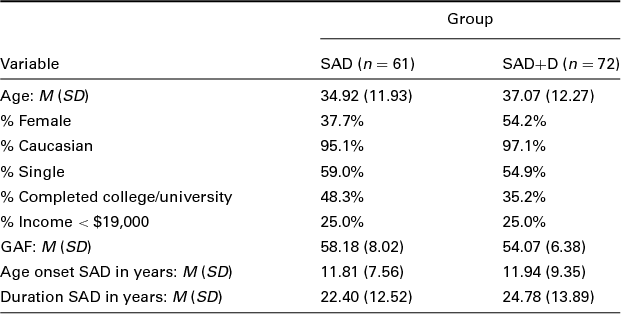
Demographic and clinical characteristics of participants in the SAD and SAD+D groups are presented in Table 1. The two groups did not significantly differ in age, t(131) = 1.02, percent female, χ2(1, N = 133) = 3.60, ethnicity, χ2(2, N = 131) = 2.19, marital status, χ2(4, N = 132) = 3.05, education, χ2(5, N = 131) = 7.75, or household income, χ2(5, N = 112) = 6.42, ps > .05.
Participant Characteristics

Note: SAD = Social Anxiety Disorder, SAD+D = social anxiety disorder plus comorbid depressive disorder.
Pretreatment Clinical Characteristics
The two groups were compared on clinical variables at pretreatment (see Table 1). Independent samples t tests indicated that the SAD and SAD+D groups did not significantly differ on age of onset of social anxiety disorder, t(125) < 1, or duration of social anxiety disorder, t(125) = 1.04, ps > .05. The two groups, however, differed according to GAF, t(129) = 3.26, p < .01, with SAD+D group receiving a lower GAF rating than the SAD group. In addition, as expected, the SAD+D group obtained a significantly higher score on the DASS-D than did the SAD group, t(131) = 6.01, p < .001.
To evaluate the effects of comorbid MDD on pretreatment social anxiety symptom measures, a one-way multivariate analyses of variance (MANOVA) was conducted with group (SAD, SAD+D) as the independent variable for pretreatment social anxiety symptom measures (SPIN, SIAS, SPS). There was a significant effect for group, Wilks’ λ = 0.89, F(3, 129) = 5.45, p < .01, η2 = .11. Compared to the SAD group, the SAD+D group obtained significantly higher scores on the SPIN, F(1, 131) = 11.96, p < .01, η2 = .08, SIAS, F(1, 131) = 9.75, p < .01, η2 = .07, and SPS, F(1, 131) = 15.39, p < .001, η2 = .11.
Attrition
Of the 133 participants who started CBGT for SAD, 113 (85.0%) provided posttreatment data. Treatment non-completers did not differ from treatment completers in age, t(131) < 1, sex, χ2(1, N = 133) = 1.69, pretreatment DASS-D scores, t(131) < 1, pretreatment SPIN scores, t(131) = 1.29, or GAF ratings, t(131) < 1, ps > .05. Importantly, attrition rates also did not differ between the SAD or SAD+D groups, χ2(1, N = 133) < 1, p > .05. Treatment completers and non-completers did, however, differ in their SIAS, t(131) = 2.17, p < .05, and SPS scores, t(131) = 2.15, p < .05. Treatment non-completers reported significantly higher SIAS and SPS scores at pretreatment (M SIAS = 50.65, SD SIAS = 9.72; M SPS = 46.70; SD SPS = 16.91) compared to treatment completers (M SIAS = 45.19, SD SIAS = 10.49; M SPS = 38.27; SD SPS = 16.02).
Post-Treatment Outcome
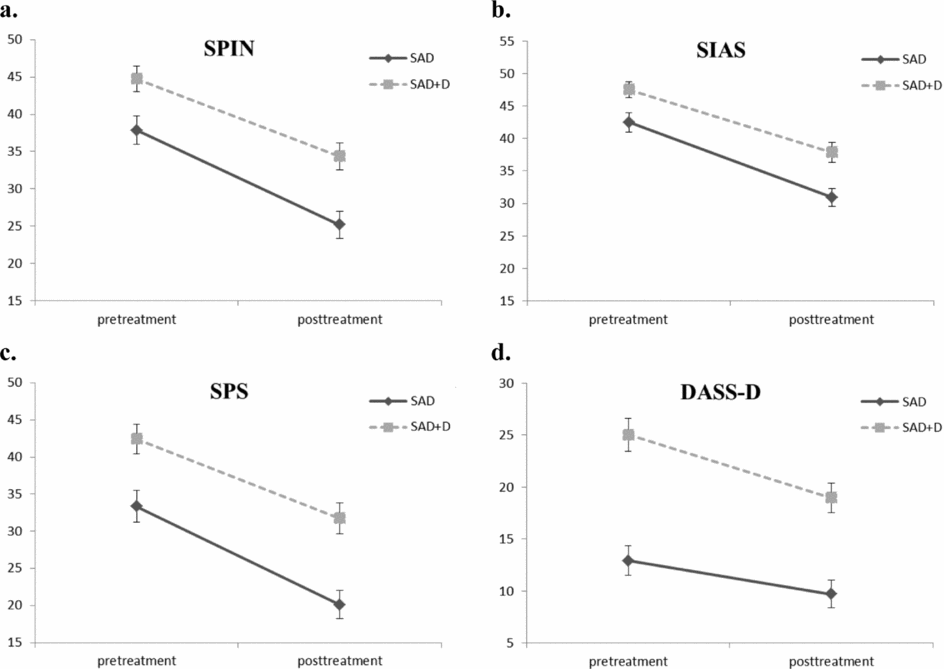
To examine the effectiveness of CBGT for SAD with and without comorbid depression, a repeated-measures MANOVA was conducted with time (pretreatment, posttreatment) as the within-subject factor and group (SAD, SAD+D) as the between-subject factor on the three social anxiety symptom measures (SPIN, SIAS, SPS). There was a significant main effect of time, Wilks’ λ = 0.44, F(3, 109) = 47.27, p < .001, η2 = .57, and group, Wilks’ λ = 0.87, F(3, 109) = 5.34, p < .01, η2 = .13. The time by group interaction, however, was not significant, Wilks’ λ = 0.99, F(3, 109) < 1, p > .05, η2 = .01. Follow-up tests indicated a significant decrease from pretreatment to posttreatment for scores on the SIAS, F(1, 111) = 129.34, p < .001, η2 = .54, SPIN, F(1, 111) = 86.17, p < .001, η2 = .44, and SPS, F(1, 111) = 100.42, p < .001, η2 = .48 (see Figure 1a–c). Despite the overall decrease in symptom measures from pretreatment to post-treatment, the SAD+D group reported higher post-treatment scores compared to the SAD group on the SIAS, F(1, 111) = 11.35, p < .01, η2 = .09, SPIN, F(1, 111) = 13.03, p < .001, η2 = .11, and SPS, F(1, 111) = 16.42, p < .001, η2 = .13.
SPIN, SIAS, SPS, and DASS-D symptoms in the SAD and SAD+D groups over the course of CBGT for SAD. Note: SAD = social anxiety disorder; SAD+D = social anxiety disorder plus comorbid depressive disorder; SPIN = Social Phobia Inventory; SIAS = Social Interaction Anxiety Scales; SPS = Social Phobia Symptoms; DASS-D = Depression Anxiety Stress Scales-Depression Subscale.
To examine the impact of CBGT for SAD on depressive symptoms, a repeated measures analysis of variance (ANOVA) was also conducted on DASS-D scores, with time (pretreatment, post-treatment) as the within-subject factor and group (SAD, SAD+D) as the between-subject factor. There was a significant main effect of time, F(1, 111) = 20.29, p < .001, η2 = .16, and group, F(1, 111) = 35.91, p < .001, η2 = .24. However, the group by time interaction did not reach significance, F(1, 111) = 1.86, p > .05, η2 = .02. Participants reported significantly lower posttreatment DASS-D scores compared to pretreatment scores; however, the SAD+D group continued to report significantly higher DASS-D scores at post-treatment compared to the SAD group, t(111) = 4.73, p < .001 (see Figure 1d).
Predicting Change in Depressive Symptoms
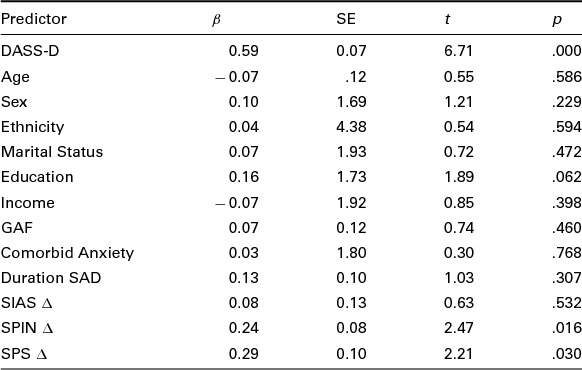
To better understand factors that influenced change in depressive symptoms, a hierarchical regression was conducted with change in DASS-D symptoms as the outcome variable. Pretreatment DASS-D scores were entered in Block 1. Demographic variables — age, sex, ethnicity, marital status, education, and household income — were entered in Block 2. Clinical characteristics — GAF, presence of comorbid anxiety disorders, and duration of SAD — were entered in Block 3. Change in SIAS scores, change in SPIN scores, and change in SPS scores were entered in Block 4. Block 1 explained 26.6% of the variance in change in DASS-D scores, F(1, 85) = 30.83, p < .001. The demographic characteristics entered in Block 2 explained an additional 4.5% of the variance in DASS-D scores, F change(6, 79) < 1, p > .05. The clinical characteristics entered in Block 3 explained an additional 2.2% of variance in change in DASS-D scores, F change(3, 76) < 1, p > .05. Block 4 explained an additional 26.8% of variance in change in DASS-D scores, F change(3, 73) = 16.34, p < .001. A significant effect was found for both SPIN and SPS scores, but not for SIAS scores (see Table 2).
Regression Analysis Predicting Change in Depression Anxiety Stress Scales — Depression Scale
Note: DASS-D = Time 1 Depression Anxiety Stress Scales-Depression Subscale; SAD = Social Anxiety Disorder; SIAS Δ = Change Time 1 to Time 2 Social Interaction Anxiety Scales; SPIN Δ = Change Time 1 to Time 2 Social Phobia Inventory; SPS Δ = Change Time 1 to Time 2 Social Phobia Symptoms.
Discussion
This study examined how the presence of comorbid depressive disorders affected SAD symptom severity and treatment outcomes following CBGT for SAD. We used a large, inclusive, naturalistic sample with clearly diagnosed comorbid depressive disorders. Consistent with our hypothesis, compared to individuals without comorbid depression, individuals with comorbid depression presented with more severe symptoms of social anxiety and depression at pretreatment. Nevertheless, CBGT for SAD was similarly effective for socially anxious individuals with and without comorbid depression, as evidenced by significant decreases in both anxiety and depressive symptoms. However, it is important to note that individuals with comorbid depression continued to report higher symptom severity at post-treatment compared to individuals without comorbid depression. The current study also extended past research in this area by examining factors that contributed to change in depressive symptoms. Larger decreases in anxiety symptoms as measured by the SPIN and SPS predicted larger decreases in depressive symptoms
The current study has several important implications. For one, results provide evidence that the presence of comorbid depression does not affect the effectiveness of CBGT for SAD. Compared to participants without comorbidity, participants with SAD and comorbid depression exhibited equivalent rates of attrition and reported equivalent improvement in social anxiety symptoms over the 12 weeks of CBGT. Our results are consistent with the several past studies investigating the effect of comorbid depression on treatment for SAD (Erwin et al., Reference Erwin, Heimberg, Juster and Mindlin2002; Joormann et al., Reference Joormann, Kosfelder and Schulte2005; Marom et al., Reference Marom, Gilboa-Schechtman, Aderka, Weizman and Hermesh2009) and other anxiety disorders (e.g., Allen et al., Reference Allen, White, Barlow, Shear, Gorman and Woods2010; Newman, Przeworski, Fisher, & Borkovec, Reference Newman, Przeworski, Fisher and Borkovec2010). Although our findings differ from Chambless et al. (Reference Chambless, Tran and Glass1997) and Ledley et al. (Reference Ledley, Huppert, Foa, Davidson, Keefe and Potts2005), these studies did not directly compare individuals with comorbid depression to those without. Moreover, the latter study excluded participants with a diagnosis of MDD, thereby limiting the observed range in depressive symptoms. Although depressive symptoms did not affect attrition rates in the current study, we did find that treatment non-completers had higher SIAS and SPS symptoms at pretreatment. Higher social anxiety symptom severity might therefore be one factor that predicts dropout. Taken together, increasing evidence suggests that comorbid depression does not impede the effectiveness of CBT for social anxiety. Instead, our findings suggest that more severe symptoms of social anxiety could be an important determinant of treatment dropout.
Second, results provide evidence that despite improvements made during CBGT for SAD, individuals with comorbid depression continued to report higher symptoms at post-treatment than those without depression. Group differences were observed in symptoms of anxiety and depression, which is in line with Joormann et al. (Reference Joormann, Kosfelder and Schulte2005). Although it is possible that high rates of comorbid anxiety in the SAD+D group may have contributed to more severe symptoms, other studies have found similar severity and outcome values between individuals with SAD+D who were diagnosed with a comorbid anxiety disorder and those who were not. Thus, results suggest that additional or more intensive treatment may be needed for individuals with comorbid depression to ensure an adequate treatment response, and subsequent treatment that specifically targets depressive symptoms may be beneficial.
Lastly, the current study also provides evidence that CBGT for SAD leads to improvement in depressive symptoms, despite the fact that depression was not explicitly targeted during treatment. Some insight is offered into factors that predicted change in depression severity during CBGT for SAD. Interestingly, demographic and clinical variables — including household income, education, age, and duration of SAD — did not influence change in depressive symptoms. In contrast, larger decreases in anxiety symptoms as measured by the SPIN and SPS predicted larger decreases in depressive symptoms. There are several possible explanations for this finding. For one, as anxiety in social situations decreases, participants may engage in more interpersonal interactions. This, in turn, could provide opportunities for individuals to increase their social support, which has been shown to have positive effects on depression (see Paykel, Reference Paykel1994, for a review). If this were the case, we would expect the SIAS to make particularly strong contributions to change in depressive symptoms given that the SIAS most closely assesses social engagement with others; however, this is the one measure that did not predict change in depressive symptoms. Instead, the SPIN and SPS, which respectively assess symptoms of social anxiety and fear of being observed during routine activities, are the measures that predicted change in depressive symptoms. It could therefore be argued that the more individuals re-engage in everyday activities, the more their depression improves. This possibility is in line with studies showing that behavioural activation is a particularly effective treatment for major depressive disorder (e.g., Dimidjian et al., Reference Dimidjian, Hollon, Dobson, Schmaling, Kohlenberg, Addis and Jacobson2006). An equally possible explanation for the relation between change in anxiety and change in depressive symptoms is that participants may have applied the cognitive skills taught in CBGT for social anxiety (e.g., cognitive reappraisal) to help cope with their depressive symptoms. Additional research is needed, however, to understand factors — such as behavioural activation or cognitive restructuring — that mediate the relation between improvement in anxiety symptoms and improvement in depressive symptoms.
There are some limitations in the current study. For one, given that a waitlist control group was not included in the current study design, it is possible that reductions in symptom severity were due to the passing of time. Effect sizes in the current study, however, are comparable to effect sizes found across research examining the efficacy of CBGT in a naturalistic setting (e.g., Erwin et al., Reference Erwin, Heimberg, Juster and Mindlin2002; Marom et al., Reference Marom, Gilboa-Schechtman, Aderka, Weizman and Hermesh2009), suggesting that reductions in symptoms reflect treatment gains. Additionally, this study did not include long-term follow-up. Future research might consider adding additional symptom assessments at 6 or 12 months after treatment in order to examine the stability of treatment effects.
Strengths of this study include the use of a carefully diagnosed sample of those with SAD with or without a comorbid depressive disorder. The decision to include multiple depressive disorders (e.g., individuals with MDD, depressive disorder NOS, and bipolar disorder who are in a currently depressed episode) enhances the generalisability of our results. Similarly, completion of research in a naturalistic outpatient setting further adds to the generalisability of findings. An additional strength of the current study is the use of several of the most common measures to assess symptom severity. This not only enhances reliability of the current results, but also facilitates across-study comparison.
Overall, findings from the current study lend confidence that CBGT for SAD is effective even in the presence of significant comorbidity, and thereby provide empirical support for including individuals with comorbid depression in CBGT for SAD. Nevertheless, given that people with comorbid depression remained more severe at posttreatment, additional treatment beyond 11 to 12 weeks of CBGT for SAD should be considered for those with comorbidity. Additional research is needed to determine the type of treatment that would be most beneficial (i.e., further treatment for social anxiety or novel treatment focused on symptoms of depression). Furthermore, future research might examine other mechanisms through which change in social anxiety symptoms predicts change in depressive symptoms. Understanding this connection could allow us to maximise the effectiveness of CBT for individuals with comorbidity.