

Introduction
Non-indigenous parasites can be co-introduced to new habitats together with their hosts, which then play the role of ‘spreaders’ (Taraschewski, Reference Taraschewski2006). Many non-native parasite species remain a component of the original non-indigenous host's parasite fauna, and spread their range alongside that of the exotic host (Lymbery et al., Reference Lymbery, Morine, Kanani, Beatty and Morgan2014), while others may infect native hosts in newly inhabited biotopes, thereby reinforcing their range expansion (Galli et al., Reference Galli, Stefani, Benzoni and Zullini2005). This could represent a potential benefit to the introduced host, particularly where the parasites have a negative impact on their new native hosts (Tompkins et al., Reference Tompkins, White and Boots2003).
Successful colonization of new species could result in a temporary escape from parasites and pathogens in the original non-native host, these being less infected in the invaded habitat than in their native habitat (Torchin et al., Reference Torchin, Lafferty, Dobson, McKenzie and Kuris2003; Prenter et al., Reference Prenter, MacNeil, Dick and Dunn2004), known as the ‘enemy release hypothesis’ (Keane & Crawley, Reference Keane and Crawley2002). Non-indigenous species could also act as a source of newly introduced parasites, which then infect local hosts (Mack et al., Reference Mack, Simberloff, Lonsdale, Evans, Clout and Bazzaz2000). Following the successful establishment of a non-native population, exotic species begin to be colonized by parasites of ecologically similar native hosts, a concept termed ‘parasite spillover’ (Cleaveland et al., Reference Cleaveland, Hess, Dobson, Lauenroth, McCallum, Roberts, Woodroffe, Hudson, Rizzoli, Grenfell, Heesterbeek and Dobson2002; Prenter et al., Reference Prenter, MacNeil, Dick and Dunn2004). Subsequently, the concept of ‘parasite spillback’ was proposed as a prolongation of the enemy release hypothesis (Kelly et al., Reference Kelly, Paterson, Townsend, Poulin and Tompkins2009). In this case, once a non-native host becomes colonized by native parasites, it begins to spread them, thereby playing an important role in increasing the native parasite's range and establishment of new populations.
Several tapeworm species are known to have been introduced into Europe together with their fish hosts. A number of these are stenoxenous species, such as Nippotaenia perccotti (Akhmerov, 1941), which is specific to Asian odontobutid fish but infects the invasive Chinese sleeper (Perccottus glenii Dybowski, 1877) in Europe (Kvach et al., Reference Kvach, Kutsokon, Stepien and Markovych2016a). Two other stenoxenous cestodes, Khawia sinensis (Hsü, 1935) and Khawia japonensis (Yamaguti, 1934), were introduced into Europe from the Asian Far East as hitchhikers on common carp Cyprinus carpio (Linnaeus, 1758) (Scholz et al., Reference Scholz, Binh and Dezfuli2011a). An American cestode specific for carps, Atractolytocestus huronensis (Anthony, 1958), has also spread into Eastern Europe (Oros et al., Reference Oros, Hanzelová and Scholz2004), while the Asian euryxenous parasite, Schyzocotyle acheilognathi (Yamaguti, 1934), now infects a wide spectrum of European fish hosts (Scholz et al., Reference Scholz, Kuchta, Williams, Woo and Buchmann2011b).
The pumpkinseed, Lepomis gibbosus (Linnaeus, 1758) (Antinopterygii: Centrarchidae), is a native fish of North America, being found in fresh waters in the eastern part of the continent, from New Brunswick in Canada to north-eastern Georgia in the USA (Scott & Crossman, Reference Scott and Crossman1973). The species is now considered one of the most successful of the fish introduced into Europe (Fox et al., Reference Fox, Vila-Gispert and Copp2007). At the end of the 19th century, the pumpkinseed was imported into Western Europe, together with five other centrarchid species, for recreational fishery and as an aquarium and garden pond fish (Maes, Reference Maes1898). Today, the species is common in many European countries (Copp & Fox, Reference Copp, Fox and Gherardi2007), with numbers in many ponds and lakes so high as to cause negative impacts on native fish species (Ribeiro & Leunda, Reference Ribeiro and Leunda2012); indeed, the species is now registered as harmful under French national environmental regulations.
European pumpkinseed populations host several co-introduced parasite species, including ancyrocephalid and gyrodactylid monogeneans (Sterud & Jørgensen, Reference Sterud and Jørgensen2006; Ondračková et al., Reference Ondračková, Dávidová, Přikrylová and Pečínková2011, Reference Gillilland and Muzzall2019; Havlátová et al., Reference Havlátová, Ondračková and Přikrylová2015; Kvach et al., Reference Kvach, Ondračková, Kutsokon and Dzyziuk2018b; Stoyanov et al., Reference Stoyanov, Mutafchiev, Pankov and Georgiev2017b) and one digenean (Kvach et al., Reference Kvach, Jurajda, Bryjová, Trichkova, Ribeiro, Přikrylová and Ondračková2017; Stoyanov et al., Reference Stoyanov, Georgieva, Pankov, Kudlai, Kostadinova and Georgiev2017a; Ondračková et al., Reference Ondračková, Kvach, Martens and Jurajda2019). In this study, we report the first case of the possible introduction into Europe of a non-indigenous cestode native to the pumpkinseed's native range in North America.
Materials and methods
Samples of pumpkinseed were caught by hook and line at three localities in the Bordeaux Métropolis of France in June 2018: Site (1) Bègles Plage (N 44.802869, W –0.538280); Site (2) Bordeaux Lac (N 44.878589, W –0.576175); and Site (3) Parc de Fontaudin (N 44.797972, W –0.626781). The fish were transported alive in aerated field water to the laboratories of the Institut National de Recherche en Agriculture, Alimentation et Environment, where they were placed into outdoor tanks. Prior to dissection, the standard length (SL, mm) of each fish was measured. All fish were dissected within three days of sampling to ensure maximum parasite recovery (see Kvach et al., Reference Kvach, Ondračková, Janáč and Jurajda2016b). In total, 62 individual fish were examined (table 1).
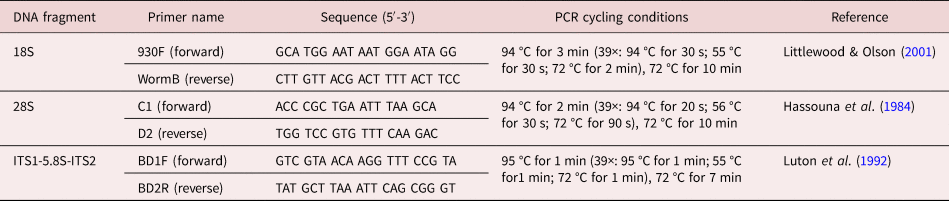
List of primers and PCR cycling conditions used for molecular analysis.

Cestodes located in the liver and mesentery were isolated from the capsule and fixed in hot 4% formaldehyde (Cribb & Bray, Reference Cribb and Bray2010). A small piece was cut from each worm and preserved in 96% ethanol for further molecular study. The formaldehyde-preserved samples were stained using iron acetic carmine, dehydrated in ethanol of increasing concentration and mounted in Canada balsam as permanent slides (Georgiev et al., Reference Georgiev, Biserkov and Genov1986). Indices of prevalence, mean intensity and mean abundance were then calculated for each parasite species (Bush et al., Reference Bush, Lafferty, Lotz and Shostak1997).
Total genomic DNA was extracted from four ethanol-preserved specimens using the DNeasy Blood & Tissue Kit (Qiagen, Hilden, Germany), according to the manufacturer's protocol. The following fragments of nuclear ribosomal DNA were used for molecular characterization: (1) partial 18S; (2) partial 28S; and (3) ITS1-5.8S-ITS2. Primer details and amplification conditions are given in table 1. Polymerase chain reaction (PCR) analysis was carried out on a total volume of 30 μl containing 5 μl of DNA extract, 1× PCR buffer (Fermentas), 2.5 mm MgCl2, 200 μM each of dNTP, 0.2 μM (for 18S), 0.5 μM (for 28S) or 0.3 μμ (for ITS1-5.8S-ITS2) of each primer, and 1 U of Taq polymerase (Fermentas). All PCR products were purified using an ExoSAP-IT (Affymetrix Inc., Santa Clara, USA) according to the manufacturer's indications and sequenced directly from both strands using the PCR primers. The DNA sequencing was performed on an Applied Biosystems 3130 Genetic Analyser (Applied Biosystems, Thermo Fisher Scientific, Prague, Czech Republic) using the BigDye Terminator v3.1 Cycle Sequencing kit (Applied Biosystems). Sequence data were then assembled and edited using Sequencher software (Gene Codes Corp., Ann Arbor, Michigan, USA). The newly generated sequences were compared with the National Center for Biotechnology Information database using BLASTn to assess sequence similarity. The obtained sequences of the partial 18S, 28S and ITS1-5.8S-ITS2 were deposited in the GenBank database under accession numbers MN759649, MN7596640 and MN7871161, respectively.
The proteocephalid description and identification keys provided by Freze (Reference Freze1965) were used for the morphological identification of nine worms found. Measurements were taken for body total length, body width (anterior part), length and width of the scolex, length and width of two visible suckers and the length and width of the apical sucker (all measurements in μm, except total body length (presented in mm)).
Results
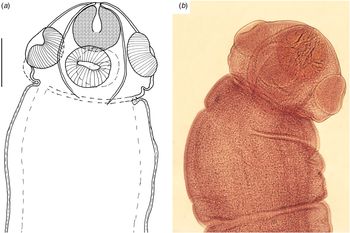
The presence of plerocercoids encapsulated in pumpkinseed liver and mesentery was confirmed at Bègles Plage only, none being found at Bordeaux Lac or Parc de Fontaudin (table 2). Four specimens were subjected to molecular analysis, and the resulting sequences displayed no intraspecific sequence variation. The BLASTn search revealed that the ITS1-5.8S-ITS2 sequence (1281 bp) showed 100% similarity with the fragment covering 5.8S-ITS2 (45% sequence coverage) of Proteocephalus ambloplitis (Leidy, 1887) (plerocercoid stage) isolated from bluegill Lepomis macrochirus (Rafinesque, 1810) and longear sunfish Lepomis megalotis (Rafinesque, 1820) (Centrarchidae; KT30887–KT30964) in the USA (Lake Reidsville, Reelfoot Watershed Lake). For the partial 28S rDNA sequence (1005 bp), the BLASTn search revealed highest similarity (99.5%) with a sequence isolated from P. ambloplitis (adult stage; AJ388633) parasitizing bluegill in the US (Pearl River, Mississipi), and 98.2% similarity with P. ambloplitis obtained from channel catfish Ictalurus punctatus (Rafinesque, 1818) (Ictaluridae; FM956085) and bowfin Amia calva (Linnaeus, 1766) (Amiidae; FM956084) from the Reelfoot Lake in Tennessee. The partial 18S rDNA sequence (1001 bp) showed the highest similarity (99%) with a sequence from Proteocephalus perplexus La Rue, 1911 (KF685833) parasitizing bowfin in Lake Ontario, Canada. Due to no sequence records of ITS1 and complete 18S for P. ambloplitis in the GenBank database, it was not possible to compare the ITS1 or the partial 18S sequences within this species. The plerocercoids obtained from Bègles Plage pumpkinseed were 4–21 mm long (mean 12 mm) and 350–1170 μm wide (mean 790 μm). Scolex differing in shape (from triangular to rounded), 367–582 μm long (mean 487 μm) and 576–870 μm wide (mean 725 μm), armoured with five suckers (see fig. 1). Four longitudinal grooves make the scolex four-lobed. Four suckers are 181–367 μm long (mean 248 μm) and 158–311 μm wide (mean 227 μm), posted cross-wise. Each sucker is on clearly separated elevation, divided by longitudinal grooves. In live worms, the elevations with suckers are very mobile, looking like octopus tentacles. Apical sucker well-developed, large – 243–396 μm long (mean 301 μm) and 226–384 μm wide (mean 278 μm) – immersed into scolex, having yellowish colouration on stained slides. Proglottids were not clearly visible; reproductive organs not developed.
Drawing (A) and microphotograph (B) of the plerocercoid scolecis of Proteocephalus ambloplitis ex Lepomis gibbosus; Bègles Plage, France. Scale bar: 300 μm.

Number and size of Lepomis gibbosus collected at three sites in France, with Proteocephalus plerocercoid infection parameters.

N, number of fish examined; SL, standard length, mm (mean ± standard deviation (SD), min–max); P, prevalence, %; MI, mean intensity (mean ± SD, min–max); A, mean abundance.
Both morphological and molecular data confirm a strong relationship between the plerocercoids obtained from pumpkinseed in France and the American cestode species, P. ambloplitis (Proteocephalidae).
Discussion
This is the first report of P. ambloplitis in Europe. The main morphological characteristics available for identification of this worm to species level, such as vaginal sphincter (must be several times longer than wide), testicles (less than 100) and uterine diverticles (more than 15 on each side; Freze, Reference Freze1965), are invisible in the larvae. The characteristics observable in the larvae included the four-lobed scolex, suckers on elevations divided by longitudinal grooves and a well-developed large apical sucker immersed into the scolex parenchyma. Other characteristics specific for P. ambloplitis include the presence of a capsule around the larvae and infection of centrarchids. The four-lobed scolex is an important feature for distinguishing P. ambloplitis from another parasite of centrarchid fish, Proteocephalus fluviatilis Bangham, 1925 (Scholz et al., Reference Scholz, Choudhury, Uhrová and Brabec2019).
This is the 12th representative of this genus registered in European fishes (Scholz & Hanzelová, Reference Scholz and Hanzelová1998), and is the only representative of the genus, encapsulated in larval stage, in Europe. All European representatives of Proteocephalus display a two-host life cycle, with planktonic invertebrates as the first intermediate host and fish as the second (Scholz, Reference Scholz1999). In comparison, non-indigenous P. ambloplitis have a three-host life cycle, which is unique for the family Proteocephalidae (de Chambrier et al., Reference de Chambrier, Scholz, Mariaux, Kuchta, Caira and Jensen2017). The definitive hosts of this tapeworm are large predatory centrarchids, with small-sized fishes as second intermediate hosts and copepods as first intermediate hosts (Fischer & Freeman, Reference Fischer and Freeman1973).
The main hosts of P. ambloplitis in North America are predatory centrarchids, such as rock bass Ambloplites rupestris (Rafinesque, 1817), smallmouth bass Micropterus dolomieu Lacépède, 1802 and largemouth bass Micropterus salmoides (Lacépède, 1802) (Freze, Reference Freze1965; Gillilland & Muzzall, Reference Gillilland and Muzzall2004). Plerocercoids are euryxenous and infect a wide range of fish hosts from different families, mainly centrarchids, but also including cyprinids, cyprinidontids, esocids and percids (Amin, Reference Amin1990). The source of this non-indigenous European cestode could have been largemouth bass, which have been introduced for recreational fishing in several countries, including France (Wurtz-Arlet, Reference Wurtz-Arlet1952; Ribeiro & Leunda, Reference Ribeiro and Leunda2012). The largemouth bass is an agent of several introduced American parasites in Europe, such as the monogenean Onchocleidus principalis (Mizelle, 1936) (Ancyrocephalidae) and the diplostomid trematode Posthodiplostomum centrarchi (Hoffman, 1958) corresponding to Posthodiplostomum sp. 8 sensu Locke et al. 2010 (Lambert, Reference Lambert1978; Galli et al., Reference Galli, Strona, Benzoni, Crosa and Stefani2007; Locke et al., Reference Locke, McLaughlin and Marcogliese2010; Kvach et al., Reference Kvach, Jurajda, Bryjová, Trichkova, Ribeiro, Přikrylová and Ondračková2017, Reference Kvach, Matvienko, Bryjová and Ondračková2018a). However, these parasite species are specific for centrarchids and usually do not infect local fish fauna.
The presence of a non-indigenous cestode parasitizing European pumpkinseed could represent a case of ‘invasion meltdown’, whereby the introduction of two non-indigenous species facilitates each other's establishment (Simberloff and von Holle, Reference Simberloff and von Holle1999). This concept has also been verified in parasitology, where an invasive fish host facilitates the distribution of non-indigenous parasites introduced through some other vector (Hohenadler et al., Reference Hohenadler, Honka, Emde, Klimpel and Sures2018a). For example, invasive Ponto-Caspian gobiids are agents for the distribution of the Eastern European acanthocephalan Pomphorhynchus laevis (Zoega in Müller, 1776) (likely introduced via their amphipod host, Dikerogammarus villosus (Sowinsky, 1894)) and the Asian nematode Anguillicola crassus Kuwahara, Niimi & Itagaki, 1974 (introduced with Japanese eels Anguilla japonica Temminck & Schlegel, 1846) in European freshwaters (David et al., Reference David, Staentzel, Schlumberger, Perrot-Minnot, Beisel and Hardion2018; Hohenadler et al., Reference Hohenadler, Nachev, Thielen, Taraschewski, Grabner and Sures2018b; Kvach et al., Reference Kvach, Ondračková, Janáč, Krasnovyd, Seifertová and Jurajda2019). During its plerocercoid stage, the newly registered P. ambloplitis is not host-specific and, as such, can switch to parasitizing local fish. In this case, distribution of the non-indigenous parasite will be in accordance with the ‘parasite spillover’ concept (Cleaveland et al., Reference Cleaveland, Hess, Dobson, Lauenroth, McCallum, Roberts, Woodroffe, Hudson, Rizzoli, Grenfell, Heesterbeek and Dobson2002; Prenter et al., Reference Prenter, MacNeil, Dick and Dunn2004), as seen with the Asian tapeworm S. acheilognathi, which uses the invasive monkey goby (Neogobius fluviatilis (Pallas, 1814)) as a distribution vector in the Dnieper River basin (Zaichenko, Reference Zaichenko2015). Likewise, in the Rhine basin, it parasitizes the non-indigenous Asian grass carp (Ctenopharyngodon idella (Valenciennes, 1844)) and the convict cichlid (Amatitlania nigrofasciata (Günther, 1867)) (Sures et al., Reference Sures, Nachev, Grabner, Mehlhorn and Klimpel2019 and references therein). To date, only one representative of the genus Proteocephalus is known to have been introduced into a non-native region – namely, P. fluviatilis introduced into Japan with largemouth bass (Shimazu, Reference Shimazu1990).
The Bègles Plage, the waterbody in which P. ambloplitis was registered, is an isolated artificial lake within a public recreational area; hence, natural range expansion is very unlikely. On the other hand, fish release for angling/aquacultural purposes is known to be one of the most frequent vectors of invasive fish introduction in Europe (Carpio et al., Reference Carpio, De Miguel, Oteros, Hillström and Tortosa2019), while the intentional introduction of largemouth bass for angling purposes is the most likely vector of invasive trematode introduction (Kvach et al., Reference Kvach, Matvienko, Bryjová and Ondračková2018a). As such, introduction of largemouth bass, along with the anthropogenic spread of potential hosts (e.g. pumpkinseed and largemouth bass) between waterbodies, will very likely contribute to future expansion of the non-indigenous tapeworm P. ambloplitis in Europe.
Acknowledgements
We thank Jean Martin (Fédération des Associations Agréées de Pêcheet de Protection des Milieux Aquatiques de la Gironde, Beychac-et-Caillau, France) for valuable assistance during fish sampling in the Bordeaux region, and Markéta Pravdová, Jitka Fojtů and Kevin Roche for their help with sample collection. We would also like to thank Kevin Roche for his help with English-language proofreading.
Financial support
This study received financial support through the European Centre of Ichthyoparasitology (ECIP) – Centre of Excellence, Grant Agency of the Czech Republic (project number P505/12/G112) and from the Ministry of Education, Youth and Sports of the Czech Republic (project number LTAUSA19092).
Conflicts of interest
None.
Ethical standards
All applicable international, national and/or institutional guidelines for the care and use of animals were followed.