Deep sternal wound infection (DSWI) is a major complication of cardiac surgery, and its incidence is significant after coronary artery bypass grafting (CABG).Reference Kolh, Windecker and Alfonso1–Reference Taggart, Altman and Gray4 Negative pressure wound therapyReference Patel, Woznick, Welsh, Bendick, Boura and Mucci3,Reference Tarzia, Carrozzini and Bortolussi5,Reference Fleck and Fleck6 and advances in reconstructive surgery of the sternum may improve the outcome of patients with postoperative DSWI,Reference Raza, Sabik, Masabni, Ainkaran, Lytle and Blackstone7,Reference Kieser, Rose, Aluthman, Montgomery, Louie and Belenkie8 but hospital and late mortality in these patients remains non-negligible.Reference Mehaffey, Hawkins and Byler9–Reference Gatti, Benussi and Brunetti13 Furthermore, the financial burden associated with the treatment of sternal wound complications is relevant due to the direct costs incurred by the related prolonged therapies and hospital stay.Reference Mehaffey, Hawkins and Byler9,Reference Perrault, Kirkwood and Chang10,Reference Hollenbeak, Murphy and Koenig14 In this context, effective preventive strategies along with a tailored method of DSWI risk stratification are of utmost importance. In particular, identification of high-risk patients is important when bilateral internal mammary artery (BIMA) grafting is planned because the risk of DSWI is higher with this technique. Although several specific risk scoring methods exist, their predictive accuracy is not well studied and their use in the clinical setting is not widespread.Reference Russo and Spelman15–Reference Raja, Rochon and Jarman18 We aimed to develop a simple risk score for bedside stratification of the risk of DSWI after isolated CABG and to compare its predictive accuracy with that of other specific risk scores.
Patients and methods
Study population
The E-CABG studyReference Biancari, Ruggieri and Perrotti19 is a prospective, multicenter registry containing data on 7,352 consecutive patients who underwent CABG at 16 centers of cardiac surgery in 6 European countries (England, Finland, France, Germany, Italy, and Sweden). Data were collected in a dedicated Access (Microsoft, Redmond, WA) datasheet. The recruitment period was between January 1, 2015, and May 19, 2017.
Baseline characteristics of patients, surgical techniques, and postoperative complications were defined according to the E-CABG and the European System for Cardiac Operative Risk Evaluation (EuroSCORE) II definition criteria.Reference Biancari, Ruggieri and Perrotti19,Reference Nashef, Roques and Sharples20 Diabetes was defined as hyperglycemia requiring any pharmacological treatment. Chronic lung disease was defined as long-term use of bronchodilators or steroids for lung disease. Critical preoperative state was defined as ventricular tachycardia or ventricular fibrillation or aborted sudden death, preoperative cardiac massage, preoperative ventilation before anaesthetic room, preoperative inotropes or intra-aortic balloon pump (IABP), or preoperative acute renal failure (anuria or oliguria <10 mL/h). The operative risk of these patients was estimated using the EuroSCORE II equation.Reference Nashef, Roques and Sharples20 All patients received antibiotic prophylaxis before surgery and perioperatively according to institutional policies. A policy of liberal perioperative glycemic control was adopted at all participating centers.
The primary outcome of this study was DSWI, and the secondary outcomes were all-cause mortality during the index hospitalization and at 1 year after surgery. DSWI was defined according to the Centers for Disease Control and Prevention classification of surgical site infections.Reference Mangram, Horan, Pearson, Silver and Jarvis21 Deep infection was defined as an infection involving the deep soft tissues (fascial and muscle layers) with or without involvement of the sternal bone, and organ-space infection of the mediastinum.Reference Mangram, Horan, Pearson, Silver and Jarvis21 The diagnosis of DSWI was based on the results of bacterial cultures, clinical parameters, and surgical findings.
Statistical methods
Statistical analyses were conducted September 15, 2019, through September 30, 2019, using SPSS version 26.0 software (IBM, Armonk, NY) and Stata version 15.1 software (StataCorp, College Station, TX). Continuous variables are reported as mean and standard deviation, and categorical variables are reported as counts and percentages. Risk estimates are reported as odds ratio (OR) and hazard ratio (HR) with their 95% confidence intervals (CIs). The Mann-Whitney test, the χ2 test, the Fisher exact test, the linear-by-linear association test, and receiver operating characteristics curve (ROC) analysis with estimation of the area under the curve (AUC) were used for univariate analysis. The DeLong test was used for comparative analyses of the estimated ROC curves. One-year mortality was evaluated in the derivation and validation data set using the Kaplan-Meier method with the log-rank test and the Cox proportional hazards method adjusted for EuroSCORE II.
The data set was randomly divided into a derivation data set (66.7% of patients) and a validation data set (33.3% of patients) (Supplementary Table 1 online). Logistic regression was performed to identify risk factors for DSWI in the derivation data set considering covariates with P < .10 for DSWI in univariate analysis (Table 1). Multilevel mixed-effects logistic regression was employed to confirm the results of logistic regression by adjusting for any interinstitutional difference. A hierarchical model was formed using unique hospital identification numbers as random effects in the model. An additive score, the E-CABG DSWI score, was derived by rounding the estimated OR to the nearest integer. Because the estimated ORs of all independent risk factors were all close to 2.0, for the sake of simplicity we assigned 1 point to each of these risk factors. The performance of the E-CABG DSWI score was tested in the validation data set and compared with the Alfred Hospital risk index,Reference Russo and Spelman15 the Fowler score,Reference Fowler, O’Brien, Muhlbaier, Corey, Ferguson and Peterson16 the Friedman score,Reference Friedman, Bull and Russo17 and the Bromptom-Harefield infection scoreReference Raja, Rochon and Jarman18 using the DeLong test, the net reclassification improvement, the integrated discrimination improvement, and the decision curve analysis. P < .05 was considered statistically significant.
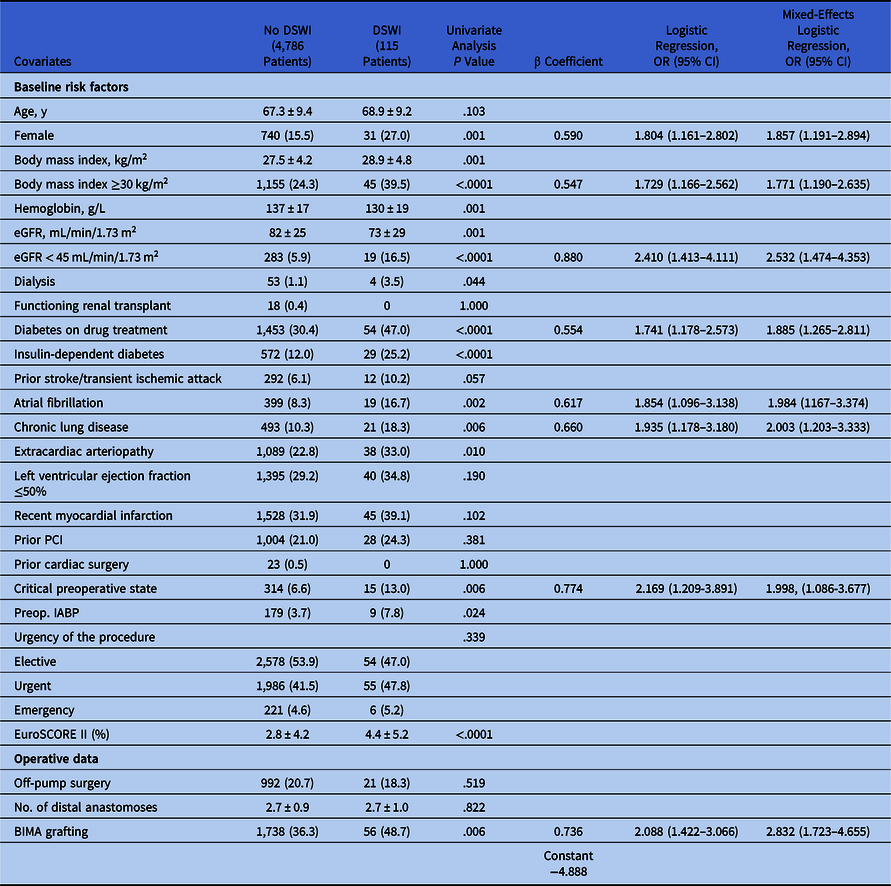
Risk Factors Associated With Deep Sternal Wound Infection or Mediastinitis After Isolated Coronary Surgery in the Derivation Data Set

Note. CI, confidence interval; eGFR, estimated glomerular filtration rate according to the Modification of Diet in Renal Disease Study Group equation; PCI, percutaneous coronary intervention; IABP, intra-aortic balloon pump; BIMA, bilateral internal mammary artery.
Continuous variables are reported as mean and standard deviation. Categorical variables are reported as counts and percentages (in parentheses).
Results
The E-CABG registry included 7,352 patients who underwent isolated CABG: mean age, 67.4 ± 9.4 years, 16.4% women, mean EuroSCORE 2.8 ± 4.2% (median, 1.6%). Regarding the specific preventive strategies against DSWI in the participating centers, nasal swab culture (and mupirocin when indicated) was used at 7 centers, gentamycin-impregnated collagen sponge at the site of sternotomy was used at 1 center, and prophylactic negative pressure wound dressing was used at 1 center. A local antibiotic at the site of sternotomy was not used at any center.
DSWI occurred in 181 patients (2.5%) 19.8 ± 16.1 days (median, 16.0 days) after the index CABG procedure. Among these patients, 63 (0.9%) had mediastinitis. The rate of DSWI varied from 0% to 5.8% among the participating institutions (Supplementary Figure 1 online), without marked differences between the derivation and validation data sets, and 4 centers reported a DSWI rate >3.0%. Patients with DSWI had significantly higher hospital mortality (7.7% vs 1.6%; P < .0001, adjusted for EuroSCORE II: OR, 4.841; 95% CI, 2.689–8.712) and 1-year mortality (log-rank test, 14.8% vs 3.3%; P < .0001; adjusted for EuroSCORE II: HR, 4.275; 95% CI, 2.804–6.517) compared with those who did not experience this complication.
The characteristics and operative data of patients randomly included in the derivation and validation data sets were similar (Supplementary Table 1 online).
Predictors of DSWI after CABG in the derivation data set
Logistic regression showed that female gender (OR, 1.804; 95% CI, 1.161–2.802), body mass index ≥30 kg/m2 (OR, 1.729; 95% CI, 1.166–2.562), estimated glomerular filtration rate <45 mL/min/1.73 m2 (OR, 2.410; 95% CI, 1.413–4.111), diabetes (OR, 1.741; 95% CI, 1.178–2.573), chronic lung disease (OR, 1.935; 95% CI, 1.178–3.180), preoperative atrial fibrillation (OR, 1.854; 95% CI, 1.096–3.138), critical preoperative state (OR, 2.196; 95% CI, 1.209–3.891), and BIMA grafting (OR, 2.088; 95% CI, 1.422–3.066) were independent predictors of DSWI in the derivation data set (Hosmer-Lemeshow test: AUC 0.706; 95% CI, 0.656–0.756; P = .839) (Table 1). Multilevel mixed-effects logistic regression adjusted for the effect of interinstitutional variability provided similar findings of logistic regression (participating centers [OR, 0.278; 95% CI, 0.756–1.019] vs logistic model; P = .0013) (Table 1). However, the mixed-effects model had an ROC with a significantly larger AUC (DeLong test: AUC, 0.757; 95% CI, 0.713–0.801; P < .0001) compared to the logistic regression model.
Performance of the E-CABG DSWI risk score in the validation data set
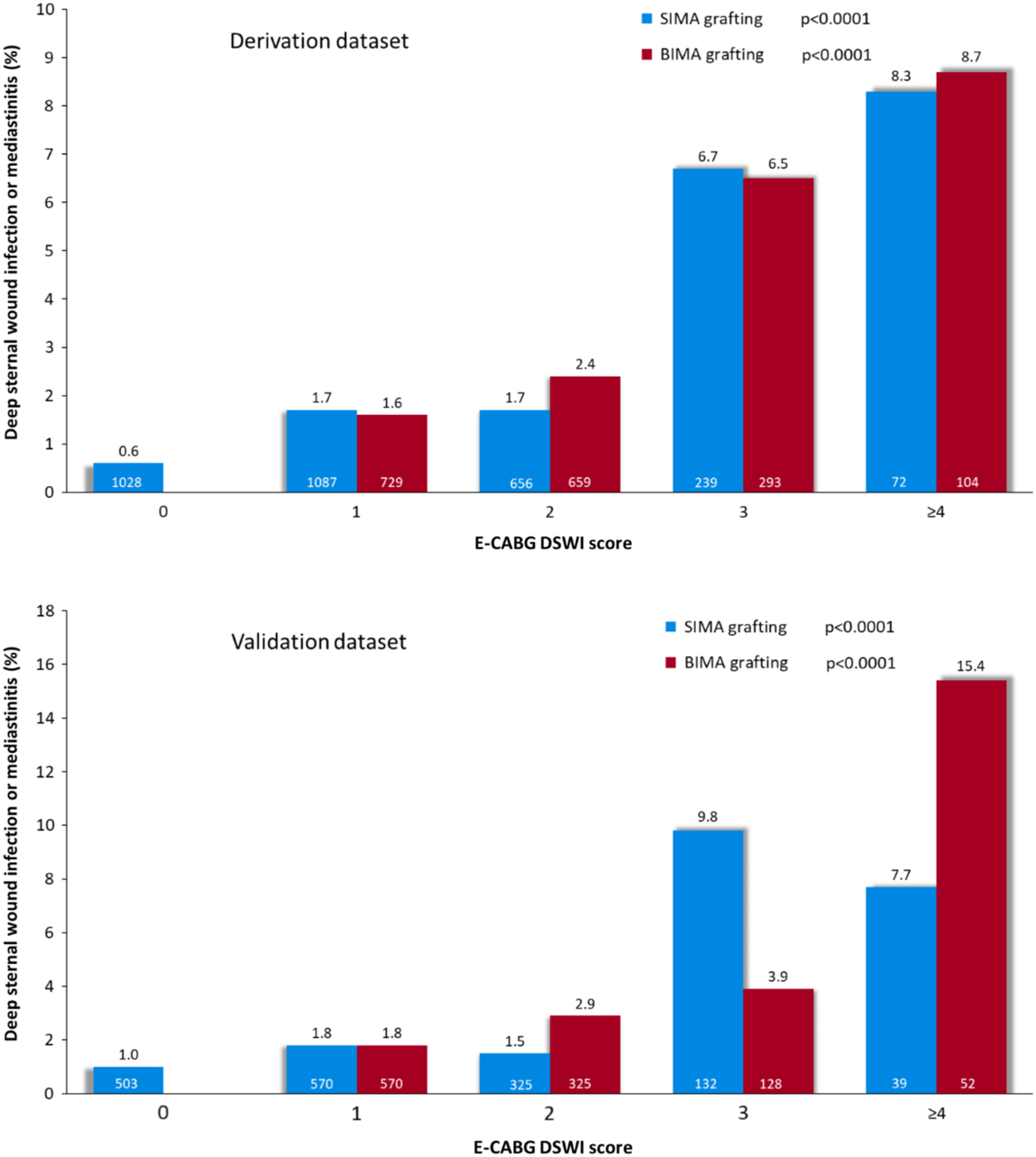
The rate of DSWI in the validation data set was 2.7% (compared to the derivation data set, P = .366). One point was assigned to each of the independent risk factors for DSWI, and the obtained additive risk score had an AUC of 0.693 (95% CI, 0.623–0.763). The risk of DSWI increased linearly with increasing E-CABG DSWI score both in the derivation and validation data sets (Fig. 1).
Rates of deep sternal wound infection or mediastinitis after isolated coronary artery bypass grafting in increasing E-CABG DSWI scores (P < .0001). Note. BMI, body mass index; eGFR, estimated glomerular filtration rate; BIMA, bilateral internal artery; AUC, area under the receiver operating characteristics curve.

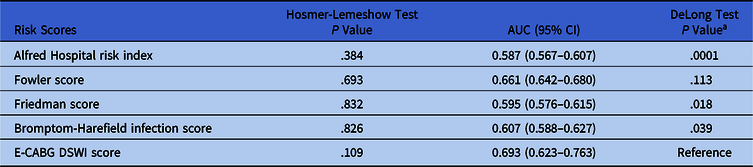
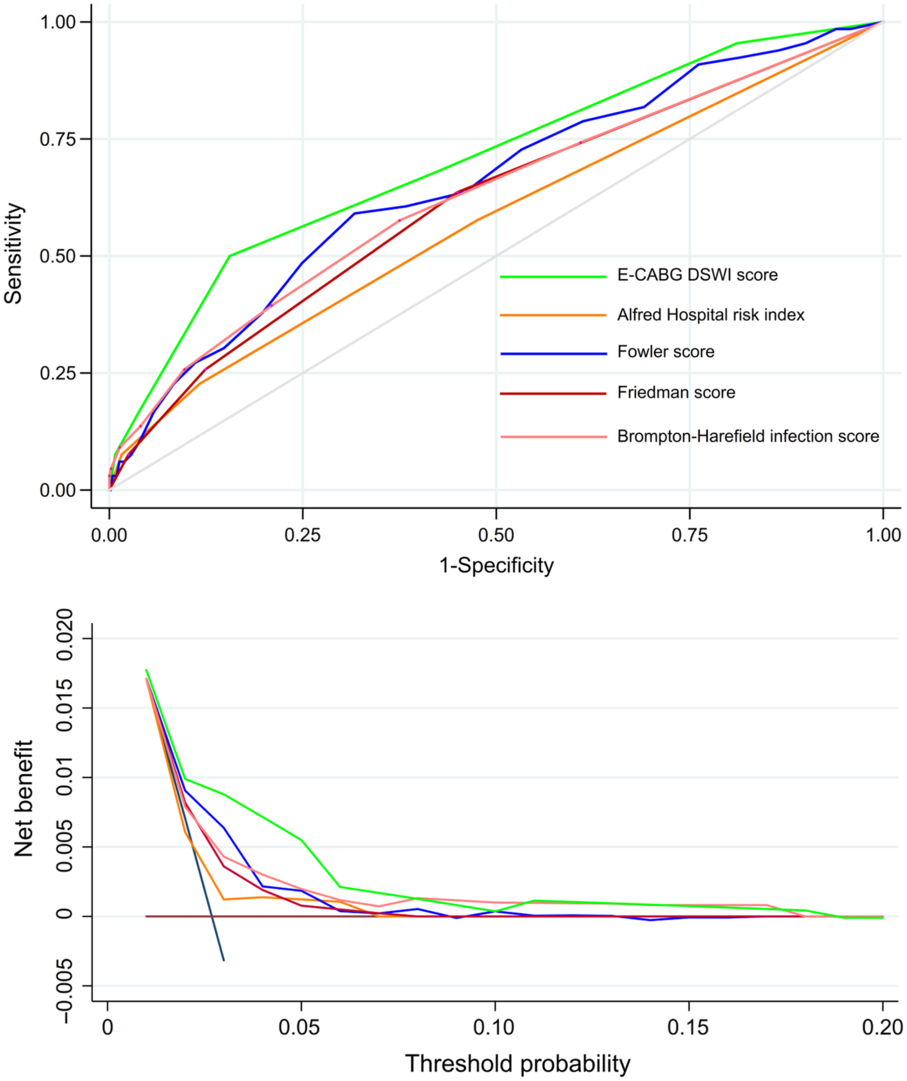
When evaluated in the validation data set, the E-CABG DSWI score had better discrimination than the Alfred Hospital risk index (P = .0001), the Friedman score (P = .018), and the Brompton-Harefield infection score (P = .039), but the difference did not reach statistical significance when compared to the Fowler score (P = .113) (Table 2 and Fig. 2). Decision curve analysis confirmed the better prognostic performance of the E-CABG DSWI score compared to all the other risk scores (Fig. 2). The NRI improvement using the E-CABG DSWI score compared to the other specific risk scores was statistically significant (all comparisons: P < .01) with a correct reclassification of events ranging from 9% to 18%. Significant IDI improvement ranging from 1.2% to 2.1% was observed as well (all comparisons: P < .05) (Table 3).
Calibration and Discrimination Ability of Specific Risk Scores for Deep Sternal Wound Infection or Mediastinits After Isolated Coronary Artery Bypass Grafting in the Validation Data Set

Note. AUC, area under the receiver-operating characteristic curve; CI, confidence interval; E-CABG DSWI, European multicenter coronary artery bypass grafting registry deep sternal wound infection.
a Compared to the E-CABG DSWI score.
Discrimination ability and decision curve analysis of specific risk scores for deep sternal wound infection or mediastinitis after isolated coronary artery bypass grafting in the validation data set.

Improvement in Prediction Performance Gained by the E-CABG DSWI Score Over 4 Specific Risk Scores for Sternal Wound Infection After Isolated Coronary Artery Bypass Grafting in the Validation Data Set

Note. E-CABG DSWI, European multicenter coronary artery bypass grafting registry deep sternal wound infection NRI, net reclassification improvement index; IDI, integrated discrimination improvement index; CI, confidence interval.
Performance of the E-CABG DSWI risk score in patients undergoing single versus bilateral internal mammary artery grafting
In the overall series, the E-CABG DSWI score had similar discrimination in the single internal mammary artery (SIMA) grafting cohort (AUC, 0.700; 95% CI, 0.645–0.755) and the BIMA grafting cohort (AUC, 0.667; 95% CI, 0.607–0.728; P = .434). Figure 3 summarizes the rates of DSWI along increasing E-CABG DSWI scores in the SIMA and the BIMA grafting cohorts. In both the derivation and validation data sets, the risk of DSWI increased markedly in patients with a score >2.
Rates of deep sternal wound infection or mediastinitis along increasing E-CABG DSWI scores in patients undergoing single (SIMA) or bilateral internal mammary artery grafting (BIMA) in the derivation and validation data sets.

Discussion
Our results indicate that the risk of DSWI and mediastinitis after isolated CABG is substantial and carries a significant risk of early mortality. Regression analyses identified a few clinical variables that provided an accurate stratification of the risk of DSWI in patients undergoing isolated CABG. The predictive ability of the additive E-CABG DSWI score was satisfactory both in the SIMA and the BIMA grafting cohorts. The DeLong test, the net reclassification improvement, the integrated discrimination improvement, and the decision curve analysis demonstrated the improved performance of this risk score over other specific risk scores.Reference Russo and Spelman15–Reference Raja, Rochon and Jarman18
Female gender, obesity, diabetes, and chronic lung disease were confirmed to having central roles in the risk of surgical site infection, as previously observed.Reference Russo and Spelman15–Reference Raja, Rochon and Jarman18 In addition, BIMA grafting almost invariably increases the risk of DSWI, even when the skeletonized harvesting technique is usedReference Urso, Nogales and González22 due to a significant reduction of blood flow in the sternal region.Reference Lust, Sun and Chitwood23
Renal failure was also observed as an independent risk factor for DSWI, and this finding is consistent with previous studies.Reference Fowler, O’Brien, Muhlbaier, Corey, Ferguson and Peterson16,Reference Blanchard, Hurni, Ruchat, Stumpe, Fischer and Sadeghi24 Reduced glomerular filtration rate is associated with an increased risk of surgical site infection. In a large Swedish study, an estimated glomerular filtration rate <60 mL/min/1.73 m2 was associated with almost 2-fold risk of risk of surgical site infection.Reference Ishigami, Trevisan, Xu, Coresh, Matsushita and Carrero25 Poorer general conditions of patients with renal failure and a direct effect of uremia-mediated derangement of the immunity may explain such a susceptibility to surgical site infection.Reference Eleftheriadis, Antoniadi, Liakopoulos, Kartsios and Stefanidis26,Reference Cohen and Hörl27 We speculate that renal failure may be associated with DSWI also by increasing the risk of severe perioperative bleeding,Reference Biancari, Brascia and Onorati28,Reference Kim, Oak and Kim29 which is a determinant of postoperative infection.Reference Biancari, Mikkola, Heikkinen, Lahtinen, Airaksinen and Juvonen30,Reference Cutrell, Barros and McBroom31 As a matter of fact, in the present study, an estimated glomerular filtration rate <45 mL/min/1.73 m2 was associated with an excessive risk of transfusion of >4 units of red blood cells and/or reoperation for bleeding (ie, E-CABG bleeding grades 2–3: 21.0 vs 5.7%; P < .0001). Preoperative atrial fibrillation (E-CABG bleeding grades 2–3: 9.5% vs 6.3%; P = .003) and critical preoperative state (E-CABG bleeding grades 2–3: 18.2% vs 5.8%; P < .0001) were also associated with increased risk of both DSWI and severe bleeding. In turn, E-CABG bleeding grades 2 and 3 increased the risk of DSWI (9.1% vs 2.0%; P < .0001).
The E-CABG DSWI score is a simple risk stratification tool for bedside decision making on whether to use BIMA grafting. Indeed, these findings showed that BIMA grafting can hardly be justified in the presence of at least 2 other risk factors because it may lead to a risk of DSWI > 6% (Fig. 1). The performance of this risk scoring method was validated separately in subsets of patients who underwent isolated or bilateral internal mammary artery grafting to demonstrate its accuracy (and clinical utility with the decision curve analysis) in the latter subgroup of patients. Furthermore, avoinding the use of bilateral internal mammary grafting can be complementary to interventions aimed at preventing DSWI. In fact, the E-CABG DSWI score may allow the identification of high-risk patients who could be targeted by DSWI prevention strategies in studies evaluating the efficacy and safety of these strategies.
This study has several limitations. We did not have data on the internal mammary artery harvesting technique, which prevented an analysis of the impact of the skeletonizing harvesting technique on our results. We recognize the prognostic importance of glycated hemoglobin level on the occurrence of surgical site infection, but we did not include this parameter in the regression models because routine preoperative monitoring of glycated hemoglobin is not widespread. Mixed-effects logistic regression demonstrated a significant interinstitutional difference in the rate of DSWI, which is likely related to a variability of patient characteristics, surgical strategies, and perioperative care among the participating centers. However, the risk estimates of mixed-effects logistic regression for DSWI were similar to those of the logistic regression. Thus, such differences would not change the weights of the risk factors included in the E-CABG DSWI score. Neither operative variables such as the length of surgery and of cardiopulmonary bypass nor postoperative complications, such as the severity of postoperative bleeding and use of blood products, were included in this analysis. Indeed, our aim was to develop a stratifying tool to guide the decision-making process before surgery and to identify high-risk patients in trials investigating strategies for the prevention of surgical site infection. Finally, this additive risk score should be validated in patients undergoing major cardiac surgery procedures other than isolated CABG.
In conclusion, this study confirmed that the risk of DSWI after isolated CABG is substantial and is associated with increased risk of early postoperative mortality. The E-CABG DSWI score seems to accurately stratify the risk of DSWI and avoidance of bilateral internal mammary grafting in high-risk patients can be complementary to interventions for prevention of this severe complication.
Supplementary material
To view supplementary material for this article, please visit https://doi.org/10.1017/ice.2019.375
Acknowledgments
None.
Financial support
No financial support was provided relevant to this article.
Conflicts of interest
All authors report no conflicts of interest relevant to this article.