Introduction
Maternal and child deaths have declined around the world, but they continue to pose a severe threat, particularly in South Asia and sub-Saharan Africa, which globally have around 65% of maternal and 80% of child deaths (Lawn et al., Reference Lawn, Tinker, Munjanja and Cousens2006). An estimated 303,000 women worldwide died due to complications of pregnancy and childbirth in 2015, mostly in low- and middle income countries (WHO, 2018). Globally, 2.5 million children died in the first month of life in 2018 – approximately 7000 neonatal deaths every day – with one-third dying on the first day (UNICEF, 2019). About three-quarters of neonatal deaths occur in the first week after birth (Lawn et al., Reference Lawn, Tinker, Munjanja and Cousens2006) and there are about 4 million still-births (Black et al., Reference Black, Morris and Bryce2003; Kerber et al., Reference Kerber, De Graft-Johnson, Bhutta, Okong, Starrs and Lawn2007). The Maternal Mortality Ratio (MMR) in India reduced from 212 in 2007 to 130 in 2014–16 (Registrar General of India, 2018), but is still on the high side. The Infant Mortality Rate stands at 41 and the Under Five Mortality Rate at 50 (IIPS, 2015). These deaths could be averted with appropriate management and care.
The majority of maternal and newborn deaths are due to inadequate and poor maternal health care services, including antenatal care (ANC), delivery and postnatal care (PNC). Most problems at birth are caused by prematurity, fetal growth restriction, congenital abnormalities or asphyxia (Lincetto et al., Reference Lincetto, Mothebesoane-anoh, Gomez and Munjanja2006; Sharma et al., Reference Sharma, Shastri and Sharma2016). With access to ANC, especially in early pregnancy, many of these deaths could be prevented or anticipated. Skilled birth attendance, which refers to delivery care provided by skilled health personnel (doctor, nurse or midwife), has been advocated as an important factor in reducing the risk of maternal mortality (WHO, 2014). Similarly, the receipt of postnatal care within 48 hours of birth is critical to the management of postpartum haemorrhage – a leading cause of maternal deaths in developing countries (WHO, 2015).
Given the importance of these three interventions, it is essential that they are provided as a continuum of maternal health care. The expression ‘continuum of care’ was first introduced in the 1970s for the integration of research and practice for care of the elderly (Kodner & Kyriacou, Reference Kodner and Kyriacou2000; Burns & Pauly, Reference Burns and Pauly2002). In subsequent decades, the use of the term has expanded (although most commonly to refer to individual patient care and case management) to mean the advancement of properly co-ordinated care with a progression of linkages to guarantee that no patient is lost to follow-up (Kerber et al., Reference Kerber, De Graft-Johnson, Bhutta, Okong, Starrs and Lawn2007). Continuum of care has recently been advocated as a core principle of programmes for maternal, newborn and child health, and as a means to reduce the burden of maternal deaths (Kerber et al., Reference Kerber, De Graft-Johnson, Bhutta, Okong, Starrs and Lawn2007; Bhutta et al., Reference Bhutta, Ali, Cousens and Black2008; Ekman et al., Reference Ekman, Pathmanathan and Liljestrand2008).
Continuum of care means providing care throughout the life course, including adolescence, pregnancy, childbirth and childhood. The World Health Report 2005 highlighted the need to integrate health interventions for newborn babies into maternal and child health programmes. Furthermore, it emphasized that the continuum of care approach should promote the care of mothers and children from pregnancy to delivery, the immediate postnatal period and childhood, recognizing that safe childbirth is critical to the health of both the woman and the newborn child. The continuum of care approach has tried to eliminate the choice between saving the lives women and those of children. Until recently, the focus has been on either maternal health or child health with no policy to align the two. The continuum of care focus invites the integration of maternal, newborn and child health programmes (Kerber et al., Reference Kerber, De Graft-Johnson, Bhutta, Okong, Starrs and Lawn2007).
Continuum of care in maternal health services has been little explored in India. Past studies have either been restricted to analysing the separate maternal health care components, or have just explored the links between one or more components. Also, the relationship between full antenatal care, institutional delivery and postnatal care and complete immunization status of children has not previously been documented in the country. The objectives of this study were therefore two-fold: to explore the levels and determinants of continuum of maternal health care in India; and secondly, to evaluate not only the association but also the causal relationship between continuum of maternal health care and child immunization.
Methods
Data
The study used data from the fourth round of the India Demographic and Health Survey (DHS) conducted in 2015–16, known as the National Family Health Survey (NFHS-4). This used a two-stage stratified sampling design. In urban areas, Census Enumeration Blocks (CEBs) were chosen as the Primary Sampling Units (PSUs), and villages were chosen as the PSUs in rural areas using the 2011 Census as the sampling frame. In second stage, from each selected PSU, 22 households were chosen using systematic random sampling. Data were collected from 601,509 households, of which 699,686 eligible women aged 15–49 years were interviewed (IIPS, 2015).
In the most recent round of the NFHS, two separate questionnaires (long and short) were used to collect data. The long questionnaire exclusively had information about sexual behaviour, HIV/AIDS knowledge, attitudes and behaviours and domestic violence (available only at state level). The remaining information was common to both the questionnaires. A representative random sub-sample of 15% of households was selected to implement the long questionnaire (IIPS, 2015). This long questionnaire contained all the questions needed for district-level estimates, plus additional questions on the topics listed above. This was termed the ‘state module questionnaire’. This study used women’s working status, permission to go to health facility, permission to go to market and whether women had a bank account as independent variables in the analysis, which were only available in the state module questionnaire. Since this subsample was representative of India and contained additional information important for the present analysis, this was used for the study.
The NFHS-4 only collected information on ANC and PNC for the most recent birth of women in the last 5 years, so the analysis was restricted to women having such births. Two separate data files (individual re-code and birth re-code) were used. A total sample of 33,422 women aged 15–49 was used for analysis of maternal health care, and 8246 children aged 12–23 months for analysis of child immunization.
Outcome variables
The outcome variable for the analysis of maternal health care was ‘number of services utilized by mother’. This was created using the three maternal health indicators full ANC, institutional delivery and PNC, delineated into four categories coded ‘0’ for use of no maternal health service, ‘1’ for any one service, ‘2’ for any two services and ‘3’ for three services. Full ANC was defined as having at least four ANC visits, at least one tetanus toxoid (TT) injection and taking iron–folic acid tablets or syrup for 100 or more days (IIPS, 2015). The outcome variable for the analysis of child immunization was ‘whether the child in the age group 12–23 months had received all necessary vaccinations’. Full immunization was defined as: one dose of BCG vaccine, three injections against DPT, three doses of polio vaccine (excluding the polio vaccine given at birth) and one vaccine against measles (IIPS, 2015). The vaccination variable was dichotomized into a binary variable (0 = no vaccination/partial vaccinations; 1 = all essential vaccinations).
Treatment and matching variables for propensity score matching analysis
The outcome variable ‘number of services utilized by mother’ was further dichotomized into: 1 = full continuum (if mother received all three services); and 0 = otherwise. This variable was used as the principal independent variable in the logistic regression and as the ‘treatment’ variable in the propensity score matching analysis of child immunization.
The literature on propensity score matching analysis suggests that covariate selection should be based on theory and prior research and not observed outcomes (Guo & Fraser, Reference Guo and Fraser2014; Pan & Bai, Reference Pan and Bai2015). Matching based on a large number of variables ensures a better chance of the propensity score matching assumption holding true (Becerril & Abdulai, Reference Becerril and Abdulai2010; Dixit et al., Reference Dixit, Dwivedi and Ram2013). Thus choice of matching variables for propensity score matching was based on previous literature on the determinants of maternal health and child immunization. Previous studies have reported that women who are older, less educated and who belong to poorer households have a lower likelihood of adequate maternal health care utilization (Pathak et al., Reference Pathak, Singh and Subramanian2010; Singh et al., Reference Singh, Rai and Singh2012a). India has one of the highest socioeconomic and demographic heterogeneities in the world at the regional level (James, Reference James2011). These differences are due to differences in community development, population size and composition, state health expenditure, poverty level and the availability/affordability of maternal health care services (Singh et al., Reference Singh, Rai, Alagarajan and Singh2012b). Therefore, a region variable was constructed including the six major geographical divisions of India: North, Central, East, West, South and North-East.
In India, maternal health care utilization has also been shown to vary by caste, with those of lower caste (Scheduled Caste [SC], Scheduled Tribe [ST] and Other Backward Classes [OBC]) being less likely to utilize adequate maternal health care services, such as safe delivery and adequate ANC and PNC, than those of higher castes (Saroha et al., Reference Saroha, Altarac and Sibley2008; Baru et al., Reference Baru, Acharya, Acharya, Shiva Kumar and Nagaraj2010). Other studies have identified religion as an important predictor of utilization of maternal health care services (Dharmalingam et al., Reference Dharmalingam, Navaneetham and Morgan2005; Singh et al., Reference Singh, Rai, Alagarajan and Singh2012b). Furthermore, a women’s maternal health behaviour has been found to be associated with region of residence (urban, rural), parity and sex composition of total births (girls > boys, equal number of boys and girls, girls < boys). Previous studies have also documented the role of women’s empowerment in the uptake of maternal health care services (Furuta & Salway, Reference Furuta and Salway2006; Mistry et al., Reference Mistry, Galal and Lu2009; Senarath & Gunawardena, Reference Senarath and Gunawardena2009; Nigatu et al., Reference Nigatu, Gebremariam, Abera, Setegn and Deribe2014; Adhikari, Reference Adhikari2016; Sohn & Jung, Reference Sohn and Jung2020). Studies have also found that women with decision-making power for their own health care, household purchases and visiting family and relatives were more likely to receive health care than those whose partners had the decision-making power. Thus, the following independent variables were considered in the analysis: woman allowed to go to the market (not at all, alone, with someone else), woman allowed to go to the health facility (not at all, alone, with someone else) and woman had a bank account (no, yes).
Bivariate and multivariate regression analyses
Bivariate cross-tabulations were performed and unadjusted percentages were calculated by socioeconomic and demographic correlates of utilization of maternal health care services. A multivariable ordered logistic regression model was fitted to examine the influence of socioeconomic and demographic factors on the continuum of maternal care services. Coefficients from multivariate ordered logistic regression were converted into adjusted percentages for meaningful interpretations.
In order to test the association of mother’s maternal health care continuum with immunization of children aged 12–23 months, bivariate and multivariate logistic regression analysis was carried out and unadjusted and adjusted odds ratios were calculated.
Propensity score matching (PSM)
A serious limitation of most studies is that they have not been able to explicitly determine the causal effects of mother’s continuum of maternal health care on child’s immunization, or, in other words, they have failed to establish a proper counterfactual situation and identify true causality. To achieve this, the propensity score matching approach was applied to estimate the causal treatment effects taking mother’s maternal health care continuum as the binary treatment variable and immunization of the children as the outcome variable.
Overview of PSM
A causal effect may be described as the average effect due to a specific intervention or treatment (Li, Reference Li2013). Propensity score matching (PSM) is a statistical method developed to estimate treatment effects with non-experimental or observational data (Li, Reference Li2013; Guo & Fraser, Reference Guo and Fraser2014). The effect of a treatment on an individual can be evaluated by finding the difference in the outcome with and without treatment:
 $${{{D}}_{{i}}} = {{{Y}}_{{{1i}}}}-{{{Y}}_{0{{i}}}}$$
where D i is the difference between outcomes of individual i with and without treatment and (Y 1i, Y 0i) shows the outcome of individual i with and without the treatment. Unfortunately, for each unit i, Y 1i and Y 0i are not observable at the same time because the same unit cannot simultaneously be in both the treatment and control groups. The unobserved outcome is called a ‘counterfactual outcome’ (Caliendo & Kopeinig, Reference Caliendo and Kopeinig2008).
Alternatively, the Average Treatment Effect (ATE) can be estimated over the entire population as:
 $${\rm{ATE}} = E\left[ {{D_i}} \right] = E({Y_{\rm{1}}} - {Y_0}) = E\left( {{Y_{\rm{1}}}} \right) - E\left( {{Y_0}} \right)$$
where E(Y 1) is the expected value of Y for all the units in the treatment group, and E(Y 0) is the expected value of Y for all the units in the control group.
In observational studies, most of the time the parameter of interest is the ‘average treatment effect on the treated’ (ATT), which is defined as:
 $${\rm{ATT}} = E({Y_{\rm{1}}} - {Y_0}|T = {\rm{1}})$$
 $${\rm{ATT}} = E\left( {{Y_{\rm{1}}}|T = {\rm{1}}} \right)-E\left( {{Y_0}|T = {\rm{1}}} \right)$$
Here, T = (0, 1) refers to the control and treatment conditions. The term E(Y 0 | T = 1) is a counterfactual mean which is not observable from the data. A proper substitute should be chosen for it in order to estimate ATT. As the substitute outcome, E(Y 0 | T = 0) can be taken if treatment assignment is random.
However, in observational studies, such direct comparisons may be misleading because the units exposed to one treatment generally differ systematically from the units exposed to the other treatment (Rosenbaum & Rubin, Reference Rosenbaum and Rubin1983). Because observational data lack randomized assignment of participants into treatment conditions, statistical procedures must be employed to balance the data before assessing treatment effects (Guo & Fraser, Reference Guo and Fraser2014). The PSM approach can be used to reduce this bias by assembling a sample in which confounding factors are balanced between treatment groups (Morgan, Reference Morgan2018). A propensity score is used to balance the distribution of observed baseline covariates between treated and untreated subjects (Austin, Reference Austin2011). Although the original sample is not balanced on observed covariates between treatment and control conditions, the sample matched on propensity scores balances treatment and controls for selection bias on observed measures (Guo & Fraser, Reference Guo and Fraser2014).
Advantages of PSM over regression model
Historically, the most popular method to adjust for selection bias has been the use of regression adjustment to account for differences in measured baseline covariates between treated and untreated subjects. Recently, there has been increasing interest in methods based on the propensity score to reduce or eliminate the effects of confounding when using observational data (Austin, Reference Austin2011). Li (Reference Li2013) explained the three major advantages of using PSM over conventional regression modelling. Adjustment of covariates across treated and control groups allows the reconstruction of counterfactual outcomes with observational data, and if the strongly ignorable assumption is satisfied, then PSM can produce an unbiased causal effect using observational data. Incorrectly specified econometric modelling using observational data may produce biased estimators. One source of such bias may be lack of distribution overlap between treated and control groups, and regression analysis cannot examine the distribution overlap between two samples. Propensity score matching can detect the lack of covariate distribution overlap between treated and untreated groups and adjust the distribution accordingly. To adjust for confounding factors, linear or non-linear models are used, but such models rely heavily on assumptions regarding functional form. Although the procedure to calculate propensity scores is parametric, using propensity scores to estimate causal effect is mostly non-parametric. Thus, using PSM to compute causal effect is less susceptible to the violation of model assumptions.
Also, Guo and Fraser (Reference Guo and Fraser2014) stated that the analysis using a regression model is, at best, correlational. Therefore, in order to estimate causal treatment effects with observational data, the PSM approach was preferred.
Assumptions of the PSM technique
Baum (Reference Baum2013) discussed the two key assumptions to be tested for the validity of the PSM approach:
i) Conditional independence: there exists a set X of observable covariates such that after controlling for these covariates, the potential outcomes are independent of treatment status:
 $$({Y_{\rm{1}}},{Y_0}) \,\bot\, T|X$$
ii) Common support: for each value of X, there is a positive probability of being both treated and untreated:
$$0 < P\left( {T = {\rm{1}}|X} \right) < {\rm{1}}$$


This assumption of common support ensures that there is sufficient overlap in the characteristics of treated and untreated units to find adequate matches (Baum, Reference Baum2013). When these two assumptions are satisfied the treatment assignment is said to be strongly ignorable (Rosenbaum & Rubin, Reference Rosenbaum and Rubin1983).
Results
Characteristics of analytical sample
Table 1 shows the background characteristics of the analytical (state module) sample of women who had a live birth in the last 5 years. Most had rural residence (74%), were not working (82%) and belonged to the Hindu religion (72%). Around 18% belonging to Scheduled Castes (SC) and 20% to Scheduled Tribes (ST), with the majority (39%) belonging to OBC communities. Around 16% of the women had ever terminated a pregnancy, and almost 12% had suffered a child loss. Half of woman reported having a bank account.
Distribution of women who had a live birth in the 5 years preceding the survey by background characteristics, NFHS-4, India 2015–16

Table 2 shows the percentages of study women who had received the three key types of maternal health care (full ANC, institutional delivery and PNC). Only 23% of the women had received full ANC services. Full ANC was higher in urban areas (34.1%) than rural areas (18.5%). Over 82% have delivered in an institution and 70% have received PNC for their last birth.
Percentage of women who had a birth in the 5 years before the survey receiving the three maternal health care services by place of residence

Utilization of maternal health care services by background characteristics
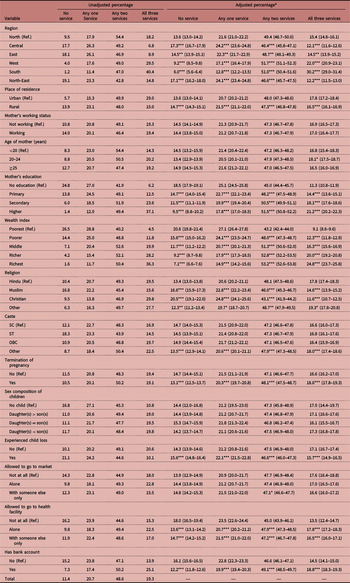
Table 3 shows the adjusted and unadjusted percentages of women using maternal health care services by socioeconomic and demographic characteristics. The South (30.2%, p < 0.01) and West regions (22.0%, p > 0.01) had higher percentages of women utilizing all three services than other regions. The utilization of all three services showed an increasing trend with an increase in women’s educational level (no education: 11%, p < 0.01; higher: 21%, p < 0.01) and wealth status (poorest: 9%, p < 0.01; richest: 25%, p < 0.01). Women’s empowerment indicators significantly positively influenced maternal health care utilization.
Unadjusted and adjusted percentages of women using maternal health care services (ANC, institutional delivery and PNC) by selected background characteristics, NFHS-4, India, 2015–16

a Adjusted percentages calculated with ordered logistic regression.
Confidence intervals in parentheses; Ref.: reference category.
*p < 0.1; **p < 0.05; ***p < 0.01.
Child immunization by mother’s health care utilization
The immunization status of children by number of maternal health care services received by women is presented in Figure 1. While 43% of children were fully immunized in the case mothers who received no maternal health care services, 58% were fully immunized in the case mothers who received any one maternal health care service. Furthermore, the percentage of full immunization increased with an increase in the utilization of maternal health care services among mothers. For instance, 67% of children were fully immunized if their mothers received any two maternal health care services, and 76% were fully immunized if their mothers had complete continuum of care.
Uptake of maternal health care services by women and percentage of children with complete immunization.

The association between child immunization status and continuum of care, along with other confounders, is presented in Table 4. The results indicate that full immunization was significantly higher among children born to mothers who received complete continuum of care (OR: 1.83, p < 0.01) after controlling for other confounders. The age of the mother significantly influenced the immunization status of children, with the children of mothers aged 25 years and over being more likely to be fully immunized (OR: 1.35, p < 0.01) than those of mothers 24 years or under. The estimates showed a negative association between birth order and immunization of children. The likelihood of being fully immunized decreased as the birth order of the child increased. Women who had experienced any child loss had higher odds (OR: 1.32, p < 0.01) of immunizing their child. The likelihood of being fully immunized was higher among women who were allowed to visit a health facility (OR: 1.4, p < 0.01); and among those with a bank account (OR: 1.2, p < 0.01) (Table 3).
Unadjusted and adjusted odds ratios (ORs) of full child immunization by mother’s continuum of care for children aged 12–23 months (N = 8246), India, 2015–16

Ref.: reference category.
*p < 0.1; **p < 0.05; ***p < 0.01.
Propensity score matching results
Table 5 shows the matching estimates obtained from the propensity score analysis. Both the Average Treatment Effect (ATE) and Average Treatment Effect on the Treated (ATET) showed a significant impact of maternal health continuum on child immunization. The ATE value was 0.17 (p < 0.01), which means that completion of maternal health continuum increased the chance of full child immunization by 17 percentage points. Similarly, the ATET value of 0.12 (p < 0.01) signified that the propensity for full child immunization was 12 percentage points higher among the children of mothers who had completed the maternal health care continuum than among the matched control group.
Propensity score matching analysis of the impact of mother’s continuum of maternal health care on child immunization (N = 8246), NFHS-4, India, 2015–16

ATE: Average Treatment Effect; ATET: Average Treatment Effect on the Treated; SE standard error; CI: confidence interval.
*p < 0.1; **p < 0.05; ***p < 0.01.
The overlap assumption
Several ways are suggested in the literature to test the overlap assumption, but the most straightforward is visual analysis of the density distribution of the propensity score in the two groups (Caliendo & Kopeinig, Reference Caliendo and Kopeinig2008). The overlap assumption states that each individual has a positive probability of receiving each treatment (StataCorp, 2015). Estimated densities of the probability of getting each treatment was plotted to check whether the overlap assumption was violated. Figure 2 shows that estimated densities had a substantial amount of mass in the region where they overlapped. There is clear evidence that the overlap assumption held true and a moderate level of overlapping was visible between the two densities.
Overlap plot for propensity score for each treatment.

The covariate balance assumption
Linden (Reference Linden2015) suggested preferring graphical methods over numerical diagnostics for assessing covariate balance. To check the covariate balance the tebalance density command of Stata 14 was used, which generates kernel density plots of covariates over treatment levels for raw and matched samples. If the kernel density plots for a matched sample of the covariates are the same over the treatment levels, the covariates are said to be balanced (StataCorp, 2015). The density plot for matched sample almost overlapped (Figure 3), which means that matching on the estimated propensity scores balanced the covariates. Since these two assumptions were satisfied in the analysis, the treatment assignment was strongly ignorable, implying that the estimated treatment effects were unbiased.
Kernel density plot for covariance balance.

Discussion
Continuum of care has become a key intervention strategy in maternal and child health programmes in many countries for simultaneously improving the health and well-being mothers and children. This strategy requires the connectivity and integration of the three components of maternal health care – ANC, institutional delivery and PNC services– and the continuation of high-quality services for the children, such as immunization. For this to happen it is essential to understand the country’s current position in relation to continuum maternal health care: women are often lost in the path from one service to another, and how the move from one facility to another affects the level of child immunization at both the country and regional level (Singh, Reference Singh2013). In India, just 19% of mothers have complete continuum of care for maternal health, with around 23% receiving full ANC, 82% institutional delivery and 70% postnatal care services. The major barrier to achieving continuum of care for maternal health is the uptake of full ANC.
The results show that women from the South region were more likely to have complete continuum of care than women from other parts of the country. This may be linked to the state’s level of socioeconomic and demographic progress. The Central and East regions combined have the largest share of total population living below the poverty line. Moreover, states in the North, Central and East regions include eight of the Empowered Action Group (EAG) states, which are characterized by poverty, low women’s education, low exposure to mass media and low mean age at marriage (Paul & Sridhar, Reference Paul and Sridhar2015).
The study found substantial socioeconomic differences in the use of maternal health care services in India. Women who had better education and who belonged to wealthier households were more likely to receive all three services and have complete continuum of care. The findings are consistent with previous studies which found a positive association between education and wealth with the uptake of maternal health care services in different countries (Ahmed et al., Reference Ahmed, Creanga, Gillespie and Tsui2010; Chalasani, Reference Chalasani2012; Govindasamy & Ramesh, Reference Govindasamy and Ramesh1997; Yaya et al., Reference Yaya, Bishwajit and Shah2016). Empirical evidence suggests that education is one of the most important determinants of maternal health care utilization. The present study also found that the likelihood of receiving continuum of maternal health care was higher among women with higher education. Education could enable women to understand the concept of safe motherhood and acquire knowledge about the hazards of inadequate care during pregnancy. Furthermore, education also leads to positive choices and increases the likelihood of receiving high-quality and complete maternal health care services (Singh et al., Reference Singh, Rai, Alagarajan and Singh2012b; Weitzman, Reference Weitzman2017; Yaya et al., Reference Yaya, Bishwajit and Shah2016; Barman et al., Reference Barman, Saha and Chouhan2020).
Wealth is the next most important determinant of continuum of care in maternal health care services. Previous studies have documented the role of wealth status separately for different maternal health care services (Baru et al., Reference Baru, Acharya, Acharya, Shiva Kumar and Nagaraj2010; Houweling et al., Reference Houweling, Ronsmans and Kunst2011; Singh et al., Reference Singh, Rai, Alagarajan and Singh2012b; Yaya et al., Reference Yaya, Bishwajit and Shah2016; Sarker et al., Reference Sarker, Sheikh, Mahumud and Sultana2018). The rich are more likely to complete continuum of care, being better educated and belonging to families with a modern world view of health care systems. On the other hand, poor women may prefer traditional health care practices for pregnancy care. Studies have also reported that professional providers treat poor women with less consideration than richer and more educated women (Houweling et al., Reference Houweling, Ronsmans and Kunst2011). There is also evidence that poor families in low-income countries are less willing to spend money on women’s health care (Sword, Reference Sword1999; Barua & Kurz, Reference Barua and Kurz2001; Currie & Wiesenberg, Reference Currie and Wiesenberg2003). Lack of affordability might also explain the large rich–poor gap in completing continuum of care. There are free maternal health care services provided by the government but there may be hidden costs like travel to the facility and the cost of medicines and diagnosis tests that are not covered by the government.
The study also documented autonomy of women as another important determinant of continuum of care. If a woman is allowed to go to a health facility by herself then her chances of receiving all three maternal health services increases. Such women will be more concerned about their own well-being and have a more modern approach towards pregnancy care. A study in Ghana documented the views of women on decision-making and its impact on maternal health care utilization. Most reported that their husbands and mothers-in-law decided whether or not they could have hospital-based care during pregnancy. Most of the women reported that they wanted to receive pregnancy care but felt powerless to make this decision for themselves (Ganle et al., Reference Ganle, Obeng, Segbefia, Mwinyuri, Yeboah and Baatiema2015). Bloom et al. (Reference Bloom, Wypij and Das Gupta2001) also reported that women’s freedom of movement had a strong effect on the utilization of maternal health care, even after controlling for socio-demographic factors.
Previous studies have assessed women’s utilization of a single maternal health service, such as uptake of ANC, skilled birth delivery or PNC services (Choi & Lee, Reference Choi and Lee2006; Sines et al., Reference Sines, Syed, Wall and Worley2007; Oyerinde, Reference Oyerinde2013; Singh et al., Reference Singh, Pallikadavath, Ram and Alagarajan2014), but none considered the complete utilization of all three services and the impact of this on the immunization status of their children. India’s child immunization rates are uniformly lower than in many other underdeveloped countries (Choi & Lee, Reference Choi and Lee2006; Singh, Reference Singh2013; Shrivastwa et al., Reference Shrivastwa, Gillespie, Kolenic, Lepkowski and Boulton2015). The present study tested the relationship between the continuum of maternal health care utilization and its effect on child immunization, controlling for socio-demographic and economic background characteristics known to be significant predictors of child immunization. The results showed that mother’s continuum of care was a significant predictor of complete child immunization. The unadjusted OR of continuum of care on child immunization was 2.2, and after controlling for other predictors of child immunization it became 1.8. This indicates that continuum of care of mothers around pregnancy is one of the most important factors for child immunization, irrespective of women’s socio-demographic and economic backgrounds. If a woman receives all three services during pregnancy, delivery and the postnatal period, then regardless of her educational or wealth status, her child is more likely to be fully immunized. Thus, the immunization levels of children can be improved just by ensuring women receive all three services, and this will accelerate India’s progress towards achieving MDG-1 and MDG-4.
A strength of the study was that it was community based and used large-scale data, representative of the whole country. Also, it attempted to estimate the causal treatment effects using propensity score matching to establish causality between continuum of maternal health care and child immunization. Nevertheless, it had its limitations. It did not cover information pertaining to the quality of services received by mothers. Furthermore, the survey lacked information on the accessibility of maternal health care services and the availability of health care providers at facilities, which could impact the drop-out of women in receiving continuum of care. Moreover, immunization service delivery factors, including the availability of vaccines, health care professionals and logistics, were not explored.
Despite many efforts by the India government to ensure universal child immunization, there are still areas where levels of immunization are low. The key message emerging from this analysis is that continuum of maternal care health service utilization is a strong predictor for child immunization in India. It is therefore recommended that, to ensure universal child immunization coverage, the government should ensure all women receive comprehensive maternal health services utilization using the continuum of maternal and health care approach.
Conflicts of Interest
The authors have no conflicts of interest to declare.
Ethical Approval
The authors assert that all procedures contributing to this work comply with the ethical standards of the relevant national and institutional committees.
Funding
This research received no specific grant from any funding agency, commercial entity or not-for-profit organization.