Introduction
The vision of the United Kingdom's (UK) government, as stated in the new loneliness strategy, is for the country to be a place where families, friends and communities can support each other and build strong social relationships, especially at vulnerable points where individuals are at an increased risk of loneliness (HM Government, 2018). However, much of the evidence included in this and other strategies is based predominantly on the experiences of older white people. This is problematic as older white people may have followed very different lifecourse trajectories compared to people from minoritised ethnic groups. Consequently, older Black and Minority Ethnic (BME) people may have a different set of risk factors for isolation and loneliness, and, in turn, may also have different support needs. The structure and density of social networks is a key determinant of both social isolation and loneliness, and may be one dimension upon which the experiences of older white people differ systematically from other ethnic groups. This paper draws on survey data to examine how older BME people differ from older white people in one domain of social relationships, the friendship network, which is considered relevant to a range of policy matters including informal support, physical and mental health, and even neighbourhood renewal (Allan, Reference Allan, Dannefer and Phillipson2010).
Background
Social isolation, loneliness and older BME people
Older people are vulnerable to the experiences of social isolation and loneliness when they are no longer able actively to engage within their communities owing to bereavement, reduced mobility, declining health, limited income (Social Care Institute for Excellence, 2012) or the impact of ageism on the social arrangements available to them. Aside from these age-related life events that increase the risk of social isolation and loneliness, older BME people also have to contend with the negative experiences associated with racial discrimination, stigmatisation and other hostile reactions from the society (Fokkema and Naderi, Reference Fokkema and Naderi2013). They are also at elevated risk of experiencing mental health problems owing to racial and cultural pressures and prejudices that some have been subjected to over their lifecourse (Phillipson, Reference Phillipson2013). In addition, there is a wealth of empirical evidence that shows that when compared to older white people, older BME people have poorer health (Tillin et al., Reference Tillin, Hughes, Mayet, Whincup, Sattar, Forouhi and Chaturvedi2013), higher levels of economic inactivity (Steventon and Sanchez, Reference Steventon and Sanchez2008) and increased risks of late-life poverty (Gough and Adami, Reference Gough and Adami2013). These socio-economic and health inequalities have the potential to restrict social participation, the frequency of interaction with friends and the quality of functional social support, thereby increasing the risk of social isolation and loneliness for older BME people.
Despite their likely increased vulnerability to social isolation and loneliness, relatively little research in the UK to date has explored these phenomena in older BME people. Only one study has been purposively conducted to ascertain the prevalence of loneliness in older BME people in Britain. In a sample of 300 minority ethnic elders aged 65+ living in the community, 24–50 per cent of participants from Africa, Bangladesh, the Caribbean, China and Pakistan reported loneliness (Victor et al., Reference Victor, Burholt and Martin2012). On the other hand, 8–10 per cent of the Indian participants reported loneliness; rates that were comparable to the white British sample (Victor et al., Reference Victor, Burholt and Martin2012). The research available finds both very high rates of loneliness in many older BME people and reveals differences among different groups that are frequently treated as homogenous within the BME classification/categorisation. This current study aims to build on this by exploring how older BME people's friendship networks differ from those of older white people.
Assumptions about the experience of loneliness and social isolation in older BME people
Despite the high rates of loneliness found in older BME people, it is often assumed that they are protected from social isolation and loneliness because they are perceived as being likely to live in multigenerational households with traditional family practices (Butt and O'Neil, Reference Butt and O'Neil2004; Khan, Reference Khan, Joplin and Barnett2017). These stereotypical assumptions may stem from the association made between ethnic minority populations and collectivist cultures which value interdependence and are orientated towards cohesion, commitment and obligation (Burholt et al., Reference Burholt, Dobbs and Victor2018).
However, such assumptions are problematic for a number of reasons. First, they appear to conflate loneliness with social isolation in assuming that larger households offer guaranteed protection from loneliness. Yet, it is known that loneliness is a subjective concept and some people can be lonely despite being amongst others (de Jong Gierveld, Reference de Jong Gierveld1998). Second, they ignore the diversity of the older BME population who have varied family structures and living arrangements. For instance, the findings of a nationally representative survey involving people of Caribbean and Asian origin revealed that African Asians and Indians were most often found in small families and Caribbean people were more likely to live on their own or with just their children (Modood and Berthoud, Reference Modood and Berthoud1997). Third, these assumptions tend to overlook the broader societal factors such as changes in patterns of marriage, immigration policies that divide many families, inadequate housing, and economic mobility that can erode the traditional family structures and kinship practices of some BME groups (Ahmad and Walker, Reference Ahmad and Walker1997).
Among other issues, past and recent research on older BME people has been criticised for narrowly focusing on family, intergenerational and social relationships, health inequalities, health and social care (Phillipson, Reference Phillipson2015; Torres, Reference Torres and Westwood2019). Assumptions about the disproportionate importance that family and intergenerational relationships may hold for older BME people appear to have guided the focus of researchers away from friends and peers who also have a role to play in reducing social isolation and loneliness in older BME people (Cela and Fokkema, Reference Cela and Fokkema2017).
Comparing the role of friends and family members in reducing social isolation and loneliness
Very few researchers have looked explicitly at the role of the friendship networks of older BME people in reducing social isolation and loneliness. Although both family and friend relationships provide emotional support, they differ with regard to instrumental support, which is more prominent in family relations, whereas companionship, social integration and reaffirmation of self-worth are more characteristic of friendship relations (Huxhold et al., Reference Huxhold, Miche and Schuz2014). Undoubtedly, these varying functions of friendship and family networks and their perceived adequacy have implications for the experiences of social isolation and loneliness.
For many older BME people, their experiences of loneliness are linked to their migration histories (Khan, Reference Khan, Joplin and Barnett2017). Therefore, they may not necessarily share this history with members of their family or household, who are much more likely to have been born and raised in the UK (Khan, Reference Khan, Joplin and Barnett2017). Perhaps unsurprisingly, they may be more likely to share this history with friends and peers, so that absence of these relationships may be particularly detrimental. This notion is supported by findings from a qualitative study of older Albanian and Moroccan migrants living in Italy which indicate that the cause of their loneliness was largely related to a lack of meaningful relations with non-kin age peers (Cela and Fokkema, Reference Cela and Fokkema2017). The authors propose that more non-kin contact, especially with co-ethnic peers, could substantially reduce feelings of loneliness. As such, supporting friendship networks of older BME people appears to be crucial in alleviating the experiences of loneliness and social isolation, and they ought to be examined.
The number of BME people aged 65 and over is estimated to increase from 0.4 million in 2011 to 2.7 million by 2051 (Lievesley, Reference Lievesley2010; NOMIS, 2013). Given the increasing diversity in the ageing population, this research aims to investigate how the friendship networks of older BME people differ from those of older white people living in the UK. It shifts the focus from kin to kith by analysing information on the friendship networks of a representative sample of older BME people living in the UK. In doing so, it moves away from the narrow focus of past research on older BME people living in the UK. It responds to the calls made by researchers for more comparative studies on social isolation and loneliness in older BME people living in the UK (Victor et al., Reference Victor, Burholt and Martin2012). The findings of such analyses are central to understanding the context that essential planning services, targeted measures and policies need to consider in order to meet the needs of a diverse ageing population.
There are two aims of the study:
(1) To examine how dimensions of the friendship networks of older BME people differ in comparison with those of older white people.
(2) To explore the association between ethnicity and dimensions of the friendship network while controlling for socio-demographic variables.
Methods
Data
The infrastructure for conducting research with older BME people in the UK is poorly set up (Sin, Reference Sin2004). There are few surveys or cohort studies that include sufficient numbers of older minority ethnic people to allow quantitative analyses of prevalence rates, patterns and trends of social isolation and loneliness in different ethnic populations. This is unsurprising given that few national studies of older BME people in Britain exist (Sin, Reference Sin2004). Where they are available, these studies are small-scale and involve samples that are localised (Sin, Reference Sin2004), making generalisability impracticable.
Surveys such as Understanding Society address some of these limitations. This survey has been running since 2009 and data are collected from the same individuals annually on topics such as family and social ties, wellbeing, education, employment, financial resources and health (Understanding Society, 2017). Unlike other national surveys such as the English Longitudinal Study of Ageing (ELSA), it includes an ethnic minority boost sample of over 4,000 households (McFall et al., Reference McFall, Nandi and Platt2016). A further boost sample of around 3,000 immigrant and ethnic minority group members was added in Wave 6 (McFall et al., Reference McFall, Nandi and Platt2016). The samples enable research on ethnicity and immigration that compares the experiences of the UK's ethnic groups over time (Understanding Society, 2017). As such, it has been used in studies examining minority groups. Although the survey was not intended to address the issues of older BME people, it has a larger proportion of older BME people (approximately 7%) compared to ELSA's survey sample (approximately 3%). In fact, studies that have utilised data from this survey describe it as ‘ideal’ owing to the ethnic minority boost sample that provides adequate numbers of BME people (Vlachantoni et al., Reference Vlachantoni, Feng, Evandrou and Falkingham2015, Reference Vlachantoni, Feng, Evandrou and Falkingham2017).
This study utilises data from Wave 6 (collected between 2014 and 2015) where a further boost sample of around 3,000 immigrant and ethnic minority group members was added (McFall et al., Reference McFall, Nandi and Platt2016). The mainstay of the analysis is based on respondents aged 65 and above, although some supplementary analyses exploring trends for older people aged 50 and over are included. A total of 9,677 participants (717 of whom identified as BME) took part in this wave. Those with missing, inapplicable, proxy data were excluded; missing data were not imputed because of concerns that missingness was not random. An analytical sample was created consisting of 7,499 participants, 329 (4.3%) of whom were from a BME background (for a breakdown of the number of participants in each ethnic category, see the online supplementary material). All analyses in this study were adjusted for the complex survey design with both unweighted and weighted numbers displayed next to analyses (McFall et al., Reference McFall, Nandi and Platt2016).
Identification of friendship network indicators
The identification of appropriate indicators of the friendship network was informed by measures for social isolation and loneliness used elsewhere. In surveys such as ELSA, loneliness is measured using the three-item Revised UCLA scale (Shankar et al., Reference Shankar, McMunn, Banks and Steptoe2011). These questions include: ‘How often do you feel you lack companionship?’, ‘How often do you feel left out?’ and ‘How often do you feel isolated?’ Past studies that have utilised data from ELSA have derived an index of social isolation by incorporating items such as living arrangements, frequency of contact with members of one's network such as family, friends and relatives, as well as participation in social activities (Shankar et al., Reference Shankar, McMunn, Banks and Steptoe2011). Questions such as ‘How often do you meet with friends?’, ‘How often do you speak on the phone with friends?’ and ‘Number of close relationships with friends’ that have been used in measures of exclusions from social relationships (Kneale, Reference Kneale2012) also informed the identification of appropriate variables.
Relevant variables in the Social Network module and the Best Friend module of Wave 6 of Understanding Society were identified. The variables that met these criteria were ‘Number of close friends’, ‘Proximity of friends’, ‘Number of family members who are friends’, ‘Social visits’ and ‘Barriers to going out socially’. Variables that reflected the quality or adequacy of interactions with friends were unavailable.
Socio-demographic variables
Socio-demographic variables such as age, gender, rurality, household size, marital status and ethnicity were selected because they have been shown to influence social isolation and loneliness (Wenger et al., Reference Wenger, Davies, Shahtahmasebi and Scott1996; Bernard, Reference Bernard2013). Socio-economic and health indicators such as current financial situation and long-standing illness or disability were included as these are known to influence social isolation and loneliness, especially for older BME people (Fokkema and Naderi, Reference Fokkema and Naderi2013). Overall life satisfaction was also included as it was a subjective variable that reflected the overall quality of life. (For more details on how all the variables were re-coded, see the online supplementary material.)
Analysis
The analysis was conducted using Stata/MP 14.0 (Stata, 2018) beginning with descriptive cross-tabulations. We construct binary logistic regression models to analyse whether observed associations remained after controlling for eight potentially confounding variables (age, gender, marital status, household size, rurality, current financial situation, long-standing illness and life satisfaction).
Results
Descriptive cross-tabulations
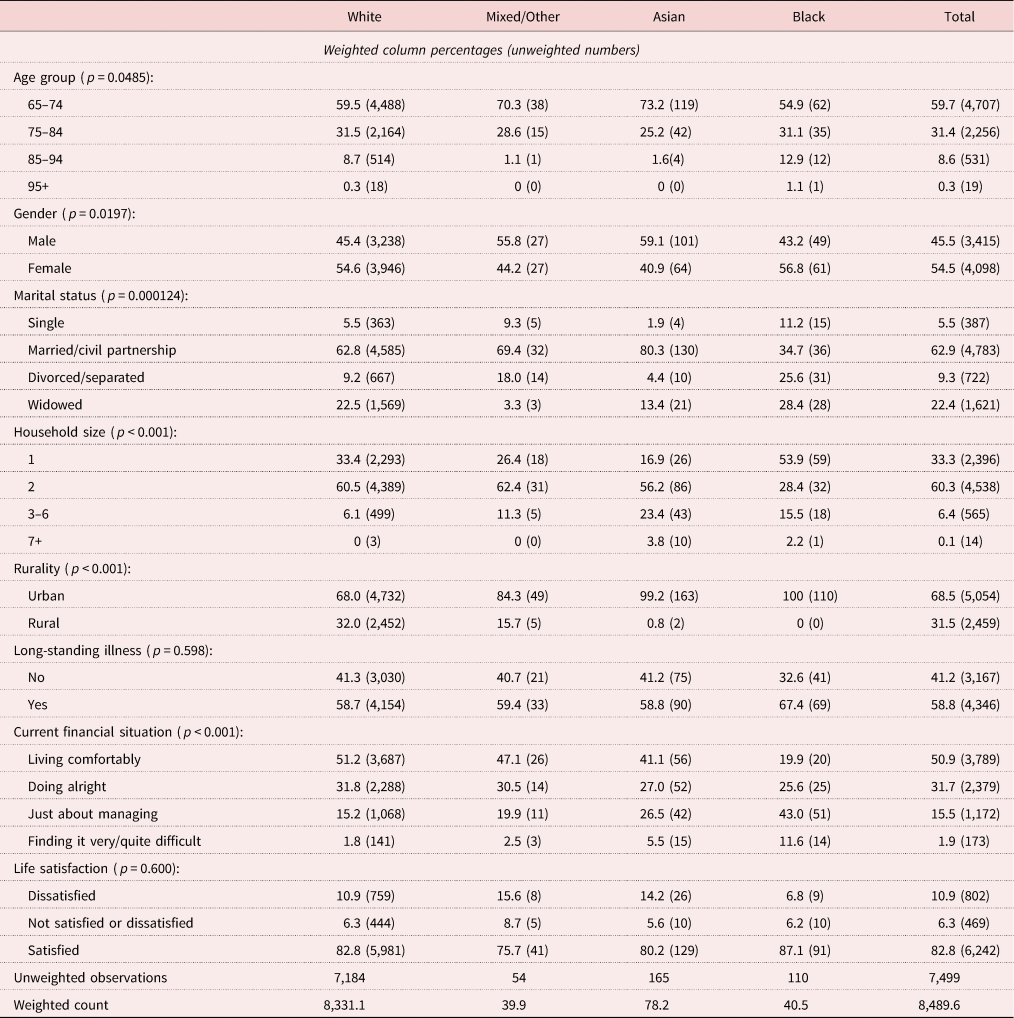
Table 1 shows the characteristics of the analytical sample. It emphasises the variation in some socio-demographic factors between BME people and white majority people, and also between BME people aged 65 + .
Socio-demographic characteristics of Wave 6 Understanding Society respondents aged 65+

Those Black people included in the sample were more likely to be female and aged over 85 years, while Asian people and those of Mixed/Other ethnicity were more likely to be male and aged under 75. With the exception of the gender profile for the Asian and those of Mixed/Other ethnicity, these findings are not unlike the 2011 Census data which indicate that the BME population in England and Wales is generally younger than the White British population with the exception of Black Caribbean and White Irish people (Centre for Policy on Ageing, 2013). All Black people and 99.2 per cent of Asian people reported living in urban areas compared to those of Mixed/Other ethnicity (84.3%) and White people (68%). This is in line with evidence showing that relatively few BME people live in rural areas in the UK (Lievesley, Reference Lievesley2010).
In this sample, older Asian people were more likely to be married (80.3%) and living in households of three to six people (23.4%), while Black people were more likely to be single (11.2%) and living in one-person households (53.9%). The number of older Black people reporting a long-standing illness (67.4%) is around eight percentage points higher than older White (58.7%), Asian (58.8%) and Mixed/Other (59.4%) people. Also, compared to other groups, Black people were least likely to report that they were living comfortably but more likely to report that they were finding it very/quite difficult financially (11.6%) compared to White (1.8%), Asian (5.5%) and people of Mixed/Other ethnicity (2.5%). Together, these findings suggest marked health and income inequality both between and within ethnic groups. Despite this, Black people were least likely to report dissatisfaction with life overall (6.8%) compared to White (10.9%), Asian (14.2%) and those of Mixed/Other ethnicity (15.6%).
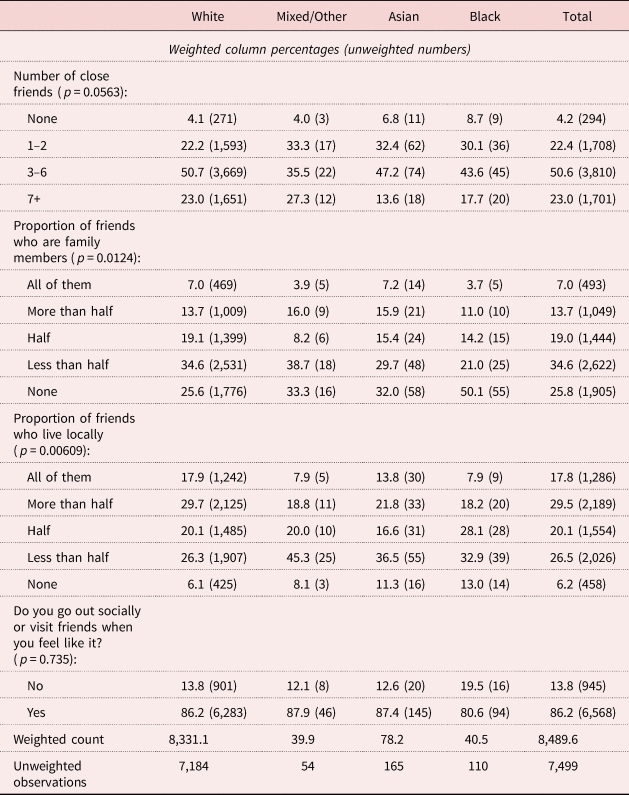
The descriptive results in Table 2 show Black and Asian respondents were almost twice as likely to report having no close friends (8.7 and 6.8%, respectively) compared to White and Mixed/Other respondents (4.1 and 4.0%). Around half of the Black respondents (50.1%) reported that none of their friends were family members compared to a third of respondents with Mixed/Other ethnicity (33.3%) and Asian respondents (32%), and just a quarter of White respondents (25.6%). A higher proportion of Black (13%) and Asian (11.3%) people reported that none of their friends lived locally compared to White people (6.1%) and those of Mixed/Other ethnicity (8.1%). Similarly, Black respondents were more likely to respond ‘No’ to a question on whether they visit friends socially (19.5%) compared to White (13.8%), Asian (12.6%) and those of Mixed/Other ethnicity (12.1%), although these differences were not statistically significant. These findings indicate that compared to older White people, many BME people may lack close friends and confidants and may not have immediate access to their friendship networks. Further analyses suggested that Black people (12.3%) were more likely to report that health was a barrier to going out socially compared to older Asian, Mixed/Other and White people (7.7, 7.2 and 6.7%, respectively), although this result was based on a smaller sub-sample of respondents who reported that they did not go out socially or visit friends when they felt like it.
Ethnic variations in selected social network variables of respondents aged 65+ in Wave 6 Understanding Society

Binary logistic regression models
It is possible that some of the associations between ethnic group and friendship variables may be confounded by other systematic differences between older white people and BME people. Logistic regression models were thus constructed to analyse whether the observed associations remained after controlling for these confounding factors. Although aggregation of the different groups of BME people into one group may have resulted in the masking of important differences between the groups, it was necessary because of the small number of BME people in the sample and the implications of this analytic decision are considered in full in the discussion.
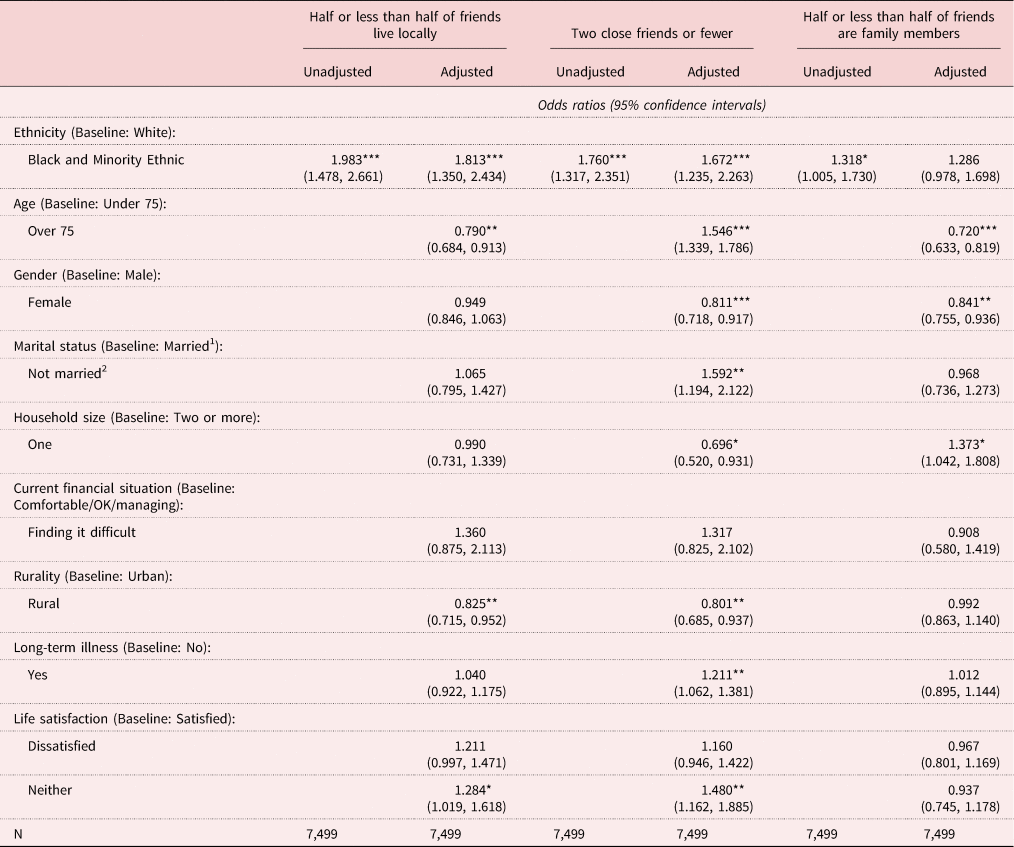
Table 3 shows the adjusted and unadjusted results of the logistic regression models showing the association between the friendship variables and the selected demographic factors of those aged 65 and over. The adjusted values have been adjusted for confounding by age, gender, marital status, household size, current financial situation, rurality, long-standing illness and life satisfaction. After controlling for these factors, some of the results described above are still evident. Older BME people remain significantly more likely to report that half or less than half of their friends live locally (odds ratios (OR) = 1.81, 95% confidence interval (CI) = 1.35–2.43) compared to older white people. They also remain more likely to report having two or fewer close friends (OR = 1.67, 95% CI = 1.24–2.26) compared to older white people. The association between ethnicity and having friends as family members is, however, no longer statistically significant. Models using a more disaggregated measure of ethnicity show similar trends and are available in the online supplementary material. These findings suggest that older BME people's friendship networks may be restricted both in size and accessibility.
Logistic regression models showing the association between friendship network indicators and selected socio-demographic factors (age 65+)

Notes: 1. Refers to married, civil partnerships and co-habiting individuals. 2. Refers to single, divorced, separated, never married, widowed, former civil partners and surviving civil partners.
Significance levels: * p < 0.05, ** p < 0.01, *** p < 0.001.
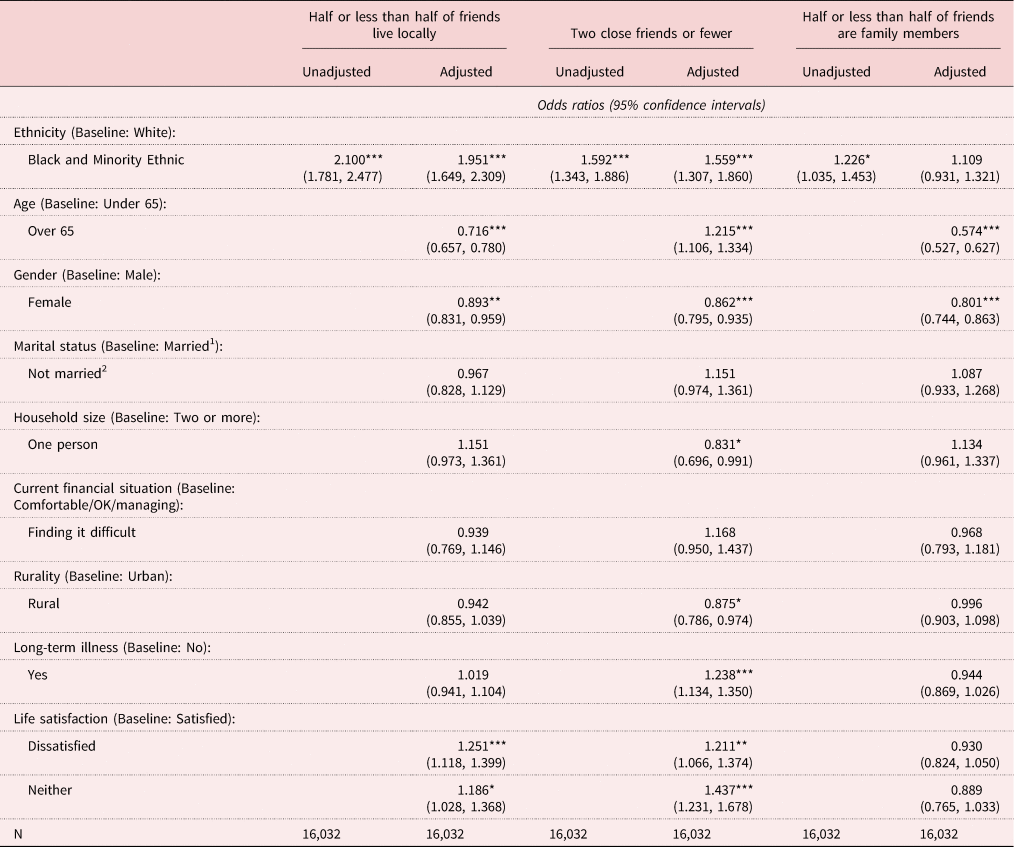
The same models were created for respondents aged 50 and over to assess whether these trends held (see Table 4). Similar trends were observed with the younger BME cohort also being 1.56 (95% CI = 1.31–1.86) times more likely to report having fewer close friends and 1.95 (95% CI = 1.65–2.31) times more likely to report that half or less than half their friends live locally when compared to their white counterparts. Models with a breakdown of the BME groups show similar trends and are available in the online supplementary material.
Logistic regression models showing the association between friendship network indicators and selected socio-demographic factors (age 50+)

Notes: 1. Refers to married, civil partnerships and co-habiting individuals. 2. Refers to single, divorced, separated, never married, widowed, former civil partners and surviving civil partners.
Significance levels: * p < 0.05, ** p < 0.01, *** p < 0.001.
Discussion
This study set out to examine how dimensions of the friendship network of older BME people differ compared to older white majority people and to explore the association between ethnicity and dimensions of the friendship network while controlling for demographic variables. The key finding of this study is the suggestive link between ethnicity and disparities in some dimensions of the friendship network.
In this sample, a higher proportion of older Black and Asian people reported that they had no close friends and that none of their friends lived locally. Thus, they appear to have the sparsest friendship networks. After controlling for age, gender, marital status, household size, rurality, current financial situation, long-term illness and life satisfaction, older BME people were more likely to report having fewer close friends and more likely to have friends who do not live locally. Although there may be a number of explanations for this finding, it can be interpreted as being indicative that older BME people lack close confidants and have friendship networks that are less geographically accessible than those of older white people. Since social isolation is defined as having minimal quantity and quality of structural and functional support (Dickens et al., Reference Dickens, Richards, Greaves and Campbell2011), a lack of confidants and a less geographically accessible friendship network may negatively impact the quality and frequency of interactions and emotional, information and instrumental social support. Also, network size, isolation, time alone and the presence of a confidant have all been shown to be consistently associated with loneliness (Victor et al., Reference Victor, Scambler, Bowling and Bond2005). Thus, a lack of confidants and geographical separation from one's social network is a cause for concern. It potentially places older BME people at risk of both social isolation and loneliness.
The fact that older BME people in this present study were more likely to report that they had fewer friends who lived locally may be reflective of a geographically dispersed network that is characteristic to migrants. Geographical separation from social networks as a result of migration has been proposed as a factor that can explain the higher levels of loneliness in older BME people (Treas and Mazumdar, Reference Treas and Mazumdar2002). Migrants leave behind their friends and family members when moving to a new country. Feelings of isolation and loneliness may develop when new ties are yet to be developed (Koelet and de Valk, Reference Koelet and de Valk2016). However, this issue may be more acute for recently arrived migrants, and adjustment may come with time (Van Tilburg et al., Reference Van Tilburg, Vingerhoets and Van Heck1996). As such, further exploration would be needed to establish whether the majority of the friendship networks of older BME people are based within the UK or outside the UK. Factors such as the number of years spent in the UK and language proficiency could also be examined as they are likely to have an impact on the formation of friendships. If the results of such an analysis indicate that older BME people's friendship networks are indeed outside the UK, then further exploration could look at how these relationships are maintained and the extent to which these relationships are adequate in reducing social isolation and loneliness.
It can also be argued that with the ubiquity of the internet and the availability of multiple platforms of communication (Government Office for Science, 2016), older BME people may have several ways of offsetting the geographical separation of their friendship networks. This may be the case, but little is known about the uptake of such technologies among older BME people or the extent to which ‘virtual’ contact is a good proxy for face-to-face contact for older people. Moreover, offsetting a lack of close friends is undoubtedly a more complicated process. More robust research with a larger representative sample and appropriate indicators is needed to uncover whether and/or how older BME people use different platforms of communication to offset any lack of confidants and/or geographical separation from their friendship networks. In addition, qualitative research would be useful in understanding whether or not such platforms meet their needs and the mechanisms that result in the findings.
One explanation for the differences seen between older BME people and older white people could lie in the interpretation of some concepts such as ‘locally’ or ‘close friend’. For example, ‘locality’ can be equated to the term proximity which is a fluid concept with a multitude of meanings (Solá and Vilhelmson, Reference Solá and Vilhelmson2018). For some, proximity relates to their close physical surroundings, whilst for others, it refers to their neighbourhoods and local communities (Solá and Vilhelmson, Reference Solá and Vilhelmson2018). Still, others may consider the regional level when asked about proximity. Evidently then, without specifying intended meaning, the different ways in which such concepts are subjectively understood may have produced the differences seen in the response. Moreover, almost all older BME people in this sample lived in urban areas. This may also have had implications in the way they regarded locality. The same applies to the interpretation of the concept ‘close friend’. For some, the term ‘close friend’ is associated with intimacy, involving discussing personal matters, asking for advice or material exchanges (Policarpo, Reference Policarpo2015: 172). Others might interpret the term ‘close’ literally, in terms of proximity. As such, we cannot discount the possibility that these concepts may have been misinterpreted and, therefore, the differences observed are artefacts.
It would, therefore, be beneficial if concepts that are likely to be misinterpreted are clarified for respondents, in order to address the issue of subjectivity. For example, in their investigation of under-reporting of HIV-related high-risk behaviours, Mirzazadeh et al. (Reference Mirzazadeh, Shokoohi, Navadeh, Danesh, Jain, Sedaghat and Haghdoost2018) asked participants questions relating to close friends. They clarified what they meant by defining the term ‘close friend’ as a person with whom the respondent had a close friendship, discussed personal information, shared meals as well as received social support (Mirzazadeh et al., Reference Mirzazadeh, Shokoohi, Navadeh, Danesh, Jain, Sedaghat and Haghdoost2018: 215). In Understanding Society, the questions relating to the number of close friends and the locality of friends were part of the mainstage individual questionnaire administered during the individual adult computer-assisted personal interview by trained interviewers (Understanding Society, 2013). As such, there was scope for ambiguous concepts to be clarified during these interviews. However, it is unclear whether any clarification was done. In the interest of avoiding misinterpretation, future waves of Understanding Society should ensure that concepts that are likely to be subjectively interpreted are clarified and reported accordingly.
There are also possibilities that the language spoken might influence the interpretations of questions. However, it is important to note that from Wave 6 onwards, the questionnaire used was made available in Bengali, Gujarati, Polish, Portuguese, Punjabi (Gurmukhi), Punjabi (Urdu), Somali, Turkish, Urdu and Welsh (McFall et al., Reference McFall, Nandi and Platt2016). The process of translating the questionnaires did not simply involve a word-by-word translation from the English questionnaire. Rather, the development process ensured that the construct being questioned was equivalent and elicited the same kinds of information (McFall et al., Reference McFall, Nandi and Platt2016). Thus, the potential for the concepts to be misinterpreted was minimised in the translation of the questionnaire.
The findings of this study contribute to the otherwise sparse literature on older BME people living in the UK and add to scholarship on social isolation and loneliness. Whilst some novel findings have been revealed, this study is not without limitations. First, for the descriptive cross-tabulations, older BME people were grouped into categories: Asian, Black and Mixed/Other. Further, for the binary logistic regression models, all older BME people were grouped together to form one broad category. Grouping older BME people into these overarching categories was unavoidable owing to the small numbers of people in some categories. However, it is important to note that underlying these categories is a lot of heterogeneity that is masked when ethnic categories are grouped together. This also applies to older white people, some of whom are equally migrants with experiences of discrimination and racism (Spencer et al. Reference Spencer, Ruhs, Anderson and Rogaly2007; Janta et al. Reference Janta, Ladkin, Brown and Lugosi2011). Relatedly, creating an analytical sample further reduced the number of older BME people from 717 to 329. Despite the small sample size used in this study, it mirrors that of other purposeful studies conducted by Victor et al. (Reference Victor, Burholt and Martin2012) who explored the prevalence of loneliness in 300 older BME people living in Great Britain. The analysis may have been underpowered, but nevertheless, the findings give an indication of underlying trends in friendship networks.
Second, in relation to older BME people in particular, variables reflective of their migration histories and how they impact on their friendship networks were absent. Also, there was a lack of appropriate variables that could explicitly measure the subjective dimension of the friendship network. Given that both the objective and subjective measures of the friendship network are important in understanding the lived experience of social isolation and loneliness (Cloutier-Fisher et al., Reference Cloutier-Fisher, Kobayashib and Smith2011), it was surprising that only some quantifiable measures of the friendship network were available in Understanding Society. With the absence of variables that explicitly measure the quality of interactions or satisfaction with the friendship networks, further investigations are necessary. It was out of the scope of this study to explore this but such explorations could reveal the extent to which older BME people find the number and proximity of confidants adequate in meeting their needs.
Together, these limitations emphasise the difficulties past and current researchers face when using large-scale surveys to explore the experiences of older BME living in the UK (Sin, Reference Sin2004). Nevertheless, the data from Understanding Society provide insights into important dimensions of the friendship networks that impact on social isolation and loneliness which remain under-researched in older BME people.
Conclusion and recommendations
From a policy and practice perspective, the findings of this study suggest that older BME people may have different needs to older white people, thereby highlighting the continuing need for interventions for older people to move away from a ‘one-size-fits-all’ approach and, instead, to invest in interventions that are targeted, evidence-based and reflective of the diverse experiences of older people.
Given that social isolation and loneliness is an emerging issue across all ages, subsequent waves of Understanding Society need to ensure that appropriate measures are available. They also need to include adequate numbers of older BME people and measures that are based on a theoretical framework which includes their lifecourse experiences. Further, conducting analysis using a lifecourse perspective could be particularly useful in highlighting the importance of the multiple ways in which the rich and diverse lives of older adults mediate the effects of having small social networks (Cloutier-Fisher et al., Reference Cloutier-Fisher, Kobayashib and Smith2011). Such an approach would bring us one step closer to understanding not only the ethnic variations in friendship networks of older people, but also how social isolation and loneliness is experienced by members of an increasingly diverse ageing population.
The results of studies such as this provide a starting point for further research. However, they would need to be supplemented by qualitative data to give an indication of the meanings of variables and to provide a holistic evidence base that can adequately inform policy makers and practitioners about the friendship networks of older BME people. This could, in turn, support the development and implementation of targeted measures to tackle social isolation and loneliness in older BME living in the UK.
Supplementary material
The supplementary material for this article can be found at https://doi.org/10.1017/S0144686X19001624
Financial support
This work was supported by the Economic and Social Research Council (Project 526388; Award 157351).
Author contributions
BH and DK planned the study and performed data analysis. BH wrote the paper. DK and AP contributed to revising the paper.