




No CrossRef data available.
Article contents
The impact of a multidimensional exercise program on self-reported anxiety and depression in cancer patients undergoing chemotherapy: A phase II study
Published online by Cambridge University Press: 03 March 2006
Abstract
Little is known about the role of exercise in improving cancer patients' mood while undergoing chemotherapy. In this phase II study changes in self-reported anxiety and depression and fitness (VO2max) are reported in relation to a 6-week, 9 h weekly, multidimensional exercise program. A total of 91 patients receiving chemotherapy, between 18 and 65 years old, completed a Hospital Anxiety and Depression Scale Questionnaire (HADS; response rate 91%, adherence rate 78%). Anxiety (p < 0.001) and depression (p = 0.042) was significantly reduced. The mean ± SD of the change was −1.14 ± 2.91 for anxiety and −0.44 ± 2.77 for depression. Improvements in fitness were correlated with improvements in depression, χ2(1) = 3.966, p = 0.046, but not with improvements in anxiety, χ2(1) = 0.540, p = 0.462. The research suggests that exercise intervention may have a beneficial impact on psychological distress for cancer patients receiving chemotherapy with low to moderate levels of baseline psychomorbidity. The study furthermore indicates that changes in distress may be associated with disease status and levels of physical activity undertaken during disease. The study is followed up by an ongoing randomized clinical controlled trial to evaluate potential causal effects of exercise intervention on psychological distress and fitness in cancer patients undergoing chemotherapy.
Information
- Type
- Research Article
- Information
- Copyright
- © 2005 Cambridge University Press
INTRODUCTION
The use of chemotherapy in the treatment of cancer has become more frequent and more advanced. An increasing number of cancer patients are offered chemotherapy for advanced disease and for adjuvant treatment after surgery and radiation. This means that the importance of helping people to live with a chronic life threat and the side effects of arduous treatment is growing (Baum & Andersen, 2001). Physical activity is a strategy that is currently gaining importance as a viable choice of complementary treatment within several medical specialities including cancer. This development has roots in longstanding evidence in sports science that physical activity—beyond a series of somatic effects—has a favorable impact on apathy, depression, anxiety, hypochondria, self-esteem, compliance, sleep, and social contact (Morgan & Goldston, 1987; Ossip-Klein et al., 1989; Martinsen, 1990; Petruzzello et al., 1991; Glenister, 1996). Among other factors, it has been shown that physically active people are less stressed than inactive people, and that reduced stress has a direct relationship to physical training (Camacho et al., 1991; Cramer et al., 1991; King et al., 1993; Paffenbarger et al., 1994). The participants studied have ranged from healthy individuals with few or no symptoms of anxiety or depression to individuals who experience a clinically diagnosed disorder (Dunn et al., 2001).
Preliminary results within psychooncology have indicated that physical training can improve cancer patients' physical performance (MacVicar et al., 1989; Segal et al., 2001) and quality of life (QOL; Friedenreich & Courneya, 1996; Courneya & Friedenreich, 1997, 1999; Courneya et al., 2000, 2003; Pinto et al., 2000; Burnham & Wilcox, 2002). Others have focused on the reduction of side effects of treatment (Winningham & MacVicar, 1988; Dimeo et al., 1997; Schwartz, 1998, 1999; Oldervoll et al., 2003; Segal et al., 2003; Stricker et al., 2004). Few of these studies were carried out with cancer patients undergoing cytostatic treatment (MacVicar et al., 1989; Winningham et al., 1989; Schwartz, 1998; Dimeo et al., 1999, 2003; Kolden et al., 2002; Young-McCaughan et al., 2003). In two instances researchers have focused explicitly on the psychological benefits of physical exercise (Segar et al., 1998; Blanchard et al., 2001). Blanchard et al. (2001) investigated the effect of a single bout of exercise on anxiety levels whereas Segar et al. (1998) evaluated the effect of 10 weeks of aerobic exercise on depression and anxiety symptoms. Women with breast cancer, who received adjuvant chemotherapy, represent the largest group of patients in these studies, and the exercise undertaken has primarily included cardiovascular training. However, in a recent review article by Galvão and Newton (2005), the authors conclude that other cancer groups, in addition to those with breast cancer, should be included in clinical trials to address more specifically dose–response training for this population.
“Body and Cancer” is a five-year multidisciplinary research project designed to determine the effects of a 6-week structured exercise intervention program in a heterogeneous sample of cancer patients undergoing chemotherapy. Data regarding feasibility, physical capacity, and health benefits have been published recently (Adamsen et al., 2003). The primary aim of the current study was to examine the effects of the exercise intervention on self-reported psychological distress. The primary outcomes were changes in anxiety and depression levels between baseline and postintervention. The study furthermore includes pre-/postintervention changes in aerobic capacity (VO2max). The specific hypotheses for this study were drawn from the Adamsen et al. (2003) results. First, it was hypothesized that the exercise intervention would have beneficial outcomes on both anxiety and depression, and second, that this positive outcome would be associated with improvement in aerobic capacity.
METHODS
Intervention
The intervention consisted of a 6-week, 9 h weekly, structured exercise program. Patients undertook activities that were classified as either high or low intensity. High intensity activities were those that considerably raised the heart rate and included anaerobic heavy resistance training and aerobic fitness training for 1.5 h, three times a week, including warm-up and cool-down exercises. The practical goal in the heavy resistance-training component was to accomplish three continuous series of five to eight repetitions using three different machines: a leg press, a chest press, and a lat machine (Technogym, Gambettola, Italy). During heavy resistance training, patients trained at 85%–95% of one repetition maximum (1RM) corresponding to 6 metabolic equivalents (METs; American College of Sports Medicine). The fitness training involved 10-min interval efforts on stationary bicycles, with an intensity of 150–250 W corresponding to 10.5 METs and/or 85%–95% of each patient's maximum heart rate. Warm-up and cool-down exercises comprised dynamic actions with the large muscle groups (8 METs), stretching, and coordination training (2.5 METs). In total the high intensity activities corresponded to 33 MET-hours per week.
Inspired in part by findings from psychosocial cancer research that document a reduction in treatment-related anxiety using various behavioral techniques (Lyles et al., 1982; Lerman et al., 1990; Burish & Jenkins, 1992; Ferrell-Torry & Glick, 1993; Sabo & Michael, 1996; Arakawa, 1997) and findings from sports psychology literature about the role of mental training in athletes' pursuit of peak performance (Pensgaard & Ursin, 1998; Hall, 2001), the physiologically demanding activities were followed and supported by lower intensity activities. Low intensity activities required lower energy expenditure by patients and included relaxation (15 min four times a week) using principles of progressive relaxation, body awareness training (1.5 h one time a week) with a focus on balance, coordination, grounding, and the integrated use of senses, and massage (30 min two times a week) in the form of either classic, scar tissue or venous pump massages. The aim of the low intensity activities (relaxation, body awareness training, and massage) was to achieve a low state of physiological arousal and required the subject to concentrate on his/her breathing and muscle tensions (Wright et al., 2002). In total, the low intensity activities corresponded to 4 MET-hours per week. The program was supervised by trained physiotherapists and a specially trained nurse who participated in the physical training component. The patients trained in mixed groups (men and women) of seven to nine patients in each group. The program took place in specially designed work-out rooms located at the hospital and was carried out in the mornings. During the program, time was set aside for patients to exchange experiences (work, family, illness, and treatment; Adamsen et al., 2004). After completion of the program patients were invited to an open training session once a week. Safety: For safety precautions, daily preexercise screening was performed (Adamsen et al., 2003, pp. 708–709). Other safety measures included on-site supervision by nurses and wireless heart monitors worn by patients during the training sessions.
Procedure
Recruitment
Patients in this study were informed about the project by means of posters and pamphlets made available to them in the outpatient clinic or in the wards of the Hematology and Oncology clinic (Copenhagen University Hospital, Copenhagen, Denmark). Recruitment was based on self-referral. Thus, not all eligible patients were systematically informed about the program nor invited to participate in it. Patients who met the following inclusion criteria were allowed to participate: men and women between 18 and 65 years of age, who were diagnosed with an oncological or hematological disease, and were undergoing cytostatic treatment, and had a WHO performance status of 0 or 1. Subjects were enrolled in the program a minimum of 1 month after they had received their cancer diagnosis and after they had undergone at least one cycle of chemotherapy. Patients in terminal care, patients with brain or bone metastases, in anticoagulation treatment, or with cardiac diseases that would preclude exercise were not included in the study.
Design
This was a prospective, follow-up study using a one-group design. Assessments were made at baseline (test 1) and repeated after 6 weeks (test 2). The study was carried out with the approval of the Ethics Committee (# 01-273/00).
Instruments
Psychological Distress (The Hospital Anxiety and Depression Scale—HADS)
When assessing anxiety and depression in cancer patients undergoing chemotherapy, it was important to identify a method that could separate side effects of treatment from symptoms of psychological burden. The Hospital Anxiety and Depression Scale (HADS; Zigmond & Snaith, 1983) was found to be a useful tool in this respect as one of its core features was the exclusion of symptoms that may have both emotional and physical etiologies, for example, loss of appetite or sleep disturbance. The HADS was devised for use on patients with somatic diagnoses and consists of 14 items—7 related to anxiety and 7 linked to depression, which made it possible to divide the questions into two subscales. The anxiety subscale (HADS-A) measured autonomic anxiety (Dunbar et al., 2000) and indicated the state of physiological and emotional hyperarousal marked by high muscle tension and strong feelings of subconscious and uncontrollable fear or anger. The depression subscale (HADS-D) measured anhedonia, understood as a complete loss of interest or pleasure, and which Snaith described as the “exclusion from the pleasure dome” (Snaith, 1992). Together the two factors, autonomic anxiety and anhedonia, were considered to be subordinate to a higher factor, psychological distress or negative affectivity (Clark et al., 1994; Smith et al., 2002). Subjects were asked to respond to these items by indicating how well they applied to their respective emotional states over the past week. Item scores were summed to total scores for each of the subscales. Scores of 11 or more on either subscale was considered to indicate those who were likely to be a clinically significant “case” of psychological morbidity, whereas scores of 8–10 represented “borderline” or doubtful cases and 0–7 “normal” or noncases. As every somatic item that could have a confounding effect on the evaluation of depression was eliminated, the instrument showed itself to be reliable and valid in detecting mild degrees of anxiety and depression likely to be present in patients of nonpsychiatric hospital departments (Aylard et al., 1987). In a study of a large heterogeneous cancer population of 1474 patients, Smith et al. (2002) presented Cronbach's coefficient alphas around 0.83 and 0.79, respectively, on the anxiety and depression scales, both scores within acceptable limits. This study used the HADS both as an instrument for the assessment of psychological morbidity in the population and as a research tool to measure psychological distress before and after an intervention (Herrmann, 1997).
Aerobic Capacity (VO2Max Test)
Aerobic capacity of the participants was indirectly estimated by use of a stepwise work capacity on an exercise bicycle (Monark Ergomedic 839E; Andersen, 1995). The first part of the test was a “steady rate” test of 8 min duration whereas the second part comprised a “watt max” test. The steady rate test started with a workload of 67 W over 8 min with the participants' pulse rates being recorded during the final minute of the test. The watt max test started with a workload of 67 W, increasing by 20 W each consequent minute. The test was terminated when the participant could not or did not wish to continue cycling. The heart rate, the workload, and collective time duration were then recorded. VO2Max was estimated using the formula VO2max = 0.16 + (0.0117 × maximum power output MPO) as previously described by Andersen (1995).
Patient Characteristics
Patients' medical records provided information about disease characteristics, including diagnosis, previous and current treatment regime, and cancer stage. Demographic variables were drawn from semistructured interviews. The interviews included information about previous and current level of physical activity and exercise habits, using a validated instrument (Saltin & Grimby, 1968; Grimby et al., 1971), classifying the patients as (I) sedentary (completely inactive), (II) walking or cycling for pleasure, (III) regular physical exercise at least 3 h/week, or (IV) intense regular physical training at least 4 h/week.
Statistical Methods
Data were entered into Excel using Microsoft Office 2000 Professional for Windows 2000. Statistical analyses were carried out using SAS for Windows (version 6.2). To determine the prevalence and the severity of self-reported psychological distress in the population at baseline, predetermined threshold scores for case validity were identified on the HADS. In this connection, one-way analysis of variance (ANOVA) and linear regression were used to analyze the relationship between the baseline anxiety and depression scores and the selected background variables. Next, paired t tests were applied to compare pre- and postintervention anxiety and depression scores. Due to the relatively small number of patients in the study only marginal analyses were carried out (i.e., without controlling for potential influence of other variables). To examine whether changes were related to each of the selected background variables, ANOVA was performed with the continuous change in anxiety and depression as functions of each of the discrete variables. The analyses were performed separately for the response variables, anxiety and depression, and for each of the explanatory variables. A p value of 0.05 was set to indicate statistical significance. Values are expressed in mean and standard deviations (SD).
RESULTS
Study Population
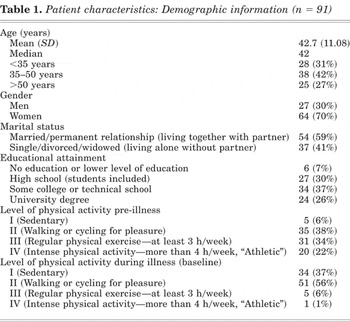
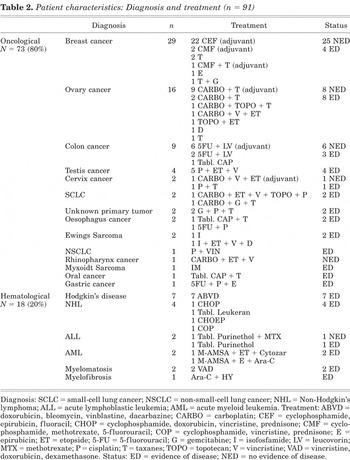
The study included a total of 115 patients enrolled in the intervention between April 2001 and June 2003. Ten patients (9%) dropped out of the study due to work or transportation problems and 5 patients' (4%) data were removed from the data set because their chemotherapy treatments were discontinued prior to completion of the program. Out of the remaining population of 100 patients (adherence rate 78%), 9 patients completed the program but failed to provide postintervention data (referred to as missing), corresponding to a response rate of 91%. These nine persons were not significantly different from the overall population with respect to their preintervention levels of anxiety, F(1,98) = 0.16, p = 0.689, and depression at baseline, F(1,98) = 1.95, p = 0.166. The demographic characteristics of the patients (n = 91) and their diagnoses and treatments are detailed in Tables 1 and 2, respectively. The mean age of the patients was 42.7 years (range 18–65, median age = 42); 70% were female, 59% were married or lived in a permanent relationship, and 63% had (at least) graduated from college or technical school. The sample was heterogeneous in terms of pre-illness activity levels and medical variables. The reported level of physical activity at baseline showed that 37% of the population had sedentary lifestyles. Eighty percent of the sample were oncology patients, of whom 40% were women with breast cancer. All patients were undergoing chemotherapy at the time of the study: 55% received chemotherapy against advanced or dissiminuated disease, whereas 45% received adjuvant treatment. Patients had received 1 to 10 series of treatment (median 3) in 3–4-week intervals. With respect to disease status, 54% of the patients showed evidence of disease indicating remaining or progressive disease (referred to as ED), whereas 46% showed no evidence of disease (referred to as NED).
Patient characteristics: Demographic information (n = 91)

Patient characteristics: Diagnosis and treatment (n = 91)

Prevalence of Anxiety and Depression (HADS Scores at Baseline)
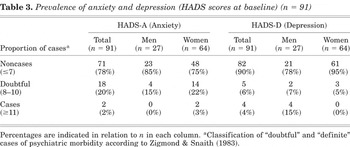
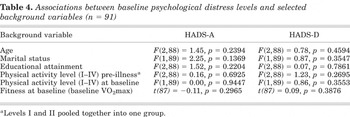
The study attempted to provide a description of the level of psychological distress (anxiety and depression) in the sample and to examine whether these levels were related to differences in gender, age, treatment regime, disease status, self-reported physical activity levels pre-illness and baseline, and baseline fitness (VO2max). The mean score on the HADS-A was 4.8 (SD 2.9) with a range between 0 and 12. The mean score for HADS-D was lower at 3.6 (SD 2.8) with a range between 0 and 11. Using a threshold score of 8, as recommended by Zigmond and Snaith (1983), resulted in 22% of the patients being identified as at least “doubtful” cases for anxiety, and 10% as at least “doubtful” or definite cases suffering from depression. As seen in Table 3, the proportion of patients scoring 8 or higher on the HADS-A was higher among women (25%) than men (15%), whereas the opposite was found to be the case for the HADS-D (5% vs. 22%). At baseline, there was a trend for the female patients to score significantly higher on the HADS-A than the men, F(1,89) = 3.86, p = 0.053. In contrast, the male patients scored significantly higher on the HADS-D at baseline than the women, F(1,89) = 5.37, p = 0.022. With respect to disease status, there was a trend for the patients with evidence of disease to score higher on the HADS-D than patients with no evidence of disease, F(1,89) = 3.55, p = 0.062. Patients in adjuvant treatment showed a significantly lower depression level at baseline, F(1,89) = 4.86, p = 0.031. Further associations between baseline psychological distress levels and selected background variables are listed in Table 4.
Prevalence of anxiety and depression (HADS scores at baseline) (n = 91)

Associations between baseline psychological distress levels and selected background variables (n = 91)

Changes in Anxiety and Depression (HADS)
As illustrated in Table 5, analysis of the data revealed a statistically significant reduction in psychological distress measures over the 6-week intervention period. Paired sample t tests indicated a highly significant decrease in anxiety, t(90) = −4.22, p < 0.001, and a more moderate but still significant decrease in depression, t(90) = −2.06, p = 0.042. The mean ± SD of the change was −1.14 ± 2.91 for the HADS-A and −0.44 ± 2.77 for the HADS-D. Conversely, it is important to note the substantial number of patients showing no change (HADS-A: 16.5%; HADS-D: 23.3%) or an increase in psychological distress (HADS-A: 26.4%; HADS-D: 28.6%).
Changes in anxiety and depression (HADS) (n = 91)

Changes from Pre- to Posttest HADS Ratings in Relation to Background Variables
Age
With respect to age, the sample was divided into three groups of approximately similar size (group 1: <35 years, n = 28; group 2: 35–50 years, n = 39; and group 3: >50, n = 24) to allow score comparisons across different age groups. The result of the one-way analysis of variance between the improvement in anxiety and the age variables (all combined into one model) showed no association between age and improvements in anxiety scores, F(2,88) = 0.29, p = 0.749, and depression score, F(2,88) = 0.22, p = 0.803. Descriptive statistics show that in the group of patients under 35 years of age, 57.1% experienced an improvement in depression level. In the group of patients over 50 years of age, 37.5% experienced a decrease in depression score compared to 41.7% who showed an increase.
Gender
Regarding the patient's gender, it was seen that the women made better progress on the HADS-A than the men, F(1,89) = 2.68, p = 0.105. The women's improvements were in average almost an entire point (0.99) greater than the men. There was no difference in depression level changes between the women and the men, F(1,89) = 0.07, p = 0.792. At week 6, the men were significantly more depressed, F(1,89) = 6.96, p = 0.009, than the women.
Treatment
The patients who were in treatment for residual disease (i.e., not in adjuvant treatment) achieved a greater reduction in anxiety, F(1,89) = 0.35, p = 0.557, and depression F(1,89) = 0.41, p = 0.522, scores, with reaching significant differences.
Disease Status
No significant association was found between ED and NED and change in HADS score. At the end of the intervention (week 6), the patients with evidence of disease (residual disease) were significantly more depressed, F(1,89) = 4.56, p = 0.035, than patients without evidence of disease.
Physical Activity Level
While dividing patients into categories of physically nonactive (n = 33) (i.e., sedentary patients classified at physical activity level 1 in Table 1) and physically active (n = 58) (i.e., physically active patients corresponding to physical activity levels 2–4 in Table 1), it is noted that the physically nonactive patients at baseline reported a significantly greater reduction in anxiety scores from test 1 to test 2, F(1,89) = 4.40, p = 0.038, whereas there is no significant relationship between improvement in depression level and baseline physical activity, F(1,89) = 1.91, p = 0.167. On average, sedentary patients improved their anxiety score by 1.94 (SD = 2.32) whereas physically active patients improved their score by 0.74 (SD = 2.76). On the depression scale, the nonactive patients similarly improved more (mean = 1.06, SD = 2.52) when compared with the physically active patients at baseline (mean = 0.28, SD = 2.63).
Associations between Changes in HAD Scores and Fitness (VO2max)
Eighty-four patients completed both the HADs and the test of fitness. Sixteen patients (out of the original sample size of 100) failed to give both HADS and VO2max posttest data. These patients were not different from the rest of the population with respect to disease status χ2(1) = 1.191, p = 0.275, baseline fitness (VO2max), F(1,96) = 1.05, p = 0.308, baseline HADS-A score, F(1,98) = .01, p = 0.923, or baseline HADS-D level, F(1,98) = 0.61, p = 0.436. The data (n = 84) showed that VO2max significantly increased, t(83) = 7.10, p < 0.001. On average there was an increase of 0.272 l/min, equal to 12%. When we compared the improvement with the continuous improvement in anxiety and depression scores, we found no correlation, HADS-A: t(83) = 0.06, p = 0.951; HADS-D: t(83) = −1.67, p = 0.098. However, as a consequence of having over, respectively, 78% and 91% of the patients in the “noncases” group at baseline, we divided the sample into three groups based on whether the subjects had improved, unchanged, or worsened pre- to posttest levels of anxiety and depression scores. The results of this division show that improvements in VO2max were associated with improvements in depression, χ2(1) = 3.966, p = 0.046, but not with improvements in anxiety, χ2(1) = 0.540, p = 0.462. Figure 1 shows the average rate of improvement in VO2max in relation to observed changes in anxiety and depression levels during the 6-week program. In Figure 1 it can be seen that those patients who had a worsened anxiety and/or depression score also achieved a more conservative improvement in VO2max.

The relationship between changes in fitness (VO2max) and psychological distress (anxiety and depression) (n = 84).
DISCUSSION
The purpose of this prospective study was to examine the outcomes of exercise intervention on self-reported psychological distress in cancer patients undergoing chemotherapy. In support of our hypothesis, the intervention proved beneficial on anxiety and depression. The findings of this prospective, pilot study indicate that participation in structured exercise intervention could have an effect in reducing anxiety and depression in cancer patients with advanced disease undergoing chemotherapy. The HADS baseline scores demonstrated that the population in general reported fairly low levels of distress, and thus did not suffer from major psychosocial distress. Most subjects had anxiety and depression scores near the possible lower limit, statistically causing a low degree of statistic variation (cf. floor effect). This argument is supported by the fact that we found a significant reduction in both anxiety and depression symptoms, most notably among patients who showed significantly elevated symptoms at baseline. However we did obtain significant reductions in both anxiety and depression, across the entire population. We found an average change of −1.14 points in the HADS-A and −0.44 in the HADS-D. However no guideline is available for the HADS in order for us to consider whether these findings could be considered to impose a clinically important difference (CID). Two subjects (both women) at baseline had HADS-A scores above 10. One remained a “clinically significant” case after the six weeks, while the other had decreased her score to 10 and thus moved to the group of “doubtful” or “borderline” cases. Four subjects (all men) were defined as clinically significant cases on the HADS-D at baseline. One increased his score during the 6-week period, and remained a “definite” case, whereas the others achieved postintervention scores below 8, and thereby moved to the category of noncases. The average percentage change equals a reduction of 23.7% on the HADS-A and a reduction of 12.4% on the HADS-D.
Direct comparisons to other studies are difficult because of differences in measurement of psychological distress (e.g., POMS, Beck, Hamilton, etc.), and difference in population (diagnosis and treatment regimes). Also, the physical training used in the current study offered more than exercise (e.g., massage, body awareness training), making it difficult to compare the obtained results with those in studies that offered only exercise training. Despite these limitations, the findings in this study show results similar to, in particular, Burnham and Wilcox (2002), who found that survivors of breast cancer or colon cancer (n = 18) significantly reduced their anxiety level by 15.4% and their depression level by 6.3% (measured on a 100-mm Linear Analogue Self-Assessment scale) during a 10-week low- or moderate-intensity (25–50% of heart rate reserve) supervised aerobic exercise program. In addition, Segar et al. (1998) found a significant decrease (25%) in anxiety (measured with STAI) and a significant decrease (44%) in depression scores (measured with the Beck Depression Inventory) in a study of 24 breast cancer survivors who completed 10 weeks of aerobic exercise following treatment. Both these studies included cancer survivors not undergoing treatment and thereby a less physically burdened population than was included in this study.
A priori, a number of variables were considered that might be correlated with both the prevalence of and the changes in anxiety and depression. An unexpected finding in this study was that men both pre- and postintervention had significantly higher HADS-D scores than the women. This is in conflict with the comprehensive psychiatric literature, which points to a female preponderance in prevalence, incidence, and morbidity risk of depressive disorders (Piccinelli & Wilkinson, 2000; Kuehner, 2003), which also has been found to be true in psychosocial cancer research (Baider et al., 1997; Akechi et al., 1998; Hagedoorn et al., 2000). However this finding could also be explained with reference to the men's relatively more advanced disease status, which has been shown in this study and others (Hotopf et al., 2002; Potash & Breitbart, 2002) to be associated with increased risk of depression. The number of patients with confirmed evidence of disease comprised 70% of the male population (19 out of 27) compared with the women, who showed under half (48%) of those with evidence of disease (31 out of 64). As such, it may not be gender but rather disease status that affected distress levels in the men participating in this study. The women's relatively high anxiety level is in keeping with the prevalence found in other studies. For example, Osborne et al. (2003) found in their study of 731 women with breast cancer a prevalence of “probable” psychological morbidity due to anxiety in 23% of the population, which is comparable with the prevalence found in the current study where 45% (29/64) of the women had breast cancer. The results of this study show that patients who are inactive at baseline experienced a higher improvement in psychological well-being than those patients who were physically active from the start of the intervention. Physical inactivity might be a contributing factor to allow cancer patients undergoing chemotherapy to achieve a positive psychological effect from structured exercise intervention. One explanation could be that patients who are sedentary at baseline, for some time have relinquished well-known pleasures of the body such as assuming a more groomed appearance, increased concentration, and self-esteem (Cramer et al., 1991; Fentem, 1994; Glenister, 1996) as well as socialization linked to physical activity in the community (Stroot, 2001). In this respect it has recently been documented that the absolute amount of exercise since cancer diagnosis is less strongly associated with cancer patients' QOL than changes in physical activity caused by the disease (Blanchard et al., 2003). However, to better understand the association between disease-related changes in physical activity level and psychological distress, other possible mediating factors such as time since diagnosis, time in treatment, and treatment type need to be taken into consideration.
We tested the hypothesis that patients who reported a greater reduction in anxiety and depression could also be characterized with corresponding improvement in objective physiological performance. This association was partially confirmed in the current study. It has been suggested that exercise in general may reduce psychosocial distress by influencing central neuroregulatory mechanisms associated with the pathophysiology of the distress itself (Dunn et al., 2002; Hollenberg et al., 2003). It is possible that the exercise intervention in this study may have resulted in increased brain neurotransmitter activity (e.g., serotonin, dopamine, norepeniphrine); however, it is impossible to isolate this suggestion from other psychological explanations such as a positive distraction from distressing events, a sense of accomplishment and control in completing the exercise, and improved social relations. Future research should consider more specifically the relationship between self-reported psychological well-being and objective physiological changes in a joint effort to discover possible psycho-physiological mechanisms behind the positive outcomes of physical training in cancer patients undergoing treatment.
The study has some limitations. The sample in this study may not be typical and thus representative of all cancer patients in Denmark. Although not confirmed by our study, clinically anxious or depressed people with cancer may not have been likely to participate. The patients were self-referred and therefore might have comprised a special group characterized by exceptionally good psychological and motivational resources for physical training. It may be mentioned however that the percentage of female patients scoring 8 or more on the HADS-A (i.e., doubtful and definite cases) in this study was 25%, which is in accordance with Gronvold et al. (1999) who, in a study of Danish women with breast cancer (n = 462), found an occurrence of doubtful and definite cases at 27.7% on the HADS-A.
Another limitation of the study is the unequal numbers of patients across the different cancer diagnoses, which did not allow for cross-cancer comparisons to be made concerning the psychological respondance to the intervention. Furthermore the study lacked access to valid data on patients' potential use of psychopharmacological drugs, which could help to further explain the prevalence of distress in relation to the effect of the intervention. Finally the study was preliminary and observational and did not include a control group. Hence the study cannot distinguish whether the observed associations hide a causal link or not. It is not possible to discard that the documented changes are coincidental, given that the population in this study was not randomized. A control group is necessary to define the effect of the intervention. The reported changes could at least theoretically be explained by changes over time, which could allow adjustment to illness, changes in disease, and so forth. A randomized study to evaluate the causal effects of structured exercise intervention on psychological distress, cardiovascular fitness, and muscle strength in cancer patients undergoing chemotherapy is presently being carried out.
The results of this study provided evidence that cancer patients (with different diagnoses and at various stages of disease) who participated in structured exercise intervention while concurrently being treated with chemotherapy significantly reduced their levels of anxiety and depression. We found that men and women reported different levels of psychological distress. This gender difference, however, may equally well be associated with the (current) status of the disease. Overall the results of this study indicated that anxiolytic and antidepressant effects could be caused by exercise intervention.
ACKNOWLEDGMENTS
This research was supported through grants from The Danish Cancer Society (Kræftens Bekæmpelse) (grant number PP03027), and The Ministry of Culture Committee on Sports Research (Kulturministeriets Udvalg for Idrætsforskning) (grant number N100110-023).
References
REFERENCES
Adamsen, L.,
Midtgaard, J.,
Andersen, C.,
et al.
(2004).
Transforming the nature of fatigue through exercise: Qualitative
findings from a multidimensional exercise programme in cancer patients
undergoing chemotherapy.
European Journal of Cancer Care,
13,
362–370.Google Scholar
Adamsen, L.,
Midtgaard, J.,
Rorth, M.,
et al.
(2003).
Feasibility, physical capacity, and health benefits of a
multidimensional exercise program for cancer patients undergoing
chemotherapy.
Supportive Care in Cancer,
11,
707–716.Google Scholar
Akechi, T.,
Kugaya, A.,
Okamura, H.,
et al.
(1998).
Predictive factors for psychological distress in ambulatory lung
cancer patients.
Supportive Care in Cancer,
6,
281–286.Google Scholar
Andersen, L.B.
(1995).
A maximal cycle exercise protocol to predict maximal oxygen
uptake.
Scandinavian Journal of Medicine and Science in Sports,
5,
143–146.Google Scholar
Arakawa, S.
(1997).
Relaxation to reduce nausea, vomiting, and anxiety induced by
chemotherapy in Japanese patients.
Cancer Nursing,
20,
342–349.Google Scholar
Aylard, P.R.,
Gooding, J.H.,
McKenna, P.J.,
et al.
(1987).
A validation study of three anxiety and depression self-assessment
scales.
Journal of Psychosomatic Research,
31,
261–268.Google Scholar
Baider, L.,
Perry, S.,
Sison, A.,
et al.
(1997).
The role of psychological variables in a group of melanoma patients:
An Israeli sample.
Psychosomatics,
38,
45–53.Google Scholar
Baum, A. &
Andersen, B.L.
(2001).
Psychosocial Interventions for Cancer.
Washington, DC:
American Psychological Association.
Blanchard, C.M.,
Baker, F.,
Denniston, M.M.,
et al.
(2003).
Is absolute amount or change in exercise more associated with
quality of life in adult cancer survivors?
Preventive Medicine,
37,
389–395.Google Scholar
Blanchard, C.M.,
Courneya, K.S., &
Laing, D.
(2001).
Effects of acute exercise on state anxiety in breast cancer
survivors.
Oncology Nursing Forum,
28,
1617–1621.Google Scholar
Burish, T.G. &
Jenkins, R.A.
(1992).
Effectiveness of biofeedback and relaxation training in reducing the
side effects of cancer chemotherapy.
Health Psychology,
11,
17–23.Google Scholar
Burnham, T.R. &
Wilcox, A.
(2002).
Effects of exercise on physiological and psychological variables in
cancer survivors.
Medicine and Science in Sports and Exercise,
34,
1863–1867.Google Scholar
Camacho, T.C.,
Roberts, R.E.,
Lazarus, N.B.,
et al.
(1991).
Physical activity and depression: Evidence from the Alameda County
Study.
American Journal of Epidemiology,
134,
220–231.Google Scholar
Clark, L.A.,
Watson, D., &
Mineka, S.
(1994).
Temperament, personality, and the mood and anxiety disorders.
Journal of Abnormal Psychology,
103,
103–116.Google Scholar
Courneya, K.S. &
Friedenreich, C.M.
(1997).
Relationship between exercise pattern across the cancer experience
and current quality of life in colorectal cancer survivors.
Journal of Alternative and Complementary Medicine,
3,
215–226.Google Scholar
Courneya, K.S. &
Friedenreich, C.M.
(1999).
Physical exercise and quality of life following cancer diagnosis: A
literature review.
Annals of Behavioral Medicine,
21,
171–179.Google Scholar
Courneya, K.S.,
Keats, M.R., &
Turner, A.R.
(2000).
Physical exercise and quality of life in cancer patients following
high dose chemotherapy and autologous bone marrow transplantation.
Psychooncology,
9,
127–136.Google Scholar
Courneya, K.S.,
Mackey, J.R.,
Bell, G.J.,
et al.
(2003).
Randomized controlled trial of exercise training in postmenopausal
breast cancer survivors: Cardiopulmonary and quality of life
outcomes.
Journal of Clinical Oncology,
21,
1660–1668.Google Scholar
Cramer, S.R.,
Nieman, D.C., &
Lee, J.W.
(1991).
The effects of moderate exercise training on psychological
well-being and mood state in women.
Journal of Psychosomatic Research,
35,
437–449.Google Scholar
Dimeo, F.C.,
Tilmann, M.H.,
Bertz, H.,
et al.
(1997).
Aerobic exercise in the rehabilitation of cancer patients after high
dose chemotherapy and autologous peripheral stem cell
transplantation.
Cancer,
79,
1717–1722.Google Scholar
Dimeo, F.C.,
Stieglitz, R.D.,
Novelli-Fischer, U.,
et al.
(1999).
Effects of physical activity on the fatigue and psychological status
of cancer patients during chemotherapy.
Cancer,
85,
2273–2277.Google Scholar
Dimeo, F.,
Schwartz, S.,
Fietz, T.,
et al.
(2003).
Effects of endurance training on the physical performance of
patients with hematological malignancies during chemotherapy.
Supportive Care in Cancer,
11,
623–628.Google Scholar
Dunbar, M.,
Ford, G.,
Hunt, K.,
et al.
(2000).
A confirmatory factor analysis of the Hospital Anxiety and
Depression scale: Comparing empirically and theoretically derived
structures.
British Journal of Clinical Psychology,
39,
79–94.Google Scholar
Dunn, A.L.,
Trivedi, M.H.,
Kampert, J.B.,
et al.
(2002).
The DOSe study: A clinical trial to examine efficacy and dose
response of exercise as treatment for depression.
Controlled Clinical Trials,
23,
584–603.Google Scholar
Dunn, A.L.,
Trivedi, M.H., &
O'Neal, H.A.
(2001).
Physical activity dose-response effects on outcomes of depression
and anxiety.
Medicine and Science in Sports and Exercise,
33,
S587–S97.Google Scholar
Fentem, P.H.
(1994).
ABC of sports medicine: Benefits of exercise in health and
disease.
British Medical Journal,
308,
1291–1295.Google Scholar
Ferrell-Torry, A.T. &
Glick, O.J.
(1993).
The use of therapeutic massage as a nursing intervention to modify
anxiety and the perception of cancer pain.
Cancer Nursing,
16,
93–101.Google Scholar
Friedenreich, C.M. &
Courneya, K.S.
(1996).
Exercise as rehabilitation for cancer patients.
Clinical Journal of Sport Medicine,
6,
237–244.Google Scholar
Galvão, D.A. &
Newton, R.U.
(2005).
Review of exercise intervention studies in cancer patients.
Journal of Clinical Oncology,
23,
899–909.Google Scholar
Glenister, D.
(1996).
Exercise and mental health: A review.
Journal of the Royal Society of Health,
116,
7–13.Google Scholar
Grimby, G.,
Wilhelmsen, L.,
Bjorntorp, P.,
et al.
(1971).
Habitual physical activity: Aerobic power and blood lipids, plasma
lipoprotein and physical activity: A review. In
Muscle Metabolism during Exercise: Proceedings of a Karolinska
Institutet Symposium held in Stockholm, Sweden, September 6–9,
1970,
Pernow, B. &
Saltin, B. (eds.), pp.
469–481.
New York:
Plenum Press.
Gronvold, M.,
Fayers, P.M.,
Sprangers, M.A.G.,
et al.
(1999).
Anxiety and depression in breast cancer patients at low risk of
recurrence compared with the general population: A valid
comparison?
Journal of Clinical Epidemiology,
52,
523–530.Google Scholar
Hagedoorn, M.,
Buunk, B.P.,
Kuijer, R.G.,
et al.
(2000).
Couples dealing with cancer: Role and gender differences regarding
psychological distress and quality of life.
Psychooncology,
9,
232–242.Google Scholar
Hall, C.R.
(2001).
Imagery in sport and exercise. In
Handbook of Sport Psychology,
Singer, R.N.,
Hausenblas, H.A. &
Janelle, C.M (eds.), pp.
529–550.
New York:
John Wiley & Sons.
Herrmann, C.
(1997).
International experiences with the Hospital Anxiety and Depression
Scale: A review of validation data and clinical results.
Journal of Psychosomatic Research,
42,
17–41.Google Scholar
Hollenberg, M.,
Haight, T., &
Tager, I.B.
(2003).
Depression decreases cardiorespiratory fitness in older
women.
Journal of Clinical Epidemiology,
56,
1111–1117.Google Scholar
Hotopf, M.,
Chidgey, J.,
Addington-Hall, J.,
et al.
(2002).
Depression in advanced disease: A systematic review Part 1:
Prevalence and case finding.
Palliative Medicine,
16,
81–97.Google Scholar
King, A.C.,
Taylor, C.B., &
Haskell, W.L.
(1993).
Effects of differing intensities and formats of 12 months of
exercise training on psychological outcomes in older adults.
Health Psychology,
12,
292–300.Google Scholar
Kolden, G.G.,
Strauman, T.J.,
Ward, A.,
et al.
(2002).
A pilot study of group exercise training (GET) for women with
primary breast cancer: Feasibility and health benefits.
Psychooncology,
11,
447–456.Google Scholar
Kuehner, C.
(2003).
Gender differences in unipolar depression: An update of
epidemiological findings and possible explanations.
Acta Psychiatrica Scandinavic,
108,
163–174.Google Scholar
Lerman, C.,
Rimer, B.,
Blumberg, B.,
et al.
(1990).
Effects of coping style and relaxation on cancer chemotherapy side
effects and emotional responses.
Cancer Nursing,
13,
308–315.Google Scholar
Lyles, J.N.,
Burish, T.G.,
Krozely, M.G.,
et al.
(1982).
Efficacy of relaxation training and guided imagery in reducing the
aversiveness of cancer chemotherapy.
Journal of Consulting and Clinical Psychology,
50,
509–524.Google Scholar
MacVicar, M.G.,
Winningham, M.L., &
Nickel, J.L.
(1989).
Effects of aerobic interval training on cancer patients'
functional capacity.
Nursing Research,
38,
348–351.Google Scholar
Martinsen, E.W.
(1990).
Benefits of exercise for the treatment of depression.
Sports Medicine,
9,
380–389.Google Scholar
Morgan, W.P. &
Goldston, S.E. (eds.).
(1987).
Exercise and Mental Health.
London:
Hemisphere Publishing.
Oldervoll, L.M.,
Kaasa, S.,
Knobel, H.,
et al.
(2003).
Exercise reduces fatigue in chronic fatigued Hodgkins disease
survivors: Results from a pilot study.
European Journal of Cancer,
39,
57–63.Google Scholar
Osborne, R.H.,
Elsworth, G.R., &
Hopper, J.L.
(2003).
Age-specific norms and determinants of anxiety and depression in 731
women with breast cancer recruited through a population-based cancer
registry.
European Journal of Cancer,
39,
755–762.Google Scholar
Ossip-Klein, D.J.,
Doyne, E.J.,
Bowman, E.J.,
et al.
(1989).
Effects of running or weight-lifting on self-confidence in
clinically depressed women.
Journal of Consulting and Clinical Psychology,
57,
158–161.Google Scholar
Paffenbarger, R.S.,
Lee, I.-M., &
Leung, R.W.
(1994).
Physical activity and personal characteristics associated with
depression and suicide in American college men.
Acta Psychiatrica Scandinavica Supplement,
377,
16–22.Google Scholar
Pensgaard, A.M. &
Ursin, H.
(1998).
Stress, control, and coping in elite athletes.
Scandinavian Journal of Medicine and Science in Sports,
8,
183–189.Google Scholar
Petruzzello, S.J.,
Landers, D.M.,
Hatfield, B.D.,
et al.
(1991).
A meta-analysis on the anxiety-reducing effects of acute and chronic
exercise: Outcomes and mechanisms.
Sports Medicine,
11,
43–82.Google Scholar
Piccinelli, M. &
Wilkinson, G.
(2000).
Gender differences in depression: Critical review.
British Journal of Psychiatry,
177,
486–492.Google Scholar
Pinto, B.M.,
Eakin, E., &
Maruyama, N.C.
(2000).
Health behavior changes after a cancer diagnosis: What do we know
and where do we go from here?
Annals of Behavioral Medicine,
22,
38–52.Google Scholar
Potash, M. &
Breitbart, W.
(2002).
Affective disorders in advanced cancer.
Hematology/Oncology Clinics of North America,
16,
671–700.Google Scholar
Sabo, C.E. &
Michael, S.R.
(1996).
The influence of personal message with music on anxiety and side
effects associated with chemotherapy.
Cancer Nursing,
19,
283–289.Google Scholar
Saltin, B. &
Grimby, G.
(1968).
Physiological analysis of middle-aged and old former athletes:
Comparison with still active athletes of the same ages.
Circulation,
38,
1104–1115.Google Scholar
Schwartz, A.L.
(1998).
Patterns of exercise and fatigue in physically active cancer
survivors.
Oncology Nursing Forum,
25,
485–491.Google Scholar
Schwartz, A.L.
(1999).
Fatigue mediates the effects of exercise on quality of life.
Quality of Life Research,
8,
529–538.Google Scholar
Segal, R.,
Evans, W.,
Johnson, D.,
et al.
(2001).
Structured exercise improves physical functioning in women with
stages I and II breast cancer: Results of a randomized controlled
trial.
Journal of Clinical Oncology,
19,
657–665.Google Scholar
Segal, R.J.,
Reid, R.D.,
Courneya, K.S.,
et al.
(2003).
Resistance exercise in men receiving androgen deprivation therapy
for prostate cancer.
Journal of Clinical Oncology,
21,
1653–1659.Google Scholar
Segar, M.L.,
Katch, V.L.,
Roth, R.S.,
et al.
(1998).
The effect of aerobic exercise on self-esteem and depressive and
anxiety symptoms among breast cancer survivors.
Oncology Nursing Forum,
25,
107–113.Google Scholar
Smith, A.B.,
Selby, P.J.,
Velikova, G.,
et al.
(2002).
Factor analysis of the Hospital Anxiety and Depression Scale from a
large cancer population.
Psychology and Psychotherapy,
75,
165–176.Google Scholar
Snaith, P.
(1992).
Anhedonia: Exclusion from the pleasure dome.
British Medical Journal,
305,
134.Google Scholar
Stricker, C.T.,
Drake, D.,
Hoyer, K.A.,
et al.
(2004).
Evidence-based practice for fatigue management in adults with
cancer: Exercise as an intervention.
Oncology Nursing Forum,
17,
963–976Google Scholar
Stroot, S.A.
(2001).
Socialisation and participation in sport. In
The Sociology of Sport and Physical Education: An Introductory
Reader,
Laker, A. (ed.), pp.
129–147.
London:
Routledge.
Winningham, M.L. &
MacVicar, M.G.
(1988).
The effect of aerobic exercise on patient reports of nausea.
Oncology Nursing Forum,
15,
447–450.Google Scholar
Winningham, M.L.,
MacVicar, M.G.,
Bondoc, M.,
et al.
(1989).
Effect of aerobic exercise on body weight and composition in
patients with breast cancer on adjuvant chemotherapy.
Oncology Nursing Forum,
16,
683–689.Google Scholar
Wright, S.,
Courtney, U., &
Crowther, D.
(2002).
A quantitative and qualitative pilot study of the perceived benefits
of autogenic training for a group of people with cancer.
European Journal of Cancer Care,
11,
122–130.Google Scholar
Young-McCaughan, S.,
Mays, M.Z.,
Arzola, S.M.,
et al.
(2003).
Research and commentary: Change in exercise tolerance, activity and
sleep patterns, and quality of life in patients with cancer participating
in a structured exercise program.
Oncology Nursing Forum,
30,
441–454.Google Scholar
Zigmond, A.S. &
Snaith, R.P.
(1983).
The hospital anxiety and depression scale.
Acta Psychiatrica Scandinavica,
67,
361–370.Google Scholar
Patient characteristics: Demographic information (n = 91)
Patient characteristics: Diagnosis and treatment (n = 91)
Prevalence of anxiety and depression (HADS scores at baseline) (n = 91)
Associations between baseline psychological distress levels and selected background variables (n = 91)
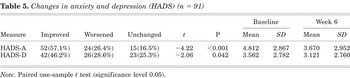
Changes in anxiety and depression (HADS) (n = 91)

The relationship between changes in fitness (VO2max) and psychological distress (anxiety and depression) (n = 84).
 You have
Access
- 30
- Cited by