Introduction
Research on the loess–paleosol series (LPS) of the Afghan-Tajik depression, initiated in the 1970s, focused on regional stratigraphy development (Lazarenko et al., Reference Lazarenko, Pakhomov, Pen'kov, Shelkoplyas, Giterman, Minina and Ranov1977). Significant discovery of stone artifacts during geological studies was spearheaded by Ranov (Ranov, Reference Ranov1995; Ranov and Schäfer, Reference Ranov and Schäfer2000), which spurred extensive archaeological research. Among Tajik LPS, the Obi-Mazar section is notably rich in artifacts (Schäfer et al., Reference Schäfer, Sosin and Ranov1996; Schäfer and Sosin, Reference Schäfer and Sosin2013). Research expanded to include stratigraphy, age, and properties of LPS sections (Lomov et al., Reference Lomov, Sosin and Sosnovskaya1982; Bronger et al., Reference Bronger, Bruhn-Lobin, Heinkele, Ringrose-Voase and Humphreys1993, Reference Bronger, Winter and Heinkele1998a, Reference Bronger, Winter and Sedovb; Dodonov and Baiguzina, Reference Dodonov and Baiguzina1995; Dodonov, Reference Dodonov2002), leading to a stratigraphic scheme based on thermoluminescence dating (Dodonov and Pen'kov, Reference Dodonov and Pen'kov1977; Schäfer et al., Reference Schäfer, Sosin and Ranov1996), which was correlated with the oxygen isotope curve (Shackleton et al., Reference Shackleton, An, Dodonov, Gavin, Kukla, Ranov and Zhou1995) and Chinese Loess Plateau sections (Ding et al., Reference Ding, Ranov, Yang, Finaev, Han and Wang2002). The Darai-Kalon section is now the most thoroughly studied geologically and paleopedologically (Frechen and Boergnik, Reference Frechen and Boergnik1997; Frechen and Dodonov, Reference Frechen and Dodonov1998; Dodonov et al., Reference Dodonov, Shackleton, Zhou, Lomov and Finaev1999).
Loesses in this region are aeolian, sourced from the Karakum and Kyzylkum deserts (Yang et al., Reference Yang, Ding and Ding2006), and were deposited even during warm Pleistocene stages (Ranov and Schäfer, Reference Ranov and Schäfer2000; Dodonov, Reference Dodonov2002). The Quaternary paleoclimate of southern Tajikistan was largely influenced by global orbital-scale climate patterns (Parviz et al., Reference Parviz, Shen, Yunus and Zulqarnain2020). The stage of loess formation corresponding to the glacial stage in the piedmont took place in an arid and sharply continental climate (Dodonov et al., Reference Dodonov, Shackleton, Zhou, Lomov and Finaev1999).
Paleosols from the middle to late Pleistocene indicate warm, humid intervals (Dodonov and Baiguzina, Reference Dodonov and Baiguzina1995), forming complex, vertically extended profiles due to rapid loess accumulation (Lomov et al., Reference Lomov, Sosin and Sosnovskaya1982). Challenges arise in horizon identification and paleosol classification due to their polygenetic nature (Lomov, Reference Lomov and Dodonov1980; Bronger et al., Reference Bronger, Winter, Derevjanko and Aldag1995; Dodonov et al., Reference Dodonov, Shackleton, Zhou, Lomov and Finaev1999). Modern classifications are based primarily on Holocene soils with known soil-forming processes. Some researchers therefore describe soil genesis based on climatic stages rather than genetic horizons. Soil formation during the interglacial occurred in three climatic phases: “initial”, which was during the transition from glacial to interglacial with desert–steppe landscapes; “optimal”, which was during the wettest and warmest period with development of forest vegetation; and “final”, which was during gradual aridization with steppe and desert–steppe landscapes (Lomov and Sosin, Reference Lomov and Sosin1976; Veklich, Reference Veklich1979; Lomov, Reference Lomov and Dodonov1980). The precipitation amount in the “optimal” phase was close to the current level (Pakhomov, Reference Pakhomov1991).
The study of LPS and their implications for paleoenvironmental reconstruction in Tajikistan gained attention in the late twentieth century (Bronger et al., Reference Bronger, Bruhn-Lobin, Heinkele, Ringrose-Voase and Humphreys1993; Lomov et al., Reference Lomov, Tursina and Zhou1996; Mestdagh et al., Reference Mestdagh, Haesaerts, Dodonov and Hus1999; Bronger and Smolíková, Reference Bronger and Smolíková2019). These and earlier investigations offered only a broad overview of the climatic signals found in the complete LPS of South Tajikistan (Lomov and Sosin, Reference Lomov and Sosin1976; Lomov et al., Reference Lomov, Sosin and Sosnovskaya1982; Schäfer et al., Reference Schäfer, Ranov and Sosin1998). The present study aims to identify soil-formation processes during the last two interglacial periods, associated with the first and second pedocomplexes (PC) and oxygen isotope stages 5 and 7, respectively (Frechen and Dodonov, Reference Frechen and Dodonov1998), focusing on microfeatures and chemical compositions of paleosols. This research provides insights into Pleistocene human settlement conditions in Central Asia, with cultural horizons typically associated with buried soils (Ranov, Reference Ranov1995; Khudzhageldiev, Reference Khudzhageldiev2007; Kurbanov et al., Reference Kurbanov, Anoykin, Filimonova, Karaev, Meshcheryakova, Kulakova, Filatov, Chistyakov and Sharipov2022).
Study area
The Khovaling Loess Plateau, located in the northern Afghan-Tajik depression between the Hindu Kush, Pamir, and Gissar-Alai mountain systems (Fig. 1A), features extensive loess cover with thicknesses reaching 150–200 m, distributed across piedmonts and river terraces at altitudes of 300–2500 m (Dodonov and Pen'kov, Reference Dodonov and Pen'kov1977; Lomov and Ranov, Reference Lomov, Ranov, Agrawal, Kusumgar and Krishnamurthy1985; Dodonov, Reference Dodonov2002). The region's paleoclimate alternated between warm, humid interglacials and dry, cold glacials. Currently, Obi-Mazar experiences average annual temperatures of 11–13°C and precipitation of 800–1000 mm (Mestdagh et al., Reference Mestdagh, Haesaerts, Dodonov and Hus1999; Yang and Ding, Reference Yang and Ding2006), with 70% occurring from January to May, peaking in March and April (Häggi et al., Reference Häggi, Eglinton, Zech, Sosin and Zech2019). This climate supports a xeric soil-moisture regime (Soil Survey Staff, 2022) or dry subtropic conditions (Gerasimov and Glazovskaya, Reference Gerasimov and Glazovskaya1960). The Plateau is located in the northern subzone of the subtropical zone in the middle of Eurasia and the temperature is constantly mesic. The ratio of evaporation to precipitation is 1:3 (Scientific and Applied Handbook on the Climate of the USSR, 1988). Dust storms are frequent during the dry summer, driven by westerly winds carrying aeolian dust from Central Asian deserts, settling upon reaching the Pamir Plateau (Dodonov and Baiguzina, Reference Dodonov and Baiguzina1995).
(A) Study area in the Afghan-Tajik depression. The red dot shows the location of the Obi-Mazar section. (B) General view of the outcrop and section of the Obi-Mazar. Yellow lines show the levels of occurrence of six identified pedocomplexes (PC); blue arrow shows flow direction of the Obi-Mazar River.

Natural vegetation near the Obi-Mazar section includes mixed open conifer and broad-leaf forests with open meadows, which are often utilized for farming and grazing. Vegetation includes broad-leaf genera such as Crataegus, Ziziphus, Acer, Ulmus, Populus, and Rosa, and the coniferous Juniperus. Herbaceous genera found in this region are Agropyron, Achillea, Malva, Hypericum, Melilotus, Origanum, Salvia, Cousinia, Prangos, and Ferula (Dodonov et al., Reference Dodonov, Sadchikova, Sedov, Simakova and Zhou2006; Häggi et al., Reference Häggi, Eglinton, Zech, Sosin and Zech2019).
The region's soil types, ordered by increasing precipitation levels, are Regosols, Cambisols, Calcisols, and Kastanozems, as per the World Reference Base for Soil Resources (IUSS Working Group WRB, 2022). Kastanozems, found under natural vegetation or minimally disturbed areas, degrade to Cambisols and Regosols on overgrazed or intensively plowed slopes (Dodonov et al., Reference Dodonov, Sadchikova, Sedov, Simakova and Zhou2006; Khormali et al., Reference Khormali, Valizadeh, Talebi, Tokareva, Schnider, Tazikeh, Sosin, Kurbanov, Buylaert and Murray2024).
Study section
The Obi-Mazar section (38°17′52.1″N, 69°53′01.6″E; 1300 m asl) is situated opposite the village of Lakhuti on the northwestern bank of the Obi-Mazar River in the Khovaling region of southern Tajikistan. The bank features a 150-meter-high outcrop composed of subaerial deposits approximately 80 meters thick, underlain by pebbly, sandy, and clayey alluvium (Fig. 1B). The LPS in the Obi-Mazar section comprises six pedocomplexes (Schäfer et al., Reference Schäfer, Ranov and Sosin1998; Dodonov, Reference Dodonov2002). The loess units were deposited under cold and arid conditions (glacials), while the paleosols developed during warm and humid periods (interglacials) (Bronger et al., Reference Bronger, Winter, Derevjanko and Aldag1995; Dodonov and Baiguzina, Reference Dodonov and Baiguzina1995). Our study focused on the upper 35 meters of the section, examining PC1, PC2, and the loess units separating them. Thermoluminescence (TL) dating suggests that PC1 of the Khovaling Loess Plateau dates to approximately 71–127 ka, and PC2 dates to approximately 186–242 ka (Frechen and Dodonov, Reference Frechen and Dodonov1998).
Methods
The Obi-Mazar section extends 35 m from the current surface, featuring a steep cliff (Fig. 2B), which complicates the study of its most complete and uneroded LPS at the center. To address this, three trenches were established: the uppermost for the Holocene section, the middle for maximum coverage of loess 1 (L1), and the lowest for examining paleosols PC1 and PC2.
(A) Correlation of stratigraphic schemes of the Darai Kalon (modified after Dodonov et al., Reference Dodonov, Sadchikova, Sedov, Simakova and Zhou2006) and Obi-Mazar sections with an optimized scheme of lettered marine isotope substages (Railsback et al., Reference Railsback, Brook, Ellwood, Liang, Cheng and Edwards2015a, Reference Railsback, Gibbard, Head, Voarintsoa and Toucanneb). Thermoluminescence dating of the Darai Kalon section was carried out by Frechen and Dodonov, Reference Frechen and Dodonov1998. VPDB = Vienna Peedee Belemnite; vertical scale in meters; gray-shaded bands show correlation intervals of the MIS scale with stratigraphic units; (B) stratigraphic scheme of the upper part of the Obi-Mazar section discussed in this paper. (C) General view of the Obi-Mazar outcrop (based on materials from Schäfer and Sosin, Reference Schäfer and Sosin2013); orange stripes indicate pedocomplexes; black rectangle indicates studied part of the loess–paleosol series deposits. (D–G) Macrophotographs of soil features: (D) calcite pseudomycelia, L1; (E) calcite pseudomycelia and organic-mineral coatings along the root channels, 2ABwk, PC1; (F) buried biolith capsules of invertebrate fauna with dense calcite rims, 2BAk, PC1; (G) carbonate rhizoliths and high biogenic porosity, 3Bk, PC1.

Fieldwork involved preparing vertical walls in each trench, subdividing them into small sections or “pickets,” numbered top to bottom. Heights between adjacent pickets were measured using a water level, ensuring the trenches were positioned on stable loess and paleosols that were unaffected by landslides. Detailed lithological descriptions and macro-morphological characteristics of the deposits were recorded in the trenches. The horizon indices are given according to IUSS Working Group WRB (2022).
Field magnetic susceptibility (FMS) was measured throughout the section every 3 cm using a portable kappameter PIMV. In the laboratory, soil colors were determined using the Munsell color chart for dry samples from each soil horizon (Munsell Color, 2000).
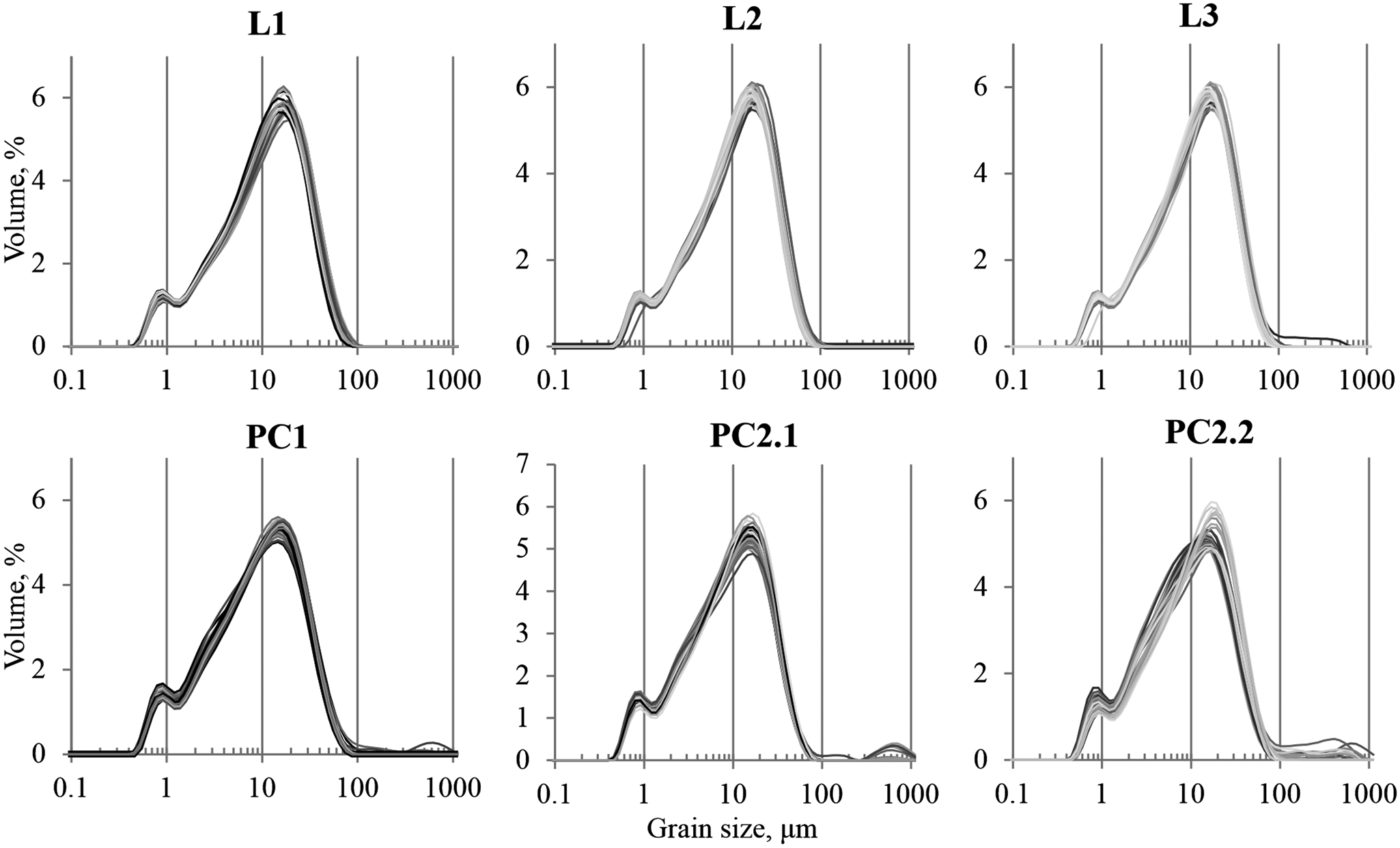
For grain-size analysis, samples were taken at vertical intervals of every 2 cm for the entire thickness of the section. Sample preparation included grinding the material, sequential removal of carbonates (using 10% HCl) and organic matter (using 30% H2O2), and peptization (using 4% Na₄P₂O₇) (Varga et al., Reference Varga, Újvári and Kovács2019). The grain sizes of all samples were measured using a Malvern Mastersizer 2000 laser diffraction particle-size analyzer in the Environmental Paleoarchives laboratory of the Institute of Geography of the Russian Academy of Sciences (Moscow). The sample was introduced into the HydroEV disperser unit and sonicated at 70% power for 100 seconds. Subsequently, seven repeated measurements were conducted after the ultrasonic unit was turned off, and the results were averaged using the Mastersizer v.3.62 Application. Particle size was calculated using the Mie theory, with refractive index values of n = 1.33 for the dispersant, n = 1.55 for the particles, and an absorption coefficient of k = 0.1 (Özer et al., Reference Özer, Orhan and Işik2010). The following particle-size fractions were identified: clay ≤ 2 μm; fine silt > 2–6.3 μm; medium silt > 6.3–20 μm; coarse silt > 20–63 μm; fine sand > 63–200 μm; medium sand > 200–630 μm; coarse sand > 630–2000 μm; gravel >2000 μm, according to the international scale ISO 14688-1:2017. Measurements of 40 randomly selected samples from each unit (L1, PC1, L2, PC2, L3) were used to construct grain-size distribution curves, showing the volume of particles (%) of a certain size (μm). Base statistical parameters (arithmetic mean, median, mode, and skewness) for particle sizes were calculated. The U-ratio index (ratio between the 16–44 μm and 5.5–16 μm fractions), which reflects the strength of the wind during sedimentation (Vandenberghe et al., Reference Vandenberghe, Zhisheng, Nugteren, Huayu and Van Huissteden1997) was calculated. The grain-size index (GSI; ratio between the 20–50 and < 20 μm fractions) was also calculated as an index of the cyclicity of wind intensity, as well as the combined influence of wind and precipitation regime (Rousseau et al., Reference Rousseau, Antoine, Hatté, Lang, Zöller, Fontugne and Othman2002).
Loose samples were taken from the middle part of each genetic paleosol horizon and separate morphologically distinct layers of PC1, L2, PC2, and L3 for analysis of chemical composition, as well as samples with an undisturbed structure for micromorphological studies. For the bulk chemical analysis, samples were sieved through a 1-mm sieve and measured for the content of macro- and microelements using energy-dispersive X-ray fluorescence methods in the Department of Chemistry and Physical Chemistry of Soils of the V.V. Dokuchaev Soil Science Institute. The contents of the elements are calculated for a non-calcined sample. The organic-carbon content was measured by Tyurin's method (Vorob'eva, Reference Vorob'eva1998) without preliminary removal of carbonates. The method is based on the oxidation of soil organic matter with chromic acid to form carbon dioxide and back titration with ferrous ammonium sulfate. The analysis was carried out in the Laboratory of the Institute of Water Problems, Hydropower and Ecology NAST (Dushanbe).
Micromorphological properties were studied in thin sections of 4 × 5 cm in size, made in the laboratory of mineralogy and micromorphology of soils of the V.V. Dokuchaev Soil Science Institute (patent 2728926). The description of thin sections was carried out according to international guidelines (Stoops, Reference Stoops2021) using an Olympus BX51 polarizing microscope with an Olympus DP26 digital camera. Soil processes were reconstructed based on neoformation types in the paleosol horizons (Fig. 5).
Results
Stratigraphy and lithology
Generalized stratigraphic characteristics of the loess–paleosol series in the upper part of the Obi-Mazar are detailed in Supplementary Table 1. The entire sequence is affected by pedogenic processes to some extent. Boundaries between the layers and/or horizons are smooth and gradual. Paleosols and pedocomplexes are numbered from top to bottom. Horizons within each pedocomplex are numbered sequentially from top to bottom, such as 1ABk for the first soil and 2BAk for the second. Six units were identified from top to bottom in the stratigraphy of the upper part of the Obi-Mazar (Fig. 2B).
Unit 1 (HS) 0–0.38 m
Unit 1 (HS) is a Holocene soil classified as a Regosol (IUSS Working Group WRB, 2022) that is greatly eroded due to its location on a slope, active plowing in Soviet times, and its current use for grazing. The properties of the modern soil were not considered in this study.
Unit 2 (L1) 0.38–12.85 m
Unit 2 (L1) is calcareous loess with a characteristic vertical wall and weak pedogenic features. The loess consists of light yellowish brown (10 YR 6/4d; Munsell Color, 2000) structureless, silt loam texture, compacted aleurite with a small number of fine pores. There are five loess layers (L1.1–L1.5) with varying degrees of biological development in the structure of the unit.
Unit 3 (PC1) 12.85–16.1 m
Unit 3 (PC1) is a welded pedocomplex of light brown silt loam, weakly structured, that predominantly contains CaCO3 concretions. Three paleosols (PC1.1, PC1.2, PC1.3) were distinguished in Unit 3 (PC1).
Unit 4 (L2) 16.1–18.68 m
Unit 4 (L2) is a calcareous pale-yellow loess, silt loam, slightly porous, structureless, with CaCO3 concretions. Two layers (L2.1 and L2.2) are distinguished.
Unit 5 (PC2) 18.68–26.15 m
Unit 5 (PC2) is a compound polygenetic pedocomplex that is light brown to dark brown, from silt loam to silty clay loam, with CaCO3 concretions and biolith capsules. Unit 5 contains two paleosols, PC2.1 and PC2.2, and two sublayers consisting of loess between them.
Unit 6 (L3) 26.15–34.86 m
Unit 6 is calcareous loess. Its main properties are similar to Unit 4 (L2). There are seven layers (L3.1–L3.7) distinguished by neoformations.
The noted biolith capsules are chambers formed as a result of the vital activity of beetles of the family Tenebrionidae and subfamily Melolonthinae. They are found predominantly in Calcisols under an arid climate and form pupal chambers at depths of 0.3–1 m and in paleosols can record a period of relative stability of the land surface (Mestdagh et al., Reference Mestdagh, Haesaerts, Dodonov and Hus1999). Their larvae for pupation form nests with a compacted calcareous wall. During burial, the capsules are filled with surrounding soil material (Valiakhmedov, Reference Valiakhmedov1977). Biolith capsules form round or ellipsoidal patterns in the layer. They are not lithified and consist of dense, compacted parent material having sometimes compacted carbonate rims (Dodonov and Lomov, Reference Dodonov, Lomov, Agrawal, Kusumgar and Krishnamurthy1985; Lomov and Ranov, Reference Lomov, Ranov, Agrawal, Kusumgar and Krishnamurthy1985).
Micromorphological properties
Micromorphological properties across all units show a porphyric distribution pattern (Stoops, Reference Stoops2021), predominantly featuring the silt fraction and rare scattered sand grains. Loess typically displays a massive microstructure with primary calcite grains. The groundmass is characterized by varying degrees of micritic impregnation and significant biogenic processing, along with a low content of amorphous organic-mineral clots. The latter are organic colloids associated with colloidal Si, Al, and/or Fe compounds. Rounded, usually calcified excrements are found in the pores of all layers and horizons. The mineral compositions include quartz, feldspars, dark-colored minerals, including hematite, as well as micas and their weathered forms.
In layer L1.5, typical loess characteristics such as high porosity, abundance of silt material, and significant calcite impregnation are evident. Pedogenic features are minimal, including calcite redistribution (Fig. 3A), moderate content of organic-mineral clots near the pores, remains of rhizoliths, and signs of biological processing including excrements from invertebrate pedofauna and mollusk shell fragments. The groundmass here contains coarse calcite grains (Supplementary Table 1).
Microfeatures of the PC1 horizons, units L1 and L2 in the upper part of the Obi-Mazar section. XPL = cross-polarized light; PPL = plane-polarized light; GM = groundmass. (А) Calcite hypocoatings next to a pore with GM infill, L1.5, XPL; (B) clusters of calcite grains, 1ABk, XPL; (C) granular microstructure, silt coatings and infillings, and calcite coatings, 1BAk, PPL; (D) calcite grains, micritic-silt coatings and infillings, calcite hypocoatings, 2ABwk, XPL; (E) silt infillings, deep calcite hypocoatings, highly decalcified groundmass with speckled b-fabric, 2BAk, XPL; (F) calcareous excrement in pores and carbonate micronodules, 3ABk, XPL; (G) rounded humified aggregate inherited from a humus horizon, thin calcite coatings, 3Bk, XPL; (H) large porous calcite infilling и Fe-clots inside, 3BCwk, PPL; (I) silt crescent infilling, 3BCwk, PPL; (J) biogenic channels, micritic calcite coatings, organic-mineral clots, excrement, L2.2, PPL.

Paleosol PC1.1
Paleosol PC1.1 features horizons 1ABk–1BAk, with subtle pedogenic signs at the macroscopic level (Supplementary Table 1). At the microscopic level, pedogenesis is more evident. The 1ABk horizon is characterized by humus impregnation, a mostly granular coprogenic microstructure, and various coatings including calcite and Fe–Mn accumulations. The clusters of calcite grains are likely inherited from the loess (Fig. 3B). The underlying 1BAk horizon exhibits a channel microstructure with some granular microzones (Fig. 3C), few organic-mineral clots, and hypocoatings. Horizon 1BAk is extensively reworked by biota and includes clay–humus non-calcified aggregates. Unlike 1ABk, horizon 1BAk has stronger micritic impregnation, but lacks calcite grains and Fe–Mn hypocoatings and nodules.
Paleosol PC1.2
Paleosol PC1.2, comprising horizons 2ABwk–2Bkm–2BAk, exhibits more calcified residual zones, weakly calcified humus–clayey, multilayered calcite–humus–silty coatings (Fig. 3D) and infillings (Fig. 3E) than PC1.1. Paleosol PC1.2 shows an increased content of calcite grain clusters, with clay coatings noted in 2ABwk and multilayer coatings observed in 2BAk (silty coating over carbonate).
Paleosol PC1.3
With a profile of 3ABk–3Bk–3BCwk, Paleosol PC1.3 is saturated with small carbonate threads but lacks biolith capsules at the macroscopic level. It features acicular calcite (lublinite) coatings, with 3ABk showing humus impregnation and diverse calcite neoformations (e.g., coatings, hypocoatings, and nodules) (Fig. 3F). Horizons 3Bk and 3BCwk contain silty coatings, Fe–Mn nodules and hypocoatings, and non-calcified aggregates (Fig. 3G). Horizon 3BCwk has fragmentary clay coatings and silt-crescent infilling formed by earthworms or other invertebrates (Kooistra and Pulleman, Reference Kooistra, Pulleman, Stoops, Marcelino and Mees2018) (Fig. 3I). In addition, large infillings of highly calcified material with Fe nodules occur (Fig. 3H).
Layer L2.1 has clay–humus aggregates, like in the 3ABk horizon, and lots of excrement (Fig. 3J). Layer L2.2 is characterized by weak calcite impregnation. Clusters of calcite grains with destroyed boundaries and single-crystal gypsum leaching pores in the groundmass were observed.
Paleosol PC2.1
Paleosol PC2.1 has a profile 1BCk–1ABk –1ABwk–1Bwk–1Bkm–1Bk. Horizon 1BCk has a finer porous structure than L2. It contains rare calcite coatings, excrement, organic-mineral material (Fig. 4A), and gypsum leaching pores. Horizon 1ABk has a channel microstructure and non-calcified, weakly clayey groundmass with stipple-speckled and porostriated b-fabric. All pores have thin calcite coatings that grade into hypocoatings. Coatings of complex composition and structure (Fig. 4B) and many carbonate coatings consisting of calcified excrement and plant remains were observed. Horizon 1ABwk is characterized by an angular–blocky microstructure, significant humus content, clay, and dark-colored minerals. There are a large number of orthic aggregate Mn-hydroxide nodules and impregnated dendritic Fe-Mn-hydroxide nodules (Fig. 4C). Horizon 1ABwk also has clay–humus aggregates with diffuse (already assimilated) and sharp boundaries, a huge amount of calcified excrement, and sparite grains (Fig. 6). Horizon 1Bwk has a dense near-pore micritic impregnation and a lots of calcite features. The gypsum-depleted pores form a loosened zone up to about 1 cm wide with characteristic edges for gypsum crystals (Fig. 4D). Horizon 1Bk is located under the calcic cemented horizon (carbonate crust) and has many infillings of calcareous excrement (Fig. 4E).
Microfeatures of the PC2 horizons and L3 in the upper part of the Obi-Mazar section. XPL = cross-polarized light; PPL = plane-polarized light, GM = groundmass. (А) Humus-mineral hypocoating and aggregate in a pore, 1BCk, PC2.1, PPL; (B) multilayer silt-calcite coatings with calcite hypocoating, 1ABk, PC2.1, XPL; (C) dendritic Mn-hydroxide nodule, carbonized excrement, 1ABwk, PC2.1, PPL; (D) gypsum leaching pores from water flow, 1Bwk, PPL; (E) intense calcite impregnation of GM, infilling of calcareous excrement covered by acicular calcite, 1Bk, XPL; (F) gypsum leaching pores, dendritic Mn-organic nodule, lots of excrement, Ck1 in PC2.1, PPL; (G) shells, calcite hypocoatings, 2BAk, XPL; (H) groundmass saturated by Fe and clay, orthic aggregate Mn-hydroxide nodule, 2BAwk, XPL; (I) silt infilling and excrement with micritic impregnation, 2Bk, XPL; (J) Mn-organic hypocoating, weathered mica, L3.1, PPL.

Degrees of occurrence of microfeatures in the studied paleosol horizons and loess layers of the Obi-Mazar section. The width of the column in the scheme reflects the frequency of occurrence of a genetic microfeature for each horizon. Imp. = impregnation; Coat. = coatings; Hypocoat. = hypocoatings; Inf. = infillings; GM = groundmass. Shaded areas indicate a mixture of two features.

Degrees of occurrence of gypsum and calcite microfeatures in the studied paleosol horizons and loess layers of the Obi-Mazar section. The width of the column in the scheme reflects the frequency of occurrence of a genetic microfeature for each horizon. Impreg. = impregnation. Coat. = coatings; Hypocoat. = hypocoatings. In the column for micritic impregnation, 4 degrees of impregnation are distinguished: from white (crystallite), to black (the most leached).

Loess (Ck) in PC2.1 separating the two paleosols shows evidence of high biogenic reworking and has many carbonate microfeatures. Calcite forms very thick hypocoatings and micritic and cytomorphic microsparite coatings. The gypsum-depleted pores (Fig. 4F) are twinned crystals and have the appearance of water intrusion. Currently, these pores have calcite hypocoatings. An increase in the content of dendritic Mn-organic nodules and hypocoatings predominantly associated with calcite hypocoatings was observed.
Paleosol PC2.2
Paleosol PC2.2 has a profile 2BAk–2BAwk–2Bkm–2Bk. Horizon 2BAk has calcite impregnation and various neoformations, shells (Fig. 4G), plant remains, humus zones, and hypocoatings. Horizon 2BAwk is a well-developed horizon because of dense reddish groundmass saturated with Fe and clay (Fig. 4H). The groundmass has an angular blocky structure and stipple-speckled b-fabric. Horizon 2Bk beneath the carbonate crust contains carbonized groundmass rich in clay and dark minerals, with extensive micritic hypocoatings (Fig. 4I) and larger calcite crystals.
Loess L3 is distinguished by high content of clay and dark-colored minerals. Microzonal calcite impregnation is noted, the pores have thick calcite hypocoatings and coatings. Layer L3.1 has signs of low biological activity including organic-mineral clots (Fig. 4J), destroyed excrement, and migration of carbonates. Mn-organic clots away from the pores are found in the groundmass. Layer L3.2 contains shells, organic-mineral hypocoatings, Mn-organic dendrites, single dense calcite micronodules, and clusters of calcite grains in the groundmass.
Grain-size composition
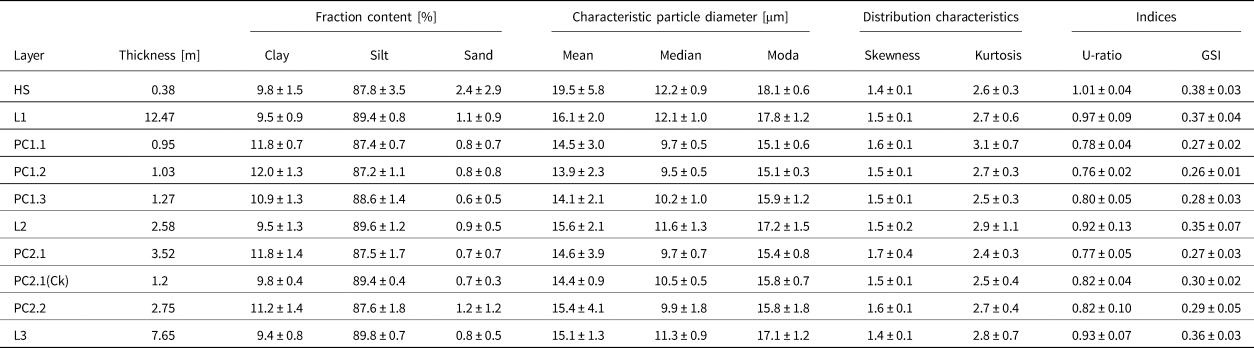
The studied deposits in the Obi-Mazar section are characterized by a silty grain-size composition with high sorting indices (Fig. 8), which is why the compositional stratification within the section is poorly expressed. The sediments are dominated by the silt fraction (> 2–63 μm) making up over 87% of the material, while the clay fraction (≤ 2 μm) accounts for about 9.7% in the loess and 12% in the paleosols (Table 1). The highest clay fractions are found in PC1.2 and PC2.1, resulting in the lowest median and index values for these layers. The mean sand content generally remains under 1%, although localized peaks occur (Fig. 7).
Stratigraphy and distribution of particle-size analysis data for the upper part of the Obi-Mazar section. FMS = field magnetic susceptibility.

Grain-size distribution curves of studied PC1 and PC2 and loess units of the Obi-Mazar section.

Distribution of chemical composition for the upper part of the Obi-Mazar section.

Contents of fractions, statistical parameters and indices for stratigraphic layers of the Obi-Mazar section, calculated based on grain-size analysis. U-ratio index = ratio of fractions 16–44 μm/5.5–16 μm; index GSI = ratio of fractions 20–50 μm/<20 μm

The mean particle size in the studied sequence of the Obi-Mazar section is fairly uniform and fluctuates around 15 μm (Table 1), showing a maximum in units L1 and L2. The mean values for the layers decrease from loess to paleosols. The median particle-size ranges around 11–12 μm in loess and 9–10 μm in paleosols. The modal particle size ranges around 17 μm in loess and 15–16 μm in paleosols. The fractions have a monomodal distribution with a mode in the coarse dust fraction (Fig. 8). The particle distribution measured for each sample has positive skewness and positive-peaked kurtosis (i.e., a small spread in grain size). Throughout the entire thickness, the asymmetry remains virtually unchanged.
The U-ratio and GSI indices display almost identical curves, very similar in profile to other basic statistical parameters, with values typically below 0.97 and 0.37, respectively. Indices are higher in loess layers, indicative of colder stages with strong winds, and lower in paleosols associated with weaker winds.
Chemical composition
The chemical composition of the LPS is relatively uniform. Statistical analysis showed no significant variation in Na2O and K2O content across soil horizons and loess layers (Fig. 9). However, in older Tajikistan LPS pedocomplexes, paleosols often have lower Na and K levels than loess due to weathering and soil-forming processes, with Mg and Na being more actively removed than K (Yang et al., Reference Yang, Ding and Ding2006).
The CaO content is higher in some soil horizons, likely due to strong carbonation, matching micromorphological evidence. The CaO levels are particularly high in horizons with abundant carbonate neoformations. The consistency of SiO2, Al2O3, and Fe2O3 ratios across the LPS suggests a common loess source and minimal weathering of silicate minerals.
Humus content is generally low, around 0.3%. In L1, organic matter varies between 0.06% and 0.70%, influenced by varying soil-formation intensities and climatic fluctuations, which affect the formation and preservation of organic matter. In the humus AB and BA horizons, humus content is higher, around 0.42%, but drops to 0.26% in the middle horizons. Humus levels in horizons PC1.3 (3Bk, 3BCwk) and L2 are approximately 0.14%.
Discussion
Correlation and chronology
Climatic variations in Central Asia, influenced by ice volumes in northern latitudes and solar insolation, are reflected in the Obi-Mazar section's LPS stratigraphy. Millennial humidity variability exhibits long, high amplitudes during interglacials and short, low amplitudes during glacials, aligning with North Atlantic cooling rhythms (Fan et al., Reference Fan, Jia, Liu, Zhao, Liu, Gao and Xia2022). That is why the nature of the FMS curve of the Obi-Mazar section, as well as it's stratigraphy and comparison with other LPS sections of Tajikistan, provide evidence for correlating the sediments of the Obi-Mazar section with the marine isotopic stages as orbital-scale records (Fig. 2) (Lisiecki and Raymo, Reference Lisiecki and Raymo2005). Despite assumed hiatuses, the correlation with major glacial and interglacial cycles remains unaffected. The upper 35 m of the section, dating to the late and part of the middle Pleistocene, indicates a connection with the broader climatic context.
One of the debatable issues of the evolution of the LPS of the Khovaling Plateau is the problem of identifying the paleosols of stage MIS 3 (Alekseeva et al., Reference Alekseeva, Bayguzina, Belsky, Vangengeim, Vislobokova, Gamov and Dmitrieva1977; Pospelova at al., Reference Pospelova, Laukhin, Ranov, Vlasov, Volgina, Kulikov, Pilipenko and Sharonova2005). Brief warming during MIS 3 led to the formation of 1–3 paleosols globally, such as the Bryansk soil in Eastern Europe and the Iskitim pedocomplex in Siberia (Volvakh et al., Reference Volvakh, Volvakh, Ovchinnikov, Smolyaninova and Kurbanov2022) and the soil horizon in Northeast Asia (Velichko et al., Reference Velichko, Borisova and Zakharov2017). In the Obi-Mazar section, layer L1.3 likely corresponds to MIS 3, which is suggested by a slight increase in FMS and annual precipitation (Song et al., Reference Song, Hao, Ge, Zhao, Zhang, Li, Zuo, Lü and Wang2014) and more stable U-ratio and GSI indices, indicating uniform wind strength and dustiness. Macroscopic-level evidence of soil processes in L1.3 and carbonate illuviation in L1.4 further support weak pedogenesis during this period. A thick layer corresponding to MIS 3 is also distinguished in the Darai Kalon section (Dodonov et al., Reference Dodonov, Sadchikova, Sedov, Simakova and Zhou2006), which has been dated to 34.0 ± 0.2 ka (Frechen and Dodonov, Reference Frechen and Dodonov1998).
MIS 4, 3, and 2 are not distinguished either for Tajikistan or for the Tibetan Plateau, which is associated with the special influence of the Siberian anticyclone and the weakening of the Atlantic signal (Vandenberghe et al., Reference Vandenberghe, Renssen, van Huissteden, Nugteren, Konert, Lu, Dodonov and Buylaert2006). In L1.5, the clear macro- and microfeatures of soil formation with increased FMS and content of the clay fraction may indicate a short and smooth transition between MIS 5 and MIS 4.
PC1, which is the first (uppermost) developed pedocomplex in the Afghan-Tajik depression, includes three paleosols. PC1 in the Obi-Mazar section does not have such a large thickness or loess layers between paleosols, unlike its counterpart in the Darai Kalon and Tagidjar sections (Mestdagh et al., Reference Mestdagh, Haesaerts, Dodonov and Hus1999). There are two peaks on the FMS curve in PC1, however, PC1 contains three paleosols. MIS 5 probably was characterized by low loess accumulation, which suggests that formation of the upper paleosol (MIS 5a) affected not only the deposited loess but also the profile of the underlying paleosol (MIS 5c), partially welding paleosol profiles, akin to the Chinese Loess Plateau (Feng and Wang, Reference Feng and Wang2006). The lower paleosol, which corresponds to MIS 5e, has a more differentiated profile and was less affected by later pedogenesis. The events that formed PC1 are similar to those described earlier (Mestdagh et al., Reference Mestdagh, Haesaerts, Dodonov and Hus1999).
Unit L2, which correlates with MIS 6, is noted for its low thickness and extensive pedogenic features. The FMS curve for the transition from L2 to PC1 is not uniform, which may indicate sediment erosion and that only the lower part of unit L2 is preserved (transition from MIS 7 to 6).
Unit PC2 consists of two paleosols. According to the grain-size composition and FMS, PC2.1 probably is a paleosol formed during MIS 7a–c, the underlying Ck formed during MIS 7d, and PC2.2 is a lower paleosol of MIS 7e. The increase in FMS and changes in U-ratio and GSI in L3 in the depth interval of 26.85–29.80 m (layers L3.2–L3.4) suggest a similar interstadial incipient paleosol formation as observed in L1.
Micromorphological features
B-fabric
The b-fabric of the micromass is crystallitic for loess and weakly leached paleosol horizons (Fig. 6). Leaching of carbonates from groundmass occurs due to the action of large amounts of precipitation. In more-developed horizons such as ABwk, BAwk, and Bw (Fig. 4H) the b-fabric ranges from stipple-speckled to poro- and mono-striated, depending on the degree of clay mobility due to swelling and shrinking (Nettleton et al., Reference Nettleton, Flach and Brasher1969; Khormali and Kehl, Reference Khormali and Kehl2011). Each paleosol except PC1.1 contains horizons with an index “w”.
Calcitic pedofeatures
Differentiating primary and secondary carbonates is crucial in understanding soil formation. While the nature of primary carbonates such as single crystals in the groundmass generally is clear, the genesis of secondary carbonates in the studied paleosols remains questionable. They can be the result of recrystallization of calcite within the profile, or diagenetic features. It must be remembered that the same forms of carbonates can be formed under different conditions, including from recrystallization of calcite within a profile or diagenetic features (Kovda, Reference Kovda, Targulian and Goryachkin2008). Therefore, we present only the most-probable conditions of genesis in our opinion.
Primary (lithogenic) calcite grains and fragments of shells from terrestrial mollusks are frequent in loess. Coarse, welded calcite grains in the groundmass of L1 and upper horizons of PC1 paleosols (1ABk, 2ABwk) may be reworked by bioturbation (Kemp, Reference Kemp1995; Bronger et al., Reference Bronger, Kalk and Schroeder1976), initially forming by calcite filling root parenchyma cells during long dry seasons (Becze-Deàk et al., Reference Becze-Deàk, Langohr and Verrecchia1997). Grain clusters consist of several calcite crystals and vary between 50 μm and 150 μm, which exceeds the grain size of the coarse fraction. These grains often appear as microcodium (Retallack and Wright, Reference Retallack and Wright1990), which are radiating petal-shaped calcite crystals formed by symbiotic fungal-root activity (Klappa, Reference Klappa1991).
Sparite grains result from root-cell calcification during decarbonization of the groundmass, forming sparite calcite crystals, known as cytomorphic calcite, in the root channels (Jaillard, Reference Jaillard1987; Durand et al., Reference Durand, Monger, Canti, Verrecchia, Stoops, Marcelino and Mees2018). Their formation is linked to high rainfall and warm periods conducive to dense vegetation (Herrero et al., Reference Herrero, Porta and Fedoroff1992).
Recrystallization of calcite and its migration up and down the profile are present in the form of coatings, hypocoatings, and nodules (Fig. 6). Carbonate coatings appear to be formed by dissolution and mechanical translocation (Siesser, Reference Siesser1973; Hay and Wiggins, Reference Hay, Wiggins, Wright and Tucker1991). Hypocoatings composed of micritic carbonate are formed from soil solutions percolating along the pores and penetrating the soil groundmass (Kemp, Reference Kemp1995). Acicular (needle-shaped) calcite formation in PC1.3 and PC2.1 is driven by fungal activity, with Mg predominating over Ca (Folk, Reference Folk1974) and varies with seasonal contrasts (Becze-Deàk et al., Reference Becze-Deàk, Langohr and Verrecchia1997; Bindschedler et al., Reference Bindschedler, Milliere, Cailleau, Job and Verrecchia2012, Reference Bindschedler, Cailleau and Verrecchia2016). Along with cytomorphic calcite, they indicate wetter and warmer conditions and denser plant cover (Khormali et al., Reference Khormali, Abtahi and Stoops2006). Acicular calcite is the most mobile form of the carbonates present (Polyakov, Reference Polyakov1989). Calcite coatings and hypocoatings may also result from diagenetic processes during loess accumulation in interglacials, with carbonates from airborne dust dissolving and settling in underlying layers when precipitation is below 750 mm/year (Schoeneberger et al., Reference Schoeneberger, Wysocki and Benham2012).
The origin of pedogenic calcite nodules is influenced by a very large number of factors (Zamanian et al., Reference Zamanian, Pustovoytov and Kuzyakov2016; Durand et al., Reference Durand, Monger, Canti, Verrecchia, Stoops, Marcelino and Mees2018). It is likely that diffuse nodules of micritic calcite are formed due to weak impregnation of the groundmass. Leaching of impregnated micritic suggests rainfall exceeding 600 mm/year during soil formation (Yaalon, Reference Yaalon1997; Schoeneberger et al., Reference Schoeneberger, Wysocki and Benham2012). Layered calcite-silty coatings in the center of PC2 suggest a sequence of carbonate migration within the profile, followed by fine-grained silt movement and diagenetic calcite precipitation from leached loess dust. However, the question remains about the wetting front and the precipitation depth of calcite neoformations, the solution of which would help to reconstruct the paleoclimate.
Genesis of the calcite crust (Bkm horizon) is associated with the illuviation of calcite from the overlying horizons into the lower part of the most clayey Bw horizon (Schoeneberger et al., Reference Schoeneberger, Wysocki and Benham2012).
Excrements and faunal galleries
Excrements or coprolitic aggregates observed in all loess layers and paleosol horizons are generally ellipsoidal or bacillo-cylindrical. Enchytraeid worms and oribatid mites produce these types of excrements (Bullock et al., Reference Bullock, Fedoroff, Jongerius, Stoops and Tursina1985). They are associated with channels and round pores and have a variable calcareous composition (Mestdagh et al., Reference Mestdagh, Haesaerts, Dodonov and Hus1999).
Gypsum pseudomorphs
Signs of the gypsum presence occur infrequently as rhombic and rosette-shaped voids (Fig. 6). Gypsum contents reach up to 0.1–0.2% (Lazarenko, Reference Lazarenko, Dodonov, Melamed and Nikiforova1977). Gypsum crystallized in the soil matrix at the boundary of the boundary of the groundmass and a solution saturated with gypsum, the result of which has the form of an intrusion. Subsequently, the leaching of gypsum occurred through the same intrusion pores, loosening the groundmass. This is different from the star-shaped gypsum joints in other PC1 layers (Mestdagh et al., Reference Mestdagh, Haesaerts, Dodonov and Hus1999).
Gypsum is formed under arid to semiarid conditions with P/ETo (ratio of mean annual precipitation to mean annual reference crop evapotranspiration) < 0.4 or 300–400 mm annual rainfall (Khormali and Abtahi, Reference Khormali and Abtahi2003). Gypsum leaching indicates a change from arid conditions to more humid ones, under which a short-term leaching regime occurred. The formation and dissolution of gypsum in these paleosols are associated with the final stage of diagenesis since gypsum is more soluble than calcite and can crystallize more easily (Mestdagh et al., Reference Mestdagh, Haesaerts, Dodonov and Hus1999). Gypsum leaching pores were observed in PC1.2, L2.1, and PC2.1 (1Bwk, Ck), indicating several very dry periods.
Clay coatings
The presence of clay coatings is quite rare (Fig. 5) and weakly expressed in only two horizons of PC1 (2ABwk, 2BCwk) without association with the illuvial process, which does not allow us to assign the index “t” to these horizons. Instead, these features, observed as mono- and porostriated clay orientations in the groundmass of PC2 (1ABwk-1Bwk, 2BAwk), result from in-situ weathering and indicate pedogenic changes rather than structural edge coatings (Bronger et al., Reference Bronger, Winter and Sedov1998b), so we use the index “w” for these horizons. The movement of clays in calcareous soils occurs at the precipitation of about 800 mm/year when carbonates are leached and pH values are in the range of 5–7 (Scheffer and Schachtschabel, Reference Scheffer, Schachtschabel and Enke2004; Khormali and Kehl, Reference Khormali and Kehl2011). Partial decalcification and a pH decrease appear to be associated with temporary or short-seasonal moisture, which leads to local dispersion and intra-horizon mobility of clay particles with the formation of poorly developed Bw.
Humus and organic-mineral complexes
The humus content in the paleosols of Tajikistan is low since organic compounds are poorly preserved in arid conditions. Some upper horizons of PC1 and PC2 show residual humus impregnations and humus-clay, non-calcite aggregates with sharp boundaries, which potentially are remnants of eroded mollic horizons (Bronger et al., Reference Bronger, Winter and Heinkele1998a).
Organic-mineral complexes that include Fe and/or Mn are much more common (Fig. 5). Amorphous organic-mineral neoformations are represented by external nodules (clots) and hypocoatings of Fe/Mn along organic residues. Factors influencing their genesis are described in detail in Vepraskas et al. (Reference Vepraskas, Lindbo, Stolt, Stoops, Marcelino and Mees2018). Hypocoatings were formed along small root channels, often influenced by intermittent water saturation and short, seasonal moisture that fosters transient waterlogging (Veneman et al., Reference Veneman, Vepraskas and Bouma1976; Hseu and Chen, Reference Hseu and Chen1999; Kyuma, Reference Kyuma2004).
These neoformations generally accumulate in the lower parts of paleosol profiles, particularly above the Bkm crust in PC2.2 (Fig. 5), suggesting moisture saturation and stagnant water conditions above this dense horizon, which acted as an aquitard. The presence of amorphous nodules in subsoil loess layers is linked to downward diffusion of reduced Fe, where it is oxidized and precipitated as Fe-oxide neoformations (Stolt et al., Reference Stolt, Ogg and Baker1994).
Overall, this description aligns with prior studies, although some variability might be due to microrelief effects (Bronger et al., Reference Bronger, Winter and Heinkele1998a, b; Mestdagh et al., Reference Mestdagh, Haesaerts, Dodonov and Hus1999; Dodonov et al., Reference Dodonov, Sadchikova, Sedov, Simakova and Zhou2006).
Grain-size features
The grain-size analysis of the Obi-Mazar section indicates that the LPS is homogeneous and well sorted, predominantly consisting of silt (> 2–63 μm) with minimal sand content, suggesting a rather distant location of the provenance (Yang et al., Reference Yang, Ding and Ding2006) and stable sedimentation conditions with occasional interruptions and/or erosion (Ding and Ding, Reference Ding and Ding2003).
The clay fraction peaks in PC1.2 and PC2.1, leading to lower median and index values in these layers, indicating the presence of Bw horizons (Table 1, Fig. 7). Unit PC2.1 shows two depth ranges with high clay content and corresponding peaks in FMS, hinting at overlapping paleosols during MIS 7a–c. The clay content in PC1 and PC2 of the Karamaidan and Darai Kalon sections is estimated at 20–35% (Dodonov et al., Reference Dodonov, Sadchikova, Sedov, Simakova and Zhou2006; Bronger and Smolíková, Reference Bronger and Smolíková2019). Differences in measured clay content between this study and earlier works are due to varying methodologies. Classical sieve–pipette measurements overestimate clay content compared to more accurate laser diffractometry (Konert and Vandenberghe, Reference Konert and Vandenberghe1997; Pabst et al., Reference Pabst, Kuneš, Havrda and Gregorová2000; Yudina et al., Reference Yudina, Fomin, Valdes-Korovkin, Churilin, Aleksandrova, Golovleva, Philipov, Kovda, Dymov and Milanovskiy2020).
Sand content is generally higher in loess than in paleosols. However, PC2.2 shows unexplained low U-ratio and GSI values alongside a sharp increase in the sand fraction, which likely is due to short-term influence of nearby provenance such as river alluvium and covers of slope accumulations (Dodonov, Reference Dodonov2002). Lower U-ratio indices for cold stages were also observed in the nearby Chashmanigar section (Ding et al., Reference Ding, Ranov, Yang, Finaev, Han and Wang2002). Layers L2.1 and L2.2 differ, which probably indicates strong differences in atmospheric circulation during the periods of their formation. Layer L2.1 shows characteristics of strong winds and high dust content in the atmosphere, while layer L2.2 matches the paleosol layers (Ding et al., Reference Ding, Ranov, Yang, Finaev, Han and Wang2002).
The studied LPS of the Obi-Mazar is similar to other Central Asian LPS with high silt content and increases in clay and fine-grained silt from loess to paleosols, indicating more intense soil formation and moisture during paleosol periods. However, Tajik LPS differ from others by the particle-size distribution processed by the end-member method. Observing the fine-grained edge of histograms, a characteristic asymmetry is noted, indicating the presence of an additional amount of silt in the 2–10 μm range. One of the three end members has a modal grain size of 9 μm in Tajik loess (Vandenberghe, Reference Vandenberghe2013).
In the late Pleistocene loess of the Fergana Valley, the composition is predominantly silt at 88.3%, with sand at 2.8%, and clay at 8.9%. There is a notable increase in clay and decrease in sand with depth, especially in paleosols, where mean particle size can reach up to 33 μm (Li et al., Reference Li, Song, Kaskaoutis, Zan, Orozbaev, Tan and Chen2021). Tajik LPS have more clay, suggesting more humid conditions or different mineral compositions. Sand content varies more in Tajikistan, likely due to local relief and wind influence.
The Kyrgyz Tian Shan LPS, although similar to Tajik LPS, contains more sand and less clay. The content fractions average 12% sand, 80% silt, and 7% clay (Youn et al., Reference Youn, Seong, Choi, Abdrakhmatov and Ormukov2014). Grain-size distribution in Tian Shan is more uniform than in Tajikistan, implying more stable sedimentation conditions.
Iranian loess, which is closer to its source, shows higher coarse-grained silt content compared to Tajik loess, indicating an increase in wind intensity during the Pleistocene (Vlaminck et al., Reference Vlaminck, Kehl, Lauer, Shahriari, Sharifi, Eckmeier, Lehndorff, Khormali and Frechen2016; Wang et al., Reference Wang, Wei, Khormali, Taheri, Kehl, Frechen, Lauer and Chen2017). The LPS of the Iranian Loess Plateau have higher U-ratio values and mean grain size, especially for loess layers. Upper Pleistocene LPS in both regions is systematically coarser than in Lower Pleistocene units, suggesting an increase of wind intensity during the Pleistocene. The upper Pleistocene LPS of Iran exhibits a trimodal grain-size distribution, whereas Tajik loess is mainly bimodal.
Tajik LPS, in terms of grain-size distribution, are similar to those of the Chinese Loess Plateau (Sun et al., Reference Sun, Bloemendal, Rea, Vandenberghe, Jiang, An and Su2002, Reference Sun, Bloemendal, Rea, An, Vandenberghe, Lu, Su and Liu2004, Reference Sun, Lu and An2006, Reference Sun, An, Clemens, Bloemendal and Vandenberghe2010). The latter is characterized by a predominance of bimodal particle-size distributions with one mode in the fine-grained sand area and one in the fine-grained silt area. The mean grain size is 20–30 μm (Vandenberghe, Reference Vandenberghe2013; An, Reference An2014), while the mean grain size for Tajik loess is 13–16 μm. The grain-size distribution of the Chinese Loess Plateau allows for a good correlation with marine and ice-core records, whereas Tajik loess has specific changes in grain sizes making such correlation less clear (Vandenberghe et al., Reference Vandenberghe, Renssen, van Huissteden, Nugteren, Konert, Lu, Dodonov and Buylaert2006). Tajik LPS demonstrate a higher frequency and amplitude of grain-size fluctuations compared to the loess on the Chinese Plateau, reflecting more dynamic climatic conditions in this region.
Chinese LPS resemble those of Tajikistan (Sun et al., Reference Sun, Bloemendal, Rea, Vandenberghe, Jiang, An and Su2002, Reference Sun, Bloemendal, Rea, An, Vandenberghe, Lu, Su and Liu2004, Reference Sun, Lu and An2006, Reference Sun, An, Clemens, Bloemendal and Vandenberghe2010), mainly showing a bimodal particle-size distribution with modes in the fine-grained sand area and in the fine-grained silt area. The mean grain size is 20–30 μm (Vandenberghe, Reference Vandenberghe2013; An, Reference An2014), while the mean grain size for Tajik loess is 13–16 μm. While Chinese loess aligns well with marine and ice-core records by grain-size distribution, Tajik loess has distinct grain-size variations that make correlations less pronounced (Vandenberghe et al., Reference Vandenberghe, Renssen, van Huissteden, Nugteren, Konert, Lu, Dodonov and Buylaert2006). The higher frequency and amplitude of grain-size fluctuations in Tajik loess indicate more dynamic climatic conditions in the region.
Classification of studied paleosols
Despite the fact that it is quite difficult to classify paleosols according to modern classifications and not reasonable in all cases (Nettleton et al., Reference Nettleton, Olson and Wysocki2000; Imbellone, Reference Imbellone2011), we tried to correlate paleosols PC1 and PC2 according to the IUSS Working Group WRB (2022) in order to get some idea of the possible paleoenvironments.
Paleosol PC1.1 is a Haplic Calcisol. Nowadays, these soils are widespread and occupy steppes, hill slopes, and/or plateaus. The climate associated with these soils varies from Mediterranean to arid and semi-arid, with annual rainfall of 170–600 mm (Özden et al., Reference Özden, Keskin, Dinç, Kapur, Akça, Şenol and Dinç2001) and mean annual temperatures of 10–25°C. These soils have a wide distribution and occupy large areas in Turkey, Spain, North Africa, and the Middle East (Zdruli et al., Reference Zdruli, Kapur, Çelik, Kapur, Eswaran and Blum2011). The Khovaling Plateau soils were probably developed in semi-arid conditions under a xerophytic grassland (Mestdagh et al., Reference Mestdagh, Haesaerts, Dodonov and Hus1999).
Paleosol PC1.2 is a Calcic Luvic Kastanozem. They are developed in semi-arid and sub-humid regions with 400–650 mm annual rainfall under Mediterranean sclerophyllous woodland and a short-grass steppe belt conditions. The soils are the most widespread in Europe (Dan et al., Reference Dan, Gerson, Koyumdjisky and Yaalon1981; Badía-Villas and del Moral, Reference Badía-Villas, del Moral and Gallardo2016). The Khovaling Plateau vegetation was probably dominated by xerophytic grasses and shrubs in combination with some broad-leaf trees during the formation of this paleosol (Mestdagh et al., Reference Mestdagh, Haesaerts, Dodonov and Hus1999).
A welded profile of PC1.1 and PC1.2 likely was promoted by low accumulation rates of aeolian dust over PC1.2. During PC1.1 formation, fine particles moved down the profile, settling as silt infillings in PC1.1 horizons, enriching horizon 2ABwk. Alternatively, the accumulation of fine-grained silt and clay in 2ABwk might be from carbonates being sequentially removed from the PC1.1 profile, forming horizontal carbonate interlayers in 2Bkm. The latter could represent an early stage of carbonate-crust formation, acting as a barrier to additional particle movement down the profile.
Paleosol PC1.3 is a Luvic Kastanozem. They often develop on loess parent materials and are associated with a dry and continental climate with relatively cold winters and hot summers. They are formed in regions where the average annual temperature is 8–9°C with 550–650 mm annual rainfall and a 0.75–0.9 P/ETo under subtropical oak–hornbeam forests and meadow ecosystems (Lomov et al., Reference Lomov, Sosin and Sosnovskaya1982; Lomov and Ranov, Reference Lomov, Ranov, Agrawal, Kusumgar and Krishnamurthy1985; Tobiašová et al., Reference Tobiašová, Dębska and Banach-Szott2013; Pospíšilová et al., Reference Pospíšilová, Uhlík, Menšík, Hlisnikovský, Eichmeier, Horáková and Vlček2020).
Both paleosols PC2.1 and PC2.2 are Luvic Petrocalcic Kastanozems. Kastanozems develop under a fairly wide range of conditions, but the averages are 15.5°C annual temperature, 1.16 P/ETo, and 550–650 or more mm annual rainfall (Costantini et al., Reference Costantini, Barbetti, Fantappie, L'Abate, Lorenzetti and Magini2013). They are formed from steppes to forests dominated by oak or hornbeam (after Spaargaren, Reference Spaargaren1994; Nestroy, Reference Nestroy2001; Zdruli et al., Reference Zdruli, Kapur, Çelik, Kapur, Eswaran and Blum2011). The difference between PC2.1 and PC2.2 is that the latter forms in a relatively humid climate.
The results of Dodonov et al. (Reference Dodonov, Sadchikova, Sedov, Simakova and Zhou2006) and Mestdagh et al. (Reference Mestdagh, Haesaerts, Dodonov and Hus1999) are closest to this classification for the Tajik LPS, where they distinguish the following taxa: PC1.1 – Haplic Calcisol or Serozem in the Russian classification (Egorov et al., Reference Egorov, Fridland, Ivanova, Rozov, Nosin and Friev1987); PC1.2 – Luvi-Calcic Kastanozems (Carbonate Cinnamon soil); PC1.3 – Luvic Kastanozems (Leached Cinnamon soil); PC2.1 – Calcic Kastanozem (Carbonate Cinnamon soil); PC2.2 – Luvi-Endocalcic Kastanozems (Typical Cinnamon soil). In our opinion, the classification of Tajik paleosols as Phaezems is not entirely correct (Bronger et al., Reference Bronger, Winter and Heinkele1998a) because secondary carbonates are present in the paleosol profiles. This also applies to the Holocene soil, which does not yet have diagenetic signs, although the current amount of precipitation reaches 1000 mm/year (Yang and Ding, Reference Yang and Ding2006). Moreover, Phaezems are not identified in the modern soil cover of Tajikistan (Khormali et al., Reference Khormali, Valizadeh, Talebi, Tokareva, Schnider, Tazikeh, Sosin, Kurbanov, Buylaert and Murray2024).
In the Chinese LPS, two paleosols are distinguished in the upper pedocomplex: MIS 5a–c paleosols, which can be correlated with Calcic Kastanozem or Luvic Phaeozem, and MIS 5e paleosols, which can be correlated with Luvic Kastanozem or a strongly rubificated Chromic Luvisol (Guo et al., Reference Guo, Fedoroff and Tung Sheng1993). Holocene soils are classified as Chernozem and Phaeozem. The late Pleistocene climate in this region was likely influenced by local agents and was wetter than in Tajikistan.
It is difficult to compare the studied paleosols with the Holocene ones since a complete, undisturbed profile of modern soil has not been described for this relief element and structure of soil cover. At this research stage, we can say that the paleosols of PC2 are closest to the modern soil in the area, but there are differences such as the presence of the Bkm horizon and biolith capsules in the paleosols.
Conclusions
The studied 35-meter loess–paleosol sequence at the Obi-Mazar reference section on the Khovaling Loess Plateau, spanning the last 250 ka, probably formed under fairly stable conditions without significant breaks in sedimentation. The sequence consists of the first pedocomplex with three paleosols, correlated with MIS 5 (ca. 71–130 ka), and the second pedocomplex with two paleosols, correlated with MIS 7 (ca. 191–243 ka) of the regional chronostratigraphy of the Khovaling Loess Plateau.
Significant biological activity was noted in all loess layers and paleosol horizons. The distribution of calcite, Fe/Mn, and fine-grained silty and clayey neoformations reflect soil processes such as active humus formation, but rapid mineralization of organic matter, leaching of carbonates and gypsum, temporary soil moisture saturation, downward fine-grained particle movement, and weak clay weathering and mobility.
The deposits are characterized by a silty grain-size composition with high sorting indices leading to poorly expressed compositional stratification and indicating homogeneity in loess accumulation on the plateau. With about 90% silt, less than 1% sand, and 9–12% clay, the loess–paleosol series in Tajikistan differs from those in China and Iran. The chemical composition is fairly uniform, with a slight increase in humus in paleosol horizons. Structural, micromorphological, and grain-size characteristics, along with regional soil distribution, suggest the paleosols belong to the Calcisols–Kastanozems groups, with PC1 likely formed under drier conditions than PC2. Paleosol PC2 is closest to modern soil. Our results fit well into the context of previous studies of Tajik LPS.
Supplementary material
The supplementary data for this article can be found at https://doi.org/10.1017/qua.2024.32.
Acknowledgements
The work is supported by the Russian Science Foundation (Project №22-18-00568). P.M. Sosin, R.N. Kurbanov and I.K. Ashurmadov were supported by the NordForsk THOCA project (№105204), Prof. F. Khormali was supported by the Iran National Science Foundation under project 99006758.