


Deficit model designates a way of approaching the public understanding of science and science communication that is characterized by an emphasis on scientific illiteracy and on the need to educate the public. Although it has been the object of abundant critical analysis in the social and human sciences, it remains a mainstream mode of commentary, as well as the spontaneous approach for scientists and practitioners examining how their fields are depicted in film. As will be documented here by way of discussions about neurology and psychiatry in fiction film, a major factor for such resilience resides in the enduring strength of aesthetic realism. To suggest the broader intellectual context of such discussions, as well as the far-reaching power of aesthetic realism, we shall explore parallels regarding historical film and the filmic adaptation of literature, where the notion of a “deficit model” has no currency.
The label deficit model emerged in the 1990s to name an established mode of analysis and practice characterized by the assumption “that public understanding of science coincides with scientific literacy,” the belief that the ability to understand science as divulged by experts “guarantees favorable attitudes toward science and technological innovation,” and the tendency to make the public answerable for the shortcomings of its relationship to science (Bucchi and Neresini Reference Bucchi, Neresini, Hackett, Amsterdamska, Lynch and Wajcman2007, 450; emphasis in the original).Footnote 1 Since then, the deficit model has been the object of both empirical research and critical analysis in media studies, education, science studies, the sociology of science and technology, and institutions engaged with science communication policy. The examination of science and technology in film has undergone a parallel development, with increasing attention paid to how pictures shape the cultural meanings of science rather than on how they communicate information (Kirby Reference Kirby, Bucchi and Trench2014). Nevertheless, outside the fields just mentioned, cinema is predominantly approached in a “deficit” perspective that makes it appear as an unreliable means of transmitting scientific values and knowledge or even as a medium that may harm science literacy.
In the three domains that shall be examined here (science, history, literature), both the “deficit” turn of mind and the vocabulary of realism invariably carry affective weight, and, beyond providing cognitive tools for informed judgment, convey values and convictions of an ontological, aesthetic, epistemic, normative and moral nature. However, the deficit model is not a “model” in any strict sense of the word, and neither it nor aesthetic realism are coherent theoretical programs. Rather, both tend to function as heterogeneous mindsets, as loosely connected but not carefully considered attitudes and presumptions. In particular, with regard to the public understanding of science and professional knowledge generally, the realist stance encourages seeing film in terms of information to be extracted and comparing such information to contents that experts would provide. Since experts obviously know more than lay persons, works of fiction (and on the whole works of art insofar as they engage with knowledge) will inevitably seem to suffer from informational deficit. Yet their specific goal is not to be instructional; and once this is taken into account, they will appear to be characterized by a surplus of meaning rather than by a shortage of information or an inadequate representation of knowledge.
“And the winner is: not science”
“And the winner is: not science” is the title of a note by freelance science policy writer and former news editor of Nature, Colin Macilwain. Published in Nature in February 2015, it comments on The Imitation Game and The Theory of Everything. These two movies, both released in 2014, dramatize the lives of mathematician Alan Turing and physicist Stephen Hawking respectively – and leave, according to the journalist, “a great deal to be desired” (Macilwain Reference Macilwain2015).Footnote 2 Both, he writes, “feature a catalogue of clichés, of eccentric scientists and true love,” and reproduce the “bombastic, simplistic and ‘hero-takes-all’ picture of science” that “is still promoted heartily through the Nobel prizes, and by much science writing.” In Macilwain's opinion, “scientists deserve to see major, fact-based feature films about science present their lives in ways that resonate, at least to some extent, with the world of science as it really is. Most of us can recognize the authentic when we see it; in the case of these two films, we don't” (ibid.). Here a judgment about credibility, accuracy or veracity (“science as it really is”) interacts with the intuitive recognition of authenticity as the valuable quality par excellence. The drama should not only adhere to the facts that inform it and which it in part represents, but also be in tune with the viewers’ experience and educate those who still lack the means to “recognize the authentic.”Footnote 3 In this view, scientists emerge as the most authoritative judges and the most entitled audience. With regard to scientific contents and depictions of how science is done, the deficit model gives them authority to tell which “simplifications” are appropriate or helpful, and which are perilous “distortions;” as “a useful political tool for scientific experts,” it embodies and reinforces an “epistemic hierarchy” that ranks scientists above other actors, from the general public to science studies scholars (Hilgartner Reference Hilgartner1990, 520, 530, 533; see Simis et al. Reference Simis, Madden, Cacciatore and Yeo2016, 405–409, for scientists’ generally unfavorable views of the public).
Science must “win” because it is believed that misrepresenting it on screen generates misgivings about its nature and value, and that public misunderstanding may negatively affect legitimacy and funding. The perceived relevance of the media's science reporting has inspired science communication and public understanding of science as research areas that still focus on coverage of the natural sciences, Western countries, and the print media (Schäfer Reference Schäfer2016). Studies carried out in these areas since the 1980s contradict the assumption of earlier scientific literacy research that the more you know, the more you love it, and demonstrate an inverted U-shaped relationship between knowledge and attitudes: “below a certain level knowledge drives positive attitudes, beyond that point knowledge drives skeptical attitudes towards science” (Bauer Reference Bauer2009, 224, 230). This is in turn tied to economic development, which has been shown to correlate with the rejection of a blanket confidence in science, and with more utilitarian and case-by-case assessments (ibid., 231–232). Moreover, as a recent synthesis of research on science literacy concludes, whereas “perhaps the most commonly heard claim is that a more science literate population helps democratic societies make prudent and equitable decisions about policy issues that involve science,” the currently available evidence does not provide enough information to decide if such claims are justified or not (Snow and Dibner Reference Snow and Dibner2016, S.3).
This panorama clashes with the persistence of the deficit model. Though often in a more dialogical mode than was customary, that model “underlies many programmatic statements from the scientific community” (Sturgis and Allum Reference Sturgis and Allum2004, 57), remains the “default option in many sectors of science” (Trench Reference Trench, Cheng, Claessens, Gascoigne, Metcalfe, Schiele and Shi2008, 122), and is the backbone of most outreach activities “even if they claim to be doing something different” (Hetland Reference Hetland2014, 8).Footnote 4 Macilwain's opinion in Nature embodies this deficit outlook; acting as an official reminder from scientists and their institutions about their entitlements, it insists that science must be accurately represented, and conveys the belief that depicting “the world of science” otherwise than “as it really is” has negative consequences for both science and society.
Which passion expert audiences feel about accuracy and how strongly they believe films must adhere to rigorous veracity standards depend on how socially relevant or sensitive the dramatized issues are felt to be and what “impact” movies are thought to have. Passion, as we shall see, is intensely moral and political in the case of pictures about mental illness and historical events of contemporary import. Physics-themed movies also prompt commentators to chase mistakes, assess truthfulness, and describe the blatant filmic violations of physical laws that are often indispensable for things to happen (e.g. Rogers Reference Rogers2007). Blockbusters such as Alfonso Cuarón's Gravity (2013), Christopher Nolan's Interstellar, or Riddley Scott's The Martian (both 2014) gave rise to abundant questions about “realism,” “accuracy,” and “real” or “bad” science (e.g. Billings Reference Billings2014; Dickerson Reference Dickerson2015; Di Justo Reference Di Justo2013; Overbye Reference Overbye2014; Weir Reference Weir2013; Zubrin Reference Zubrin2015). Nevertheless, even in books as austere as The Science of Interstellar, by the Feynman Professor of Theoretical Physics Emeritus at Caltech (Thorne Reference Thorne2014), the fact-checking game is played with a light touch, obvious amusement, and a desire to use fiction to popularize science rather than with the quest for reparation that characterizes more politically laden fields.Footnote 5 Across the board, however, aesthetic realism is the rule.
Realism
Several empirically documented factors may explain the persistence of the deficit model in science communication: scientists’ training leads them to believe that information is always processed rationally; they have not been taught anything about communication; their conceptualizations of “the public” convey the perception of a knowledge deficit; and the model carries on because it works well for policy design (Simis et al. Reference Simis, Madden, Cacciatore and Yeo2016). Its endurance, however, is also part of a broader, long-lasting cultural phenomenon: the tradition of mimeticism and the continuance of realism as a criterion for judging representational artworks. Resemblance and representation, however, can be reckoned according to a variety of criteria; the terms involved in the realist outlook, such as accuracy, authenticity, fidelity, truthfulness or verisimilitude, are neither univocal nor self-contained; mimesis is not the same as imitation; and the legacy of mimeticism is irreducible to debates around the slogan of art's “imitation of nature” (Halliwell Reference Halliwell and Halliwell2002). The discussions we shall explore are nevertheless concerned with the extent to which films adequately mirror characters and events, and such an unwitting realist outlook is part and parcel of the deficit model those discussions spontaneously incarnate.
The longevity of realism results from a combination of ontological intransigence and empirical adaptability. The concept, as the young Roman Jakobson noted in 1921, is characterized by its “extreme relativity” (Jakobson [1921] Reference Jakobson, Pomorska and Rudy1987, 24):
Classicists, sentimentalists, the romanticists to a certain extent, even the “realists” of the nineteenth century, the modernists to a large degree, and finally the futurists, expressionists, and their like, have more than once steadfastly proclaimed faithfulness to reality, maximum verisimilitude – in other words, realism – as the guiding motto of their artistic program. (Ibid., 20)
Moreover, Jakobson explained, realism is manifold not only in its objects, but also in its modalities. It can refer to an artistic intention; it can be something perceived by the person who judges; it can be associated with specific movements or theories; it can be characterized by particular techniques (such as the verbal or pictorial depiction of apparently inessential objects or actions); or it can embody the desire (to faithfully depict reality) that motivates the choice of a particular style or technique. In practice, these modalities often merge with each other and can be “conservative” or “progressive” (Jakobson's terms), i.e. they can be actualized by conforming to accepted representational norms, or by violating them to make viewers confront “the real” that lies beyond representation.
This is a vast subject matter, but for our topic two points can be made that closely follow from Jakobson. First, realism is not a “period style” but a “recurrent effect” (McHale Reference McHale2008, 7). Second, judgment in the areas we examine here consists of assessing realism in Jakobson's second sense: “A work may be called realistic if I, the person judging it, perceive it as true to life” (Jakobson [1921] Reference Jakobson, Pomorska and Rudy1987, 20). This basic position goes hand in hand with anxiety about the effects of the works being judged. It thus expresses the “dual concern,” characteristic of the mimeticist tradition since antiquity, “with the status of artistic works or performances and with the experiences they invite or make available” (Halliwell Reference Halliwell and Halliwell2002, 16). Indeed, mimetic theories repudiate the “affective fallacy,” holding that insofar as artworks have emotional effects, they must be evaluated partly on the basis of those effects. The dual preoccupation with how well or badly works adhere to reality, and with their correspondingly beneficial or pernicious impact, is constant in discussions of science in fiction film. Furthermore, in the same way that such concerns assume a positive correlation between accuracy and positive outcomes, they bolster the norm, ubiquitous but generally implicit, that even fiction films should be educational. That norm in turn assumes and fosters both realism and the deficit model.Footnote 6
The emphasis on accuracy is consistent with the prominence of realism in the history of film aesthetics. As the German philosopher Martin Seel has shown, the cinema is as “indifferent” to realism as to anti-realism; films are capable of using all modes of representation and narration, and “engender a unique event of sight and sound that need be perceived neither as a real event nor as an illusion of such an event” (Seel Reference Seel2008, 166; emphasis in original). Film, however, has recurrently been understood as a medium that, in contrast to other representational arts, entertains an ontological or indexical relation with reality. As Seel points out, theories of film differ according to how they understand the relationship between film and photography (ibid., 167). The conviction that realism belongs to the nature of cinema has been linked to the photographic foundation of film and to photography's unique “evidential force” (Barthes [1980] Reference Barthes and Howard1981, 89). For Roland Barthes, “every photograph is somehow co-natural with its referent;” it is a “certificate of presence” where “the power of authentication exceeds the power of representation” (ibid., 76, 87–88, 89). Such “evidential force” was potentiated by the cinema's singular capacity to combine time and movement, and by the resulting reality effects and their physical, emotional, and intellectual impact. Realist film theory prevailed until the 1960s (Aitken Reference Aitken2001, chaps. 7–8; idem Reference Aitken2006, Reference Aitken2016; Thomson-Jones Reference Thomson-Jones2008, chap. 2). The analytic focus later shifted from ontology to semiotics and structuralism, from an interest in cinema as the phenomenal depiction of reality to the analysis of its semiological means and conventions (Stam, Burgoyne, and Flitterman-Lewis [1992] Reference Stam, Burgoyne and Flitterman-Lewis2005, Part V).
This shift was celebrated as a liberation from the snarls of realism, and works such as John Tagg's The Burden of Representation profoundly historicized and contextualized photography's “evidential force” (Tagg Reference Tagg1988) Since the mid-1990s, however, realist perspectives have re-emerged in world cinema and television, realism has been rehabilitated in film and media theory, and has been supported by an expanding “cognitivist” perspective (Nagib and Mello Reference Nagib, Mello, Nagib and Mello2009) according to which “perceptual recognition of something in the [filmic] image is on the whole neither arbitrary nor culturally variable” (Bordwell Reference Bordwell2015). By emphasizing how “our experience of cinematic images and cinematic narrative resembles our experiences of seeing and comprehending events and processes in reality,” cognitivism displays “a strong realist tendency” (Currie [1999] Reference Currie, Miller and Stam2004, 106).
Realism has long guided analyses of the filmic representation of knowledge, though not always as absolute principle. For example (and to anticipate the next section), Images of Madness: The Portrayal of Insanity in the Feature Film first identifies major themes (such as madness and society, madness and possession, or madness and murder), and then discusses two movies per theme (Fleming and Manvell Reference Fleming and Manvell1985). Although it leans toward realism, it does not systematically assess accuracy.Footnote 7 The same can be said of Neuroscience in Science Fiction Films, published three decades later, which opens by noting that many different fields “can lay claim to this subject matter” and that “authors with different training and different persuasions” would tackle it very differently (Packer Reference Packer2015, 1). The point seems obvious, but its spirit runs against scientific experts’ usual claims to authority. A different approach consists of not considering accuracy issues, and highlighting the imaginative and intertextual dimension of film, the multiplicity of its functions and contexts, and the diversity of its stylistic and technical resources. Further in the same direction, one can altogether reject representation as a frame of reference, examine how cinematic techniques convey mental states and psychological experience, and criticize the very idea that films should be assessed on the basis of clinical observations or scientific studies (e.g. Macauley Reference Macauley2015a and Reference Macauley2015b). This approach favors movies produced mainly since the 1990s, which instead of depicting psychopathologies from a psychological or medical viewpoint aestheticize them by turning them into “structural elements of film narrative” (Trifonova Reference Trifonova2014, 40). There is no evidence that the authors discussed below are conversant with these and earlier developments in film aesthetics; but although they make no claims in favor of realism, their goal of determining if films are “true to life” (and true to science) betrays a realist view about the nature of cinema.
Accuracy (Movies and Mental Illness)
Accuracy is one of the keywords of the realist turn of mind, and the main one in connection with science on screen.Footnote 8 We shall here illustrate this through the case of neurology and psychiatry, with a focus on the representation of officially identified and named disorders. This choice corresponds to the place of mental illness in film history. The excellent website NeuroPsyFi: The Brain Science behind the Movies, which provides ongoing “realist” commentary of movies depicting psychiatric and neurological conditions, reflects one of cinema's most durable interests (www.neuropsyfi.com; see also McKechnie Reference McKechnie2015). Possession, hypnosis, hypnotic crime, lunatics, asylums, and psychiatrists were major themes in the early decades of the medium (Andriopoulos Reference Andriopoulos, Jansen and Andriopoulos2008; Shortland Reference Shortland1987), and the connection of the mad and their doctors with crime has been central ever since (on the evil psychiatrist in particular, see Packer Reference Packer2012). Psychiatric narratives are prevalent in the larger universe of the medical film (Harper and Moor Reference Harper and Moor2005, 4) – one of the earliest and richest cinematic genres, and one that, from the beginning, was committed to accuracy and had recourse to professionals as consultants (Reagan, Tomes, and Treichler Reference Reagan, Tomes, Treichler, Reagan, Tomes and Treichler2007).
The psy universe in film is of course not reducible to mental illness, but the questions are comparable across topics. Thus, with regard to psychiatrists on screen, scholars have asked “to what extent [films] influence patients’ or potential patients’ inclinations to seek or accept psychiatric help” (Gabbard and Gabbard Reference Gabbard and Gabbard1999, 176). Reinforced by empirical research into how the media portrayal of psychologists influences people's attitudes (Maier et al. Reference Maier, Gentile, Vogel and Kaplan2014), official institutions remain actively concerned. The American Psychological Association (Div. 46) Media Watch Committee annually gives the Shirley Glass Golden Psi Award “for the most accurate and responsible portrayal of mental health professionals” in any medium, and the U.S. Substance Abuse and Mental Health Services Administration delivers the Voice Awards honoring “consumer/peer leaders and television and film professionals who inform the public about behavioral health” in an accurate and respectful manner (Stringer Reference Stringer2016, 47, 48).Footnote 9
With regard to mental health patients, the anxiety about movies’ impact is broader than the preoccupation with stigma. It includes such topics as aggression, sexual behavior, substance use, and attitudes, beliefs and stereotypes other than those related to psychiatric conditions. The debate about media effects has been heated since the topic was first investigated in the late 1920s. The present overall view, based on decades of empirical inquiry, is that films sometimes have relatively small effects on audiences, that they do not affect everyone in the same way, that media exposure does not cause anything by itself, and that effects research neglects essential aesthetic and narrative forms and variables (Young Reference Young2012, 145–149).
Like NeuroPsyFi, most books on filmic “images of madness” have an educational purpose, and include accuracy ratings as a guide to selecting movies for teaching.Footnote 10 Most are also remarkably well documented, attesting to a single-minded search for materials and a gargantuan movie consumption. In Neurocinema, neurologist Eelco F. Wijdicks explains, “The ultimate goal is to connect the viewing experience with the known reality and to gain more information about neurologic disease,” and asks the typical questions:
How are neurologic disorders shown, and how accurately are they depicted? How is the practice of the neurologist represented? How do documentaries handle the seriousness of these disorders? Do films have educational value for neurology residents, and can the topic bring about a useful discussion? (Wijdicks Reference Wijdicks2015, 263, xi)
The panorama he sketches is varied. There are “neurofollies” mixing comedy and science fiction, as well as “neurological nonsense in horror movies involving the brain;” but “these films are a particular genre” where entertainment must be let to “win over reality” (ibid., 241). Wijdicks concludes that in about one-third of 115 rated films (excluding neurofollies), “the portrayal of neurological conditions is excellent” and that “there has been an overall improvement in portrayal of neurology over the years” (ibid., 262).
Such combination of systematic classifications, educational goal and balanced assessment is the rule. Reel Psychiatry: Movie Portrayals of Psychiatric Conditions follows DSM-IV-TR (the American Psychiatric Association's Diagnostic and Statistical Manual of Mental Disorders, fourth edition, text revision) to classify movies according to the conditions depicted. Films are rated, and the best are characterized as an “excellent portrayal. The depiction is particularly accurate and conveys a strong sense of what the condition is actually like” (Robinson Reference Robinson2009, 16). The general impression is positive:
With few exceptions, reasonably accurate portrayals of most psychiatric conditions can be found in popular films. This is a fortunate coincidence for psychiatric education because filmmakers are under no obligation to bring to life a set of diagnostic criteria, and entertainment will almost always prevail over accuracy. (Ibid., 4)
Imágenes de la locura (Images of madness) also follows DSM-IV-TR; each chapter covers a group of disorders, seeking to teach viewers about psychopathology and offering them means “to analyze and understand the films they watch” (Poseck Reference Poseck2006a, 12; also Reference Poseck2006b). Analyzing and understanding here boil down to determining accuracy according to established knowledge. The realist approach thus links representational correctness with public education, especially to fight the stigma associated with mental illness.
A pioneer work in such a perspective was psychologist Otto Wahl's Media Madness: Public Images of Mental Illness. In this richly documented critical book of 1995 (over 200 movies and TV shows are considered), as in later research, Wahl was concerned with how media depictions of mental illness affect public attitudes and the manufacture and perpetuation of stigma (e.g. Wahl Reference Wahl1999 and Reference Wahl2012; Wahl and Aroesty-Cohen Reference Wahl and Aroesty-Coen2010):
Persons with psychiatric disorders are often in the audience when films, television programs and news stories portray them as dangerous villains, when mental illness is presented as a source of humor and ridicule, and when slang references to “nuts” and “psychos” are tolerated in ways that slang terms would not be for other serious disorders. (Wahl Reference Wahl2012, 9)
Wahl considered that, partly as a consequence of media misrepresentation, diagnosed individuals were discriminated against, could be reluctant to seek treatment, and suffered from situations that undermined their mental and physical health. Thus, he wrote, if the public is “to make fair decisions about issues related to mental illness, [they] need to understand the nature of the media images of mental illness that may shape their ideas and the relationship of those images to the facts of mental disorder” (Wahl Reference Wahl1997, 13). Understanding the “nature” of film images again implies determining whether or not they correspond to established “facts.” Movies supposed to be sources of information about mental illness must be assessed on the basis of that information.
Writings in this area always state that visual media are chief sources of knowledge and attitudes about mental illness. Most do not provide any evidence for that claim nor refer to impact studies, but assume a “transmission” model of media effects, a relatively direct relationship between exposure and attitudes. In contrast, research since the 2000s has documented how opinion about scientific issues “is a complex function of interrelationships among numerous factors, among which media depictions are only one” (Dudo et al. Reference Dudo, Brossard, Shanahan, Scheufele, Morgan and Signorielli2011, 772). This research shows that attitudes and perceptions are shaped by previous knowledge, value predispositions, “schema” (how people integrate new information and experiences), interest, trust in sources, and media forms (Nisbet and Goidel Reference Nisbet and Goidel2007; Takahashi and Tandoc Reference Takahashi and Tandoc2015; Zhao Reference Zhao2009; Snow and Dibner Reference Snow and Dibner2016, 5.1-7). The perceived connection between “false” depictions and negative impact sustains the imperative of accuracy and the moral passion that animates media-and-mental-illness scholarship. This imperative also applies to inaccurate positive depictions, which do nothing “to further the public's education” and can lead to such harmful practical consequences as confusion between symptoms, loss of trust in the diagnosing clinician or delay in treatment (Roth Edney Reference Roth Edney2004, 5). The stakes of (in)accuracy and (mis)representation are high because they are said ultimately to impinge on persons’ rights and well-being (Rubin Reference Rubin2012).
The fourth edition of Movies and Mental Illness uses DSM-5 to class films according to psychiatric conditions. On that basis, it notes that while some films offer “sympathetic portraits” of people with mental illness, “many more do not,” and by depicting them as aggressive, dangerous, and unpredictable, they help bring about “the continuing stigma of mental illness” (Wedding and Niemiec Reference Wedding and Niemiec2014, 2, 3). Illustrating the current celebration of “neurodiversity” (Ortega Reference Ortega2009), it declares that an “optimal portrayal” should be not only correct in diagnostic terms, but also humanizing (showing the person beyond the disability), dynamic (displaying positive features in addition to deficits), balanced (between emphasizing the disability and glorifying it), and meaningful insofar as it tells a “compelling and substantive story” (Wedding and Niemiec Reference Wedding and Niemiec2014, 20). Stigmatization is said to involve “three common misconceptions” widely conveyed in the media: people with mental illness “are homicidal maniacs who should be feared; they are rebellious, free spirits; or they have childlike perceptions of the world that should be marveled” (Rüsch, Angermeyer, and Corrigan Reference Rüsch, Angermeyer and Corrigan2005, 530). The association of mental illness with violence has been particularly widespread (Byrne Reference Byrne2009a and Reference Byrne2009b; McGinty et al. Reference McGinty, Kennedy-Hendricks, Choksy and Barry2016; Sukel Reference Sukel2016; Tartakovsky Reference Tartakovsky2015). It also turns out to be gendered: the news, films, and soap operas portray female perpetrators of violence in a more nuanced and sympathetic manner than they depict men, and underline social and personal factors rather than (predominantly male) psychopathic features (Quintero Johnson and Miller Reference Quintero Johnson and Miller2016, 225). Now, if the media so decisively contributes to the problem, then it also has to be part of the solution (NAS 2016).
The connection of crime and insanity is constitutive of forensic psychiatry and criminal anthropology, and has been a popular-media topic since the early years of those two disciplines around the mid-nineteenth century. Since the mid-1990s, when the goal of overcoming discrimination and stigma started to become a major mental health priority (Sayce Reference Sayce2016), media and disability scholars have criticized the link between mental illness and dangerousness. For example, in addition to Wahl's 1995 Media Madness, there was the equally pioneering Glasgow University Media Group's Media and Mental Distress (Philo Reference Philo1996), which combined audience research, quantitative content analysis and the study of media production decisions. A decade later, however, although it was recognized that the cinematic representation of persons with mental illness had improved, criticism was raised against the overly positive and sanitized filmic picture of mental distress that had emerged in the meantime (with its potentially counterproductive emphasis on relatively minor conditions, recovery, and autonomy), the depoliticizing effects of the prevalent therapeutic rhetoric, the transformation of people with mental health issues into a homogenous group, the simplistic understanding of violence prevalent in anti-stigma discourse (Harper Reference Harper2005), and the neglect of differences among media forms (especially film and TV) and genres, e.g. biopics and soap operas (Cross Reference Cross2010; Harper Reference Harper2008).
Two elements of criticism are especially relevant here. One concerns the deficit model implicit in anti-stigma campaigns, which consider that the stigma of mental illness “emanates from public ignorance, and can be eliminated by presenting the public with ‘the truth’” as established by professionals, and aim at educating “an imagined ignorant and monolithic public” (Long Reference Long2014, xi, 218). In fact, discrimination is often not the result of ignorance, but the unintentional effect of awareness of the dramatic consequences of severe mental disturbance. Criticism is also directed at anti-stigma campaigners’ overvaluation of medical accuracy, and at their tendency to look for errors and to class media images as correct or incorrect. One objection to such approach is political: by implying that there is a straightforward truth to be communicated and that the main problem is insufficient information, the deficit model depoliticizes the production and dissemination of knowledge in society.Footnote 11 Another is methodological: the “overreliance on verisimilitude as the criterion for judging representational acceptability” leads to neglecting the function, norms, and contexts of production that determine what is depicted and how (Harper Reference Harper2005, 475–478; idem Reference Harper2009, 51–58).Footnote 12
These political and methodological difficulties with realism coalesce into a feature that might be described as naturalizing anachronism or anachronistic naturalization. It is the interpretive mode, familiar to historians of medicine, of retrospective diagnosis (Arrizabalaga Reference Arrizabalaga2002). It usually stays behind the scenes, but sometimes moves center stage, as for example in Table 1.
Excerpt from Movies and Mental Illness, Table 2: DSM-5 categories and movies that portray them (Wedding and Niemiec Reference Wedding and Niemiec2014, 9).
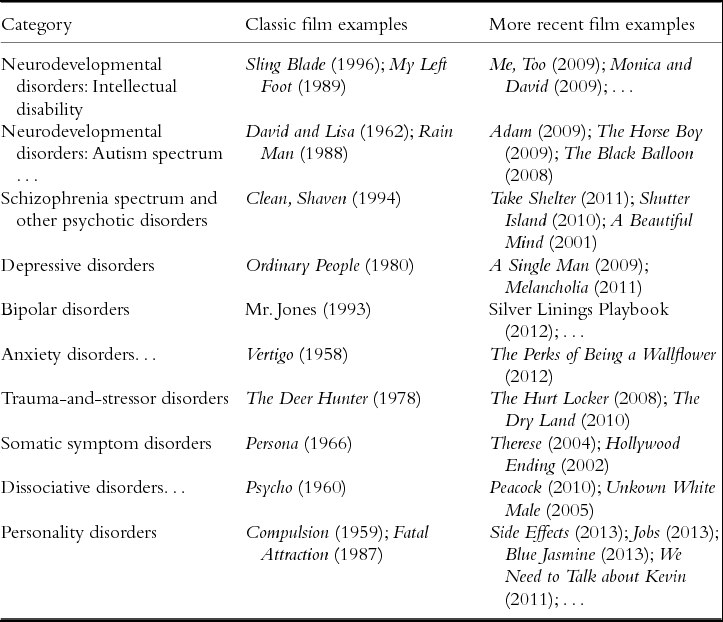
Excerpt from Movies and Mental Illness, Table 2: DSM-5 categories and movies that portray them (Wedding and Niemiec Reference Wedding and Niemiec2014, 9).
The authors of this Table classified movies according to DSM-5, published in 2013; others (Robinson Reference Robinson2003; Poseck Reference Poseck2006a) used the previous edition or referred to diagnostic features as established in the specialized medical literature (e.g. Wijdicks Reference Wijdicks2015, Table 3.3, “Differential Diagnostic Features of Autism Spectrum Disorders”). Europeans might prefer the ICD-10, the tenth, most recent edition of the International Classification of Diseases published by the World Health Organization and in use since 1994, labeling films according to ICD diagnosis codes: F21 (Schizotypal disorder) for James Whale's epoch-making Frankenstein (1931), F32.2 (Major depressive disorder) for Luchino Visconti's Death in Venice (1971), F60.2 (Antisocial personality disorder) for Jonathan Demme's The Silence of the Lambs (1991), F60.5 (Obsessive-compulsive personality disorder) for Josef von Sternberg's The Blue Angel (1930), F60.80 (Narcissistic personality disorder) for Orson Welles’ Citizen Kane (1941), F65.4 (Pedophilia) for Fritz Lang's M (1931), F65.5 (Sadomasochism) for Luis Buñuel's Belle de jour (1968), and so forth (examples from Doering and Möller Reference Doering and Möller2008, whose explicit goal is to further the use of film in the education of doctors, psychologists and psychotherapists). In some cases, as also illustrated in Table 1, the label is tautological: since the main protagonist of Barry Levinson's Rain Man (1988) is an autistic savant, the label can only be F84.0 (Autistic disorder).
DSM or ICD, the result is that the single characters (those who suffer from the identified diagnosis) are picked out at the expense of the film as a totality, and that most movies are assessed for accuracy according to criteria formulated after they were produced. This makes the assessment anachronistic and places realists in a paradoxical situation. While filmic “images of madness need to be understood as facts that are conditioned by their media form, not simply as distortions of timeless truths about mental illness” (Harper Reference Harper2005, 477), the realists’ decontextualizing approach fixates and naturalizes diagnostic categories. At the same time, insofar as it follows the nosographic state of the art, it tacitly admits that its own criteria evolve and implies that they cannot be used to evaluate films that predate them. This is particularly unsettling in connection with DSM, which has undergone major changes and has always been the object of heated controversy (Demazeux and Singy Reference Demazeux and Singy2015; Surís, Holliday, and North Reference Surís, Holliday and North2016). The use of tables or lists to identify and comment on “misleading or incorrect” situations or statements in film and TV is of course not limited to the psychiatric field (for a recent example, on brain death, see Lewis, Weaver, and Caplan Reference Lewis, Weaver and Caplan2016).
The preceding observations are not meant to devalue work that is remarkable in scope, and wishes to promote public awareness of psychiatric conditions and fight the stigmatization of persons with mental illness. Rather, their aim is only to illustrate how realism serves as the foundation of film assessment and constitutes the aesthetic core of the default model implicit in discussions of filmic “images of madness.”
Authenticity and Fidelity (History and Literature)
Realism underlies other areas rich in film analysis, such as history and the adaptation of literature, where the dominant keywords are, respectively, authenticity and fidelity. The deficit turn of mind does not pertain exclusively to the public understanding of science, but is at work in domains where it is not recognized as a “deficit model.” This suggests the significance of aesthetic realism as an overarching epistemic principle, and situates the issues surrounding science communication in a broader cultural and historical framework. Historical feature films share crucial features with movies involving “images of madness”: they assert or imply that they are partly or entirely based on documented empirical facts; the filmic representation of those facts is said to shape spectators’ beliefs and attitudes; and since these are considered to have social significance, it seems important to assess films for accuracy. We find here the dual concern of the mimeticist tradition – with the status of the work of art and with the experiences it affords – as well as the belief that cinema must instruct and can do so only by being truthful.
In connection with literature, adaptation theory is “one of the oldest areas in film studies” (Leitch Reference Leitch2007, 1). It has long been characterized by a “profoundly moralistic” language, “awash in terms such as infidelity, betrayal, deformation, violation, vulgarization, and desecration, each accusation carrying its specific charge of outraged negativity” (Stam Reference Stam and Naremore2000, 54). To the extent that such outrage reflects the “intensely subjective” nature of judgment (Whelehan Reference Whelehan, Cartmell and Whelehan1999, 3), “fidelity criticism” is doomed: “the critic who quibbles at failures of fidelity is really saying no more than: ‘This reading of the original does not tally with mine in these and these ways’” (McFarlane Reference McFarlane1996, 8–9). That critic, however, implicitly holds the Kantian notion of subjective universality, according to which judgments of taste stem from individual responses of pleasure or displeasure but also claim universal validity. Moreover, the sense that a masterpiece was defiled is political insofar as it entails a view about the cultural values necessary for the collective good. In that respect, the passion animating discussions about adaptation is akin to the one driving debates about filmic “images of madness” and, as we shall see, the realist position with regard to historical film.
In his seminal Novels into Film, George Bluestone criticized the norm of fidelity, wryly noting, “It is as fruitless to say that film A is better or worse than novel B as to pronounce Wright's Johnson Wax Building better or worse than Tchaikowsky's Swan Lake” (Bluestone Reference Bluestone1957, 5–6). Since then, there have been many calls to treat adaptation as a contextual and intertextual process. The notion of fidelity has been criticized for being “essentialist” in relation to the media involved (the text has a core truth that film can truthfully render), as well as for disregarding the specificities of each and ignoring the ways by which texts become pictures, such as selection, amplification, concretization, actualization, extrapolation, popularization or reculturalization. The field of adaptation studies, which has incorporated new forms of intertextuality – such as novelizations (film to novel adaptations), films based on comic strips, or films that feel like (but are not) literary adaptations – and which has come to accept the “democratizing effect” of filming literature (Cartmell Reference Cartmell and Cartmell2012), is no longer haunted by the “heresy of paraphrase” (the notion that a poem cannot be reworded because its content cannot be abstracted from its form). The field periodically publicizes “new approaches” and “new directions” (e.g. Albrecht-Crane and Cutchins Reference Albrecht-Crane and Cutchins2010; Bruhn, Gjelsvik, and Hanssen Reference Bruhn, Gjelsvik and Hanssen2013), and has recently experienced attempts at shifting its “dominant framework from the analysis of cine-literary case studies to the socio-cultural mechanisms and political economies that determine their value” (Hassler-Forest and Nicklas Reference Hassler-Forest, Nicklas, Hassler-Forest and Nicklas2015, 2–3).
Some scholars, however, have positively reconsidered the question of “truth to the spirit” (MacCabe, Murray, and Warner Reference MacCabe, Murray and Warner2011). Such reconsideration is understandable because, no matter how theoretically discredited, fidelity retains “a grain of experiential truth” (Stam Reference Stam, Stam and Raengo2005, 14). But this grain of truth is, precisely, experiential; and insofar as the fidelity judgment is subjective, it questions the existence of an essence of the origin text, while depending on that essence to be more than mere opinion. In such inherent subjectivity resides one of the differences between fidelity in adaptation, and accuracy and authenticity in the filmic “portrayal” of science and history. The reason why a filmed Anna Karenina may accurately stage episodes from the novel and yet be unrecognizable as Tolstoy's work is that viewers’ judgment and experience do not primarily concern the novel's contents or the material world it depicts. In short, “the sign of the problematic of adaptation is the signature of the author” (Andrew Reference Andrew, MacCabe, Murray and Warner2011, 27).Footnote 13
In contrast, in movies dealing with science and history, even when there is a source text (and there have been many from the Bible onward), the referents are not the texts themselves (e.g. DSM or a particular history book), but their empirical subject matter. If psychiatry defines paranoia by certain features, then these are the ones that a movie must stage to depict paranoia accurately; similarly, historical events in film should be based on historical research and testimony. Of course there are mixtures (films depicting an historical event or mental illness have often been based on novels), as well as polemics and disagreements; a filmmaker (such as Oliver Stone in JFK, his controversial 1991 conspiracy thriller about Kennedy's assassination) can choose to dramatize the least consensual interpretation of events. Nevertheless, the mere transference of knowledge from one medium to another – from DSM or historical scholarship to the screen – functions as a paraphrase and is not considered an obstacle to passing accuracy judgments.
The debate around Ava DuVernay's Selma (2014) is exemplary. The movie tells the story of the three marches that took place from Selma to the Alabama capital Montgomery in March 1965 to protest the obstructions suffered by African-American citizens when registering to vote. Central elements of the story include the “Bloody Sunday” when state troopers attacked the unarmed marchers, as well as meetings between Martin Luther King Jr. and U.S. President Lyndon B. Johnson. This widely acclaimed movie inspired the usual “fact-checking” (e.g. Labrecque Reference Labrecque2015), but controversy broke out around Johnson. Former aides complained that the film portrayed him as patronizing, confrontational, and reluctant to protect civil rights. Andrew Young, the future mayor of Atlanta and U.S. ambassador to the U.N. who was at Selma and is pictured in the film, praised the movie, but questioned its depiction of the interaction between King and Johnson. “Everything else,” he said, “they got 100 percent right” (Tumulty Reference Tumulty2014). Whereas an analysis of African-American media concluded that Blacks in the civil rights movement would disagree most with Selma’s depiction of Johnson (Tillery Reference Tillery2015), for some viewers the movie “is more than fair to L.B.J.” (Davidson Reference Davidson2015). And while a critic lamented that “a generation of young moviegoers would now see L.B.J.’s role in civil rights through DuVernay's lens” and observed, “On matters of race – America's original sin – there is an even higher responsibility to be accurate” (Dowd Reference Dowd2015), another explained that Selma’s value “has less to do with strict adherence to the facts than with stirring images, riveting drama and authentic deep emotion” (Hornaday Reference Hornaday2015). Selma, a film scholar declared, “is not education, it's mobilization” (quoted in Buckley Reference Buckley2015).
But emotions too differ widely. Thus, while one viewer experienced the performance of Johnson's voting rights act speech (televised and delivered before a joint session of Congress on 15 March 1965) as “one of the most affecting moments of the movie” (Hornaday Reference Hornaday2015), another wrote, “Here the movie fails miserably, deliberately playing down the drama of the occasion” and draining “of its force” one of Johnson's “most significant and passionate” speeches (Drew Reference Drew2015). The paradox is that whereas Johnson's words in the movie are those of his speech in real life (and yet they may have sounded false), King's stirring speeches in Selma (which struck audiences as true) are not: since the Martin Luther King Jr. estate had licensed the right to use them on screen to DreamWorks and Warner Bros. for a Steven Spielberg biopic, DuVernay could not cite King's own words. King's speeches are found entirely acceptable not (or not only) because external factors made them inevitably “inaccurate,” but primarily because they feel authentic. What ultimately counts is that Selma’s “emotive account rings true with witnesses” (von Tunzelmann Reference von Tunzelmann2015).
What matters most, then, is not accuracy, but this “ringing true” – in other words, authenticity, the quality the Nature critic found lacking in The Theory of Everything and The Imitation Game. The French historian Marc Ferro, a pioneer in thinking about cinema and history, noted “that historical reconstructions [in film] may have hardly any historical reality” and yet enact the past in such exemplary manner that they shape our understanding of it (Ferro [1975] Reference Ferro, Ferro and Greene1988, 84). Similarly, as Natalie Zemon Davis pointed out, “the credibility and genuine historicity” of a film do not depend on a realistic mode of representation (Reference DavisDavis 1986–87, 464). Those qualities can be understood in the realist mode of mainstream public commentary, which is also many filmmakers’ default mode: “a movie that looks like the past is like the past” (Carnes Reference Carnes2004, 47) – even though, as amply documented (e.g. in Carnes Reference Carnes1995), historical films are riddled with inaccuracies, fabrications and every sort of deviation from the historical record. At the opposite extreme of the realist turn of mind, some claim that historical films “are all fictional,” and that historians who go fact-checking worry “about a meaningless question” (Sorlin [1981] Reference Sorlin and Landy2001, 37–38). The tension in this area is highest with regard to Holocaust cinema, which is riddled with debates on the possibility and legitimacy of dramatizing the Shoa, on the risk of trivialization, on facticity and authenticity, on artistic freedom, and on the moral and intellectual dangers of fictionalizing historical truth (e.g. Baron Reference Baron2005; Bösch Reference Bösch2007).Footnote 14
Contemporary scholarship tends to fall in between, approaching history film as a mode of historical reflection and historiographical exploration or as an opportunity to probe contemporary concerns, and asking why a film represents the past as it does, rather than if it does so accurately (e.g. Burgoyne Reference Burgoyne2008; Palmer Reference Palmer2009, chaps. 1–2; Rosenstone and Parvulescu Reference Rosenstone and Parvulescu2013). Nevertheless, the tension between accuracy and authenticity will not go away (Stubbs Reference Stubbs2013, chap. 2). The realism of a historical film, materialized in “period” visual information, sustains the feeling that the picture possesses nominal authenticity, i.e. that which in art distinguishes a genuine work from a forgery. The nominally authentic film looks so much like the past that we see the fictionalized world as an accurate representation of “how it really was.” Such a movie can nonetheless be experienced as lacking expressive authenticity, i.e. that which truthfully expresses the sense, meaning, spirit or nature of the dramatized characters and events.Footnote 15 That is why Selma may misrepresent L.B.J. and at the same time “feel” perfectly true.
A Surplus of Meaning
Lots of details are right, and still the overall picture feels fake; or many details are wrong, yet the film seems to capture the essence of the dramatized characters and situations: such is the paradox of attempts at judging fiction movies on the basis of whether they accurately represent knowledge, persons, and events. The affinity in this respect between science-themed pictures, historical film, and cinematic adaptations of literature has remained unnoticed. It is nonetheless significant because it unveils a realist aesthetics at the core of the deficit model, and helps account for its resilience. The “deficit” mentality, which spontaneously drives judgment among scientists and scientific commentators, and contributes to inspiring science communication programs at the highest levels of policymaking, presupposes aesthetic realism. Filmic adaptations of literature may appear to lack the political import of pictures dealing with mental illness or historical events of contemporary relevance. Nevertheless, how they are judged also depends on the cultural, moral, and political significance attributed to the source texts, on the purposes adaptations are understood to serve, and on the impact they are believed to have.
The deficit model focuses on the gap that separates fiction from fact. A film is praised if the gap is narrow, and criticized if it is broad. Such a gap patently exists, and – as highlighted by the persistence of the deficit model – it has long seemed appropriate to focus on it in the case of science. But such focus implies two problematic assumptions about both science and film. First, it suggests that scientific knowledge is produced in isolation from non-scientific contexts, especially those of its public dissemination. Yet the cinema has long been “an ideal vehicle for establishing a technology's necessity, its viability and its benevolence within society” (Kirby Reference Kirby2010b, 66); reciprocally, film references in scientific articles are not infrequent and help convince readers or underscore positive or negative aspects of a scientific development (Levin and De Filippo Reference Levin and Filippo2014). Second, the deficit model obliterates factors, such as entertainment appeal, “filmability,” and storytelling, which in a filmmaker's perspective necessarily take precedence over accuracy. Scientific expertise may contribute to verisimilitude, but never dictates a movie's factual content (Kirby Reference Kirby2003).
While the production of filmic truthfulness involves numerous visual and dramatic ingredients, “deficit” assessments approach movies as depictions or portrayals to be judged chiefly on the basis of their likeness to what those who judge consider most relevant with regard to the reality of interest. Accuracy in a realist vein gains importance by being isolated from other features of a movie's entire “rhetorical apparatus,” and this isolation facilitates its political use, as when the identification of “errors” provides ammunition for one side in a controversy (Mellor Reference Mellor2009). By the same token, it obliterates the intrinsic polysemy of film. Contrary to what the deficit model implies, films complexify rather than simplify. Their crucial epistemological feature, as that of images in general, is that they are “irreducible to propositions alone” (Galison Reference Galison, Carusi, Hoel, Webmoor and Woolgar2014, 204). They proclaim that there is not a unique normative standard against which to judge what happens on screen; and they do so with specifically cinematographic means, which may convey ambivalence and contradiction, or simultaneously display ostensibly incompatible claims.Footnote 16 Such impurity does not evince inconsistency or informational deficit, but reveals the cinema's ability to beget signification beyond what is needed to instruct and learn, as well as its potential to unfold the complexity of the questions raised by and about science while suggesting that there are no univocal answers. The mode of criticism at work in the deficit model of the public understanding of science seems to negate that capacity of film; yet, both by its intrinsic efficacy and the debates it inspires, it too contributes to the surplus of meaning it otherwise tends to foreclose.
Acknowledgments
I wrote this article during a stay as Visiting Scholar in Department II of the Max Planck Institute for the History of Science, Berlin. I thank Lorraine Daston for her invitation and the Institute's library staff for their dedicated assistance. Research has been partly supported by the Generalitat de Catalunya (grant AGAUR 2017 SGR 1138).



