





Policy significance statement
As the integration of algorithmic systems in public administration grows, effective governance tools have become essential. Our analysis of the instruments currently on the policy agenda reveals two critical insights for policymakers. First, these instruments not only aim to mitigate specific risks but also institutionalize particular notions of risk. Policymakers should pay close attention to the value judgments and priorities embedded in instruments. Second, to improve the governance of algorithmic systems, we recommend adopting a reflexive governance approach, which situates the algorithmic systems within their socio-technical context and emphasizes continuous learning. While quick fixes still dominate the agenda, there is a rising awareness of the need for more substantial measures, ultimately leading to a more robust and adaptive governance framework.
1. Introduction
All over the world, algorithmic systems are being introduced in public administration to improve, for example, policy processes, public services, and access to information. An early example can be found in Singapore, where algorithms have been in use since 2011 to improve the functioning of public transport systems (Maciejewski, Reference Maciejewski2017). Another example is the online reporting tool at the Dutch National Police that helps process reports of online fraud (Soares et al., Reference Soares, Grimmelikhuijsen and Meijer2024). The advantages of algorithmic systems in public administration decision-making processes are often considered to be personalization, scalability, efficiency, and transferability across different sectors (Dencik et al., Reference Dencik, Hintz, Redden and Warne2018; Levy et al., Reference Levy, Chasalow and Riley2021). The strong belief in the potential of algorithmic systems to increase personalization, scalability, and efficiency has led to an increased use of algorithmic systems in the public sector, which is considered a form of technological solutionism (Hoekstra et al., Reference Hoekstra, Chideock and Van Veenstra2021; Lindgren and Dignum, Reference Lindgren and Dignum2023; Soares et al., Reference Soares, Grimmelikhuijsen and Meijer2024).
Disadvantages of algorithmic systems in public administration decision-making processes that are often mentioned are the lack of transparency (Watson and Nations, Reference Watson and Nations2019), a diminishing degree of discretionary power of civil servants (Busch and Henriksen, Reference Busch and Henriksen2018; Bullock et al., Reference Bullock, Young and Wang2020), a risk of discrimination, a risk of unfair treatment, and a large environmental impact (Grimmelikhuijsen and Meijer, Reference Grimmelikhuijsen and Meijer2022). Furthermore, some argue that increased transparency about the algorithmic systems and the data used to train these systems is a necessity for public accountability (Arrieta et al., Reference Arrieta, Díaz-Rodríguez, Del Ser, Bennetot, Tabik, Barbado, García, Gil-López, Molina and Benjamins2020; Walmsley, Reference Walmsley2021); others state that this could harm innovation and encourage people to “game the system” (Hartholt, Reference Hartholt2018; Cofone and Strandburg, Reference Cofone and Strandburg2019; Bannister and Connolly, Reference Bannister and Connolly2020).
In recent years, there have been several incidents where the use of an algorithmic system in a public administration decision-making process has led to discrimination, such as the Childcare Benefits scandal (a political scandal involving false allegations of welfare fraud by the Tax and Customs Administration against thousands of families claiming childcare benefits. This resulted in demands to repay their received allowances in full, causing severe financial hardship for many families.) (Amnesty International, 2021) and the DUO scandal (the Dutch Education Executive Agency (DUO) used an algorithmic system to flag students for fraud. The process targeted students based on arbitrary risk factors that disproportionately targeted students from immigrant backgrounds.) in the Netherlands (Heilbron et al., Reference Heilbron, Kootstra and van Nuland2023; Schravesande, Reference Schravesande2023), the Robodebt Scandal in Australia (Van Krieken, Reference Van Krieken2024), or the MiDAS scandal in the United States (Charette, Reference Charette2018). Such public examples of failures have sparked an intense debate surrounding transparency, accountability, and fairness in using algorithmic systems. Furthermore, as Artificial Intelligence (AI) and algorithmic systems in general become increasingly embedded in society and the public sector, new legislation has also appeared, accompanied by several audit and risk assessment instruments. For example, the increased collection and processing of personal data for use in algorithmic systems under the GDPR comes with the obligation to perform a Data Protection Impact Assessment (DPIA) in certain cases. Similarly, article 27 of the EU AI Act requires a fundamental rights impact assessment for high-risk systems. In the Netherlands, the Fundamental Rights and Algorithms Impact Assessment (FRAIA) (Gerards et al., Reference Gerards, Schäfer, Muis and Vankan2022) is aimed at increasing public accountability and transparency of algorithmic systems.
This debate about the advantages and disadvantages of the use of algorithmic systems in the public sector is a manifestation of ongoing debates about the use of technology in society. Using large amounts of data and statistical methods to rationalize and automate governmental decision-making processes is not a recent phenomenon, as automated systems have been used in the public sector for several decades (Levy et al., Reference Levy, Chasalow and Riley2021). Nor is the call for more transparency and control of government organizations unprecedented—Power (Reference Power1997) already highlighted this in his book “The Audit Explosion,” in which he observed a surge in auditing practices across various sectors, driven by a growing demand for accountability and assurance in an increasingly complex and risk-averse society. To deal with this growing demand, instruments such as audits created an illusion of control (Power, Reference Power1997), where Power famously observed that these instruments do not just reflect existing risks but actively construct and operationalize them. Risk management instruments are not neutral or objective in observing risk; rather, they actively shape how risk is perceived.
Building on Power’s (Reference Power1997) concept of the audit society, this article examines how governance instruments for algorithmic systems are developed and framed in the media, advisory reports, and parliamentary documents, as they do not merely respond to risks but actively construct and institutionalize specific notions of risk in governance. While specific instruments, such as the algorithm register (Cath and Jansen, Reference Cath and Jansen2021; Nieuwenhuizen, Reference Nieuwenhuizen2024), or ethical and legal guidelines (Fest et al., Reference Fest, Wieringa and Wagner2022), have been studied, the broader discussion around the emergence of governance instruments for algorithmic systems has not yet been investigated. For this reason, this article addresses the following research question: how are notions of risk constructed and institutionalized in instruments for the governance of algorithmic systems?
As the Netherlands is a frontrunner (as set out in the State of the Digital Decade report of 2024 and 2025 [European Union 2024, 2025]) in digitalized public services and has seen several scandals involving algorithmic systems, this article systematically examines which discourses around algorithmic risk make it onto the Dutch political agenda and in what way governance instruments can manage or mitigate these risks. The discussions in the European Union around the regulation of AI have also influenced the discourses in the Netherlands, in particular concerning the AI Act. By examining the interplay between problems, policies, and politics, this study identifies key factors that shape problem framing and governance choices. Using a discourse analysis of media articles, advisory reports, and parliamentary documents, the research provides a deeper understanding of the dynamics that drive the governance of algorithmic systems and the creation of governance instruments.
The article makes two key theoretical contributions to the literature on the governance of algorithmic systems (Lorenz et al., Reference Lorenz, Erp and Meijer2022; Ulbricht and Yeung, Reference Ulbricht and Yeung2022). First, it extends and refines Power’s (Reference Power1997) theory of audits and governance instruments more broadly, as rituals of verification: our analysis reveals the emergence of a call for substantive auditing practices, with instruments that aim to foster learning and long-term risk management, in addition to more superficial and ritualistic instruments. This suggests a shift in the institutional forces shaping regulatory practices, as less attention is paid to so-called “quick fixes.” Our second theoretical contribution integrates the role of the media and mediatization (Strömbäck, Reference Strömbäck2008) into Kingdon’s (Reference Kingdon1984) streams framework to better explain why certain governance instruments are selected over others. By incorporating mediatization, we highlight how media logic shapes the selection and framing of governance instruments, prioritizing those that align with the demand for clear, simplified narratives and immediate, technical solutions over more complex, long-term governance approaches. These framings of governance instruments add to more substantive debates on the governance of algorithmic systems by highlighting how these framings influence the constructed nature of current governance approaches. As a result, governance instruments continue to frame algorithmic risk primarily as a technical issue, focusing on the technical aspects of an algorithmic system, rather than addressing broader sociopolitical concerns.
2. Theoretical framework
2.1. The construction of algorithmic risk: technological and human framings
The rapid rise of algorithmic systems has been accompanied by a rising concern about the risks posed by these systems. Algorithmic systems aimed at aiding decision-making come with additional risks, such as bias, opacity, and accountability concerns (Arrieta et al., Reference Arrieta, Díaz-Rodríguez, Del Ser, Bennetot, Tabik, Barbado, García, Gil-López, Molina and Benjamins2020; Walmsley, Reference Walmsley2021; Williams et al., Reference Williams, Cloete, Cobbe, Cottrill, Edwards, Markovic, Naja, Ryan, Singh and Pang2022), which in turn have led to the discussion of creating (additional) governance instruments, including but not limited to algorithm audits, explainability requirements, and ethical guidelines. Understanding the dynamic of the creation of governance instruments is crucial for evaluating whether governance instruments for algorithmic systems serve as meaningful safeguards or primarily function to create an appearance of control in an increasingly complex technological landscape.
The governance of algorithmic risks is by no means a unique phenomenon. As modern societies have become increasingly complex, they have transformed into what Beck (Reference Beck1992) describes as “risk societies,” where social, environmental, and technological risks dominate public debates. In response, governance instruments have gained prominence as tools to manage and mitigate these risks, shaping policy interventions and institutional practices. Power (Reference Power1997) identified a dual role of these governance instruments: they serve as responses to risk but also shape how risks are perceived, categorized, and managed.
Two main framings of algorithmic risks can be found in scientific literature. The first focuses on so-called technological risks—either focusing on incomplete data, not enough data to build an accurate model, or an incorrect mathematical formula to capture certain public values (Oswald et al., Reference Oswald, Grace, Urwin and Barnes2018; Osoba et al., Reference Osoba, Boudreaux, Saunders, Irwin, Mueller and Cherney2019; del Barrio et al., Reference del Barrio, Gordaliza and J-M2020; Saxena et al., Reference Saxena, Moon, Chaurasia, Guan and Guha2023). This framing emphasizes the epistemic limitations of algorithmic systems, where the reliability of the predictions is dependent on the quality and representativeness of the data used for training the model (Binns, Reference Binns2018; Ferrario et al., Reference Ferrario, Facchini and Termine2024). Another example of a technological risk is the concern about the opacity of the system, particularly when algorithmic systems generate outcomes that are not easily interpretable by their designers (Burrell, Reference Burrell2016; Rehill and Biddle, Reference Rehill and Biddle2024). At times, the model itself is considered not to be understood and tested enough before and during deployment (Waller and Waller, Reference Waller and Waller2020; Hauer et al., Reference Hauer, Krafft and Zweig2023).
The second framing of risk focuses less on the algorithmic systems and more on the humans behind or in algorithmic systems. The focus lies on the process of “algorithmization,” the process in which an organization rearranges its working routines around the use of algorithms (Meijer and Grimmelikhuijsen, Reference Meijer and Grimmelikhuijsen2020; Meijer et al., Reference Meijer, Lorenz and Wessels2021). Risk is not located in the algorithmic system but throughout the socio-technical context, with more attention paid to human-centered risk. Responsible algorithmization is a form of risk mitigation for this type of risk. This can mean focusing on more human oversight or algorithmic systems with a human-in-the-loop, or on increased explainability that enables users to understand algorithmic decisions (Arrieta et al., Reference Arrieta, Díaz-Rodríguez, Del Ser, Bennetot, Tabik, Barbado, García, Gil-López, Molina and Benjamins2020; Benedikt et al., Reference Benedikt, Joshi, Nolan, Henstra-Hill, Shaw and Hook2020; Meijer et al., Reference Meijer, Lorenz and Wessels2021; Haitsma, Reference Haitsma2025). Giest et al. (Reference Giest, McBride, Nikiforova and Sikder2025) propose introducing safeguards that are part of the institution, acknowledging risks like bias and privacy concerns. Another proposal for increasing responsible algorithmization focuses on ethical guidelines for civil servants working with these systems (Mökander, Reference Mökander2023).
Echoing Power (Reference Power1997), the broader literature on algorithmic governance and regulation (Ulbricht and Yeung, Reference Ulbricht and Yeung2022; Wieringa, Reference Wieringa2023) laments that risk is too often framed in technical terms, instead of in a more complex and human-centered way. The current governance instruments are said to prioritize procedural compliance over substantive engagement. Procedural compliance refers to the adherence to formal rules and checklists, often reducing governance to box-ticking exercises that prioritize administrative convenience over meaningful outcomes (Black, Reference Black2008). In contrast, substantive governance instruments are designed to address the root causes of risks and foster adaptive, context-sensitive solutions that align with societal values and needs. While the literature on algorithmic governance effectively critiques the focus on technology-centered solutions as these do not address underlying causes of risk, it largely assumes rather than explains why such technical solutions prevail and tends to focus on specific cases rather than examining broader and historical patterns of governance (Wieringa, Reference Wieringa2023). This research addresses this gap by systematically examining how and why certain governance instruments make it onto the Dutch political agenda in the first place. A helpful heuristic to understand this agenda-setting process is Kingdon’s (Reference Kingdon1984) Multiple Streams Framework, which offers tools to analyze how problem definitions, policy proposals, and political dynamics interact to influence which governance tools are put forward and which are set aside.
2.2. The construction of algorithmic governance instruments: problems, policies, and politics
The governance of algorithmic systems is shaped by complex political processes that influence problem framing, solution proposals, and actual decision-making. Kingdon’s Multiple Streams Framework (MSF) helps explain why specific policies gain traction over others, even when multiple options for governance exist. Decision-making processes are often constrained by limited information, time pressures, and uncertainty about whether proposed policies will work. Furthermore, as policy problems, potential policies, and political conditions are constantly shifting, the connection between the three streams is not always obvious (Hoefer, Reference Hoefer2022).
Central to the governance of algorithmic systems is the framing of the problem—the first stream of the MSF. Issues such as algorithmic bias or lack of transparency might not automatically be seen as problems, but are framed in such a way as to prompt political action (Kingdon, Reference Kingdon1984; Kordzadeh and Ghasemaghaei, Reference Kordzadeh and Ghasemaghaei2021; Günther and Kasirzadeh, Reference Günther and Kasirzadeh2022; Hoefer, Reference Hoefer2022). Different actors, including but not limited to policymakers, technology experts, and civil society groups, offer varying interpretations of algorithmic systems and attempt to convince others that an intervention based on their specific problem framing is necessary (Saurugger, Reference Saurugger2016). Knaggård (Reference Knaggård2016) expands on this idea by introducing the concept of knowledge-brokers, who frame issues of governance of algorithms without necessarily proposing immediate policies. Thus, problems and policy alternatives can develop independently, and policies may emerge without a direct link to the problem they are intended to address.
The second stream of the MSF, public policies, can be presented as the ideal solution to a specific issue (Kingdon, Reference Kingdon1984). Similar to the problem framing, these policies are not only based on purely scientific evidence but are also influenced by ideologies and norms. Hoefer (Reference Hoefer2022) points out that policies are not merely proposed by political actors—academics, think tanks, and experts also play key roles in developing and promoting policies. These policies are often linked to governance instruments: tools, mechanisms, or frameworks used by public sector organizations to implement policies, manage resources, and regulate behavior to achieve specific objectives (Hood, Reference Hood1986).
The political stream, the third and final stream of the MSF, includes the national mood, the actions of elected officials, and the influence of interest groups (Kingdon, Reference Kingdon1984). When a window of opportunity arises, policy entrepreneurs can link a problem—for example, focusing on transparency when using algorithmic systems—to a solution—creating more human oversight—and turn this into policy (Cairney and Jones, Reference Cairney and Jones2016; Levy et al., Reference Levy, Chasalow and Riley2021). Coupling problems, policies, and political conditions is done by a Policy Entrepreneur, who seizes the opportunity to bring the streams together and secure the support needed for implementation (Kingdon, Reference Kingdon1984; Hoefer, Reference Hoefer2022). Windows of opportunity often stem from changes in indicators or focusing events (Rüb, Reference Rüb2016). Changes in indicators, such as reports or statistics, can signal that an issue has become critical and requires immediate action. Focusing events, like significant failures of an algorithmic system used in decision-making, attract media attention and can shift public opinion, prompting calls for different government policies.
While the role of the media in agenda-setting is treated by Kingdon (Reference Kingdon1984) as an indirect influence, the media is not explicitly included in the MSF. However, the media increasingly plays an important role as a source of information for citizens, as well as a channel of communication between policymakers, the citizenry, and between different organizations in the public sector (Strömbäck and Esser, Reference Strömbäck, Esser, Esser and Strömbäck2014). Especially if stakeholders are divided about the way policy issues should be understood or handled, the role of the media can be more critical, and government and other political actors are more obliged to respond to demands emerging from (social) media (Grossman, Reference Grossman2022). Media coverage, therefore, plays a crucial role in shaping how algorithmic systems are perceived and thus governed, alongside the broader political and societal context in which these policies are developed, debated, and implemented, and through which societal biases are reinforced or changed (Ingram et al., Reference Ingram, Schneider and DeLeon2019).
2.3. Conceptual framework for studying the construction of algorithmic governance instruments and the construction of algorithmic risk
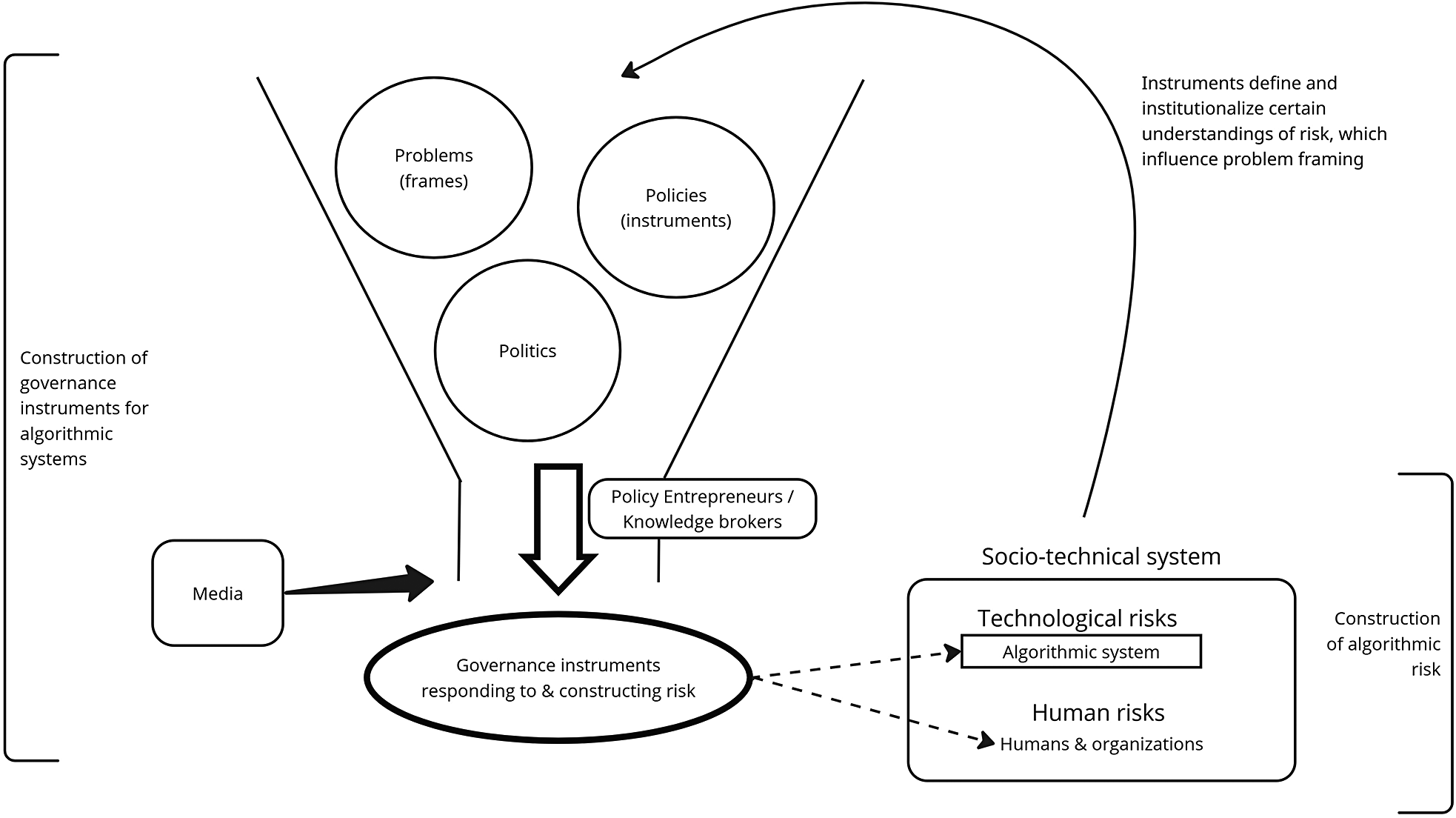
The ideas discussed so far can be brought together in this conceptual framework (see Figure 1) that will guide the analysis of this article. The framework visualizes the construction of governance instruments and the concurrent construction of algorithmic risk. It highlights how governance instruments emerge in response to concerns about algorithmic systems while shaping the perception and categorization of algorithmic risks. At the top of the figure, the problems, policies, and politics streams from Kingdon’s MSF structure the policy process. The media plays a role in shaping public discourse and influencing problem definitions. From this policy process, governance instruments emerge as responses to algorithmic risk, constructed through different actors such as policy entrepreneurs and knowledge-brokers. These instruments can construct risk through two primary framings: technological and human-centered. The framing affects how notions of risk are understood and can further influence the problem framing.
Conceptual framework: understanding the construction of algorithmic governance instruments and the construction of algorithmic risk.

Figure 1. Long description
The diagram is divided into two main sections. On the left, a large funnel represents the Construction of governance instruments for algorithmic systems. Inside the wide top of the funnel are three circles labeled Problems (frames), Policies (instruments), and Politics. A large downward arrow points from these circles through the neck of the funnel toward an oval at the bottom labeled Governance instruments responding to and constructing risk. To the left of the funnel neck, a box labeled Media points an arrow inward. To the right of the funnel neck, a rounded box is labeled Policy Entrepreneurs / Knowledge brokers.
On the bottom right, a section labeled Construction of algorithmic risk contains a box titled Socio-technical system. Inside this box, two dashed arrows from the governance oval point to Technological risks (Algorithmic system) and Human risks (Humans and organizations).
A long, curved feedback arrow originates from the right side of the diagram and points back to the top of the funnel. Text next to this arrow reads: Instruments define and institutionalize certain understandings of risk, which influence problem framing.
This framework thus captures the recursive relationship between governance instruments and algorithmic risk: on the one hand, governance instruments are constructed to respond to (perceived) risks, while on the other hand, these governance instruments define and institutionalize certain understandings of risk, shaping the future governance landscape. In this article, this framework will be applied to examine the Dutch societal context to investigate the processes that shape the construction of governance instruments. This analysis will provide insight into how notions of risk are constructed and institutionalized in instruments for governing algorithmic systems, and whether these instruments effectively address the complexities of algorithmic decision-making or merely serve symbolic purposes.
3. Methodology
To analyze how notions of risk are constructed and institutionalized in instruments for the governance of algorithmic systems, we conducted a discourse analysis on Dutch documents. Combining Kingdon’s Multiple Streams Framework with discourse analysis can enhance insight into connections between the three different streams and show how policy entrepreneurs make use of windows of opportunity (Winkel and Leipold, Reference Winkel and Leipold2016). By considering the three streams of the MSF (problems, policies, and politics) as discursive patterns, the framework allows for a nuanced understanding of how these streams interact and influence each other through language and communication. Additionally, the discourse approach sees policy entrepreneurs as discursive agents who actively shape and manipulate problem and policy narratives, highlighting the way policy entrepreneurs connect the streams and mobilize support for their connections of problem, policy, and politics (Fischer, Reference Fischer2003; Winkel and Leipold, Reference Winkel and Leipold2016). Using discourse analysis to examine the three streams and the role of policy entrepreneurs highlights the influence of social construction in policy-making.
3.1. Data selection
Three categories of sources for the discourse analysis were chosen to provide a comprehensive overview: media articles, advisory reports, and parliamentary documents. Media articles often align with the problem stream because they highlight issues that capture public attention, and news coverage can drive awareness, frame problems, and trigger public concerns (De Vreese, Reference De Vreese, Esser and Strömbäck2014). Advisory reports fit well in the policy stream because they often contain expert analyses, policies, and advocacy viewpoints (Tortajada, Reference Tortajada2016; Fraussen and Halpin, Reference Fraussen and Halpin2017). These reports can provide detailed recommendations that may influence policymakers. Policy documents are especially relevant to the politics stream, as they reflect the official stance of public organizations and can help illuminate how certain issues make it to the official agenda. However, these document categories are not limited to a single stream—for example, a media article may also discuss policies or political stances, and advisory reports can also highlight urgent problems or political choices (Hoppe, Reference Hoppe2010). This overlap provides a nuanced understanding of the connections between and framings of problems, policies, and political forces in agenda-setting (Fischer, Reference Fischer2003). A reference to the documents cited in the article can be found in Supplementary Annex 2. The complete dataset has been shared on Zenodo (Schepers et al. Reference Schepers, Bex, Kempeneer and Meijer2026)
3.1.1. Media articles
A systematic search strategy was used to identify the relevant media articles for this article. The initial search query focused on “AI AND/OR algoritm*” (Dutch for algorithm*), as this would also capture articles focusing on, for example, “algorithmisch schandaal” (algorithmic scandal) or “algoritmes maken beslissingen” (algorithms make decisions). To narrow down the search further, articles between the 1 January 2018 and the 15 July 2024 were selected, where “algoritm*” appeared in the title or first paragraph of the article. Five national newspapers were selected to provide a range of societal views, from right-wing populism to left-wing progressivism, including center-liberal and central-right viewpoints (The five newspapers included in the search were Het Financieele Dagblad [center-right orientation with a strong focus on market and business news], NRC Handelsblad [center/liberal orientation], De Telegraaf [right-wing populist orientation], Trouw [center-right orientation with a protestant leaning], and De Volkskrant [left-wing orientation]). With these additional criteria, 1,222 media articles were selected after filtering out duplicate articles, of which 144 were considered relevant for the study. However, as newspaper subscriptions decline and many consume news through social media platforms (Vermeer and Kormelink, Reference Vermeer, Kormelink, Schapals and Pentzold2024), it is important to take into account that there might be additional perspectives shared on these platforms not taken into account in this article.
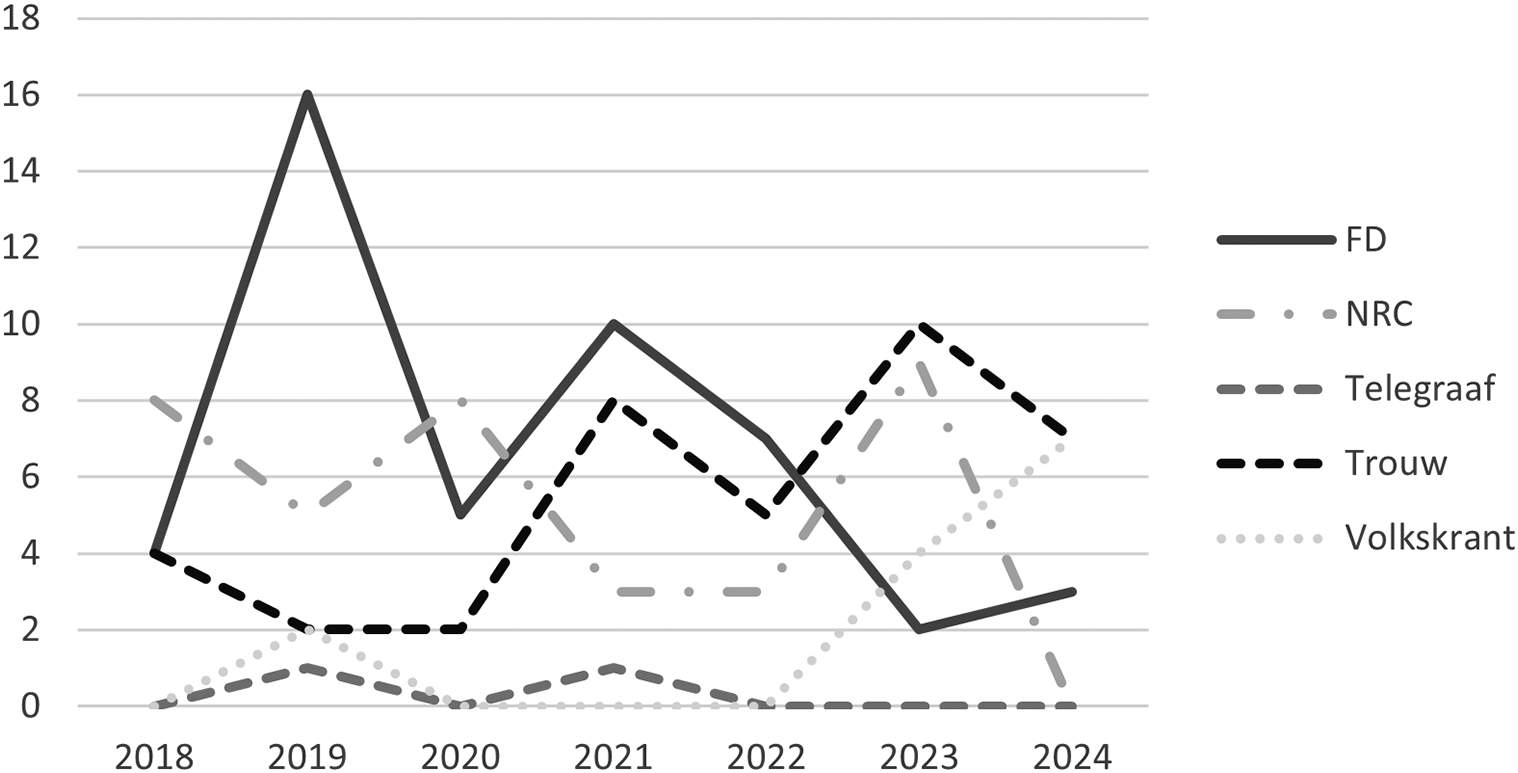
These articles were then read in their entirety and selected for further analysis and coding if they met the following criteria: the article (1) explicitly discussed the implementation, use, or impact of algorithms in public sector organizations and processes; (2) focused on the role of algorithms in official decision-making processes; and (3) addressed challenges and/or policies related to the governance of algorithms. As the search query was intentionally quite broad, a large number of articles were selected as not relevant. In total, 135 media articles were selected for coding from these newspapers (see Figure 2).
Relevant articles per newspaper per year.

Figure 2. Long description
The X-axis represents years from 2018 to 2024. The Y-axis represents the number of articles, ranging from 0 to 18 in increments of 2. Five newspapers are tracked.
* F D (solid black line): Starts at 4 in 2018, peaks sharply at 16 in 2019, drops to 5 in 2020, rises to 10 in 2021, then declines to 2 in 2023 before a slight rise to 3 in 2024.
* N R C (dash-dot grey line): Starts at 8 in 2018, fluctuates between 5 and 8 through 2021, peaks at 9 in 2023, and drops to 0 in 2024.
* Telegraaf (dashed grey line): Remains very low, starting at 0, peaking at 1 in 2019 and 2021, and staying at 0 from 2022 to 2024.
* Trouw (thick dashed black line): Starts at 4 in 2018, drops to 2 in 2019 and 2020, rises to 8 in 2021, dips to 5 in 2022, peaks at 10 in 2023, and ends at 7 in 2024.
* Volkskrant (dotted light grey line): Remains at 0 from 2018 to 2021, then rises steadily from 2022 to reach 7 in 2024.
3.1.2. Advisory reports
Reports were found through an initial Google search, focusing on the governance of algorithmic systems and/or AI, and through snowballing—often, reports referenced work from other stakeholders and/or previous work from the same organization. Advisory reports mentioned in the parliamentary documents were also included. An article was selected if it fit the following criteria: the report (1) had to be written between 1 January 2018 and 15 July 2024, (2) had to be aimed at a public sector organization or concern public sector activities, and (3) addressed challenges and/or policies related to the governance of algorithms. Fifteen reports were selected based on the executive summary after an initial search, varying in length from 12 to 512 pages. After reviewing these reports, 12 were coded.
3.1.3. Parliamentary documents
Through the official website of the Dutch government (overheid.nl), the search query focused on “algoritme AND/OR AI,” between 1 January 2018 and 15 July 2024. This included all document types and both chambers of parliament (the House of Representatives and the Senate). Based on the title and type of the document, such as motions or official letters from ministers to inform parliament of recent developments, parliamentary documents were selected for further analysis. A document was selected if (1) it had been written between 1 January 2018 and 15 July 2024, (2) it was aimed at a public sector organization or concerned public sector activities, and (3) it addressed challenges and/or policies related to the governance of algorithms. In total, 85 parliamentary documents were selected as relevant and were coded.
3.2. Data analysis
A discourse analysis was conducted on the collected documents to examine the three streams of the MSF: problematizations, framing of policies, and political conditions. The analysis consisted of abductive coding: an iterative process between the literature on the governance of algorithmic systems and the conceptualizations found in the documents themselves (Graneheim et al., Reference Graneheim, Lindgren and Lundman2017; van Hulst and Visser, Reference van Hulst and Visser2024). This allows for the combination of surprise at what is found in the data and prior knowledge based on the literature (van Hulst and Visser, Reference van Hulst and Visser2024). Several codes (initial codes in the Table in Supplementary Annex 1) were identified based on the literature. A code was added when an additional problematization or proposed policy was identified based on the documents (codes added per document category; see the Table in Supplementary Annex 1), and a brief description was added to the code. After all the data was analyzed and the coding table seemed complete, each document was analyzed again to ensure the codes fit within the predefined categories and categories defined during the process and that no problematizations or proposed policies were left out during the earlier stage of the research.
4. Results
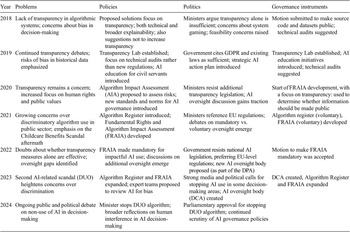
The results of our analysis are presented per year. Following the conceptual framework set out above, for each year we examine each of Kingdon’s streams, starting with Problem framing, followed by Policy (solutions), and concluding with the Political context. We then examine which policy instruments make their way through Kingdon’s “funnel” and how they construct risk. An overview of the findings can be found in Table 1.
Overview of main findings per year

Table 1. Long description
The table consists of seven rows representing years and five columns.
* 2018: Problems include lack of transparency and bias. Policies focus on technical explainability. Politics involve ministerial arguments that transparency is insufficient. Governance instruments include motions for public source code and technical audits.
* 2019: Problems emphasize historical data bias. Policies include the establishment of a Transparency Lab and A I education. Politics cite G D P R as sufficient. Governance instruments include the Transparency Lab and technical audits.
* 2020: Problems focus on human rights. Policies propose Algorithm Impact Assessments (A I A). Politics show resistance to new legislation. Governance instruments mark the start of F R A I A development.
* 2021: Problems highlight the Childcare Benefits Scandal. Policies introduce an Algorithm Register and F R A I A. Politics reference E U regulations. Governance instruments include voluntary registers and F R A I A.
* 2022: Problems identify oversight gaps. Policies make F R A I A mandatory for impactful A I. Politics propose a new oversight body under the D P A. Governance instruments confirm the mandatory status of F R A I A.
* 2023: Problems involve the D U O scandal. Policies expand the Algorithm Register. Politics see calls to stop A I in certain areas and the creation of the D C A. Governance instruments include the D C A and expanded F R A I A.
* 2024: Problems focus on the non-use of A I. Policies involve stopping the D U O algorithm. Politics show parliamentary approval for halting specific algorithms. The Governance instruments cell is empty for this year.
4.1. 2018: Different understandings of transparency
In 2018, the lack of technical transparency in algorithmic systems became a central concern in public discourse. Media articles highlighted issues related to data bias and the opaque nature of algorithmic decision-making, often linking these concerns to the Childcare Benefits Scandal, where an algorithmic system was involved in the decision-making process for financial benefits. Calls for greater transparency emerged, with critics arguing that algorithmic systems are inherently non-neutral and challenging to interpret. The algorithmic systems, according to one opinion piece, “do not work neutrally, and they are by definition not transparent. We do not always understand how they arrive at their conclusions” (NRC, Van Oenen, 2018).
In response, media, advisory reports, and parliamentary discussions proposed several policy solutions, including publicizing datasets and source codes or conducting technical audits. The motion submitted by Verhoeven (a member of parliament for D66—social liberal party), Buitenweg (a member of parliament for GroenLinks—green left-wing), and Van Nispen (a member of parliament for SP—Socialist Party) asked the cabinet to make all source code available to citizens, as well as the datasets used to train these algorithmic systems (Verhoeven, 2018). If it was not possible to share this information due to compelling interests, these three members of parliament asked the cabinet to perform a “technical audit” and publish the results of this audit. Simultaneously, the Ministry of the Interior and Kingdom Relations launched an investigation into government use of algorithmic systems and how this could be improved. Policies mentioned in the media for the problem of opacity also focus on increasing transparency: “The importance of data and algorithms is too great not to make them public, especially in the public domain” (NRC, Kapitan, 2018). The focus on transparency was furthermore reflected in responses from the Minister on the book from the University of Utrecht (2017) focusing on human rights and algorithms (Ollongren, 2018), the investigation from the Central Statistical Office focusing on the use of algorithmic systems, and several Open Government requests from news agencies (Knops, 2018).
However, ministers pushed back on the demand for full transparency, arguing that technical transparency alone would not prevent bias or discrimination. They emphasized the distinction between technical transparency and explainability, stating that citizens would benefit more from clear explanations of algorithmic decisions rather than mere access to raw technical details (Dekker, 2018). Additionally, concerns were raised about individuals gaming the system and the financial burden of implementing full transparency measures.
4.2. 2019: Multiple proposals for increasing responsible use of algorithmic systems
The concerns over transparency persisted in 2019, but discussions in the media expanded to include the risks associated with biased historical data and statistical reinforcement of societal inequalities. Media reports warned that “the risk is that [certain groups of people] are more likely to be judged by the computer because they appear more often in the statistics, causing them to end up even more frequently in those statistics” (FD, Rotman, 2019). The use of historical data and the fact that this could lead to bias was also mentioned in the media articles—humans can make biased decisions that are then used to train algorithmic systems (FD, Van Wijnen, 2019). The systems themselves cannot recognize discrimination; they only focus on patterns in the dataset.
The debate on transparency continued, and several concrete steps were taken to determine where additional transparency would be beneficial. One of these examples is the Transparency Lab (“Transparantielab”) in place at the Ministry of the Interior and Kingdom Relations, where principles for data use, guidelines for ethics, and operationalizations of these guidelines were tested (Ollongren, 2019). At the same time, it was often argued that additional measures for transparency were not necessary because several legal safeguards were already in place, such as the GDPR and several articles in administrative law. This was also the result of a commissioned report from the Ministry of the Interior and Kingdom Relations: the conclusion of the report stated that there were no legal gaps concerning transparency towards citizens (Frissen et al., 2019). Additional legislation or oversight bodies were not considered to create additional safeguards, but rather add more bureaucratic burden.
As an alternative to additional legislation, technical audits or checks were mentioned as a solution if the algorithmic systems were too complex or if there were risks of citizens “gaming the system.” These checks would focus on the validity of the data analyses and the algorithmic systems themselves (Dekker, 2019). This mainly concerned whether these systems were functioning correctly. Technical audits were also mentioned as solutions in media articles. One article states that Caspar Chorus, an econometrist from Delft Technical University, had found a way to “make ethical algorithms,” and additionally gives an example from a researcher in the United States that stated he found a way to filter “undesirable behavior” out of an algorithmic system (FD, Van Wijnen, 2019).
The Strategic Action Plan for AI (Strategisch Actieplan voor AI, SAPAI, 2019) and the accompanying letter from the Minister of the Interior and Kingdom Relations (Ollongren, 2019) added a focus on education. To “use AI optimally” in public organizations, the government aimed to increase civil servants’ knowledge and seek partnerships with other public organizations or through public–private partnerships. Additional tasks focused on experimenting more with algorithmic systems in the public sector and encouraging government information reuse. At the same time, the government acknowledged that using algorithmic systems in government can come with risks and that steps should be taken to guarantee human rights.
The report by Frissen et al. (2019)—written on behalf of the Ministry of the Interior and Kingdom Relations—mentioned specific policy instruments that can help govern algorithmic systems: technical audits and assessment frameworks. The technical audits ought to focus on the design and functioning of the system, whether civil servants have a sufficient degree of discretionary power, and whether the control system is functioning properly. The assessment frameworks proposed would focus mostly on the impact of the algorithmic system on citizens, and should be understandable for civil servants, legal experts, and data scientists. The main actors mentioned who could take on an oversight role were the Dutch Data Protection Authority, the Netherlands Court of Audit, and the College for Human Rights. The Dutch Data Protection Authority also saw this as a role that fit the organization: their strategy report for 2020–2023 mentioned oversight of algorithmic systems using personal data specifically (Autoriteit Persoonsgegevens, 2019).
Political resistance to additional legislation remained strong, with ministers emphasizing that new regulatory bodies would impose unnecessary bureaucratic burdens. Instead, the government positioned voluntary audits and education as preferred governance mechanisms.
The discussion on improving transparency is similar to that in 2018, though now attention was also paid to technical audits to ensure the proper use of the algorithmic systems, if technical transparency was not possible due to fears of gaming the system, or safeguarding sensitive information. Notions of algorithmic risk focused on the technical aspects of the algorithmic system. Additionally, educational initiatives were mentioned to increase civil servants’ knowledge of algorithmic systems and algorithmic risk. Here, several particular instruments were introduced to govern algorithmic systems: the Transparency Lab was created, and assessment frameworks were mentioned.
4.3. 2020: Moving towards specific instruments
Transparency still remained a point of contention in 2020. In the media, transparency focused on the information concerning the algorithmic system and/or datasets used to train the system. One article from NRC stated that “to stop mass surveillance and discrimination through algorithms, the entire process needs to become more transparent” (NRC, Oudshoorn, 2020).
Increased attention was also paid to public values and human rights, going beyond the focus on education for civil servants as mentioned in 2019. Within media, this was reflected in statements such as “If that is not possible [people defending themselves against the system], for example, because the operation of the algorithm is unknown, then it constitutes nothing less than a violation of fundamental rights. In this way, algorithms render people without rights and powerless” (NRC, 2020).
The idea of an assessment specifically for the impact of an algorithmic system on citizens emerged on the political agenda in 2020. It had been mentioned in the report from Frissen et al. (2019) as a way to increase control over algorithmic systems in the public sector, though not yet put into action. An algorithm impact assessment (AIA) would help identify and mitigate these systems’ risks. In response to an initiative nota from Middendorp (a member of parliament for VVD—Dutch liberal democrats), the ministers for the Interior and Kingdom Relations, Economic Affairs and Climate, and Legal Protection proposed to work on such an AIA, which could also be used as a way to determine whether it is necessary to publish information about the algorithmic system (Dekker et al. 2020).
In response to the initiative note submitted by Verhoeven (a member of parliament for D66—social liberal party), the Minister for Legal Protection referred to the importance of creating standards and norms, specifically when these have a large impact on citizens, to ensure that “they contain the proper safeguards” (Dekker et al., 2020). These standards were meant to make legal norms and principles more understandable for civil servants and to ensure that the algorithmic systems take European norms and values into account.
When motions to increase transparency on algorithmic systems made it to parliament, the response from the minister remained the same as it was in 2019. There were, according to the minister, no legal gaps when it came to transparency, and additional legislation to increase transparency with regard to algorithmic systems would not be necessary.
In 2020, transparency remained an important topic on the political agenda. The motion from Middendorp (a member of parliament for VVD—Dutch liberal democrats) (Middendorp, 2020) started the creation of an impact assessment for algorithmic systems, which should also be used to determine whether publishing information about the algorithmic system was possible.
4.4. 2021: The algorithm register and other instruments
Public concern over the use of algorithmic systems in government deepened in 2021, particularly due to the lingering effects of the Childcare Benefits Scandal. Amnesty International’s report on “Xenophobic Machines” highlighted how algorithmic profiling had disproportionately affected minority communities, reinforcing structural discrimination (Amnesty International, 2021). The broader discourse on AI governance began shifting toward the need for systemic changes, with calls for oversight mechanisms that could prevent discrimination before it happened rather than merely addressing it afterwards.
In April 2021, Klaver (a member of parliament for GroenLinks—a green left-wing party) submitted a motion for the creation of an algorithm register to increase transparency about the use of algorithmic systems in the public sector (Klaver, 2021). This instrument had already been introduced in the municipalities of Rotterdam and Amsterdam, and the Dutch Scientific Council for Policy (WRR) recommended the creation of a national register for algorithmic systems (WRR, 2021). A report from Amnesty International also strongly recommended the creation of an algorithm register, specifically focusing on the aftermath of the Childcare Benefits Scandal (Amnesty International, 2021). In the media, most of the attention was on the municipal registers rather than a national one, as the municipal registers were already in place (Trouw and Baneke, 2021).
The University of Utrecht was commissioned to create a Fundamental Rights and Algorithm Impact Assessment (FRAIA, or IAMA in Dutch) (Ollongren et al., 2021). The FRAIA was mentioned as a voluntary governance instrument that organizations can use to determine what the impact of an algorithmic system would be for citizens. At the same time, there were references to a number of governance instruments in parliamentary documents (Ollongren et al., 2021). Next to the FRAIA, a guide to AI system principles for nondiscrimination and the Code for Good Digital Public Governance were also being developed as aids for civil servants. The cabinet, in response, stated that it “wants to guard against the development of new instruments while various existing instruments are still being evaluated to determine how they can—together—contribute as effectively and proportionally as possible to the protection of human rights” (Ollongren, 2021).
The cabinet still referred to the GDPR, Open Government Legislation, and additional legislation already in place as sufficient, but did agree with several motions that there were challenges that the legal framework does not sufficiently address (e.g., Azarkan, 2021; Van Baarle, 2021). While certain instruments—such as the FRAIA and an algorithm register—could help address these challenges, the working group focusing on norms for and oversight of algorithmic systems stated that it is too soon to say whether these will truly “fix” what they are meant to fix (Projectgroep Normering en Toezicht Algoritmen, 2021). On a European level, discussions were also focused on creating additional transparency measures. The Dutch government often referred to these EU proposals when members of parliament asked for additional transparency measures.
With the creation of the national algorithm register and the FRAIA, two instruments for the governance of algorithmic systems were in place, although discussions continued about whether to make these instruments mandatory. According to the cabinet, additional legislation on transparency or the responsible use of algorithmic systems was unnecessary.
4.5. 2022: (additional) Policy instruments will not solve all problems
Media narratives increasingly framed transparency as necessary but insufficient. Amnesty International’s (2021) report pointed out that transparency alone would not prevent algorithmic discrimination. Concerns about algorithmic bias, particularly regarding predictive models used in government decision-making, remained at the forefront of public debate. Investigations into the Algorithm Register suggested that while transparency measures had increased public awareness, they did little to curb discriminatory outcomes. Additionally, the voluntary nature of, for example, the algorithm register led critics to question whether organizations were truly being held accountable. Minister Van Huffelen acknowledged these concerns, stating that “up until now, transparency about the use of algorithms often falls short” (2022). Calls for stricter regulations remained, particularly due to increasing doubts about the effectiveness of voluntary transparency measures.
In March 2022, a motion from parliament members Bouchallikh (a member of parliament for GroenLinks—green left-wing party) and Dekker-Abdulaziz (a member of parliament for D66—social liberal party) proposed to make the FRAIA mandatory in all cases where algorithmic systems were involved in decision-making processes with an impact on human beings, and to make the results of this assessment public where possible (Bouchallikh and Dekker-Abdulaziz, 2022). This motion was passed.
In the media, the announcement from Minister Van Huffelen on the algorithm register was seen as a step in the right direction: one journalist mentioned that “establishing a national algorithm registry is easier said than done, and transparency is not a panacea, but such a registry is a step toward the responsible use of AI” (Trouw and Van Boven, February 2022) while another stated that “the Netherlands is a frontrunner in Europe with its algorithm registry” (FD, Houtman, November 2022).
The cabinet took up the suggestion to make FRAIA mandatory, and the minister for digitalization, Van Huffelen, announced that she would look into similar instruments and see where these overlap. By doing so, she also responded to Amnesty International’s request (made in the report on Xenophobic Machines, 2021) to create an obligatory impact assessment for human rights.
The Minister for Digitalization also published an official response to the Amnesty International report (2021), where she stated that while the report focused on the algorithmic system used in granting financial benefits to parents as one of the factors that resulted in the Childcare Benefits scandal, but not the only one (Van Huffelen, 2022). Within this letter, she focused on ethical and legal education for civil servants working with these systems, and further legal safeguards. In context of the latter, she often referred to the European Union and upcoming legislation such as the Digital Services Act and the AI Act. Similar to previous years, she stated that additional legal measures were not necessary.
Despite earlier statements that each oversight body would focus on algorithmic systems within their own sector, the cabinet announced that they would create an additional group specifically for algorithmic systems to be placed with the Dutch Data Protection Authority (Kabinetsreactie WRR-rapport “Opgave AI,” 2022). The main reason to do so was that oversight needed to go beyond sectors, specifically where algorithmic systems are concerned, and that creating one oversight body would be more efficient (Van Huffelen, 2022).
In 2022, the FRAIA became mandatory for algorithmic systems with an impact on citizens as a way to mitigate possible risks, though the cabinet still insisted that additional legislation for the use of algorithmic systems was not necessary, or that it would be better to wait for European legislation rather than create Dutch-specific laws. A similar pattern can be seen in the discussion of oversight of algorithmic systems—requests about the creation of an algorithm oversight body had initially been refused, yet in the end, this new organization was created.
4.6. 2023: The instruments in place do not go far enough
A second scandal involving algorithmic systems came out in 2023, and calls increased to stop using algorithmic systems in decision-making altogether. Especially in the media, these calls to stop using algorithmic systems were strong, often combined with statements that the Netherlands did not have a digitalization problem, but rather “a discrimination problem. And until that problem is resolved, the government can, in good conscience, only do one thing: stop using profiling algorithms” (Austin & Benaissa, NRC, 2023). In June 2023, several media articles were published about an algorithmic system at DUO, the Dutch Executive Agency for Education, the organization in charge of student finance and study grants. Based on an algorithmic system built on assumptions from employees, students with a migration background were disproportionately accused of fraud. Minister Dijkgraaf (Education) promised parliament an in-depth investigation at DUO (2023).
Three particular governance instruments were consistently mentioned in the parliamentary documents: the algorithm register, the FRAIA, and the IKA (Implementatie Kader Algoritmes, or “Algorithm Implementation Framework”). Despite the fact that the algorithm register and FRAIA had both been made obligatory, a large number of public sector organizations were not yet working with these governance instruments. Member of parliament Dekker-Abdulaziz (a member of parliament for D66—social liberal party) submitted a motion to include all high-risk algorithmic systems used by the government in the algorithm register and to subject them to a FRAIA (2023). The IKA aimed to support specifically the government in the responsible use of algorithmic systems and would mainly focus on high-risk algorithmic systems (Van Huffelen, 2023). While the FRAIA and algorithm register had gotten attention in the media and advisory reports, the IKA was not mentioned.
In 2023, a specific oversight body for algorithmic systems was created: the DCA (Directie Coordinatie Algoritmes, or Directorate for Algorithm Coordination) was specifically tasked with safeguarding fundamental rights during the development and implementation of algorithmic systems and received an additional budget to meet these objectives.
Where cabinet reactions to demands for increased transparency had already focused on the difference between technical transparency and explainability, this was now also reflected in several parliamentary questions and a motion. Kathmann, Van Baarle, and Bouchallikh (respectively, members of parliament for PvdA [labor party], DENK [minority rights platform], and GroenLinks [green left-wing party]) submitted a motion stating that while the algorithm register was a step in the right direction, it would not provide complete insight into the algorithm itself (Kathmann et al., 2023). Therefore, expert teams should (on a confidential basis) gain access to the algorithms to perform a technical check and ensure that the algorithmic systems were not discriminatory.
Three instruments have been created for the governance of algorithms and algorithmic risk, each with a different focus and audience. Yet members of parliament started to doubt the efficacy of the algorithm register, echoing earlier statements from ministers that technical transparency alone would not improve the situation. The DUO scandal brought questions of discrimination to the forefront, and a new oversight body (DCA) was created.
4.7. 2024: Uncertainty about the way forward (until July 15, 2024).
In 2024, the DUO scandal and the argument for non-use continued to be part of the public discourse on algorithmic systems in the public sector. Other than the Amnesty International report from 2021, however, no advisory reports advised the Dutch government to stop using algorithmic systems altogether.
Minister Dijkgraaf had decided to stop using the algorithmic system altogether (2024), and in a plenary debate, members of parliament expressed their approval of this decision (Plenair Debat Fraude DUO, 2024). In response to the DUO scandal, additional (written) questions were asked of the Minister, specifically about the usefulness of human interference in the decision-making process. The minister responded that human interference had led to the scandal—and would therefore not be a perfect solution to discrimination by algorithmic systems—would be taken into account “in a broad sense in the follow-up process” (Dijkgraaf, 2024).
5. Discussion
First, regarding agenda-setting, the empirical analysis shows that Kingdon’s three streams bring forward both technical and human-centered regulatory instruments. The documents analyzed show that, on the one hand, relatively simple technical tools (such as technical audits or an algorithm register) are proposed by some to manage an issue that, in reality, is far more complex. Nieuwenhuizen (Reference Nieuwenhuizen2025) calls this a “paper reality,” as the algorithm register is seen as a checklist without any incentive to complete all fields or update the information if anything in the algorithmic system changes. On the other hand, the results also show push-back and more substantive suggestions from actors with more expertise. Power (Reference Power1997) argued that audits and governance instruments were doomed to become mere rituals of verification, prioritizing what is easily measurable and feasible to assess. Our analysis reveals the emergence of a call for more substantive auditing practices, with instruments that should foster learning and long-term risk management, such as the fundamental rights impact assessment (FRAIA). This aligns with Cath and Jansen’s (Reference Cath and Jansen2021) finding: if actors critically engage with and continuously reflect on algorithmic systems, governance tools that focus on ethical considerations can play an essential role in integrating algorithmic systems into public administration. Additionally, a FRIA can serve as a feedback mechanism that promotes organizational learning about risks and safeguards (Harris, Reference Harris2020). However, if algorithmic systems are seen as apolitical or mere technical tools to increase efficiency in public administration, governance instruments can become “ethics theatre” or simple box-ticking exercises (Cath and Jansen, Reference Cath and Jansen2021). The introduction of the FRAIA does suggest a shift in the institutional forces shaping governance practices. Knowledge brokers and policy entrepreneurs who understood the complexity of the issue, especially in the Dutch context, where scandals such as the Childcare Benefits Scandal and the DUO scandal served as prime examples of what was considered to be algorithmic risk, were able to bring together more human-centered and complex problem framings and policy solutions.
Second, we find that the technical solutions still prevailed due to mediatization. Most of the tools that have made it onto the policy agenda over time and have been implemented promote mostly technical risk management. This is not only the case for algorithmic systems—societal risks are often reduced to technical problems in media, which casts risk as easily manageable through technical solutions (Roslyng and Eskjær, Reference Roslyng and Eskjær2017). The technical risk framings often reduce a more complex issue, such as transparency, to a seemingly manageable issue, such as providing technical information, leading to a false sense of security while neglecting broader structural issues inherent in socio-technical systems. This means that structural issues within Kingdon’s problem stream do not reach the end of the funnel. Our results suggest that the popularity of these technical instruments can be explained by the “mediatization of politics” (Strömbäck and Esser, Reference Strömbäck, Esser, Esser and Strömbäck2014), the interplay between media dynamics and political decision-making, where brevity, clarity, and visual appeal are prioritized over substantive effectiveness. This is apparent, for instance, in the narrative surrounding the national algorithm register. The media and members of parliament focused on making the source code and datasets of algorithms available to citizens (called “technical transparency” by Minister Dekker [Dekker, 2018]), while Minister Dekker proposed to focus on a more meaningful and complex notion of explainability. Yet this was not picked up by the media, and the technical solution, namely the publication of technical information in the algorithm register, was eventually put into place and even said to be a good way to increase transparency by Minister Van Huffelen. However, upon the introduction of a more substantive governance instrument such as the FRAIA, the media do refer to this instrument as a solution, likely due to the fact that all “ethical issues” are consolidated into a single, easily identifiable governance instrument. The media, therefore, plays a dual role in inhibiting and encouraging the creation and implementation of more substantive governance instruments and how these instruments further institutionalize certain interpretations of algorithmic risk.
This relates to our third finding that governance instruments often have to function as quick fixes, focused on procedural compliance. Media and society at large demand immediate responses, which encourages politicians to propose short-term, visible solutions rather than long-term structural reforms (Gerton and Mitchell, Reference Gerton and Mitchell2019; Ingrams et al., Reference Ingrams, Piotrowski and Berliner2020; Wieringa, Reference Wieringa2023). We find that when algorithmic systems reveal problematic outcomes, such as discrimination in fraud detection programs or concerns about transparency of decision-making, there is an immediate response of quick fixes. These are instruments designed for rapid implementation, such as a (mandatory) algorithm register (Cath and Jansen, Reference Cath and Jansen2021), to demonstrate responsiveness, which often fail to address the underlying complexities of the issues at hand (Power, Reference Power1997; Ingrams et al., Reference Ingrams, Piotrowski and Berliner2020). For instance, regarding discrimination, several documents, such as the Amnesty International report or the response from Minister Dijkgraaf on the DUO scandal, clearly state that it is not only the algorithmic system at fault, but also the civil servants working with these systems. However, the majority of instruments proposed still focus on technical problems with the algorithmic system, thereby emphasizing one interpretation of the problem and something that can easily be fixed and audited. The decision to stop working with the algorithmic system does not address underlying issues, such as discrimination or a lack of accountability, within the organization.
Overall, it is reassuring to see that there are proposed policies that address underlying issues, such as the focus on more (legal and ethical) education for civil servants, proposed by the Minister of Digitalization in 2023. This suggests that governance instruments can be more than mere rituals of verification. Still, our analysis shows several technical quick fixes that can respond immediately to visible issues, but might not be effective in solving long-term problems such as systemic inequalities or entrenched biases. For instance, the algorithm register focuses more on appearance (whether or not a particular algorithmic system is included) than effectiveness (whether the tool works as intended, providing transparency to citizens) (Nieuwenhuizen, Reference Nieuwenhuizen2025). These governance instruments often create an illusion of control, emphasizing procedural accountability over substantive problem-solving (Power, Reference Power1997). This approach can lead to resource misallocation and a false sense of security, as regulators focus on media appearances and meeting procedural benchmarks rather than addressing underlying vulnerabilities. For instance, complex socio-technical issues are often reduced to box-ticking exercises due to practical constraints, and the drive for procedural compliance overshadows the nuances of algorithmic decision-making (Selbst, Reference Selbst2021; Mökander, Reference Mökander2023). In this way, the (proposed) instruments risk becoming a performative exercise, producing legitimacy rather than meaningful transformation.
6. Conclusion
This article addressed the question of how notions of algorithmic risk are constructed and institutionalized in instruments for the governance of algorithmic systems. The governance of algorithmic systems in the public sector reveals a persistent tension between quick fixes (such as an algorithm register) and substantive, long-term solutions (such as an algorithm impact assessment designed to discuss underlying values). Our analysis shows that governance instruments that emphasize procedural compliance are often chosen over instruments that create more substantial solutions, driven in part by the mediatization of politics and the prioritization of visibility over effectiveness. The proliferation of these kinds of instruments constructs a technical understanding of risk that emphasizes technical aspects of the algorithmic system. This can be seen in, for instance, the algorithm register, the Algorithm Impact Assessment (AIA), and the expert technical audits (focused on uncovering bias). These simple technical tools offer an appearance of control without necessarily mitigating the structural issues they are meant to resolve.
This study has four notable limitations. First, it focuses on (a limited number of) written documents rather than policymakers’ lived experiences. Future research could include interviews or participatory methods to gain deeper insights into the mechanisms driving algorithmic governance. Second, the analysis primarily examines regulatory intent and perception rather than the actual implementation of instruments in the real world. Future studies could examine how algorithmic governance instruments function in practice. Third, as many now consume and are exposed to news through social media (Ausat, Reference Ausat2023; Dreston and Neubaum, Reference Dreston and Neubaum2025; Kothur and Pandey, Reference Kothur and Pandey2025), how risk is constructed on these platforms can have an effect on the way governance instruments are created and implemented. This would be an interesting direction of future research.
Our findings also offer some practical recommendations. First, the limitations of quick fixes and procedural approaches underscore the need for the implementation of reflexive and adaptive governance frameworks. Reflexive governance, as discussed by Feindt and Weiland (Reference Feindt and Weiland2018), emphasizes continuous learning, adaptability, and stakeholder engagement. This approach is particularly relevant for managing algorithmic systems, where rapid technological evolution demands iterative evaluation and adaptation if necessary. Yet more comprehensive proposals put forward by ministers or civil servants are not put into practice, even though they focus on actions with long-term impact, such as education for civil servants or creating sufficient oversight. This is a deviation from Kingdon’s Multiple Streams Framework, where policies can more easily address structural problems and where the media is not considered to play an important role. Mediatization promotes brevity, clarity, and visual appeal (Strömbäck, Reference Strömbäck2008). The increased mediatization of politics seems to prevent the three streams from coming together for more durable solutions, which can take longer to implement. It is essential to monitor the different effects on the governance of algorithmic systems of quick fixes and substantive approaches as they are deployed to gain a more profound understanding of their place in the socio-technical system.
At the same time, our findings suggest that some policymakers are increasingly aware of these limitations, as seen in recent proposals for more structural interventions, such as enhanced legal and ethical education for civil servants. This shift points to an emerging recognition that governance must go beyond reactive technical solutions to engage with the broader societal and ethical implications of algorithmic decision-making. This evolving perspective stands in contrast to much of the existing regulatory scholarship, where scholars such as Ulbricht and Yeung (Reference Ulbricht and Yeung2022), Wieringa (Reference Wieringa2023), and Busuioc (Reference Busuioc2021) have often expressed deep skepticism about the way algorithms are regulated. Many scholars critique the prevailing reliance on technical instruments, arguing that they prioritize compliance over substantive accountability. Our findings, however, tentatively suggest a more nuanced reality. While these critiques remain relevant and valid, there is evidence that policymakers are beginning to move beyond a purely technical framing of algorithmic governance and algorithmic risk. As policymakers continue to refine the governance of algorithmic systems, it remains crucial to monitor whether these developments can move past the pressures of mediatization and quick fixes to translate into substantive changes in practice.
Supplementary material
The supplementary material for this article can be found at http://doi.org/10.1017/dap.2026.10095.
Data availability statement
The data that support the findings of this study are available at www.lexisnexis.com and www.tweedekamer.nl/kamerstukken.
Acknowledgments
A statement to acknowledge non-authorship contributions.
Author contribution
Writing—original draft: T.S. Writing—review and editing: T.S., F.B., S.K., and A.M. All authors approved the final submitted draft.
Funding statement
This material is produced as part of AlgoSoc, a collaborative 10-year research program on public values in the algorithmic society, funded by the Dutch Ministry of Education, Culture and Science (OCW) under the Gravitation program (project number 024.005.017). Any opinions, findings, and conclusions or recommendations expressed in this material are those of the author(s) and do not necessarily reflect the views of OCW or those of the AlgoSoc consortium as a whole.
Competing interests
The authors declare none.


 Open access


Comments
No Comments have been published for this article.