Patients with CHD are increasingly surviving into adulthood.Reference Warnes 1 Unfortunately, many of these patients will require surgery, either as a primary procedure or as a re-operative procedure. In patients with multiple residual lesions, it is often challenging to determine the significance of individual lesions and to determine which lesions require surgical correction when an operation is being considered.
It has previously been reported that concomitant procedures performed during adult congenital heart surgery are a risk factor for adverse outcomes.Reference Kogon, Grudziak and Sahu 2 , Reference Jain, Oster and Kilgo 3 Although the risk is expected to be somewhat higher in concomitant procedures, the degree to which the risk increases remains unknown. In addition, the indications for performing these concomitant procedures are not always clearly defined.
In the present study, our aims were as follows: to characterise the concomitant procedures performed in adult congenital heart surgery, and to better define the risk involved with performing concomitant procedures during a single operation.
Methods
Institutional Review Board approval was obtained to perform this retrospective study, and individual patient consent was waived. A retrospective analysis was conducted for 458 adult patients, who underwent cardiac surgery for CHD between 2000 and 2010.
Patient characteristics included standard demographics, preoperative medical and cardiac status, and operative factors. The Society of Thoracic Surgeons database was used to define the list of patient risk factors and has been detailed previously.Reference Kogon, Grudziak and Sahu 2
Major procedures were characterised as aortic, mitral, pulmonary, tricuspid, septal defect, single ventricle, transplant, and others. Single ventricle refers primarily to those patients who underwent Fontan revision or conversion.
Outcomes
Operative mortality, presence of a major adverse event, and length of hospital stay >7 days were chosen as the three primary outcomes. Operative mortality was defined as death occurring within the surgical hospital stay or within 30 days of surgery. Our major adverse event composite outcome variable was positive when the patient suffered from any of the following major complications: stroke, renal failure, deep sternal infection, re-operation, and operative mortality. The Society of Thoracic Surgeons database was used to define the list of complications and has also been detailed previously.Reference Kogon, Grudziak and Sahu 2
Statistical analysis
Logistic regression models were constructed to assess the risk for mortality, major adverse event, and prolonged length of stay among patients who underwent a single procedure and those who underwent concomitant procedures.
As the incidence of endocarditis was significantly higher in the group undergoing concomitant procedures, these patients were excluded from the analysis. In a subset analysis of patients with conotruncal anomalies, patients with an original congenital diagnosis of Tetralogy of Fallot, truncus arteriosus, double-outlet right ventricle, and transposition of the great arteries were included. All these patients had undergone previous operations that involved closure of a septal defect(s) and reconstruction of the right ventricular outflow tract.
Results
Patient characteristics
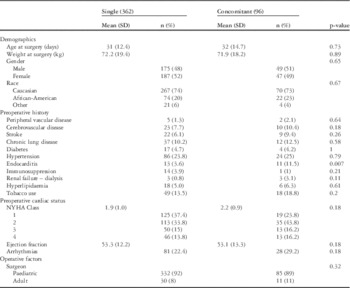
For the entire cohort, the median age and weight at surgery were 27 years – with a range from 18 to 72 – and 70 kg – with a range from 36 to 143 – respectively; 49% of the patients were male and 73% were Caucasian. With exception of endocarditis, there were no significant differences in the patient characteristics among those patients who did and did not undergo concomitant operations (Table 1).
Patient characteristics.

Outcomes
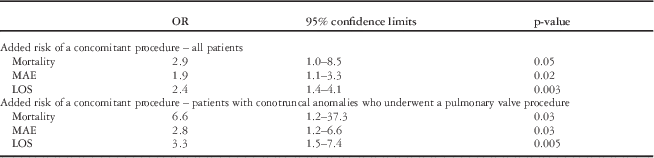
A total of 458 operations were performed. Among them, 362 (79%) operations involved a single procedure, whereas 96 operations involved concomitant procedures. Performing concomitant procedures was associated with increased mortality (7.3 versus 2.5%), major adverse events (21.8 versus 14.9%), and prolonged length of stay (29.2 versus 17.1%) (Table 2). A logistic regression analysis was performed to evaluate the risk of adding a concomitant procedure to a single procedure. The added risk of performing concomitant procedures for mortality, major adverse event, and prolonged length of stay was 2.9 (95% CI 1.0–8.5, p=0.05), 1.9 (95% CI 1.1–3.3, p=0.02), and 2.4 (95% CI 1.4–4.1, p=0.003), respectively (Table 3).
Overall breakdown and outcomes.

LOS=length of stay; MAE=major adverse events
Logistic regression analyses.

LOS=length of stay; MAE=major adverse events; OR=odds ratio
There were 200 patients with conotruncal anomalies who underwent pulmonary valve surgery. Similarly, in this subset, the added risk of performing concomitant procedures for mortality, major adverse event, and prolonged length of stay was 6.6 (95% CI 1.2–37.3, p=0.03), 2.8 (95% CI 1.2–6.6, p=0.03), and 3.3 (95% CI 1.5–7.4, p=0.005), respectively (Table 3).
Concomitant procedure breakdown and outcomes
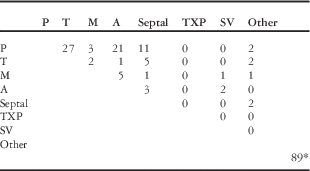
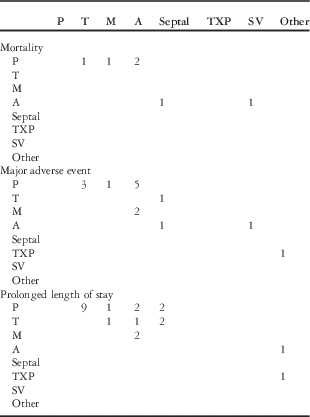
The pairing for the 89 patients who underwent two concomitant procedures is shown in Table 4. Not included in the table are those seven patients who underwent three or four concomitant procedures. For those patients undergoing concomitant procedures, 71/96 (74%) involved the pulmonary valve. The three most common combinations were pulmonary valve and tricuspid valve operations (n=27), pulmonary valve and aortic operations (n=21), and pulmonary valve and septal defect operations (n=11). The breakdown of complications for each concomitant pairing is shown in Table 5.
Concomitant surgery breakdown.

A=aortic; M=mitral; P=pulmonary; SV=single ventricle; T=tricuspid; TXP=transplant
* Includes only those patients undergoing two concomitant procedures
Complication breakdown by concomitant operation pairings.

A=aortic; M=mitral; P=pulmonary; SV=single ventricle; T=tricuspid; TXP=transplant
Discussion
Surgery in adults with CHD is complex. In two separate previous analyses, we have reported risk factors for morbidity and mortality in adults undergoing surgery for CHDs, first in a cohort of all adult patients and then in a cohort of patients with Tetralogy of Fallot.Reference Kogon, Grudziak and Sahu 2 , Reference Jain, Oster and Kilgo 3 Looking at numerous demographic, preoperative medical and surgical, and operative factors, we found that performing concomitant procedures was associated with adverse outcomes in both studies. Although the risk is expected to be somewhat higher in concomitant procedures, the degree to which the risk is increased and whether there are specific combinations that pose excessive risk remain unknown. For this study, we chose not to focus on the other risk factors previously reported, but chose to concentrate on the concomitant procedure influence.
In patients with multiple residual lesions, it is often challenging to determine the contribution of each lesion to the patient’s symptoms and overall cardiac health and to determine which lesions require surgical correction when an operation is being considered. Although American College of Cardiology/American Heart Association guidelines exist for surgery in adults with CHD, they may not always be helpful in determining which lesions should be addressed.Reference Warnes, Williams and Bashore 4 , Reference Nishimura, Otto and Bonow 5 First, the majority of these guidelines address lesions in isolation, not when they are being performed as concomitant procedures. Second, there are virtually no Class I recommendations – procedure should be performed – and no Level A evidence – data derived from multiple randomised clinical trials or meta-analysis. Most of these recommendations are Class IIa – it is reasonable to perform a procedure – or IIb – procedure might be considered – with level B and C, conflicting, evidence.
We focus the remainder of our discussion on the three most common combinations that were found in our cohort: pulmonary valve with concomitant tricuspid, aortic, or septal defect operations.
Pulmonary valve with tricuspid valve operation
Concomitant operations involving the combination of the pulmonary and tricuspid valves were the most common (n=27), 23 of which occurred in the subset of patients with conotruncal anomalies. This combination occurs most frequently in patients with congenital pulmonary stenosis or Tetralogy of Fallot. Palliative disruption of the pulmonary valve in childhood results in subsequent pulmonary insufficiency, right ventricular dilation, and possibly functional tricuspid regurgitation. For those patients with Tetralogy of Fallot, an additional potential mechanism is distortion of the septal leaflet of the tricuspid valve with closure of the ventricular septal defect. Whether to intervene on the tricuspid valve at the time of pulmonary valve replacement is controversial.
In the 27 patients who underwent tricuspid valve surgery, regurgitation was mild-to-moderate (one), moderate (11), moderate-to-severe (eight), and severe (five); two patients had prosthetic valve stenosis with peak gradients of 11 and 15, respectively. Most of the Class I American College of Cardiology/American Heart Association guidelines for tricuspid valve surgery recommend intervention in the presence of severe regurgitation and left-sided heart disease.Reference Warnes, Williams and Bashore 4 , Reference Nishimura, Otto and Bonow 5 In these instances, better long-term outcomes have been reported when concomitant tricuspid valve annuloplasty was performed in addition to the primary coronary bypass and/or mitral valve operation;Reference Shinn and Schaff 6 otherwise, it may be considered for asymptomatic or minimally symptomatic patients with severe regurgitation and progressive degrees of moderate or greater right ventricular dilation and/or systolic dysfunction (Class IIb, Level of Evidence C).Reference Warnes, Williams and Bashore 4 , Reference Nishimura, Otto and Bonow 5
Interestingly, our group previously reported a similar degree of improvement in tricuspid regurgitation and right ventricular dilation at 1 month with and without concomitant tricuspid valve annuloplasty during pulmonary valve replacement.Reference Kogon, Patel and Leong 7 These results were independent of a congenital diagnosis of pulmonary stenosis or Tetralogy of Fallot.Reference Kogon, Patel and Leong 7 During a recent re-analysis of the same patients to a mean follow-up of 7.0±2.8 years, we have actually shown a higher degree of tricuspid regurgitation in the group that underwent concomitant tricuspid valve annuloplasty.Reference Kogon, Mori, Alsoufi, Kanter and Oster 8 Therefore, we have advocated for a conservative approach towards concomitant tricuspid valve intervention during pulmonary valve replacement.
Pulmonary valve with aortic operation
Concomitant operations involving the combination of the pulmonary valve and the aorta/aortic valve were the second most common in our cohort (n=21), 10 of which occurred in the subset of patients with conotruncal anomalies. The other frequent setting in which this combination occurs is in the setting of a previous Ross procedure performed for aortic valve pathology. As repeat right-sided surgery becomes necessary, associated aortic pathology, particularly aortic dilation, is often identified; however, it is unclear whether the dilated aorta in patients with conotruncal anomalies or a previous Ross procedure carries the same risk of rupture as in patients with a dilated aorta secondary to bicuspid aortic valve or connective tissue diseases. In addition, the aorta is often not comprised of native aortic tissue. There are coronary re-implantation sites or synthetic aortoplasty patches that may enlarge the aortic size without increasing the risk of rupture. Whether to intervene on the aorta in some of these instances is controversial.
In the 21 patients who underwent concomitant aortic or aortic valve surgery, the reasons were variable; eight patients underwent surgery for aortic valve stenosis, although all of them had preserved left ventricular function. Moreover, nine patients underwent aortic root replacement for aortic insufficiency. Although the degree of insufficiency ranged from mild to severe, all the patients had dilated aortas ranging from 3.5 to 5.7 cm; three patients required aortic transection to expose the right pulmonary artery/pulmonary bifurcation and underwent subsequent reconstruction with an aortic interposition graft, and one patient required patch aortoplasty secondary to injury during sternal re-entry. The Class I American College of Cardiology/American Heart Association guidelines for aortic valve stenosis recommend intervention for severe stenosis in the presence of left ventricular dysfunction or during surgery on other heart valves.Reference Warnes, Williams and Bashore 4 , Reference Nishimura, Otto and Bonow 5 The Class I American College of Cardiology/American Heart Association guidelines for aortic valve regurgitation recommend intervention for severe regurgitation in the presence of symptoms, left ventricular dysfunction, or left ventricular dilation.Reference Warnes, Williams and Bashore 4 , Reference Nishimura, Otto and Bonow 5 Otherwise, aortic valve surgery may be considered in adults with ascending aortic dilation, with an ascending aorta diameter >4.5 cm, coexisting with aortic stenosis or regurgitation (Class IIB, Level of Evidence B).Reference Warnes, Williams and Bashore 4 , Reference Nishimura, Otto and Bonow 5
Interestingly, in a series of 81 patients operated on over 35 years, Stulak et alReference Stulak, Dearani and Burkhart 9 concluded that moderate ascending aortic enlargement is common among patients with conotruncal anomalies presenting for operation, but aortic dissection is rare, as is the subsequent need for aortic re-operation. Despite current enthusiasm for prophylactic operations on the ascending aorta in patients with acquired disease, the moderately dilated aorta in this setting may be observed.Reference Stulak, Dearani and Burkhart 9 In a separate report, Dearani et alReference Dearani, Burkhart and Stulak 10 proposed the following approach. The authors suggest replacing the ascending aorta when the size is ≥5.5 cm. When the size of the ascending aorta is 5.0–5.5 cm, treatment is individualised, depending on the associated anomalies requiring surgery, patient co-morbidities, and life expectancy. Often a simple reduction ascending aortoplasty is considered in this group of patients. When the size of the ascending aorta is <5.0 cm, it is observed. We have also adopted a similar conservative approach.
Pulmonary valve with septal defect operation
Concomitant operations involving the combination of the pulmonary valve and septal defects were the third most common (n=11), nine of which occurred in the subset of patients with conotruncal anomalies. Both unintentional and intentional residual ventricular and atrial septal defects may be present following childhood palliation. In the majority of cases, these defects are quite small and contribute minimally to haemodynamic aberrations. It is unclear whether these residual anatomical defects should be addressed at the time of pulmonary valve surgery.
In the 11 patients who underwent septal defect closure, four were ventricular-level shunts and six were atrial-level shunts. For the ventricular septal defects, two were described as small peripatch defects, and the other two had calculated Qp:Qs ratios of 1.3 and 1.8, respectively. For the atrial septal defects, two were described as small secundum defects and the other four as patent foramen ovales. Most of the Class I and II indications for surgical closure of atrial septal defects and ventricular septal defects are primarily related to the presence and degree of symptoms, cardiac dilation, left-to-right shunting, embolic events, and pulmonary hypertension, as well as elevated pulmonary vascular resistance.Reference Warnes, Williams and Bashore 4 , Reference Nishimura, Otto and Bonow 5 There are no guidelines that address closing septal defects during concomitant operations, with the exception of atrial septal defect closure during tricuspid valve surgery.Reference Warnes, Williams and Bashore 4 , Reference Nishimura, Otto and Bonow 5
During concomitant pulmonary operations in particular, it may be feasible to close a residual ventricular septal defect through the existing right ventricular outflow tract incision; however, in most cases, closure of a residual atrial or ventricular septal defect likely would require additional dissection and potentially a different cannulation strategy. Although closing a septal defect likely increases cardiopulmonary bypass time, it may either shorten or lengthen the ischaemic time, depending on the surgeon’s comfort in performing pulmonary valve surgery with the heart beating. Regardless, we have adopted a conservative approach to closing small residual septal defects during pulmonary valve replacement.
Conclusion
We have shown that concomitant procedures performed during adult congenital heart surgery add significant risk to the operation. The most common combinations are tricuspid, aortic, and septal defect procedures in conjunction with pulmonary valve operations. Awareness of this risk may improve surgical decision making and outcomes.
Acknowledgement
None.
Financial Support
This research received no specific grant from any funding agency, commercial, or not-for-profit sectors.
Conflicts of Interest
None.
Ethical Standards
Institutional Review Board approval was requested to perform this operation and case review. Consent was waived.