




1. Introduction
Cosmic shear, the subtle distortion of distant galaxy shapes by intervening large-scale structure, provides a sensitive probe of dark energy and is one of the main science drivers for upcoming Stage IV surveys, including Euclid (Laureijs et al. Reference Laureijs2011), LSST (LSST Dark Energy Science Collaboration 2012), and Roman (Spergel et al. Reference Spergel2015). Achieving the full potential of these surveys requires unprecedented control of systematic effects, including, for example, noise, model-fitting, and selection biases (see Mandelbaum Reference Mandelbaum2018). Machine learning (ML) methods offer a promising approach to shear estimation (e.g. Tewes et al. Reference Tewes, Kuntzer, Nakajima, Courbin, Hildebrandt and Schrabback2019; Ribli et al. Reference Ribli, Dobos and Csabai2019). However, all ML methods depend critically on training set fidelity - mismatches between training simulations and real survey data introduce systematic biases. This study investigates CNNs for precision shear measurement, focusing on hyperparameter optimization and sensitivity to point spread function (PSF) misestimation in the training data.
2. Methodology
2.1. Gravitational shear and bias requirements
The intrinsic shape of a galaxy can be described by its complex ellipticity,
 \begin{equation} e^{\mathrm{int}} = \left(\frac{a-b}{a+b}\right)e^{2i\phi} = e^{\mathrm{int}}_1 + i e^{\mathrm{int}}_2,\end{equation}
where a and b denote the major and minor axes and
 $\phi$
is the position angle. In the weak lensing limit, lensing adds a small shear, so that
 \begin{equation} e^{\mathrm{len}}_1 \approx e^{\mathrm{int}}_1 + \gamma_1, \quad e^{\mathrm{len}}_2 \approx e^{\mathrm{int}}_2 + \gamma_2,\end{equation}
with
 $\gamma_1$
and
 $\gamma_2$
the shear components.
Shear measurement methods are commonly assessed using a linear model for the recovered shear,
 \begin{equation} \hat{\gamma}_i = (1+m_i)\gamma_i + c_i,\end{equation}
where
 $m_i$
and
 $c_i$
quantify multiplicative and additive biases. For Euclid, the performance targets are
 $|m_i| < 2\times10^{-3}$
and
 $|c_i| < 2\times10^{-4}$
(Amara & Réfrégier Reference Amara and Réfrégier2008).
2.2. CNN architecture and loss function
We train two independent CNNs, one for each ellipticity component
 $\hat{e}_i$
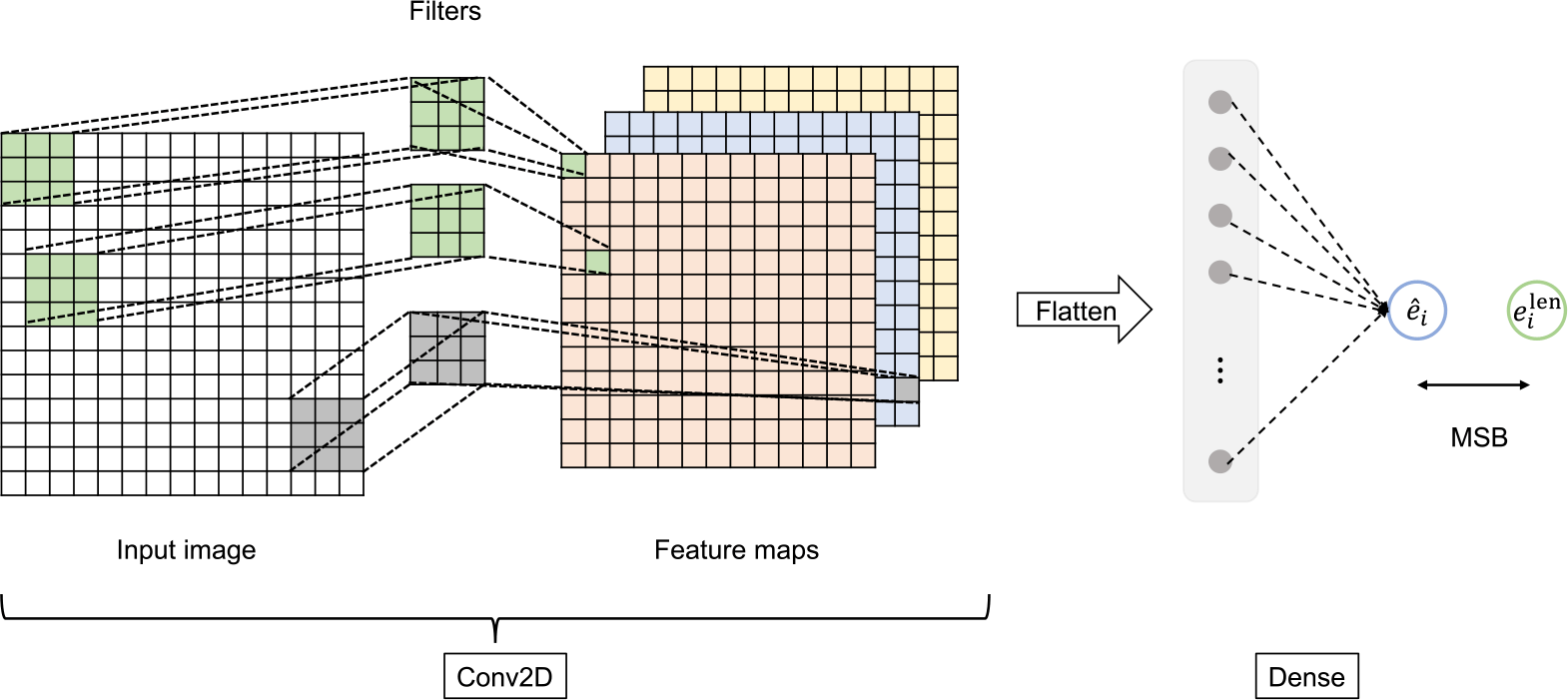
. The networks follow a shallow design (Figure 1) with a single convolutional layer consisting of 3
 $\times$
3 pixel filters, followed by a dense layer with hyperbolic tangent activation function.
Schematic of the CNN used for shear estimation (from Voigt Reference Voigt2024). Each input is a
 $15\times15$
pixel stamp containing a PSF-convolved galaxy. The network predicts galaxy ellipticities
 $\hat{e}_i$
, which are then averaged across the sample to obtain shear estimates
 $\hat{\gamma}_i$
.

To reduce the impact of noise bias we employ a mean square bias (MSB) loss function (Gruen et al. Reference Gruen, Seitz, Koppenhoefer and Riffeser2010):
 \begin{equation} \mathrm{MSB} = \frac{1}{n_{\mathrm{gal}}}\sum_{n=1}^{n_{\mathrm{gal}}}\left[\frac{1}{n_{\mathrm{real}}}\sum_{m=1}^{n_{\mathrm{real}}}\left(e_i^{\mathrm{len}}-\hat{e}_i\right)\right]^2,\end{equation}
where
 $n_{\mathrm{gal}}$
is the number of unique galaxy images in the training set, and
 $n_{\mathrm{real}}$
is the number of noisy versions generated for each.
2.3. Galaxy and PSF simulation
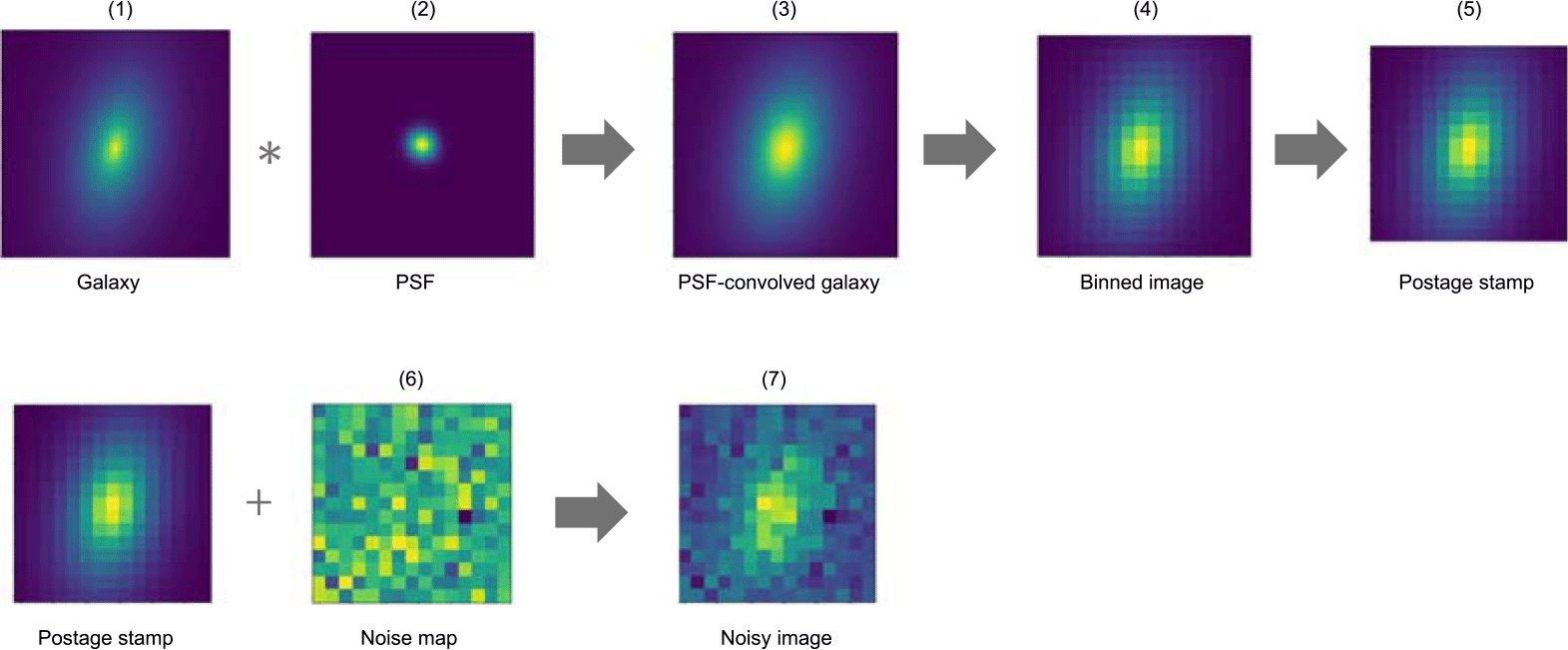
We create simulated Euclid-like images with a pixel scale of 0.1 arcsec and an elliptical Gaussian PSF with FWHM 0.17 arcsec. The galaxy population consists of exponential disks and de Vaucouleurs ellipticals in a 4:1 ratio, with sizes, ellipticities and signal-to-noise ratios drawn from realistic distributions (Fig. 2, see Voigt Reference Voigt2024).
Simulation workflow. Starting from analytic galaxy (1) and PSF (2) models, images are convolved on a large, fine grid (3), binned up to 0.1 arcsec pixels (4), cropped (5), and combined with noise (6) to produce the final
 $15\times15$
pixel stamps (7). Figure from Voigt (Reference Voigt2024).

3. Results
3.1. CNN optimisation
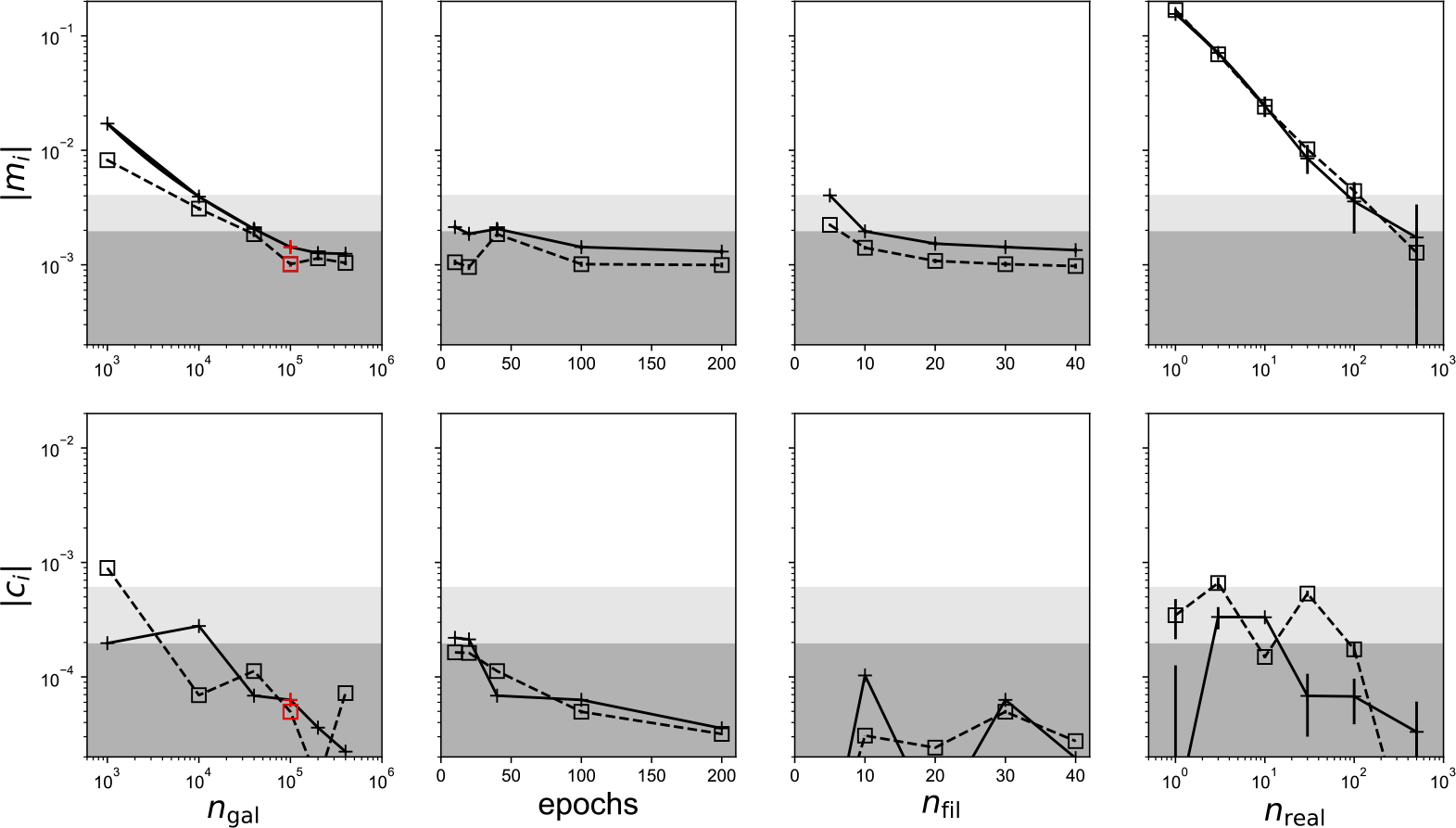
We investigate how the CNN performance depends on the model hyperparameters. As shown in Figure 3, we find that using
 $10^{5}$
galaxies in the training sets with 30 filters and 100 epochs is sufficient for the multiplicative and additive biases to fall within the Euclid requirements. For models trained on noisy images, the number of noisy realisations of each unique galaxy image is critical. With
 $n_{\mathrm{real}}=1$
(equivalent to a mean square error loss) the multiplicative biases remain large (
 $|m_i|\gtrsim 0.1$
). Using
 $\gtrsim500$
noise realisations suppresses noise bias by nearly two orders of magnitude, bringing the results in line with the requirements.
Dependence of multiplicative (
 $m_i$
; top) and additive (
 $c_i$
; bottom) biases on training set size (left), epochs (middle left), number of filters (middle right), and number of noisy realisations (right). Crosses (squares) denote the first (second) shear component. Dark shaded regions show Euclid requirements. Figure from Voigt (Reference Voigt2024).

3.2. PSF misestimation
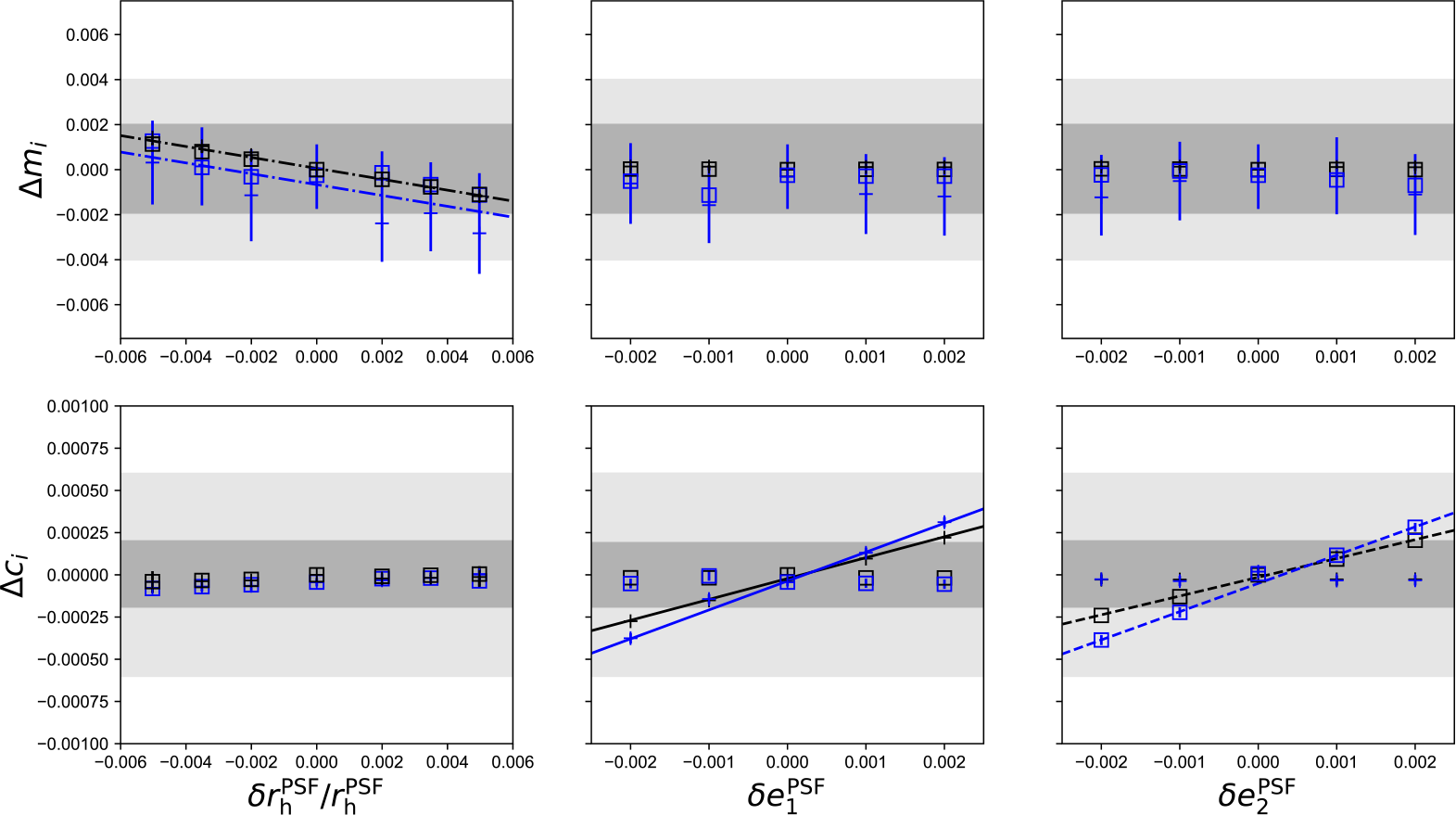
We assess how shear estimates are affected when the PSF used for training differs from that in the test data. The dependence of the multiplicative and additive biases can be described by
 \begin{equation}m_i = \beta_{0,i}+\beta_{1,i}\left(\frac{\delta r_\mathrm{h}^{\mathrm{PSF}}}{r_\mathrm{h}^\mathrm{PSF}}\right), \qquad c_i = \alpha_{0,i} + \alpha_{1,i} \,\delta e_i^{\mathrm{PSF}},\end{equation}
where
 $\delta r_\mathrm{h}^{\mathrm{PSF}}$
and
 $\delta e_i^{\mathrm{PSF}}$
are offsets in PSF size and ellipticity between the training and test sets. As expected, PSF ellipticity errors influence the additive biases, while PSF size errors affect the multiplicative biases. Our results (Figure 4) show that the CNN meets the Euclid requirements provided
 $|\delta e^{\mathrm{PSF}}_i|\lesssim10^{-3}$
and
 $|\delta r^{\mathrm{PSF}}_{\mathrm{h}}|/r^{\mathrm{PSF}}_{\mathrm{h}}\lesssim5\times10^{-3}$
. These tolerances are an order of magnitude less stringent than the requirements on the PSF model size and shape set out in the Euclid Definition Study Report (Laureijs et al. Reference Laureijs2011).
Impact of PSF misestimation on shear biases. Residual multiplicative
 $\Delta m_i$
(top) and additive
 $\Delta c_i$
(bottom) biases, relative to the fiducial case. Results are shown for offsets in PSF size (left) and ellipticity (middle/right), using both noise-free and noisy simulations. Points and shaded regions as in Figure 3. Figure from Voigt (Reference Voigt2024).

4. Conclusions
CNNs offer a promising approach for precision shear measurement in next-generation surveys. Using a shallow architecture with an appropriate loss function designed to mitigate noise bias, we achieve biases below Euclid requirements. Furthermore, the biases are relatively robust to PSF modeling uncertainties.
Acknowledgements
This work is based on research published in Voigt (Reference Voigt2024).
 15×15
 e^i
 γ^i
 15×15
 mi
 ci
 Δmi
 Δci

 Open access

