Introduction
Tonsillectomy is the most common and routine procedure in the daily practice of general otorhinolaryngologists. However, it is associated with notable morbidity, including intra-operative blood loss, post-operative pain and haemorrhage, painful swallowing, and limitations in daily activities and diet.Reference Ragab1–Reference Parsons, Cordes and Comer3 Several different methods have been used to perform tonsillectomy, including the classical technique (using ‘cold steel’ instruments), monopolar and bipolar electrocautery, radiofrequency, carbon dioxide laser, endoplasmic microdebrider, harmonic scalpel, blunt dissection, and argon plasma coagulation.Reference Ragab1–Reference Magdy, Elwany, Al-Daly, Abdel-Hadi and Morshedy5 In order to minimise the morbidity associated with tonsillectomy, various studies have evaluated these techniques to determine their advantages and disadvantages.
Electrocautery and cold steel instrumentation have been the most widely used methods, and are currently regarded as traditional tonsillectomy techniques. Recently, the innovative radiofrequency technique has become established.Reference Friedman, LoSavio, Ibrahim and Ramakrishnan4 One distinction between the electrocautery and the radiofrequency techniques is the operation temperatures involved; radiofrequency devices function at lower temperatures (40–70°C) than monopolar electrocautery (400°C or higher).Reference Friedman, LoSavio, Ibrahim and Ramakrishnan4–Reference Noordzij and Affleck6 Thus, by decreasing the operation temperature and thereby the thermal damage to tissues, it has been suggested that the radiofrequency technique could reduce post-tonsillectomy pain.Reference Parsons, Cordes and Comer3, Reference Magdy, Elwany, Al-Daly, Abdel-Hadi and Morshedy5, Reference Littlefield, Hall and Holtel7 Several studies have compared the effect on post-tonsillectomy morbidity of monopolar electrocautery versus radiofrequency methods. Radiofrequency was found to be superior to monopolar electrocautery with respect to post-operative pain.Reference Noordzij and Affleck6, Reference Littlefield, Hall and Holtel7 However, other studies have found no improvement in post-operative pain with radiofrequency versus electrocautery or classical cold steel tonsillectomy.Reference Shah, Galinkin, Chiavacci and Briggs8, Reference Bäck, Paloheimo and Ylikoski9
Therefore, no definitive consensus has been reached regarding an optimal technique with which to decrease the morbidity associated with tonsillectomy.Reference Friedman, LoSavio, Ibrahim and Ramakrishnan4 The aim of the present study was to generate more data comparing the efficacy and safety of radiofrequency versus monopolar electrocautery tonsillectomy techniques, regarding post-operative pain and haemorrhage, operation duration, and tonsillar fossa healing, in patients with recurrent chronic tonsillitis.
Materials and methods
A prospective, randomised, double-blind, controlled clinical study was conducted to compare the effects of standard monopolar electrocautery versus radiofrequency tonsillectomy techniques in patients with recurrent chronic tonsillitis. A total of 50 patients aged over 10 years, admitted for tonsillectomy between March 2007 and June 2008, were enrolled in the study. (Patients younger than 10 years have difficulty defining pain accurately and assessing pain using a visual analogue scale (VAS), and were thus excluded.) The study protocol was approved by our institutional ethics committee. Written, informed consent was obtained from patients older than 18 years of age; for patients aged 10–18 years, written, informed consent was obtained from their parents. Patients for whom general anaesthesia was contraindicated were excluded.
Immediately prior to surgery, routine antibiotic treatment, analgesia and dexamethasone (0.15 mg/kg) were administered intravenously to all patients.
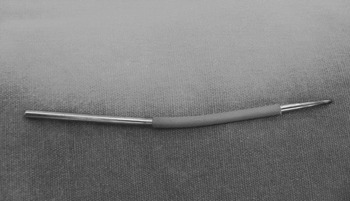
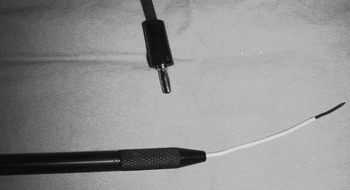
Surgery was performed under general anaesthesia. Each tonsil was dissected out together with its capsule, in a similar manner to traditional tonsillectomy. Patients were randomised to have one tonsil removed by a radiofrequency device (Ellman Surgitron FFPF EMC Radiosurgical Device; Ellmann International, Ellman International Inc 1135 Railroad Avenue Hewlett, NY 11557, USA), set at a level of six in the cut/coagulation mode, and the other tonsil removed by a monopolar electrocautery device (KLS Martin ME 411 Electrosurgical Unit; KLS Martin, Tuttlingen, Germany), set in cutting mode with a power of 20–35 W. The monopolar electrocautery needle and radiofrequency probes used in the study are shown in Figures 1 and 2, respectively. All patients were operated upon by the first author. The method applied, the relevant side and the operation duration were recorded by the operating surgeon.
The monopolar electrocautery needle.

The radiofrequency probe.

Post-operative evaluation was performed by a different clinician. Both this clinician and the patients themselves were blinded to the surgeon's choice of techniques.
All patients stayed in the hospital for one day post-operatively. Oral antibiotics and analgesia were administered post-operatively for 10 days. After discharge, patients were requested to return to the hospital if bleeding occurred.
The following outcome measures were recorded: operation duration for each side, post-operative haemorrhage, post-operative pain, post-operative complications and degree of wound healing.
In order to assess post-operative pain, patients were requested to complete a form, or be interviewed by telephone, twice a day (morning and evening), over the 14 post-operative days. Pain was evaluated using a 10-point VAS.
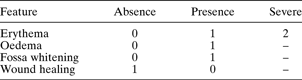
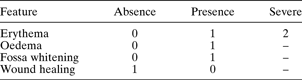
Tonsillar fossa wound healing was evaluated according to the method described by Magdy et al. Reference Magdy, Elwany, Al-Daly, Abdel-Hadi and Morshedy5 Oedema, erythema (in addition to signs of inflammation; thus, erythema scored up to two points), fossa whitening and wound healing were rated and evaluated on the first, fifth, 10th and 14th post-operative days. The scoring system used for tonsillar fossa wound healing is shown in Table I. The degree of tonsillar fossa wound healing was evaluated by summing the scores: a maximum score of five points indicated the absence of tonsillar wound healing, while a minimum of zero points indicated complete tonsillar fossa wound healing.
Scoring system for tonsillar fossa wound healing
All statistical analyses were performed using the Statistical Package for the Social Sciences version 12.0 for Windows software. Descriptive statistics (mean, median, standard deviation (SD), and minimum and maximum values) and frequency tables were calculated for numerical and categorical variables, respectively. The Mann–Whitney U-test was used to compare the radiofrequency and monopolar electrocautery methods. Repeated measurements analysis of variance was used to compare repeated measurements. The Spearman correlation was used to evaluate the relationship between mean VAS pain scores and operation duration, as well as age variables. A significance level of p < 0.05 was accepted.
Results
A total of 50 patients with a mean ± SD for age of 18.7 ± 8.2 years were enrolled. Patients comprised 27 males (mean ± SD age 19 ± 8.9 years) and 23 females (mean ± SD age 18.3 ± 7.7 years).
The mean ± SD for time required to remove one tonsil was 8.1 ± 1.6 minutes for the radiofrequency technique and 7.3 ± 1.5 minutes for the monopolar electrocautery technique. Thus, the operation time for radiofrequency tonsillectomy was statistically significantly longer than that for monopolar electrocautery (p = 0.034), although this time difference was not clinically significant.
No serious intra-operative haemorrhage was encountered during either monopolar electrocautery or radiofrequency tonsillectomy; thus, statistical comparison in this respect was thought unnecessary. Post-operative haemorrhage was observed in only three patients (13.6 per cent): two on the monopolar electrocautery side (one minor and one major haemorrhage) and one on the radiofrequency side (a minor haemorrhage). The minor haemorrhages resolved with topical intervention. The patient with major haemorrhage on the monopolar electrocautery side was taken to the operating theatre, where the haemorrhage was controlled using bipolar electrocautery.
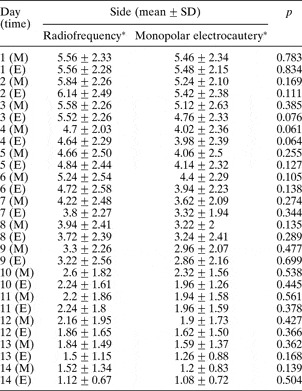
The mean ± SD pain scores for radiofrequency and monopolar electrocautery tonsillectomy were 3.7 ± 1.6 and 3.3 ± 1.4, respectively. On inter-group analysis, no statistically significant difference was observed between the two methods regarding pain scores over the whole 14-day post-operative period (p < 0.126). Also, inter-group analysis showed no significant differences between the two methods regarding mean morning and evening pain scores for each of the 14 post-operative days (Table II). The daily decrease in pain scores was significant for both tonsillectomy methods on intra-group analysis (p < 0.01 for both methods); however, this daily decrease was statistically insignificant when the two methods were compared using inter-group analysis (p = 0.718). Intra-group analysis detected no correlation between operation duration and mean pain scores for both methods (radiofrequency method: r = 0.076, p = 0.598; monopolar electrocautery method: r = 0.194, p = 0.177).
Pain scores over 14 post-tonsillectomy days: radiofrequency vs monopolar electrocautery

* n = 50 tonsils removed. SD = standard deviation; M = morning; E = evening
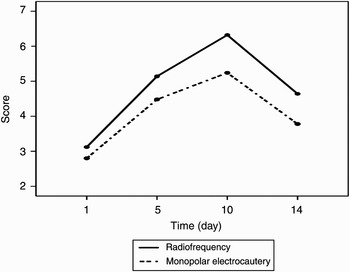
Intra-group analysis found no statistically significant difference between the radiofrequency and monopolar electrocautery methods regarding altered tonsillar fossa wound healing scores evaluated on the first, fifth, 10th and 14th post-operative days (p < 0.106) (Figure 3). On inter-group analysis, tonsillar fossa wound healing scores evaluated on the first, fifth, 10th and 14th post-operative days were statistically significantly greater for the radiofrequency method compared with the monopolar electrocautery method (p < 0.001). The mean ± SD tonsillar fossa wound healing scores were similar for radiofrequency and monopolar electrocautery methods only on the first post-operative day (being 3.1 ± 1.7 and 2.8 ± 1.1, respectively; p = 0.260).
Estimated marginal mean scores for tonsillar fossa wound healing at the first, fifth, 10th and 14th post-operative days.

Discussion
New tonsillectomy techniques continue to evolve, and it is necessary for otolaryngologists to continue to assess the safety and efficacy of these methods. The present study evaluated monopolar electrocautery and radiofrequency tonsillectomy methods in terms of operation duration and tonsillectomy morbidity (i.e. post-operative pain and haemorrhage and tonsillar fossa wound healing), in patients aged over 10 years with recurrent chronic tonsillitis.
Monopolar electrocautery is the most common method of tonsillectomy; it is preferred as it is known to reduce intra-operative bleeding and facilitate homeostasis.Reference Leinbach, Markwell, Colliver and Lin10–Reference Wexler12 In the present study, no significant difference was observed between the frequency of haemorrhage encountered with radiofrequency versus monopolar electrocautery tonsillectomy methods. Another reason for performing electrocautery tonsillectomy is its shorter operation time, compared with other tonsillectomy techniques such as radiofrequency, plasma-mediated ablation and microdissection needle.Reference Noordzij and Affleck6–Reference Shah, Galinkin, Chiavacci and Briggs8, Reference Perkins and Dahiya13 Noordzij and Affleck reported a mean operation time of 8.22 minutes for the radiofrequency technique and 6.33 minutes for the monopolar technique.Reference Noordzij and Affleck6 Similarly, Littlefield et al. found a mean operation time of 8 minutes for the radiofrequency method and 6 minutes for the monopolar electrocautery method.Reference Littlefield, Hall and Holtel7 The present study findings were consistent with these previous results, observing a significantly longer mean ± SD operation duration for the radiofrequency method (8.1 ± 1.6 minutes) compared with the monopolar electrocautery (7.3 ± 1.5 minutes). However, despite this statistical significant, the observed difference in operation times can be considered clinically insignificant, as no correlation was found between operation duration and pain scores for either method.
• This study aimed to compare the efficacy and safety of radiofrequency and monopolar electrocautery tonsillectomy
• Fifty patients aged over 10 years who required tonsillectomy were randomly assigned to have one tonsil removed by radiofrequency and the other by monopolar electrocautery
• Operation duration, post-operative haemorrhage and pain, and tonsillar fossa wound healing were compared
• Monopolar electrocautery tonsillectomy was superior to radiofrequency tonsillectomy regarding post-operative tonsillar fossa wound healing, but both technigues were comparable regarding post-operative pain
It should be noted that the radiofrequency technique can be used to remove tonsillar tissue in three different ways: by using the probe to dissect along the capsular plane of the tonsil (much like a traditional tonsillectomy); by using the probe to create small channels in the tonsil, with subsequent tonsil shrinkage and volume reduction (i.e. radiofrequency ablation); and by using the probe to perform a subtotal tonsil reduction, protecting the underlying tissue.Reference Friedman, LoSavio, Ibrahim and Ramakrishnan4 Thus, the post-operative pain and tonsillar fossa wound healing would differ according to the radiofrequency technique performed. In the present study, the radiofrequency probe was used to dissect along the capsule of the tonsil (similar to a traditional tonsillectomy).
In the present study, inter-group analysis indicated no statistically significant difference in the pain scores for radiofrequency versus monopolar electrocautery methods. Similarly, Shah et al. found no improvement in post-operative pain after paediatric tonsillectomy using radiofrequency (plasma-mediated ablation) versus monopolar electrocautery methods.Reference Shah, Galinkin, Chiavacci and Briggs8 In contrast, in the prospective, blinded studies conducted by Littlefield et al. and Hall et al. (which were similar to the present study in terms of study design, with n = 17 and randomisation of patients to undergo one tonsil removal with radiofrequency and the other with unipolar electrocautery), the radiofrequency method was associated with significantly less post-operative pain compared with the monopolar electrocautery method, for both tonsillotomy and tonsillectomy.Reference Littlefield, Hall and Holtel7, Reference Hall, Littlefield, Birkmire-Peters and Holtel14 These reported differences in pain outcomes following radiofrequency tonsillectomy may relate to differences in the radiofrequency technique used.
Paediatric tonsillectomy is known to be easier and less painful compared with adult tonsillectomy, due to reduced scar formation in the former.Reference Tan, Hsu, Eng, Ng, Lu and Tan2 In the present study, intra-group analysis indicated that pain scores increased significantly with increasing age, for both tonsillectomy methods.
Post-operative tonsillar fossa wound healing was also assessed in the present study. Previous studies of this subject have yielded contradictory results; some have reported faster tonsillar fossa wound healing after radiofrequency tonsillectomy compared with electrocautery methods, while others have reported no difference.Reference Littlefield, Hall and Holtel7, Reference Shah, Galinkin, Chiavacci and Briggs8 Shah et al. reported that radiofrequency paediatric tonsillectomy (plasma-mediated ablation) led to significantly less histopathological evidence of thermal injury, compared with monopolar electrocautery.Reference Shah, Galinkin, Chiavacci and Briggs8 However, despite this they reported no improvement in recovery for radiofrequency versus monopolar electrocautery tonsillectomy. In addition, Noordzij and Affleck observed no difference between monopolar electrocautery and radiofrequency coblation technique in terms of tonsillar fossa wound healing.Reference Noordzij and Affleck6
Thus, various authors have evaluated the morbidity associated with monopolar electrocautery versus radiofrequency tonsillectomy methods, with varying outcomes. We suggest that further randomised, controlled studies with larger sample sizes are needed in order to further clarify this situation.
Conclusion
The present study demonstrated that radiofrequency tonsillectomy takes longer to perform than monopolar electrocautery tonsillectomy. No serious peri- or post-operative haemorrhage was observed for either method. Monopolar electrocautery tonsillectomy appeared to be superior to radiofrequency tonsillectomy in terms of post-operative tonsillar fossa wound healing. There was no obvious difference between the two methods as regards post-operative pain. Different studies have reported various outcomes regarding the efficacy, safety and morbidity of monopolar electrocautery versus radiofrequency tonsillectomy. In order to clarify this issue, further randomised, controlled studies with larger sample sizes are required.