INTRODUCTION
Human communication is multimodal, including gestures. Gestures are visible actions of body parts (Kendon, Reference Kendon2004) and constitute a crucial part of conversation. Co-speech gestures accompany spoken speech. They contribute to felicitous communication by facilitating listeners' comprehension of a spoken message (Beattie & Shovelton, Reference Beattie and Shovelton2006; Hostetter, Reference Hostetter2011; Kendon, Reference Kendon1994) and help speakers retrieve information stored in the mental lexicon (Frick-Horbury & Guttentag, Reference Frick-Horbury and Guttentag1998; Krauss, Chen & Gottesman, Reference Krauss, Chen, Gottesman and McNeill2000; Ruiter, Reference Ruiter and McNeill2000). The close relationship between gesture and speech and their mutual influence are widely recognized. Accounts of embodied cognition assume that motor actions, such as observing a speaker gesturing, enhance memory and learning (Madan & Singhal, Reference Madan and Singhal2012).
Gestures are classified into different types. Here, we focus on iconic hand gestures, which capture meaning aspects of the entity that is conveyed by the gesture (McNeill, Reference McNeill1992), for example flapping hands representing a bird flying. Iconic gestures have been suggested to facilitate word learning. It is argued that iconic gestures are less arbitrary than most spoken symbols. The visuospatial aspects of gesture help process the accompanying speech and lead to strengthened memory traces and deeper conceptual understanding (Hostetter, Reference Hostetter2011; So, Chen-Hui & Wei-Shan, Reference So, Chen-Hui and Wei-Shan2012). A comprehensive review of the existing literature (Hostetter, Reference Hostetter2011) proposed that gestures are particularly helpful to children. The focus of the present study is on word learning in typically developing (TD) children and in children with specific language impairment (SLI). Previous research indicated a gesture advantage in children with SLI as compared to their TD peers such that they show stronger associations between gesture and language (Botting, Riches, Gaynor & Morgan, Reference Botting, Riches, Gaynour and Morgan2010), and benefit more from gesture input for pragmatic comprehension (Kirk, Pine & Ryder, Reference Kirk, Pine and Ryder2011; Lavelli, Barachetti & Florit, Reference Lavelli, Barachetti and Florit2015). So far, this has not been demonstrated for word learning. Therefore, it is interesting to investigate the influence of gestures on word learning in typically developing and language impaired populations.
Word learning in children with SLI
SLI is defined as a developmental language disorder in the absence of any identifiable reason for the disorder (Bishop, Reference Bishop2014; Leonard, Reference Leonard1998). It is generally agreed that the population is heterogeneous and that children with SLI show various deficits in language, including slow acquisition of the lexicon and grammar, and limited comprehension and production of vocabulary or grammatical forms (Bishop & Snowling, Reference Bishop and Snowling2004; Conti-Ramsden & Botting, Reference Conti-Ramsden, Botting, Verhoeven and van Balkom2004; Leonard, Reference Leonard2009). Limited processing capacities and difficulty with sustained attention are reported as well (Alt, Myers & Alt, Reference Alt, Meyers and Alt2013; Ebert & Kohnert, Reference Ebert and Kohnert2011; Eichorn, Marton, Campanelli & Scheuer, Reference Eichorn, Marton, Campanelli and Scheuer2014; McKean, Letts & Howard, Reference McKean, Letts and Howard2013; Sheng & McGregor, Reference Sheng and McGregor2010).
Problems with word learning are often part of the characteristics associated with SLI. Word learning is a process in which word representations are gradually established, starting from an incomplete representation after first perceiving the new form–referent link through fast mapping until the word is represented and stored completely through slow mapping (Horst & Samuelson, Reference Horst and Samuelson2008; Justice, Meier & Walpole, Reference Justice, Meier and Walpole2005). Children with SLI are reported to have weak word knowledge, i.e. weak semantic and phonological representations, compared to peers. Thereby, both fast and slow mapping are affected (Alt et al., Reference Alt, Meyers and Alt2013; Gray, Reference Gray2003; McKean et al., Reference McKean, Letts and Howard2013). Given that the vocabulary deficiencies seem to reflect immaturities in semantic representation (McGregor, Newman, Reilly & Capone, Reference McGregor, Newman, Reilly and Capone2002; Sheng & McGregor, Reference Sheng and McGregor2010), methods to support word learning in children with SLI are desirable. Below, we summarize findings regarding the role of iconic gesture as a means of enhancing word learning in TD children and children with SLI.
Contribution of observing iconic gesture to children's word learning
For word learning, children use a number of cues, gestures among them. To derive benefit from iconic gestures, two mechanisms are important. First, the child has to be capable of detecting the meaning conveyed by the gesture. While still fragile in toddlerhood, the ability to derive meaning from iconic gestures develops at three years of age and is acquired by age 3;5 to 4;0 (Namy, Campbell & Tomasello, Reference Namy, Campbell and Tomasello2004; Novack, Goldin-Meadow & Woodward, Reference Novack, Goldin-Meadow and Woodward2015; Stanfield, Williamson & Özçaliṣkan, Reference Stanfield, Williamson and Özçaliṣkan2014; Tolar, Lederberg, Gokhale & Tomasello, Reference Tolar, Lederberg, Gokhale and Tomasello2008). Preschool children can also learn from arbitrary gestures, but once they are able to recognize iconicity they learn from iconic gestures more readily than from arbitrary ones (Marentette & Nicoladis Reference Marentette and Nicoladis2011; Namy et al., Reference Namy, Campbell and Tomasello2004). Besides, some types of iconic gestures appear to be easier to identify than others, for example gestures depicting actions associated with an object (Hodges, Özçaliṣkan & Williamson, Reference Hodges, Özçaliṣkan and Williamson2015), and gestures showing how an object is handled are recognized earlier in development than gestures based on the shape of an object (Tolar et al., Reference Tolar, Lederberg, Gokhale and Tomasello2008). Second, the child has to be able to process and integrate multimodal information. While typical word learning implies mapping a spoken word onto a referent, word learning paired with gestures requires additional cognitive demands such that both a spoken word and a gesture have to be mapped onto the referent (Puccini & Liszkowski, Reference Puccini and Liszkowski2012). It has been shown that children at age three are able to integrate information presented in iconic gesture and speech (Sekine, Sowden & Kita, Reference Sekine, Sowden and Kita2015).
Evidence supporting the notion that observing iconic gestures facilitates word learning for a range of word classes comes from studies with young TD children. It has been demonstrated that seeing iconic gestures helped preschool children to focus on a particular aspect of novel verbs and thereby enhanced learning their meaning (Goodrich & Hudson Kam, Reference Goodrich and Hudson Kam2009; Mumford & Kita Reference Mumford and Kita2014). Capone and McGregor (Reference Capone and McGregor2005) showed that co-speech iconic gestures exemplifying the shape and function of novel objects improved word retrieval in toddlers. Moreover, iconic shape gestures were more effective than pointing gestures (Capone Singleton, Reference Capone Singleton2012). McGregor, Rohlfing, Bean, and Marschner (Reference McGregor, Rohlfing, Bean and Marschner2009) taught two-year-olds the preposition under either with or without iconic gestures. At delayed post-test, children showed a more robust and abstract knowledge of the meaning when the words were paired with a gesture. Moreover, it was found that observing iconic gestures was particularly effective when spoken messages were complex (McNeil, Alibali & Evans, Reference McNeil, Alibali and Evans2000). Observing iconic gestures appears to improve immediate comprehension and, in particular, benefit slow mapping (McGregor et al., Reference McGregor, Rohlfing, Bean and Marschner2009; Munro, Baker, McGregor, Docking & Arciuli, Reference Munro, Baker, McGregor, Docking and Arciuli2011). Two studies suggest that iconic co-speech gestures can serve to scaffold word learning in children with SLI. Work by Ellis Weismer and Hesketh (Reference Ellis Weismer and Hesketh1993) has shown that in a fast mapping task children with SLI as well as TD children understood novel spatial terms better when the words were trained with iconic gestures compared to words trained without additional input. However, there were no effects on naming. Lüke and Ritterfeld (Reference Lüke and Ritterfeld2014) expanded this work by additionally investigating slow mapping. Effects of observing iconic shape gestures on the learning of names for cartoon characters were compared to a no-gesture condition. Contrary to Ellis Weismer and Hesketh's (Reference Ellis Weismer and Hesketh1993) study, no immediate advantage of the iconic gesture condition emerged. However, during slow mapping children showed a gesture benefit for naming – but not for comprehension. The authors of both studies conclude that observing iconic gestures leads to more efficient word learning in children with SLI. Yet, generalization of this conclusion has serious limitations. First, stimuli used in the studies (novel words for spatial terms, whose meaning children already knew, and proper names for cartoon characters) are not representative of the words children acquire. Second, the number of children with SLI in the experimental groups was rather small (eight and ten children, respectively).
Moreover, in both studies the control condition was merely an absence of gesture, involving no additional cues beyond speech. Hence, word learning conditions differed with respect to their processing demands (So et al., Reference So, Chen-Hui and Wei-Shan2012; Yap, So, Yap & Tan, Reference Yap, So, Yap and Tan2011): Whilst in the iconic learning condition both a spoken word and a gesture had to be mapped onto the referent, the control condition required the child to process auditory information only (Puccini & Liszkowski, Reference Puccini and Liszkowski2012). In a ‘gesture vs. no-gesture’ design, it remains unclear whether children benefit from iconic gestures due to the specific information conveyed by the gesture, or rather because the additional visual input directed children's attention to the target words and thus improved learning. In order to show that iconic gestures do more than focus attention, demonstration of an iconic gesture benefit over a control condition that goes beyond a no-gesture condition is required. However, studies comparing two different gesture types in word learning (in terms of mapping a lexical form and semantics) are rare. Lüke and Ritterfeld (Reference Lüke and Ritterfeld2014) conducted a fast mapping experiment and found that both iconic and arbitrary gestures had a beneficial effect on TD preschoolers' initial word learning. Capone Singleton (Reference Capone Singleton2012) demonstrated enhanced learning of novel nouns paired with iconic gestures as compared to pointing gestures. Pointing gestures are stationary gestures which scaffold referential understanding by focusing children's attention on the referent whose lexical form they are learning (Novack et al., Reference Novack, Goldin-Meadow and Woodward2015), provided the referent is in the immediate environment. Iconic gestures, however, require attention to hand movement and represent referents (Puccini & Liszkowski, Reference Puccini and Liszkowski2012). Results led Capone Singleton (Reference Capone Singleton2012) to suggest that iconic gestures enrich semantic learning, establish more robust word knowledge, and in this way make word learning more efficient than pointing gestures do. The current study set out to substantiate and expand these findings.
Current study
For this purpose, we designed a study to compare the learning of unknown words (nouns and verbs) in a within-subjects design under two gesture conditions. In the experimental condition, new words were taught with iconic gestures. To ensure that a potential iconic gesture advantage does not merely reflect enhanced attention to the target word, we applied a control condition, in which the target words were paired with an attention-directing gesture in the form of a raised forefinger in front of the upper body. Such a gesture does not convey the semantic meaning of the referents, and resembles pointing gestures in that it is stationary and visually guides attention. At the same time, the control gesture covers functions of iconic gestures, such that it directs attention to hand movement, nevertheless lacking the specific property of iconic gestures, namely visually capturing meaning aspects of the referent. Rather, the control gesture guides listeners to attend to particular parts of the utterance, increases the salience of the word, and thus serves a metalinguistic purpose. Such a control condition enabled us to investigate whether iconic gestures do more than focus attention. This approach allowed us to compare two conditions where both the spoken word and a gesture have to be mapped onto the referent. In a subsequent control experiment, we modified the control condition by using different arbitrary gestures instead of the constant attention-directing gesture.
We investigated the ability to learn words in two gesture conditions in TD children and children with SLI, and assumed that children of either group could master the task. Our main research interest was on the relative effect of observing co-speech iconic gestures on word learning. The following hypotheses were tested:
-
1. Observing iconic co-speech gestures should impact more effectively on word learning than observing non-iconic gestures. This hypothesis grounds on research showing that children by the age of three can master the cognitive requirements to process co-speech gesture and can learn from iconic gestures. Moreover, enhanced learning with iconic gestures as compared to pointing gestures was demonstrated in young TD children (Capone Singleton, Reference Capone Singleton2012). We expected that this effect would apply to the learning of both nouns and verbs, since an iconic advantage over mere verbal input has been found for a range of word classes, including nouns and verbs. Finally, former research gives rise to the hypothesis that such an iconic effect should be apparent at both the initial learning and the retention of the new words.
-
2. It was expected that observing iconic gestures would have a positive influence on word learning in children with and without language impairment. However, as children with SLI are a special group of language learners it is unclear whether the degree of the iconic gesture advantage differs across groups.
METHOD
A word learning study was conducted employing a mixed design to test for differences between two learning conditions, involving three groups of preschool children: (i) twenty children with SLI; (ii) twenty TD children matched individually for chronological age (±9 months) and gender (age-matched group, AM); and (iii) twenty TD children matched individually to children with SLI for grammar comprehension and word comprehension scores (±½ SD) (language-matched group, LM). Observations extended over three points in time. The University of Applied Sciences Fresenius Ethics Committee gave approval for the study.
Participants
Participants in the study were TD children and children with SLI from the wider areas of Frankfurt and Hamburg in Germany. TD children were recruited via nurseries, children with SLI via certified speech–language therapists. All children were drawn from middle-class backgrounds regarding parental education and professional training as indicated by parent reports. The parents gave informed consent to the study and answered a questionnaire focusing on the child's general and language development. Criteria for inclusion were: (i) age under six; (ii) normal general development, including physical, sensory, and non-verbal cognitive skills according to parent reports; and (iii) monolingual German speakers.
Children with SLI had formerly been diagnosed by the child's speech and language therapist. Detailed information regarding language skills and intervention was obtained through a therapist-reported questionnaire. Importantly, no treatment involved gestures. The diagnoses and information concerning language and non-verbal cognitive skills were confirmed by standardized measures administered before training. Non-verbal cognitive ability was measured using the Coloured Progressive Matrices (CPM; Raven, Bulheller & Häcker, Reference Raven, Bulheller and Häcker2010) in SLI and AM children. Since this test does not provide normative data for children under age 3;9, non-verbal cognitive ability in LM children was measured using the subtest ‘Muster legen’ (patterns identification) of the Wiener Entwicklungstest (WET; Kastner-Koller & Deimann, Reference Kastner-Koller and Deimann2012).
Language ability was measured using validated norm-referenced tests frequently used in clinical practice in Germany. The skills assessed were as follows: (i) grammar comprehension using the test for reception of grammar – German version (TROG-D; Fox, Reference Fox2006); (ii) receptive and expressive vocabulary (nouns and verbs) using subtests of the Patholinguistische Diagnostik bei Sprachentwicklungsstörungen (PDSS; Kauschke & Siegmüller, Reference Kauschke and Siegmüller2010); (iii) word definition using a subtest of the WET (Kastner-Koller & Deimann, Reference Kastner-Koller and Deimann2012); and (iv) nonword repetition using a subtest of the Sprachentwicklungstest für drei- bis fünfjährige Kinder (SETK3–5; Grimm, Reference Grimm2010). Additionally, speech sound disorders were assessed using the screening version of the Psycholinguistische Analyse kindlicher Sprechstörungen (PLAKSS; Fox, Reference Fox2005). To examine scoring reliability, a second investigator scored 25% of the standardized assessments. Overall agreement was 96%.
In addition to parent report and therapist's diagnosis, to be included in the group with SLI the child had to perform more than one standard deviation (SD) below the mean on at least three of the language subtests administered. Controls had to perform within normal range in all language assessments. Five children with SLI and thirteen TD children who did not meet the criteria were excluded from the study.
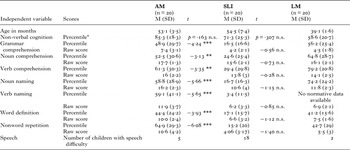
The final sample consisted of twenty children with SLI (10 girls, 10 boys) with a mean age of 4;6 (SD 0;7), twenty children matched for age and gender (AM; mean age 4;5, SD 0;3), and twenty younger children matched for language (LM; 11 girls, 9 boys; mean age 3;3, SD 0;16). Group means and standard deviations of the cognitive and language testing in terms of percentile ranks and raw scores as well as between-group comparisons for the children with SLI and the control groups are reported in Table 1.
Participant characteristics for the group with SLI and controls

notes: a Percentile: refers to a value on a scale of hundred (mean of 50 and standard deviation of 34) that indicates the percent of a distribution that is equal or below; M (SD) = mean (standard deviation); n = number of participants; ** p < ·01, *** p < ·001, n.s. = non-significant.
All children fulfilled the requirement of lying within the normal range for non-verbal cognition. One-way analyses of variance (ANOVA) showed a significant group effect (F(2,49) = 6·67, p = ·003, ω = ·18). Post-hoc analyses (Bonferroni) revealed that AM children performed significantly better than LM children on the cognitive measure (p = ·002), an effect which we attribute to the use of different tests in AM and LM children. There was no significant difference between LM and SLI children (p = ·307). AM children did not differ from children with SLI with respect to non-verbal cognition (p = ·163). Note that we were not interested in whether AM children performed better in the training than children with SLI, but instead in how the different groups responded to the learning conditions.
Regarding language measures, mean scores for the children with SLI were significantly lower than the scores of the AM children on each of the measures, whereas they did not differ from those of the LM children. All children with SLI exhibited limited expressive language abilities, eleven children also showed receptive limitations. TD children exhibited overall normal-range performance.
General procedure
All assessments and training took part in a separate room in children's nurseries. Within two weeks, children were seen individually for six sessions lasting approximately 30 minutes each. All sessions were video recorded (JVC camcorder HD Everio GZ-V515). The procedure of the assessment and the training was explained to the children by the investigator in a child-appropriate way.
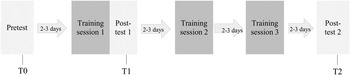
The first two sessions comprised assessment of non-verbal cognition and language measures (independent variables). Moreover, children's knowledge of the target words to be learned in the training (dependent variables: naming and comprehension task) was assessed (T0). Subsequently, three training sessions were conducted two to three days apart. The target words were introduced during the first session and repeated in the following two sessions. Learning achievement was assessed immediately after the first training (T1, fast mapping) and two to three days after completion of the training (T2, slow mapping) – as shown in Figure 1.
Study design (training and assessments).

Target stimuli
The target items consisted of twelve German words (6 nouns and 6 verbs). Nouns represented rare animal species, verbs were intransitive and represented unusual movement types. When using real words in a training study, it is vital to ensure that children do not know the words prior to training. Thus, nouns and verbs of very low frequency were chosen from German dictionaries. Word frequency, if available, was determined by use of the corpus-based collection of the University of Leipzig (University of Leipzig, 1998–2013). In a pre-study, the words had been tested in TD four-year-old and five-year-old monolingual German children. None of the children (n = 16) had been able to name any of the stimuli. Assessment of comprehension – when presenting the target item and three distractors – showed a maximum of 7% to 21% of correct reactions to stimuli, which is below the chance level of 25%. Word forms were monosyllabic or bisyllabic, following the German trochaic prosodic pattern.
A pilot study revealed that children between four and five years of age were easily able to learn twelve words. For younger children and children with SLI, however, learning twelve words caused mental overload, reduced attention during training, and led to floor effects. For these children, learning eight new words turned out to be appropriate. In order to avoid ceiling or floor effects, we decided to train unequal numbers of target words (12 in AM, 8 in LM and children with SLI). Accordingly, data analyses are based on percentages.
Learning conditions
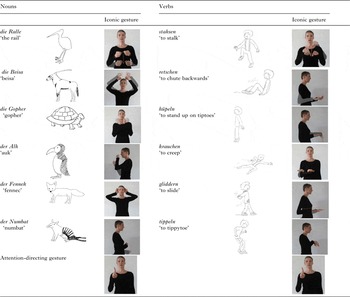
Children learned words under two conditions: in the iconic gesture condition (ICON), spoken stimuli were paired with a gesture that highlighted the shape of the animal (nouns) or the manner and/or path of the movement (verbs). Shape gestures had been shown to particularly support noun learning (Capone & McGregor, Reference Capone and McGregor2005) whereas manner gestures helped children interpret new verbs (Mumford & Kita, Reference Mumford and Kita2014). The gestures were dynamic iconic symbols lasting for 1–2 seconds, performed with the hands in the upper body or head region. A gesture-to-referent matching task was conducted with twenty-four adult students (age 19–24), confirming that adults were able to match the gestures to the respective referents in 83% to 98% on average. In the control condition, stimuli were paired with an attention-directing gesture (ATTENT) in the form of a raised forefinger in front of the upper body. Stimuli and conditions are given in Table 2.
Stimuli: words, pictures, and gestures in the iconic and attention-directing condition (Drawings copyright © 2013, Joy Katzmarzik leap4joy graphics)

Half of the target words were learned in the ICON condition, the other half in the ATTENT condition. Words to be learned in the ICON and the ATTENT gesture condition were counterbalanced across children but remained paired with the referent throughout training.
Training procedure
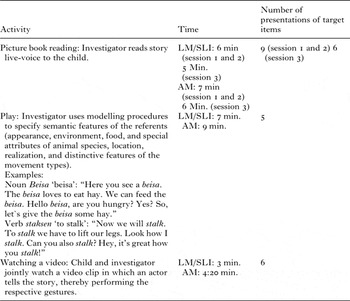
All target words were introduced in the first training session and repeated in the next two sessions. Children were taught the words following a standard protocol, hearing the target words repeatedly being paired with either the ICON or ATTENT gesture. Children were allowed, but not encouraged, to imitate the gestures; however, their gesturing was not responded to. Throughout training, children were exposed to each target word twenty times before the first learning assessment (T1) and fifty-seven times before the second (T2). Since preschool children are familiar with listening to stories and benefit for word learning (Horst, Parsons & Bryan, Reference Horst, Parsons and Bryan2011), a story was created and illustrated in a story book. The story comprised all target words and served as basis for the training. Training sessions were organized in three phases and specified in detail in a comprehensive training manual (see Table 3 for an overview of the content of sessions).
Content and structure of each training session

Learning assessment
We were interested in both the initial stage of word learning (fast mapping) and in the subsequent stage of gradual differentiation and retention of the word's meaning (slow mapping). Since our pilot study suggested that compliance and task performance deteriorated with repeated testing, we chose to assess learning performance immediately after the first training session (T1) and two to three days after training completion (T2). Learning achievement was assessed through naming and comprehension tasks.
-
a. Assessment of naming performance: a single coloured picture of the target in the middle of a page was shown to the child. The child was asked “What is this?” or “What is he doing?”, respectively. Responses were classified as accurate if the child produced the target word or a morphological variant within a multiple-word response. Responses of children evidencing phonological difficulty were scored as correct if the phonological variation of the word had systematically been observed in the child's productions on the assessment measures.
-
b. Assessment of comprehension performance: the investigator presented the target word and the child had to point to one of four coloured pictures on a page (one target and three distractors). Two distractors depicted an animal or movement that were taught during training, one distractor depicted an animal or movement not included in the training that was similar in shape and category to the target (e.g. target: rail, distractor: blackbird). To be counted as a correct comprehension response, the child had to point to the respective target.
Children earned one point for each correct response. For both naming and comprehension, self-corrections leading to the targets within 4 seconds were counted as accurate. Performance scores are expressed in percentages as unequal numbers of words were trained across groups. To evaluate scoring reliability, 25% of all dependent measures were scored via videotape by a second coder blind to the learning condition of responses. The mean point-to-point agreement was 95%.
Data analysis
Data were analyzed using omnibus 4-way mixed design ANOVAs with the independent variables (IV): test time (T0: pre-test, T1: post-test 1, T2: post-test 2) × gesture condition (ICON, ATTENT) × word class (nouns, verbs) as within-subjects factors, and group (SLI, LM, AM) as between-subjects factor for the dependent variables comprehension and naming. Greenhouse–Geisser corrections were applied where necessary. Significant main effects were resolved by pairwise comparisons using Bonferroni corrections. P-values were considered significant at the p < ·05 level. To quantify differences among learning conditions, test times and word class effect sizes (partial eta squared: η p 2) were calculated. Data were analyzed using IBM SPSS statistics version 21.
RESULTS
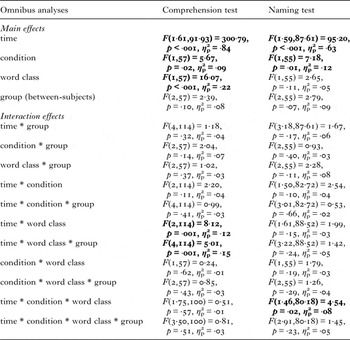
Omnibus 4-way analyses tested the effect of learning nouns and verbs under two gesture conditions (ICON vs. ATTENT) over time (pre-test, post-test 1, post-test 2) in children with SLI and TD children matched for language (LM) and age (AM). As no effect of gender on learning performance was found, data are collapsed in all analyses. We first report on the comprehension task before turning to the naming task. Mean scores and standard deviations (SD) are shown in Tables 4 and 5, respectively. An overview of main and interaction effects is given in Table 6.
Iconic vs. attention-directing gestures: mean percentage (+SD) of correct responses on the comprehension test

Iconic vs. attention-directing gestures: mean percentage (+SD) of correct responses on the naming test

Iconic vs. attention-directing gestures: main and interaction effects (significant results in bold)

Comprehension
The ANOVA confirmed a main effect of test time (F(1·61,91·93) = 300·79, p < ·001, η p 2 = ·84). As expected, scores were significantly higher at T2 (M% ± SD: 85 ± 13) than at T1 (58 ± 22; p < ·001), which in turn were significantly higher than at T0 (21 ± 13; p < ·001). No between-groups effect emerged (F(2,57) = 2·39, p = ·10, η p 2 = ·08), indicating that children of all groups were able to learn the new words. There was a significant main effect of word class (F(1,57) = 16·07, p < ·001, η p 2 = ·22), which was modified by significant interactions time × word class (F(2,114) = 8·12, p = ·001, η p 2 = ·12), and time × word class × group (F(4,114) = 5·01, p = ·001, η p 2 = ·15). As our research focuses on gesture condition rather than word class per se, we did not follow up these effects.
Importantly, comprehension varied by gesture condition, as revealed by a significant main effect (F(1,57) = 5·67, p = ·02, η p 2 = ·09). Overall, children demonstrated better comprehension of words presented with ICON than ATTENT gestures. No significant interaction time × gesture condition was found (F(2,114) = 2·20, p = ·11, η p 2 = ·04), indicating that condition similarly influenced comprehension performance over time. Critically, comprehension did not differ between conditions at pre-test (t(59) = ·19, p = ·84). No significant interaction condition × word class was found (F(1,57) = 0·24, p = ·62, η p 2 = ·01), demonstrating that gesture condition affected learning of both nouns and verbs. There was no significant interaction condition × group (F(2,57) = 2·04, p = ·14, η p 2 = ·07), and so no evidence that children with SLI responded to the learning conditions differently from TD children.
Naming
For naming, the ANOVA revealed a significant main effect of test time (F(1·59,87·61) = 95·20, p < ·001, η p 2 = ·63). Post-hoc testing showed a steady increase in naming performance: T0 (M% ± SD = 0) < T1 (10 ± 13; p < ·001) < T2 (32 ± 21; p < ·001). No between-groups effect arose (F(2,55) = 2·79, p = ·07, η p 2 = ·09), demonstrating that children of all groups improved naming performance over time.
A significant main effect of gesture condition was revealed (F(1,55) = 7·18, p = ·01, η p 2 = ·12), such that children named more words presented with ICON gestures than with ATTENT gestures. No significant interaction test time × gesture condition was found (F(1·50,82·72) = 2·54, p = ·10, η p 2 = ·04). Importantly, naming performance at pre-test did not differ by condition, as no child was able to name any of the target words (M% ± SD = 0). Thus, gesture condition affected performance at both post-test times.
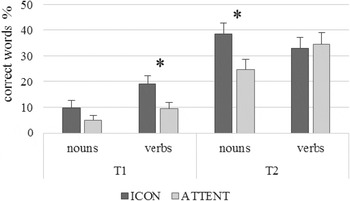
However, the main effects were qualified by a significant interaction test time × gesture condition × word class (F(1·46,80·18) = 4·54, p = ·02, η p 2 = ·08). Separate analyses indicated that at T1 children named more verbs trained with ICON gestures (19 ± 26) than verbs trained with ATTENT gestures (9 ± 18, t(57) = 2·58, p = ·012), but not nouns (ICON 9 ± 21, ATTENT 5 ± 13, t(57) = 1·65, p = ·10) , whilst at T2 more nouns trained with ICON gestures (38 ± 34) were named than nouns trained with ATTENT gestures (24 ± 30, t(57) = 2·67, p = ·010), but not verbs (ICON 33 ± 32, ATTENT 34 ± 34, t(57) = –0·26, p = ·79). The interaction is illustrated in Figure 2. Notably, there were no significant interactions gesture condition × group (F(2,55) = 0·93, p = ·40, η p 2 = ·03), and test time × gesture condition × word class × group (F(2·91,80·18) = 1·45, p = ·23, η p 2 = ·05), reflecting the fact that children with SLI and TD children responded similarly to the learning conditions.
Proportion of correct naming responses (mean and standard error) across word classes in the iconic and attention-directing gesture learning condition at two post-test times (groups collapsed).

Control condition
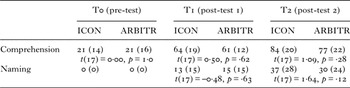
In order to address a potential confound, namely the use of a constant gesture as a control condition (as opposed to different iconic gestures), an additional experiment with 18 TD preschool children (mean age 4;9) was conducted. In this analysis, we compared the same iconic gestures as in the first experiment to an equal number of item-specific, dynamic non-iconic gestures. Training and assessments were identical. Only the ATTENT gesture was substituted with item-specific arbitrary (ARBITR) gestures, which showed no resemblance to the respective referents. Mean scores and standard deviations in terms of comprehension and naming are shown in Table 7. Scores were higher in the ICON gesture condition, except for naming performance at T1, suggesting that, overall, children demonstrated better comprehension and naming of words presented with ICON gestures. Due to the small sample size, the descriptive advantage failed to reach significance. However, the results point in the same direction as in the main experiment.
Iconic vs. arbitrary gestures (n = 18): mean percentage (+SD) of correct responses on the comprehension and naming test (nouns and verbs collapsed)

DISCUSSION
Previous research has shown that observing iconic gesture helps TD children as well as children with SLI learn new words. However, studies mostly compared word learning with and without the help of gestures. To rule out the possibility that children may simply have profited from the increased attention they paid to words paired with gestures, the present study set out to investigate word learning under two gesture conditions: (a) simultaneous presentation of words and iconic gestures vs. (b) presentation of words and attention-directing gestures. In addition, this study expands previous research by including children both with and without language impairment. Word learning (comprehension and naming of nouns and verbs) was assessed after the first training session (fast mapping) and after training completion (retention). First, there was a steady increase in comprehension and naming performance over time, demonstrating that both TD and language impaired children were able to learn the new words. Beyond the demonstration of a general learning achievement, our study yielded two main findings: (i) observing iconic gestures improved learning to a greater extent than observing non-iconic gestures did; and (ii) the iconic gesture advantage was similar in TD and language impaired children. We will now review and discuss these findings.
The role of iconic gestures in word learning
Former research revealed that words are learned better while simultaneously seeing iconic gestures than with mere verbal input in TD children (e.g. Capone & McGregor, Reference Capone and McGregor2005; McGregor et al., Reference McGregor, Rohlfing, Bean and Marschner2009; Munro et al., Reference Munro, Baker, McGregor, Docking and Arciuli2011) and children with SLI (Ellis Weismer & Hesketh, Reference Ellis Weismer and Hesketh1993; Lüke & Ritterfeld, Reference Lüke and Ritterfeld2014). In this study, we compared the effects of observing iconic and non-iconic (attention-directing and arbitrary gestures) and demonstrated that the iconic gesture advantage holds true not only over mere verbal learning. In accordance with our first hypothesis, children learned words (nouns and verbs) presented with iconic gestures better than with a gesture that guided their attention towards the new words. This was the case for both comprehension and naming during initial learning (fast mapping) and retention.
Our results confirm the findings of Capone Singleton (Reference Capone Singleton2012), who showed enhanced word learning with iconic shape gestures over pointing gestures in TD toddlers. The results strongly suggest that iconic gestures provide an advantage over and above focusing children's attention. Why do iconic gestures provide an advantage for word learning? Both iconic and non-meaningful gestures (like pointing and attention-directing) can focus children's attention and lead to increased salience of the target word, which in turn supports the child's fast mapping and retention of the lexical form. Indeed, the fact that children comprehended the majority of words presented with attention-directing gestures at post-test 2 (81%), suggests that to some extent attention-directing gestures do benefit learning. Iconic gestures, however, contribute to word learning in a different way than just making children more engaged and attentive (Mumford & Kita, Reference Mumford and Kita2014; Novack et al., Reference Novack, Goldin-Meadow and Woodward2015). Rather, it appears that specific features of iconic gestures contribute to effective word learning. Our results indicate that children make use of information from observing iconic gestures for processing and encoding new lexical forms. Along with Capone Singleton (Reference Capone Singleton2012), our results demonstrate that iconic gestures may help children strengthen the links to the lexical form. In this way, watching iconic gestures prompts rich encoding and makes word learning more efficient.
Findings of a fast mapping study with TD children indicated that arbitrary gestures might also benefit word learning (Lüke & Ritterfeld, Reference Lüke and Ritterfeld2014). To address this issue, we conducted an additional experiment, this time comparing iconic gestures to an equal number of arbitrary gestures. The results revealed a numerical advantage for the iconic gestures, even though the small sample size did not allow for detection of potential effects of this magnitude. Thus, the additional analysis suggests that the difference in word learning may remain even when we compare iconic and arbitrary gestures. Therefore, it appears that it is the iconicity of the gestures (that is the resemblance to the referent), rather than the item-specific encoding of both auditory and visual information to a lexical form, that helps learning. Further research is needed to substantiate these findings and to determine in more detail which specific pieces of information constitute the iconic gesture advantage.
In addition, the finding that iconic gestures enhance word learning more than attention-directing gestures do can be specified further with regard to word class and stage of word learning. Our results show that iconic gestures contributed to word learning at different points in time. As we paired learning nouns with shape gestures and verbs with combined manner and path gestures, our results shed light on how readily accessible different types of iconic gesture are for preschool children. For comprehension, children's responses did not differ with respect to word class, i.e. children learned both nouns and verbs better with iconic gestures. For naming, as the more demanding task, the impact of iconic gestures varied with regard to word class and test time. During initial learning, children were better at naming verbs trained with iconic gestures than verbs trained with attention-directing gestures, but there was no advantage of either gesture type in noun naming. Conversely, during slow mapping, children named nouns, but not verbs, better when trained with iconic gestures. Thus, for naming during initial learning, the path–manner gestures paired with verb learning caused the iconic advantage, whereas for retention this advantage was due to the shape gestures used for noun learning. Apparently, observing iconic path–manner gestures for movements has an immediate impact, while observing iconic shape gestures for objects has an effect in the longer term.
These results find confirmation in the recent literature. Research has shown that recognizing iconicity in gesture types emerges at different points in time in development. While children at age two can learn from iconic gestures that convey action information, it is only at age three that they are able to recognize iconic gestures representing the shape properties of objects (Hodges et al., Reference Hodges, Özçaliṣkan and Williamson2015; Novack et al., Reference Novack, Goldin-Meadow and Woodward2015). Probably, iconic gestures of actions provide multiple types of information and are more closely aligned to the body than iconic shape gestures. Therefore, it might be easier to map movement gestures onto actions, but cognitively more demanding to map shape gestures onto objects (Hodges et al., Reference Hodges, Özçaliṣkan and Williamson2015). Our results support these findings, suggesting a difference in the timing of the impact on word learning. Providing iconic movement gestures apparently aids learning in the initial stage of word learning. In contrast, iconic gestures conveying shape information seem to particularly assist retention. These findings are also in line with the results of Lüke and Ritterfeld (Reference Lüke and Ritterfeld2014), who showed that iconic shape gestures did not enhance word learning at the fast mapping interval; only during slow mapping were children able to benefit from shape information.
To summarize: as predicted, our results demonstrate that observing iconic co-speech gestures more effectively enhances comprehension and naming of new words than does observing attention-directing or arbitrary gestures. Iconic gestures prompt richer encoding and make word learning more efficient for both the initial stage of learning and for retention of the words. Moreover, expecting children to benefit from iconic shape gestures for noun learning and from iconic manner–path gestures for verb learning proved true. However, these effects manifest themselves in different stages of word learning. During the initial stage, iconic gestures enhanced performance in verb naming, while noun naming improved at the slow mapping interval. Children make use of information provided by iconic gestures to establish and strengthen the connections to the lexical form, and this effect differs depending on the stage of word learning and word class.
The role of iconic gestures in children with and without SLI
So far, we have shown that seeing iconic gestures improves word learning in children with and without SLI. Do children with SLI derive a differential (i.e. smaller or bigger) benefit as is sometimes suggested? Evidence is not uniform in this respect. Only one study compared word learning (at the fast mapping interval) with iconic gestures in children with SLI and TD children. Ellis Weismer and Hesketh (Reference Ellis Weismer and Hesketh1993) reported that comprehension of both groups similarly improved. This is also true for the children in the present study. Children of all groups (children with SLI, language-matched TD, and age-matched TD children) more effectively benefited from iconic gestures for word learning than from attention-directing gestures, for both comprehension and naming. The patterns of response were similar across groups, and no particular benefit for children with SLI emerged. This is in line with a meta-analysis (Hostetter, Reference Hostetter2011) which found no evidence that gestures are more valuable for special populations such as children with developmental disorders. Although considered a special group of language learners, children with SLI are capable of perceiving information in iconic gestures, to integrate information conveyed by gesture and speech, and to use this information for word learning. With regard to our second hypothesis, we conclude that children with SLI benefit from iconic gestures for mapping a lexical form and semantics in a similar way and to a similar degree as TD children do.
Limitations
Some limitations of this study need to be mentioned. First, in face-to-face interaction it is not possible to continuously control for children's attention. Although we spared no effort in making children observe the gestures during training, we could not ascertain that they did so consistently. Second, it is sometimes suggested that children yield higher rates of learning when they perform the gestures themselves (the enactment effect; Engelkamp & Cohen, Reference Engelkamp and Cohen1991), rather than merely observing another person gesturing. In this study, children were not encouraged to enact the gestures. Had we done so, learning patterns might have changed. Future research is needed to investigate a possible added value of enacting gestures during word learning.
CONCLUSIONS AND PERSPECTIVES
The results presented here have important implications for both research and practice. Iconic gestures can be regarded as a suitable tool for teaching words to children with and without SLI in clinical contexts and educational settings. Shape gestures in particular qualify as a support for consolidation of nouns. For verbs, it may be advisable to employ combined manner and path gestures during the initial phase of learning. This study furthers our knowledge on how iconic gestures support word learning in children with and without SLI. Our findings help to attain a more differentiated understanding of the role of specific iconic gestures in the course of learning. This will allow tailoring of therapeutic and educational procedures to children with and without SLI.