Implications
By the year 2012, all feed ingredients in an organic diet for poultry must be organically approved. This may cause problems in fulfilling the birds’ requirement of the amino acid, methionine, especially as the use of fishmeal is being questioned for ethical reasons. The unique aspect with using mussels is that they serve a double purpose being both a high-quality protein source and at the same time contributing to the recovery of the seawater environment. This study shows that it is possible to compose a fully organic diet for layers using mussel meal as a major source of methionine.
Introduction
The first limiting nutrients in typical laying hen diets are sulphur amino acids (AAs) and, in particular, methionine. To fulfil the birds’ recommended requirement, conventional diets are supplemented and balanced with synthetic methionine. However, the use of such feed additives is not allowed in organic production (European Community (EC), 2007). Therefore, it becomes important to find high-quality protein feed ingredients from alternative sources of organic diets. As there is limited access to organic protein feed ingredients available on the market, probably a wide variety of ingredients will be needed to achieve the required level of sulphur AAs in the diet. Today it is possible to use up to 10% conventional feed ingredients, for example, corn gluten meal and potato protein, both relatively rich in methionine. However, European Economic Community council regulation indicates that organic poultry should be fed 100% organically produced feed stuffs from January 2012 (EC, 2007). While this date is getting closer, there is still no solution to how the AA requirements should be fulfilled. Thus, there is an urgent need for the development of a new high-quality protein feed ingredients to assure organic egg and poultry meat production in the future.
A shortage of high-quality protein sources may jeopardize both bird health and performance. The content of methionine in the feed is known to affect the efficiency of feed utilization (Schutte et al., Reference Schutte, De Jong and Bertram1994). Tiller (Reference Tiller2001) showed that methionine deficiency in hens housed in floor systems may cause severe welfare problems such as feather pecking and cannibalism and, according to Van Krimpen et al. (Reference Van Krimpen, Kwakkel, Reuvekamp, Van Der Peet-Schwering, Den Hartog and Verstegen2005), diets with essential AA contents below the NRC (National Research Council, 1994) recommendations could be one factor that increases pecking behaviour. Elwinger et al. (Reference Elwinger, Tufvesson, Lagerkvist and Tauson2008) reported that a low level of dietary methionine impairs feather condition and reduces egg weight. Thus, the fulfilment of the methionine requirement of the birds is crucial both from a welfare and production point of view. Fishmeal is rich in sulphur AAs and is frequently used in organic diets for layers. However, the escalating cost of production, in combination with the common opinion that fish should be used for human consumption and not for feeding animals, is likely to limit the use of fishmeal in the future.
For several reasons, the meat of blue mussels (Mytilus edulis) may be an interesting alternative to fishmeal. Mussels have a high content of protein with an AA pattern similar to fishmeal (Berge and Austreng, Reference Berge and Austreng1989; Jönsson and Elwinger, Reference Jönsson and Elwinger2009). They are also able to filter immense volumes of coastal waters. The filtration is an effective tool to cleanse seawater from nitrogen and phosphorus, which leak into the water from areas of intensive agriculture (Lindahl et al., Reference Lindahl, Hart, Hernroth, Kollberg, Loo, Olrog, Rehnstam-Holm, Svensson, Svensson and Syversen2005). Mussels can thus contribute to decrease the oversupply of these elements and may become an approved feed ingredient according to the organic standards.
Recent studies with a limited number of hens in cages during a short-term study have shown that mussel meal may be an excellent source of protein and thus, from a nutritional point of view, a possible substitute for fishmeal in diets for layers (Jönsson and Elwinger, Reference Jönsson and Elwinger2009). Furthermore, L. Waldenstedt and L. Jönsson (unpublished results) showed that the mussel meal could replace fishmeal in identical quantities in diets for broiler chickens.
The aim of this experiment was to evaluate the possibility of composing a diet with 100% organically approved feed ingredients using mussel meal as a major source of methionine. As a comparison two different diets, both composed according to the regulation in force from 2006, allowing up to 15% of conventional ingredients, were included. The experiment comprised a whole production period with two commonly used genotypes and production performance and egg quality were studied.
Material and methods
Birds and management
The experiment was carried out between April 2006 and April 2007, comprising the time from 20 to 72 weeks of age. The experiment included 678 Lohmann Selected Leghorn (LSL) and 678 Hyline White, W-98, reared under identical conditions in the same building on litter with access to perches, water and feed on raised one-tier wire floor platforms covering pits of manure. At 15 weeks the birds were transferred to the experimental building and given 9.5 h of light/day. This was successively increased to 16 h from 0630 to 2230 h at 27 weeks. One wall of the experimental building had a row of small windows close to the roof and slightly covered with a cloth. The birds were housed in 12 pens (groups) in the Marielund aviary system described by Abrahamsson and Tauson (Reference Abrahamsson and Tauson1995). This system consists of three welded wire tiers of which the two lower ones have feed troughs and the top-resting tier has perches. Nipple drinkers were available on all tiers. Each pen measured 5.8 × 2.8 m2 and housed 113 birds, implying 7.0 hens/m2 ground floor area and 3.6 hens/m2 available area. Wood shavings were used in the litter area placed between the wire tiers and the three levels of single nests available on the opposite wall. The nests were open from 0100 to 1600 h. Belts for manure removal were located under each wire tier and manure was removed once a week. The birds had free access to feed and water. The hens were vaccinated against coccidiosis, Marek’s disease, infectious bronchitis and avian encephalomyelitis during rearing. The aviary system fulfilled the Swedish Animal Welfare Directives and the experiment was approved by the National Ethics Committee for Animal Research.
Diets and feeding
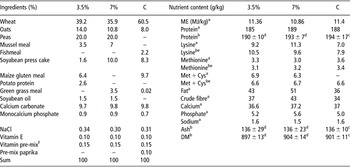
The pullets were fed a commercial grower diet as crumbles until 16 weeks. From 16 weeks until 18 weeks they were given a commercial pre-layer diet and from 18 weeks a commercial organic feed for laying hens (C). From start of registration at 20 weeks the layers were fed one of three diets. Each diet was given to two groups (replicates) of each genotype. The diets studied were C, a feed containing 3.5% mussel meal (3.5% diet) and a feed containing 7% mussel meal (7% diet). The C diet, was produced by a Swedish feed manufacturer and contained fishmeal and up to 15% conventional feed ingredients. The 3.5% diet also included up to 15% conventional feed ingredients but used 3.5% of mussel meal and no fishmeal. The 7.0% diet included 7.0% of mussel meal and was based only on feed ingredients, which are supposed to be available for growing and processing according to EU (European Union) standards for organic egg production in 2012. All diets were steam pelleted and crumbled and feed was available ad libitum and automatically distributed by chain feeders five times a day. An organically approved antioxidant Vitalox (Helm, Hamburg, Germany) was added when the mussel meal was prepared. The mussels used in this experiment were approved according to the regulation for human consumption. Crude protein, dry matter (DM) and ash were analysed in each batch of feed – six occasions for the commercial diet and seven for the 3.5% and 7% diets. Composition and nutrient content of the diets are shown in Table 1. The results of protein and AA analyses of the mussel meal is presented in Jönsson and Elwinger (Reference Jönsson and Elwinger2009). All birds had free access to chopped straw from alfalfa but the birds were prohibited to have access to outdoor runs due to directives with regard to the bird flu at the time of the experiment.
Composition and calculated nutrient content of the experimental diets

C = commercial organic feed for laying hens; ME, metabolizable energy; DM = dry matter.
aCalculated values.
bAnalysed values per kg DM.
cMean values and s.d. for six batches of feed.
dMean values and s.d. for seven batches of feed.
eAnalysed value from a mixed sample of seven batches of feed.
fVitamin pre-mix provided the following (per kg feed) – vitamin A: 10 000 IU; vitamin D: 2500 IU; choline: 1053.2 mg; copper: 6 mg; and selenium: 0.3 mg.
Registrations and analyses
All data were collected per treatment group, that is, 113 hens housed in the same aviary pen. A sample of birds from each genotype was weighed on arrival at the research station at 15 weeks. Fifteen birds per treatment group were weighed at 51 weeks, and all birds were weighed at the end of the trial (72 weeks). An average weight per treatment group of the three weight measurements was used in the statistical analyses. Egg production, number of misplaced eggs (e.g. on the litter floor, on the wire tiers or in the range outside) and dead birds were recorded daily. Feed consumption and feed conversion ratio (FCR) were recorded on a 4-week basis. Egg weight on all collected eggs was recorded once a week. The proportion of cracked and dirty eggs was recorded by candling all eggs collected during five consecutive days on four occasions (at 24, 41, 64 and 70 weeks) using a pilot version of a commercial egg-candling machine.
At 33, 50 and 70 weeks, 10 randomly collected eggs from each treatment were analysed with regard to shell deformation, shell breaking strength, egg yolk pigmentation, albumen height and egg white DM content. Shell deformation was calculated from the average value of measurements at three different points across the egg equator, after a load of 1000 g was applied on the egg (The Canadian Egg Shell Tester, Otal Precision Co. Ltd, Ottawa, Ontario, Canada). The eggs for which the standard deviation of the repeated measurements of shell deformation exceeded 15 × 10−3 mm were excluded from the analyses of interior egg quality (in total 14 eggs). Egg yolk pigmentation was analysed according to the Roche Yolk Colour Fan with a scale from 1 to 15. DM content in fresh excreta samples collected from the manure belts was analysed at 33, 50 and 70 weeks.
Mussel meal and diet preparation
Mussel meal was prepared from blue mussels (M. edulis). A fresh live blue mussel roughly consists of three equal parts: shell, meat and water. The raw material used for the meal production must be fresh and the whole process must be carried out under the same hygienic conditions as for seafood production. In order to separate the meat from the shell, the mussels were steamed quickly and were thereafter spread on a shaking grid where the coagulated meat comes loose from the shell. It is then simple to separate meat and shell by using a density bath in which the meat floats and the shell sinks. This is a standard technique used by the seafood industry to separate shell and meat. The meat was dried between 85°C and 90°C to about 5% water content and then ground.
The heating from 85°C to 90°C well fulfils the hygienic requirements for poultry feed (75°C). Regardless of the heating procedure, each batch of meal used had to be tested for occurrence of Salmonella before it was allowed to be delivered to the feed factory and included in the complete feed. To control rancidity, 350 p.p.m./kg feed of the antioxidant Vitalox was added to the feed.
Statistical analysis
Data were analysed by analysis of variance (ANOVA) using the GLM procedure of the statistical system (Statistical Analysis Systems Institute (SAS), 2004). Model assumptions, that is, independence, homoscedasticity and normality of residual errors, were checked by tests and plots. In the case of heteroscedasticity among treatments, the Satterhwaite’s adjustment for Student’s t-test was applied. Data expressed in percentages were subjected to arcsine-root transformation before analyses (Snedecor and Cochran, Reference Snedecor and Cochran1989). Production performance and live weight of the birds were analysed with diet and genotype as fixed effects. Interactions between diet and genotype were tested.
Egg quality traits and DM content of the excreta were analysed as above, but including age and group as fixed effects, with age of birds and interaction between bird age, genotype and diet included in the model with adjustment for repeated measurements.
Results
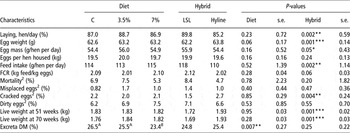
No significant interaction effects were found between diet and genotype. Production performance is presented in Table 2 and egg quality characteristics in Table 3 (a and b). Diet had no significant effect (P > 0.05) on laying percentage, egg mass, eggs per hen housed, feed intake, FCR, mortality, live weight at 51 or 72 weeks, or proportion of misplaced, cracked or dirty eggs. Diet showed a tendency (P > 0.06) to significant effect with regard to egg weight with the mussel diets giving higher egg weight (Table 2). Mortality was, on average, 6.6%.
Production performance between 20 and 72 weeks of age for three different experimental diets and two hybridsFootnote 1

C = commercial organic feed for laying hens; LSL = Lohman Selected Leghorn; FCR = feed conversion ratio; DM = dry matter.
1 No significant interactions were found between diet and hybrid.
2 Statistical analyses were performed on arcsin-transformed data according toSnedecor and Cochran (Reference Snedecor and Cochran1989).
A,B Significant difference (P < 0.01) between treatments.
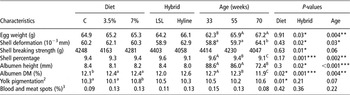
Effect on egg quality characteristics of three experimental diets including mussel meal and two hybrids measured at three agesFootnote 1

C = commercial organic feed for laying hens; LSL = Lohman Selected Leghorn; DM = dry matter.
1 No significant interactions were found between diet and hybrid.
2 Roche 15-score scale.
3 Statistical analyses were performed on arcsin-transformed data according to Snedecor and Cochran (Reference Snedecor and Cochran1989).
a,b Significant difference (P < 0.05) between treatments.
A,B,C Significant difference (P < 0.01) between treatments.
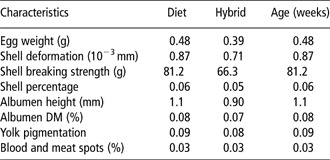
Effect on egg quality characteristics of three experimental diets including mussel meal and two hybrids measured at three ages (s.e.).

DM = dry matter.
Egg quality parameters such as shell deformation, shell breaking strength, albumen height, shell percentage and proportion of blood and meat spots were also unaffected by the diet (Table 3). There was a significant difference in egg yolk pigmentation (P < 0.01) and in albumen DM content (P < 0.02). The egg yolk was more coloured, that is, given a higher Roche score in the 7% diet. (P < 0.01) and the albumen DM content was significantly (P < 0.02) higher for the diets including mussel meal.
Feed intake and laying percentage of Hyline birds were lower than for LSL (P < 0.002), but FCR as kg of feed/kg of eggs tended to be lower (P < 0.06) for the Hyline birds. The Hyline birds also showed higher egg weight (P < 0.001) but lower egg mass per day than LSL birds (P < 0.05). The Hyline birds had a higher proportion of cracked eggs (P < 0.004) than LSL, but there were no significant differences between the two genotypes with regard to mortality, eggs per hen housed and proportion of misplaced or dirty eggs. There were significant differences with regard to live weight at both ages between genotypes (P < 0.001) in which the Hyline birds were heavier than LSL (Table 2).
Genotype affected shell deformation (P < 0.02), shell breaking strength (P < 0.01), shell percentage (P < 0.001) and albumen height (P < 0.02) favouring LSL birds, whereas Hyline eggs showed higher albumen DM (P < 0.001). Yolk pigmentation and proportions of blood and meat spots were unaffected by genotype.
The age of the birds influenced all egg quality traits except proportion of meat and blood spots and egg yolk pigmentation. Thus, with increasing age, egg weight increased, albumen height and albumen DM content decreased, egg shell quality deteriorated, that is, shell percentage decreased, shell deformation increased and shell breaking strength tended to decrease. The proportion of cracked eggs increased with increasing age. No significant interaction effects were found.
The DM of the excreta (Table 2) was significantly lower (P < 0.01) for both genotypes when given the 7% diet. The occurrence of red mites caused high mortality in some groups.
Discussion
Diet did not affect any of the production parameters, showing that with an inclusion of 7% of mussel meal as a source of methionine it is possible to compose a 100% organically approved diet and receive the same production level and egg quality as with the inclusion of 15% conventional feed ingredients. Furthermore, mussel meal may become a substitute for today’s commonly used fishmeal in organic poultry diets. The results also show that it is possible to obtain a high production level with commonly used laying genotypes in Sweden for organic production. Even when using a feed including only ingredients probably approved according to the organic standards for 2012, that is, without adding synthetic AAs, laying percentage was approximately 87% and FCR was 2.1 kg feed/kg eggs. Many authors have shown that the amount of methionine in the diet is of significant importance for production performance in laying hens. According to Sohail et al. (Reference Sohail, Bryant and Roland2002) egg weight, egg production and feed consumption increased linearly as dietary total sulphur AAs increased, and Harms and Russell (Reference Harms and Russell1998) reported an increase in egg production, egg weight and egg mass as the level of methionine was increased. The NRC (1994) recommendation of methionine is 300 mg/hen per day. However, the experiments upon which these requirements are based do not account for the genetic progress of laying hens during the last 15 years; in Swedish practice the amount of methionine in the feed is approximately 25% higher than the NCR recommendations. Elwinger et al. (Reference Elwinger, Tufvesson, Lagerkvist and Tauson2008) reported that feeding free range hens only 3.0 g methionine/kg feed could affect plumage condition negatively. In this experiment, the diets contained between 3.1 and 3.4 g methionine/kg feed and the hens received on average 387, 350 and 368 mg methionine/day for the C, 3.5% and 7% diets, respectively. This is well above the NRC recommendations but below the breeder manual recommendations during the peak production phase. The results from this experiment show that despite a small lack of methionine during the pre-lay and peak production periods, the production may be considered acceptable and it should be possible to fulfil the birds’ methionine requirement by 2012 if using mussels and feed ingredients are approved according to the organic standards.
Several of the production parameters, that is, laying percentage, egg weight, egg mass and feed intake differed between the two genotypes used. This is in accordance with the breeder manuals, which describe LSL as having a higher peak production, lower egg weight, higher feed intake and slightly higher egg mass than Hyline birds. In this experiment, the Hyline birds showed a higher body weight than the breeder’s manual outline. Both genotypes, to a large extent, laid their eggs in the nests, but the Hyline birds had a higher proportion of cracked eggs regardless of diet treatment, possibly due to the larger eggs and lower shell strength noticed in Hyline birds. Although feather condition was not a parameter in this study, it was observed that LSL birds had a worse plumage condition than Hyline birds, implying increased heat losses (Peguri and Coon, Reference Peguri and Coon1993). This fact can partly explain the differences between genotypes in feed consumption.
Egg quality, that is, egg weight, shell breaking strength, shell deformation, shell percentage, albumen height and albumen DM, was influenced by age and genotype of bird but not by inclusion level of mussel meal. The age effects were typical for both genotypes with increasing egg weight, decreasing albumen height, decreasing albumen DM content and impaired shell quality parameters, that is, higher shell deformation, lower shell breaking strength and a lower shell percentage as the hens got older, which agrees with Roberts (Reference Roberts2004).
The colour of the egg yolk is considered to be an important factor in determining the acceptability of a product to the consumer. Synthetic carotenoids were widely used for several years, but consumers’ concern with regard to synthetic additives and an increasing interest for natural alternatives have led to the use of, for example, paprika powder (Karadas et al., Reference Karadas, Grammenidis, Surai, Acamovic and Sparks2006). The intensity of the yolk colour depends on the accumulation of carotenoids. Animals in general, including laying hens, are unable to synthesize carotenoids and are thus dependent on a dietary supply of these pigments (Nys, Reference Nys2000). Today a layer diet is based mainly on cereals, which are low in carotenoid content, making it difficult to obtain an attractive colour of the egg yolk. Therefore, the use of some additional pigment source is common. Pigments that efficiently contribute to yolk colour are lutein, zeaxanthin and capsanthin, and the main plant sources used in Europe today are, for example, corn products and alfalfa meal (Nys, Reference Nys2000). Corn gluten meal contains, on average, 130 to 260 mg xanthophyll/kg and the content of xanthophylls in alfalfa meal seems to vary between 40 and 620 mg/kg (Cole and Haresign, Reference Cole and Haresign1989).
Mussels consume algae rich in carotenoids. Matsuno (Reference Matsuno1989) reported that molluscs contain carotenoids such as β-carotene, lutein A, zeaxanthin, astaxanthin, and also chlorophyll and other xanthophyll pigments originating from the micro-algae consumed by the mussels. Campbell (Reference Campbell1969) showed that carotenoid content in blue mussels varies due to season of the year and maturity state of the mussels, but values of total carotenoid content in fresh mussels were never below 80 mg/kg (400 mg/kg DM). Barclay et al. (Reference Barclay, Irvin, Williams and Smith2006) showed a similar carotenoid content of mussels (70 mg/kg, i.e. 280 mg/kg DM).
No carotenoid analyses were carried out in this experiment but the results show a significant difference between treatments in yolk colour with the 7% diet producing a stronger colour of the yolks, that is, on average, 10.7%, compared to 10.1% and 10.2% for the control and the 3.5% diet, respectively. This is in agreement with Jönsson and Elwinger (Reference Jönsson and Elwinger2009) who showed that egg yolk colour became significantly stronger when the amount of mussel meal in the feed was increased. The high content of corn gluten meal in the C and 3.5% diets and the free access to chopped alfalfa are most likely the reasons for the relatively small differences in yolk colour in this experiment compared to Jönsson and Elwinger (Reference Jönsson and Elwinger2009). Hence, including mussels in the diet can replace the inclusion of other pigments and decrease the need for other expensive carotenoid-rich feed sources or synthetic substances.
The results with regard to fish flavour of eggs from hens given diets containing different fish sources are ambiguous. Fish products, as well as mussels, contain long chain fatty acids (Jönsson and Elwinger, Reference Jönsson and Elwinger2009) and several experiments show the possibility of incorporating and enriching eggs with healthy n-3 fatty acid (Gonzalez-Esquerra and Leeson, Reference Gonzalez-Esquerra and Leeson2000). The off-flavour development in eggs may be the result of an oxidation of these fatty acids (Van Elswyk et al., Reference Van Elswyk, Dawson and Sams1995). Wall et al. (Reference Wall, Jönsson and Johansson2010) the evaluated sensory characteristics of eggs from two different genotypes using the same experimental diets as in this experiment and found no significant effects on off-odours or off-flavours.
An important aspect with regard to mussels as a protein source in poultry feed is the potential risk of toxin contamination, and the occurrence of heavy metals and pathogens such as bacteria and viruses. Hernroth (Reference Hernroth2002) described that content of such substances in mussels vary depending on geographical and seasonal conditions. Furthermore, Jönsson and Holm (Reference Jönsson and Holm2010) showed that animal health, production and egg quality in laying hens were not affected by the mussel toxin okadaic acid when feeding mussels containing okadaic acid just above the tolerance limit for human consumption. In addition, bacteria and the majority of viruses will be eliminated either during heat treatment of the mussels or during heat treatment of the feed (75°C).
In conclusion, there were no significant differences in bird performance between treatments, showing that mussel meal can be used as a high-quality source of methionine for organic laying hens. The unique aspect of using mussels in the feed is that they serve a double purpose being a high-quality protein source at the same time as they contribute to recovery of the seawater environment. Using mussels in the future would make it possible to compose a feed containing 100% organic feed ingredients and at the same time, fulfilling the birds’ requirements of methionine without using fishmeal. More research with regard to animal health, for example, bird exterior appearance and the occurrence of heavy metals is necessary before mussels can be considered fully evaluated as a feed ingredient. Such experiments are currently under way within the frame of this project.
Acknowledgements
The authors thank the Swedish Research Council for Environmental, Agricultural Sciences and Spatial Planning for financial support. The project is carried out in cooperation with Odd Lindahl (associate professor) and Dr Sven Kollberg at Kristineberg Marine Research Station who provided the mussel meal required for the experiment.