



%20--%3e%3c!DOCTYPE%20svg%20PUBLIC%20'-//W3C//DTD%20SVG%201.0//EN'%20'http://www.w3.org/TR/2001/REC-SVG-20010904/DTD/svg10.dtd'%3e%3csvg%20version='1.0'%20id='Layer_1'%20xmlns='http://www.w3.org/2000/svg'%20xmlns:xlink='http://www.w3.org/1999/xlink'%20x='0px'%20y='0px'%20width='64px'%20height='64px'%20viewBox='5.5%20-3.5%2064%2064'%20enable-background='new%205.5%20-3.5%2064%2064'%20xml:space='preserve'%3e%3cg%3e%3ccircle%20fill='%23FFFFFF'%20fill-opacity='0'%20cx='37.785'%20cy='28.501'%20r='28.836'/%3e%3cpath%20fill='%23595959'%20d='M37.441-3.5c8.951,0,16.572,3.125,22.857,9.372c3.008,3.009,5.295,6.448,6.857,10.314%20c1.561,3.867,2.344,7.971,2.344,12.314c0,4.381-0.773,8.486-2.314,12.313c-1.543,3.828-3.82,7.21-6.828,10.143%20c-3.123,3.085-6.666,5.448-10.629,7.086c-3.961,1.638-8.057,2.457-12.285,2.457s-8.276-0.808-12.143-2.429%20c-3.866-1.618-7.333-3.961-10.4-7.027c-3.067-3.066-5.4-6.524-7-10.372S5.5,32.767,5.5,28.5c0-4.229,0.809-8.295,2.428-12.2%20c1.619-3.905,3.972-7.4,7.057-10.486C21.08-0.394,28.565-3.5,37.441-3.5z%20M37.557,2.272c-7.314,0-13.467,2.553-18.458,7.657%20c-2.515,2.553-4.448,5.419-5.8,8.6c-1.354,3.181-2.029,6.505-2.029,9.972c0,3.429,0.675,6.734,2.029,9.913%20c1.353,3.183,3.285,6.021,5.8,8.516c2.514,2.496,5.351,4.399,8.515,5.715c3.161,1.314,6.476,1.971,9.943,1.971%20c3.428,0,6.75-0.665,9.973-1.999c3.219-1.335,6.121-3.257,8.713-5.771c4.99-4.876,7.484-10.99,7.484-18.344%20c0-3.543-0.648-6.895-1.943-10.057c-1.293-3.162-3.18-5.98-5.654-8.458C50.984,4.844,44.795,2.272,37.557,2.272z%20M37.156,23.187%20l-4.287,2.229c-0.458-0.951-1.019-1.619-1.685-2c-0.667-0.38-1.286-0.571-1.858-0.571c-2.856,0-4.286,1.885-4.286,5.657%20c0,1.714,0.362,3.084,1.085,4.113c0.724,1.029,1.791,1.544,3.201,1.544c1.867,0,3.181-0.915,3.944-2.743l3.942,2%20c-0.838,1.563-2,2.791-3.486,3.686c-1.484,0.896-3.123,1.343-4.914,1.343c-2.857,0-5.163-0.875-6.915-2.629%20c-1.752-1.752-2.628-4.19-2.628-7.313c0-3.048,0.886-5.466,2.657-7.257c1.771-1.79,4.009-2.686,6.715-2.686%20C32.604,18.558,35.441,20.101,37.156,23.187z%20M55.613,23.187l-4.229,2.229c-0.457-0.951-1.02-1.619-1.686-2%20c-0.668-0.38-1.307-0.571-1.914-0.571c-2.857,0-4.287,1.885-4.287,5.657c0,1.714,0.363,3.084,1.086,4.113%20c0.723,1.029,1.789,1.544,3.201,1.544c1.865,0,3.18-0.915,3.941-2.743l4,2c-0.875,1.563-2.057,2.791-3.541,3.686%20c-1.486,0.896-3.105,1.343-4.857,1.343c-2.896,0-5.209-0.875-6.941-2.629c-1.736-1.752-2.602-4.19-2.602-7.313%20c0-3.048,0.885-5.466,2.658-7.257c1.77-1.79,4.008-2.686,6.713-2.686C51.117,18.558,53.938,20.101,55.613,23.187z'/%3e%3c/g%3e%3c/svg%3e)
%20--%3e%3c!DOCTYPE%20svg%20PUBLIC%20'-//W3C//DTD%20SVG%201.0//EN'%20'http://www.w3.org/TR/2001/REC-SVG-20010904/DTD/svg10.dtd'%3e%3csvg%20version='1.0'%20id='Layer_1'%20xmlns='http://www.w3.org/2000/svg'%20xmlns:xlink='http://www.w3.org/1999/xlink'%20x='0px'%20y='0px'%20width='64px'%20height='64px'%20viewBox='5.5%20-3.5%2064%2064'%20enable-background='new%205.5%20-3.5%2064%2064'%20xml:space='preserve'%3e%3cg%3e%3ccircle%20fill='%23FFFFFF'%20fill-opacity='0'%20cx='37.637'%20cy='28.806'%20r='28.276'/%3e%3cg%3e%3cpath%20fill='%23595959'%20d='M37.443-3.5c8.988,0,16.57,3.085,22.742,9.257C66.393,11.967,69.5,19.548,69.5,28.5c0,8.991-3.049,16.476-9.145,22.456%20C53.879,57.319,46.242,60.5,37.443,60.5c-8.649,0-16.153-3.144-22.514-9.43C8.644,44.784,5.5,37.262,5.5,28.5%20c0-8.761,3.144-16.342,9.429-22.742C21.101-0.415,28.604-3.5,37.443-3.5z%20M37.557,2.272c-7.276,0-13.428,2.553-18.457,7.657%20c-5.22,5.334-7.829,11.525-7.829,18.572c0,7.086,2.59,13.22,7.77,18.398c5.181,5.182,11.352,7.771,18.514,7.771%20c7.123,0,13.334-2.607,18.629-7.828c5.029-4.838,7.543-10.952,7.543-18.343c0-7.276-2.553-13.465-7.656-18.571%20C50.967,4.824,44.795,2.272,37.557,2.272z%20M46.129,20.557v13.085h-3.656v15.542h-9.944V33.643h-3.656V20.557%20c0-0.572,0.2-1.057,0.599-1.457c0.401-0.399,0.887-0.6,1.457-0.6h13.144c0.533,0,1.01,0.2,1.428,0.6%20C45.918,19.5,46.129,19.986,46.129,20.557z%20M33.042,12.329c0-3.008,1.485-4.514,4.458-4.514s4.457,1.504,4.457,4.514%20c0,2.971-1.486,4.457-4.457,4.457S33.042,15.3,33.042,12.329z'/%3e%3c/g%3e%3c/g%3e%3c/svg%3e)
Introduction
Traumatic experiences, particularly interpersonal victimization, are highly prevalent among individuals with psychosis and play a critical role in its onset, persistence, and phenomenology (Trotta, Murray, & Fisher, Reference Trotta, Murray and Fisher2015; Zhou et al., Reference Zhou, Sommer, Yang, Sikirin, van Os, Bentall, Varese and Begemann2025). Post-traumatic stress disorder (PTSD) commonly co-occurs at disproportionately high rates (~15%) in this population, contributing to poorer clinical outcomes (de Bont et al., Reference de Bont, van denBerg, van der Vleugel, de Roos, de Jongh, van der and van Minnen2015; Grubaugh et al., Reference Grubaugh, Zinzow, Paul, Egede and Frueh2011).
Despite this, the efficacy of trauma-focused therapies is understudied in psychosis populations. People with psychosis are typically excluded from trauma therapy trials and services due to concerns about iatrogenic effects (Chadwick & Billings, Reference Chadwick and Billings2022; Ronconi, Shiner, & Watts, Reference Ronconi, Shiner and Watts2014). Prolonged Exposure (PE), Eye Movement Desensitization and Reprocessing (EMDR), and Cognitive Restructuring (CR) have been evaluated in randomized controlled trials (RCTs) involving individuals with psychosis (Mueser et al., Reference Mueser, Rosenberg, Xie, Jankowski, Bolton, Lu, Hamblen, Rosenberg, McHugo and Wolfe2008, Reference Mueser, Gottlieb, Xie, Lu, Yanos, Rosenberg, Silverstein, Duva, Minsky, Wolfe and McHugo2015; Steel et al., Reference Steel, Hardy, Smith, Wykes, Rose, Enright, Hardcastle, Landau, Baksh, Gottlieb, Rose and Mueser2017; van den Berg et al., Reference van den Berg, de Bont, van der Vleugel, de Roos, de Jongh, Van Minnen and van der Gaag2015). These therapies target distinct mechanisms of change implicated in theoretical models of PTSD. PE focuses on exposing people to trauma-related memories and situations, resulting in habituation of anxiety and reduced avoidance, and thereby emotional processing of traumatic memories. EMDR emphasizes taxing working memory through bilateral stimulation (e.g. eye movements or taps), and adaptive information processing. CR is a core component of cognitive behavioral therapy approaches which involves supporting people to learn how to identify, evaluate, and modify unhelpful trauma-related beliefs that underlie PTSD symptoms.
To date, these therapies have been shown to be safe and acceptable in psychosis populations, with meta-analyses indicating reductions in PTSD symptoms at post-therapy and follow-up (Niemeyer et al., Reference Niemeyer, Opper, Sabé, Holmes and Böge2025; Sin & Spain, Reference Sin and Spain2017). The only RCT of CR in a schizophrenia-spectrum sample found a null result, which may be attributable to an absent treatment effect or methodological issues (Steel et al., Reference Steel, Hardy, Smith, Wykes, Rose, Enright, Hardcastle, Landau, Baksh, Gottlieb, Rose and Mueser2017). For example, this sample had a substantially lower baseline severity of PTSD symptoms compared to more promising CR trials in severe mental illness samples (Mueser et al., Reference Mueser, Rosenberg, Xie, Jankowski, Bolton, Lu, Hamblen, Rosenberg, McHugo and Wolfe2008, Reference Mueser, Gottlieb, Xie, Lu, Yanos, Rosenberg, Silverstein, Duva, Minsky, Wolfe and McHugo2015), which has been found to have less temporal stability over time (Mueser et al., Reference Mueser, Rosenberg, Fox, Salyers, Ford and Carty2001) and to be associated with attenuated outcomes in CR treatment (Mueser et al., Reference Mueser, Rosenberg, Xie, Jankowski, Bolton, Lu, Hamblen, Rosenberg, McHugo and Wolfe2008). While recent reviews have accordingly reported more favorable findings for primarily exposure-based than cognitive interventions, this conclusion appears premature given the relatively small number of RCTs conducted and most samples not meeting criteria for comorbid PTSD and psychosis. Psychosis outcomes have been found to be null or equivocal, with symptom-specific analyses indicating benefits for delusions but not voice-hearing or negative symptoms (Brand et al., Reference Brand, McEnery, Rossell, Bendall and Thomas2018; Niemeyer et al., Reference Niemeyer, Opper, Sabé, Holmes and Böge2025; Toutountzidis et al., Reference Toutountzidis, Ricketts and Laws2026). Moreover, existing trials were conducted in different countries, with varied designs, therapy dosages, inclusion criteria, PTSD symptom severity levels, and therapist expertise, limiting the comparisons that can be drawn.
The RE.PROCESS trial is the first RCT to directly compare PE, EMDR, and CR plus treatment as usual (TAU) to a waitlist control (WL) plus TAU in a sample of individuals with PTSD and lifetime psychosis (Burger et al., Reference Burger, van der Linden, Hardy, de Bont, van der Vleugel, Staring, de Roos, van Zelst, Gottlieb, Mueser, van Minnen, de Jongh, Marcelis, van der Gaag and van den Berg2022). This provides insight into their acceptability and effects. The primary objective was to compare the effects of these therapies to WL on researcher-rated severity of PTSD symptoms over time from baseline to 6-month follow-up. Secondary objectives were to examine these effects for researcher-rated severity of PTSD symptoms at the separate time points (i.e. mid-treatment, post-treatment, and at 6-month follow-up) and to test the effects (over time and at each time point) for researcher-rated presence of PTSD diagnosis, and self-rated severity of (complex) PTSD symptoms. Further, effects on post-traumatic cognitions, dissociation, depression, paranoid ideation, voice-hearing, social functioning, personal recovery, resilience, adversities, and revictimization were evaluated.
Methods
Study design and participants
The RE.PROCESS study is a pragmatic, single-blind, multicenter, superiority randomized controlled trial with four arms: PE, EMDR, or CR plus TAU, compared to a WL plus TAU control group. Ethical approval was granted by the Medical Ethics Committee of the Amsterdam University Medical Centre (METC number: 2019.046/NL66431.029.19). The trial was prospectively registered on June 19, 2019 (ISRCTN 56150327), and the protocol has been published (Burger et al., Reference Burger, van der Linden, Hardy, de Bont, van der Vleugel, Staring, de Roos, van Zelst, Gottlieb, Mueser, van Minnen, de Jongh, Marcelis, van der Gaag and van den Berg2022).
Participants were recruited via outpatient services of 12 mental healthcare organizations in the Netherlands. Inclusion criteria were: (1) age ≥ 16 years; (2) a lifetime schizophrenia spectrum psychotic disorder per the Structured Clinical Interview for DSM-5 (SCID-5; First, Williams, Karg, & Spitzer, Reference First, Williams, Karg and Spritzer2015); and (3) meeting current PTSD symptom criteria based on the Clinician-Administered PTSD Scale for DSM-5 (CAPS-5; Weathers et al., Reference Weathers, Bovin, Lee, Sloan, Schnurr, Kaloupek, Keane and Marx2018) with a total score ≥ 23. Exclusion criteria were: (1) medication changes (antipsychotics/antidepressants) within 4 weeks of eligibility assessment; (2) insufficient Dutch proficiency; (3) severe intellectual impairment (estimated IQ ≤ 70); and (4) inability/unwillingness to (learn to) use a smartphone for weekly assessments.
Randomization and masking
Random allocation was conducted by an independent researcher following baseline assessment via a randomization program (http://www.randomizer.org). Participants were randomly assigned to one of four treatment conditions at a 1:1:1:1 allocation ratio, stratified by trial therapist. The allocation sequence was saved in a protected folder to which the research team had no access. Research workers involved in assessments were masked to group allocation until after the 6-month follow-up assessment. Allocation was unmasked in 39 (9.7%) of 402 follow-up assessments completed. These assessments were either completed (34 [87.2%]) or scored (5 [12.8%]) by a different blinded research worker.
Procedures
Trial therapists and their teams identified potential participants and referred them to the study coordinator. The coordinator or a trained research assistant provided both oral and written information about the study, allowing a minimum of one week to consider participation. Following informed consent, eligibility was assessed. If enrolled, participants completed a baseline assessment and were randomized, with their trial therapist informing them of allocation. Primary, secondary, and additional outcomes (apart from social functioning, adversities, and revictimization) were assessed by research workers at baseline (T0), mid-treatment (T2) at 7 weeks, post-treatment (T3) at 3 months, and 6-month follow-up (T6).
In each therapy arm, participants received up to 16 sessions (75 minutes each, twice weekly). Participants in the WL group received the trauma therapy of their choice after T6. All participants received TAU for psychosis, comprising multidisciplinary assertive outreach care that typically included antipsychotic medication, psychological interventions, and supportive counseling from various mental health professionals. Participants and their treatment teams were asked to keep medication unchanged until the 6-month follow-up. However, exceptions were made when clinically indicated, such as in response to adverse events or an increase in psychotic symptoms requiring intervention. Early completion of PE or EMDR therapy was permitted, following supervisor consultation, when all trauma and psychosis targets had reached a subjective units of distress (SUD) score of 0, and re-experiencing and avoidance symptoms had remitted. The Template of Intervention Description and Replication (TIDieR; Table 1) provides detailed information on all three therapies.
Template for intervention description and replication (TIDieR) table for describing prolonged exposure, eye movement desensitization and reprocessing therapy, and cognitive restructuring

Table 1. Long description
The table is structured with four columns: Item, Prolonged Exposure (P E), Eye Movement Desensitization and Reprocessing therapy (E MDR), and Cognitive Restructuring (C R).
* Item 1 (Brief name): Lists the three therapies.
* Item 2 (Why): PE focuses on emotional processing of trauma memories; EMDR focuses on working memory taxation through bilateral stimulation; CR targets distressing and unhelpful thoughts.
* Item 3 (What material): PE and EMD R use paper handouts and SUD hierarchy forms; EMDR may include lightbars or buzzers; CR uses worksheets for symptom management and action plans.
* Item 4 (What procedures): PE involves imaginal and in vivo exposure; EMDR involves simultaneous memory retrieval and eye movements; CR involves 16 sessions focusing on identifying and evaluating distressing thoughts.
* Item 5 (Who provided): All therapies were delivered by trained frontline clinicians (psychologists) with competence assessments.
* Item 6 (How): Individual, face-to-face delivery.
* Item 7 (Where): Outpatient services or at home across 12 mental health organizations in the Netherlands.
* Item 8 (When and how much): Up to 16 sessions of 75 minutes each over 12 weeks.
* Item 9 (Tailoring): Personalized case formulations based on baseline PTSD and psychosis symptoms.
* Item 10 (Modification): Up to 50 percent of sessions allowed via videoconferencing.
* Item 11 (How well planned): Monthly supervision and fidelity checklists with a 70 percent sufficiency threshold.
* Item 12 (How well actual): Mean sessions attended were 11.4 for P E, 12.2 for EMD R, and 14.1 for CR. Treatment fidelity was rated sufficient for 100 percent of P E, 95.4 percent of EMD R, and 84.4 percent of CR sessions.
For each therapy, fidelity was assessed by trained raters by randomly selecting and rating a minimum of 8% of all recorded sessions using therapy-specific fidelity checklists. Treatment fidelity was rated as sufficient if the total score was 70% or higher.
Outcomes
The primary outcome was change in researcher-rated PTSD symptom severity over time from baseline to 6-month follow-up, as measured by the CAPS-5 (Weathers et al., Reference Weathers, Bovin, Lee, Sloan, Schnurr, Kaloupek, Keane and Marx2018). The CAPS-5 was anchored to all reported criterion A events, including traumatic events associated with psychosis.
Secondary outcomes were CAPS-5 total scores at the separate time points (i.e. mid-treatment, post-treatment, and at 6-month follow-up) and the treatment effects (over time and at each time point) for clinician-rated presence of PTSD diagnosis as measured by the CAPS-5, self-rated severity of PTSD symptoms as measured by the PTSD Checklist for DSM-5 (PCL-5; Blevins et al., Reference Blevins, Weathers, Davis, Witte and Domino2015), and self-rated severity of complex PTSD (cPTSD) symptoms as measured by the International Trauma Questionnaire (ITQ; Hyland et al., Reference Hyland, Shevlin, Brewin, Cloitre, Downes, Jumbe, Karatzias, Bisson and Roberts2017). Additional outcomes included disruption of social functioning by PTSD symptoms (Weathers et al., Reference Weathers, Bovin, Lee, Sloan, Schnurr, Kaloupek, Keane and Marx2018), post-traumatic cognitions (Wells et al., Reference Wells, Morland, Torres, Kloezeman, Mackintosh and Aarons2019), dissociation symptoms (Murray, Ehlers, & Mayou, Reference Murray, Ehlers and Mayou2002), depression symptoms (Beck, Steer, & Brown, Reference Beck, Steer and Brown1996), paranoid ideation (ideas of reference and persecutory ideas; Freeman et al., Reference Freeman, Loe, Kingdon, Startup, Molodynski, Rosebrock, Brown, Sheaves, Waite and Bird2021), frequency (Drake et al., Reference Drake, Haddock, Tarrier, Bentall and Lewis2007; Haddock, McCarron, Tarrier, & Faragher, Reference Haddock, McCarron, Tarrier and Faragher1999), and impact (Hayward et al., Reference Hayward, Ashment, Frost, Byles, Vogel, Walsh, Fowler, Loizou and Strauss2024) of distressing voice-hearing, personal recovery (Neil et al., Reference Neil, Kilbride, Pitt, Nothard, Welford, Sellwood and Morrison2009), and resilience (Smith et al., Reference Smith, Dalen, Wiggins, Tooley, Christopher and Bernard2008). All additional outcomes were assessed at baseline, mid-treatment, post-treatment, and 6-month follow-up. Additionally, social functioning (Fowler et al., Reference Fowler, Hodgekins, Painter, Reilly, Crane, Macmillan, Mugford, Croudace and Jones2009), adversities (van den Berg et al., Reference van den Berg, de Bont, van der Vleugel, de Roos, de Jongh, van Minnen and van der Gaag2016), and revictimization (Carr, Hardy, & Fornells-Ambrojo Reference Carr, Hardy and Fornells-Ambrojo2018) were measured through weekly smartphone assessments from baseline to 6-month follow-up. The study protocol (Burger et al., Reference Burger, van der Linden, Hardy, de Bont, van der Vleugel, Staring, de Roos, van Zelst, Gottlieb, Mueser, van Minnen, de Jongh, Marcelis, van der Gaag and van den Berg2022) provides detailed descriptions of the employed measures.
During study participation, trial therapists were asked to monitor and report any severe adverse events (SAEs) and their possible study- and/or therapy-relatedness. An SAE was defined as any untoward medical occurrence that resulted in death, was life-threatening, required hospitalization (excluding voluntary hospital admissions), caused persistent or significant disability, or any other important medical event that could have led to these outcomes without medical intervention.
Statistical analysis
We initially aimed to recruit 200 participants (50 per arm) to detect a medium effect size (d = 0.50) compared to the control group with two-sided α of 0.05, 80% power, assuming 20% attrition, correlation between measures (ρ) of 0.45, and 3 follow-up assessments (Burger et al., Reference Burger, van der Linden, Hardy, de Bont, van der Vleugel, Staring, de Roos, van Zelst, Gottlieb, Mueser, van Minnen, de Jongh, Marcelis, van der Gaag and van den Berg2022). Due to recruitment difficulties, partially caused by the COVID-19 pandemic, the Medical Ethics Committee approved a revised sample size calculation and recruitment target on February 7, 2024. Our previous RCT (van den Berg et al., Reference van den Berg, de Bont, van der Vleugel, de Roos, de Jongh, Van Minnen and van der Gaag2015) in this population demonstrated larger effect sizes (0.65–0.78), and with twice as many sessions offered here, power calculations indicated 164 participants were needed to detect d = 0.55, and 140 for d = 0.60. Thus, our final sample size of 162 participants supported statistically reliable conclusions for our primary outcome.
Statistical analyses were specified in a statistical analysis plan that was signed off and uploaded before database lock on the ISRCTN registry on May 28, 2025. Any deviations from the statistical analysis plan are documented in the Supplementary Materials. Analyses were performed in R (version 4.4.2), including data from all randomized participants following intention-to-treat principles. In three cases, data to calculate total scores of the primary outcome (CAPS-5) were partially missing due to premature termination of the assessment interview. In these cases, we decided to impute the data using multiple imputation via chained equations at item level to allow for calculation of the total scores. Primary, secondary, and additional continuous outcomes were analyzed using linear mixed models with restricted maximum likelihood estimation to handle missing data and account for repeated measures. Models included participant-specific random intercepts and fixed effects for baseline score and group (WL group as reference) to examine the overall treatment effect from baseline to 6-month follow-up. The participant-specific random intercept accounted for within-subject correlation and implied a compound symmetry covariance structure. Time-specific treatment effects (i.e. mid-treatment, post-treatment, and 6-month follow-up) were analyzed using group-time interaction terms. Between-group effect size Cohen’s d was calculated at post-treatment and 6-month follow-up by dividing the difference in mean pre-post changes between therapy and control group by the pooled pretest standard deviation (dppc2; 0.2 small, 0.5 medium, and 0.8 large effect; Morris, Reference Morris2008). Dichotomous outcomes were analyzed over time and at each timepoint using logistic generalized estimating equations (GEE) with an exchangeable correlation structure, with odds ratios (ORs) calculated by exponentiating model coefficients. As an exploratory measure of clinical significance, numbers needed to treat (NNTs) and corresponding confidence intervals were calculated for each therapy relative to the WL group for loss of PTSD diagnosis at post-treatment and 6-month follow-up. The significance level for all analyses was set at α = 0.05.
Weekly smartphone data (social functioning, adversities, and revictimization) were aggregated between baseline and post-treatment and between post-treatment and 6-month follow-up. Social functioning was analyzed using linear mixed models, and count data on self-reported adversities and revictimization using negative binomial generalized linear mixed models (to account for overdispersion). Both models included group as a fixed factor and participant-specific random intercepts.
Per-protocol sensitivity analyses of primary and secondary outcomes were conducted to estimate treatment effects among participants who completed their allocated therapy (i.e. participants who completed all 16 therapy sessions or who met criteria for early completion [see Table 1]).
Results
Between June 2019 and April 2024, 243 individuals were referred to the trial (Figure 1). Of these, 213 were assessed for eligibility, of whom 34 did not meet the inclusion criteria, and 17 declined participation. Of the 162 enrolled participants, 40 were randomized to WL, 40 to PE, 41 to EMDR, and 41 to CR. Of participants allocated to one of the therapy groups, 29 completed PE therapy (72.5%; 5 early completers [12.5%]), 32 completed EMDR therapy (78.0%; 13 early completers [31.7%]), and 33 completed CR therapy (80.5%). Outcome data were available for 141 (87.0%) participants at mid-treatment, 130 (80.2%) at post-treatment, and 131 (80.9%) at 6-month follow-up. The final 6-month follow-up assessment was completed on Feb 4, 2025.
CONSORT flow diagram. Note: CR, ‘cognitive restructuring’; EMDR, ‘eye movement desensitization and reprocessing therapy’; PE, ‘prolonged exposure’; WL, ‘waitlist control group’.

Figure 1. Long description
The flowchart is divided into five vertical phases.
1. Screening and Enrollment: At the top, 243 individuals were referred to the study. 30 were excluded pre-screening. 213 were assessed for eligibility, and 51 were excluded (34 not meeting criteria, 17 declined). 162 participants were randomized.
2. Allocation: Participants were divided into four groups:
* Allocated to WL (n equals 40).
* Allocated to PE (n equals 40): 29 received therapy (24 completers, 5 early completers) and 11 did not receive therapy.
* Allocated to EMDR (n equals 41): 32 received therapy (19 completers, 13 early completers) and 9 did not receive therapy.
* Allocated to CR (n equals 41): 33 received therapy and 8 did not receive therapy.
3. Follow-Up:
* WL group: 33 completed T1, 32 completed T3, and 34 completed T6 assessments.
* PE group: 35 completed T1, 31 completed T3, and 30 completed T6 assessments.
* EMDR group: 36 completed T 1, 35 completed T 3, and 32 completed T6 assessments.
* CR group: 37 completed T1, 32 completed T3, and 35 completed T6 assessments.
4. Analysis:
* WL: 40 included in intention-to-treat, 40 in per-protocol.
* PE: 40 included in intention-to-treat, 29 in per-protocol.
* EMDR: 41 included in intention-to-treat, 32 in per-protocol.
* CR: 41 included in intention-to-treat, 33 in per-protocol.
Baseline demographic and clinical characteristics are presented in Table 2. Most participants were women (62.3% [101 of 162]) and the mean age was 39.6 years (SD 12.0). The majority of participants were born in the Netherlands, and just under half had a migration background. The mean duration since onset of psychotic symptoms was 19.0 years (SD 13.8), and the mean duration since onset of PTSD symptoms was 20.1 years (SD 13.3). Virtually all participants (100% [159 of 159], 3 participants missing) reported experiencing repeated and multiple traumatic events, with participants reporting a mean of 8.9 (SD 2.1) different trauma types and high levels of perceived impact on current difficulties (Supplementary Table S1). Based on the ITQ, the majority of participants fulfilled criteria for probable cPTSD. Schizophrenia was the predominant lifetime psychotic disorder diagnosis. A substantial proportion reported current psychosis symptoms, with approximately half experiencing distressing voices in the past week or reporting distressing delusional beliefs. Most participants were prescribed antipsychotic medication.
Demographic and clinical characteristics

Table 2. Long description
The table presents data for WL (n = 40), PE (n = 40), EMDR (n = 41), CR (n = 41), and a Total (n = 162).
* Age: The mean age is 39.6 years (S D 12.0).
* Gender: The total sample includes 101 women (62.3%), 58 men (35.8%), 2 non-binary individuals (1.2%), and 1 other (0.6%).
* Country of birth: 128 (79.0%) were born in the Netherlands.
* Migration background: 87 (53.7%) are Dutch, 20 (12.3%) are children of one migrant parent, 21 (13.0%) are children of two migrant parents, and 34 (21.0%) are migrants.
* Living situation: 81 (50.0%) live alone, while 45 (27.8%) are married or cohabitating.
* Education: Vocational education is the most common highest completed level at 75 (46.3%).
* Employment: 32 (19.8%) are currently employed.
* Clinical Diagnosis (S C I D 5): Schizophrenia is the most common diagnosis at 77 (47.5%), followed by Schizoaffective disorder at 23 (14.2%).
* Symptom Duration: Mean duration since onset of psychosis is 19.0 years (S D 13.8) and PTSD is 20.1 years (S D 13.3).
* Current Symptoms: 114 (70.4%) report current psychosis symptoms. 76 (46.9%) report distressing voices with a mean PSYRATS-AHRS score of 28.99. 84 (51.9%) report distressing delusional beliefs with a mean PSYRATS-DRS score of 15.01.
* Trauma Scores: Mean CAPS-5 total score is 44.22. 99 out of 161 (61.5%) meet complex PTSD criteria on the IT Q.
* Medication: 124 (76.5%) are on antipsychotic medication.
Note: CR, cognitive restructuring; EMDR, eye movement desensitization and reprocessing therapy; ITQ, international trauma questionnaire; PE, prolonged exposure; PSYRATS-AHRS, auditory hallucinations rating subscale of the psychotic symptoms rating scales; PSYRATS-DRS, delusions rating subscale of psychotic symptoms rating scales; PTSD, post-traumatic stress disorder; SCID-5, structured clinical interview for the DSM-5; WL, waitlist control group.
a Data from 30 participants was missing as the gender variable was introduced after the start of data collection. Missing data was imputed with gender as reported in clinical case notes.
b Country of birth and migration background were categorized following Statistics Netherlands updated guidelines (Nieuwe Indeling Bevolking Naar Herkomst, 2022).
c One participant based on DSM-5.
d Data not available for all randomized participants, data are presented as mean (SD) [n] or n/N (%).
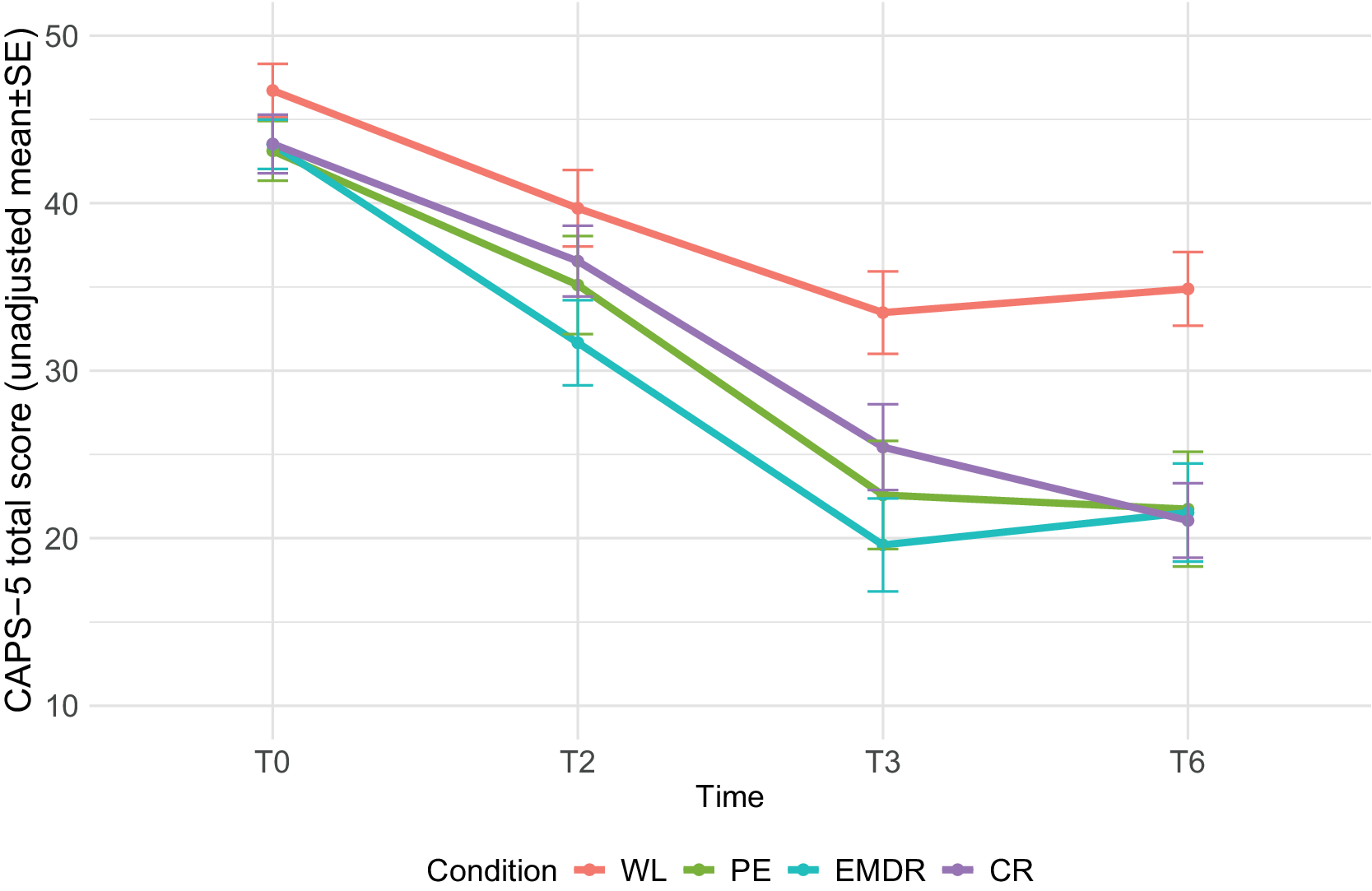
Descriptive statistics of primary and secondary outcomes over time and at each time point, results of the linear mixed models, and corresponding between-group effect sizes at post-treatment and 6-month follow-up are listed in Table 3. The primary outcome analysis indicated that all three therapies significantly reduced PTSD symptom severity compared to WL over time from baseline to 6-month follow-up. The baseline-adjusted mean differences on the CAPS-5 were −6.15 (95% CI −11.84, −0.47; p = 0.034) for PE, −10.07 (95% CI −15.69, −4.44; p = 0.0005) for EMDR, and −7.30 (95% CI −12.85, −1.75; p = 0.010) for CR (Figure 2). Analyses of treatment effects per time point indicated a significant improvement for the EMDR group at mid-treatment compared to WL, and for all therapies at post-treatment and 6-month follow-up. Between-group differences at post-treatment translated to an effect size Cohen’s d of −0.68 (95% CI −1.13, −0.23) for PE, −1.09 (95% CI −1.56, −0.63) for EMDR and −0.45 (95% CI −0.90, −0.01) for CR, and at 6-month follow-up to −0.90 (95% CI −1.36, −0.44) for PE, −1.04 (95% CI −1.50, −0.58) for EMDR, and −1.00 (95% CI −1.46, −0.54) for CR.
Summary of linear mixed models of continuous primary and secondary outcomes and logistic GEE of dichotomous secondary outcomes

Table 3. Long description
A complex data table presenting outcomes for four groups: WL (Waitlist), PE (Prolonged Exposure), EMDR (Eye Movement Desensitization and Reprocessing), and CR (Cognitive Restructuring).
Primary Outcome: Researcher-rated PTSD symptom severity (C APS-5).
* Baseline T0: Means range from 43.12 to 46.73.
* Post-treatment T 3: E M D R showed the lowest mean (19.60) compared to W L (33.47). Adjusted differences for P E, E M D R, and C R were all statistically significant (p < 0.05) compared to W L.
* 6-month follow-up T 6: E M D R (21.53), P E (21.73), and C R (21.06) maintained significant improvements over W L (34.88).
Continuous Secondary Outcomes:
* Self-rated P T S D (P C L-5): All active treatments (P E, E M D R, C R) showed significant adjusted differences at T 3 and T 6 compared to W L. E M D R had the largest effect size at T 3 (Cohen’s d = -1.40).
* Complex P T S D (I T Q-P T S D and I T Q-D S O): Significant reductions were observed for all active treatment groups by T 6 compared to W L.
Dichotomous Secondary Outcome: Loss of P T S D diagnosis (C A P S-5).
* At T 3, E M D R had the highest recovery rate at 61.0 percent (O R 5.85, p = 0.0010).
* At T 6, C R had the highest recovery rate at 56.1 percent (O R 4.20, p = 0.0052).
* Effect over time from T 0 to T 6: All active treatments showed significant adjusted differences compared to the waitlist control.
Note: CAPS-5, clinician-administered PTSD scale for DSM-5; CR, cognitive restructuring; EMDR, eye movement desensitization and reprocessing therapy; ITQ, international trauma questionnaire; PCL-5, PTSD checklist for DSM-5; PE, prolonged exposure; PTSD, post-traumatic stress disorder; and WL, waitlist control group.
a Adjusted differences are taken from linear mixed models, adjusted for baseline scores.
b NNT 95% confidence intervals that included infinity were not reported; the corresponding 95% confidence intervals for the risk differences are reported instead.
Researcher-rated PTSD symptom severity CAPS-5 scores at baseline (T0), mid-treatment (T2), post-treatment (T3), and 6-month follow-up (T6). Data are unadjusted mean ± SE. Note: CAPS-5, ‘clinician-administered PTSD scale for DSM-5’; CR, ‘cognitive restructuring’; EMDR, ‘eye movement desensitization and reprocessing therapy’; PE, ‘prolonged exposure’; WL, ‘waitlist control group’.

Figure 2. Long description
The x-axis is labeled Time with four discrete points: T 0, T 2, T 3, and T 6. The y-axis is labeled C A P S dash 5 total score (unadjusted mean plus or minus S E) ranging from 10 to 50. Four colored lines represent different conditions: W L in coral, P E in green, E M D R in teal, and C R in purple.* All conditions start at T 0 with scores between 43 and 47.* W L (coral) shows the highest scores throughout, decreasing from 47 at T 0 to 40 at T 2, 34 at T 3, and slightly rising to 35 at T 6.* P E (green) decreases from 43 at T 0 to 35 at T 2, 23 at T 3, and 22 at T 6.* E M D R (teal) shows the steepest initial decline from 43 at T 0 to 32 at T 2, reaching a low of 20 at T 3, and ending at 22 at T 6.* C R (purple) decreases from 44 at T 0 to 37 at T 2, 26 at T 3, and 21 at T 6.Vertical error bars representing standard error are present at every data point for all four conditions.
Four colored lines represent the conditions:
* W L (red): Starts highest at T 0 (approximately 46), decreases to 40 at T 2, reaches its lowest point at T 3 (approximately 34), and slightly increases at T 6 (approximately 35).
* P E (green): Starts at approximately 43 at T 0, decreases steadily to 35 at T 2, drops to 23 at T 3, and remains stable at 22 at T 6.
* E M D R (teal): Starts at approximately 43 at T 0, decreases to 32 at T 2, reaches its lowest point at T 3 (approximately 20), and slightly increases to 22 at T 6.
* C R (purple): Starts at approximately 44 at T 0, decreases to 37 at T 2, drops to 26 at T 3, and reaches its lowest point at T 6 (approximately 21).
All groups show a downward trend in symptom severity over time, with the treatment groups (P E, E M D R, and C R) showing a more pronounced decrease compared to the W L control group. Error bars representing S E are present at each data point.
Across continuous secondary outcomes, all three therapies were superior compared to WL in reducing self-rated PTSD symptom severity (PCL-5 and ITQ-PTSD), and complex PTSD/disturbances in self-organization (ITQ-DSO) over time from baseline to 6-month follow-up. Analyses of treatment effect per time point showed that these differences emerged at mid-treatment (but only statistically significant for EMDR and PE on PCL-5 and ITQ-PTSD) and increased at post-treatment and 6-month follow-up for all three interventions, corresponding to large effect sizes (Table 3). Moreover, participants in the therapy groups were more likely to lose PTSD diagnostic status than those in the WL group over time from baseline to 6-month follow-up. Absolute rates of loss of PTSD diagnostic status at 6-month follow-up were 25.0% (10 of 40) in the WL group, 45.0% (18 of 40) in the PE group, 43.9% (18 of 41) in the EMDR group, and 56.1% (23 of 41) in the CR group.
Per-protocol sensitivity analysis of primary and secondary outcomes showed a similar pattern of results as the main analyses when including therapy completers only (Supplementary Table S2).
Analyses of additional continuous outcomes showed significantly greater improvements compared to WL for all therapies over time from baseline to 6-month follow-up on post-traumatic cognitions, dissociation symptoms, and depression symptoms (Supplementary Table S3). Therapy-specific effects were observed for EMDR on the disruption of social functioning by PTSD symptoms, and for CR on ideas of reference, personal recovery, and resilience. None of the therapies showed significantly greater improvements over time or at any time point compared to WL on measures of persecution, distressing voice-hearing frequency, or distressing voice impact. An overview of between-group effect sizes at 6-month follow-up of all outcomes is provided in Figure 3.
Forest plot of between-group effect sizes (Cohen’s d) for primary, secondary, and additional continuous outcomes at 6-month follow-up (intention-to-treat sample). Note: CAPS-5, ‘clinician-administered PTSD scale for DSM-5’; BDI-II, ‘beck depression inventory II’; BRS, ‘brief resilience scale’; CR, ‘cognitive restructuring’; EMDR, ‘eye movement desensitization and reprocessing therapy’; ITQ, ‘international trauma questionnaire’; PCL-5, ‘PTSD checklist for DSM-5’; PE, ‘prolonged exposure’; PSYRATS-AHRS, ‘psychosis symptom rating scale – auditory verbal hallucinations scale’; PTCI-9, ‘brief version of the post-traumatic cognitions inventory’; QPR, ‘questionnaire about the process of recovery’; R-GPTS, ‘revised version of the Green et al. paranoid thoughts scale’; TDSQ-s, ‘trait state dissociation questionnaire – short version’; TFT, ‘trauma-focused therapy’; VIS, ‘voice impact scale’; and WL, ‘waitlist control group’.

Figure 3. Long description
The forest plot is divided into two main sections: continuous outcomes (Cohen’s d) and a dichotomous outcome (O R).
Top Legend: Therapy groups are color-coded as P E (green square), E M D R (teal square), and C R (purple square).
Continuous Outcomes (X-axis from -2 to 1.5, where negative values Favours T F T and positive values Favours W L):
* Primary Outcome: Researcher-rated P T S D symptom severity (C A P S-5). All three therapies show significant improvement with Cohen’s d values around -0.90 to -1.04.
* Secondary Outcomes: Includes P C L-5, I T Q-P T S D, and I T Q-D S O. All therapies show significant negative effect sizes, indicating improvement compared to W L.
* Additional Outcomes: Includes C A P S-5 social functioning, P T C I-9, T D S Q-s, B D I-I I, R G P T S, P S Y R A T S-A H R S, V I S, Q P R, and B R S. Most outcomes favor T F T, though some confidence intervals for psychotic symptoms (R G P T S, P S Y R A T S) cross the zero line, indicating non-significance.
Dichotomous Outcome (X-axis from -5 to 12, where values greater than 1 Favours T F T):
* Loss of P T S D diagnosis: O R values are 3.12 for P E, 3.06 for E M D R, and 4.20 for C R. All confidence intervals are above 1, indicating all three therapies significantly increase the likelihood of losing a P T S D diagnosis compared to the waitlist.
In terms of weekly outcome measures, 150 participants (92.6%) completed at least one smartphone assessment (mean 11.9, SD 5.2) during the therapy period (T0-T3) and 106 participants (65.4%; mean 8.6, SD 3.8) during the follow-up period (T3-T6). Analyses of social functioning indicated no differences between WL and any of the therapies in terms of time spent with others or time spent doing pleasurable activities during therapy (T0 to T3) or the follow-up period (T3 to T6; Supplementary Table S4). Similarly, analyses indicated no differences between WL and any of the therapies in terms of the number of distinct adversities or revictimization types experienced during therapy or the follow-up period (Supplementary Table S5).
During the study period, six serious adverse events (4 in PE and 2 in CR) were recorded. Two cases of psychiatric hospital admission (one for psychosis symptom exacerbation and one for self-harm) were evaluated as possibly therapy-related (both PE group). In both cases, PE was associated with a temporary increase in anxiety and distress, which contributed, among other factors, to the psychiatric hospital admission. Importantly, both participants continued and completed PE. All SAEs were reported to and reviewed by the Medical Ethics Committee.
Discussion
PE, EMDR, and CR were found to be superior compared to WL in reducing PTSD symptoms in 162 participants meeting diagnostic criteria for PTSD and a lifetime psychotic disorder. Moreover, all three therapies demonstrated efficacy in reducing self-rated PTSD and cPTSD symptoms. Effects were robust, as consistent across researcher-led and self-report outcomes, at post-treatment and 6-month follow-up, and per-protocol sensitivity analyses. Notably, effects on PTSD symptoms were large and exceeded those found in our previous RCT of PE and EMDR, where therapy duration was eight sessions. This supports treatment guidelines recommending extending therapy duration for populations with complex trauma histories and needs (National Institute for Health and Care Excellence, 2018).
All three therapies were found to be effective in reducing PTSD symptoms in individuals with psychosis. This suggests that, in our trial context, trauma-focused therapies targeting either trauma-related episodic memories (as in PE and EMDR) or trauma-related beliefs (as in CR) may be effective for reducing PTSD in psychosis. Theoretical models of PTSD propose that symptoms arise from the interaction between trauma-related memories and beliefs, which maintains a sense of current threat and associated, understandable, but problem-sustaining safety behaviors (Brewin, Gregory, Lipton, & Burgess, Reference Brewin, Gregory, Lipton and Burgess2010). Given this interaction, it follows that both therapeutic targets have the potential to improve PTSD symptoms. Moreover, cognitive therapies can facilitate memory processing, and memory-focused therapies can modify beliefs. However, these findings depart from the Steel et al. (Reference Steel, Hardy, Smith, Wykes, Rose, Enright, Hardcastle, Landau, Baksh, Gottlieb, Rose and Mueser2017) RCT of CR compared to TAU in psychosis, which had a null finding for all outcomes. Though, it is unclear whether this finding was due to the absence of treatment effects or methodological issues. Differences may be attributable to trial design, sample, or context, and further replication is required. For the exposure-based therapies (EMDR and PE), the current findings replicate the previous findings of the T-TIP trial and the more recent STAR trial, supporting the efficacy of these approaches in treating PTSD in psychosis (Peters et al., Reference Peters, Swan, Underwood, Jafari, Varese, Steel, Dudley, Greenwood, Emsley, Keen, Bowe, Hardy, Morrison, Byford, Freeman, Frost, Ganguli, Heslin, Kuipers and Wood2026; van den Berg et al., Reference van den Berg, de Bont, van der Vleugel, de Roos, de Jongh, Van Minnen and van der Gaag2015).
All three therapies showed significant, medium or medium-large improvements for post-traumatic cognitions, depression, and dissociation at post-therapy and follow-up, although only CR had a significant effect on personal recovery and resilience. This suggests that CR may confer benefits for a broader range of trauma-related outcomes, including those valued by patients. This could be attributable to the protocol flexibly addressing a broader range of trauma effects and other difficulties through skills training. Effects on psychosis outcomes were limited for the three therapies, as the WL group also showed improvements for paranoia and voice-hearing, with only the ideas of reference subscale of the RGPTS reaching significance for CR. This may be due to effective TAU of psychosis, reduced power to detect effects (as 53.1% and 48.1% of the sample did not experience distressing voices and delusional beliefs at baseline, respectively), temporal instability of these symptoms, participant selection factors, and/or insufficient targeting of psychosis-related trauma processes during therapy, which will be explored in subsequent analyses.
As in previous work, all three trauma-focused therapies were found to be acceptable and safe, with good engagement, modest dropout rates, and few therapy-related SAEs. This is especially noteworthy in the highly traumatized psychosis sample studied here, with a high prevalence of cPTSD (66.5%), prolonged care involvement, and a majority experiencing active psychotic symptoms at baseline. Importantly, the onset of PTSD symptoms occurred, on average, more than 20 years ago (mean 20.1 years), demonstrating that these therapies confer therapeutic benefit despite the protracted time elapsed since the traumatic event(s) and prolonged PTSD-related distress before accessing them.
These findings provide further evidence against the exclusion of people with psychosis from trauma therapy trials and services. It is, however, of note that dropout rates appear slightly higher (overall 23.0%) than those reported in a recent meta-analysis of trauma-focused therapies in non-psychosis samples (i.e. 20.9%, 95% CI 17.2, 24.9; Varker et al., Reference Varker, Jones, Arjmand, Hinton, Hiles, Freijah, Forbes, Kartal, Phelps, Bryant, McFarlane, Hopwood and O’Donnell2021). The co-occurrence of psychosis and severe trauma histories may partly account for this, and it may be that further therapy adaptations are required to reduce dropout for this subgroup. Although two psychiatric hospital admissions in the PE condition were judged as possibly therapy-related, both participants continued and finished the PE therapy. These events underscore the importance of monitoring adverse reactions during trauma-focused therapy, particularly in this clinically complex population. Overall, our findings demonstrate that trauma-focused therapies can be safely delivered to individuals with psychosis, challenging concerns that they will lead to iatrogenic harm. This is especially noteworthy given that therapy was provided by a diverse group of therapists from a range of healthcare organizations, with varying levels of background training, as part of their routine psychosis care roles. This is an encouraging indication that frontline therapists can effectively deliver trauma-focused therapies, if provided access to specialist training and supervision, and is in line with previous research (Mueser et al., Reference Mueser, Gottlieb, Xie, Lu, Yanos, Rosenberg, Silverstein, Duva, Minsky, Wolfe and McHugo2015). Further work is required to evaluate if such therapies can be implemented at scale.
Limitations include the lack of an active control condition. Although the superiority of trauma-focused therapies has already been robustly demonstrated compared to non-specific interventions (Jericho, Luo, & BerleHow, Reference Jericho, Luo and Berle2022), effect sizes relative to WL + TAU may be larger than those that would be observed against an active psychological control condition. The sample size was also relatively small, especially given the four arms, which limits the precision of the estimates of treatment effects and precluded direct head-to-head comparison between the three therapies. Further, the effects may have been influenced by the Dutch context, which provides good access to health and social care. Replication in larger samples and other healthcare services is required.
In conclusion, this novel multi-site RCT evaluated PE, EMDR, and CR compared to WL for the treatment of PTSD in people with psychosis, delivered by therapists working in routine care. Building on our previous RCT, the findings demonstrate that all three trauma-focused therapies were safe, acceptable, and efficacious for PTSD in our complex trauma sample, with high rates of cPTSD, and larger effects found when therapy duration was doubled. Secondary effects were more promising for outcomes related to emotions, functioning, and recovery, particularly for CR, than those for psychosis. If replicated, the findings support offering patient choice in therapy selection when the focus is on reducing PTSD symptoms. They also suggest that flexibly integrating trauma-focused therapy protocols to target a broader range of trauma-related effects, such as in trauma-focused CBT for psychosis (Peters et al., Reference Peters, Swan, Underwood, Jafari, Varese, Steel, Dudley, Greenwood, Emsley, Keen, Bowe, Hardy, Morrison, Byford, Freeman, Frost, Ganguli, Heslin, Kuipers and Wood2026) or EMDR for psychosis (Varese et al., Reference Varese, Sellwood, Pulford, Awenat, Bird, Bhutani, Carter, Davies, Aseem, Davis, Hefferman-Clarke, Hilton, Horne, Keane, Logie, Malkin, Potter, van den Berg, Zia and Bentall2024), is a promising area of research for this population. Further work is needed to investigate potential moderators of outcome, to understand processes of change, the qualitative therapy experience, and long-term effectiveness and cost-effectiveness, which will be reported in adjunct studies. Trauma-related mental health needs in the psychosis population should be addressed with evidence-based psychological interventions.
Supplementary material
The supplementary material for this article can be found at http://doi.org/10.1017/S0033291726106291.
Data availability statement
Data are not publicly available due to privacy and ethical restrictions. De-identified data and statistical code can be shared upon reasonable request. Data are stored at the VU University and MRC Research Centre.
Acknowledgments
We thank Marion Bruns for her contributions to the data management. We thank the following mental health organizations that participated in the trial: Antes, Arkin, GGZ Centraal, GGZ Delfland, GGZ Eindhoven, GGZ inGeest, GGZ Noord-Holland Noord, GGZ Oost Brabant, Parnassia, Pro Persona, PsyQ, and Vincent van Gogh Instelling. We thank the therapists who helped recruit and provided the trauma-focused interventions to study participants: Abigaël Herschberg, Anne Rous, Annemarieke de Haan, Bianca Raijmakers, Charity van Tienen, Denise Braber, Desi van der Hoek, Donna Herweijer, Dorieke Opsteen, Elisa Kramer, Ellie Wekking, Femke Freijzer, Gitty de Haan, Hester van ‘t Blik, Jacky Pop, Janneke Ensing, Johanna Verloop, Judith Rietdijk, Karin Blankman, Kelly Breeman, Maaike Weber, Marion de Boer, Marjolein Mazereeuw, Miranda van den Berg, Nelly Dorssers, Rahja König, Rosie Kidane, Sara Baltus, Sophie van Alebeek, Stephanie Uijleman, and Suzanne Huizer. We express our gratitude to research assistants, local researchers, independent specialists, mental health workers, and all others who contributed to this study. Above all, we sincerely thank all those who participated in this study.
The authors acknowledge the use of OpenAI’s ChatGPT (version 5.2) and Anthropic’s Claude (version Sonnet 4.5) during manuscript preparation for the purpose of improving clarity, readability, and linguistic quality. These tools were employed solely as language-editing aids and did not contribute to content generation. All AI-assisted outputs were carefully reviewed and revised by the authors, who take full responsibility for the content of the final publication.
Author contribution
DvdB and AH developed the concept and design of the study. DvdB served as the principal investigator and led the drafting of the grant application. CvZ, SB, IV, TvdL, and DvdB were responsible for the daily management and coordination of the trial. SB and IV oversaw data collection, while SB, IV, CvZ, and ET handled data management. AH, AvM, CdR, AdJ, AS, PdB, BvdV, and TvdL were involved in the training and supervision of therapists. JDG and KM advised the trial team on the execution and fidelity of CR. AH, AvM, CdR, AdJ, AS, PdB, BvdV, MvdG, and MM acted as study supervisors. IV conducted the statistical analyses. SB, IV, AH, and DvdB drafted the original manuscript. All authors reviewed, contributed to, and approved the final version of the manuscript.
Funding statement
This study was funded by the Dutch support foundation Stichting tot Steun Vereniging voor Christelijke Verzorging van Geestes en Zenuwzieken (DvdB, grant number 241). AH is part-funded by the National Institute for Health Research (NIHR) Biomedical Research Centre at South London and Maudsley NHS Foundation Trust and King’s College London.
Competing interests
AH, AS, MvdG, and DvdB receive income for published books on psychotic disorders and for the training of postdoctoral professionals in the treatment of psychotic disorders. JDG and KM receive income for a published book on Cognitive Restructuring for PTSD and for the training of mental health professionals in Cognitive Restructuring. AdJ receives income for published books on EMDR therapy and for the training of postdoctoral professionals in this method. AvM receives income for published book chapters on PTSD and for the training of postdoctoral professionals in Prolonged Exposure. CdR receives income for the training of postdoctoral professionals in EMDR therapy for children and adolescents. PdB and BvdV receive income for the training of postdoctoral professionals in the treatment of psychotic disorders. All other authors have no conflict of interest to declare.
Ethical standards
The authors assert that all procedures contributing to this work comply with the ethical standards of the relevant national and institutional committees on human experimentation and with the Helsinki Declaration of 1975, as revised in 2008.




 Open access

