



INTRODUCTION
Hokuriku district in Japan has much snow, which is usually wet because of a relatively warm climate in winter. Hence, for such practical purposes as avalanche prevention and snow removal, it is important to study mechanical properties of wet snow. In this paper, Kinosita’s hardness of wet snow (Kinosita 1960) is discussed. This is defined as the average resistance per unit area offered by snow to vertical penetration of a metallic disk driven into the snow surface by a blow from a drop hammer.
HARDNESS MEASUREMENTS OF NATURAL WET SNOW
Kinosita’s hardness R, density p and free water content W of 208 natural wet snow samples were measured in the field in the winter of 1981-82. The free water content, measured with a newly designed calorimeter (Akitaya 1978), was less than 22% in weight except in two nearly-saturated samples.
Since hardness was supposed to depend mainly on the solid structure of snow, dry density ρd was calculated from free water content W and density ρ and used as a parameter in analysis of the obtained data. The wet snow samples were qualitatively classified into two types: I (coarse-grained granular snow) and II (new and fine-grained compact snow).
In Figure I, In R was plotted against ρd, where solid circles represent snow I and open circles snow II. Clearly, snow II is harder than snow I with the same dry density. Also In R seemed to increase linearly with increasing ρd for both types of snow. On the other hand, In R of fine-grained compact snow (snow II) was reported to decrease linearly with increasing W (Akitaya and Endo 1981). Hence, the dependence of R on W and ρd was assumed as

and the constants a, b and c were obtained by multiple regression method for each snow type. The results are:


where R is measured in Pa, W in % and ρd in kg/m3. The values of b and c of these relations are significant at less than 0.1% level. The correlation coefficients of these relations, shown in Table 1, are high except the partial correlation coefficient of In R and W with respect to ρd for snow I. The reason for this low correlation is probably that the dependence of R on W is strongly affected by ρd. Actually, we found that R of snow I with ρd larger than 500 kg/m3 was almost independent of W, while R of snow I with ρd smaller than 300 kg/m3 occasionally decreased by up to 90% when W was increased to saturation.
The relation (1c) with W = 0 agrees well the formula for dry snow reported by Kinosita (1960).

LABORATORY EXPERIMENTS
To study aging effect on hardness and also the difference of hardness between dry and wet snow of the same solid structure, we carried out the following experiments in a cold room. Samples were prepared at -10°C from natural snow by first disassembling it into grains with a sieve and then redepositing them. The samples will be hereafter termed “coarse-grained” and “fine-grained” according to origin (snow I and snow II). Mean density of nine coarse-grained samples (0.84 mm < grain size <2.83 mm) was 525 kg/m 3 while that of seven fine-grained samples (g.s. < 1 mm) was 425 kg/m 3. The prepared samples were allowed to sinter at -10°C for various time intervals before R was measured. Then they were soaked in water at 0°C for 10 seconds. After surplus water had been allowed to drain, hardness was measured at 1±1°C occasionally for up to several hours, during which the free water content was nearly constant (about 7% for coarse-grained and 28% for fine-grained samples).
Sintering effect in the dry state was obtained from


where R-5 is hardness normalized to -5°C (Tusima 1972) in Pa and t the sintering time in hour. Numerals in parentheses are the values of correlation coefficient.
Aging effect in wet state was also expressed by a similar form
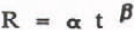
where R-5 is hardness in Pa and t the lapse time after water supply in minutes. Here analyzed data were taken from each sample and we have as many sets of constants α and β as the number of samples. Values of α ranged from 10700 to 60900 and of β from 0.164 to 0.566. The value of the correlation coefficient ranged from 0.840 to 1.000.
Finally, the hardness of sample 1 minute after the addition of water (that is, α) is compared with R-5, the hardness just before water was added. In Figure 2, yR = In (α /R-5) was plotted against the sintering time t,

which may be an indication of bond growth in dry state. It is clear that yR is strongly dependent on t and grain size.



