Introduction
Attention deficit hyperactivity disorder (ADHD) is a common neurobehavioural disorder characterisized by core symptoms of inattention, hyperactivity and impulsivity (Lahey et al. Reference Lahey, Pelham, Chronis, Massetti, Kipp, Ehrhardt and Lee2006; Barkley & Brown, Reference Barkley and Brown2008). A growing body of evidence supports the important relationship of ADHD and subsequent substance use in adolescents and adults (Wilens & Biederman, Reference Wilens and Biederman1993; Lynskey & Fergusson, Reference Lynskey and Fergusson1995; Biederman et al. Reference Biederman, Wilens, Mick, Milberger, Spencer and Faraone1995; Wilens, Reference Wilens2007) raising a significant public health concern. Adolescence is a period of significant clinical interest, since interventions during this developmental stage may be relevant for prevention of later substance use disorders (Wilens et al. Reference Wilens, Biederman, Spencer and Frances1994, Reference Wilens, Adamson, Monuteaux, Faraone, Schillinger, Westerberg and Biederman2008; Faraone & Wilens, Reference Faraone and Wilens2007; Kollins, Reference Kollins2008; Mannuzza et al. Reference Mannuzza, Klein, Truong, Moulton, Roizen, Howell and Castellanos2008). Adolescence also marks a period crucial for developing substance use habits and provides a meaningful window for prospective studies in developmental pathways of substance use.
Whether boys and girls suffering from ADHD differ in their vulnerability to substance use remains uncertain. Clinical reports suggest that girls with ADHD may be at higher risk than boys for substance use disorders, especially in early adolescence, which merits further studies (Biederman et al. Reference Biederman, Mick, Faraone, Braaten, Doyle, Spencer, Wilens, Frazier and Johnson2002, Reference Biederman, Monuteaux, Mick, Spencer, Wilens, Klein, Price and Faraone2006; Biederman & Faraone, Reference Biederman and Faraone2004). However, clinically ascertained cases, often with disabling and severe disruptive behavioural symptom profiles, are unlikely to be fully representative of the disorder. In particular, they may not sufficiently characterize the attention deficit hyperactivity spectrum among females (Arnold, Reference Arnold1996; Gaub & Carlson, Reference Gaub and Carlson1997).
Few studies have assessed patterns of association of ADHD and substance use in large-scale representative population-based samples of boys and girls. Disney and colleagues (Reference Disney, Elkins, McGue and Iacono1999), studying 632 girls, suggested that girls with ADHD may be at higher risk for substance use than boys, albeit in this substudy of the Minnesota Twin Family Study, the association of ADHD symptoms and substance use in adolescence was mediated through conduct disorder. A recent study from the same population suggested that even a single symptom of ADHD independently predicted poor substance use outcome, and concluded that the association of ADHD and substance use may have not been observed consistently in previous literature when studying diagnostic categories (Elkins et al. Reference Elkins, McGue and Iacono2007).
That study addressed some of the limitations of previous prospective and longitudinal studies; our sample includes balanced representation of boys and girls, and is derived from a population-based resource with high participation rates; we used rigorous age-standardized assessments, and dimensional and categorical information was available from parents' and teachers' reports and professionally administered interviews. We focused on the longitudinal course of these behavioural symptoms from early- to mid-adolescence, assessing psychiatric co-morbidity and substance use outcome among young females and males.
Methods
Study design and participants
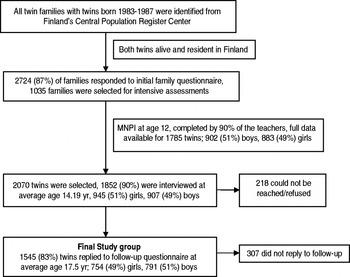
FinnTwin12 (FT12) is an ongoing longitudinal twin study launched in 1994 to investigate the developmental genetic epidemiology of health-related behaviours (Rose et al. Reference Rose, Dick, Viken and Kaprio2001) (Fig. 1). From 1994 to 1998, all Finnish families with twins born during 1983–1987 were identified from Finland's Population Register Centre and enrolled into a two-stage sampling design (Kaprio et al. Reference Kaprio, Pulkkinen and Rose2002). The first-stage study included questionnaire assessments of all twins and parents at baseline (87% participation rate, 2724 families) conducted during late autumn of the year in which consecutive twin cohorts reached 11 years; the first follow-up of all twins was made at age 14. Nested within this population representative study was intensive assessment of a subsample of 1035 families, comprising about 40% of all twins, most of them (72.3%, 748 families) selected at random. About one-quarter of the subsample (27.7%, 287 families) was enriched with twins assumed to be at elevated familial risk for alcoholism, based on one or both parents' elevated scores on an 11-item lifetime version of the Malmö-modified Michigan Alcoholism Screening Test (Seppä et al. Reference Seppä, Sillanaukee and Koivula1990). Details about the subsample have been described previously (Rose et al. Reference Rose, Dick, Viken, Pulkkinen and Kaprio2004; Dick et al. Reference Dick, Viken, Kaprio, Pulkkinen and Rose2005). We report analysis of the full sample to retain statistical power, because results of random subset and total sample did not differ significantly from each other (tabular comparison data available on request).
Flowchart. Data collection and sampling procedures in a 7-year prospective longitudinal study of adolescent Finnish twins.

Assessments of baseline ADHD symptom domains, DSM-III-R/DSM-IV psychiatric disorders and substance use in prospective longitudinal 7-year follow-up study of Finnish twins
Baseline assessments: DSM-IV-based ADHD symptoms reported by parents and teachers
Behavioural ratings of presence and severity of symptoms of ADHD (inattentiveness, hyperactivity, impulsivity) were obtained by Multidimensional Peer Nomination Inventory (MPNI), which was administered to the twins at age 11–12 years, during each spring following completion of baseline questionnaires by twins' teachers and their parents. The MPNI was developed for use in FT12 from a long-term longitudinal study of Finnish children; it has high reliability, internal consistency and discriminative validity (Pulkkinen et al. Reference Pulkkinen, Kaprio and Rose1999). Its items cover three dimensions; (1) behavioural problems (inattention, hyperactivity, impulsivity, aggression), (2) adjustment (constructiveness, compliance, social activity) and (3) emotional problems (depression, anxiety). The original MPNI included 30 items; in adapting it for use with Finnish twins, additional items were added to the Teacher Rating Form (total 38 items) to enrich the coverage of ADHD, and these items were tested and refined in pilot studies (Isomaki & Kokkonen, Reference Isomaki and Kukkonen1993) to be age-appropriate as suggested by Banbury & Wellington (Reference Banbury and Wellington1989), following closely the DSM-IV descriptions. Further analysis has demonstrated that the MPNI differentiates behavioural problems, e.g. aggression from hyperactivity (Pulkkinen et al. Reference Pulkkinen, Vaalamo, Hietala, Kaprio and Rose2003). In the MNPI format, ADHD items are presented in the form of statements: the four inattentiveness items were: (1) is unable to concentrate on anything; (2) is forgetful; (3) tends to ignore instructions; (4) is not conscientious with homework. The seven hyperactivity and impulsivity items were (1) is restless, unable to sit in class; (2) often acts rashly, i.e. without thinking about the possible consequences; (3) talks all the time; (4) has difficulties in waiting his or her turn; (5) runs about and climbs everywhere in spite of warnings; (6) is disobedient at school; (7) is hyperactive. The informants were asked to rate each twin on every item on a 4-point scale, where 0=does not apply, 1=applies sometimes, 2=certainly applies, 3=applies in a pronounced way. Sum scores of each symptom were constructed as the mean of the items (Barman et al. Reference Barman, Pulkkinen, Kaprio and Rose2004).
Follow-up assessments
The first follow-up: psychiatric assessment at age 14, based on semi-structured interview
The participants were interviewed using the C-SSAGA-A (Buzholz et al. Reference Buzholz, Cadoret, Cloninger, Dinwiddie, Hesselbrock, Nurnberger, Reich, Schmidt and Schuckit1994) (adolescent version of the Semi-Structured Assessment for the Genetics of Alcoholism), a widely used, reliable instrument providing lifetime DSM-III-R/DSM-IV diagnoses (APA, 1987, 1994) for alcohol dependence, major depressive disorder, anxiety disorders, conduct disorder, oppositional defiant disorder, ADHD and eating disorders. Both smoking behaviour and illicit drug use were analysed in detail in multi-item sections in the same interview. Assessments of non-responders at each stage revealed no evidence of selection associated with family structure, parental age, residential area, type or sex of the twins, or other systematic bias. All interviewers had previous interview experience and were Masters of Psychology, Health Care, or registered nurses; they received supervised training at Indiana University's Institute of Psychiatric Research using standard Consortium of Genetics of Alcoholism (COGA) interview-training procedures (Edenberg, Reference Edenberg2002). The mean age of twins at interview was 14.2 years; 75% of the twins' interviews were completed between ages 14.0 and 14.3 years, and all were completed before age 15. The final interview sample of 1845 adolescents consisted of 945 (51%) boys and 907 (49%) girls, a participation rate of 90%.
Data collection procedures were approved by the Ethics Committee of the University of Helsinki and by the Institutional Review Board of Indiana University, Bloomington. Parents provided written informed consent for their children's participation.
The second follow-up: substance use assessments reported by participants at age 17.5
Subsequently, during 2000–2005 at the average age of 17.5, twin participants from all five birth cohorts were approached again with a mailed follow-up questionnaire including substance use assessments. A total of 1545 interviewed adolescents (83% participation rate) born 1983–1987 replied at age 17 [754 (49%) females, 791 (51%) males]. The participants were asked detailed questions on smoking behaviour, illicit drug use and the frequency of their alcohol use.
Smoking behaviour
‘Have you ever tried smoking’ and for those who had, a multi-categorical follow-up was asked: ‘Which of the following best describes your current smoking’. The response alternatives were: (1) I smoke 20 cigarettes or more/day; (2) 10–19 cigarettes/day; (3) 1–9 cigarettes/day; (4) I smoke once a week or more often, not daily; (5) I smoke less than once a week; (6) I'm no longer smoking; and (7) I have experimented with smoking, but I don't smoke. Alternatives (1), (2) and (3) were defined as daily smokers, (4) and (5) as occasional smokers; and alternative (7) as experimenters. Those who had been smokers but were no longer smoking were excluded, because of unknown earlier smoking exposure. In multinomial regressions, never smokers formed the reference group.
Illicit drug use
‘Have you ever tried illicit drugs (marijuana, hash or similar drugs)?’ Response options were: (1) never (abstainers); (2) 1–3 times (experimenters); (3) 4–9 times or 10–19 times (moderate use); and (4) more than 20 times (frequent use). In multinomial regressions, the abstainers formed the reference group.
Alcohol use frequency
‘How often do you use alcohol, even in small amounts, like half a bottle of beer or a sip of wine?’ Nine response options were given: (1) daily; (2) a couple of times a week; (3) once a week; (4) a couple of times a month; (5) once a month; (6) once in a couple of months; (7) 2–4 times a year; (8) once a year or more rarely; and (9) I don't use alcohol. In multinomial analyses, since only one person reported daily alcohol use, categories (1) and (2) were collapsed as frequent users. Alternative (9) was considered as abstaining and was used as the reference category.
Statistical analysis
Significance of gender differences in means and distributions was tested with design-based F tests and standard procedures for survey data (svy option in Stata; www.stata.com). To study the associations of DSM-IV-based ADHD symptoms and substance use, multinomial logistic regression was applied to the data. First, a multinomial logistic regression model to examine the unadjusted association with the outcomes was conducted. Second, potential confounding covariates of daily smoking behaviour, illicit drug use, alcohol use and co-morbid psychiatric disorders were added to the model. To determine whether moderation by sex existed in the associations, sex×diagnosis or sex×symptoms interaction terms were added to the logistic models. However, even if the interaction did not reach significance, given the rarity of reports describing female participants with externalizing symptoms and substance use outcomes, models were fit separately for boys and girls. Gender differences were further tested with likelihood-ratio tests to confirm significance of the differences between coefficients in models separately fit to data from boys and girls. p values and confidence intervals were adjusted using standard procedures for survey data (Williams, Reference Williams2000) (cluster option in Stata) to correct for the non-independence of observations within twin pairs. The minority subsample selected to enrich familial risk for alcoholism was compared to the random sample (comprising 72% of all participants). Analysis suggested no bias, so we report significant substance use outcomes of the full sample to retain statistical power (tabular comparisons available upon request). All analyses were conducted using Stata version 9.2 statistical software (StataCorp., USA).
Results
Descriptive analysis
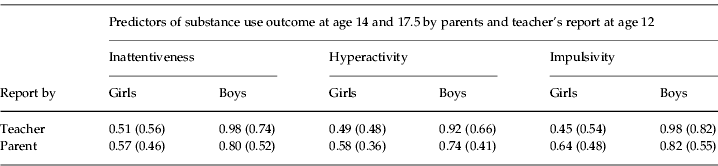
At baseline age 11–12, the sum scores of parental and teacher ratings of inattentiveness, hyperactivity and impulsiveness were significantly higher for boys than for girls (design-based F tests, all p<0.001). The mean scores and standard deviations are presented in Table 1.
Mean scores of inattentiveness, hyperactivity and impulsivity by gender, 754 (49%) girls and 791 (51%) boys (predictors of substance use outcome at age 14 and 17.5 by parents' and teachers' report at age 12)
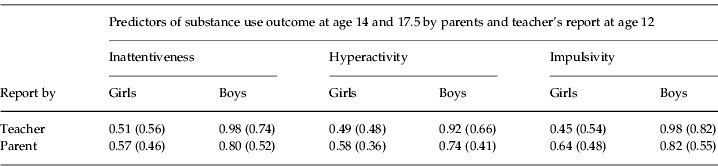
Values are mean (s.d.).
Substance use outcomes were assessed at ages 14 and 17.5. At age 14, 13.4% of girls v. 12.8% of boys reported daily cigarette smoking, 4.9% of girls v. 3.2% of boys reported alcohol abuse or dependence, and 1.7% of girls v. 1.1% of boys reported using illicit drugs, respectively. At age 17.5, 28.5% of girls v. 27.3% of boys were daily smokers, 8.8% of girls v. 7.6% of boys reported frequent alcohol use (at least a couple of times a week) and 1.0% of girls v. 1.7% of boys reported frequent illicit drug use (more than 20 times). No significant sex differences were found in full distributions of substance use. The substance use outcomes have been described in detail previously and are comparable to those of other epidemiological surveys in Finland.
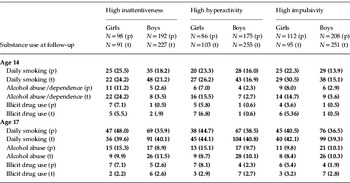
For descriptive purpose, sum scores of predictor variables were categorized into tertiles. Table 2 presents adolescents with high inattentiveness, high hyperactivity and high impulsivity (representing the most inattentive, hyperactive or impulsive adolescents) and substance use at follow-up.
Descriptive results. The percentage of adolescents at first (age 14) and at second (age 17.5) follow-up with daily smoking, alcohol abuse/dependence and illicit drug use with high inattentiveness, hyperactivity and impulsiveness reported by their parents (p) classroom teachers (t) and at baseline age 12

In this prospective three-wave data, high inattentiveness, hyperactivity and impulsivity rated by parents and teachers were of importance regarding daily smoking behaviour among both genders at age 14 (on average, 24% of girls v. 21% of boys with high symptoms smoked daily) and at age 17.5 (44% of girls v. 39% of boys smoked daily). However, the outcome regarding alcohol abuse or dependence or illicit drug use in the diagnostic interview, and the adolescents' own reports of weekly alcohol use and illicit drug use were unfavourable to girls: 15.4% of 91 highly inattentive, 14% of 103 highly hyperactive, and 14.7% of 95 highly impulsive girls rated by their classroom teachers had alcohol use disorders while 3.5% of 228 inattentive boys, 4.5% of 257 hyperactive boys and 3.6% of 253 impulsive boys had alcohol abuse or dependence diagnosis at follow-up. By the age of 17.5 years, 15.4% of girls exhibiting high inattentiveness reported daily or weekly alcohol use while 8.8% of boys exhibiting high baseline symptoms of inattentiveness later reported weekly drinking.
The prospective results regarding illicit drug use showed similar pattern: among the 98 girls whose parents reported high inattentiveness, 7.3% had illicit drug use at first age 14 follow-up. While 191 boys had high inattentiveness at baseline, less than 1% of them had illicit drug use by age 14. Among the 91 girls whose teachers reported high inattentiveness 5.5% reported illicit drug use at the interview compared to 0.9% of 228 boys with high inattentiveness. By the age of 17.5, 32.5% of the girls with high baseline inattentiveness had at least experimental illicit drug use. Finally, at 14, 2% of the inattentive girls were frequent illicit drug users compared to 5% of the inattentive boys.
Multinomial logistic regressions
Significant gender by ADHD symptom score interactions (p level <0.01) were found in multinomial logistic regressions in the associations with the follow-up C-SSAGA interview assessments of illicit drug use and alcohol abuse or dependence at first follow-up at age 14, as well as illicit drug use at age 17.5.
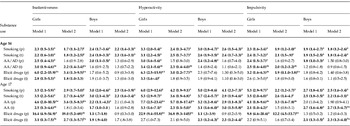
Controlling for conduct disorder, both teachers' and parents' ratings of ADHD symptoms consistently predicted daily smoking at ages 14 and 17.5 among boys and girls. But only among girls were the baseline DSM-IV ADHD symptoms also prospectively associated with alcohol abuse and alcohol dependence diagnoses, and with illicit drug use at age 14 (Table 3). Gender differences were further tested with likelihood-ratio tests to confirm the significance of differences between the coefficients in models separately fit to data from boys and girls. At follow-up age 17.5, after controlling for conduct disorder and previous substance use, inattentiveness and hyperactivity were significant predictors of frequent alcohol use (several or at least a couple of times a week) and illicit drug use (ever used more than 20 times). At age 17.5, impulsivity reported by the classroom teachers was a significant predictor for alcohol and illicit drug use outcomes among boys. Parents' and teachers' ratings did not always mark a consistent pattern of substance use outcome, although in many categories, substance use outcome was unfavourable for girls compared to boys. Inattentiveness reported by both informants was a strong predictor of illicit drug use in young females across adolescence.
Relative risk (RR) ratios and 95% confidence intervals of substance use outcomes at follow-up by inattentiveness, hyperactivity and impulsivity assessed by parents' (p) and teachers' (t) ratings age 11–12. RR ratios before (model 1) and after controlling the confounders (model 2) are presented. Gender differences were further tested with likelihood-ratio testsFootnote *

AA, Alcohol abuse; AD, alcohol dependence.
* Statistically significant (p<0.05) likelihood-ratio tests for coefficients in models separately fit to data from boys and girls.
1p<0.05; 2p<0.01; 3p<0.001 in multinomial logistic regression models.
Smoking: daily smoking, at least 1 cigarette/day. Illicit drugs: lifetime illicit drug use >20 times.
Discussion
Results from this sample, derived from a large nationwide population-based study offer new evidence of prospective associations of ADHD symptoms with alcohol abuse and alcohol dependence as well as with frequent illicit drug use among young females. Population-based findings such as these are few, but suggestive that even symptoms of ADHD might predict substance use problems. Our data add substantial evidence in that girls with symptoms of ADHD may be at higher risk compared to boys, and that the girls' risk may not be mediated by conduct disorder, a strong predictor for substance abuse.
The data shown here confirm the significance of behavioural symptoms of ADHD; inattentiveness, hyperactivity and impulsivity among both boys and girls and substance use disorders, in line with previous literature. In this study, in multinomial logistic regression, the risk ratios were lower after controlling for the confounders: previous substance use and conduct disorder, but still strongly significant. This result is in line with the few longitudinal short-frame studies on young age groups similar to FinnTwin12 (Gau et al. Reference Gau, Chong, Yang, Yen, Liang and Cheng2007). In recent studies, spanning up to 37 years, conduct disorder has been suggested as a mediator in the relationship of ADHD and substance use disorder (Brook et al. Reference Brook, Brook, Zhang and Koppel2010).
Inattentiveness was a consistent predictor of substance use, especially for illicit drug use among girls. The role of inattentiveness among young females should be investigated further, since inattentiveness may also be associated with other mental health disorders in adulthood (Kessler et al. Reference Kessler, Green, Adler, Barkley, Chatterji, Faraone, Finkelman, Greenhill, Gruber, Jewell, Russo, Sampson and Van Brunt2010). Impulsivity among boys when rated by teachers was a significant predictor of alcohol and illicit drug use at the last follow-up among boys only. Impulsive behaviour may subject boys to experimenting with psychoactive substances in general and promote continued substance use (Leeuwen et al. Reference Leeuwen, Creemers, Verhulst, Ormel and Huizink2010). Impulsive behaviour, such as answering before a question is completed and excessive talking, may also be more disturbing in the school environment than at home. Our findings contribute to those few previous findings supporting the prospective association of impulsivity and substance use. We conclude that impulsivity could be a marker for identifying adolescents, especially boys, at risk for substance use.
Our analyses have several limitations. Baseline assessments were representative of the range of inattentiveness, hyperactivity and impulsivity in the general population, but were not diagnostic with clinical utility. Our study can conclude that symptoms of ADHD, i.e. inattentiveness, hyperactivity and impulsivity, are of importance in the development of substance use, without extending our findings to the actual diagnostic level. Further, the prevalence of DSM-III-R ADHD at adolescents' semi-structured interview was low (1.35%, 95% CI 0.82–1.88) and almost equally common among girls (1.43%, 95% CI 0.66–2.20) and boys (1.27%, 95% CI 0.55–1.98) which prevented meaningful gender-specific statistical analysis. The low prevalence in the semi-structured interview could be because adolescents generally do not recognize these symptoms or the impairment caused by these, which further highlights the importance of parents' and teachers' assessments. Previous studies (Elkins et al. Reference Elkins, McGue and Iacono2007), as well as ours, confirm that dimensional predictors may be informative, perhaps more so than categorical diagnosis of ADHD. Further, restricting analyses to diagnostic categories only may be misleading, since the risk factors may operate across a range of these symptoms. Multiple informants, in our data both parents and teachers, enhance the reliability of this report.
The self-reported substance use assessments at age 17.5 were vulnerable to self-report bias, and the intensively studied sample, although mostly selected at random, may not be fully representative. However, comparisons of this subsample to the larger population base (>4000 individuals) from which it was drawn suggest no significant differences in baseline DSM-symptoms of inattentiveness, impulsivity and hyperactivity. The substance use distributions were similar, and in the larger sample we were able to detect a slight difference between initiation of illicit drugs by age 17.5 (15% of girls v. 13% of boys; see Korhonen et al. Reference Korhonen, Huizink, Dick, Pulkkinen, Rose and Kaprio2008). We did not have data on stimulant medication used between follow-ups. However, during the study period, the use of methylphenidate and other stimulant drugs in adolescents was rare in Finland compared to other Western countries. The prevalence of treatment-seeking due to attentional problems or other ADHD problem behaviours among the participants was less than 1%. Of those with DSM-III-R ADHD only 1/3 had received treatment, mostly psychological interventions. Thus, the potential protective effect of stimulant treatment among young males is unlikely to explain the results.
Finally, our results are associations, and the prospective analyses are limited to a 7-year time span; clearly, these results do not permit confident conclusions of causality. However, the follow-up of these individuals will address substance use outcomes in adulthood. In the context of these limitations, our results warrant further studies and suggest that young females with core symptoms of ADHD, such as inattentiveness and hyperactivity, may be at higher risk for substance misuse than young males, and that the risk among these girls is not significantly attenuated by the presence of conduct disorder. Whether early recognition and interventions among girls with behavioural symptoms of ADHD holds potential for substance use prevention further in their lives needs more research.
Acknowledgements
We acknowledge support from The Centre of Excellence in Complex Disease Genetics, the National Institute on Alcohol Abuse and Alcoholism (AA-12502 and AA-09203 to R.J.R., AA15416 to D.M.D.), and the Academy of Finland (100499, 205585, and 118555 to J.K.). We thank Dr John Nurnberger, Director of the Institute for Psychiatric Research at the Indiana University School of Medicine and Sandy Love and Nan Thompson for training our interview staff.
Declaration of Interest
None.