In a forthcoming article, Willy Clarysse presents an overview of the name Socrates in Egypt.Footnote 1 He argues for an evolution from a ‘normal Greek name’, with no specific reference to the Athenian philosopher (Ptolemaic period), to a Greek name with Egyptian connotations (Roman period).
This paper does not intend to refute his hypothesis. On the contrary, I wish to demonstrate that quantitative methods and techniques from the blossoming field of Digital Humanities can reinforce his theory and can provide a more accurate picture of the context in which this name was used in Ptolemaic, Roman and Late Roman Egypt. It is, however, most of all an opportunity to highlight some issues that continue to plague large-scale onomastic research, despite the advances in digitization made over the past decade. I will therefore start with an introduction to the history of Graeco-Egyptian onomastics before moving on to the name Socrates. In conclusion, some desiderata and possible avenues for future research will be discussed.
One of the benefits of Digital Humanities is how it enables us to visualize data in many ways that were previously not possible, such as the maps and networks presented here. Unfortunately, traditional forms of publication (whether on paper or as PDF) are not yet geared toward these new advancements. Screenshots are reproduced to give an impression of the visualizations, but owing to restrictions in page size these inevitably turn out rather small, and are thus in many cases not very clear. These images do not allow readers to explore the data with the same level of detail as in the actual software, as it is not possible to zoom in, filter, or explore diachronic changes, for example. To get the full experience, readers are therefore encouraged to visit the accompanying website, www.trismegistos.org/tmcorpusdata/10, where interactive versions of the timelines, maps and network are displayed.Footnote 2
STUDYING PERSONAL NAMES FROM GRAECO-ROMAN EGYPT
Owing to linguistic and disciplinary barriers, Graeco-Egyptian onomastics initially consisted of two segregated domains: names in Egyptian texts were studied by Egyptologists and demotists, while names in Greek texts were reserved for papyrologists. Many of the great onomastic lexica were compiled in these early days: Preisigke's Namenbuch for names in Greek documents;Footnote 3 Ranke's Die ägyptischen Personennamen for names in the hieroglyphic and hieratic material;Footnote 4 and Lüddeckens's Demotisches Namenbuch for names in Demotic.Footnote 5 Attention soon turned toward their origin and meaning, resulting in numerous, often very brief, studies on the etymology of a specific name (for example the prodigious amount of contributions by Quaegebeur). In this respect, papyrologists also benefit from the substantial amount of literature produced by Greek philologists, such as Masson.Footnote 6 Even nowadays, practically every papyrological edition includes a commentary on new names, peculiar names or so-called ‘ghost names’, that is, names that have been misread by editors of ancient sources, and did thus in fact never exist.Footnote 7
The linguistic value of names was recognized early on, as Greek transliterations of Egyptian names provide valuable clues about the pronunciation of the Egyptian originals, where vowels are not included in writing.Footnote 8 Nevertheless, little attention has been paid to Egyptian dialects before the rise of Coptic: a first impulse was given by Quaegebeur,Footnote 9 but only recently have names been used on a larger scale in an attempt to discern Egyptian dialectal regions.Footnote 10
The compilation of the Prosopographia Ptolemaica,Footnote 11 a collection of all individuals of the Ptolemaic empire, fostered the study of names from a social-anthropological perspective (now called ‘socio-onomastics’).Footnote 12 As a result, names have played a crucial role in the way in which this society has been interpreted. As the first project systematically incorporating both Greek and Egyptian sources, the Prosopographia brought to light several examples of people switching between a Greek and an Egyptian name, and of whole families where names of different linguistic origins were used. This sparked a lively debate about whether names can be used as indicators of a person's ethnicity,Footnote 13 and successfully challenged the stark picture of two coexisting but largely segregated societies of privileged Greeks (so-called Hellenes) vs the hoi polloi of Egyptians.Footnote 14
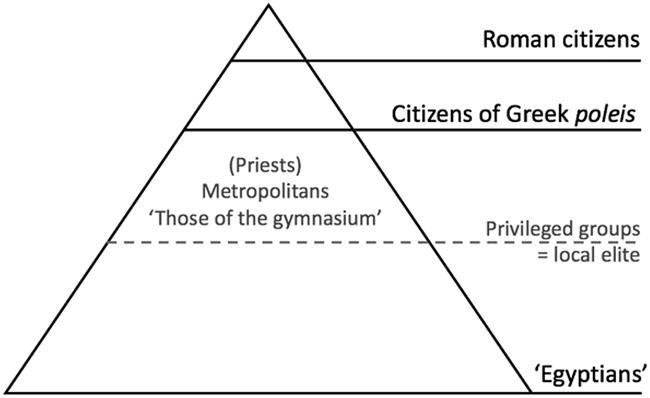
Since the Romans no longer officially distinguished between ‘Hellenes’ and Egyptians, the concept of ethnicity is not used in regard to onomastics of this period.Footnote 15 Rather, most scholars speak of names as indicators of cultural identity.Footnote 16 Perhaps the heavy focus on the (theoretically) strict socio-legal classification of the population (figure 1) has led scholars to assume that there was also a clear cultural divide, with a quintessentially Greek local elite as opposed to the rest of the population, which had remained largely Egyptian.Footnote 17 It is thus often presumed that someone with a Greek name must have belonged to the local elite. At first sight, this seems to be confirmed by a preliminary study based on the prosopographies of several officials.Footnote 18 However, many of the Greek names born by the privileged population can be characterized as ‘Greek names from Egypt’,Footnote 19 since they have an Egyptian ring to them (for example Sarapias, derived from the god Sarapis). Moreover, new names explicitly combining Greek and Egyptian elements (for example Anoubion, based on the Egyptian god Anoubis, but with a typically Greek ending in –ion) attest to a growing fusion of Greek and Egyptian culture.Footnote 20
The population of Roman Egypt

Since most Egyptian names are religiously inspired, it is not surprising that these theophoric names have received much attention. Many studies are rather superficial, however, simply listing different types.Footnote 21 More interesting are those that focus on specific gods,Footnote 22 as these case-studies clearly illustrate the reciprocity between the local pantheon and naming traditions. Studies on Greek theophoric names in Egypt are rather rare.Footnote 23 Religion also dominates onomastic research of the late antique period, for which names have been used to calculate the pace of Christian conversion, sparking lively discussions about their value as evidence.Footnote 24
FINDING SOCRATES
Trismegistos People [TM People; www.trismegistos.org/ref] served as the starting point for both Clarysse's and my own survey of the name Socrates. About a decade ago, this cluster of databases within the Trismegistos platform was developed to house the former Prosopographia Ptolemaica, and to expand it to later periods. With the help of automated extraction techniques (‘Named Entity Recognition’),Footnote 25 some 350,000 attestations of names were filtered from Greek papyri dated between c.330 b.c. and a.d. 500 (the full texts of which were provided by the Duke Databank of Documentary Papyri, now incorporated in papyri.info). The lack of a comprehensive digitized corpus of the Egyptian material for this period prevented automated data collection for these sources; names from hieroglyphic, hieratic and demotic sources were therefore entered manually. The same goes for Greek inscriptions and all Latin documentation. The Coptic material was integrated thanks to Alain Delattre's Brussels Coptic Database.Footnote 26
Some ten years is a long time in academia, even for a field that progresses rather slowly (compared to the hard sciences at least). Many new sources have been published in the meantime, while the reading of others has been corrected. In other words, the collection in TM People is becoming outdated. A handful of these new texts have been processed manually, but a systematic update is urgently needed to stay on track of recent scholarly developments. A quick search at papyri.info resulted in nine new attestations of the name Socrates; another four were spotted by chance when going through a tax register of the village Soknopaiou Nesos.Footnote 27
The final Socrates data-set created by Clarysse and myself consists of 384 individuals.Footnote 28 Some people are mentioned multiple times within one or several sources, such as Socrates, father of Sokmenis, Heracles and Ptolemaeus (TM Per 118753: 36 times).Footnote 29 In total, there are 665 attestations of these people. Prosopographical identifications have been carried out as far as the evidence permits. Trismegistos has a cautious policy in this respect: when too little evidence is available to confirm the identity of two or more attestations, they are kept apart. This is one of the few downsides of working in a digital environment, where everything is black-and-white: for the computer, two attestations either refer to the same person or they do not. There are no in-between options. Keeping the records apart then seemed a better alternative to express doubt than merging in uncertain cases, as this could lead scholars to suppose that we have evidence to support an identification, and thus base their research on unfounded interpretations.
Most of the people with the name Socrates are mentioned in Greek sources (376 individuals with 656 attestations). Twelve individuals combine the name with a second, generally Greek, name,Footnote 30 for example Socrates-Ammonius and Sarapion-Socrates.Footnote 31 There is some variation in spelling owing to phonetic similarity between omega and omicron, and delta instead of tau (for example Σοκράδης instead of Σωκράτης);Footnote 32 some variants are simply scribal errors (e.g. Σωκαρτης and Σωρατης).Footnote 33 Three names are derived from Socrates: the diminutives ΣωκρατικόςFootnote 34 and Σωκρατίων,Footnote 35 and the uncertain Σοκράτων.Footnote 36 Eight individuals appear in Egyptian sources: seven attestations are in Demotic (generally as Sgrts Footnote 37 but also Skrts,Footnote 38Sqrts Footnote 39 and Swgrts);Footnote 40 three are in Coptic (ⲥⲱⲕⲣⲁⲧⲏⲥ and ⲥⲟⲕⲣⲁⲧⲉ).Footnote 41
There are only four women (with 12 attestations): Σωκράτη daughter of Cyrillus from Antinoopolis (date unknown, probably late antique judging by the patronymic);Footnote 42 and Σοκρατιαίνα (x2) and Σοκράτιον.Footnote 43
SOCRATES IN TIME …
Clarysse presents a basic overview of the absolute number of individuals named Socrates per century: figures are fairly low in the Ptolemaic and Early Roman periods (ranging between 10 and 34), but in the second century a.d. there is a sudden leap to over 200 individuals bearing the name. After that, Socrates fades out, with only a handful of examples until the seventh century a.d. Working with absolute numbers can be misleading, however, since they generally follow the survival pattern of the papyri. A relative count, comparing all individuals with the name Socrates to the total population recorded in TM People, gives more meaningful results.
When working with almost 400 individuals, it is difficult to present a more detailed breakdown, since many texts are not precisely dated, but are rather assigned a date range. One can hardly start counting a Socrates mentioned in a text dated to a.d. 182–7 as a full attestation for each of these five years though; this would lead to an over-representation. Van Beek and Depauw devised a system of ‘weighed dates’ to solve this problem.Footnote 44 The attestation is divided equally over the total number of years to smooth out the distortions caused by broadly dated texts. The Socrates of a.d. 182–7 is thus counted as 0.166 (1/6) for the year a.d. 182, 0.166 (1/6) for a.d. 183, etc.
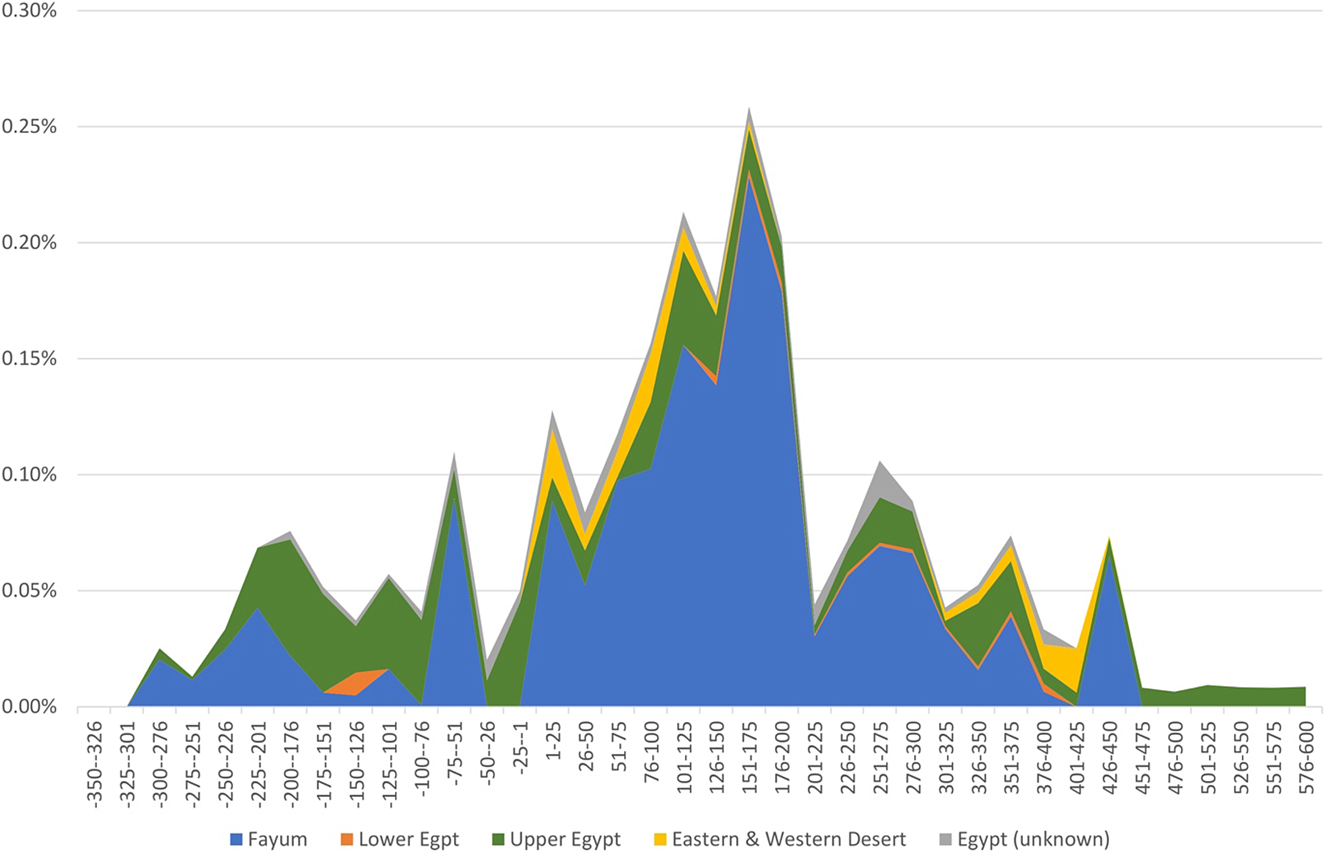
Plotting the individuals named Socrates against the entire available population in TM People with the weighed-dates system yields the following graph, with a breakdown per region (figure 2):Footnote 45
Chronological evolution of the popularity of the name Socrates, with a breakdown by region

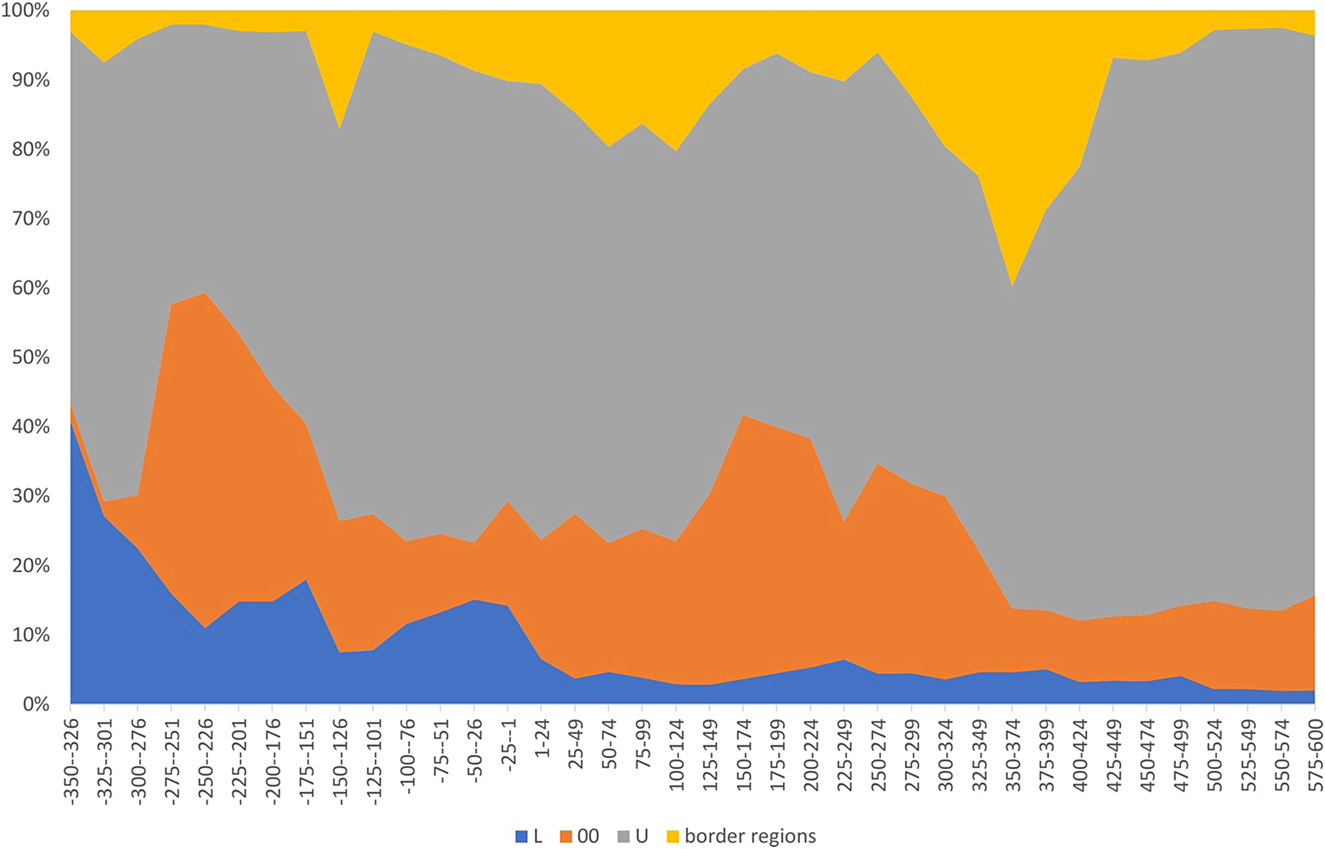
In the Ptolemaic period, less than 0.1% of the population bears the name Socrates. It starts off in the Fayum, but quickly spreads to Upper Egypt as well (mainly Elephantine; see the following section ‘… and space’). Since the survival of the impressive Zenon archive (more than 1,800 texts mentioning over 4,000 individuals,Footnote 46 which is clearly visible in the sudden peak of texts from the Fayum region in figure 3 in the middle of the third century b.c.) often leads to statistical distortions, it must be noted here that the rise in the second half of the third century b.c. has nothing to do with this exceptional cache. The name Socrates is attested only once in this archive, which means that it is amply attested in texts other than those collected by Zenon.
Relative chronological distribution of all texts from Egypt per region (L = Lower Egypt, 00 = Fayum, U = Upper Egypt, border regions = Eastern & Western Desert)

On the other hand, in the Roman period the evidence is overwhelmingly Fayumic. The disproportionately small number of individuals from Upper Egypt in this period is striking, as on average 50% of all texts are from the Nile valley (figure 3). The name Socrates starts rising in the first century a.d., and reaches its peak in the second half of the second century a.d. (figure 2). This is quite striking, since for the years a.d. 172–5 we have an enormous amount of names owing to the tax rolls of Karanis, a prosperous town in the north-eastern Fayum. These documents list thousands of people paying taxes, with the addition of their father's name, and often also their grandfather's and mother's. The over-representation of names from this village in this period usually results in a dip in popularity for most names. As we shall see further on, however (in the next section ‘… and space’), it is exactly in Karanis where the name Socrates is best attested. From the end of the second century a.d. onwards, the name slowly declines, disappearing from the Egyptian repertoire by the end of the fifth century.
The weighed-dates system allows for a more balanced and detailed analysis of the evolution of the name Socrates. Nevertheless, the result is not completely satisfactory, owing to shortcomings of a) TM People, b) of the sources and c) of the method:
a) First of all, despite its name, TM People is currently not a collection of individuals. Its initial goal was to collect attestations of people (and thus also names). Many of these attestations actually refer to the same individual, however, as people are often mentioned multiple times in different texts, especially in papyrological sources. Working on the level of attestations instead of individuals can have serious statistical implications: the name Socrates, for example, is recorded 26 times in Elephantine between a.d. 76 and 95. If one were to count on this level, Socrates would appear to have been rather common in that town at the end of the first century, while in fact it refers to only one individual, a tax collector (TM Per 269600). As mentioned above, prosopographical identifications have been carried out for the name Socrates. However, on a larger scale, only the individuals mentioned in the Prosopographia Ptolemaica, TM People's predecessor, have been identified systematically. And yet, 16 years after the last volume,Footnote 47 even the Ptolemaic section of TM People does not incorporate all recent scholarship. This means that there are many more records for people than there should be, which leads to an under-representation of the name Socrates in the above graph; but at least it gives an idea of the name's evolution. To realize a proper up-to-date prosopography of the entire Graeco-Roman period is obviously a gargantuan task, for which the small Trismegistos team currently does not have the means. We remain optimistic, however, that one day, hopefully in a not-too-distant future, this will change.
b) Second, assigning a name to a date is not straightforward. Since names were generally given at birth by parents with conscious or subconscious motivations, this date would be the best to chart the popularity of a name. The age of most people at the time in which they appear in our sources is unknown, however. Exceptions can be found in funerary contexts (for example mummy labels and funerary stēlai—yet these documents are often undated), and especially in documents relating to fiscal status, such as birth and census declarations.Footnote 48 However, this only relates to a marginal portion of our data, and since age is not (yet) included in TM People, it cannot be taken into consideration. In any case, when someone is mentioned in a text, it is usually not when he or she is born. To date individuals, TM People therefore uses the dates of the texts they are attested in as a proxy, that is, the dates of activity. If a person appears in multiple texts, the earliest date is taken as starting date, and the latest date as end date.
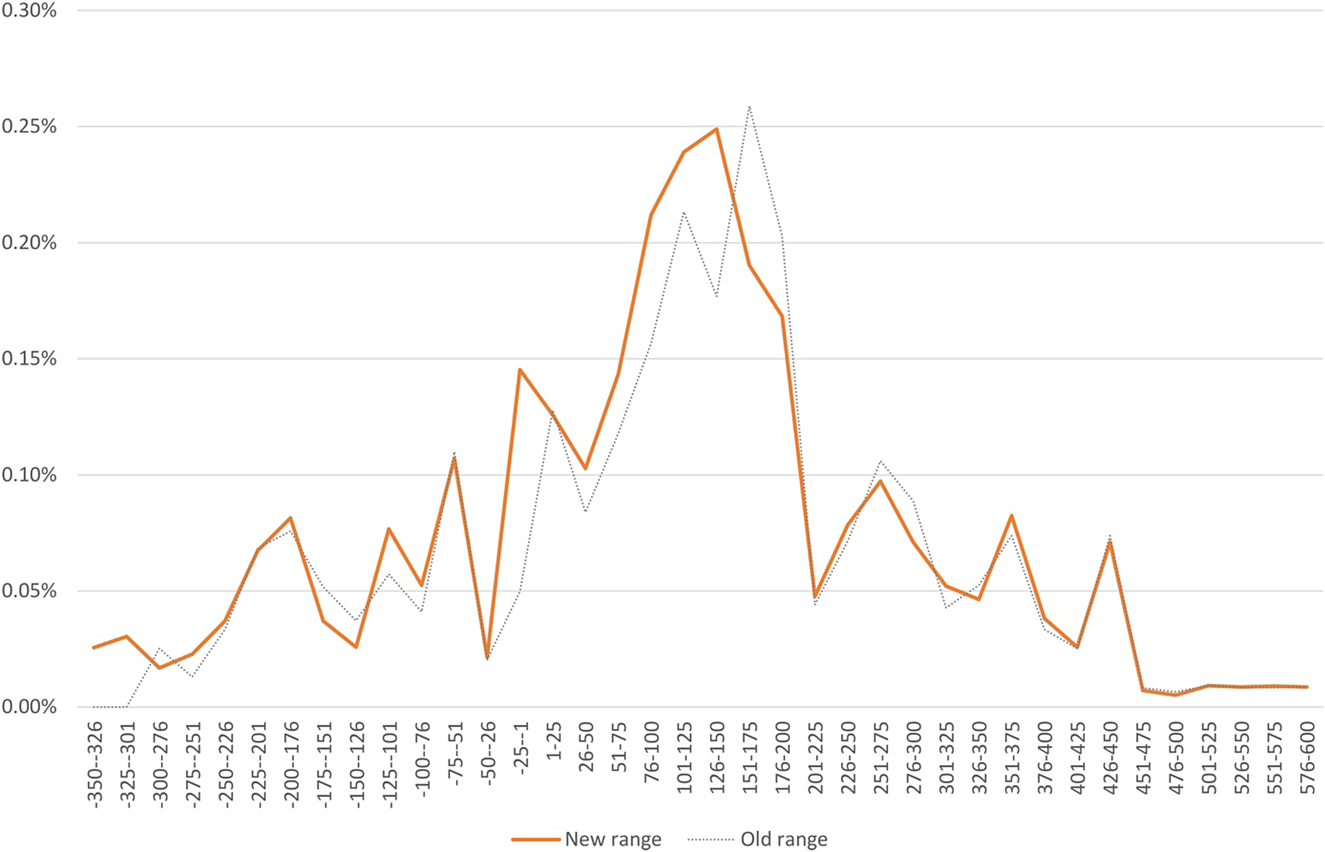
c) Third, related to the issue of age is the capacity in which people are attested in the texts. Forty per cent of the people named Socrates are, in fact, only attested as fathers or grandfathers. They too are simply dated according to the texts they appear in, which causes even greater distortions. If a Socrates is mentioned as a grandfather in the Karanis tax-roll of a.d. 175, for example, it means that his grandson is old enough to pay taxes, that is, at least 14 years old. The boy's father would presumably be somewhere between 32 and 65 (if not already dead), and the Socrates-grandfather in question at least 50 (or even more likely to be dead). This particular instance of Socrates is therefore not representative for the year a.d. 175; assigning him to the beginning of the second century would be more accurate. To set this right, I have therefore further fine-tuned the weighed-dates method. Going over all the details would lead too far here,Footnote 49 but it comes down to names attested only as genealogical identifiers (that is, patronymics, metronymics, etc.) being assigned an earlier date-range. In figure 4, the evolution based on the original weighed dates is compared to the results of the new method. The overall impression remains the same: a gradual rise from the beginning of the Ptolemaic period into the Roman period, with a peak in the second century and a drastic drop until the beginning of the third; from then on, the decline progresses more slowly. There are some remarkable differences, however. The earlier start of the attestations (350–325 b.c. instead of 300–276 b.c.) should be approached with caution: this is the result of three patronymics attested in texts assigned to the third century in general, and we cannot be sure that these fathers were also present in Egypt at this early stage. Another major difference is the disappearance of the jagged rise in the second century, which is replaced by a smoother increase. The name Socrates is now at the height of its success during the first half of the second century instead of during the third quarter, when it was actually already in decline.
Comparison of the new vs the old weighed-dates method

… AND SPACE
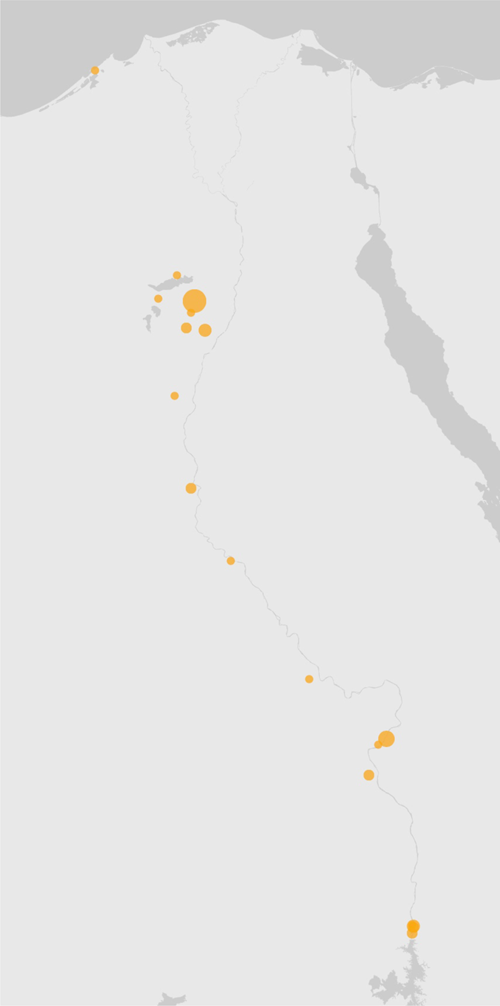
As is already clear from figure 2, there is a large discrepancy regarding the provenance of Socrates names between the Ptolemaic and the Roman periods. Overall, the name was more typical of Upper Egypt in the Ptolemaic period (332–30 b.c.), with most people being attested in the Elephantine and Theban areas (figure 5).Footnote 50 Only half of the Fayum individuals can be traced to a specific village or town; the other half appears in documents that can only be pinpointed to the Fayum in general, so it is not clear whether the name was already typical of certain villages at this time.
the name Socrates from 332–30 b.c.

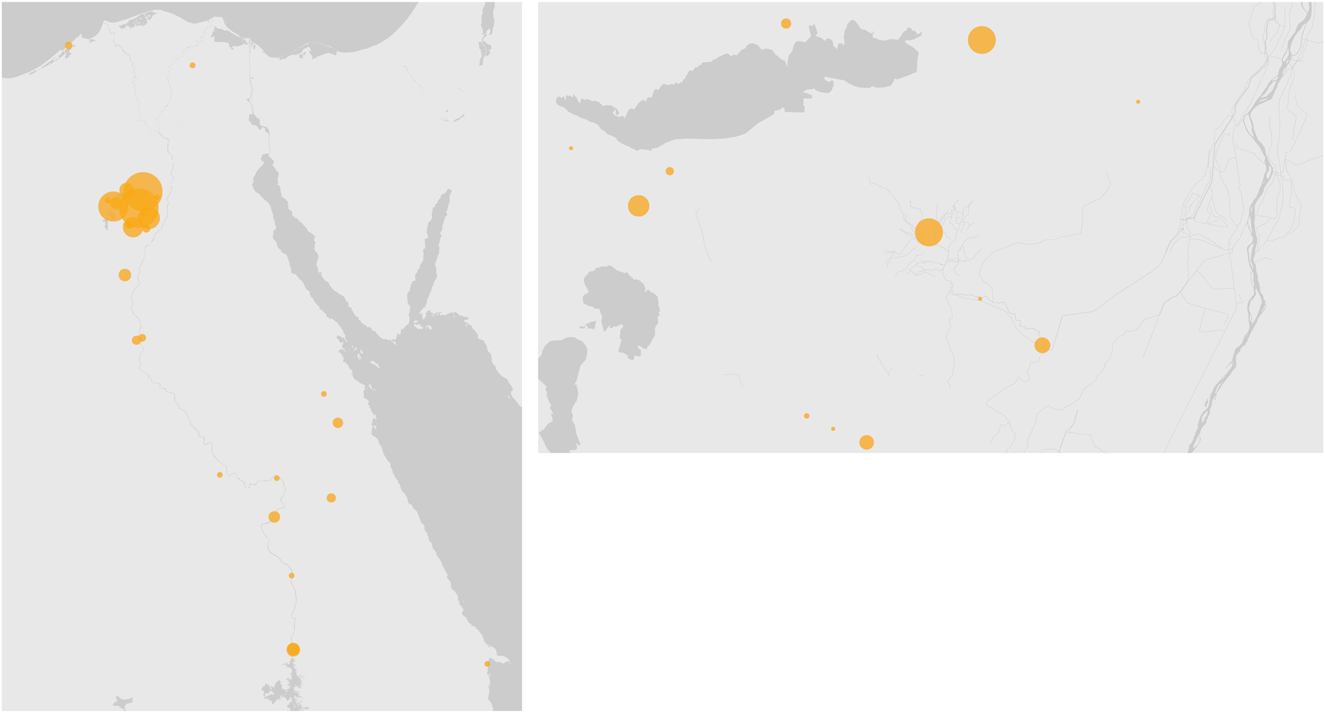
In the Roman period (30 b.c.–a.d. 285), the balance shifts to the Fayum, where 76% of the individuals are attested (figure 6).Footnote 51 Oxyrhynchos and Hermopolis, two other major find spots of Roman-period papyri, are seriously under-represented, however, indicating that the strong geographical concentration in this period is not simply a result of the survival pattern of the papyri (depicted in figure 3).
the name Socrates from 30 b.c.–a.d. 285 (left: all Egypt – right: the Fayum)

Krokodilopolis, the district capital of the Fayum, figures most prominently on the map, but this is because individuals of whom the exact provenance is unknown are added here (see below).Footnote 52 The majority are from Karanis (72 out of 237), where the name was probably passed down in several families. Socrates, father of Ptolemaeus and Chairemon in a.d. 131,Footnote 53 for instance, could be the same person as Socrates, son of Chairemon in a.d. 132–3.Footnote 54 Perhaps his son Ptolemaeus is also the Ptolemaeus mentioned as patronymic of another Socrates in a.d. 159.Footnote 55 Socrates, father of Chairemon in a.d. 172,Footnote 56 could be the same as Socrates, son of Chairemon in a.d. 173,Footnote 57 but he could also be the Socrates, father of Chairemon and grandfather of Ptolemaeus in a.d. 175.Footnote 58 Since Chairemon and Ptolemaeus are common names, however, and we have little to no background information on these people, it is difficult to draw firm conclusions. They are therefore all recorded as separate individuals. Most Upper Egyptian examples are again from Elephantine, and now the name also pops up in the Eastern desert in the Roman army camps. However, on the basis of a tax receipt found at Mons Claudianus, issued by tax officials of Syene,Footnote 59 it is clear that these people were actually ‘expats’.
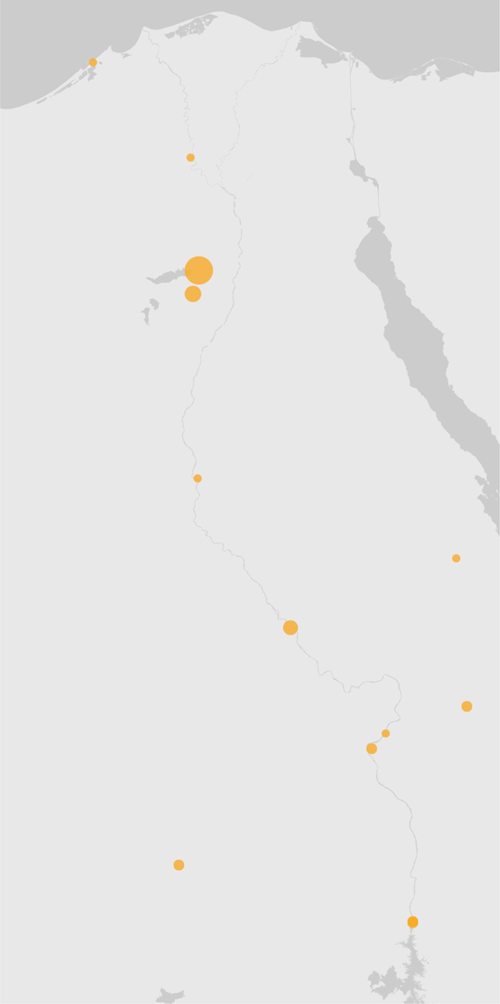
In the late Roman period (a.d. 285–640), Karanis remains the most typical Socrates-town (figure 7).
the name Socrates from a.d. 285–640

Studying the geographical spread of names comes with its own problems. A person's origins were not part of his or her standard identification, but were only added in specific types of documents. In the Ptolemaic period, for example, an immigrant's ethnic was only required in contracts and litigations, except if he was a citizen of one of the three Greek poleis; these people identified themselves by means of their tribe (and for Alexandria, Ptolemais and Antinoopolis, also by means of their deme).Footnote 60 Ethnics should be approached with caution, however, since in the course of the Ptolemaic period they gradually lose their connection to geographical origins and become associated with status and occupation.Footnote 61 In Egyptian tradition, the addition of a place of residence was unusual, yet it seems that Egyptians were required to provide their residence in official Greek documents, given as τῶν ἀπὸ + toponym.Footnote 62 In the Roman period, this becomes the standard format for designations of origin. A systematic study of these ‘geographical identifiers’ would be most welcome to gain better insights into their frequency and the contexts in which they were used, for example.Footnote 63
Since these designations of origin are not yet available in TM People, and most individuals moreover do not provide a designation of origin, by default TM People locates individuals on the basis of the provenance of the sources they appear in. Where possible, Trismegistos lists three provenances for a text: written, destination and found. For onomastic studies, the place of writing is used, since, in most cases, a document tends to refer to the site where it was drafted. The archive of Apollonius, for example, was found in his home town Hermopolis, but contains a great deal of texts related to his term of office as stratēgos in the Apollonopolites Heptakomias nome, some 100 kilometres to the south. The names in these papers are therefore not at all representative for Hermopolis.Footnote 64
There are important exceptions, however. Especially in the case of letters, the destination or find place can be more relevant. For example, when Apollinari(u)s writes to his mother Taesis from Italy, asking her to give her reply to Socrates, who will forward it, the latter is not in Italy but in Karanis.Footnote 65 Administrative documents are not always straightforward either, as P.Petaus 90 demonstrates: this overview of liturgists was compiled in Ptolemais Hormou by the village scribe, but since he was also responsible for several neighbouring villages, some sections list individuals from Syron Kome and Kerkesoucha Orous.Footnote 66 These names are now assigned to Ptolemais Hormou in TM People, but should ideally be linked to the villages in question. To set this straight would require a close reading of all sources, for which Trismegistos again simply does not have the manpower.
A second issue concerns the location of ancient sites. There are quite some places of which the exact whereabouts are unknown, which has repercussions when visualizing data on a map. To return to the villages Syron Kome and Kerkesoucha Orous: we know that they were situated in the vicinity of Ptolemais Hormou (located in the southeast Fayum) since they belonged to the same administrative unit, but they cannot be pinpointed with certainty. Such cases have been assigned to the nearest known location so as not to lose this information when mapping the name Socrates (in this case, to Ptolemais Hormou, for example). Likewise, texts are attributed to a nome in general when their exact provenance is unknown; they have been counted among the examples from the district capitals.
Finally, our sources are not evenly spread throughout Egypt. The geography and climate in the Delta region and in Alexandria caused papyri to decay, resulting in few finds there. With 48% of all texts, the Fayum, on the other hand, is over-represented; while the Nile valley is mainly represented by three nomes (the Oxyrhynchite, Hermopolite and Hermopolite).Footnote 67 The texts are not distributed evenly in time either: evidence from the Ptolemaic period is dominated by material from the Fayum and the south, while in the Roman period the focus in the Nile valley shifts to Middle Egypt; moreover, after the second century a.d. even the rich Fayum documentation starts to dwindle. The concentration of Socrates names was therefore perhaps not as strong as our documentation suggests. It is, however, significant that important find spots, such as Oxyrhynchus and Hermopolis, barely yield results.Footnote 68 Given the abundance of documents originating from these district capitals, it is clear that the name was not fashionable there.
SOCRATES AND THE CROCODILE: A PERFECT MATCH?
In his paper, Clarysse advances the hypothesis that, in the Roman Fayum at least, the name Socrates became associated with the Egyptian Sobek. This god, venerated in the form of a crocodile, was the primary god of the Fayum. There is no direct evidence to prove this point. People rarely expressed their motivations for choosing a specific name. We therefore need to look for circumstantial evidence. Clarysse argues that the link between the two arose owing to assonance: in Greek, this divine component was rendered as σουχ or, at the beginning of a name, as σοκ (for example Σοκονωπις for Sbk-Ḥʿpy). This sounds much like σωκ, when in the Roman period the distinction between ω and ο disappears.Footnote 69 Examples of families where both Socrates and Sobek-names are attested, and where the ‘Sok’ element is passed down from one generation to the next (for example Sokmenis, son of Socrates, grandson of Sokmenis),Footnote 70 seem to confirm the association.
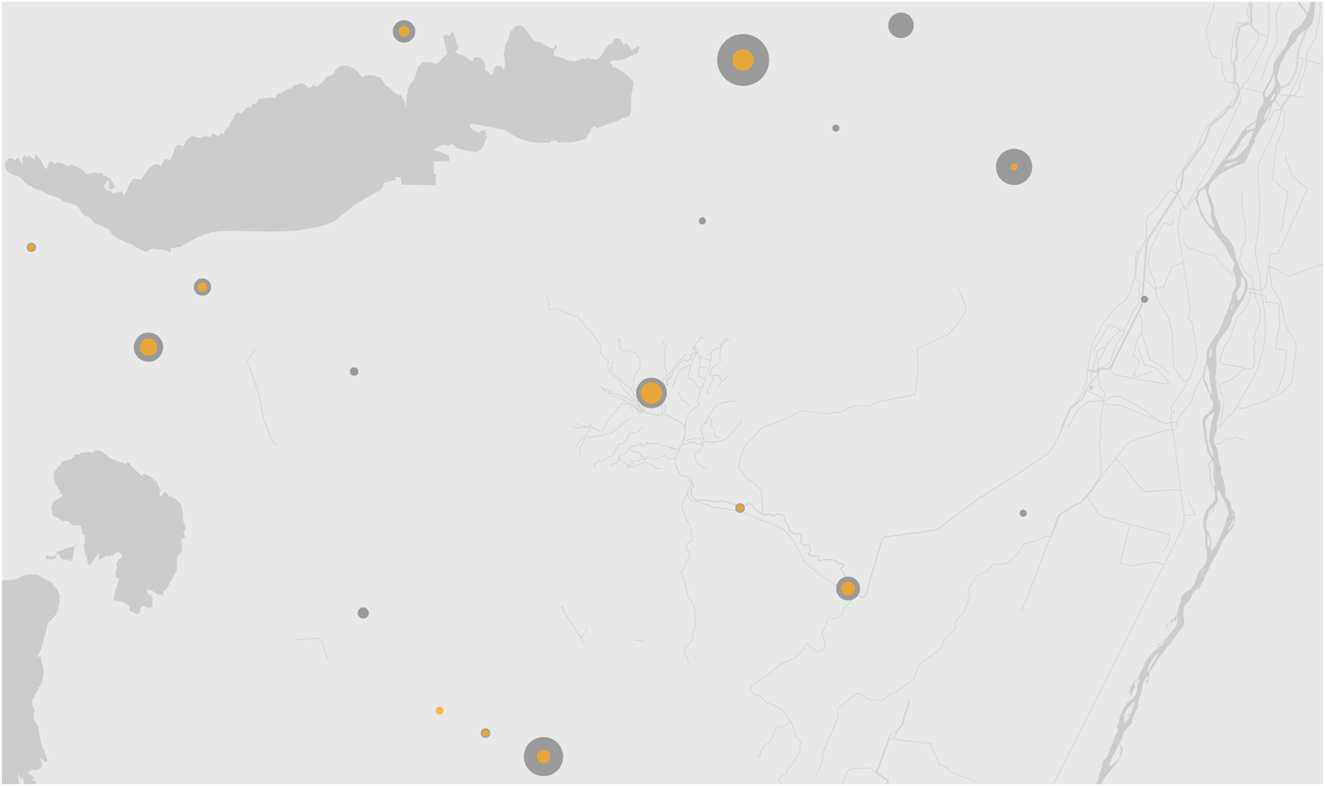
Thanks to digital tools, a little extra circumstantial evidence can be added. If Socrates did indeed come to be seen as a Sobek name on the basis of assonance, one would, for one, expect a geographical link between the two. Adding the onomastic evidence for Sobek to the Roman-period Fayum map reveals a remarkable degree of overlap (figure 8):Footnote 71 not only are Socrates names attested only in places where there are also Sobek names, but in exactly those places where Sobek names are most popular (Karanis, Theadelpheia, Ptolemais Hormou and surrounding villages, and Tebtynis).Footnote 72
Geographical overlap of Socrates and Sobek names (orange = Socrates, gray = Sobek names)

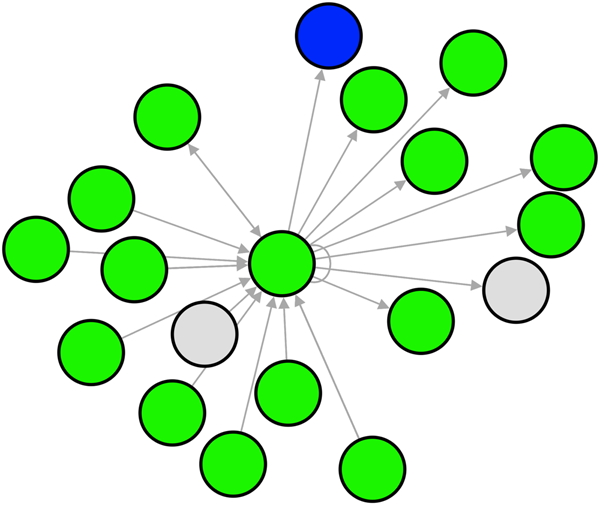
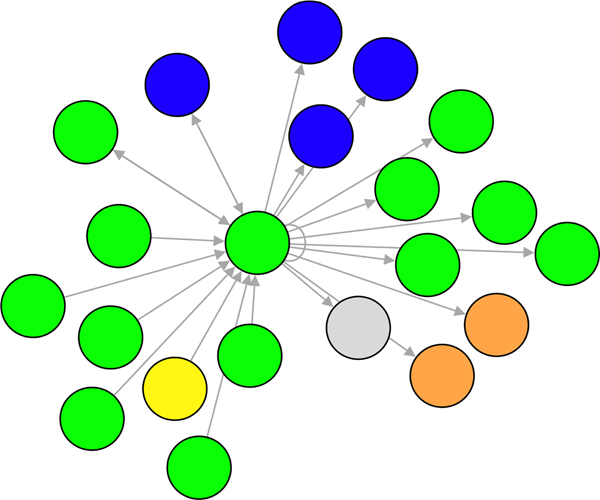
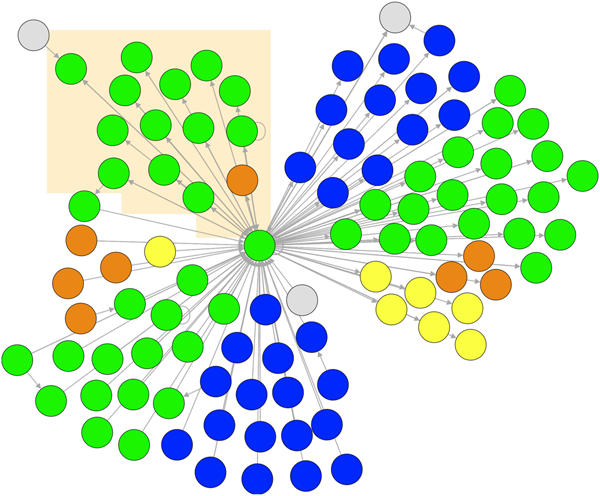
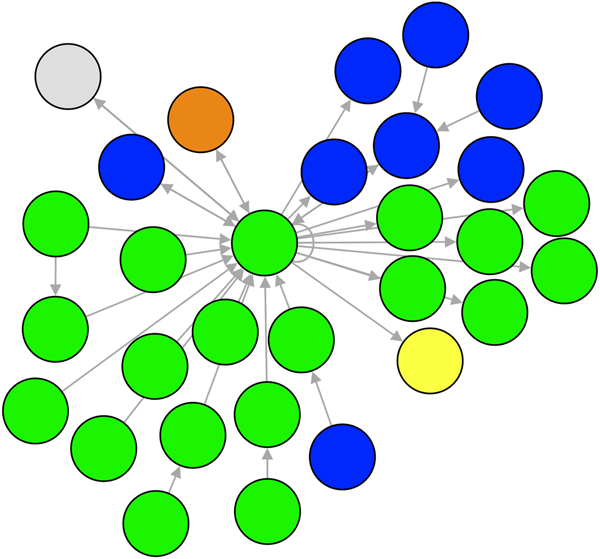
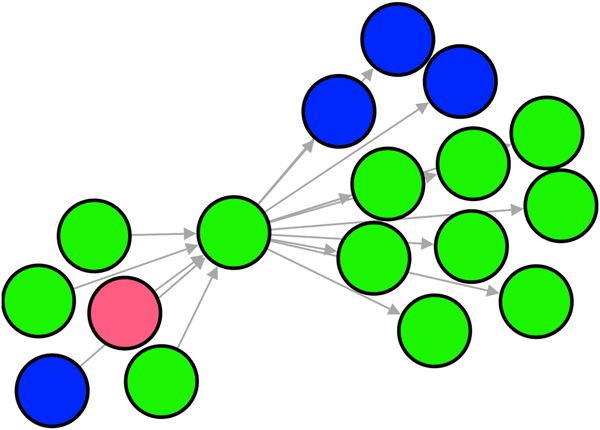
Network analysis can provide a further clue. Originally, social network analysis was developed in mathematics, anthropology and sociology to measure structural forms of relationships between individuals.Footnote 73 Over the past decades, it has gained momentum in numerous other fields, from molecular biology to philology, as the techniques it encompasses can be applied to relations between any type of entity, not just humans. Since names are generally the result of conscious choices made by parents (except in the case of slaves, who are therefore excluded from the following section), the family tie between parents and children can serve as a relation between their names, and thus provide the basis for what can be coined ‘onomastic networks’.Footnote 74 In other words, in the following networks, two names X and Y are connected if a person with name X names his or her child Y. Those names are represented by circles (‘nodes’); the central node in each of the graphs below represents the name Socrates.Footnote 75 The genealogical relations between these names are indicated by arrows starting from the name of the parent, pointing in the direction of the name of the child. For example, if a parent with the name Heracleides chose the name Socrates for his son, the arrow starts from ‘Heracleides’ and points to ‘Socrates’.Footnote 76 The names are coloured according to their language: Greek names are green, Egyptian names are blue, Latin names are yellow, hybrid names are orange, Thracian names are pink, and names of unknown origin are grey. To highlight changes over time, screenshots have been taken for five periods: the Ptolemaic period (figure 9; since there is little data, there is no use in splitting it up further), the Early Imperial period (30 b.c.–a.d. 69: figure 10), the Middle Imperial period (a.d. 69–192: figure 11), the Late Imperial period (a.d. 192–284: figure 12), and the late antique period (a.d. 284–640: figure 13).Footnote 77
Ptolemaic network (330–30 b.c.)

Early Imperial network (30 b.c.–a.d. 68)

Middle Imperial network (a.d. 69–192)

Late Imperial network (a.d. 193–283)

Late antique network (a.d. 284–640)

In the Ptolemaic period, the genealogical context is overwhelmingly Greek (figure 9), though one must bear in mind that the data set is very small (only 19 names and 24 relations between them). All fathers and children of individuals named Socrates bear Greek names, apart from one daughter, who was named Taubastis, and two damaged names, for which the linguistic origin is therefore marked as ‘unknown’.
The Early Imperial period (figure 10) presents a more mixed picture, but when distinguishing between generations a clear shift emerges. The names pointing to Socrates—that is, the fathers’ names—are mostly Greek, with the exception of one Latin name (Gaius Marcius, a Roman cavalryman) and one Egyptian name, which just so happens to be a Sobek name (Sokmenis, ‘Sobek endures’). The names of the children with a father called Socrates are more varied, with five Greek names, three Egyptian names (again one Sobek name: Petesouchus) and two hybrid names (one Graeco-Egyptian, Apia, and one Graeco-Semitic, Sambas).
Most of the data comes from the Middle Imperial period, resulting in a much larger network of 98 names (figure 11). By this time, Egyptian names figure prominently in both the generation of the parents as well as that of the children of individuals named Socrates. The overall portion of Egyptian names during this period is significantly higher, however (30.6% vs 19% in the Early Roman period). A remarkable evolution is the large cluster of reciprocal ties in the top left of the graph (the highlighted section). In a directed network such as this, where links are represented as arrows marking the direction of the relation, reciprocal ties can point to the tradition of passing down names from grandfather to grandson, for example Socrates, son of Apollonius, grandson of Socrates.Footnote 78 It is thus an important indication of conservative naming practices, often found among the elite, who limit their choice to a restricted onomastic pool in order to emphasize family relations (which were important in the transmission of privileged status) and social exclusiveness.Footnote 79
In the Late Imperial period (figure 12) there is again a clear dichotomy between the generation of parents, which is predominantly Greek, and the generation of children, among whom Greek and Egyptian names are evenly distributed. A possible explanation could be that relatively many of the individuals on which this network is based belong to privileged groups, who tended to emphasize their ‘Greekness’ in their choice of names: 32.6% of the parent-children pairs belonged to the local elite (the so-called ‘metropolites’ and ‘those of the gymnasium’),Footnote 80 as opposed to only 9.8% in the network of the previous period. Finally, the portion of Egyptian names drops slightly in the late antique period (figure 12), but given the small size of this data set (only 17 names and 16 relations between them) the results here are hardly statistically significant.
The transition from an almost exclusively Greek environment in the Ptolemaic period to a gradually more Egyptian genealogical context in the course of the Early Imperial period is a nice illustration of the trickle-down effect of elite names. When the name Socrates was first introduced in Egypt by Greek settlers, it was obviously associated with this elite's cultural heritage. As these immigrants and their descendants married into local families, and Egyptians worked their way up the administrative or military ladder, Greek traditions, and thus also names, were gradually adopted by native families. The high portion of Egyptian names in the Middle Imperial network indicate that Socrates was no longer exclusively associated with ‘Greekness’, and suggest that, for contemporaries, it did indeed carry an Egyptian connotation.
The maps and networks presented here are no hard evidence, but they do offer a little more credibility to Clarysse's Sobek hypothesis. The fact that the etymology of the name Socrates (a Greek name constructed with σῶς, ‘safe’, and κράτος, ‘strength’) has nothing to do with Sobek does not take the edge off the argument. Although the separate elements of such compound names were based on actual Greek words, the combination was not necessarily meaningful. It was simply a common way to generate new names in the Greek world, and by the time these reached Egypt in the Ptolemaic period, their etymology was long forgotten. Socrates is thus a nice example of ‘semantic erosion’, whereby names lose their original meaning and become associated with new cultural values. A similar process takes place later on in the Christian period, when some pagan names, such as Paesis (‘the-one-of-Isis’), remain in vogue not because of a lingering devotion to Isis but because of an early Christian martyr after whom many children were named.Footnote 81
THE FUTURE OF ONOMASTIC RESEARCH
Despite the zeal with which scholars turn to names for historical analysis, onomastics remains a fractured domain: as the overview at the beginning of this paper demonstrates, names are studied from many different angles, but the interplay between these different mechanisms behind naming practices is never sufficiently addressed. This is, in part, still due to disciplinary boundaries (scholars still tend to entrench themselves within a single time-period, for example), but is also enforced by the lack of a comprehensive data-source, and by apprehension toward digital techniques that are indispensable for a multifaceted study of names.
These obstacles have led to the proliferation of ‘guestimates’: scholarly hypotheses that are based largely on experience, without providing ‘hard’ evidence. A well-known example is the presumed popularity of Egyptian names among elite women in the Roman Hermopolis,Footnote 82 which has become a much-repeated mantra extrapolated to Egypt in general, even though the author himself stressed that the paper was just ‘une chasse méthodologique aux questions’. Without a systematic study of all names, it is difficult to verify such statements.
There was much hope that this all would change thanks to TM People. With its almost half a million attestations of names in total, it seemed that it would finally open up possibilities for large-scale quantitative analysis. Despite this development, however, there are still many issues, as the Socrates case-study demonstrates.
Several flaws in TM People's data model prevent a major breakthrough. The first, and most critical, obstacle, is the fact that, despite its name, TM People is currently not a prosopography. Not only do many references to individuals still await identification (see above), but a systematic categorization of this population on the basis of titles, status designations, occupations, etc. (referred to as ‘functions’ in Trismegistos) is also needed in order to look into aspects such as social, legal and economic status. Although the Prosopographia Ptolemaica lay at the basis of TM People, its original purpose—namely listing and classifying individuals according to administrative and military functions, occupations or origin—has faded into the background. Since the classificatory structure devised for the original (paper) version of the Prosopographia was geared toward the specificities of Ptolemaic society, it cannot simply be extrapolated to the Roman and late Roman data; it is, moreover, not well suited for a digital environment. Moreover, the bulk of these ‘functions’ still needs to be collected for these periods. Consequently, it is not yet possible to reconstruct the various environments that define the meaning and purpose of a name.
Second, a proper classification of the names themselves is needed to allow a systematic analysis. Currently, only the language of a name (based on lexical and morphological criteria) is annotated in TM People. Yet, as the example of Socrates shows, a typology on the basis of form alone is too simplistic. In a multicultural society, language cannot simply be equated with culture. Socrates may be a Greek name in origin, as it is formed with purely Greek elements, but, over the course of time, it may have acquired a local Egyptian connotation. In the case of Kronion, for instance, this dichotomy between the etymology and the cultural value of a name is very clear. It is also a Greek name, consisting of the name of the Titan Kronos and the ending –ίων. Yet, in Egypt, Kronos was identified with Geb, the Egyptian god of the earth. The name Kronion is attested only seven times in the Lexicon of Greek Personal Names,Footnote 83 while it appears 982 times in the papyri from Egypt.Footnote 84 It is thus clearly one of those ‘Greek names from Egypt’.
Some studies try to go further than simply distinguishing between Greek and Egyptian. Canducci made an attempt in her discussion of the names of the local elite of the Roman Fayum region, but it lacks consistency: she speaks of Greek vs Graeco-Egyptian names, but in the former category she collects names on the basis of language, while the latter is determined by their cultural value.Footnote 85 Moreover, she seems to use different criteria for masculine and for feminine names, as Isidorus is listed as Graeco-Egyptian but Isidora as Greek. Using the same data set, Bagnall proposed a new model, where the ‘Greek names from Egypt’ are assembled under the umbrella of theophoric names alongside names of Egyptian formation; these theophoric names are then distinguished from Macedonian-dynastic names, common Greek names, Latinate names and ‘other–unknown’.Footnote 86 The result, however, is a mix-up of different aspects of a name (language, meaning, cultural value), making it impossible to take into account the changing connotation of name.
A more systematic classification is therefore needed, consisting of multiple categories, each of which highlights a different intrinsic aspect of a name: language (for example Greek, Egyptian, Latin, hybrid), internal syntax (for example compound vs simple names), semantics (theophoric vs non-theophoric, and various sub-categories) and cultural value. The latter aspect will be the most difficult to record, as it can vary over time: Cleopatra was originally one of several Macedonian elite names and only became a dynastic name of Egypt after the daughter of Antiochus the Great married Ptolemy V at the end of the second century b.c.; in Rome it even became a slave name in the Imperial period. Such a classification will therefore need to be dynamic, taking into account all significant connotations of a name, since it is precisely this aspect that reflects changing values in society.Footnote 87
Updating TM People with the new material and the corrections that have been published these past ten years, and then processing roughly half a million attestations of people and their names to arrive at a well-structured prosopography and onomastic lexicon that will allow a systematic study of naming practices may seem like an impossible task. Thanks to recent technological advances, however, it is no longer a utopian dream. The original Named Entity Recognition procedure, which initially only worked for Greek texts, has already been adapted to accommodate Latin sources as well.Footnote 88 It will, moreover, no longer be limited to names. It will thus be possible to mark and extract any type of entity, such as titles, occupations, status markers, etc., and link these attributes automatically to the attestations of individuals already at our disposal. This will result in a new database, TM Functions, with a table for the attestations of all these attributes or ‘functions’, and one that structures these functions into meaningful categories in order to classify the population into meaningful categories. Moreover, these attributes are often a decisive factor in determining whether or not two attestations refer to the same individual.
Digital techniques can likewise facilitate the classification of names. The new data must be linked to TM People's onomastic collection: new variants will have to be added to existing names, or new names will need to be created altogether. This can be decided with the help of the Levenshtein distance.Footnote 89 This method from computational linguistics measures the similarity between two words and is often used in dialectology to study phonetic, and thus dialectal, variation.Footnote 90 It basically counts the number of deletions, insertions or substitutions needed to transform one string into another: e.g. the distance between Βερενίκη and Βερνίκα is two, since the second ε is deleted, and the final η is replaced by an α. The lower the ‘distance’ between two attestations, the more likely it is the same name. This way, it will no longer be necessary to look up each attestation manually; the computer can make well-founded suggestions to speed up the process.
In light of various projects, some of the aspects of the classification system proposed above have already been or are being noted. The language of names has been recorded from the very beginning of the onomastic lists in TM People. In order to analyze Egyptian names in Greek transcription, Blasco Torres has broken them down into syntactic elements;Footnote 91 she is currently doing the same for Greek names for a study of the reverse phenomenon. The markup of name components will not only be useful to document the spread of certain types of names, as has already been done for Latinized names ending in –ianus,Footnote 92 or for Pȝ-dỉ- names,Footnote 93 for example. It will also open up new possibilities for the study of family traditions. Homonymy or ‘repetition’ (that is, the inheritance of an entire name) between grandparents and grandchildren, and to a lesser extent between parents and children, is a well-known practice in Graeco-Roman Egypt.Footnote 94 In some families, several boys bore the same name as their uncle, a practice that could point to a form of ‘godparenthood’ among the closed privileged group of ‘those of the gymnasium’ in the Roman period.Footnote 95 Indirect forms of transmission (‘variation’), such as the inheritance of name elements (for example Artemidorus, son of Theodorus), are more difficult to trace, and have therefore received little attention. Mapping both forms alongside each other is common practice in medieval studies.Footnote 96 With an improved dataset in TM People, this will also be possible for the Graeco-Egyptian data on a large scale, which will lead to a more varied picture of family-naming traditions, and perhaps also to new links such as the one between Sobek and Socrates.
Regarding semantic categorization, all theophoric names have been tagged in preparation of a general overview.Footnote 97 Since Egyptian and Greek theophoric names have generally been studied in isolation, mapping the entire ‘onomastic pantheon’ will, for instance, allow us to determine to what extent names were bound to a single belief system, or to investigate the continued existence of pagan names against the background of the growing dominance of Christianity (with the potential of creating a clearer picture of the relations between pagans and Christians). The meaning and thus subcategorization of non-theophoric names can be established with the help of a new lexical tool developed by Keersmaekers and Depauw,Footnote 98 TM Words, which will allow to tag the roots in names of Greek origin. For Egyptian names, here too the work of Blasco Torres is of invaluable importance.
Mapping the onomastic repertoire of each individual village, as well as on the overarching district level, will generate more accurate and empirical data to establish the origin of unlocalized documents, especially those now attributed to a nome or Egypt in general. Such a detailed survey will, moreover, provide a firmer basis to study the movement of individuals on the basis of their names, as the abovementioned tax receipt found at Mons Claudianus, though pertaining to a Socrates from Syene, demonstrates.
Finally, networks such as the ones presented above for Socrates are particularly helpful when gauging the cultural value of a name. As we have seen above, the name Socrates probably acquired an ‘Egyptian ring’ by the Early Roman period. By distinguishing between the original language and the (changing) cultural value of a name, the traditional view of a stark dichotomy between ‘Greek elites’ and ‘Egyptian peasants’ can be challenged. It is true that elites generally have had a way of trying to set themselves apart by means of their names. It is difficult to imagine that the Duke and the Duchess of Cambridge will name their third child Harper or Freddie, for example. By focussing on the ‘Greekness’ of the local elites, however, scholarly literature has de-emphasized any possible Egyptian aspects, denying them the right to acknowledge their Egyptian heritage. Yet, at some point, it became acceptable among the descendants of the original Greek settlers in Ptolemaic Egypt to adopt names with an Egyptian connotation, or even some names of Egyptian origin. This new classification will make it possible to chart this evolution in all its subtleties, and to present a more refined view than the ruling black-and-white Greek vs Egyptian model.
The goal of this paper was to demonstrate that digital techniques can lend more weight to hypotheses formed on the basis of traditional (semi-)analogue research.Footnote 99 Clarysse's suggestion that the Greek name Sokrates, introduced by the Ptolemaic settlers in the Egyptian countryside, acquired an Egyptian overtone in the Early Roman period, served as a case in point. At the same time, it allowed me to expose some of the shortcomings of the onomastic data set in Trismegistos, and to touch on some digital methods that can help improve the database. Although working on such a large scale is only possible thanks to the computer,Footnote 100 it can, of course, never replace scholarly experience. Someone has to teach the computer how to perform the tasks mentioned above in the first place, and afterwards the results need to be scanned for errors and finally checked against the sources to verify hypotheses and formulate conclusions. As banal as they are, names are often used as parameters in historical research, be it for a study of ethnic identity or for providing criteria to date and locate sources. Detailed empirical tools are therefore indispensable for the scholarly community to be able to make well-founded claims about historical issues on the basis of names. Without structural resources, progress is slow, but the Trismegistos remains hopeful and is as motivated as ever to provide even better services in the future.